Tuesday, May 19, 2020

Han Shaogong's "A Dictionary of Maqiao": Book Review

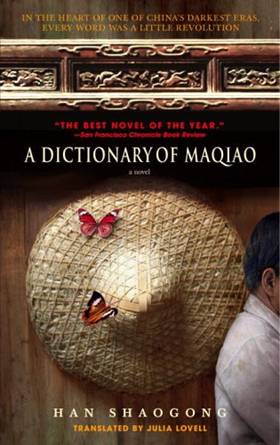
A Dictionary of Maqiao

Julia Lovell translates Han Shaogong's 1998 novel, which explores the remote village to which he (or a version of such) was sent as one of the "Educated Youth" during the Cultural Revolution. The author uses the structure of dictionary entries on particular words and terms, so limited to the region and dialect, some not, to illustrate the culture he found, and gradually, as the non-alphabetical and subtly topical arrangement reveals, the stories of those who lived there. It's neither romanticized nor sensationalized. It's intellectual without sounding clever, and philosophical without losing pithiness. Lovell notes how the Tao is filtered (in some odd and creepy settings) through the last of the "Immortals" skulking about the temple ruins. You smell the stench and recoil at the sensory assault.

The novel reminded me immediately of Milorad Pavic's A Dictionary of the Khazars (1994; tr. 1988) I recall seeing this book a lot when it appeared, in the finer bookshops, but I have never heard anyone discuss it since. It boasted that the "male" and "female" editions were identical--except in one paragraph. Thanks to the Net I did not have to buy a second copy and trace each entry in tandem. The answer is here. Not sure if it matters much, and I doubt if I'll try to find out. I liked the book but was not wowed by it. Still, the predecessor in the "lexicon novel" is worth mentioning, as Shaogong's was prepared by 1995, published in 1996, and translated in 2003. Looking up this data, I learned from its Wikipedia stub: "After the book was published, some critics claimed that it violated the copyright of Pavic's novel, Dictionary of the Khazars. The author, Han Shaogong, brought a defamation case against the critics and won this case." That stub documents in turn this helpful resource of reviews.

Not an easy read, this compendium, but not beyond comprehension. This strategy's pitched at an erudite bookworm, and not a drugstore (if they still sell such) paperback. I agree with Danny Yee's site above that the narrator gets subsumed into the density of his (?) descriptions, and I repeat Lowell's admission that she could not capture a few of its 115 entries as puns, leaving them out.

And what remains, over four hundred small print pages, tends to glide past. While the "Maple Demon" and "House of Immortals" sections early on stood out, when going back to check their titles, I found that great chunks of other sections had not registered much of an impact on me. That may be my fault rather than the author or translator, but, again, this ambitious book might inevitably have some of its depth diffused in rendering it in understandable English and for an audience who did not survive the depredations of Chairman Mao and the "Down to the Countryside Movement." (Most of the above to Amazon US 11/12/17)

P.S. Lowell quotes the Sinologist A.C. Graham in her introduction to the work:

"Taoists are trying to communicate a knack, an aptitude, a way of living… [They] do not think in terms of discovering Truth or Reality. They merely have the good sense to remind us of the limitations of the language which they use to guide us towards that altered perspective on the world and that knack of living. To point the direction they use stories, verses, aphorisms, any verbal means which come to hand. Far from having no need for words, they require all available resources of literary art." I haven't been able to track online the provenance of Graham's remark so far, but it's apt.

P.P.S. I paste the start of this entry as an example of the author's strategy and scope. "*Maple Demon"

"Before I started writing this book, I hoped to write the biography of every single thing in Maqiao. I'd been writing fiction for ten or so years, but I liked reading and writing fiction less and less- I am, of course, referring to the traditional kind of fiction, which has a very strong sense of plot. Main character, main plot, main mood block out all else, dominating the field of vision of both reader and writer, preventing any sidelong glances. Any occasional casual digression is no more than a fragmentary embellishment of the main line, the temporary amnesty of a tyrant. Admittedly, there's nothing to say this kind of fiction can't approach one angle on the truth. But all you have to do is think a little, and you realize that most of the time real life isn't like that, it doesn't fit into one guiding, controlling line of cause and effect. A person often exists in two, three, four, or even more interlocking strands, outside each of which a great many other elements exist, each constituting an indispensable part of our lives. In this multifarious, scattered network of cause and effect, how valid is the domination of one main thread of protagonists, plot and mood?

Anything left out of traditional fiction is normally something of 'no significance.' But when religious authority is all-important, science has no significance; when the human race is all-important, nature has no significance. When politics is all-important, love has no significance; when money is all-important, art has no significance. I suspect the myriad things in this world are in fact all of equal importance; the only reason why sometimes one set of things seems to have 'no significance' is because they've been filtered out by the writer's view of what has significance, and dismissed by the reader's view of what has significance. They are thus debarred from all zones of potential interest. Obviously, judgement of significance is not an instinct we are born with-quite the contrary, it is no more than a function of the fashion, customs, and culture of one particular time, often revealing itself in the form into which fiction shapes us. In other words, an ideology lurks within the tradition of fiction, an ideology which reproduces itself only on passing through us.

My memory and imagination aren't totally in line with tradition.

I therefore often hope to break away from a main line of cause and effect, and look around at things that seem to have no significance whatsoever, for example contemplate a stone, focus on a cluster of stars, research a miserable rainy day, describe the random back view of someone it seems I've never met and never will meet. At the very least I should write about a tree. In my imagination, Maqiao couldn't do without a big tree. I should cultivate a tree-no, make that two trees, two maple trees-on my paper, and plant them on the slope behind Uncle Luo's house in lower Maqiao. I imagine the larger tree to be at least twenty-five meters tall, the smaller around twenty. Anyone visiting Maqiao would see from faraway the crown of the trees, the tips of whose branches would spread out to encompass a panoramic view.

This is excellent: writing the biography of two trees."

Sunday, May 17, 2020

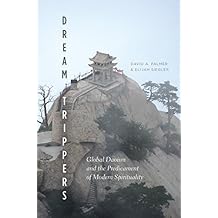
David Palmer + Elijah Siegler's "Dream Trippers": Book Review

https://images-na.ssl-images-amazon.com/images/I/51GxSrW+ROL._AC_US218_.jpg

Daoism, unlike Hindu and Buddhist faith systems, has not yet been studied seriously by many in the West. Until the dawn of the last century or so, very few scholars knew much about its texts, rituals and customs over its long history in China. During the past dozen years, professors David A. Palmer and Elijah Siegler investigated the spread of the Dao and its practices in "transnational circulations."

Dream Trippers stands for those from Healing Tao USA, seekers visiting the sacred mountain site of Huashan, "Flower Mountain." There, they meet with monks and mix with throngs of secularized Chinese tourists. For these two scholars, the "water" of Daoism sloshes in and out of its "institutional container," as Eastern and Western fluidity wash aside facile dichotomies and stereotypical binaries.

A third presence triangulates with these two Daoist groups. Louis Komjathy, a West Coast-based religious studies professor, insists upon a far more bookish, scholarly and faithful adherence to a demanding regimen which, in this American-born academic's estimation, the Dream Trippers dismiss.                                                                                                                                               Complicating matters, monastic master Chen Yuming leaves Huashan and those pilgrims who had depended upon him for guidance. Palmer and Siegler narrate the "anxieties" generated by the "predicament" of global spirituality through its "encounters, flows, and appropriations" of the indigenous traditions as they return to the motherland "Americanized." Through tours, marketing and networks, the Dao's adepts and aspirants follow "trajectories" as subjects within late modernity.

Adopting Zygmunt Bauman's post-modern critique of the self-improvement Esalen/ Human Potential movements which the 1960s counterculture promoted as a consumer commodity, the authors situate these various representatives of Dao, as a fresh product shared and sought recently beyond East Asia. As Chinese autonomy dwindles in the homeland of the Dao, American ambitions increase among the pilgrims coming to Huashan to accelerate their immersion into qigong (vital energy practice).

But factions resist easy categorization. Western does not equate with anti-traditional, nor does any authentic Chinese experience trump any fabricated New Age-tinged experience. Palmer and Siegler respect all the participants whom they observe in Huashan, beginning in 2004. They witness the massive tourism overwhelming Huashan as the corrupt regime markets its dramatic vistas and quaint monks as lucrative attractions for a burgeoning base of eager novelty seekers from within a freespending China. Those eroding the Daoist legacy come not only from abroad, but within a cynical state calculating a pro-Daoist turnabout as countering the burgeoning Christian presence throughout the PRC. Many of the monks are unsuited for the rigors of their life, and loaf as "temple rascals." 

In thematic chapters, Palmer and Siegler compare the Dream Trippers as "metaphysical travelers" to the monastic system struggling to sustain itself as Huashan's slopes fill with Chinese crowds. The Westerners value therapeutic methods channeling the power of the Dao and the complicated "inner alchemy" developed over two millennia ago; Easterners come and go for the very vertiginous vistas.

This book will appeal to anthropologists, sociologists of religion, and religious studies professors and students. While Palmer and Siegler commendably avoid jargon, and offer a detailed index and glossary, they expect their audience to possess familiarity with postmodern theorists and thinkers.

One under-examined aspect is the wider impact of the Dao on contemporary popular culture; references direct the inquirer to sources, through documented end notes and a broad bibliography. A general reader will gain value from this in-depth look at a novel predicament created by the global reach of a faith-system which until recently has mostly been relegated to (often woefully inaccurate) translations of the Daodejing and the tales of Zhuangzi when it comes to shelf visibility abroad. 

No pure legacy remains in Huashan. The rupture caused by communist devastation of religion has eased, but it has left behind a weakened heartland for the Dao. Yet the authors regard this communal evolution with equanimity. "Simply another wave" of many meetings between East and West characterizes the broad view taken of Asian reactions to the West, and vice versa. A "back and forth" pattern of outer forms adapting to each era exists within this religious discipline. Pursuits elevating the mind and energizing the body link enthusiasts from affluent professions and nations. Palmer and Siegler assert real connections, however brief, bonding the visitors with those dwelling on Huashan.

Louis Komjathy opposes this benign judgment. He denies that Daoism suits the likes of the Trippers.

A diligent exegete, his textual study grounds his everyday life as a Daoist, heir to a priestly lineage. Combining an introspective pursuit with a teaching career, he responds (as do others interviewed) to the authors by claiming fidelity to the Chinese contexts. This, lacking in callow New Age itinerants, disqualifies for Komjathy any who traverse the "spiritual marketplace" browsing fake commodities. Michael Winn, founder of the Trippers, begs to differ; the authors hear all sides out and report fairly.

That predicament, Palmer and Siegler surmise, blends a Western consumer mentality with an esoteric Eastern pursuit. Whether the Dream Trippers embody a cure or a symptom to the present-day "liquid self," lacking once-stable social structures in a hyper-capitalist consumer-driven existence, is left for the reader to contemplate. In a coda, Chen Yuming gets the last word. This sage announces: "The flower has dried up, but the root is alive." As institutional Daoism totters under tourism, a few from all over the world join those indigenous holdouts who agree to pursue virtue and find transformation.

Reviewed for Spectrum Culture. 3/8/18.

Friday, May 15, 2020

"The scholar in his study"

I've been told my blog's too eggheaded. Too hard to read, similar to the Emperor telling Mozart his music had too many notes? Well, not that much of a comparison to genius. But, here's good news. More pictures. The bad news. Only two Rembrandts; and me, snapped. 

https://lh3.googleusercontent.com/E1ZfixA98Epbsr4-qNWCttxpAexnMET4cNSlWMfKO9UU0B1vpiC3wyQT6r7-UaPdHDY
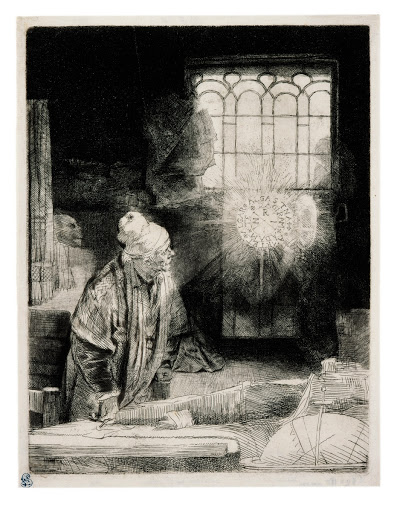
 That's Faust, ca. 1652.  "A Scholar in his Study" Rembrandt - Artwork on USEUMThere's another. Definitely looks like he's into the occult. A third one, of the artist himself under this title, doesn't wow me. R van R seems too furry. But you can take a look yourself.


Here's me, last Tuesday. I don't do selfies, which was the assignment, but I had to send a photo to work of, well, me working from home, in preparation for a "Town Hall" one day and then a "Pulse Meeting" the next. Today, I just got off a "water cooler" every Friday hour that appears to be totally voluntary, but like certain now-reoccurring events in my calendar of late, more and more becomes a place I am to make my virtual appearance. I now have presences on WebEx for my main teaching job, plus Microsoft Tools for such gatherings.

Other obligations put me on Zoom. Chats by Skype. At least the latter two include friends and family--my older son in Portland and his special one talked two hours to us for Mother's Day, for instance. And I keep in touch with a group that can't meet together, even if I do not join the rest of the extended family playing Scattergories online, as I get too nervous. Speaking of rattled sensibilities, the suspicious skeptic in me wonders cui bono~who benefits? As with 9/11, once measures get as the Irish say "copper-fastened," they aren't loosened. No, it's not three million Uighirs in a police state. But we will be monitored more.

Meanwhile, as in China's Social Credit System, the Google-Apple unprecedented partnership to track a third of the world by app, and the installation of surveillance software to "supervise" workers at home as much as in a cubicle or its equally oppressive successor, open-plan office, be careful, I keep saying silently to "colleagues" about what one wishes for.

Apropos, check this out from Josef Pieper's 1948 Leisure, the Basis of Culture. I re-read his little volume on Scholasticism to refresh my memory before tackling Gilson, and I liked it as much as I did back in college when I needed it to bone up for my medieval history of ideas seminar. Today, this popped into my feed. Proof that philosophers stay relevant, as ever.

‘Total work’, a term coined by the German philosopher Josef Pieper just after the Second World War in his book Leisure: The Basis of Culture (1948), is the process by which human beings are transformed into workers and nothing else. By this means, work will ultimately become total, I argue, when it is the centre around which all of human life turns; when everything else is put in its service; when leisure, festivity and play come to resemble and then become work; when there remains no further dimension to life beyond work; when humans fully believe that we were born only to work; and when other ways of life, existing before total work won out, disappear completely from cultural memory.
The article begins: "Imagine that work had taken over the world. It would be the centre around which the rest of life turned. Then all else would come to be subservient to work. Then slowly, almost imperceptibly, anything else – the games once played, the songs hitherto sung, the loves fulfilled, the festivals celebrated – would come to resemble, and ultimately become, work." And on the inevitable other hand, the unemployment rate is officially around 15% but it must be much higher; both my sons lost their jobs two months ago. My students report deep cutbacks in their families, parents, or siblings. This all is told as if suspended, and that somehow everything's already resuming. Our bosses want us back in plain sight, our betters want us contributing to the GDP and not slacking, and somebody out there's got to pay taxes, since the wealthy won't pony up. Already in California, it's as if we're all supposed to be eager to embrace free-spending "normality." Me, I'm not so sure.

And I wonder if Mother Nature's happy to breathe freely lately. Not that this respite will last, but it may be a final reminder of what life could have been if more of us cut back. On driving, on consuming, on endlessly racing about towards a global oneness via jet packs. On Wall Street, the investors are cashing in. Kroger's ending its $2 hazard pay bonus for workers, the better to fund the $350 million they're spending in buying back their own stock. Those tax cuts turned out great. This week, I noted with rueful mien on a "Plan-demic" viral (!) video making the rounds at the bottom a link to Alex J's peddling of masks.

For this will not be the last time our freedoms will narrow, as our planet asks for life support. While I can't work out the balance between these competing factors, the necessity to curtail our extravagance with the need to support an ever-growing demand for open borders, untrammeled movement, endless pro-business and pro-population growth, I remain uncertain, as I was in the Great Recession and after 9/11, how everyday folks will find their options restricted, as the powers that be continue to consolidate their hold on us.

The whole essay: If Work Dominated Your Every Moment, Would Life Be Worth Living? 

P.S. On the other hand, judging by his blurb, its author doesn't have it bad at all. "Andrew Taggart is a practical philosopher and entrepreneur. He is a faculty member at the Banff Centre in Canada, where he trains creative leaders, and at Kaospilot in Denmark, where he trains social entrepreneurs. His latest book is The Good Life and Sustaining Life (2014). He lives in Santa Fe, New Mexico." 

Wednesday, May 13, 2020

Audio + the inevitable

 
Lots of trouble sleeping since the temporary suspension of my before-dawn commute through hellish traffic forty miles to Irvine, down the perpetually under-construction Golden State Freeway aka Interstate-5 (only Angelenos by the way seem to append "the" before a freeway or highway name, an echo of the days when we had names for freeways--even parkways in the first in the world, my local Pasadena Freeway/ originally Arroyo Seco Parkway, and not those ugly numbers). Thus, audiobooks or podcasts as soporifics multiply.

On that commute, I'd been forever listening to at last count 52% of The Count of Monte Cristo. It started out great in prison scenes after the arrest, but they were over soon and the rest of this feels like an endless gaslighting of protagonist's accomplices who framed him.

Having finished similar weighty books from then, Les Miserables, The Hunchback of Notre Dame, Anna Karenina, The Idiot, (half of--gave up) David Copperfield, Middlemarch, Adam Bede, Bleak House (half--will resume), Dracula, Gulliver's Travels, Redburn, The Betrothed, and both Notes from Underground and Notes from a Dead House, well, I needed a break from classics. I had Paul Murray's novel Skippy Dies on my shelf and when the Audible cast of characters for it appeared, I figured--as casts generally satisfy (even if Dracula despite their efforts was surprisingly boring on re-reading as hearing it decades on), to give it a try. The fact its length was about what I'd already invested in Count dissuaded me a bit. But nearly anything save, maybe, Atlas Shrugged or Dune (the former is a joke, but my elder son likes the latter, as he's immersed in it now; one of those I've been asked if I've ever read it and no, I have not--I keep thinking of Sting in a metal thong), seemed a wise choice. As an aside, showing how small the old sod is, I gave a paper on Beckett at an Irish Studies conference a decade back; the eminent drama scholar who's Paul's father was there. Not sure if he felt like he had to hear my talk before he left to prepare his keynote speech for dinner that night, but he did without comment; he did not seem enthused. Not the first or the last presentation in which I received no questions at all from anyone. But I had sat on a panel with him years before, at another one in Hungary, and that I recall went well. His biography on Sean O'Casey's great, by the by, so check it out.

Well, deep into the pages of Skippy, all about a school standing in for the very prestigious boy's "college" in Irish terms, the preparatory Dublin academy Blackrock run once by the now-disappearing ranks of the Holy Ghost Fathers (renamed Spiritans), it's Seabrook staffed by their equivalents home from the African missions, the Paracletes. Lots of accurately rendered off-color to say the least enjoyable adolescent banter and insults pepper the conversations of the lads, while their instructors and erstwhile mentors try to deal with their own marital, personal, and institutional difficulties. The plot spins about into quantum physics, sexual awakenings, drugs, and the usual drudgery universal now of teaching to the test. Deviating from this, Howard Fallon decides to bring his restive history class out into the streets, trekking up to the abandoned (which it was back then in fact at Kilmainham) WWI memorial in Islandbridge, a derelict neighborhood of scrap metal and seedy pushers.

The gist of this is Howard's passionate narration of the "D Company" of that city's elite schoolboys who'd enlisted en masse to sail off to glory in 1914 on. They were decimated at Suvla Bay, shadowed by the now-more-famous Gallipoli, and their survivors returned to be ignored at best and derided even more by an Irish nationalism bent on elevating the sacrifices of those who'd fought the British rather than those who joined their imperial cause. The episode Murray conjures up powerfully, especially as heard after dark in my bed.

Which brings me to my guest access a couple of years ago. I used Ancestry-com to find out that my grandfather served in that war. From what I can gather, he'd been born in Co Roscommon at our family's farm. He'd left to mine coal in Bolton. While in England, he'd have been about 19, I estimate, when in 1917 he entered the ranks of the King's Own Lancashire Regiment. I'm not sure if he willingly joined or was conscripted. Records do not indicate place-of-birth for British Army ranks, strangely to me, so the estimates of how many Irish-born men served in the war cannot be discerned. As Kevin Myers' study which I am reading now explains, about 40,000 died from purportedly "Irish" regiments, although not all of them were even Irish. Contrarily, a lot of "English" or Scottish or Welsh formations supplemented their recruits, volunteering or not, with Irish. So, it's jumbled. I'd like to find out more, but even the Ancestry site could only show me the dim page of his enlistment. And that vanished, as even the photo thumbnail I have of it seems to have disappeared no less irretrievably than the spirit of the titular Skippy, who as we know from page one, like Malone in Beckett's trilogy, gets taken off this mortal coil too soon. Is death ever on time?

Image credit.

Tuesday, May 12, 2020

Death + Didascalicon


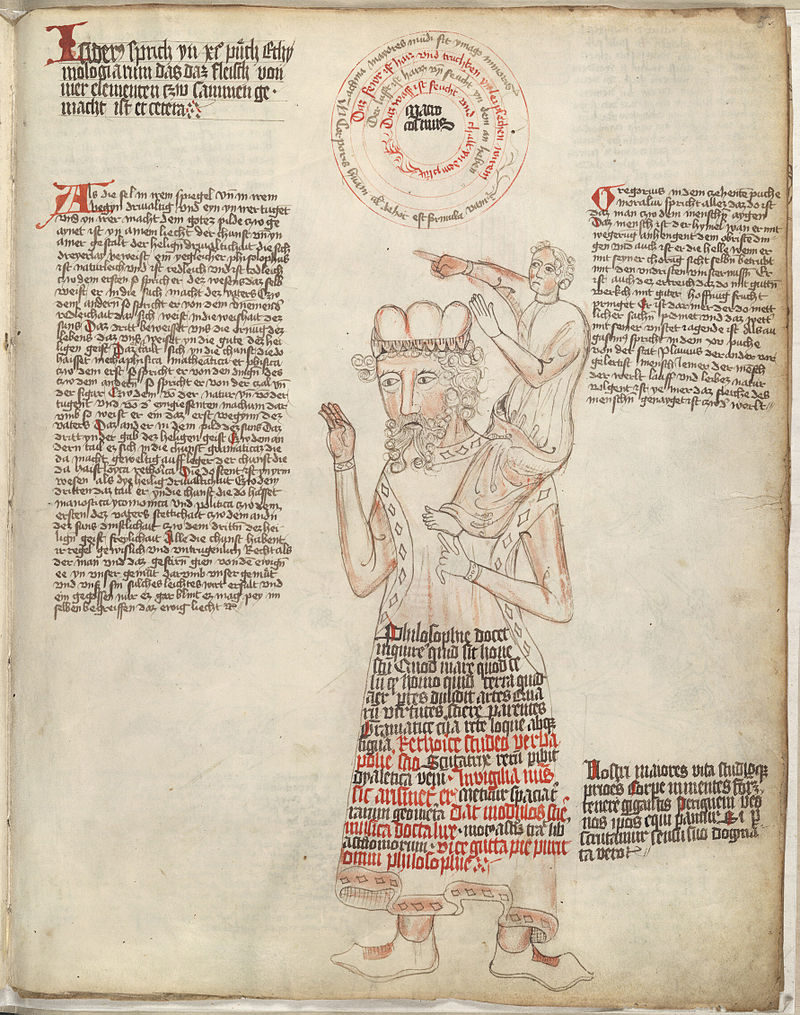
Last post began with a promised juxtaposition that stayed delayed. Too much grading intervened, too many importuning appeals. Here's the connection. In Rik Van Nieuwenhove's An Introduction to Medieval Theology (2012), the Didascalicon of Hugh of St Victor (ca. 1096-1141; pictured above) gets its moment. Don't be scared off by the title, as it's a guide to what, as you can see in my self-description on this very blog, is the medieval progression of study. The trivium's triple way from grammar to rhetoric to logic, whose remnant may be Freshman Comp (now "First-Year" to avoid gender), and then the more abstract realms of the four paths as the quadrivium into arithmetic, astronomy, geometry, and music. In turn, wisdom under the guise of theologia rules as Queen over the sciences. Literally, the fields of knowledge, from the Latin scire, to know, not our modern convention.
These seven liberal arts show the student freed from manual labor the direction to follow.

"The start of learning, thus, lies in reading, but its consummation lies in meditation; which, if any man will learn to love it very intimately and will desire to be engaged very frequently upon it, renders his life pleasant indeed, and provides the greatest consolation to him in his trials. This especially it is which takes the soul away from the noise of earthly business and makes it have even in this life a kind of foretaste of the sweetness of the eternal quiet."

That last phrase lingers like poetry. With less noise lately, more of us get squirrely, but some of us stay content. Turning off the machine and tuning in to nature, and the mind, and soul.

I'm trying to write shorter pieces for the blog, as looking back I can see I wrote ones that the ruder folk online dismiss as tl;dr (too long, didn't read). Philistines leaving graffiti, IMHO.

All the same, I am not attempting always to weave together various threads. More like the commonplace book I originally thought this blog'd be, I'll be inserting some reviews from the past couple of years stored up, as well as some even before that, Italian focused often as they were preparation for my visit there in what seems, given our already altered, or at least interrupted, collective memory, a while ago, rather than the few years on the calendar count.

What I'm musing about for much of my life: how we construct our notions of death and what either does or does not await us afterwards. Teaching a Contemporary Fine Arts, I offer a dozen very flexible theme choices so students can select an approach to slot in their own works to analyze. At first, when I added to the boring original six the course designer plunked down, another much more engaging, naturally six, and revising the six previous ones, I hesitated a second before creating one centered around death and mortality. It's been the most chosen by far each term. Sometimes half of those enrolled opt for it eagerly.

And in an already annoying to me media blitz where infection rates rise next to CNN sharing only one topic for two-plus months and counting, and where "uncertain times" came two weeks into this shutdown in two separate brands of cars advertised on air, and then a month in, the "we're with you poor brutes who have to go out and be nurses and DoorDash drivers" self-congratulatory missives, and now products pitched at the housebound or unsheltered in place, eager as the latest off-road jeep spiel starts, "from Park to Drive"--well, it's more apt than averring as I might let's have neighborhood book reads of Defoe's Journal of the Plague Year (can't get it from the library e-books as it's way booked) and the Decameron. I leave aside Camus' The Plague as it's allegory, but I do add to the shelf my own pick at the end.

Of course, I've been musing on this mortal coil and its contortions. I have my own loss that I keep private. Not sure if not being able to attend what would have been three (so far) funerals indirectly hastened to be sure by the virus and the ripple effect on hospitals, nursing homes, and the speed at which a kid drives a McLaren sports car and kills a certain pedestrian on an empty downtown L.A. street is a blessing or curse. But I am leaving off prognostications. Only noting my bemusement when a "Plan-demic" video was posted on a discussion forum, and seeing at the bottom of its conspiratorial manifesto a tag line to go to Alex J's Info-W's to purchase a 95-whatever mask. Profiting off panic, survivalist suckers.

For now, I'm reflecting, not predicting. And trying to parse if "through July" as issued by the California governor just now means shut-in until the end of June or of July itself. So, my reading will, deo volente, live on. As in this via Harper's weekly archive of arch finds from its 160 or so years of publication. As a subscriber, I unlock the magic door behind a paywall.

This pdf reveals the late John Berger's Sept. 2008 list "On the Economy of the Dead." I've been mulling it over as the past week I'd watched too the Amazon series Upload, all about the attempts of corporations in 2033 to create theme-park-resorts for those whose consciousness has been beamed onto a hard drive. Then the simalacra of the un-dead, as avatars, roam above in their digitally run paradise. With the supervision of their customer service reps in human form at keyboards who oversee their accounts--and as long as their earthbound relatives or loved ones foot the bill for their continued upkeep and fancy AI digs.

Which in turn reminds me strongly, in this lockdown phase of our own time, this 2006 novel. See my (admittedly mixed, may be spoilers) review of The Brief History of the Dead.
Have fun matching up which number you choose to align with long-gone Hugh of St. Victor.
  1. The dead surround the living. The living are the core of the dead. In this core are the dimensions of time and space. What surrounds the core is timelessness.
  2. Between the core and its surroundings there are exchanges, which are not usually clear. All religions have been concerned with making them clearer. The credibility of religion depends upon the clarity of certain unusual exchanges. The mystifications of religion are the result of trying to produce such exchanges systematically.
  3. The rarity of clear exchange is due to the rarity of what can cross intact the frontier between timelessness and time.
  4. To see the dead as the individuals they once were tends to obscure their nature. Try to consider the living as we might assume the dead to do: collectively. The collective would accrue not only across space but also throughout time. It would include all those who had ever lived. And so we would also be thinking of the dead. The living reduce the dead to those who have lived, yet the dead already include the living in their own great collective.
  5. The dead inhabit a timeless moment of construction continually rebegun. The construction is the state of the universe at any instant.
  6. According to their memory of life, the dead know the moment of construction as, also, a moment of collapse. Having lived, the dead can never be inert.
  7. If the dead live in a timeless moment, how can they have a memory? They remember no more than being thrown into time, as does everything which existed or exists.
  8. The difference between the dead and the unborn is that the dead have this memory. As the number of dead increases, the memory enlarges.
  9. The memory of the dead existing in timelessness may be thought of as a form of imagination concerning the possible. This imagination is close to (resides in) God, but I do not know how.
  10. In the world of the living there is an equivalent but contrary phenomenon. The living sometimes experience timelessness, as revealed in sleep, ecstasy, instants of extreme danger, orgasm, and perhaps in the experience of dying itself. During these instants the living imagination covers the entire field of experience and overruns the contours of the individual life or death. It touches the waiting imagination of the dead.
  11. What is the relation of the dead to what has not yet happened, to the future? All the future is the construction in which their “imagination” is engaged.
  12. How do the living lie with the dead? Until the dehumanization of society by capitalism, all the living awaited the experience of the dead. It was their ultimate future. By themselves the living were incomplete. Thus living and dead were interdependent. Always. Only a uniquely modern form of egotism has broken this interdependence. With disastrous results for the living, who now think of the dead as eliminated.

Saturday, May 9, 2020

Dwarf, Shoulder, Giant


Finding in juxtaposition very divergent commentary can reveal surprising connections. These serendipitous discoveries, one of my M.A. profs warned us, did not please him when inserted into essays. He taught us Shakespeare, the Jacobeans, some recondite philosophy in truth-claims I hated, and Milton. He hated it when he'd read an academic foray that suddenly, say, for example as this was a seminar back in 1984, brought in a passage said critic had just been perusing on her pillow the night before from, say, the bestselling Stephen King yarn Pet Semetary to illustrate a passage of, I dunno, Areopagitica. The fact I had to look up what reached the NY Times top of the charts that Orwellian year shows how out of touch I was with what the Anglophone world enjoyed beyond my academia.

Nonetheless, with a shock the other day, I tallied up my own chronicle of a life spent among admittedly far less sylvan and delightfully liberal arts campus classrooms as that one in Claremont, and I figured out I'm in my thirty-sixth (I thought it was thirty-three, the age of perfection for medievals as that is when Jesus died) year of teaching. Having begun it, as a 7-12 grade sub while attending said grad school, my first year out of college, before entering UCLA that fall for my Ph.D.

I've been taken with an odd compulsion to finally read a book that helped nudge Thomas Merton towards his faith and vocation. A sign of the times when one'd pass Scribner's window display in Manhattan and see none other than Etienne Gilson's The Spirit of Mediaeval Philosophy staring back. Merton bought it. His life took the direction we know, for better as well as for his own dangers to his quest along the uneven path as a monk towards learning and folly, holy wisdom and human passion.

Anyhow, I had a battered secondhand copy (rescued from the UCLA Newman Cente's discard bin, tellingly, of my own collegiate era) of that 1938 translation of his Gifford Lectures given, admitted in Gilson's casual aside in the book's afterward, to an audience of non-philosophers (replete with Latin untranslated and all the erudition expected of undergrads like Merton, I suppose, of Cambridge and Columbia eminence, as well as whomever Gilson delivered his twenty talks to back in 1932 or so at Edinburgh university. To think that such a title would 1) be sold like a Stephen King novel by a bookseller 2) be bought instantly on impulse by an admittedly brilliant college student 3) furthermore comprehended by him, boggles my mind, perched as if a dwarf on the shoulders of giants, as Bernard of Chartres (living at least until 1124) is said to have invented that analogy, in the words of John of Salisbury. Of course, Gilson uses that enduring image in his own lessons, and that's a neat turnabout.

For, after having finished the lapidary construction, where no sentence sidled in as superfluous, of Gilson's study, I wanted more context on intellectual history back then. Rik Van Nieuwenhove's An Introduction to Medieval Theology filled that gap. I'd had assigned David Knowles' The Impact of Medieval Thought and Friedrich Heer's The Medieval World for respectively my Medieval Philosophy and my history of ideas in the Middle Ages undergrad electives (maybe I had a bit of Merton's aspiration in me, despite the decline of Western civ), but as for a specifically theological survey, surprisingly there's none to balance the philosophical ones of Fr Copleston, Anthony Kenny, Gilson himself, his student Armand Maurer, or the podcast-turned-popularizations of Peter Adamson.

More about what I found by that professor, who intriguingly to me teaches at tech-heavy University of Limerick, where I'd once given explored the archives by the Shannon one day, next blog posting.

Friday, May 8, 2020

Distancing + Dao


I've been off the blog for a while. As I mentioned to a few faithful friends, I've kept a lower profile. My employment is not guaranteed and my tendency to speak frankly has met with my diminished expression of opinions on subjects deemed too controversial or retrograde for comfort. And, I teach about the dangers of groupthink and the necessity for caution and reason in putting out one's ideas. My students get my mini-rants about the challenges of honest communication in what's lately been deemed a "cancel culture." A visit to contrarian contributors at Quillette documents its impacts.

However, there's a lot I've wanted to chime in on. So, I am earning back online. My article in OnePeterFive yesterday represents my interest in a long-standing phenomenon, which I've been fascinated with for decades. How countercultural or marginal figures in the media and in activism may drift in their views as they mature. Not a facile "right" leaning or a "libertarian" niche, but one instead that takes from what's been called for lack of better phrasing the place in political typography charted as "left-libertarian." Not as communal as principled anarchism, maybe more an interpretation of the Daodejing (fka Tao te ching) as a collection of suggestions for not tuning out or dropping out, but rather a meditative anthology on the wisdom of opting out of the maniacal version of "social justice" which denigrates nobody but those of a particular category, which happens to be my own.

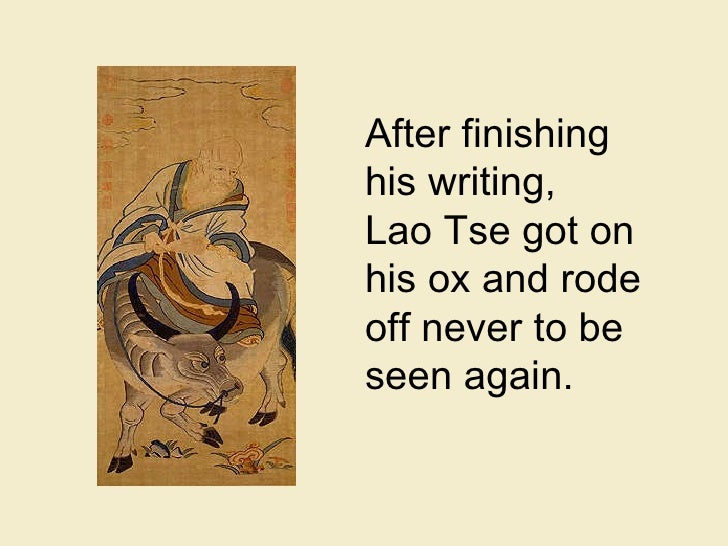
How can concepts attributed legendarily to Lao Tse's dictation as he stepped off of his ox and dictated to the gatekeeper before the sage departed China (his insights in about 5000 characters can be read in English in about 70 minutes) be tied into a situation as we find ourselves in, dodging each other's rhetorical brickbats and even before the phrase "social distancing" became literally overnight the new normal for billions of us, seeking a safe space from those we offend simply by being born this way?

That was some convoluted sentence. But as I think as I type, for better or worse, I found I have a theme to contemplate. How much do we distance ourselves from what threatens us, or unsettles us?

“The Intelligent Catholic’s Guide to John Waters.”

 john waters

“The Intelligent Catholic’s Guide to John Waters.” OnePeterFive 5/7/20

When a maverick journalist opposes popular opinion, at least as promoted by prominent media, what happens next? For rock critic turned cultural commentator John Waters, it's condemnation followed by self-imposed exile from Dublin's left-liberal, bien-pensant paper-of-record, The Irish Times.

This unrepentant dissident, not to be confused by Americans with Baltimore's cult icon and iconoclastic filmmaker, defends his patch of emerald turf against our new world order. Not (only) that of the Bushes, but of those who banish any trace of transcendence. As a longtime correspondent, Waters speaks for a “Peter Pan generation” who entered a dream-scape never glimpsed by their progenitors. Born in 1955, he and his peers from the 1960s through the 80s found themselves, boosted by a Celtic Tiger economic engine, “as foreigners working from home and emigrants in our own land.” They ushered in an “unassailable” secular agenda, rejecting Catholic, communal, rural-dominant mores once and for all.

John Waters continues his assault on post-Christian Ireland in Give Us Back the Bad Roads, his ninth book (2019). His first, a surprise bestseller Jiving at the Crossroads (1990) roughly coincided with his father's death. The period since both events unfolds in fits and starts, as the son addresses that humble mail-coach driver in a small town in Co. Roscommon, who taught him the value of manual labor and the trust in tradition. (As a relevant aside, to show how small Ireland’s networks of who-knows-who remain, my family at their farmhouse—now abandoned as all my relatives emigrated—would have gotten their post delivered by Waters and son, near the first village north of their own market-town.)

John’s career began covering music gigs for Hot Press, an upstart newspaper whose emergence proved well-timed with the punk explosion, hedonistic excess, and the demands of those raised in the wake of Vatican II to become not “the Pope’s children” addressed by John Paul II in his hyped 1979 tour, but a generation freed from clerical submission, censored expression, and class-bound economic stagnation. The results of this leap into liberation led not to freedom but to incarceration within a cunning and callow bureaucracy bent on enforcing standards of a politically-correct generation, his mates, and heirs.

This blow-back fuels Waters' longstanding determination in print and by his own interventions with similarly suffering fellow Irish families to defend the “blood link” of relationships, against referenda on “divorce-by-demand,” government intervention in the cause of “children's rights,” same-sex marriage, and legal abortion. Quixotic as this principled opposition remains in Ireland's Anglo-Americanized monoculture demolishing its customary “moral paradigm” that a younger, brash, “up from the country” Waters had volunteered to undermine, his mature self favors “common sense.” Although caricatured as a Catholic bigot by his former colleagues--“hired guns”-- and their “progressive” political-clerical cronies, Waters grounds his critique against the imposition of consumerism and corporate “rewards.”

These have obliterated his father's craft and his native town's legacy of community, sly solidarity, and respect for humble dignity. Waters witnesses the transition from his job as a railway clerk to those he and his eager counterparts sought as if Euro-topia at last, but winding up a “screen slave” or a “cubicle hostage.” The trajectory Waters has mapped in his seven intervening books gradually finds its aim. He tires of the distracted, profit-mad, sex-and-drug addled consumerism aided and abetted by his cohort.

Waters' focus, despite the repetitions (common as his many collections blending reporting, research, memoir, and cultural critique often resurrect his past and present predicaments as a prophet without honor in his homeland) sharpens. Returning to his paternal townland in a “strange collision of farmland and wilderness” overlooking Ben Bulben on the Atlantic shore (and Yeats' grave), John Waters watches turf “smoulder like Gabriel Byrne.” Bent on avoiding school on Monday, he had tried to “concentrate like Uri Geller until I conjured up a pain in my stomach.” Tellingly, Waters warns of what will transpire if the embattled “capacity to be human” gets trodden down by an Irish mob sworn to steamroller over the valuable contributions of a tradition rooted in centuries of hard-won verities rather than clogged with the media's “effluent and lies.” Waters imagines a lawn laid atop a yard of concrete: “it may briefly give the impression of health, but eventually, for obvious reason, it withers away.” Without a “consciousness of the absolute,” people will fail to nourish a mentality devoid of religion and dismissive of this venerable “public expression of the total dimension of human nature.”

Waters’ reversion to a measure of Catholic practice emerged gradually. He attended traditional Latin Mass services held at St. Kevin’s in Dublin, which were approved back in 2007. He concludes Lapsed Agnostic (2008), by documenting his growing attraction to the conservative, post-conciliar successor to Italy’s Catholic Action, Fr. Luigi Guissani’s Community and Liberation movement. Since early 2017, he contributes regularly to First Things. Last autumn, he was featured in E. Michael Jones’ Culture Wars. However, a careful parsing of John Waters’ writing presents his quest as one driven arguably far more by his own standards for uncompromising truth as any dogma. As he asks: what happens when a third generation in Ireland, and by extension, the formerly catechized realms across the world, matures with no exposure to the Faith? What follows for Ireland when the “don’ts” of Catholicism fade away?

These questions merit wise responses. Many who serve as leaders in the alternative Catholic media enter from other denominations, and, of course, perhaps none. Yet, intelligent and articulate insights from those left adrift in the last fifty-odd years, brought up in families still faithful, but who themselves fell away suddenly of slowly, often gain less vocal attention or press promotion. John Waters’ halting pilgrimage away from progressive piety might, thus, be guided well by an exchange from a once “center-left” Italian colleague in the Fourth Estate, Aldo Maria Valli (b. 1958), and composer-liturgist Aurelio Porfiri (b. 1968). Their narrative, translated last year as Uprooted: Dialogues in a Liquid Church, remains rather rare, as is that it's written by cradle Catholics too young to remember the Latin Mass as it was with any firm memories, but old enough to have undergone revised regimens post-1965.

It’s to be hoped that more thoughtful examinations of the effects of the counterculture on those now-aging Catholics who have grown apart from the Church in the experimentation and innovation may guide those who, having been raised in the pontificate of John Paul and his successors, seek solace. Not only aesthetic comfort, but, as Valli, Porfiri, and Waters concur, a way to survive amidst discontent and doubt. This demographic has been overshadowed, but it too deserves inclusion among the saving remnant. They had no recourse to clandestine TLM’s or conscientious objectors in the 1970s or 1980s.

Once recovered, after inner struggles against doubt and external battles against detractors, a reverence for the sacred, reduced among millions of cradle Catholics, lingers on. Here, Waters stands again, firm.

Headlines this past month in the Irish press reveal John Waters’ protests against a new shape-shifting foe. He and pro-life campaigner Gemma O’Doherty (another target of attack by the chattering classes) rally against COVID-19-related restrictions on public movement, in some circumstances only within a radius of two kilometers of home. Waters and O’Doherty sustain a long tradition of dissent against whatever draconian dictates they judge to come down from powers that be. Given both figures’ increasing outreach to audiences deemed beyond the pale of acceptable neo-liberal or state-socialist opinion, what transpires from their appeals to the marginalized and discontented in the Catholic circles mapped as “here lie monsters” as no-go territories will be worth watching as we continue into what the car commercials were the first to name “uncertain times,” as we ponder marks of beasts lurking ahead. 

P.S. at the site: OnePeterFive. {I was nearly at the maximum word count, so I did not get into the details of his past books, figuring that the space needed should be for introducing John Waters to a wider audience. But one of his earlier collections of essays (1997) was titled "An Intelligent Person's Guide to Modern Ireland," in turn riffing off of George Bernard Shaw's "An Intelligent Person's Guide to Socialism." In case anyone's wondering why I chose that odd and a bit verbose title.}

Friday, October 4, 2019

Patricia Applebaum's "St. Francis of America": Book Review

  St. Francis of America – How a Thirteenth-Century Friar Became America's Most Popular Saint | North Carolina Scholarship Online

St. Francis of America

How a Thirteenth-Century Friar Became America's Most Popular Saint

Patricia Appelbaum
  • Chapel Hill, NC: 
    The University of North Carolina Press. October 2015.
     288 pages $20.00.
     Hardcover. ISBN 9781469623740.
     For other formats: Link to Publisher's Website.

Review (for Reading Religion/American Academy of Religion)

Before the birdbaths, before the pet medals and the spurious sayings, Francis of Assisi stood for whatever first preoccupied Americans more than a century and a half ago. Devotees of the fine arts admired the challenges to convention by the little poor man. Rather than a refined scion, Francesco Bernardone represented a raw rebel. Today’s consumers at any gardening outlet may check him out, if reduced to a cast mold with a bar code. Both reactions to Francis remind patrons or shoppers of “what one lacks and perhaps longs for—a life free of possessions; a life that is not dominated by money or property or, in fact, consumerism (4). Religious historian Patricia Appelbaum thus introduces this well-researched and engagingly written survey of Francis’s crossover reception within a predominantly Protestant polity and now a secular, acquisitive culture. Appelbaum explains the Poverello’s enduring appeal.

Appelbaum encourages readers to widen their perceptions of her subject. She investigates how sainthood takes on or shunts aside meaning for those who do not include such a formal category in their faith or worldview. Assisi itself is elevated into a tourist site energized with an aura. The fact that Francis lived there allows seekers of any allegiance to identify with a defiant dropout who begged on medieval streets.

In nine chapters, Appelbaum surveys how Francis has been socially constructed. After placing his initial attraction within a revival of interest in Catholic aesthetics and Walter Rauschenbusch’s Social Gospel movement, she examines the impact of Paul Sabatier’s 1894 biography of Francis. The first account of Francis to reject hagiography, Sabatier’s archival effort resembled Ernest Ronan’s 1863 critical scrutiny of Christ. Appelbaum then situates this reforming impulse within the careers of Quaker Rufus Jones and socialist Vida Scudder. Their advocacy of Francis as a pacifist pioneer eased his acceptance by Progressive Era non-Catholics. These impacts sparked Catholic ripostes affirming the saint’s fidelity to the papacy and to Roman rulings.

The next section examines the era between world wars. The social activist side of Francis appealed to many, even as his advocacy of voluntary poverty hit close to home for most Americans during the Depression. The 1940s popularized the “peace prayer” erroneously credited to the saint. Meanwhile his statues spread throughout gardens across the country. Appelbaum grounds the birdbaths within a love of place. “Like the prayer, they could be private; like the hymn [‘All Creatures Great and Small’], they could be used in a small community.” This admiration set the sylvan scene for Earth Day in 1970 and the promotion of “the patron saint of ecology” (88). Postwar prosperity generated many versions of the odd man out from Assisi. Robert Lawson’s children’s tale Rabbit Hill and Bernard Malamud’s urban Jewish parable The Assistant gain in-depth analyses as they reveal narrative responses to the saint’s firm rejection of attachment to the things of this world. That such a reaction co-exists with Francis’s celebrated love of nature complicates his contemporary depictions.

Unfortunately, the hot pink and mustard yellow vibrancy of a San Francisco Summer of Love poster with an offbeat, mixed message from its municipal namesake to its hippie versus straight heirs is reproduced only in monochrome. But as with visuals throughout this study, it reveals Appelbaum’s range of references. About eighty pages document her fieldwork, list sources consulted, and include endnotes. These appendages combined with two indices enhance this book’s value. Any scholar of material Christianity or popular culture will find St. Francis of America a welcome resource.

The rise of the Jesus People and evangelicals who recast Francis as a hippie; the embrace of his spirit by environmentalists; the attempt to capture his charisma on film; and his conversion into “creation-centered spirituality” by post-Christian skeptics and New Age adherents typify recent trends. Shifts in American attitudes to Francis anticipate Appelbaum’s thoughtful inquiry into the “blessing of the animals” ritual across ecumenical or sectarian lines. Appelbaum edits replies to her 2013 questionnaire. She sifts testimony from over forty “living voices” about what Francis means personally and spiritually. These sensibilities expand into diverse contexts: Islam, postmodernism, and folklore. “Artist, poet, clown; traveler, camper, farmer; leper, street person, prisoner: the list goes on and on” (181). Sly guises illustrate disparate roles played in nine centuries of the odyssey of Francis from Assisi.

Date of Review: August 19, 2018
About the Author(s)/Editor(s)/Translator(s): 
Patricia Appelbaum is a historian and independent scholar of American religion.