Showing posts with label Czechoslovakia. Show all posts

Thursday, May 11, 2017

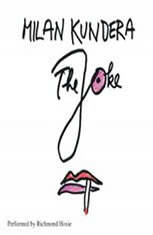
Milan Kundera's "The Joke": Audiobook Review

Overall
Performance
Story
"It's not funny anymore"
Would you say that listening to this book was time well-spent? Why or why not?
My mind wandered a lot. I can see why as the Author's Afterword complains the earlier translations (#1-4) edited and streamlined the original. Despite Kundera's protests, it needed revision. It's far too sprawling and disjointed. It turned tedious early on and rarely engaged.

What do you think your next listen will be?
I am taking on a revisit to Tolstoy's "Anna Karenina" as a reminder of quality literary fiction.

Did Richmond Hoxie do a good job differentiating all the characters? How?
He tried. He has an avuncular style similar to George Guidall. But for the females, he could not modulate his delivery much. For the protagonist, he sounded too boorish and gruff.

Was The Joke worth the listening time?
A toss-up. While it did give you an insight into Moravian folkways and music, it lacked the detailed impact of, say, how working in a mine would feel for one sentenced to a "black insignia" unarmed contingent of politically suspect comrades in early 1960s Czechoslovakia,

Any additional comments?
This confirms my unease with Milan Kundera's work. While "The Joke" by some is considered a debut (1965-7) second only to "Unforgettable Lightness of Being," I am annoyed by his seemingly slapdash manner of plot. Yes, he weighs in with the philosophical musings early in his career, but this novel frankly merited at least some of the excisions he predictably decries. The 7-part structure is promising but the results are verbose and dull. 

Friday, March 24, 2017

"Fodor's Essential Prague": Book Review


Fodor's guides tend to be more traditional than their Rough Guide or Lonely Planet competitors. More like Frommer's, Fodor's offers a long-established line of guidebooks. This one for Prague and mainly Southern Bohemia does not provide the colorful diagrams and cross-section illustrations of landmarks as DK books do. You get fewer photos. The text is satisfactory in covering the must-sees.

That being said, the maps of, say, the Jewish Quarter of Prague are a bit perfunctory, if serviceable. Sites are promoted over pp. 25-80 in the capital. The rest of the guide, besides the appendices, leans south to Bohemian sites. The map of day trips from the capital city is a quick encouragement to venture forth from the usual warren of haunting or lovely streets, pubs, restaurants, shops galore, and the wonderful bridges over the Vltava.

It's compact enough to slip into a purse or backpack. It's also useful to jot down ideas in the notes space at the end, a helpful touch. There are no fold-out maps, but there's a highway one for the Czech Republic with main roads, and another in the back with the Prague Metro. All in all, a respectable purchase to consult to plan the visit you may make or to accompany the one you're on. Either way, get to Prague and out of it too. (Amazon US 3-24-17)

Thursday, July 24, 2014

Mariusz Szczygiel's "Gottland": Book Review

Hailed as the first “cubistic” history of anywhere, this award-winning Polish compendium presents Mariusz Szczygiel’s 2006 attempt to make sense of his nation’s neighbor, the Czech lands that comprised, for most of the last century, half of Czechoslovakia. Cubist, for it refuses one perspective, or one steady perch from where to depict the angles of a land under pressure. Translated into ten languages, here is its English debut through Antonia Lloyd-Jones’ lively rendering. Snappy, moving, inquisitive, and ethical, this examination of how the Czech lands coped under fascism and especially communism, and capitalism before and after those totalitarian regimes, confronts Czech complicity.

Certainly, Szczygiel knows how his foray by way of visits, archives, and interviews reflects back on his own homeland. As an ethnic cousin, he hears resonances, and he relates attitudes Poles have foisted on what they have seen as a more feckless, or less responsible, Slavic nation bordering their own. He impressively manages, however, to make this content accessible beyond this region, so that a wider audience may learn from his diligence. Assembling in-depth profiles, which wind and turn on themselves as if fables, and interspersing wry vignettes, these vivid reports compel one’s attention.

He begins with the Baťashoe empire, which destroyed the traditional way of shoemaking by making it piecemeal work, combining Fordism with Orwellian surveillance and shrewd taskmasters to spur compliance among thousands of workers. When a village cobbler, made destitute by mass production, packed up his tools and shop and sent his final pair of shoes to Tomáš Baťa, Baťa put it on display to demonstrate the backward start from which his enterprise had moved forward. That cobbler himself committed suicide after that final shipment.

How this relentless enterprise fared under the Nazis spins off into subsequent chapters, for capitulation, chosen by most Czechs in order to survive, remains the leitmotif from which Szczygiel composes his intricately arranged scenes.

For example, amid dozens of densely detailed yet briskly told pages, suddenly we meet Ivana Zelníčkov. Born to a Baťa worker in this factory town in 1949, freshly renamed after the first Communist prime minister as “Gottwaldov”, the “American press will call her ‘the spiritual heiress of the genius of capitalism from Zlín who injected an Anglo-Saxon mentality into a Slav body”. Whatever that means. Szczygiel, in typical form, sprinkles such attributions from his journalistic predecessors throughout his chronicle. Sometimes he elaborates on them, sometimes he saunters on.

This sly structure keeps the reader off-guard. In the “liberation” of Gottwald as experienced by young Ivana and her schoolmates, the number of books destroyed was 27 million— about seven times the number of her comrades killed. The enthusiasm with which Czechs embraced their 1948 takeover, when their native Party numbered 40 percent before it wedged in and drove out the non-Communist coalition, surprised those devoted to Moscow. They begged their former rivals to vote against some Party measures, for show, but many who gave in to the new system gave in all the way. At least outwardly.

Such ambiguity sinks into this entire study. Radio Prague played not the Czechoslovakian anthem but that of the Soviet Union at the end of its broadcast. Rivalry continued, however, in more sinister ways. Eager to direct attention away from the iconic Castle to a new Prague icon, across the Vltava River, orders came for a 150-foot granite statue of Stalin, to celebrate his birthday. Szczygiel documents its slow erection, the delays engineered by reluctant architects, and the fate of its designer, sculptor Otokar Švec. His tragic predicament stands for many who had to survive under Stalinism, and the previous as well as later dictatorships. Above all, secrecy compelled intimates to turn inward, to hush.

Censorship sunk in oddly, for “there was no list of names that couldn’t be written or mentioned aloud” as one informant tells the author. How did people know there was a ban? “Everyone had to sense intuitively whose name couldn’t be mentioned.” Indirection dominates. Not only “truth” and “lie” but “I think” in Věra Chytilová’s New Wave films, and a scene in which a man cries “I’m trapped”: all met with elimination from discussion. Szczygiel notes how often the “impersonal” emerges “when people have to talk”—about Communism and their decisions under it to keep working, to keep living.

Szczygiel opines: “As if people had no influence on anything and were unwilling to take personal responsibility. As if to remind me that they were just part of a greater whole, which also had some sin of denial on its conscience.” Fifty years after Stalin was toppled from his riverside summit, “Prague’s monument to Stalin does exist.” People still cannot shake their fear that independence cannot endure. As I type this, I think of the assurances now that NATO will shore up nations along the same borders that two decades ago were hailed as harbingers of “the end of history”, as they watch Ukraine and Crimea.

Those who spoke out, as Szczygiel investigates, faced their own fears. Most of the “cultural elite” surrendered to do the bidding of “socialism”, but “a microscopic minority” protested the post-1968 Prague Spring fate of the rock band The Plastic People of the Universe, and these dissenters congregated as “pretenders and castaways from Charter 77” according to the loyal press. While Václav Havel (who appears along with his uncle now and then, in the background) is well-known, the hardships of film writer Jan Procházka and other intellectuals merit their own dramatization.

After “normalization” dominated post-1968, about a tenth of all Czechs were removed from their jobs. Many had to work in menial and even degrading occupations for which they were grossly overqualified or for which they lacked any skills. While this did admittedly advance class consciousness as the Communists cynically promoted, it made a mockery of artists who claimed, by following orders as it were, that they were in ignorance of what this compelled among the creative class. Szczygiel knows well the parallels in Poland, so he affords fairly the chance for all who made whatever decision they chose to (or had no choice but to choose) in the twisted Czech party logic to justify their own actions, given the lack of alternatives beyond imprisonment, exile, or no income.

Singer Marta Kubišová was one who, after 1968, found herself in internal exile. Separated from her successful partners in the Golden Kids Václav Neckář and Helena Vondráčková, whom she told to go on with their careers, she symbolizes the similarly silenced sufferers who endured the regime’s heavy hand. The state archives erased her songs; she could not sing in public for 20 years. When she does so again, after a long estrangement, she does so on stage, hesitantly and awkwardly, reunited with her two partners.

Journalist Eda Kriseová found herself on a list of banned writers prevented from publishing. Working as a librarian but prevented from talking to others, she sought refuge by visiting mental patients to tell them stories. For her, that was “the only normal place, because there everyone could say what they really thought with impunity.” Tracing verbal evasion back to Kafka, Szczygiel dutifully tracks down Kafka’s niece near his birthplace in Prague’s Old Town. Szczygiel explains how the nonce word “kafkárna” suitably “describes something everyone knows about, but which they also know nothing can be done about”, as typifying cagey Czechs.

Speaking of words, what about the title of this book? Evidently “Mostly True Stories” has sparked unease from certain Czech critics after its original publication. In the appendix to the new English translation, Szczygiel addresses the reaction to his choices of characters to exemplify Czech evasion and subversion. He emphasizes dissidents such as Kubišová, who faced rejection. He gives equal time to collaborators and compromisers, such as the perennial prizewinning singer and libertine Karol Gott, judged the equal to both “Presley and Pavorotti”.  To explain the adulation given Gott by the pro-Soviet regime as well as the post-1989 nation, Szczygiel applies the national stereotype. The Good Soldier Švejk “is the philosopher of cunning acquiescence. And at the same time, the archetype of adaptation.”

Havel and that tiny cadre of opponents to the regime resisted, but most, like Gott, went along, gained plaudits, and grew if not as successful, than at least safe. The alternatives, Szczygiel shows, could be dire.

Author Lenka Reinerová, placed in solitary confinement for 15 months, could not even visit the prison yard. When asked why she was incarcerated, “she invariably heard: ‘You know better than anyone.’” Years later, needing a certificate to prove her arrest, she was told: “Maybe you just imagined it all, comrade.”

Given this situation, Gottland suggests that it seemed wiser for most to bow to safer, secular idols such as Gott, who “is sacred in a desacralized reality” in what Szczygiel terms “the world’s most atheistic country”. I suspected this factoid’s veracity. (Checking, the Czech Republic ranks in 2014 number six; perhaps since the original edition in 2006 or since the Republic’s partition with Slovakia a few citizens reverted back to invisible gods.) Still, such hero worship fits Szczygiel’s set-up. Karol Gott, ever revered, keeps playing the “role of Mein Gott”. His popularity endures.

Within today’s capitalist Czech Republic, how does resistance to such idolatry play out? A young alter-globalization protester decides to emulate the end of Jan Palach. He was chosen by lot to volunteer to set himself on fire at Charles University, near the banks of the Vltava. Palach called horrific attention in January 1969 to the pain of “normalization”. He lingered in agony for 72 hours in the hospital before dying. True to our manner of social protest in a networked generation, Zdenék Adamec posted a message as “The Action Called Torch 2003”. Four yards from the place where Palach immolated himself, so did this second student, at the age of 19, that March.

Nobody called for help. He lived for more than 30 minutes, having first swallowed corrosive acid as had his predecessor to stop from screaming. As Szczygiel refers to Adamec as “Torch Number Two” (his website translates in Czech to “torch”; see his farewell message in Czech at this website and translated here), the site of this second young man’s self-destruction was confused by tourists taking pictures and paying tribute to what they thought of as Jan Palach’s memorial plaque, where “messages appear saying: ‘Zdenék, you’re right!’” Four days later, these flowers and candles were moved out of sight temporarily to allow the site to be filmed for a Canadian biopic about Hitler.

This edition’s new afterword reveals that another Václav, President Kraus, wrote the forward for the perpetually priapic, still award-winning, Gott’s autobiography. One senses Szczygiel’s frustration that the new leaders and the old rascals continue to toast each other’s success. After the poignancy and despair of the Adamec chapter, Szczygiel adds the final word to this translation, if in typically less somber fashion.

Some Czechs thought titling this after Karol G. was unfair. “I started to explain at public events that Gottland could also be understood as God’s land, which is best typified by a quotation from the Czech poet Vladimír Holan: ‘I don’t know who does the Gods’ laundry/ I do know it’s we who drink the dirty water.’” He adds in characteristically sly style: “Strangely, I’ve noticed that this explanation reassures people who object to the title.” As he prefers Holan’s verse as this book’s motto, so I conclude this review by citing it as an appropriate coda to the English version of this spirited and provocative report from half of what was Czechoslovakia. (PopMatters 5-9-14 and Amazon US 7-24-14, both in edited form.)

Thursday, February 13, 2014

Laurent Binet's "HHhH": Book Review

This novel's curious title derives from the German initials of the phrase "Himmler's brain is called Heydrich." That is, Reinhard(t), Protector of Bohemia and Moravia, #2 man in the Nazi ranks, and "the Butcher of Prague." While Laurent Binet's topic may be very well-known among students of Middle European history, the Czech lands, and of WWII, the heroism shown by Jozef Gabčík and Jan Kubiš, one Slovak, one Czech, to fight for their nation against tyranny deserves retelling.

As with two recent, massive novels  influences this French author credits, Jonathan Littell's The Kindly Ones (which he disparages as "Houellebecq does Nazis") and William T. Vollmann's Europe Central, HHhH takes on a modern perspective, plunging a reader into the German mindset and the frenzy of the era, seasoned with a retrospective judgement upon the morality abused or rescued in WWII.

The difference? Binet chooses never to immerse himself into fiction. Most of these three-hundred quickly told pages (a fraction of Littell or Vollmann) treat the subject and how it defies the reversion to fantasy or imagination. That becomes Binet's obsession. Inspired by his two Czechoslovak figures, sent to England to train for their suicide mission behind enemy lines, Binet prefers to examine the historical record and to fill in the gaps, with some dialogue and invented scenes, but only when he cannot make the facts fit his tale. Fewer times, therefore, than expected, we learn how subsequent testimony by survivors accounts for both Nazi and enemy reactions, and from these, juxtaposed with Binet's reading and reactions, the novel slowly accrues.

Operation Anthropoid, as the English termed it with the Czechoslovak resistance, itself decimated under Heydrich, draws us into the antagonist. "It's as if a Dr. Frankenstein novelist had mixed up the greatest monsters of literature to create a new and terrifying monster." (99) Worse, for he kills not on paper but in person and through his minions.

How Binet conveys this may annoy some readers. He makes it personal, and mixes up his "visions with the known facts. It's just how it is." (105) But then, on the same page, he backtracks, and he admits his mistakes as he researches his storyline. He knows "fiction does not respect anything," but he also know that the drama inherent in his subject causes him to imagine what cannot be verified.

Real people are "both greater and more flawed than any fictional character." The chapters #250 + #251 prove gripping, even though--or because--I had visited the crypt in question and seen the place commemorated today in Prague. The climax shows courage amidst absurdity. "I think the world is ridiculous, moving, and cruel. The same is true for this book: the story is cruel, the protagonists are moving, and I am ridiculous. But I am in Prague." (320) In that city of a hundred towers, the power of the predicament that seven Resistance fighters choose in 1942 remains resonant, and poignant. Amazon US 9-25-13

Tuesday, February 11, 2014

Milan Kundera's "The Unbearable Lightness of Being": Book Review

I could not recall if I had read this years ago when or before the film. Given my son's interest in both novel and adaptation, I found my wife's own copy and dove in. I realized I had not read it, but recognized early on the significance of Sabina's bowler hat, the 1988 film's icon; the pleasure of the 1984 book as in the successful cinematic version lies in how such symbols and tropes revolve and swirl over time. An intrusive narrator adds far more insights than could a film, however, gleaned from a cultural heritage, as well as such predecessors in the art of storytelling as Stendhal, Sophocles, and Tolstoy.

It's therefore a novel of ideas as well as a love triangle (at least, around Tomas; adding Franz to Tereza and F's wife Marie-Claude we extend the dimensions, let alone Tomas' unnamed hundreds of lovers). One could quote hundreds of passages. Aphoristic, the prose lingers. If you want to see infinity, the teller tells us, close your eyes. Distance between one's life and one's feelings dominates its characters as they struggle to make sense out of the Czech occupation by the Soviets after the failed 1968 demonstrations. The uprising occupies less space than one may anticipate: the aftermath, as Tomas finds in a gripping sequence, brings down many intellectuals, as doctors turn window washers. Still, that affords him more time for seduction.

Unsettled by her inability to conform, Tereza also bristles. In Paris a year or two (note the ambiguity as she reflects on it) after the occupation, she resents the supposition of her French friends that she'd join the local protests against the Soviets. "She would have liked to tell them that behind Communism, Fascism, behind all occupations and invasions lurks a more basic, pervasive evil and that the image of that evil was a parade of people marching by with raised fists and shouting identical syllables in unison. But she knew she would never make them understand." (100)

Sabina aspires to live in truth, but wonders how: "lying neither to ourselves nor to others" she considers "was possible only away from the public; the moment someone keeps an eye on what we do, we involuntary make allowances for that eye, and nothing we do is truthful. Having a public, keeping a public in mind, means living in lies." (112-3) Sabina hates novels that give away the secrets of intimacy; Kundera deepens suspense and builds momentum by state pressure to expose loyalties.

Tereza--in what may seem hyperbole to us as with the French, but to those within a police state riddled with informers, compounded by casual conversations leading to coercion and compromise in the name of Communist conformity, may not seem a literary conceit--cringes. A tableau on Prague's Petrin Hill haunts her. Her mother resembles a wailing jailer. "Almost from childhood, she knew that a concentration camp was nothing exceptional or startling but something very basic, a given into which we are born and from which we can escape only through the greatest of efforts." (137)

All three major characters attempt this liberation. Tereza interrogates herself with the types of questions about her self within her body or without it that a child might raise. "Only the most naive of questions are truly serious. They are the questions with no answers. A question with no answer is a barrier that cannot be breached. In other words, it is questions with no answers that set the limits of human possibilities, describe the boundaries of human existence." (137) Michael Henry Heim's translation shows the clarity of this expression, even as Kundera's non-chronology evades neat order.

Yet the Middle European setting reveals some control over one's mindset no matter who's in charge. The "premeditated quality" of European beauty grounds its inhabitants within "an aesthetic intention and a long-range plan." (101) By contrast, New York City represents a later stage of "beauty by mistake," not intended but a lesser expression before beauty itself perishes from this earth. 

In this grayer time, cemeteries provide peace for Sabina. A reclamation by the urban of a vanished rural presence hovers. In the secular, a deeper longing persists. Kundera evokes an older sense of interior awe within primitive people early on: one must have once marveled at the unseen, before Tomas and his colleagues invaded the body's interior. Heartbeats invisible, a soul lurked within the cage of one's own ribs, and duality turned into identity. Now, "the face is nothing but an instrument panel registering all the bodily mechanisms: digestion, sight, hearing, respiration, thought." (40)

Speaking of the differences between outer and inner, the tensions during part six, "The Great March," address the trouble when the "brotherhood of man" beloved by liberals worldwide forces conformity. Stalin's son, Parmenides' division between heaviness and lightness, Nietzsche's Turin Horse. baby Moses in the bulrushes, Descartes, Plato's Symposium, Adam's naming of the animals: allusions multiply. Kundera seeks to align his novel, with its sprawling approach (we learn in an aside, fifty pages from its end, the fate of two of the protagonists, and the time continues to leap ahead of the events we thought it would remain discussing), to the Western intellectual tradition. This can get messy, as the narrator himself would agree.

Still, the sixth section as it follows Franz into a mercy mission (with media coverage and celebrities) to let medical aid enter Communist Cambodia rouses Kundera to integrate a discussion of kitsch. This pings off of one on excrement, but his point is that glossing over the human with all its flaws leads to emotional falsity. "In the realm of kitsch, the dictatorship of the heart reigns supreme." (252)

It's a "folding screen set up to curtain off death," and the "true function" of kitsch forces upon the viewer a tyranny of giving in to unearned feelings, tired re-creations of easy sentiment. Kundera compares Sabina's explanation of her paintings earlier to Tereza: "on the surface, an intelligible lie, underneath, the unintelligible truth showing through."

In some situations, people may be "condemned to playact. Their struggle with mute power (the mute power across the river, a police transmogrified into mute microphones in the wall) is the struggle of a theater company that has attacked an army." Franz like Tereza distances himself from the posturing, yet like Tomas, he is haunted if he does not do something against the forces of oppression. (268)

Political kitsch, for Kundera's characters, threatens, whether labelled from the left or on the right. "Before we are forgotten, we will be turned into kitsch. Kitsch is the stopover between being and oblivion." (278) Yet, somehow Kundera's seventh section, "Karenin's Smile" in a powerful sequence conveying the decline of Tomas and Tereza's beloved dog, evokes not kitsch but earned emotion. I doubt if anyone who has loved a pet can read this easily.

While the conclusion (which without spoilers shows how the film adaptation differed) did not fully sustain the impact I had expected, the conjuration of the ideal attempted of the pastoral idyll within the Czech lands' occupation sharpens the contrasts Kundera favors between cities the country dwellers cannot wait to move to and the predicament of the intellectuals in internal exile who depart Prague for such places as their last defense against the kitsch and the compromises of its regimes.

Image:  Daisies (Sedmikrasky). Directed by Věra Chytilová. This fits the time and mood perfectly. (7-9-13 to Amazon US)

Sunday, February 9, 2014

Ivan Klíma's "My Crazy Century": Book Review

I've long preferred Ivan Klíma's fiction to his better-known Czech colleague, Milan Kundera. Klíma and Kundera explore the collusions imposed under totalitarianism, and the uneasy compromises chosen as democracy returns and capitalism dominates their fractious post-1989 homeland. However, Klíma emphasizes moral dilemmas in sparer, simpler prose, shorn of the philosophical digressions characteristic of Kundera; as his autobiography demonstrates, Klíma avoids cant or cliché.

His preface warns how "often deceptive goals" lure young idealists towards self-sacrifice. Once Marxism, now Islam, but the moral endures: Klíma opts for sincerity, and he resists conformity, at considerable cost to his career. How he got there brings us back to his ill-timed birth in 1931; this made him, and his family of Jewish descent, a deportee to Terezín.

Klíma adopts subtle reactions to his plight as an adolescent prisoner, from his younger perspective. "Early one morning on a gloomy autumn day--probably in 1943 because Father was still with us--they herded everyone out of town and onto a huge meadow." The vague date combined with the reminder of a fragile family bond blends with his blurred, then sharpened, memory. "The women were wailing that this was the last day of our lives, that they would shoot us or toss a bomb into our midst. And as if to confirm their fears, a plane with a black cross on its wings passed overhead."

Klíma tells his family's survival within this predicament without melodrama or sentiment. He was incarcerated in the infamous show-camp manufactured by the Nazis, who used its inmates to pretend to the Red Cross that all was well with Jewish life in a staged setting. Paper money "for our ghetto" was later distributed. "On the face of the bill was an engraving of a bearded man holding a stone tablet in his arms. Mother explained that this was Moses and that carved on the table were ten laws according to which people were meant to conduct their lives." Ivan's unfamiliarity with Judaism, given his family's Communist ties and his assimilated upbringing, come across in such well-crafted vignettes, and where a lesser talent might have inflated the pathos or irony in the Nazi invention, Klíma exerts emotional control.

This typifies My Crazy Century. "It's a strange world when you are called upon to explain why you weren't murdered as a child." His admission of "having drawn one of the few lucky numbers" in this abominable lottery" of who shall live and who shall die raises uncertainty about why he let alone most of his family survived. given he was no longer considered underage before the end of the war and so as a male inmate he was exposed to the same fate meted out to millions of his neighbors. After liberation, however, his family's status (it appears thanks to two of his mother's Communist brothers who had been executed by the enemy during the war) seems to have risen, if for a while. A putsch in 1948 brought the Communists aligned with Stalin into power, and the Klímas anticipated happiness.

Klíma's cohort, too young to have remembered much of democracy, became the first to be praised by the new regime, for the young could be raised fully indoctrinated in Marxist-Leninist rhetoric. Catching up on the education he had missed behind barbed wire, he tries to seek solace in books, but these are censored; a career as a writer comes with many restrictions. Sent as part of a hapless student brigade to build a foundation for a residence, he discovers the complicity of all involved in the making of the People's Republic in its own inevitable demise. The foreman, after goading and chastising the untrained students forced to labor in rain and mud, shows his own duplicity when it comes to tallying up the pay and the hours "worked": "They were swindling us as much as they were him." "They" stands for the State, and the system against which his own father will be held liable.

His father, with a doctorate in electrical engineering, was told to run a factory full of similarly untrained workers. Production of its motors suffered. Sentenced to prison for a stint under "Paragraph 135 (endangerment of the economic plan)", only the death of Stalin and a relative easing of sentences prevented his father from serving twenty years, or worse, for "sabotage". Chastened, Ivan seeks Party membership anyway, and to his surprise despite the taint upon his long-standing Communist family, he is accepted. Yet, this ties him all the more to his limited options, after a degree purportedly in "literary studies", adulterated by the "official ideology" through which the humanities were taught.

As a cub journalist fired for his insistence to aim for a truer version of what he witnesses than socialist realism, and as a reluctant or crafty magazine and newspaper editor, Klíma struggles to comprehend his country's shift after Stalin's death. Following Khrushchev's speech denouncing his predecessor, Klíma asks his aunt, who had lived in the U.S.S.R., why she did not tell him the truth about Russia. She responds that those who had seen firsthand Stalin's dictatorship were themselves most suspected, and besides, she avers, nobody in Czechoslovakia would have believed her anyway.

Married at twenty-seven and raising two children in early-1960s Prague, Klíma learns about Stalin's evils through a book by Isaac Deutscher. Klíma seeks help in translating damning passages from its English version, through the assistance from another aunt, a survivor of Auschwitz. A dangerous task, but this collaboration emboldens his instinctive need to elevate facts rather than fiction within his own life and calling. But he must express himself, given the scrutiny of the regime, subversively as an emerging playwright and novelist. "I finally realized that in a society in which all means of expressing disagreement are suppressed and every word of doubt is considered grounds for prosecution and subsequent execution, only the despotism of the leader comes to power."

Allegory against such a dire condition, in his early plays and stories, was forced upon him, as with many Czechs from the creative class. Otherwise, censors swooped down. He joins the Writer's Union and relates many instances of more suppression as those who seek inspiration outside approved boundaries find their presses closed down and their submissions unpublished.

Throughout his long career, Klíma strives to keep honest, and pushes against his own limits as well as those from above. "Art obviously does not begin when you succeed in generating form out of formlessness; it begins when you are able to judge the caliber of your creation and not fall into raptures over the sole fact that you have created one of countless paper kites." The bestseller or the hack, Klíma opines, asserts the success of an inferior work, full of tired phrases and hackneyed plots.

The artist worries that his or her creation may not by its merits or their lack survive even its creator's lifetime. Klíma allies himself with those who fuss and worry over words. Under totalitarian regimes, verbal and freed expression may undermine foundations too shoddily built by brigades forced into tasks. Reading this memoir, I speculate that Klíma might urge societies to look to role models such as his father, trained to fulfill their potential at jobs chosen by themselves, and to direct satisfying and productive progress agreed upon by working individuals themselves, rather than by top-down imposition.

Allowed to visit Israel and its kibbutzim and then England (where he meets Deutscher, who ironically from his own perch in a plush London book-lined study counsels book-censored Klíma to praise socialism more), he moves even before the tumultuous year of 1968 towards a dramatic showdown. Rebelling against the constitutionally enshrined "eternal rule" of the Party, Kundera defends the New Wave of filmmakers in their nation, while a fellow writer cites Marx in defense of greater liberty. Klíma denies state lies, for "in the name of some sort of future objectives, the party had deprived the people of freedom, usurped all power, destroyed political life, falsified history, mocked the art of voting, and transformed a free country into a colony". Unsurprisingly, the Party expels him.

Part two (this was originally published in two volumes in Czech; this one-volume abridgement has been carried out by skilled translator Craig Cravens with the author's assistance) opens as Klíma, after fourteen years a card-carrying Communist, is fired from his editorial position. Now a class enemy, he is under surveillance.

Yet a few months later, as 1968 ushers in Alexander Dubček's brief leadership, Klíma and dissidents were reinstated. The right to act by one's conscience was asserted officially. During the "cataclysmic Prague Spring", Klíma reports: "Never before or since have I lived with such haste or intensity." This section thickens, as Klíma documents manifestos by his fellow intellectuals agitating for reform and open elections, but this is a necessary inclusion for readers who will consult this autobiography for a better insight into the forces pushing against the State, and those tanks which pushed back. That August, Soviet forces reminded Czechoslovakians that they had no right to stand up for themselves.

Even as the Warsaw Pact troops loomed, Klíma, now having an affair, tries another play in fabulist style. It was rejected. "The criminals who soon took power no longer needed their jesters."

Oddly, he and his mistress first heard that their land was invaded on the radio, from London. The couple had a chance to stay there a few weeks. Meanwhile, his wife was on a kibbutz in Israel; her summer departure had rekindled a short liaison between Ivan and his new companion Olga. But with their children in Prague, husband and wife decided they had to return. Most cars were going in the other direction as Helena and Ivan crossed back into Czechoslovakia. Many of his friends emigrated.

As "healthy forces" in Party jargon regained control, Klíma bristled. He welcomed the chance to teach at Ann Arbor in 1969. On a limited income, he lectures at other universities and spends Christmas in Midland, Texas, sponsored for a week by a local Protestant church. Four days in, he flees to Big Bend National Park. He savors his freedom, as he sneaks across even the Mexican border. He realizes he never had to show anyone his identity card, over two weeks on U.S. highways.

He and his family are summoned back prematurely, as the crackdown at home meant their visas were suddenly terminated at the end of 1969. Neither his dissident colleagues nor his mistress can believe he came back from America. Writers who refused to conform now washed windows or built the metro. Some philosophers and historians are hired by the water board to measure a stream every few hours. Returning to a still more intolerant society, Helena and Ivan have their passports confiscated. 

As he must return to the labor force, he takes on for a few months his allotted two twelve-hour shifts weekly. He logs in part-time as a hospital orderly. "Socialist health care was free, and looked like it." Each socialist workday, he explains, consists of two periods of equal length. Work is followed by a time when "everyone pretended that work took place". 

At forty, Klíma turns from stage productions to writing fiction; his membership in the PEN Club brings about his interrogation. Arthur Miller, William Styron, and Philip Roth visit a few years after Soviet occupation, before the borders are tightened. Klíma confesses astonishment when meeting earnest, deluded Westerners who applaud "Communist propaganda". He and others among over a hundred banned writers lobby for clandestine samizdat distribution at home, for a loophole means that a writer cannot be punished for "a copy made upon an ordinary typewriter". 

After all the searches, arrests, incarcerations, and deaths he had seen, Klíma joked how he'd write a thousand-page novel. Judge on Trial (originally an underground publication in 1978), remains one of his best novels, a look at those who, like its author, did not flee after the blasts ending Prague Spring. 

In the matter of love, Klíma reckoned that people could find some semblance of choice, even under a police state. When "higher goals had been degraded and disgraced" and so much was forbidden, only the "dearth of apartments or money" stood in the way when it came to erotic fulfillment. Yet, he remains discreet about some of his personal affairs. "My wish is not to draw my loved ones into my tale; it's enough that I drew them into real life." 

1977 brings Charter 77, named for an international human rights covenant. This petition predictably brings the wrath of the dictatorship down on opponents of the regime such as Václav Havel, who was imprisoned repeatedly. Klíma, who had foreseen how this charter would play into the State Security police who reacted against "reactionaries", had prevaricated and not signed it. His lack of involvement raises suspicion. Trying to trap him, the Party press reports he in fact has signed. The police wonder if he wants his passport back, Klíma gets to play his own cat-and-mouse game. What loyal citizen, after all, would claim that the paper of record published false information?

These kind of situations beg the term Kafkaesque. (Klíma to his credit avoids the cliché, but it appears apt in Prague offices run by a police state.) His interrogator asks to see his manuscripts. His books being banned, Klíma admits to the colonel: "I had no copies of my books because I didn't want any trouble."  Many pages of such admissions ensue, and earn its wry commemoration as "a crazy century". He quotes this phrase from a samizdat copy of Donella Meadows' The Limits to Growth.

He finds in middle-age himself locked in a ghetto where he too holds now the key. Unbanned writers separated from banned, and the latter, forced into secret meetings to avoid the secret police, chafed. Yet no informers were secured, and Klíma and his comrades told nobody about such gatherings. 

More writers, musicians, and artists are forced to emigrate. Intimidation increases. As his by-now regular interrogator greets him: "Wherever something provocative is going on, we are sure to find Klíma." Suspicions prove founded. As an an unofficial "mailman" he transports such documents as Meadows' along with Czech-language publications, smuggled in from abroad. Later, bored and curious about the opposite of love, he seeks garbage. He becomes a street-sweeper. As he and his wife are "persecuted dissidents against the reigning social order", it's one job nobody can deny him.

Due to bureaucracy, Klíma keeps inventive, and quirky. Although the State employs him as little as possible, Klíma has to find approved employment at least one day for each of two years prior to his retirement, to qualify for a pension. Since his writing prohibits him from making a living as an approved author, he makes do with other tasks. These jobs will provide him with inspiration for his fiction. He finagles another time-killing messenger position. Qualifying for his pension, not needing to work, in homage to Kafka he next requests a stretch as a surveyor's lineman.  At least in this abridgement, Klíma tends towards reticence about his fiction; more about its contents might have enhanced this memoir's appeal to readers, new or old, of his work, often set among everyday people in Prague's streets. His odd jobs there enliven his samizdat novel titled, of course, Love and Garbage and his stories My Golden Trades.

Grandchildren and retirement don't slow him. 1989 ushers in another January of protests in honor of Jan Palich who had burned himself alive in 1969 to protest the Soviet invasion. This year, Havel is arrested again, but unlike past years, protests do not dwindle. Water cannons drench Klíma as he marches. But this spirited year goes more smoothly than 1969. Klíma rallies the PEN Club again. A November strike at his alma mater Charles University confronts the regime, and soon the Communist Parliament unanimously elects Havel as president of the republic. 


This volume appends eighteen essays keyed to many of Klíma's autobiographical chapters, on the impacts of ideology, propaganda, subjugation, state control, and the concept of internal freedom pursued within conditions that limit external liberty. He asserts: "I wrote about the world not the way I was ordered to by the way I perceived and experienced it." His one-page epilogue concludes, after the "heavens of freedom, imperceptible only a short time ago, had finally opened before us." 

As My Crazy Century proves, Klíma in his eighties continues to do what he chose to do, despite the forces rallied for most of his life against him and his fellow marchers and writers and workers in the Czech lands and beyond. Enjoying external as well as internal freedom for the first time in six decades, he confides: "I wanted to keep doing what I knew how, at least a little. To write."
(In shorter form to Amazon US 11-21-13; to Pop Matters as above 12-8-13)

Sunday, September 29, 2013

Ag smaoineamh faoi Prág

Bím ag léamh an h-úrscéal nua Ceardlann le Diabhail le Jáchym Topol le deánaí (mo leirmheas anseo). Is scríbhneoir na Seice é. Bhí maith liom a bhun-úrscéal ach go raibh an-deacair: Cathair Deirfiúr Airgead (mo leirmheas anseo).

Ar ndóigh, is cuimhne liom faoi ag dul go Prág i 2003 agus 2005. Chuaigh mo teaghlach ár chéile an chéad uair ansin. Fuair muid árasán deas ar thuas na Cearnach Sean-Baile ar an tstráid stairiúl ach callánach Husova ag trasna na teach tabhairne ársa U Zlateho Tygra (An Tíogair Órga).

An dara huair, d'fhán mé in óstan simplí ag thuas ar lár. Shíl mé go caitheamh sé a bheith ar an tstráid Dlouha. Is é mo chuimhne is fearr leat ag breathnú mír na clár leis cartún níos álainn (sa tSeicis nádúrtha) ar an teilifís sa stocaireacht nuair ag fanacht ar an seomra bricfeasta a oscailte.

Ní raibh mé ar ais go dtí Husova nó an ceantar thuas ar feadh mo chuairt chugainn. Theastaigh uaim ag feiceáil áiteannaí difriúlaí. Chuaigh mé go dtí músaeim go leor. D'ith mé dinnear Mháraco fós.

Ar mo aréir ina n-aonar, chuala mé Don Giovanni ina ionad céann áit a raibh sé don chéad uair i 1787. Shiúil mé ar ais go dti an t-óstan go tapa mar fearthainne a rith sé ar mo clár as an céoldrama. Ní raibh mé a fháil beagnách caillte mar a mo chéad chuirt ar an stráideannaí dorcha foiceannaí méanoiseannaí in aice láimhe chomh an grianghraf seo suas, mar sin féin.

Thinking about Prague

I've been reading a novel The Devil's Workshop (my review here) by Jáchym Topol lately. He's a Czech writer. I liked his first novel but it was very difficult: City Sister Silver (my review here).

Of course, there came to mind going to Prague in 2003 and 2005. My family together went the first time there. We got a nice flat south of the Old Town Square on historic but noisy Husova street across from the ancient U Zlateho Tygra (The Golden Tiger) pub. 

The second time, I stayed in a simple hotel north of the center. I think that it must have been on Dlouha Street. My favorite memory is watching a bit of a very lovely cartoon (in Czech naturally) on the lobby t.v. while waiting for the breakfast room to open. 

I did not want to go back to Husova or the district southwards during my next visit. I wanted to see different places. I went to many museums. I ate Moroccan food too.


On my last night alone, I heard, Don Giovanni in the same place where it was first performed in 1787. I walked back to the hotel rapidly as it rained on my program from the opera. I did not get a little lost as on my first visit on the dark winding medieval streets nearby as in this photograph above, all the same.

(Grianghraf le/Photo ina Sean-Baile in aice leis Eaglais Tyn/in Old Town near Tyn Church, by Kakna's Prague.)

Monday, September 9, 2013

Jáchym Topol's "The Devil's Workshop": Book Review

Jáchym Topol deserves your attention. Through a punk-inspired, postmodern energy erupting from his Czech homeland against its oppressors, he conveys verve, intellect, and, beneath the trot of his clipped or galloping prose, tenderness: if in Central European precedent rationed out to each according to his or her own needs. From a dissident family, a poet and a reporter for a samizdat newspaper, he helped his nation topple totalitarianism, finally doing so in 1989 by the gentle but insistent Velvet Revolution.

Topol's debut fiction conjured up diabolical vignettes memorably. He started as a rock lyricist in the 1980s, so his affinity for potent imagery shows. Out of five hundred pages of closely printed, dreamlike, and dense scenes, Mr. Novak and his heap of bones at Auschwitz loomed largest in his hallucinatory, bewildering 1994 trilogy City Sister Silver--translated ably by Alex Zucker in 2000. Even in the original language, that first novel confounded native speakers with its disjointed assault. It lashed out at materialism.

Attacking both state socialism and market capitalism, expressing the rage of those growing up in one system and suddenly under another, its urgency reminded me of Joyce and Pynchon more than his Prague predecessor Kafka. Think of the linguistic upheaval of A Clockwork Orange and the demotic fury of Trainspotting: in both film and fiction. (You can sample its first chapter translated here.) Topol returns to English audiences for his fifth novel (it appeared in Czech in 2009), with his much more matter-of-fact, unnamed narrator's voice channeled again through his Brooklyn translator, who captures Topol's conversational, insistent tone intimately. Zucker dedicates the work to the author, "my brother from another mother".

This short novel extends Topol's political direction adroitly, and more calmly. It starts in the teller's native town of Terezín, constructed in 1780 under Holy Roman Emperor Joseph II, who named its formidable redbrick, stolid fortress after his mother. (While the narrator's father claims Maria-Theresa, the last of the Habsburg rulers, "founded" the massive installation, that attribution is open to qualification; she died the year it was built.) Under the Nazis, this became the "city for the Jews"-- to show off their supposedly humane treatment to the Red Cross. After Soviet "liberation", Lebo, himself born in the imposing camp just prior to its downfall, survives as its guardian, to protect the humbler garrison town against obliteration by the post-Soviet government, who compromises by preserving only the camp. Lebo and those who've grown up there, many children of the camp survivors, rally. "Lebo didn't want to see Terezín reduced to a Monument and a few educational trails. None of us wanted that."

A commune rises, a loose camp of its own. (As Zucker notes in an afterword, this anticipates Occupy and other movements: he translated this in the fall of 2011 in New York City.) This attracts "bunk seekers", the second and third generations who search in the camps and bleak villages for traces of their forebears who had outlasted the genocide, or more often, that vastly larger contingent: those who had died. Haunted, their descendants must ask: "If it happened here, can it happen again?"

When I visited Terezín a decade ago, my then-young sons came along. Just before I read this novel, they told me that their most vivid memory was a placard at the real camp's ticket booth portal for ice cream. The juxtaposition of a place of endless deprivation and a symbol of quick satisfaction matched my own recollection; its interiors had been nearly emptied, after a flood of the River Vltava, and the emptiness of the cells and the lack of signs, furniture, or even other visitors added to its silent impact.

In The Devil's Workshop, a similar lack of specificity or detail leaves the foreign visitor to the camp vicariously in these pages filling in imagined scenes, as the equivalent gap in interpretation remains. The narrator does not play the role of a tour guide. This may stem from the familiarity of this site to Czechs; it may deepen the detached nature of the narrator's recollections about refusing to play to sentiment, as well as Topol's preference for efficient, even dry, reporting rather than effusions.

Concerning love, pursued by the narrator on fortress slopes where he once herded goats and now takes up with Sara, a Swedish granddaughter of a child transported away to freedom from the camp: "a roll in the grass was simple enough. And that's all there is to say about it." Levity or gush comes rarely to those raised here and those who peer into the shadows, one senses. Some sober pilgrims, descendants of the Czech patriots and Jewish masses kept and killed there, turn communal dwellers. "They knew they weren't in a medieval castle, but in an abyss where the world had been torn apart, a place without mercy or compassion, where anything was possible."

The narrator--back from prison--and his comrades aid Lebo by appealing to the conscience or the bank accounts of the wealthy to sustain Terezín. They amass valuable contacts. For a while, this grassroots experiment in self-sufficiency flourishes: goods are sold to tourists and ingenuity brings in cash. Sara designs a popular t-shirt, altering a certain Czech writer's image with a gallows and a stencil. "Theresienstadt: If Franz Kafka hadn't died, they would have killed him here." (This is as lighthearted as the suitably titled The Devil's Workshop gets.) By such enterprise, and by restoring the mentally ill and recuperating the bunk seekers, the modest commune succeeds.

But, its commitment cannot fend off the jealousy of bureaucrats. Scandals around Lebo are concocted by an envious press. The narrator flees, soon after meeting an older arrival at the campsite: Alex from Belarus, often called Europe's last dictatorship. Alex wants to turn the clout of Terezín's online support network against the despots of his own post-Soviet homeland, still fighting amongst itself.

Sneaking away as Terezín succumbs to "cops and doctors all over the place on account of a couple of grannies" (shades of Occupy), the narrator escapes via Prague and flies to Minsk. There, Belarusians clash as the president declares martial law. In Khatyn, Alex, leading a team of seekers more feral and less coddled than those who could afford to frequent Terezín, unearths catacombs packed with corpses. Matuška, who had ferried the narrator to safety across borders, urges him to do the math.

Stalin's henchmen murdered ninety percent of her nation's intellectuals. Czechoslovakia and Belarus have equal populations, but over ten times as many of the latter people were killed by the Nazis--and their Russian, Ukrainian, and Lithuanian collaborators. Alex informs the narrator: "The devil had his workshop here in Belarus. The deepest graves are in Belarus. But nobody knows about them. That's why you're here." Publicity and donors will enable Khatyn to outdraw tourists to Auschwitz. 

The battle over who controls the remains of four million Belarusians, what such numbers mean to a divided and shamed country where some assisted and some resisted, and who grabs their share of the tourist trade and international assistance elicits Topol's understated but firm pressure as he explores a touchy subject. This is one subject that all Belarus can agree on, and besides the income, this may achieve what a wounded nation needs for the living: the ability to finally let the dead rest in peace.

But first, their stories must be recorded, lest we forget. Topol dramatizes this in the latter half of the novel. Under the determined vision of Kagan, who as a boy made it through the ghetto and the mass grave, and Alex and their team of excavators in a land where all are bunk seekers, we see the results. Alex constructs what will be a museum unlike any other, out of a "Jurassic Park of horror".

I leave the reader to uncover the resolution. Topol integrates real accounts of barbarity skillfully into the quick snatches of testimony, and to his credit for this difficult theme, he does not revel in the re-creation of suffering. Yet, this novel proves grim. The narrator stays fresh in Zucker's translation through his everyday language and Everyman persona. But he must scurry about the settings the author designs for him as if fated. Topol turns an approachable character into a portentous archetype. 

As with his debut fiction, Topol wants to merge ideas and symbols into his perspective on the current Central and Eastern European predicament, dealing with the aftermath of of pain and deprivation. In a literary tale as short as this, while the results are more accessible for first time readers of his work, the meanings threaten to loom too large for it to carry. As the narrator finds: "soldiers come into the village and kill, houses and people burn--repeating over and over" the terrible stories then and now.

(Amazon US 8-18-13 in shorter form. As above 8/27/13 to PopMatters. See my brief take on City Sister Silver 6-19-03 at Amazon US)