Showing posts with label Greek. Show all posts

Monday, May 1, 2017

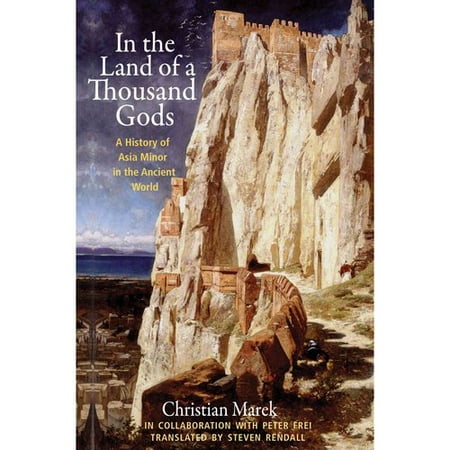
Christian Marek's "In the Land of a Thousand Gods": Book Review


After two millennia, the legacy of early Greece continues to fascinate scholars and tourists. Less appreciated may be its neighboring realm, which spawned both rivals to and recipients of Hellenic control. Asia Minor, its very name standing for the exotic beyond the ethnocentric Mediterranean, bridges the East and the West. As events from today's headlines verify, the tension between the Asian and European, the Middle East and the great sea over which so many powers have battled for power exerts itself upon this heartland, where from prehistory on, many forces emanate from an epicenter.

In the Land of a Thousand Gods tells the story of this cultural and political hub, from the Stone Age to the Roman Empire. A massive work, it began with the research into cuneiform and hieroglyphics provided by Peter Frei, who taught ancient history at the University of Zurich. His student and successor, Christian Marek, completes this survey. Steven Rendell translates the 2010 German edition and incorporates a few updates to a compilation encompassing classics, Oriental Studies, linguistics, archaeology, prehistory and anthropology. Supplemented by necessary genealogies, maps, documentation and black-and-white illustrations, these appendices total over 170 pages. The text itself, while densely printed and closely argued, nevertheless aims at the general, if diligent, reader.

Details linger within the academic exploits recorded by Marek on every page, as excavators and discoverers vied to leave their mark upon the ruins opened up to acquisition by those in the vanguard of European colonial expansion. Inscriptions upon stone drove Phillipe Le Bas, as the 19th century closed, to boast of his triumph. "I left Mylasa, having squeezed every drop of juice from the lemon. In future, travelers can dispense with going there. I have not left them the slightest kernel to find."

This eagerness to claim and conquer spurred many in centuries previous, too. The region rests on its rubble. Buildings were often destroyed to excavate even older sites. Dams flood nowadays more and more of Anatolia, hastening current archaeological digs. In the past, of course, conquerors eradicated peoples and razed cities, only to have their inhabitants, returning or replacing those victims of war, raise up new edifices, streets rising to shove levels higher. These striated remnants challenge scholars who delve beneath the surfaces, over thousands of years of occupation. From coinage to economics, religion to poetry, science and strategy, Marek allows patient students a comprehensive guide to this evolution from the Bronze and Iron Ages to the incursions of the Persians and then their bitter enemies, the Greeks. The Hellenistic polity in the wake of Alexander the Great gives way to the enforced Pax Romana. Then, the Roman republic capitulating to the imperial imposition of order, the provinces of Asia Minor emerge. Administration and socio-political considerations are then covered.

The results in this hefty volume will overwhelm any casual inquirer, but this book stands as a reference for anyone needing information about nearly any aspect of this period and this landmass. While in-depth as a whole, the chapters, needing to span so much, can race by. The reader will find that the sudden conclusion, as the Byzantine Christian establishment supplants and soon attempts to eliminate its pagan Roman forebears, comes as hastily as the onset of the new faith must have appeared to many who had long lived in Anatolia and its environs, worshiping a thousand gods. (Spectrum Culture 11/11/16; Amazon US 12/9/16.)

Sunday, February 24, 2013

Richard Hathaway's "Zen Explained"

In 128 Kindle pages, this aligns with its aim: demystification and clarity, rational presentation of what's often occluded. Richard Hathaway favors a scientifically and psychologically enriched introduction that rewards today's Westerner seeking a no-nonsense approach. He takes the novel cognate "eu zên" in Aristotle's "living well" virtue ethics and shows how it compares (harmony, satisfaction, idealization) and contrasts (impermanent, elusive, unstable) with the Zen meaning.

Early on, he investigates the "checksum" parallel of two-signal computing, and decision making based on neural chemistry that is pre-cognitive or before volition, despite our tendency for our brain to shout over our impulses. Thoughts themselves are shown to be all we are: "if there are thoughts and we are aware of these thoughts, then what we are is that which is aware of thoughts, You and I; we are consciousness." Read this section and this will make more "sense" than my concision may present this intricate but accessibly conveyed food for thought.

As to our "apparently hard-wired propensity that people have to infer that entities with plans and intentions cause the things they observe around them," I needed more. Hathaway cites Stephen Pinker about this supposition that we create a "theory of mind" to attribute causality to someone (often a God to punish us), but this section was under-explained. He appropriately turns to Daniel Dennett regarding the ego as narrator, a character in our own work of fiction--we write not our autobiographies but our biographies, Hathaway avers. Our self-identity rests on our imagination.

Of improvement, no rational system can totally please the one looking for answers. Looking within ("know thyself" and the examined life) for answers may fool us. "We have made of ourselves the author, and the author knows if the story is over he or she is finished, out of a job. There must always be a new chapter to write." That impels us to strive for goals, progress, or achievement. What Zen counters: an end to such ideals. Instead, an acceptance of one's mortality, and the freedom from grasping to what will vanish or decay. "Unhappiness stems from not accepting life as it is and instead clinging on to an image of what we want it to be." Rather, Zen offers enlightenment from within, not from without "to walk a path of quite [sic] joy, of serenity and inner peace that is always underfoot, and, as walked in the present now, lasts and does not fade in the murk of the remembered past or anticipated future." This passage demonstrates the calm with which Hathaway conveys himself.

Despite this very Buddha-dharma perspective, the treatment's light on the message attributed to the Buddha. He keeps the Asian vocabulary to a minimum. Hathaway stresses rather Taoist influence in its depths as the teaching passed through China. He elides this (saying it can be looked up elsewhere), but emphasizes that "wu wei" or "do nothing/ going with the flow" fits better with the Dao's spirit than with its superficial gloss of dharma. Whatever its derivation, it's not a system but an attitude: Zen lets us let go of our own burden, as if waking from a nightmare to find we're safe in our own bed. Wu wei encourages us to act without will or intention, to kill the ego and to stop needless striving.

Yet, we cannot seek our own release. It's a Catch-22: we cannot aim for the target we want to hit. While his chapter "Not Catholicism" disappointed by its facile caricature of that faith as teaching that one can do whatever harm one wishes as long as confession absolves the sinner, and then it's back to dirty deeds, Hathaway tries to teach, if via that poorly chosen example, how Zen demands commitment without time off during the week: it's not as if one does one's duty once on Sunday.

Reading on, I understood slightly more why Hathaway may have stereotyped Catholicism: his passion, after a "kensho"-like experience that hit him one day in Portsmouth, England, changed him from a rational skeptic--apparently non-religious and very fact-oriented--to an advocate for Zen. That term's stripped here, notably, of "Buddhism" as common qualifier or accompaniment. "In Taoism, just as God is an invention we made up between ourselves to explain nature, so the SELF [he capitalizes this as EGO to show its dominance] is an illusion we have spun into existence to explain our inner nature to ourselves. Enlightenment is realising this is so."

While I would have liked more on Taoism's influence on a more purely anarchic (in the positive sense), liberating Zen, Hathaway reminds the reader to stop reading about it. "Don't believe in Zen. Don't intellectualise and rationalise it. That is anti-Zen. Experience Zen yourself, directly. Practise zazen. Be mindful. Just that. Only that." He goes on to observe how religions are "ex vivo" (out of the living") in that they affirm an afterlife or reincarnation; Zen remains "in vivo," tethered to the here and now, yet not bound by it within the ever-present, eternal moment. Out of its creative anarchy, its creative principle moves everything.

Tricky, as this expands into a challenging take on Zen's analogous affinity with quantum physics and our own creation of our own perceived universe. He lost me a bit with this partial koan: "the universe would exist only as a probability wave if there were not living beings around to make it real." I anticipated this might lead to Teilhard de Chardin's noosphere, and a few pages later, there it was. Later, Hathaway ties such a derivation to a link from ancient Greek for moral dimensions of Zen. This material proved rewarding, if for a small book too compressed at times to take in; with about a dozen typos, sometimes the casual style mixing with lofty concepts needed clarification and editing.

He concludes by encouraging us to take on Zen with the practical, experienced integration of it not as merely "dianoia" or book-learning, but "noesis." As a lived knowledge become understanding that goes beyond words, he promises that if we sit and we then practice mindfulness not as an activity but as within our spirit, the transformation will be telling, if beyond verbal expression: "Very soon all your questions will be answered." (Amazon US 1-23-13. I was provided a copy by the author; I found this a stimulating and provocative book worth reading.)

Thursday, September 17, 2009

Simon Young's "A.D. 500": Book Review

What if a Byzantine delegation travelled to the British Isles in the chaos after the Romans left and the Saxons invaded? Young collates what's extant about British Celts, Welsh, Irish, Picts, Scots, and Saxons. He dramatizes this material as if recorded by a scribe editing the earlier ambassadors' log-book. The conceit reveals information that I predict even specialists will learn from, and the generalist will enjoy. It's instruction made entertaining, thoughtful, and even wryly witty.

Young's drawn upon archeological and historical reports that are up-to-date. He favors a rather earnest tone, but this reflects the mood he figures the Greeks would have assumed in reporting the wonders and barbarities they, emissaries from Constantinople, would have witnessed through skeptical, jaundiced, yet credulous eyes. I found the earlier material, as the dozen delegates sail up the Atlantic fringe to land around Cornwall to wander through the Pretanic homelands into Wales, rather familiar, but this time period for all its lack of substantial extant detail has been scoured by scholars. Similarly, the Irish portion must take in later accounts that are back-dated to allow us more insight into customs that presumably lasted long, and went back earlier, for the Celts.

The book does lumber along with the Greek trekkers, stringing along anecdotes but often-- if inevitably given the gaps we face in the historical record-- they seem more strung along than intertwined. As Young admits in his preface: "Though the following pages may not satisfy professorial standards of history, it is far more gratifying for reader and author alike to place the little beads of sixth-century knowledge on a fictional string, than don rubber gloves and forensically isolate them, putting each in its own sterile museum box." (x) I must agree.

I liked the Pict portion, for all its necessarily scantiness, for this people seems the most enigmatic for us. Going down through Scotland, when the party crosses the ruined Roman walls that bordered the war zones of what became England, the narrative quickens and the sense of excitement in the traveller's journals can be felt. "The days of glory, these, when legionaries knelt beside the writhing bodies of dying Picts and tried to read in vain the strange tattoos they found there" strikes the exact tone of a chronicler. (134-5) The dangers surrounding foreigners caught between the crumbling defenses of the Christianized, semi-Romanized remnants of British Celts and the ever-encroaching pagan, brutal, Saxon hordes gain vivid retelling. "In fact, modern Londinium is like a sandcastle barracked by the sea, where a child has begun to dig out its finely sculpted innards to add a few more desperate inches to its walls." (192)

This is a short book, that flows in parts-- especially in the pre-"English" section and also at the end that does not wrap up the events neatly-- too awkwardly due to the Young's task of integrating lore and data into the mindset of a sixth-century scholar editing eyewitness journals of the sights they saw in turn rumored or reckoned, taken in reality from fragmented evidence and textual scraps. Yet, he does manage to convey the horror and wonder that must have greeted perhaps the real Greeks that made it, perhaps from a couple of hints in the records, that far north. His book concludes with abundant references that support his hedges and his claims. For that reason, with hesitations, I recommend it. There's doubtless no easier way for the inquiring non-academic to dip into this century's British and Irish realms. From here, of course, the original texts and the scholarly journals can be entered. This remains my favorite period of history, for we know so little still about what fills imaginatively, if hesitantly, two hundred pages here. (Posted to Amazon U.S. and Britain, 9-17-09)

Tuesday, April 7, 2009

Jews, Arabs, Christians in Medieval Spain: Rémi Brague

Rémi Brague, a French historian, seeks to revise our notions of medieval thought, or what we mistakenly perceive as that era's lack of reason. His essays, "The Legend of the Middle Ages," explore philosophical intersections of Islamic, Jewish, and Christian pursuits of truth.

Adam Kirsch, in March 7, 2009's "NextBook," reviews Brague: "Medieval Times." Here, the reviewer sums up the scholar's take on how we look at science differently than they did. It's not that they did not study it, but that they studied it with an eye, literally, to seek another reason why to study natural phenomena.
For modern people, Brague suggests, physics—- broadly speaking, the study of the natural world and its laws—- can be intellectually engaging and aesthetically pleasing. But it is not “interesting” in the way it was to medieval thinkers, because we have lost the ability to see the natural world as a reflection of God and of ourselves.

The Jewish scholars of the time looked to the world as they did to the heavens. There was not the separation from the Creator that distinguishes for most moderns who enter the laboratory or the observatory today the walling off of God from matter.
To Maimonides, nature was the royal road to understanding God: “There is, moreover, no way to apprehend Him except it be through the things He has made; for they are indicative of His existence and of what ought to be believed about Him…It is therefore indispensable to consider all beings as they really are.” Gersonides, the 14th-century French Jewish thinker, went even further, writing that “Human happiness is achieved when a man knows reality as much as he can.”

Brague agrees that Gersonides sounds pretty modern himself with this admission. Modernity itself would not have emerged, the professor opines, without the tremendous push from the medievals who sought in Aristotle the summa of knowledge, next to the Prophet, for the Arabic translators in Spain who transferred Greek wisdom and ancient knowledge into their own language. Once carried over, the Greek could be discarded by the Arab: their sacred tongue then subsumed that of the infidel's vernacular.

Certainly, this differed from those Jews who learned Arabic to rescue, as it were, the Greek storehouse of Aristotelian science, or the Catholics who did the same by learning Hebrew to delve more deeply into the shared scholarship of their own times. Brague goes on to insist that the legacy of Aristotle we inherit comes from Arabic-speaking Jews and Christians who turned the texts into Latin for dissemination across Christian Europe. The Arabs, contrarily, held that once the Greeks had been rendered into the language of the Qur'an, that no more transmission was needed. Perfection had been attained in the tongue of the Prophet.

For the Jews, they bridged the divide opened in Spain by their expulsion from the southern part of Iberia by the Almohid dynasty in the twelfth century. The Spanish Jews fled north and brought with them fluency in Arabic and a knack for polyglot survival. The Christians learned what the Jews had learned from the Muslims, who had found what they wanted in Aristotle's Greek.

Kirsch sums up Brague on the contrasts between the relative openness of Jews and Christians towards their "pagan" inspirations and the rather more smug confidence of those in power and tenure, as it were, over Moorish Spain:
Brague quotes a 15th-century Tunisian writer to this effect: “[The Muslims] took them over into their own language from the non-Arab languages and surpassed the achievements of [the non-Arabs] in them. The manuscripts in the non-Arabic language were forgotten, abandoned, and scattered . . . . Thus students of the sciences . . . could dispense with all other languages, because they had been wiped out and there was no longer any interest in them.”

Europeans, on the other hand, tended to write commentaries on Greek authors, in which the original text was preserved and explicated line by line. The result was that Aristotle could be approached in his foreignness—he remained an “other” for medieval Europeans, and for that very reason could challenge their assumptions. For Brague, indeed, the noblest definition of Europe is that it is a culture which has always looked outside itself for guidance and inspiration: “The relationship with the exterior is internal to it.”

Although Kirsch does not expand on his closing point, I wonder if the commonplace observation of Islamic stagnation intellectually under centralized power and fear of unorthodox opinions that would run counter to the Qur'an can be traced back to such diasporic forces? These foreshadow, in their institutional arrogance and clerical domination, the dispersion of both the Jews and the last Muslims from Spain. That final conquest by Christians ended in 1492 with the great Sephardic scattering-- when some fleeing Jews found themselves back in Salonika, speaking of Greece, at the source again?

(A version of this posted to Amazon US today.)