Showing posts with label archeology. Show all posts

Monday, May 1, 2017

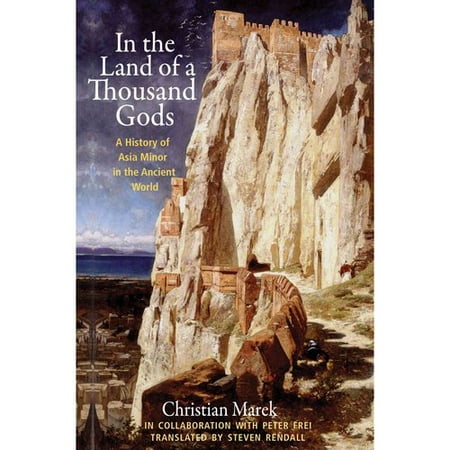
Christian Marek's "In the Land of a Thousand Gods": Book Review


After two millennia, the legacy of early Greece continues to fascinate scholars and tourists. Less appreciated may be its neighboring realm, which spawned both rivals to and recipients of Hellenic control. Asia Minor, its very name standing for the exotic beyond the ethnocentric Mediterranean, bridges the East and the West. As events from today's headlines verify, the tension between the Asian and European, the Middle East and the great sea over which so many powers have battled for power exerts itself upon this heartland, where from prehistory on, many forces emanate from an epicenter.

In the Land of a Thousand Gods tells the story of this cultural and political hub, from the Stone Age to the Roman Empire. A massive work, it began with the research into cuneiform and hieroglyphics provided by Peter Frei, who taught ancient history at the University of Zurich. His student and successor, Christian Marek, completes this survey. Steven Rendell translates the 2010 German edition and incorporates a few updates to a compilation encompassing classics, Oriental Studies, linguistics, archaeology, prehistory and anthropology. Supplemented by necessary genealogies, maps, documentation and black-and-white illustrations, these appendices total over 170 pages. The text itself, while densely printed and closely argued, nevertheless aims at the general, if diligent, reader.

Details linger within the academic exploits recorded by Marek on every page, as excavators and discoverers vied to leave their mark upon the ruins opened up to acquisition by those in the vanguard of European colonial expansion. Inscriptions upon stone drove Phillipe Le Bas, as the 19th century closed, to boast of his triumph. "I left Mylasa, having squeezed every drop of juice from the lemon. In future, travelers can dispense with going there. I have not left them the slightest kernel to find."

This eagerness to claim and conquer spurred many in centuries previous, too. The region rests on its rubble. Buildings were often destroyed to excavate even older sites. Dams flood nowadays more and more of Anatolia, hastening current archaeological digs. In the past, of course, conquerors eradicated peoples and razed cities, only to have their inhabitants, returning or replacing those victims of war, raise up new edifices, streets rising to shove levels higher. These striated remnants challenge scholars who delve beneath the surfaces, over thousands of years of occupation. From coinage to economics, religion to poetry, science and strategy, Marek allows patient students a comprehensive guide to this evolution from the Bronze and Iron Ages to the incursions of the Persians and then their bitter enemies, the Greeks. The Hellenistic polity in the wake of Alexander the Great gives way to the enforced Pax Romana. Then, the Roman republic capitulating to the imperial imposition of order, the provinces of Asia Minor emerge. Administration and socio-political considerations are then covered.

The results in this hefty volume will overwhelm any casual inquirer, but this book stands as a reference for anyone needing information about nearly any aspect of this period and this landmass. While in-depth as a whole, the chapters, needing to span so much, can race by. The reader will find that the sudden conclusion, as the Byzantine Christian establishment supplants and soon attempts to eliminate its pagan Roman forebears, comes as hastily as the onset of the new faith must have appeared to many who had long lived in Anatolia and its environs, worshiping a thousand gods. (Spectrum Culture 11/11/16; Amazon US 12/9/16.)

Wednesday, November 23, 2016

"Ice Age Columbus"


in this documentary film ice age columbus zia the chieftain
It never occurred to me that during the last Ice Age, European hunters might have been blown off course on the massive sub-polar pack ice covering the North Atlantic, towards North America. This thesis, contrasting with the conventional Bering Strait land bridge model of indigenous settlement, has been advanced by Bruce Bradley and Dennis Stanford. Predictably, there's been massive denial from the "Clovis" contingent defending the standard model of Siberian migration. Still, it's intriguing.

Discovery Channel in 2004 made a documentary you can see here under the clever title Ice Age Columbus. This dramatizes, with re-enactments (did the actors speak Basque?), computer analyses, and interviews, the "Solutrean hypothesis." Before Clovis spear points were found in today's New Mexico, ca. 500 years after the "Beringian" bridge was crossed, there may have been earlier survivors on the other coast who'd emigrated from today's South of France, with distinctive shaped spear tools.

One point, flaked to this standard, has been dredged along with a mastodon, from the waters off Virginia. This artifact is called the Cinmar biface, and if the dating with the wooly beast's remains is correct, dates to 22,000 years ago. The problem is that the shorelines back then, as in the Great Banks off Newfoundland which were probably the "Plymouth Rock" or "Vinland" for the cavemen and women made chilly, floating refugees, have been submerged by the waters after the glacial melting.

The Wikipedia entry linked to the hypothesis tends to argue against the hypothesis. But one link to a 2012 article in the Independent mentions a finding that appears key, despite detractors. The film for all its merits has to compress a lot in a little time. The seals drawn in a cave Bradley shows seem to suggest the natives knew how to hunt them, but the jump from this is too rapid; likewise why the Cinmar biface is not examined more in detail as to its origins invites speculation. So, the Indie piece may cheer on the few proponents of the alternative theory. Other tools from 26,000-19,000 y.a. have been tested, all from the American East Coast. Summing up Bradley and Stanford, it reports that "chemical analysis carried out last year on a European-style stone knife found in Virginia back in 1971 revealed that it was made of French-originating flint." How do the opponents respond to this?

The DNA data appear to be used by both sides. Haplotype X has been asserted as the genetic link between the two continents. It may be that more research has to be done, in a very contested debate.

The docu-drama has a memorable scene imagining millennia later the meeting of the eastward-bound natives with the descendants of the Iberians. That changes this prequel for Thanksgiving, doesn't it?

Tuesday, June 3, 2014

Ronald Hutton's "Pagan Britain": Book Review

This expert on past and present paganism revisits this topic, revising his 1991 survey of practices in the ancient British Isles to narrow it to Great Britain. He peers back thousands of years at rituals, monuments, and remains to surmise how people sought to connect with the sacred and the natural. Those two force-fields mingled in intricate ways, many of which may elude their stony, bony, material traces. Ronald Hutton, Professor of History at Bristol University, conveys an immense amount of scholarship in a cautious but lively manner. As with his previous books, he combines graceful prose with an awareness of the dangers of reducing this perplexing topic to romantic, lurid, or airy phrases.

Not that this factual compendium turns stodgy. While any serious presentation of such material means dry stretches will intervene, Hutton keeps a brisk pace. Endnotes pack a lot of references for scholars to pursue, but Hutton keeps his narrative academic yet accessible. The evidence being very limited for both prehistoric and early historic Britain, constraints emerge as scholars compete to advance their interpretations. Hutton shows readers frequently how current attitudes towards religion, immigration, feminism, and imperialism warp various theories applied to the archeological record, and how such an endeavor draws in diverse fields, so that scholars wind up discussing and debating across their typical divides.

Sometimes, bewilderment or enchantment seeps through Hutton's diligent recitals of digs and finds. Paleolithic images at Creswell Crags include in his captions "d) Shapes taken by some to be dancing women, and by others to be long-necked birds. e) So-called 'vulva' figures -- female genitalia or animal tracks, or something else altogether." These remind me of Borges' sly lists of Chinese marvels.

At Langdale Pikes, a remote Neolithic "factory" for stone in Cumbria's Lake District, Hutton allows us to glimpse the material and the spiritual as they blend. "The climb to the site is still long and hard, and anyone who makes it enters a world where wisps of clouds still drift along the surface of the land, and silence is usually absolute save for the voices of the wind and of thunder, and where pieces of rock, broken by frost or storm, come loose from their places and roll crashing down from the slopes of scree. It is a place where the majesty of stone is most evident, united with that of the heavens themselves." Such excursions are rare in this book, but necessary, for we view through a professor's eye the measured vision, in steady narration, the awe that accompanies so much analysis.

Stones shape into megaliths, dolmens, patterns. These by the New Stone Age after around 3000 BCE challenge conjectures that they paid homage to a Great Goddess, or that they stood for farmers who conquered hunters, or that they marked boundaries of sacred spaces and/or armed fortresses. Hutton weighs various arguments, but leans towards ambiguity. Often, the closer the evidence gets to the present-day technologies applied to interpret the traces, the less secure the previous theories become.

Even if much has vanished, the stones remain in henges and circles. So do hints of timber-circles and in tombs in turn, the slow pace of many millennia can be sensed. Systems may have been embedded very long in the British archipelago. The average Orkney Islands burial shrine held but eleven bodies over thirty to fifty generations, indicating those interred there must have been particularly favored. Avebury's stone henge was assembled over a thousand years; a Saxon-era village now surrounds it.

This antiquity attests to the wonder with which earlier Britons regarded these monuments. Its most famous site reveals prehistoric burials nearby by visitors from the Continent, marking its long fame. Stonehenge has been mythologized for at least the past nine centuries in writing, and it functions "as a mirror in which modern people can reflect and justify their own prejudices, ideals and expectations". For instance, the two most recent interpretations of Stonehenge neatly contradict each other. One proposes it as a place of magical stones and healing. The other regards it as a stony necropolis, balanced by a nearby gathering place which by its timber affirmed the powers of life.

For the next period, those doughty classifications of short, dark Neolithic inhabitants invaded by what archeologists termed on account of their imported pottery the Beaker People, and then tall, fair Celts who swept in from the Continent, meet their dismantling. Instead, genetic evidence traces trade across the North Atlantic and beyond, when smaller waves of immigrants--then as now--arrived to exchange goods, mate, and settle down with the islanders. Barrows with burials of bodies and bling faded as a warrior elite grew, and as their artifacts and cremated urns gained prestige in cemeteries.

These shifts cause some to attribute them to new beliefs, brought perhaps along with the new imports. Britain chilled, from its South of France ambiance, into Scandinavian levels of cold before resuming what is closer to today's weather. What emerged as its new set of "ritual practitioners" sparks dissent. Hutton in previous books has analyzed paganism then and now, and this Druid cult past and present.

He sums up these studies and balances them fairly against the counter-cultural champions of "avant-garde spirituality". Ley lines, astro-archeology, and earth mysteries emerge in the past few decades as the fringe battles the mainstream, and as science and magic square off in the press. Hutton explains that professors rarely rush to defend their archeological turf, as they face derision if correct and dismissal if their findings fail (as they will) to please those who ally with "poetic truth" instead. However, as his endnotes evoke, he graciously thanks many among these ranks for their contributions to widening the scope of scholarship, to take in sounds, colors, lines of sight, and mythic resonances.

Throughout Pagan Britain, Hutton places his own work within these "power politics of knowledge in the modern age" nimbly. He manages to reach out to mavericks whom most scholars ignore, while he advances mainstream scholarship. As an historian, he may be well placed, being slightly outside the archeological camp but trained in the analytical methods his own field shares, while being a fellow traveler who reports from the ranks of British iconoclasts, the unifying theme of his career's pursuit.

By late prehistory, whatever the former neat divisions of Bronze and Iron Ages now give way to, the ripples of the power that will be Rome enter Britain, perhaps as early as 400 BCE. While Julius Caesar will not land in Britannia to report on Druids until 55 BCE, goods and culture earlier shift far to the north of the Empire, as it comes closer. Outmoded conceptions of Celts as a triple threat of art, languages, and "race" as Hutton explains now adjust to a proto-European Union model, where whatever the continental peoples were before Rome, they seem to have possessed some common cultural elements to loosely unite many diverse nations. These presences, when excavated from land or water, may by a sensational media gain notoriety if the bodies of early Britons preserved in bogs as "Druid priests" or human sacrifices. Hutton knows too well the dangers of promoting sagas as fact. As with chalk figures still seen on hillsides, or Iron Age coinage, the evidence enduring creates its own problems of meaning, and figuring out what is sacred and what is secular eludes those who now try to decipher the "intractable nature" of evidence. But, one case cheered me as typical of this search.

Near my ancestral farmhouse, since the mid-1980s reverting to ruin in Ireland, stands what Hutton terms a "burnt mound" (fulacht fiadh in Irish eludes easy translation from "bloody-flesh spit for wild animals/deer"). These are found by the thousands across the archipelago, serving as the primitive equivalent of a hot tub. Professors long figured these were for heating stones to plop in to cook meat. Recently, some conjectured them as logically a place for not only feasting but, in damp weather, warming up in a sweat lodge tent; two scholars in Galway experimented with brewing barley ale via a modern mock-up. Hutton genially figures all three speculations, from evidence, meet his criteria. I dutifully add that a prosaic use has been posited, if less invigorating, just as necessary: doing laundry.

With the Romans, recognizable baths arrived, along with the historical record's advent. Yet debates over interpreting the depth of British adaptation of Roman ways continue over the evidence found of idols, inscriptions, and images from a presence that at its height numbered 55,000 troops and up to four times the amount of civilian support for that imperial occupation. Given headless corpses have been often interred, as Hutton shows, four plausible explanations can be conjectured for their presence. An image of a comely nude woman, escorted by two clad if somewhat stouter females, may be a Venus between two nymphs, or a Christian postulant readied for baptism by a pair of matrons. These examples testify to the difficulty of distinguishing native from Roman impacts on beliefs, a process accelerated in later centuries when Romanization had settled in enough to cause some to revert to a retro-paganism as Christianity began to rise, and later as legions withdrew from Britain.

This overlap between persisting Roman and nascent Christian practices, in a time of tumult during the fifth century, creates another difficult period for archeologists and historians to puzzle over. The records of what some would even then claim as the coming of dark ages reflect their Christian panic. All the same, two hundred years ensue in which the historical record, the economy, and the culture appear to have suffered dramatic cessation, as far as the British pagan legacy can be followed. For, while in the east a Germanic-Scandinavian paganism brought by invaders replaced it, this seems to have wiped out previous pagan practices. In the west of the island, descendants of the Roman colony adapted Christianity in its similarly Roman version, which appears to lack continuity with the Roman occupation, nevertheless. Discontinuity reigns: while the genetic and landscape evidence shows little sign of dramatic British change, the linguistic break from Latin and Celtic and the ethnic divisions persisting between Saxon and native run deep for many centuries after islanders convert to Christ.

While Arthurian fiction imagines shamans, wizards, and magic, Hutton remains firmly suspicious of any Anglo-Saxon presence for such "cunning men" persisting as pagan rather than as eventually Christian, and he repeats his research affirming the lack of any truly pagan practitioner of magic after the medieval acceptance of Christianity in Britain until the twentieth century, allowing for a few from inconclusive reports who may have been instead deluded or plain insane. Over a few centuries, the scattered redoubts of paganism surrendered to a relentless force. Pagan and Christian rulers fought over which petty or restive realm would be Christian or pagan; for a while, common people wavered back and forth, too. But while indigenous worship was rooted in the local, the Christian manifestation demanded elimination of any rivals, as "more aggressive, determined and monopolistic" a regime.

Yet, Hutton avers that medieval Christians conveyed four patterns that aligned with their pagan predecessors. Polytheism persisted by a cult of saints aligned to trades or holy wells, by a "provision of new figures who offered a parallel service". Ritual observances led to seasonal festivals, worship opened up spaces for female participation, and male priests kept presiding over sacrificial altars. But, there was no "continuing allegiance to the old deities in preference to Christ" even as rites, usages, ideas and festivals as "trace-elements" were absorbed into Christian and/or popular superstitions.

Herne the Hunter and Ceridwen as Mother Goddess appear, as "back-projections" of modern unease about progress or patriarchy, not pagan deities who have managed to elude 1500 years of Christian crackdown. Hutton examines the Green Man, sheela-na-gigs, labyrinths, hillside chalk giants, as he weighs this evidence for and against his position. Fair-minded but confident, Hutton strengthens his previous arguments which doubt what others have claimed when looking at these as manifestations of the pagan. These artifacts "echo" ancient images and practices, rather than confirm direct survivals.

In conclusion, four-hundred pages of this solidly presented, thoughtful narrative (given the sheer mass of material to sift through and present for both a scholarly and a mainstream audience, no small feat; my only regrets are too few maps and few typos) repeat a characteristic humility for this affable yet eminent scholar of paganism. This is a big book on a vast subject, presented intelligently. It reminds us of how quickly academic "proof" can shift, and the twenty-odd years since his 1991 study reveal how technology and our own mentalities filter into dim corners of the past. Hutton, shedding light into passage tombs, beheaded skeletons, and runic scratches, stays sober but spirited as he takes us through thousands of years of enigmatic, jumbled remains. While "The Quest for...." and "In Search of..." appeal to those who speculate as if ancient mysteries can be resolved at last, Dr. Hutton knows better. He reminds us of "how much we cannot know" as "an opportunity and a strength" rather than as an embarrassment or a hardship" when examining the "common resource" of evidence.
(5-5-14 Amazon US and to PopMatters

Friday, January 17, 2014

Nicholas J. Higham + Martin J. Ryan's "The Anglo-Saxon World": Book Review

If you can read this sentence, you owe a debt to Anglo-Saxons. Much of our basic language, perhaps bits of our law, and likely some of your former if not present neighbors if you live in the English-speaking world perpetuated and augmented a social cohesion based upon early medieval foundations of their roots. The peoples who formed the English kingdom forged it first from the elite if intrusive identities of fifth-century Saxons, Angles, and Jutes who confronted the remnants of Romano-British culture.

Before the Angles and Saxons, Brittania did not attract much attention. Although it took a tenth of Rome's legions to occupy its contested realm, it did not supply much wealth. Career opportunities for its Celtic natives, as Nicholas J. Higham and Martin J. Ryan tally them, proved limited: laborers, recruits for the military, slaves, and prostitutes. They begin their survey with an examination of Britain, as a fusion of Roman rule, adapted by native British peoples, characterized the first few centuries after its occupation in the middle of the first century C.E.  Dealing with a distant land, and increasingly beset by barbarian incursions, Rome did not sustain its dominance. Its power had faded from the island before the end of the fourth century, as the imperial legions gradually withdrew to defend the Western Empire, and the sea raiders surrounding the coasts of Britain had stormed in.

While Higham and Ryan, after paraphrasing recent research, remain hesitant to calculate how many Saxons, Angles, and Jutes left their German, Frisian, and Danish homes to settle in Britain, it appears a "high-prestige" contingent convinced or coerced the Romanized and indigenous lowland Britons to adapt Old English by the middle of the fifth century. Few words we speak in its modern descendent come from Celtic tongues, and this imbalance demonstrates the replacement of ancient languages by that new import as its popularity and status spread rapidly. A sort of "apartheid" may have accompanied this Germanic regime, so that those loyal to Celtic culture and leadership found themselves increasingly marginalized. The "wergild" or man-price value varied when restitution was sought in a violent society where invaders and resisters battled among themselves and against many occupiers: a Briton was worth half of the value of those who made the laws as Angles and Saxons.

Compounding this imposition, over the next two centuries, came Christianity. A Celtic version had endured if in a persecuted manner (as the invaders were pagan for a considerable if varying time initially) among some natives, but Saxons and Angles found that a revival of the Roman version (first introduced under later imperial occupation of Britain, intriguingly) suited martial rule and mental constructs well. Catholicism imported by missionaries from the former empire delivered clerical administration, militarized models, and continental learning. By 730, Britain had been Christianized, at least officially. As Beowulf shows, still puzzling scholars today, pagan elements lingered long.

For the Germanic peoples imposing control over fractious and divided Celtic kingdoms, the importance of family, lineage, and kindred enabled "kingship" (from the same root as "kin") to combine not only spatial advantage in territory conquered but tribal alliances negotiated to expand the dynasties of Northumbria, Mercia, Anglia, Kent, and the Saxon lands of Essex, Wessex, and Sussex. Eventually, seven kingdoms fought for dominance. Given the bloody conflicts against internal and foreign rivals, its rulers took a long time before settling on the name of England (the Latin on coinage as King Alfred craftily minted ca. 875 to call himself "rex anglorum" is an elusive phrase as it may mean king of the Angles or of the English, as they came to label themselves later). This review necessarily simplifies what "The Anglo-Saxon World" conveys in complicated chapters full of formidable names in many languages and what proves for dutiful stretches relentless strife.

This depth, compressed into density, may weigh down even a reader as fascinated by this era as this reviewer. Higham and Ryan present in nearly five hundred pages a necessarily thorough account, if one while accessibly written will be consulted more in history seminars than airport lounges. Given the scarcity of evidence for much of this period, the relative lack of social history, lively anecdotes, or everyday life as it was endured can exact demands on those looking for the past made popular, but the rather old-fashioned top-down dominant approach of names, dates, and reports does result in a trusted resource, open-ended and able to weigh and sift contested evidence.

The fact that it interprets specialist lore and scientific findings adds to its value. Its heft and generous inclusion of charts, maps, tables, and illustrations (many from archeological excavations, monuments, manuscripts, the engrossing Bayeux Tapestry, and especially coins--not sure if these depictions will be in color as I have a galley proof) will ease your learning curve; the authors supply a list of sources in a running series of endnotes, but they keep the text itself free of parenthetical citations or superscription, which lightens their academic tone.

What's admirable about this wide-ranging presentation? The asides as to how Anglo-Saxon terms and inventions echo down to us. For instance, shire-reeve incorporates the establishment of this territorial division with the man who patrolled it as a royal agent by the late tenth century, a "sheriff". And as for if not law or order, then their lack; certainly when the Vikings arrive ca. 800, the pace quickens.

The "St. Brice's Day Massacre" of November 13, 1002, may be unknown to gangland aficionados today, but it anticipates what any brutal leader who needed to crack down on his rivals and defend his turf might do. Aethelred, although denigrated in his own parlous reign as the "unready" (literally "ill-counseled" as this very term denotes linguistic shifts over a thousand years), endures as an English king determined to launch a pre-emptive strike against Danish mercenaries. After two centuries of Viking raids, then occupation, Aethelred (unlike some of his Germanic predecessors) tried to rally against the Scandinavian raiders--and their English allies, as warlords and collaborators.

When some Danes fled into St. Frideswide's Church in Oxford, the king ordered their sanctuary to be burnt down, and those within it. All over the realm, on royal command the Danes were slain, as digs over the past decade reveal. Carbon-dating and isotope analysis of skeletons now can pinpoint Scandinavian origins for the bones dug up from mass graves: many young men with multiple wounds not suffered in battle, decapitated, attacked from behind while prone, or hit in the back of the skull.

Emma, Aethelred's second wife, found herself willingly or wisely married off to his Danish successor, Cnut, who in 1016 took over England. Game of Thrones comes often to mind when reflecting on the internecine revenge and diplomatic contentions filling many paragraphs here. The hard bargain apparently driven by Emma herself hints at this sort of lively inspiration for tale tellers. 

The next year Cnut divided England among himself and three rivals, only to kill off one the same year, while eliminating three more leaders. Furthermore, consider the fate of Aethelred's sons and grandsons. "Eadwig, the son of Aethelred by his first consort Aelfgifu of York, was driven into exile in 1017 and killed soon afterwards, while Edward and Alfred, Aethelred's sons by Emma, went into exile in Normandy. Edmund Ironside's sons, Edward and Edmund, were likewise exiled to the Continent, ending up eventually in Hungary having escaped attempts by Cnut to have them murdered." One reflects upon the distance needed to flee to what was the edge of Europe, and a barbaric enclave itself, to elude vengeance of a Viking made uneasy king.

Unsurprisingly, the authors find Cnut's long reign intriguing; they trace the derivation of our meaning for "rich" to the OE "rice" which by this time melded the older meaning of "power" with the newer one of "wealth" to symbolize the fusion of the two for an ambitious set of social climbers. Among these was Cnut's favorite Godwine, who'd enter the jockeying for the throne after Cnut's death in 1035. No wonder both King Alfred and Harold II would stamp "pax" (Latin for "peace") on their coinage alongside their regal profiles: the Vikings kept pressing their advantages while the English fought or bought them off. The issue of succession defies brevity: the authors' chart of the English, Norwegian, and Danish claimants to or inheritors of the English crown, and the Norman dukes who would soon seize it, records nearly sixty progenitors, spouses, siblings, and/or descendants, with fifteen kings controlling some or all of England between the tenth and the twelfth centuries. 

The "some or all" proves the sticking point. Harold Godwineson's less than ten months as ruler found him driving back Norwegian invaders--then immediately hastening south to fend off William of Normandy, to an end every student used to know if no other date in English lore. 1066 represents the "biggest land grab" in the kingdom's history. Monasteries were given over to the newcomers; castles loomed over the angry inhabitants of besieged cities and insurgent borders. Heavy cavalry had won the Norman battle at Hastings; armed might bested the resistance put up by Harold's feebler allies.

The conclusion of this sprawling narrative may be less familiar that that preceding scene. Normans decimated those they hated as Saxons. England's elite rebelled repeatedly; William imposed a scorched-earth policy over much of the restive north of his vast but hostile kingdom. The peasants and villagers had nowhere to run. Far fewer in numbers than the fifth-century Anglo-Saxon elite who had conquered what they finally called England, the "barely one percent" of Normans swept in to take over the ninety-nine percent, its mixed peoples calling themselves now the English. The island's newest (and last successful) invaders first had settled down in France and turned from Viking Northmen into Normans. Then, emboldened to rush into an England under Scandinavian attack, and embittered by what they saw as Harold's unlawful taking of the crown against William's own claim, they killed, expelled, or drove off the ruling class among their Saxon predecessors. Ironically, many from this displaced English elite joined the Vikings as they continued in their raids--if elsewhere. (A 6-25-13; PopMatters 6-7-13)

Friday, November 22, 2013

William Azuski's "Travels in Elysium": Book Review

This philosophical thriller mixes a novel of ideas with a mystery plot on the Greek island of Santorini. The site of an immense volcanic cataclysm recorded about 3600 years ago, wiping out this bastion of Minoan civilization known once as Thera, at the village of Akrotiri (where real-life digs began in 1967) around the time of the military junta forty-odd years ago, a group of archeologists convene. They hack into the tephra, to claw into what some imagine might be remnants of Atlantis.

Whether this is metaphor or "Trojan Horse," farce, mass hypnosis, wish-fulfillment, or some "echo" of the "Perfect Form" perplexes student Nico Pedrosa. From England, he's recruited hurriedly to take his place alongside the scholars under the supervision of Marcus James Huxley. On this island, names and much more suggest hidden meanings. As Nico learns more about the rivalries, factions, and uses to which he and his fellow enthusiasts are applied under Huxley's charismatic but unsettling power, the novel burrows into the possibilities that the excavation appears to reify or which appear to recur. Frescos appeal to the imaginative, and Platonic forms appear as if to revive, deepening the uncanny.

The plot must be left somewhat vague to remain surprising to you, but this suspense earns genuine engagement by the reader.  It's not easy going; characters needed development and early on the style appeared too awkward. The book takes its time, and it's longer (I was asked to review an e-book) than I expected.  Often, the style felt overwritten. However, in conveying Nick's own youthful bewilderment and eagerness it makes sense for awhile, to portray an student in his early 20s plucked from British academia to be plopped onto a sunny island. His predicament, and his difficulty in deciding whom he can trust, enable this novel to be a coming-of-age tale, set among a lively and vivid locale, but one with its own spirits which may be emanating from its mythical shadows. This grounding in place, stranded on an awesome otherworldly terrain, heightens drama effectively.

It reminded me of some Iris Murdoch or Charles Williams storyline, or Stanislaw Lem's "Solaris." A character wonders if this isn't all an "archetypal Greek tragedy." For the Mediterranean setting, compare "Ghosts" by John Banville in a similar motif. Or even Shakespeare's "The Tempest." Abzetis manages to hold his own with a narrator who never lets on where he is ahead of the moment; this verisimilitude lets the reader along with Nico as "sorcerer's apprentice" listen to back-stories and lore.

Plato's conundrum, optical illusion, necropolis, Isles of the Blest, Oracle of the Dead, and/or the Burnt Isles: Santorini resembles other islands towards or beyond the sunset, a feature in mythological landscapes the world over. Why this attracts seekers, such as the Friends of Orpheus, and how near-death experiences may intersect with what Huxley and his rivals and supporters investigate draws in both Azuski's reflections in this intellectual whodunit, and Nico's own quest to figure it out.

Doppelgangers, ignis fatuus, wish fulfillment, Critias and Socrates, Solon and Plato: these inspire new allegories of these caves below Santorini. One character responds with a lovely analogy to coming back from the dead: "siphoned back into my body like a captured cloud," and Azuski does strive for fresh imagery. The second half of the novel does slow, as Huxley's motives keep shifting as Nico and the reader struggle to keep up with this enigmatic antagonist. He's not necessarily evil, but he's the type of elusive antagonist that compels the outmatched protagonist Nico to pursue him.

Certainly, near the end, Azuski packs a wallop. I think to enhance this impact, earlier sections needed trimming, and sharper arcs of maturation for supporting characters. Certain people come and go as if to prop up the meandering, repeatedly delayed or attenuated plot. Still, as an intellectual project, this must have consumed him as much as Huxley regarding the grand metaphor underlying, physically and psychically, this complex story. "The final deception is not the deception that comes last, but the metaphor that makes sense of all the others." Nico tries to figure out Huxley and the increasingly bewildering or dazzling insular swirl around him and emanating behind the entrance marked #34.

I would have advised stronger delineation in terms of the supporting characters in terms of this penultimate situation and how they respond--the prose does not distinguish a range of personal testimonies although a shared education may elide or mask their respective tone and fluency. While the ending does keep its own enigma that causes one to rethink the entire novel, the value of immersion in a thoughtful if sprawling examination of Thera's mythic power is ultimately evident.
Amazon US 7-23-13)

Tuesday, October 29, 2013

J. P. Mallory's "The Origins of the Irish": Book Review

Combining archeology with linguistics, adding genetics to explain the connections between these two fields, this expert in Indo-European Studies turns to his homeland to wonder how its earliest inhabitants wound up on this North Atlantic island. With attention to demystification but with an affection for the myths, J. P. Mallory builds on nearly a half-century of his research to present an academic study that anybody curious about his title will welcome. Learned but lively, Mallory's contribution remains throughout cautious in its surmises but diligent in his analyses.

He begins about as far back as the Big Bang, if in passing. Much of the first hundred pages explain how recently Ireland (and Britain, always its fractious or friendly neighbor) split off from the Continent--itself long in the making as the tectonic plates shifted slowly. Two parts of Ireland at one time faced each other, if from a distance as far apart as Australia from the island today.

After the last Ice Age, the land bridge between northwest France and Ireland cannot be firmly dated, but it broke apart over 12,000-10,000 years ago. That means whomever settled as what Mallory calls the "Irelanders"--prior to the relatively recent national formation of the "Irish" under Niall of the Nine Hostages, the first figure straddling legendary and historical times and allegedly the kidnapper of Calpurnius' Romano-Briton son to be known as Patrick--had to migrate into that thawed-out expanse after the melting glaciers filled the Irish Sea.

For only 1/43,000th of its existence as a land mass has Ireland occupied its present site and shape. Poorer in flora and fauna than Britain or the Continent, it could not have supported many prehistoric families. As few as 3,000 people may have lived in Ireland for the first 40% of its existence as we know it. Recently settled in Eurasian terms, colonists may have voyaged from the nearby Isle of Man as global warming wiped out part of that territory. Generally, Mallory favors looking closest--to the western Scottish and Welsh shores for those who would populate Ireland first.

As for farming, around 3800 BCE marks a revolution in agriculture. It may have spread rapidly, within two hundred years, and again probably westward from a British base. Brittany at the tip of today's France may have contributed, as the longer sea passages navigated back and forth in turn may have stimulated Irish-British trade all the more.

Any archeological treatment of Northern Europe debates the origins and provenance of the Beakers, the pottery goblets with a bell-like shape. Suffice to say Mallory delves into this with gusto and wit, no small feat for what can be deadly dull material for those of us outside the trenches. He loves citing his more imaginative predecessors to telling effect about the romantic interpretations of sherds and grooves. "Drink, fighting and the Irish Sweepstakes would certainly tally with Irish stereotypes," he comments as he surveys the eagerness of his gullible colleagues to imagine (ca. 2500 BCE) brutal invaders, tipsy warriors, and horse-drawn shock and awe descending upon cowering scrabblers.

Metallurgy ushers in the Bronze and Iron Ages, and the siting of dramatic hillforts may show cultural shifts for population changes and ritual behaviors at this time.  While Mallory downplays the exotic or martial, he notes how, given hoards found, Continental foreigners could have visited or stayed.  He consistently edges away from a scenario of invasion (despite the Irish legends and their "nine waves" of conquerors) to one of gradual diffusion of goods and contacts. Ironically, Niall's own inheritance centuries later would signal the end of this mythical time, as a cult from Southwest Asia and the customs and language of a dying empire would transform Ireland into the "Irish," whose legacy would be distorted by Christian interpretations of what has come to be known as a "Celtic" past.

Earlier than often assumed, by those celebrating Patrick's freedom from Niall's enslavement and his return to Ireland to convert its "pagan" natives, Roman influence entered Ireland as it had Patrick's homeland, wherever it was across the Irish Sea. In fact, perhaps by way of earlier slaves than that fabled missionary to the Hibernians in 432, Christians lived on the island; a bishop was sent there the year before Patrick to minister to that flock. Niall and his ilk engaged in an active sea-slave trade.

Mallory shows that while a pre-Christian Roman presence left a fraction of what imperial centuries of occupation over Britain had, nonetheless Irish evidence for Roman trade and settlement can be marshaled. From the classical reports of Ptolemy and the Romanized variations on the savage British and Irish tribes and places, we get the first glimpse into what "civilization" regarded as Hibernia, a damp backward dump on the world's edge. "Why the Romans or indeed anyone else should have wanted to come to Ireland is a mystery if the early classical descriptions of the island had provided copy for Roman travel brochures", Mallory remarks with typical flair. 

We also owe the classical historians another label, if an elusive one. They named the diverse peoples across Europe speaking similar languages as Celts. Mallory follows Kim McCone in matching this to a root meaning of "hidden" and therefore "offspring of the hidden one," identifying this allusion with the lord of the dead, Donn, the "dark brown one."

Speaking of enduring identifiers, generations looked south to Spain (anywhere but east!) for Irish origins, but this Latin confusion does not fool Mallory. He dismisses origin myths as modeled by monks on the biblical wanderings of the Jews. He also blames the Wikipedia equivalent of the 7th century, Isidore's Etymologies, with this persistent but false derivation of supposedly adjacent Hibernians from venerable Iberians.

Deepening his application of language, the latter third of Mallory's study finds him tackling the spread of the Celtic tongue into Ireland. These final hundred pages pack a tremendous amount of data--DNA as well as glottochronology--into a few chapters. Microliths give way to haplotypes.

He leaves us with two possibilities about the spread of Proto-Irish during the first millennium BCE. Mallory posits social prestige and identification with trend setters as likely explanations for a native adoption of a Celtic language. He suggests that an initial impact around 1000 BCE is one of two "most likely" windows of opportunity, in tandem with the emergence of hillforts. The second may be around the 3rd century BCE as Tara and other highly visible "ritual enclosures" dominated the landscape and consolidated a mental perspective that would endure as the "Irish" looked around in Niall's pivotal era to adapt the four provinces circling around a fifth center as their nation's model.

This valuable book does not leap from a petri dish or a soggy excavation to any bold conclusion. This Belfast-based professor knows his subject all too well to trust in what genetic findings from next year's lab or carbon dating from this season's dig may override. Mallory relies on commonsense and judicial balancing of the more fervid proposals of his colleagues. The Origins of the Irish serves as a trustworthy. eminently scholarly but accessible guide past tricky diversions and evasive directions. (PopMatters 4-1-13 + 4-2-13 Amazon US)

Wednesday, August 21, 2013

John Thavis' "The Vatican Diaries": Book Review


Nearly three decades of reporting from the Vatican, spanning the reigns of John Paul II and Benedict XVI, enliven this insider’s account. Close enough to introduce us to the intrigues, scandals, and idealism mingled in Rome, distanced enough as a Catholic layman, John Thavis fluently interprets the diplomatic phrases and nuanced customs which characterize its clerisy. The Vatican Diaries, despite its somewhat sensationalist title, provides a thoughtful meditation on recent papal administrations, and the bureaucrats, functionaries, and emissaries who advance or thwart Rome’s global ambitions. 

Very readable, Mr. Thavis’ narrative favors opening vignettes that feel more fictional than factual, as he documents everyday life on 110 crowded and ancient acres. Whether discussing bells rung to signal a new pope’s election which contend against human error and technological snafus, the rowdy camaraderie of the volo papale of the jet-age press corps in an age of Internet competition, or the increasingly sordid sexual and financial abuse by the founder of the controversial Legionaries of Christ, Mexican priest Marciel Maciel, Mr. Thavis relates dissension vividly, with telling quotes and thought-provoking asides. 

For instance, he contrasts the need for the press to “eyeball” the Pope for hints of non-verbal as well as verbal confirmation of a particular Vatican affirmation or denial. Expert in such interpretations, Mr. Thavis reminds readers how in a networked age, the need for physical contact persists—not only among those who flock to an audience with the pontiff, but those skilled in unmasking clerical imposters eager to finagle their way to a hearing with John Paul or Benedict. This aspect enriches the behind-the-scenes detail and it humanizes the teeming crowds, and the watchful employees tasked with keeping an eye on the millions.

“The real Vatican is a place where cardinals crack jokes and lose their tempers, where each agency of the Roman Curia jealously guards its turf, where the little guys and big shots may work at cross-purposes, and where slipups and misunderstandings are common. It’s a place where the pope’s choice of a particular hat can become the raging controversy of the day, and where an American cardinal hell-bent on underground parking can evict a two-thousand-year-old necropolis. It’s a place where the carefully orchestral liturgies and ceremonies sometimes become unglued.” 

Unpredictability, with a new pope, challenges the clerics and staff accustomed to a predecessor’s steady style. John Thavis contrasts the two natures of the last two popes. Benedict XVI prefers a detached, perhaps resigned air, while John Paul hosted folk Masses filled with guitars, Third World adaptations of ritual, and sing-alongs with youth. Determined to “shore up the base” rather than embark on globetrotting, Benedict appears to have “zero interest” in glad-handing. 

Whether the fading European core of the Church can revive appears doubtful. A pair of chapters demonstrates this artfully. Tridentine and traditionalist efforts of the Lefebvrist revanchists who oppose Vatican II’s reforms appear to flounder. The Church tries to lure back the reactionaries, but the recalcitrant faction digs in. As one informant, a Vatican official code-named the “Warbler” chortles: “I’m convinced they’re a sect, and when they do come back they’ll need deprogramming, because otherwise they’re useless. They’re troublemakers.”

Ironically, another troublemaker champions Latin against an ebbing interest in the ancient liturgical and diplomatic language once common to all in the Vatican. Fr. Reginald Foster’s profile provides a case study in how a fat Carmelite friar in overalls, a true iconoclast, can anger both conservatives and liberals.  He’s funny and on-target, but it’s sobering how Latin’s erosion undermines continuity among scholars, clergy, and now hierarchy who come to Rome ignorant of its heritage.

Another priest, Jesuit Fr. Peter Gumpel, emerges in a nuanced portrait of him as an “investigating judge” charged with the debate for the prosecution, against a firm front pushing the cause of Pius XII’s beatification forward. The telling detail stands out, under Mr. Thavis’ careful eye: “His vast wooden desk was a landscape of books and mementos. At its center a small wooden crucifix was laid flat, surrounded by porcelain figurines of dogs that looked sadly upon the crucified Christ, a bizarre and touching little tableau.” The comparison with Gumpel’s German family’s fate under the Nazis and the complicated contexts surrounding Pius and his tenure under fascist rule during the same war in Rome offer valuable reflection on the political and ideological currents swirling around the decisions mortal men must make when confirming the canonization of other men and women, now departed, as saints.

More politics crashes in, as in a deadpan recital of George W. Bush’s meeting with the current pope. Despite the “secret” archives attributed to sinister Catholic plots, the fact is that the records are kept closed except to qualified researchers, and the decorum that perhaps President Bush failed to appreciate in the Vatican persists as a manifestation of those quixotic guardians of Rome’s heritage, jealously guarding a two-thousand year legacy. Poignantly, an intricate chapter on an underground parking lot shoved through a Vatican hill by a bottom-line Michigan cardinal demonstrates the efforts of archeologists to preserve remnants of a truly ancient Roman cemetery, already cut in two by impatient bulldozers. 

Often, one reflects on tension between tradition and progress in the Vatican--as throughout the Church. Mr. Thavis listens to how clerics and popes issue statements, and he masterfully explains how a 2009 “condom study” in its theological suppositions belies the popular, anti-papal caricatures post-Humanae Vitae and its unpopular 1968 ban on artificial birth control. Mr. Thavis finds “wiggle room” in one application of condoms, and he keeps this and related topics lively in a chapter on sexuality. While Mr. Thavis’ own sympathies can be discerned, he fairly presents the practical as well as philosophical reasoning on both sides of hot-button issues. 

He also watches the pope when he strolls down the aisle to a wary press corps, the volo papale, in coach class, mid-flight. “As always in his off-the-cuff comments, Benedict spoke rapidly and without much expression, as if he were taking dictation directly from God.” This moment typifies the care with which this veteran bureau chief for the Catholic News Service (a humbler outfit than his title or placement may suggest), assembles telling moments. This sums up the Church’s leaders and the staff who assists and outwits them. One closes John Thavis’ perceptive study reflecting on the Vatican’s challenge: to persist in a secularizing world sometimes fascinated by the pomp and pageantry of St. Peter’s--but often hostile or increasingly indifferent to the Church’s determined mission to harmonize warring factions and bickering enemies, even if both are on the same Catholic side. (P.S. When I reviewed this for the New York Journal of Books 2-21-13, I cited Benedict's "resigned" attitude towards the papacy. Talk about prescient.)

Saturday, May 25, 2013

Michel Peissel's "The Ants' Gold": Book Review

Herodotus popularized what many sought in vain: "gold-digging ants" somewhere near the Himalayas in the northern Indian or western Tibetan reaches. Intrigued by this mention, Himalayan explorer and Tibetan expert Peissel seeks the answer that scholarship fails to provide. He travels in 1980 to the India-Pakistan forbidden zone along the cease-fire line in the endless Kashmir dispute. 

He takes, to my befuddlement, a Harvard director of graduate admissions, Missy--who needs leg braces and cannot navigate well by horse or foot the screes and slopes. In this landscape which soothes more the soul than the eye, its barren ten-thousand-foot expanses delight Michel. He returns as in other books (see my recent reviews of "Lords and Lamas" in Bhutan, "Tibetan Pilgrimage" and "Mustang") to a place that compels him. He feels as if descended from its people, so close does he resemble his companion there, with Caucasian long nose and grey eyes and features more European than Asian, and a temperament more excitable and enthusiastic, recalling his own French heritage. 

This may not be so far-fetched, if Peissel's theory is true. He posits that the Minaro people here are the "Dards" credited by the ancients with the realm of the ants and the gold. He also reasons that their ibex hunts, rock art, and customs link them to Neolithic inhabitants they may be descended from or may have supplanted. They survive as the last remnant of (now archaically Tibetan-speaking but) pre-Tibetan peoples pushed by warlords who took control from farmers, into terrain where they stayed independent of imperialism, technology, and kings. In turn they by dolmens, matriarchal rule, a maternal goddess-oriented "religion of man," and vestiges of a non-hierarchical agricultural and nomadic life, may exhibit as proto-Aryans the long-fabled "Aryan" heartland which has beckoned for many European scholars. Of course, this has been controversial and continues to be so now.

His travels, increasingly surreptitious as the Indian bureaucrats and military repel his entreaties to study the Minaro and the Baltistan and Zanskar homelands, prove intriguing, given the inherent interest of this topic for me. His account of twelve hours in darkness trekking in terrifying heights so as to penetrate the closed-off frontier India guards is gripping, and he knows how to keep you turning the pages. I will leave it to you to learn how Peissel solves the ants' identity. He loves this subject of "the discovery of the Greek El Dorado in the Himalayas," and he convinces you of its importance to him and to academia.

But, given the limits of his conversations (his colloquial Tibetan differs from the Indo-European dialect the Minaro preserve), contacts with everyday people there as his visits keep getting truncated by India, and his Moses-like glimpse of the promised land of the ants' gold he cannot enter, the results, however readable, remain despite what he reports as eventually four years of research compiled from among the Minaro, still elusive. Fittingly if frustratingly so for this mystery, perhaps. (2-1-13 to Amazon US)

Wednesday, July 18, 2012

Justin Marozzi's "The Way of Herodotus": Book Review

This starts with a winning appeal for returning to a text academic historians today tend to dismiss for so many tall tales. After a deft summary of the Persian Wars, this British journalist champions the charm of "The Father of History," or, to his detractor Plutarch,  of "Lies." It's a simple pitch--retrace the routes of Herodotus and find out in Turkey, Iraq, Egypt, and the Balkans during the recent decades of more war, bordering East and West again, the legacy and lessons of a book written almost 2400 years ago.

Marozzi's pace can vary. The itinerary too often does not lead to many surprises. He begins at the little-heralded birthplace of Herodotus, today's Bodrum, but more intriguing is a section on underwater archeology, which still felt under-investigated. His stint among the Coalition's troops as the Poles and Americans make a parking lot among the fragile topsoil of storied Babylon shows more poignantly the evanescent humanism of Herodotus and his insistence that the lessons of history may not be learned.

Entertainment can be educational, and as his lunch with Patrick Leigh Fermor will later reveal, every Mediterranean tale-teller needs to keep the attention of the restive listeners. Marozzi contrasts an scholarly conference's stodgy reduction of Herodotus to predictable humdrum, yet his own interviews with sexier academics in Greece blurred what they found so much more fascinating. Conversations with curators and experts fill many pages, and Marozzi displays a sympathy for the Turkish wish to enter the EU over Greece's fears, but many sections as the book progresses lack the verve of encounters in and away from seminar rooms as the journey wanders towards a humdrum, sudden exit. Still, one cannot disagree with philologist Antigoni: "the limits of the human condition" comprise the message of the "Histories." Their author reminds us: "don't think you'll be happy for ever and don't place yourself above the gods." (qtd. 230)

The strongest section comes late on, when Marozzi finds in Thessaloniki a four-volume set "Clio in the Balkans," source-texts for high schoolers meant to redress a culture where every nation makes its grievance its morality tale. "Present difficulties are explained through past injustices, lodged deep in the historical memory, so that national history becomes no more than a badge of victimhood." (250)

It reminded me in its parallel search for a past chronicler's path of Laurence Bergreen's similar, if more sober and less stolid, take on the travels of Marco Polo. Both tale-tellers embellished their pages with innuendo and salacious hints; some reviewers appear repulsed by Marozzi's penchant for the outré, but for me as for Marco Polo's readers, I liked the eye for the erotic as well as the exotic, in Marozzi's easygoing if rather British-inflected tone. Its aimed, as his predecessors, not at scholars but a wider audience longing to find out the meaning of history invented by Herodotus, caught between East and West, as curious "inquiry."  (Amazon US 6-1-12; author's website)