Showing posts with label Passover. Show all posts

Sunday, April 5, 2015

Elijah's Chair


 On April First, after Alex Gibney's HBO documentary on my hometown's most famous "tax-exempt religion" founded by a pulp novelist aired, noted atheist Neil DeGrasse Tyson dismissed scare claims. “But why aren’t they a religion?” he asked. “If you attend a Seder, there’s an empty chair sitting right there and the door is unlocked because Elijah might walk in. OK. These are educated people who do this. Now, some will say it’s ritual, some will say it could literally happen… It looks like the older those thoughts have been around, the likelier it is to be declared a religion. If you’ve been around 1,000 years you’re a religion, and if you’ve been around 100 years, you’re a cult.” I have some hesitation with Tyson's glib argument, as critiqued since by Steve Neumann. However, as I listened last summer to an audiobook, Janet Reitman's similarly thorough expose that confirms much of what Lawrence Wright's study has uncovered, I wondered about Mormons, and Jesus, Mohammed, and Moses in the same way. Or this documentary on one of my hometown's more recent, odd, spiritual set of seekers, The Source Family. If a cult survives a decade it's on way  to being a sect, and after a century, a religion. As the founders fade and memories get mythologized, in the past, invention replaces oral history with either more of the same or, as in Buddhism, belated compilation and codifications. (Yes, we keep two traditions defying logic: kosher and Elijah's Chair.)

The trouble with the Exodus, like those tablets Joseph Smith claimed to have translated before they vanished, or the historicity of Jesus, the veracity of Mohammed, or what the Buddha really said, all fall into the abyss, lacking first-hand testimony. As I wrote last year, the Exodus may not have happened, at least as we celebrate it with 600,000 fleeing Pharoah's hardened heart and actions. There might have been a small slave revolt, and few hanger-ons, the borderers called "ivrit" could have well hung out with the fugitive rabble.

Two nights ago, we held our seder. My wife narrated her version, complete with a prank she and my older son engineered well on me. But, tired of the triumphal "they tried to kill us, we survived, let's eat" storyline, we decided to host our older son, his college friends, and two older, secular Jews with a different take. We've evolved over a quarter-century of this, and so we shared this activity, I post it as it may inspire others out there, who approach with not a fixed identity but an evolving imagination how we tell this story commanded to repeat each year for thousands of them, relevantly:

"The Seder is the annual Jewish celebration commemorating the Exodus from Egypt, which freed the Jewish people from slavery. The story is that God subjected the Egyptian people to plagues which grew more brutal, culminating in the death of the first born son. The tears of thousand mothers finally softened the Pharaoh’s heart. 

We look forward each year to taking a breath, dining together and reveling in the freedom we enjoy.  Jews are commanded to tell the tale, not once, but twice. We have done so dutifully for a quarter of a century. We clean the house and get rid of bread and noodles and cookies in order to simulate the Jews hurried Exodus from Egypt. We do this though because we've always done it. We are proud that at this time Jews all over the world are reflecting on their freedom but the story we're commanded to tell might as well be Cinderella or Hansel and Gretel. The fairy tale trivializes our wonder at our own blessings and brushes the struggle of those less fortunate than we are under the rug. We long for something more real and meaningful and we come to you." (So my wife wrote, and proposed for us to fill out in Comic Sans below. I did so as an example, trying to keep my guest list limited, hint-hint.)

My Seder

My name is:

I would have my Seder at: under the redwoods where my friends Bob + Chris live

The living or not living people I would invite are: 7 Living: Bob, Chris, my wife and sons and girlfriends as applicable; 7 Not-living: Hypatia of Alexandria, "La Malinche," Emma Goldman, Hans + Sophie Scholl, Michael Dillon, Thomas Merton. 

We would eat: a vegetarian meal but a delicious one, cooked by my wife (with help!)

We would celebrate our freedom by: playing music we could all agree on in the background, while discussing ways to advance justice, equality, tolerance, and other genteel values while taking into account our own earnestness and blinkered minds

We would acknowledge those who are not free by: gathering our funds and actions to support the righteous cause of our choice, but neither for profit nor for a politician.

Instead of matzoh for affikomen we would hide: a dog's chew toy as one will be nearby.

Whoever finds the affikomen will get: to donate the amount to a favorite charity

Friday, April 3, 2015

Holy Anger


I opened FB today to find a headline from Mother Jones: "Bernie Sanders goes biblical on income inequality." The elderly Jewish socialist senator from Vermont hangs with the Democrats mostly, sure. But he critiques Obama, Hillary, and his usual allies as too soft on bankers, and too craven to the rich who control more and more of our present fealty and who limit many of our future prospects.

He tells Josh Harkinson, when asked why we should care: "I think this goes back to the Bible. There is something immoral when so few have so much and so many have so little. I don't come to San Francisco very often, but we've driven around the city and seen people sleeping out on the streets. In my state, you've got people working 40, 50 hours a week and going to emergency food shelves because they don't earn enough money to feed their families adequately. You have millions of young people graduating college deeply in debt. They can't get their lives started, can't get married. So I think the issue of income and wealth inequality is in fact a moral issue." He adds that with the losses since my childhood in unions, cheap college tuition, wage equality, and stable employment, that "It's not a question of have we lost the will; it's that the billionaire class is much more aggressive now than it used to be." So, as I have watched during my adult life and my own career, "in the last 35 or 40 years, there has been an increasingly aggressive effort on the part of the top 1 percent to take it all."

I blogged regarding another resister, Franciscan friar Fr. Louis Vitale, six years ago about Passover, peacemaking and identity. I even wrote the priest, sending him a printout of my thoughts, but I never received a reply. My wife remarked: "Maybe he's in jail." For all the careful diplomacy the new Pope Francis has shown, at least he spent a Holy Thursday washing the feet of inmates in a Roman prison.

How social protest gets allied with or against the religious majority, or is it now a minority, rouses us. There's a lot of contention about the First Amendment, as what in the North of Ireland in a similar situation called the "gay cake debate" gets repeated here in Indiana. I remain mystified why the boycotts accelerated against the Hoosiers when 19 states preceded theirs in protecting businesses to not serve those who the proprietors claimed violated their freedom of belief. Regardless, against this,  progressives fought back and denigrated, trolled, and have shut down already offending enterprises.

Jay Michaelson, a Jewish Buddhist gay rights lawyer-activist weighs in: "On the LGBT side, it’s time to stop calling religious people bigots and homophobes. I oppose the Green family, owners of Hobby Lobby, with every fiber of my ideological being. But there is still an enormous gulf between socially conservative believers and homophobic thugs. We need to take these beliefs seriously.

On the conservative side, it’s time to recognize that the vast majority of Americans — three- quarters, according to polls — believe it is wrong to discriminate against gay people. The people have spoken, the courts have (mostly) spoken, and this is the law of the land." As often, he offers a sensible view.

I'm not here to rant on. I've written about my own beliefs and how they shift often. It's easy to take potshots at organizations promising us pie in the sky and fewer worries here, as long as we sign on. I supported last year some entities from within the Catholic Church who do good works, and who need more sponsorship than the Jesuits, Franciscans, or government grants can support. Maybe some see me as hypocritical for that, but firsthand I have witnessed and benefited from their outreach in my own coming of age, so why not pay back a bit to those who gave their lives to help youths like me?

I realize the difficulty as the few friars become a global order, or the reforming clerics turn the pope's  trusted operatives. Yet, today many strive to take in whomever needs a boost, among the poor, and they ask for no surrender of one's mind or identity. However, the bad press generated by others duping the needy in terms of enlightenment and salvation rouses me to what my dad said, in the context of Jesus driving out the moneychangers, as "holy anger." But the continued tension between institutions bent on profit, as the Alex Gibney documentary based on Lawrence Wright's study of my hometown's biggest success story making a concocted "religion" tax-exempt shows, will perpetuate itself no matter if it's the LDS 180 years ago, or the past 60 years creating a relentlessly celebrity-craven and prison-camp supported "church." Lynne Stuart Parramore at Salon concludes: "even if we got rid of" that offender, "somewhere, out there in America, is another young hustler searching for meaning and money. Someone with charisma, stratospheric ambition and a few screws loose. As surely as the sun rises, her religion is just now slouching toward Hollywood waiting to be born."

Monday, April 1, 2013

Pharaoh's hard heart

Commenting on my review last year of the "New American Haggadah," Matthew A. Levine asked c/o Amazon:
I just wonder about the version of the ten plagues that you mention, is the comparison to FDR, Truman, and Lincoln really applicable? Even though I personally don't believe that violent means are ever justified, at least, according to the official version of history, in these cases it was necessary to achieve a good end. According to the Passover story, the Pharaoh was ready to let the Jews go free, and then God "hardened his heart," so in this case liberation could have been achieved without any violence whatsoever. What was the point of that, and how can it possibly be morally justified?
This refers to my statement in the original review: "the Ten Plagues again by [Jeffrey] Goldberg find memorable comparisons. The power of a God who hardened the heart of the evil Pharaoh grows mysterious. Lincoln, FDR, and Truman all are shown as presidents who took the lives of many innocents in their determination to bring about a greater good. If emancipation ends or fascism succumbs, do the ends justify the means?"

I responded: "Matthew, that's precisely the type of question this Haggadah might inspire for a seder, or your own reflection. I recently re-read Nicholson Baker's 'Harper's' essay about the reaction to his own claims in 'Human Smoke' about the folly of violence even in WWII, and his remarks remind me of yours about the hardening of a heart, and how war might have done that to the Allied foes. Perhaps the collective authors strain for relevance and parts of this smack of appealing to a certain demographic, but if its contents can spark a question such as yours (and mine), it's worthwhile."

At the risk of ostracism as a wicked son (if without a Jewish father), this recent exchange stimulated my Pesach planning. My wife wondered if a seder could avoid a mention of "God," and given the spectrum of those attending this year spans secular to atheist, and skeptics with a healthy proportion of lawyers, I figured the timing was perfect for contemplating taking this on tour, if around my table.

(Update: it went well enough, given my own probable or inevitable lapse into professorial mode. After a viewing of the South Park episode, I didn't get into the WWII-Shoah context much which may have been just as well. The youngest son answered many questions from my older son's guest who did not know about the tale much. We skipped the Four Questions, but made up by our Maggid, the narrative we retold--I checked three guests' claim that Moses found out he was Hebrew from a garment shown him by sister Miriam. Not in Exodus; a charming but non-scriptural addition?)

My investigation--as a not-wicked but too-diligent son of my own has waylaid my (admittedly Reform, so perhaps while it may lean towards refuseniks even they may not agree with Baker's pacifism) Torah, detouring me from study of its gleanings--has led me to study Baker's Human Smoke: the Beginnings of World War II, the End of Civilization.  Levine acknowledged by his own glance at its Amazon raters (where my review at that link appears 3/25/13) a massive negative swell of criticism directed at it. I was dimly aware of it when it came out in 2007 but very attentive to "Why I Am a Pacifist" in Harper's for May 2011.

In the book, Baker cites Hitler on January 30, 1941, vowing to fulfill his "prewar threat: If international Jewry pushed Germany into a world war, the Jews would be finished in Europe." (283) Baker does not hold the Allies as free of culpability. The RAF, soon under "Bomber Harris," would continue its remorseless retaliation as retribution (these three terms appear over and over in his sources by late summer of 1941). The defiant British refused to negotiate and the more Hitler bombed their homeland, the more Churchill calculated FDR would send aid and be drawn into global war.

"The bombing offensive fed Hitler's wrath, in direct connection with his concept of the 'Jew's war' against him, and helped unite his nation behind him and justify further Nazi atrocities against the remaining Jews." (qtd. 391) Historian Schlomo Aaronson's assertion supports Baker's cause and effect. Churchill's bellicosity and desire for FDR's lend-lease of weaponry to Britain implies that the Allies were partially responsible by warlust of accelerating the mayhem and backlash of the Shoah.

Civilians displaced by carpet bombing were told the Jews were at fault, and German residences were appropriated by the Nazis who then sent their former occupants off to ghettos. This blame game, as American armaments intensified British raids on innocent Germans, may have hastened the Final Solution. U.S. entry spurred ever more destruction of the Jews, as they lost their hostage status as bargaining chips with the Allies. Death camps emerged, the first readied as it were the day after Pearl Harbor. Analyzing this escalation inspired Baker's Harper's May 2011 essay "Why I Am a Pacifist," which continued the story after the end of 1941, and predictably sparked a firestorm of controversy.

So far, reflecting on Pharaoh's tale, with little commentary--as a fundamentalist might advise-- Exodus makes me wonder about who's to blame. I can't avoid the mention of God, but he may share in the blame game, if not by venerable scholars; Biblical marginalia favor an Augustinian approach. That is, the Pharaoh could have chosen mercy, but he let himself act tough, as this fit a severe ruler in the Middle Eastern model and it showed all the more the comeback of the Hebrews against overwhelming odds and a Memphis home team's martial and mental advantage at Luxor Stadium.

In a 2011 Slate essay, "Sympathy for the Pharaoh," Michael David Lukas considers various rationales advanced by theologians and critics. He notes: "Towards the beginning of the story, Pharaoh hardens his own heart (or it "is hardened" in the passive voice). Following the sixth plague, however, Pharaoh seems to lose his nerve and God steps in, hardening his heart for him." While the likes of Martin Luther King and Erich Fromm aver that the hardening is due to Pharaoh's own defiance of compassion and his decision to use free will to defy Moses' appeal, Lukas reminds us that such apologists for justice and resistance to evil stay mute as to why God steps in to harden the heart that appeared to waver after the infliction upon the recalcitrant Egyptians of boils. (I confess this always impressed or repulsed me as particularly nasty, given my adolescent reaction to skin blemishes.)

My family's search for inspirational fare led to "Jewpacabra," aired March 14, 2012, episode 4, season 16. We join the action as Cartman's dream of being transported back to ancient times leads to why frogs are raining down, God's hand in this curious trajectory, and how that seems unfair to frogs. 

Kyle: It doesn't matter. Because God is going to harden the Pharaoh's heart!
Cartman: What does that mean?
Kyle: It means Jehovah is going to use his powers to keep the Pharaoh from letting us go.
Cartman: Well that doesn't seem very fair, Kyle. I mean, if God is going to make Pharaoh say no, then why would he punish him for saying no?

South Park's script is on to something, as satire snaps. A few minutes it devotes to the depiction of the plagues and Passover: here it hones in on this conundrum. Cartman continues to dream as P's son:

Cartman: Daaad, when's it gonna stop raining frogs?
Pharaoh: It'll be okay, my son. The weather will clear.
Cartman: But my friend Kyle, he says that the reason we've had all these plagues and stuff because you won't let all the Jews leave.
Pharaoh: [sighs] It's a complicated political issue, my son. An economic social issue that needs time. We can't let them leave, but is it really all that different from when the north didn't let the confederate states leave the USA?
Cartman: Wow, that makes sense. Don't think anyone can deny that. [a bloody frog lands over the edge]
Pharaoh: Poor frogs. I feel so badly for them.
Cartman: But dad, my friend Kyle says that if we don't do whatever the Hebrews want us to do, God is gonna kill little Egyptian boys.
Pharaoh: Hah, I don't think God would do such a thing, little one. No matter what happens, we can't let ourselves believe in the Hebrew version of God. We believe in a just Lord who would never murder innocent children.
Cartman: I love you, dad.
Pharaoh: And I love you son. And our love grows.

Speaking of dad, I've mused at DeMille-epic length about my own college-age antiwar stance four years ago at Pax Christi-Passover; the elevation of a pope named Francis may align with this spring's paschal ritual. In that 2009 entry, I raised many of recollections as a child hearing my dad remark "nobody ever wins a war; there are only losers" and my own naming after my mom's only brother dead on the shores of 1944 Saipan lingered. Raised with Vietnam footage on network t.v., I recalled to Niall the "Welcome Home POWs" bracelets worn by my hippie-spawned grade-school classmates from the far more liberal side of town. I credit as an teen my own surprised encounters via Thomas Merton's autobiography and J.F. Powers' incarceration to learn that Catholic Workers and pacifists during even the "good war" and the "greatest generation" existed as fellow communicants next to my presumably unaware mom and dad as they worked day and night in factories for the "war effort."

No, they were no saints, no Franciscans jailed as Fr. Louis Vitale has been (see "Pax Christi"). During the days of the Evil Empire and the contras, I showed my dad an article by L.A.'s Cardinal Timothy Manning decrying the "culture of war" and our local "defense industry." My dad and mom had worked at such factories (as did Layne's--both our dads were turned down for induction due to punctured eardrum and stuttering respectively); my machine shop, further-deafened by tool-and-die, dad looked the prelate's op-ed over with a glance and almost sneered: the Cardinal never had to worry about how his bills were to be paid or where his next meal was coming from.

Yes, I have seen the numbers cut into the arms of the elderly; Leo and I heard Dario Gabbai tell of his fate as a sonderkommando fueling the furnaces of Auschwitz. The more I study Irish republicanism over decades, the more attentive I am to what I didn't notice once upon a time: the perpetuation of "whataboutery." What about Hitler, what about the Battle of the Boyne, what about the Irish Civil War after the one that tried to gain independence, but left in the wake of a cleverly phrased and jerry-rigged treaty dividing the Free State a legacy of bitterness for generations. Baker's allies would insist any treaty brokered ought to be preferable to more death. It's hard not to disagree, despite my clan sympathies. I remain cognizant of perhaps cognitive dissonance here, but I state my case nonetheless.

Teaching PTSD vets, kids with plates in their backs and pins in their knees, wives with babies to care for while their husbands are off in Afghanistan, students called up for reserves, active duty, or desert training in the middle of a term; survivors of firefights in Fallouja who went three months without bathing in over a hundred lbs. of cloth and gear in 140-degrees: what some must undergo to qualify for an education on a GI Bill. I despise a nation and a mindset which rewards only those who may have risked their life and their sanity to cull a few thousand dollars for improving their livelihood and their mentality. I'm not naive enough to acknowledge my own desires lurk for revenge or reprisal; my Fenian blood can run deep. Yet, my maturity demands that I seek and support calmer ways to redress wrongs and right injustices. As Einstein challenged in 1930: "If only 2 percent of the men liable for war service were to refuse, there would not be enough jails in the world to take care of them." (23)

Sunday, March 31, 2013

Beirt Cháisc 2013/5773

Tá Cáisc inniu. Nach bhfuil muid a ceiliúradh a dhéanamh air anseo, go fírinne. Ar ndóigh, is maith linn chun feacháint ar scannáin faoi an séasúr seo.

Ní feidir liom a bhréatnaigh na tsraid ar an Chaineal Stair faoi An Bíobla.  Tá mé ag muintir cúrsa "Reiligiún Comparádeacha" anois. Mar sin, cheap mé gur chóir go mbeadh liom a fheicéail é.

Mar sin féin, d'fhoghlaim mé faoi Cháisc na nGiúdach. Rinne ár teaghlach "seder" ag ar an n-teach ar feadh an tseachtaine seo caite. Thug muid a chuir ár chairde ar chéile.

Pléigh muid go léir an sceal anallach. Mhín mo mhac is oige Eaxodus. Ith mo mhac is sine matzah.

Gach mo shaol, tá suim agam leis an Bíobla. Mar sin, tá mé ag mealladh chuig an ábhar seo. Bain sult as agam díospóireachta é freisin.

A pair of Easters 2013/5773.

It's Easter today. We don't celebrate it here, truthfully. Of course, we like to watch films about this season.

I can't watch the series on the History Channel about the bible. I'm teaching a "Comparative Religions" course now. Therefore, I thought I might see it.

Nevertheless, I learned about "the Paschal feast of the Jews" (no word in Irish for Passover!). Our family made a seder at the house during the past week. We invited friends together.

We discussed the ancient story. My younger son explained Exodus. My older son ate matzah.

All my life, I've had an interest in the bible. Therefore, I'm attracted to this material. I enjoy debating it too.

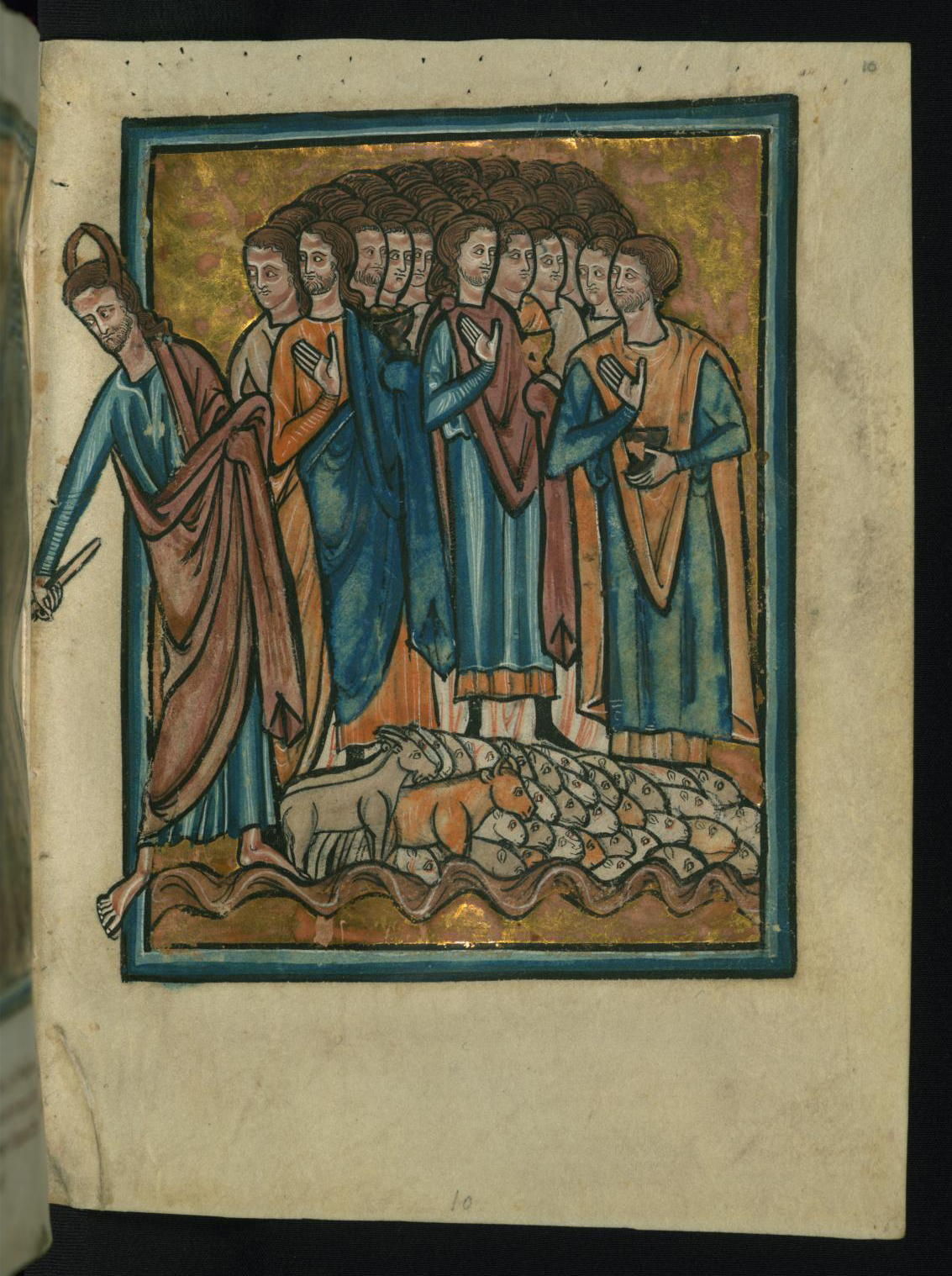
Íomhá/Image: William de Brailes: The Crossing of the Red Sea

Friday, March 29, 2013

Malachi O'Doherty's "Iscariot": E-Book Review

This Belfast journalist's previous non-fiction combines memoir and cultural and political observation well. The Trouble With Guns astutely analyzed the Provisional IRA's machinations within the Northern power structures; The Telling Year: 1972 examined the tension as he reported for the press that dramatic year about his own neighborhood; I Was a Teenaged Catholic juxtaposed his Catholic upbringing with his stint under a Hindu guru in hippie-era India; Empty Pulpits treated the retreat from mainstream Catholic dominance over much of the island this past generation. I liked each one (see my 2009 reviews on this blog or Amazon British and/or US).

It's intriguing to trace similar tension within an earlier, far more mythologized time and place: Palestine under Roman occupation in the company of Yeshua. He's "almost your double," as the narrator, Judas, tells his twelve-year-old friend, "Ben Joe," son of Yusef and Mary. Judas' own father is suspected, in the taut opening scene, of collaboration with the empire. His son, humiliated at fourteen, vows "to kill a Roman soldier." Judas by small steps--a dove, a dog, and then by mock practice with his pal--learns to take life with a knife. Certainly the shift from Ben Joe's assistance with Judas in "operations" against troops and his next encounter, watching his "double" debating Temple elders about the Book of Jonah, demonstrates a bold take on Scriptural piety. We also see the insistent resonance that widens dissension between the two youths. The puzzler that Ben Joe articulates, as Judas filters it: do you do nothing for yourself, or do you resist authority?

The combination of today's colloquial and off-color dialogue with biblical scenes enlivens this tale. Ben Joe argues that it's no crime for guerrillas to murder in the name of an oppressed people, however futile the revenge. They panic and divide the outwitted Romans--"soldiers just flailed among themselves, like a woman who has startled bees"--and stab "at close quarters" as if it's bear-baiting.

Cana's wedding, the Magdalene, the parable of the steward, and the resemblance between a pretend and a genuine preacher in Galilee complicate matters in unexpected non-Scriptural fashion. At sixteen, Ben Joe joins the zealots. The next section puts the narrator under the headstrong, wasteful command of brutal Barabbas. Pacifism meets with annihilation; the Temple rabbis counsel cooperation with the occupation. Godless Barabbas presents a compulsive alternative: more revenge.

Before murdering a man, Judas reflects: "You must either try to ignore his character or look for something in it to hate, or you will not be able to kill him."  He tells of how people expect to see what they do, as sudden death follows predictable course to provoke reprisal and worsen oppression. The pointless slaughter drives him away from the zealots.

The narrative shoves us into the baptism of the Nazarene at the Jordan by John; but confusion persists who that new preacher might be, for Judas. Yeshua's Sermon on the Mount and the loaves and fishes, however, signal a transformation. Hope arrives for Judas. He learns to put down his decade of burden. The Nazarene's sensible message is as brief and straightforward as himself, and he soon leaves the crowds for the desert.

Ben Joe, now cynical and cruel, awaits in Capernaum, where he sends out followers to do miracles and shake up the establishment, so as to further his own "authenticity." He presumes to speak for the spirit, while Yeshua restored it and taught one to listen to it. You can see how this will unfold: the preacher advocating gentle, personal transformation vs. the one defiantly rallying communal fervor against injustice. Judas must decide which Galilean to go with, and this entangles his fate once more.

Martha and Mary assist him, and they all learn of a popular preacher's arrival. The story of the "woman caught in adultery" takes a deft twist, as does that of the Samaritan, Lazarus, the Prodigal Son, and rejections of the Pharisees under a clever imperium always looking after its own interests. Back in Judas' hometown of Nazareth, complications ensue as Yeshua visits the Rabbi's home, sees Mary the mother of James, and preaches at the synagogue. "Yeshua might be a prophet, perhaps the only one to our generation, and yet mimicry and gossip had made him ridiculous." The twinned relationship skews the biblical saga; its tilted representation keeps the reader as off guard as Judas.

The novel then deepens the mystery of appeals to a wavering one's "better nature." O'Doherty's Judas filters the author's unease at subservience to another, no matter how eloquent the message or assured the medium. Yeshua confronts Peter: "Who do you think I am?" Suffice to say that the later stages of the conventional Gospel tropes of an angry and a composed, wonder-working or contemplative Jesus, a thieving Barabbas, and the conflicted narrator gain integration enriched by imagination.

The final third takes place in Jerusalem, at the Day of Atonement. Yom Kippur's autumnal timing doesn't align with the scriptural chronology naming Passover, but it allows O'Doherty to bring back the sisters and Lazarus at Bethany neatly, the cursing of the fig tree, and the entry by beast of burden into Jerusalem. It also helps him with the climactic rationale that Judas will confront. Driving out the traders from the holy precincts makes sense rearranged, as does the placement of the threat that a subversive preacher brings to the Roman citadel and Antipas and the power center of Jewish priests under Caiaphas. Parts in the home stretch, despite the natural excitement that accelerates as a fresh retelling keeps us wondering, did lag by comparison with O'Doherty's earlier revisions of the Gospel narratives. Lots of conversation slows this, as the author has to shuffle episodes around to move the logic along, and to connect characters who appeared earlier on with the action that adapts the Gospels. Admittedly, it's ambitious. Some characters felt too mustache-twiddling and backroom-conniving as villains, as the climax delays; energy lessens, explication grows. Still, you will read on, wondering how what we've long "known" of Judas' fate will square with this shape-shifting novel.

The kiss of Judas at Gethsemane earns pathos. The poignancy of the narrator's decision intersperses with the hardening of the heart. Contradictions within the Gospels, for O'Doherty's version, find commonsense solutions as he blends his fictional resolutions into those tales from the testaments--and those peddled by the apostles, Judas' "former friends." Wishing for an end, perhaps, may be salvation.

The matter-of-fact manner in which what's soon legendary starts as the mundane, mixed up by rumor by the credulous into the miraculous and manipulative, reminds me of the retellings of the Exodus and settlement of Canaan in Shulamith Hareven's trilogy Thirst (see my June 2012 review)."Iscariot" similarly reveals how it might have been, before sanctimony got the better of the secular struggles. (Kindle review to Amazon US 1-7-13)

Saturday, July 14, 2012

Shulamith Hareven's "Thirst": Book Review

As biblical novellas narrating the raw core of what became mythic tales of Exodus and the settlement of Canaan, "the Desert trilogy" explores everyday characters on the fringes of the Hebrew migration and conquest. Hillel Halkin skillfully translates Israeli novelist Shulamith Hareven's spare, poetic, and blunt shifts of tone. Her characters struggle at the margins, far from Moses or Joshua, and they witness the dramatic changes in their lives distanced from the heroes, among scrub, wilderness, mountain hamlets, flimsy campsites, and uneasy cities, isolated and vulnerable. How the Exodus felt, if you were the type who was pushed aside or stayed out of Moses' way.

These accessibly told, yet literate and elegantly phrased stories combine vivid protagonists with an omniscient point-of-view which glides from interior observations of characters with untutored, basic perceptions to unsparing, distanced, modernist dispassion about their fates. We care about them, but we also watch them along with Hareven, as from a detached, resigned, existential perspective. All three figures "thirst" for understanding, but they confront a tense terrain where borders are invisible and where journeys may end in betrothal, betrayal, or sudden execution, and where enemies lurk unseen.

Eshkar's resentment of Moses and his fellow Hebrews who keep wandering in Sinai when they could easily enter the Land of Promise comprises "The Miracle Hater." The rabble of fleeing slaves and castaways from Egypt, along with hangers-on and no-accounts, relies on their leader. Moses promises the crowd they will enter the Land, but he exacts from them fealty. "He talked on about olives, about pomegranates, about grapes, about figs, and wearily they answered, yes, yes, anything you say, as long as we don't all have to drop dead in this desert, amen. No, they would make no more statues or graven images. Yes, they would not murder. They would not bear false witness. Whatever he told them, amen."

After the Golden Calf debacle, they submit to the Law. But, Eshkar cannot, and he herds beyond the movable camps of the desert tribe. "The deception of miracles was keeping them purblind and lost." (51) He enters Canaan, he sees it, and he returns, wondering why those he leaves behind delay.

There's no pat endings for his tale or the other two, but Hareven arranges the simple events in a manner that reflects how what the Bible makes grand once was so ordinary, as with Passover and the "tenth plague" emerging out of events barely elaborated upon, in an existential time without miracles at least as Eshkar can see. For Hivai, in the middle novella, "Prophet," his failure as such for his besieged city of Gibeon compels him to flee to seek sanctuary in nearby Ai, as the Hebrews press their campaign. (This is the longest entry and there's some wandering in its telling; the other two are more tightly told, but it never lacks inherent interest.) What transpires leaves Hivai "neither Gibeonite nor Hebrew," and the original situation for the Hebrews as marginal border-dwellers and outcasts becomes, inextricably, his identity as he shares their fate but not their satisfaction with the Land of Promise, until he meets another exile.

"After Childhood" takes us to the other vantage point, that of Salu, a "blinker" who lives in a hardscrabble hamlet near the Wilderness of Zin a few years or generations later. His marriage to a mountain dweller, Moran, allows Hareven to alternate between two main protagonists, and this enriches this evocation of the barren landscapes and intimate challenges faced by a bickering couple.

Just before the story concludes in a moving scene, Moran prefers--much of the book is in interior monologue with little dialogue--to stay apart from her Hebrew neighbors and family. "[S]he would rather God stayed away from her. Let him ignore her in his heaven, because the gods burned all when they came. They brought death and sickness and madness and drought. It's all we can do to make good what they ruin. Spare us both their honey and their sting. We're no match for them." (183)

Hareven's trilogy may be a metaphor for Israel and Palestine since, and this adds depth to her story, but taken on its own terse terms as an eloquent evocation of how people once scraped out a bare living in harsh times, it's also a universally applicable theme which will reward any careful reader. (Amazon US 6-4-12)

Tuesday, May 1, 2012

May Day 2012


These posters, about a century apart, show what's changed and what's endured in our capitalist system. Half a year after the Occupy movements rose and fell, and as the supposed Spring '12 events have been revealed as a front for MoveOn and Obama for America, I write this with the same mixture of cynicism and idealism that impelled my comments last November on this blog. I opened a week-old copy of the New York Times to read about suicides attributed to the "economic crisis" rising in Ireland and Italy; the decline of influence of the Catholic Church and the pressure to tie one's identity--especially for middle-aged men--to one's job are culprits. After men face financial disaster and personal loss, the resulting collapse of one's sense of self and one's ability to cope drive more and more to end it all. A fitting epitaph or rallying cry today, also a day whose name signals utter distress.

Certainly, pressures have always been there for any breadwinner, male or female. I watched my dad work often the graveyard shift or the swing shift, after toiling with my often frail mom to run the dog kennel in the daytime that supplemented his wages and kept us solvent, if barely, when often my dad was looking for work. He seemed to find and lose jobs frequently--he explained to me his departures due to a combination of his temper and the unstable nature of a machine shop worker's occupation.

I recall going without what had been once-a-week or so steak for what may have been years; my teeth deteriorated as they came in as permanent ones as we had no insurance and I did not go to either doctor or dentist for what were indeed crucial years. I told my first girlfriend, as I started college, about how much my family made and she--her mother did not work and her own father appeared often "between jobs"--was astonished at how low the figure was. At least it ensured me a Pell Grant, back then for low-income families, and Cal Grants to supplement my financial aid to allow me to enroll at the university I had hoped to attend, in simpler times when one did not make such a choice a decade-long commitment to the right schools, the right tutors, the right scores, the right connections.

For many, as the pyramid schemes illustrate, the gap widens as much as ever between those at the "right" schools and in the right jobs--often benefiting the elite long favored by and comprising the leaders of the right wing, but more and more nowadays--despite the propaganda of the poster depicting our media-military-postindustrial complex today--more "diverse" as to admissions and international membership, if allied with the same powers that be. Those who make it into Berkeley or Harvard, Cambridge or the Sorbonne, MIT or Cal Tech, will not likely be championing Occupy once they make it on Wall Street or in corporate law, a tenured prof like Todd Gitlin or Noam Chomsky or Cornell West's photo-ops and soundbites aside as talk-show book tour exceptions proving the rule. Occupy met with applause on many progressive campuses, and among most of at least their neatly aligned faculty, I reckon; it's estimated in my liberal arts field, 19:20 instructors lean Democrat.

Still, the capitulation of most educational institutions to a corporate model-- if usually unofficially--demonstrates the reality behind the rhetoric. Secure jobs plummet for most of us less favored in getting hired at such institutions even as students are turned away; high enrollments meet budget cutbacks. Online teaching, I predict, will spread to selective universities as it has among many of those with open admissions already. This generates a lot of processed data. Whether this increases the creation of knowledge and wise use, we'll have to see. Electronic databases allow easier access and rapid production of papers and theses contrasted with index cards and library stacks I navigated as one of the last Ph.D.'s to research my dissertation traditionally; I finished just as Netscape blossomed. What happens to critical thinking, as cut-and-paste essays and "distance" degrees flourish, sobers me.

I saw a FB photo today of a mortarboarded grad at a lectern with the caption: "I couldn't have done it without Wikipedia and Google." At least it wasn't subtitled "couldnt of." Remediation, or "developmental" math and writing, take up the majority of courses facing many freshmen before they can progress at our Cal States and in our junior colleges. I have lamented this tediously, so I spare repetition. Suffice to say that the slogan on FB stands more and more for what "research" means now. I heard a tale of a student called in for plagiarism; she had insisted that since she bought the essay online, it was now her "original" work. After all, she had submitted it under her own name.

I face similar situations more and more, and however I try to enforce higher standards worthy of those earning college degrees, the disparity between many of my older students and younger ones regarding articulation, literacy, elegance of expression, and clarity of thought is often telling, and invariably disheartening. Add to this harried vets, inner-city, and international students, a 1.5 generation caught between a native language and an imperfectly learned new one, and a rush to send in rushed assignments overdue or barely on time due to work, socializing, commutes, and/or family life. My students--far from top-tier 1% campuses listed above--compete for fewer jobs and rising debts at the end of their investment. They are also competing, likely, against graduates of highly competitive schools for coveted jobs. Tuition invariably soars yearly, far outpacing the cost of living.

I heard 53% of new grads are looking for work, and out of those who gain it, the growing number of on-call, part-time, temp or "contingent" positions jukes the job stats the administration (as any in an election season) must inflate to keep the voters happy. It's common to see long-time full-timers let go, replaced by a pair of no-benefits, at-will, contracted, perhaps overqualified part-timers. I suppose this makes the government happier: two half-steps forward count as double one step back?

That post-industrial security state depicted above courts campuses and brings lucrative contracts; the liberal arts cannot compete with the hard and social sciences. Business majors lure many debt-ridden students and despite the astronomical tuition, so does law. In whatever the field, tenured radicals are greying and often obtained security in industrially fueled, tax-supported, confident postwar decades when enrollments boomed and budgets soared for those coming out of the Sixties with a doctorate, which also tended to be granted more quickly and with less difficulty than those earned by those like myself who faced straitened job prospects, enormous competition for what positions opened, and fewer hopes in the liberal arts for steady employment at all. Prisons rival schools for funding in California; Jerry Brown's return to govern finds a hammered state budget far different than that of the 70's largesse or his father Pat's social programs after WWII that boosted us all. None of this is news.

I know a woman with a doctorate about to be granted who may emigrate from Ireland to join her brother who tends bar in San Francisco. Highly accomplished in her field, she wonders if she can land a high school post over here. I told her given job layoffs, it might be more difficult than she imagines, although it sounds as if Ireland's austerity budgets make even American ones look lavish.

However, an Irish therapist mused on FB (as I find intellectual and spiritual and political ideas everywhere) how as of the magical 11-11-11 convergence, a feeling of possibility hovered. Yet, it also appeared to have set many people off kilter, and the uncertainty of our times as we are increasingly both linked electronically and cut off intimately adds up to quite a "broken social scene." That scene in "Melancholia" with Kirsten Dunst harnessing lightning from her fingers as annihilation nears appears as applicable as does the equally off-balance "The Tree of Life" with Thomas Wilfred's lumia Opus 161 animation. These two films stood out for me last year as representations of "mythos" today.

I regard this cinematic and philosophical zeitgeist as less hopeful and more unsettling, Both films and the Occupy movement roused hopes and fears; I sense among more than one friend wherever found an untethered mood, as if "all that is solid melts into air." Quoting Marx and Engels from 1848 reminds me of the enchantment of structural upheaval, and how it mixed, often fatally, with the power of disenchantment as harnessed by those shooting soldiers common to both illustrations above.

On the power grid, where do I perch? Privileged, no doubt, far more than I let on with my sad sack self. Yet, unsettled by my own determination to live by a life of the mind, when my soul searches so.

Writing this, I stare at myself with a somber mien. I'm often at a low. When one finds one's emotional support kicked out, and then one's blamed for staggering or falling, the predicament's not a happy one. Instability, personally as well as geopolitically, may make for great art and fine fiction, but when you must live through it, unsure if the ending will be apocalyptic or affirming, it's hard to take comfort in the chronicles of those who have endured similar struggles or who transform them into art.

I close this with a sense of unease. I've been reading lately a lot about the cultural evolution of religion, and I reflect upon the hard-wired nature of our wish for liberating models, inspiring chants, and momentous iconography. The Wobblies who made the older poster and the unknown artist who depicted our Occupy-era 99% share a commitment to a radical reworking of a system that for many in our world stands for the only one remaining. I have FB friends spanning the spectrum from Marxists to Tea Partiers, NRA supporters to grizzled Irish republican stalwarts, New Age infused visionaries and doggedly devoted Democrats with lattes and lapdogs. I am not sure what they share except me, but more than once I found myself sending a post--from a far-left activist turned survivalist if no less tilted to one side--to a Ron Paul military vet stalwart ready to lock and load.

What they have in common may not be much, but on May Day, they unite on a suspicion that those at the top of our pyramid scheme act in our best interests rather than theirs. Buddhists remind us of the "three poisons" of anger/greed, delusion/ignorance, and of desire/attachment. Jewish people retell the Passover story each spring as if it happened to them, to keep the pain and the promise equally alive. That's the longest running narrative handed down orally in our culture, and satirically ripe for parody as it endures, it betters Easter for it can happen to all of us, not only to a Son of God. Beneath ideological differences and political parties, perhaps we can agree that a higher value lurks beneath the slogans and posters, the soundbites and "likes" that more and more substitute for understanding. There remains a possibility for betterment that Wobblies and Occupiers, revolutionaries and reformers, campaigned for: progress for workers everywhere, not as spray painted, but as reified.

Where I teach, the library's stacks are being culled. Thousands of titles will be given to Better World Books, a worthy charity. I have little room for adding to my own collection, but I snatched John Reed's "Ten Days that Shook the World" last week from the pile facing deportation. We know how that idealistic saga from another October's days of rage ended. Maybe past failures will guide us--in this year when Dick Clark dies and some foresee no New Year to celebrate--into a chance for gentle renewal. I found my secondhand copy bought a decade ago on Teilhard de Chardin. That's a nudge.

Saturday, March 31, 2012

Coinneal ní solas: Tibéid & Chaisc na Giúdach

Scríobh mé ceithre bliana ó shin faoi droch-uair i Tibéid. Faigh mo post sin ar mo bhlag anseo. Chuaigh mé ar ais ag lorg ar an suíomh ag plé "Coinneal ní solas" ar an ghreásan ansuid inniu.

Bhí dith agam a fheicéail eolas go leor anois. Beidh Chaisc na Giúdach go luath aríst. Bím ag leamh faoi an dúshlán leanúnach i Tibéid faoi láthair. 

D'fhoghlaim mé nuair a chlicéail mé ní raibh beo ansin ar bith níos mo.  Níl láithrean gréasáin bunaidh ann. Fuair sé bas.

B'fhéidir, bhí sé ag obair ceithre bliana ó shin, go fírinne. Chuir mé cuairt go bhfearann sin mise féin roimh scríobh mo aiste beag ar ais ansin. Gan amhras, ní raibh aon gniomhíocht ar líne ó Earrach 2008 leis an feachtas seo.

Ina theannta sin, beidh mé ag déanamh cuimhneachán nua aríst--uair níos mo, ar a laghad go féin-- ar feadh Chaisc na Giúdach seo chugainn. Ar ndóigh, ní creidim go mbeadh daoine go leor ag fáil amach Tibéid agus an dlúthphártíocht leis na Giúdaigh uaim anseo! Mar sin féin, iarr mé go bhfuil tú in eineacht liom le chuis le haghaidh scaoileadh saor.

"An Unlit Candle": Tibet & Passover

I wrote four years ago about the hard times in Tibet. Find that post of mine on my blog here. I went back searching for the site discussing "An Unlit Candle"  on the web over there today.

I had a desire to see more information now. It will be Passover (literally in Irish, "Easter of the Jews"?) soon again. I've been reading about the struggle ongoing in Tibet recently.

I learned when clicking that there was nothing "live" anymore at all. No original website's there. It's dead.

Perhaps, it was working four years ago, surely. I paid a visit to that domain myself before writing my little article back then. Without a doubt, there's no activity on line since Spring 2008 with this campaign.

Furthermore, I will be making a new remembrance--once more, at least to myself--during this next Passover. Of course, I don't believe many people are finding out about Tibet and the solidarity with the Jews from me here! All the same, I ask that you join me in this simple cause for liberation.

DePaul U/Ollscoil: Photo/Grianghraf.

Tuesday, March 30, 2010

"Arrest Yourself" to free Burma


You can "Arrest Yourself" on behalf of Aung San Suu Kyi. She will turn 65 under house arrest, which this Nobel Peace Prize winner has endured, when not in prison itself, since 1988. Although she won the prize in '91, her plight appears to have been largely ignored in the shadow of other human rights violations in the two sad decades since the dictatorship incarcerated her.

Not much is known by most of us about Burma. A documentary I have yet to see, "Burma VJ," compiled from smuggled handycam footage, has been acclaimed (and nominated for an Oscar) as one document of this struggle for freedom against the military junta. It covers the protests led by Buddhist monks in the fall of 2007. Anders Østergaard directed this and uses the "lens" of a young journalist through whom we learn of the protests, the repression, and the crackdowns.

"Arrest Yourself" is a novel way to share solidarity. You stay at home 24 hours and invite others to visit you to learn about the Burmese situation and to donate funds to assist the U.S. Campaign for Burma. At their website, a simple video can show you in 2 1/2 minutes easy steps to follow in how to set up your own house arrest, as it were, to raise both awareness and assistance.

I talked about this at my family's seder last night. I figured it neatly fit with my wife's efforts on behalf of three Jewish prisoners whom we support and spreads the Passover message of liberation in a practical, tangible way. Instead of paying lip service to freedom, or sighing over the headlines, why not visit this site? Faraway as we are from this country, we can do our share to ease the pain others suffer in a nation turned into a giant land of captivity, where 90,000 children are forced to be soldiers, thousands of women are raped, and 3.500 villages razed. 600,000 natives have been displaced, while another million have fled their homeland.

For background, I recommend this book. On Amazon US, Feb. 13, 2006, I reviewed Emma Larkin's "Finding George Orwell in Burma". This harrowing account of this American journalist's clandestine stint in the police state of Myanmar resembled a captive's tale, "and I alone escaped to tell." The whole country looms as a concentration camp, an open-air workhouse, a tropical penitentiary.

Monday, April 13, 2009

Cáisc na nGiúdach 5769

Cheiliúran muid ár Cáisc on Dé Déardaoin seo caite. Fhreastíodh muid ocht agus déag duine go hiomlán. Mar sin, bhí teach lán anseo!

Chócaráil Léna bia níos mo, ar ndóigh. Is iondúil go déanamh seo uirthi. Tá grá mhór aicisean féin a rinne miasaí blásta an uair sin-- i gcónaí!

Go nádúrtha, thug duine eile lóntaí eile. Tháinig duine leis fion agus sú na fhíonchaor. Líon muid gloiní fíona go leor go h-ólta.

D'inis scéal anallód Cháisc aríst. Phlé muid faoi an fírinne nó fállasach air. Ach, d'fhoghlaim faoi ag baint le hábhar dó againnsa féin an óiche sin fós.

Bhí cuimhne duine eile orainn freisin. Ní raibh siad ábalta a dul go mbord Cháis. D'ith siad faoi ghlas, nó ar fud ar a seanbhaile. Tuig na Giúdachaí agus na pobal Éireannach faoi bheith ar deoraíocht.

Passover 5769.

We celebrated our Jewish Passover on this past Wednesday. Eighteen people attended in total. Therefore, it was a crowded house here!

Layne cooked most of the meal, of course. It's customary to do this for her. She has a great love herself to make tasty dishes at that time-- as always!

Naturally, other folks brought other provisions. People came with wine and the juice of grapes. We filled wineglasses galore for ones to be drinking.

We told the age-old story of Passover again. We debated about the truth or fallacy of it. But, we learned about the relevance of it for ourselves that night also.

Other people came to mind for us too. They were not able to go to a Passover table. They ate behind bars ["under key"=locked up], or far from their old home. The Jews and the Irish people understand about being in exile.

Illustration/ íomhá: "Exodus from Egypt/ Ecsodus ó h-Eígipt"

Thursday, April 9, 2009

Pax Christi, Passover

Yesterday I read about Franciscan friar Louis Vitale, 76, arrested for one of his hundreds of protests against nuclear weapons. This inspired my memory. I registered as a "selective conscientious objector" in college with Pax Christi. Reagan thundered as El Salvador and nukes rather than global warming and Iraq filled headlines, alongside perennials: economic crises and political anxiety. My bad dreams anticipated a second Bay of Pigs, sparked by Central American Cold Wars.

Fr. Vitale's energetic and media-savvy stance as covered in the hometown paper, him white bearded and bespectacled in his brown habit and knotted cord, reminded me of the more circumspect but similarly garbed Irish Capuchins with whom I stayed the summer I turned nineteen. I was thinking of joining them, but as I'd fallen predictably in love my freshman year before my visit, I suppose I was fated not to stay. However, as the Mexican nuns at Poverello of Assisi kindergarten inspired me as a lad of five, and as I chose the clunky name "Francis" as my confirmation patron, I like the saint if not his nerdy moniker.

I learned how to count to ten in Spanish from nuns in habits as distinctive as those of friars, same cord, same color; Vatican II ended a couple of years before. Convents had not yet emptied. They soon did at the parish of my teens. Immaculate Heart's women deserted en masse. Their leftist, artsy community after bitter battles with the Los Angeles cardinal largely laicized. One of the parish's liberated sisters joined the sugarcane harvest in Castro's Cuba.

My attraction to Francis paralled mine to the Jesuits; that congregation may number as few today at my alma mater as friars who still wear habits, not to mention the dwindling veterans of the counterculture once Immaculate Heart's conventual sisters, but the restlessly combative scholarly and ideological legacy of the Jesuits did linger, if you sought it out, at the campus I attended. (California's Franciscans had a radical reputation similar to Jesuits and IHC; unfortunately the Order locally's been embroiled in a $2 million lawsuit for sexual abuse of boys occurring in the 1970s.) I'm glad that at least the original spirit of the founder has been continued by such as the frail feisty friar. Fr. Vitale (who also earned a doctorate where I did, at UCLA) went to my college too, but three decades earlier I imagine its ambiance might have been very different: all-male back then, and probably far more regimented.

If you attended LMU when I did, outside of the chapel's bells and curricular requirement for two philosophy and two theology (renamed after I was there from "religious studies") courses, you might barely register its Catholic imprint. I sought it out, despite or because of my own wavering faith in its tenets, I served on a student committee then with a phrase still not clichéd, "Social Justice." I later worked for an ex-Immaculate Heart professor and studied under ex-Jesuits. Such ex-clergy taught at LMU; they probably outnumbered those colleagues still vowed!

At UCLA, I was busier with my studies, but a classmate told me she'd gone to hear Martin Sheen one evening; this was at the height of the Contra debacle. After the talk, she asked him if he'd like to continue the chat over coffee, and he did. This kindness impressed me, and in the article I learned that Sheen's inspiration came from such men in turn as Fr. Vitale. Despite my on-again, off-again fidelity to the Church during my college and grad school years that decade, my involvement in principled opposition to the voices demanding death plunged me into a formative milieu full of Catholic Workers, who believed utterly in total pacifism. "Pax" is the simple, eloquent, and uncompromising Franciscan motto: a hardcore word, "Peace."

I am not a pacifist; I registered as required legally. I also had to if I wanted financial aid for LMU. The accident of my birth date entered me in the first year ever called up for Selective Service under Carter's doomed end-of-term Persian Gulf Doctrine. As a pessimist, I didn't count on my myopia or even my recent and severe knee ligament injury-- which happened when I was at the Capuchin friary visiting one weekend, providentially perhaps, playing sports-- keeping me out of what loomed as inevitable conflict. I figured we pencil-necks would get dragooned into being stretcher-bearers in a malarial Salvadoran swamp. In hindsight perhaps I exaggerate the call-up threat, but more than once I felt the pressure exerted in the early 80s. One night I talked over tequila with a friend and his older brother in the dorms; older brother attended LMU ten years before. Until drafted for Vietnam. He told us of what he had seen, and of the fate of earlier classmates from our same dorms.

I also asserted, in my letter on file with Pax Christi, a Boston organization, that I was a "selective C.O." who did not equate a moral struggle against Nazis with a geopolitical foray against Contras. This nuanced explanation did not jibe with Draft Board definitions, but it did document that prior to any Armageddon that might erupt as we stared down the Evil Empire, how I was no sudden shrinking violet. I admired Thomas Merton's stance as a total C.O. during WWII, and recalled his sorrow at his brother's death fighting in that same war. But, I knew I lacked the conviction that Merton held, and as a shadow of my boyhood defense against schoolyard bullies, I suppose as a snarly Irishman I also recognized the necessity for putting up your fists, even if no geopolitical brawl met facile slogans as "the good fight." As I've matured, I cannot even cheer on the demise of Spanish fascists or screen Nazis. I wonder why I've changed. I'm still rather mean-spirited and misanthropic otherwise!

At the same time I opposed U.S. policy, I favored the Irish physical-force tradition, as its republicans parsed that phrase. I defended the IRA as a legitimate reaction to the abuse of power and the imposition of illegal rule over a people seeking freedom against another empire. This was also the time of the H-Blocks, the blanketmen, and the hunger strikers, speaking of another legacy that ran askew from that aligning martyrdom with devotion, defiance for a cause, and the suppression of the body's desires so as to empower those of the spirit. Against imprisoned and scourged figures draped in rags akin to the first friars and the perpetual poverellos, far more gaunt than many Franciscans to follow, there were arrayed the police, the troops, and the will of one statelet ruled figuratively by an wicked queen and truly by an Iron Maiden. During the 1916 Rising, Dublin's Capuchins counselled the rebels in prison and heard their confessions before their executions.

I knew less as a child about those Irish revolutionaries-- also "voices demanding death" in a complicated moral calculus that as a younger man I could not sum up and still try to reckon but clumsily now-- than Yanks vs. Krauts. I grew up pretending that my baseball bat tucked under my arm was a rifle, as I played with bags of plastic soldiers I tried to melt under a magnified glass's sunbeam. But even my conservative parents never let me hold a toy gun. Fascinated by WWII as a child, I pored over histories. I received an illustrated tome, full of Life-magazine types of black-and-white photos that documented six years of terror. One shot, of a three dead Marines sprawled in the half-ebb on a deserted Pacific beach, moved me greatly. "From Here to Eternity" indeed. That may have been the crucial image that turned me away from a boyhood dream of entering (if my vision cleared) the "Silent Service" like two of my cousins had recently, in Navy subs off the embattled Vietnamese coast.


Named after my mother's only brother who died (while navigating a "duck" or small landing craft as you see in this photo taken by Life magazine in 1943) in the invasion of Saipan in WWII, I inherited an awareness of both war's futility and its necessity. Neither of my parents despite their considerable leanings towards the right cheered on any hostilities abroad. My mom once remarked on her inability to forget the day the telegram arrived with news of her only sibling's death. My dad commented once, despite his blue-collar Reagan Democrat, lunch-pail conservatism, of how nobody wins in war.

He remarked one night to me, when I was probably about seven or eight, as Walter Cronkite recited on CBS the day's duly reported totals of US, South Vietnamese, and Viet Cong casualties, how unbelievable the count seemed. Our enemy died in numbers far exceeding ours and even our allies, but still, we were losing. This lesson, only a casual aside by him, but the sort of conversation you grow up never forgetting.

So, something resisting the dominant media message and affirming the Christian alternative must have stuck with my parents and then with me. Needing a confirmation name, I learned more about my patron saint. I admired his offbeat humor and uncompromising stance, even if as a brainy sort I wished the Franciscans boasted the intellectual passion of their rival Dominicans, not to mention the famed infamous Jesuits (they always seemed to have the coolest and most daring name, the bold congregation of cosmopolitan Sorbonne grads branding their corporate logo not after a Marian apparition or a misogynistic anchorite, but Jesus Christ Himself).

By contrast, Francis chose for his band of brethren a diminutive: "little brothers," to contend against the corrupt popes and the mighty emperors. The reason Fr. Vitale joined the Order was because of its sense of humor. An aspect I doubt inspired any postulant for the cassocked Jesuits. Nobody cements planters of St. Ignatius next to those of jolly Buddha or gentle Poverello preaching to Brother Sparrow by the birdbath. Still, we often forget that Francis could be fearsomely zealous, and his uncompromising abuse of "Brother Ass" his body wore him out at about my age. (You can read a straightforward account of his life by Adrian House, which I reviewed a few years ago on Amazon US.) To me, it's a pity that he did not live to Fr. Vitale's eminence; perhaps Francis could have curbed the rapid dissolution of his ideals. But then, the truly committed share with those committed for insanity perhaps an inability to conform; I could never eat coaldust or kiss lepers as he did.

The Franciscan combination continues memorable showmanship. As the photo shows, Fr. Vitale wears his habit when he's arrested for the two- or three-hundredth time. Yet, at least as originally intended, there's a self-effacing reserve expected of a friar, akin to that in the Jesuits. You've never heard of him. The man matters less than his mission. This energy did endear the friars to me. Yet, for a young man, there's not much of a place to learn from them if you're academically inclined-- given their founder's distrust of scholarship over service. Therefore, nearing their eighth century, Franciscans run hardly any universities. Compare this absence, being instead in parishes and prisons, with the Society of Jesus, who nonetheless faithful to their founder's apostolate are administering if in theory more than practice over two dozen colleges in America.

Apropos of education, and nodding to Fr. Vitale, he speculates if Francis may have suffered PTSD. I have taught students who come back from Iraq as mentally wounded and physically crippled. For years, nearly every course of mine has had veterans; a large VA hospital's nearby and the city where the campus sits also attracts many here for rehabilitation who take college classes under their deservedly earned benefits, along with coping with their recovery from trauma. I see the legacy of our War on Terror, and my wife's loyal worker has two daughters now enlisted, one off to Afghanistan soon, and his third girl's married to a soldier.

The Peace of Christ may be a luxury that only a majority religion can entertain. Moses killed the oppressive overseer beating a slave. Only a miracle drowned pursuing Pharoah's army. Battles against Hebrews tend to favor their opposition, otherwise. That may be why the Zionist army's called the "Israel Defense Force." The folk memory of always having to be on the lookout in hostile territory, even when one's seen-- by history's spectator but not the Hebrew participant-- as safe at home.

The previous night at our seder, Layne announced that there were nearly two billion Christians and almost a billion-and-a-half Muslims. Facing them: fourteen million Jews and declining rapidly. She wondered if Leo and Niall along with their peers gathered amidst matzoh crumbs and sticky grape juice would profess any allegiance to the faith within which we've tried to raise them, and seemed as I do tacitly to doubt this. Our discomfort with eternal verities grows with our age. I guess we transmit this meme. Richard Dawkins would approve, if not the rabbis and priests. Such a cultural meme may be viral, as Jews of our generation finally find themselves not much different than anyone else, unless they want to dress up as so.

Like the nun or friar who chooses to wear the habit, they make the decision now to stand out, while the Jesuit or Immaculate Heart member blends in. In Francis' time, he wore what the peasant wore. In Egyptian times, all women wore the veils that now only a few Sisters, long descended from such monastic recluses, choose. Sartorial status now is theirs, not imposed by the outside-- for some communities in Jewish laity as Catholic clerisy enforce the fashion, and others do not-- so much as sought by one who selects to take on the outward sign of conformity from the interior passion for discipline and faithfulness to one's promise before one's Maker.

Before that ambiguous Creator, some at our seder table denied heaven or Moses. Others, unaware or uncaring of such precision that fails to align the reenacted seder's Exodus with the historical record, regaled-- if college students of another generation as distant from mine as Fr. Vitale's collegiate experience was-- with chat about condoms at the grown-up's table. At the "kid's table," those mostly teens chattered away as is their wont. Those bar mitzvahed dismissed attention to the Four Questions; no youngsters wore the kippah proffered. Perhaps for aesthetic reasons.

Layne spoke to eighteen people in our home. All but one single man and one family of four were from families less than "entirely" Jewish by its strictest standards. And/or by their own preference. We at the table attest to a change in American Judaism equal to that in the past half-century of its Catholicism. Technically minorities, but no longer relegated to the margins. "Bridget Loves Bernie" in my childhood, "Abie's Irish Rose" in that of my parents; in our pantry we have a bottle of "Soy-Vay" sauce hawked by the nice Jewish guy who met the smart Chinese gal, and vice versa: this millennium's model for assimilation, culinary and coitally.

For mass appeal, it's even more lucrative farther downscale: a Judd Apatow casting choice for the caricatured parents of the designated Jew. Usually the groom (as Hollywood's makers enact their family romance onto the screen), less often the pivotal moment around which the screenplay tenses or the obstacle by which its shlub-like protagonist finds his amorous pursuit of the majority's trophy wife-to-be queen bee constrained. (That Jersey director's married to one rather untalented, prototypically blonde shiksa inevitably as earnest life mirrors hamfisted art.)

Of course, as my wife inevitably chimes in, "Jewish enough for Hitler" is another story. I read how the Wittgensteins, children of Catholic converts in that opportunistic if understandable lateral move that Austrian Jews in the early last century often ran, had to apply to no less than Der Fuehrer himself for dispensation from the Nuremberg Laws, for they had three grandparents tainted: this added up to "full Jew." While the Gestapo commandeered the W's considerable assets, the deal the family brokered earned them reclassified by a legal fiction, as if descended from an Aryan count. Newly half-breeds, mischlings, this status allowed a couple of compromised sisters to emigrate-- despite their earlier naivete when they tried to flee with bogus passports procured in some backwater like Serbia. Such are the tragicomic complications of allegiance, change, and survival when we try to slip away from our uncomfortable past to accommodate to an equally shifty present.

She also read from three letters she'd recently received. These too spoke of past pressures leading to present predicaments, under the imposition of law and order. Three long-term prisoners, one in for life without parole, contacted her through an activist group linking those in jail with Jewish pen-pals. George, Alan, and Joe were not raised in Judaism; all of them were no more than "mischling" themselves, if often fractionally less. All three lacked sustained exposure growing up to whomever were their Jewish forebears. In middle-to-late age, they all had begun behind bars to explore their heretofore submerged or unspoken Jewish ancestry. Now, they all groped for meaning within unfamiliar songs, stories, and rumors from their families, less spoken of by them than silenced.

They will probably not pass along such a legacy to their descendants. Our children, like their own, will bear surnames and probably punims that nobody will peg as Ashkenazi. They will blend in. Perhaps their cousins and children may read such letters and look backwards to their stories, as Marranos dared to in secret or those in New Mexico do today in public. The Jewish whisper often gets drowned out by the larger presence, in a family tree or on the local train. The seder, as we hope for our boys and the other children there, may represent a glimmer that will shine in their unpredictable and perhaps dark futures.

We never know when meaning will strike us in our moment of need. Jailhouse conversions, foxhole atheists, wake-up calls. This morning, coming to work, I began pondering Fr. Vitale's witness. He grew up one town over from me, in San Gabriel. But, a generation earlier, he came of age in an era when Catholicism still permeated the culture within which he studied. However, from a wealthy family, like Francis he grew up without much piety. Like Francis, he was in the military. He dated and lived whatever passed for the postwar fast life.

As a navigator in the Air Force, Louis Vitale had been ordered to shoot down an unidentified plane. He hesitated, and saw then two women waving to him through their commercial craft's window. Shaken by such calculation, he gave up his playboy lifestyle, sold the roadster, and entered the Friars Minor. When he was ordained, he emerged into the Civil Rights era, and did then what St. Francis would have done.

He restored a parish sanctuary, St. Boniface's on the Tenderloin, and when century-old pews were polished, he invited back the homeless of his saint's city to sleep there. A very Franciscan action. Francis' first act that set him on the road to sanctity was when he repaired San Damiano's fallen chapel after a voice from the crucifix directed him to, symbolically and practically, fix the broken Church.

Anthony McIntyre over at "The Pensive Quill" blog exchanged views March 31 ("Kick the Pope") with one anonymous commenter who critiqued A's contempt of what he's called "priestcraft"-- A's supposition that religion cannot be credited with any corner on the market of good works. In his riposte, it's likely that now, such repairs to our shattered world as moved Francis or Fr. Vitale to enter the vowed life may now draw others into, say, Doctors Without Frontiers or a UN-sponsored charity. The secularized expression of one's social conscience can break away from any spiritual foundation.

It's a thoughtful rejoinder to the defense that many make for organized religious communities in need of restoration after so much institutional rot. Yet, I consider the sacrificial weight added to the religious balance in favor, for a few able to take on such a Franciscan level of craziness, of such unworldly obligation. For a few people, and Catholic lay volunteers along with celibate clergy can be counted here, there's an added impetus of giving up one's goods, one's sexual expression, and one's will to do as one wants for a higher cause. I knew a few classmates who entered the "Jesuit Lay Volunteers" on graduation, going off to teach in Micronesia.

The celibacy issue aside-- I argue for parish clergy to marry but not those in religious orders-- I can find relevance for those who, as with the military, give up success for an ideal. Now, the same of course for the U.S. Peace Corps, but it's rarer to find those who give up their whole life in pursuit of ministering to the poor and needy. The structure-- as with the Jesuit program-- appears to shift towards short-term volunteers under supervision of a few "lifers." Most Orders and monasteries can't sustain their schools, hospitals, shelters, and parishes without "layfolk." Post-Vatican II, the Church had to seek this direction out of necessity, even if future popes refuse to alter the stricture for clerical celibacy.

Those who, in a century that offers so many possibilities formerly denied but a few who chose the religious life over a dead-end one, continue to make with sincerity the big commitment earn my respect. Such a lifelong (or if military, career) choice meets with my admiration despite my differences with the particulars of the powerful ideology furthered! I teach those who served in the military, and I have classmates who were ordained priests. They strive towards good lives and aim at good works probably more often than those who carp and snipe at their daily decisions. Their organizations may fail at their lofty goals of protection and persuasion, they do attract the unworthy along with any other human profession, and their ethical stature rises and falls by the same levels of mortal weakness and strength we others live and work within under doubtless less scrutiny.

The military has taken some of my students from the ghetto and barrio out of gangs, away from prison, and given them self-discipline, self-motivation, and self-confidence. Similarly, even if the Catholic model of renunciation is not one I can condone unreservedly, this time-tested regimen does motivate a few very good men and women. Freer from the necessity of making a living and the temptation of wasting one's time away in distractions than the rest of us, they can contemplate great achievements that, if tethered to family, possessions, and selfishness, would not push them to scale such heights of self-sacrifice.

I wish that we had more Peace and fewer Marine Corps within which such aspirations could be achieved, but until lions lie down with lambs, given our evil natures and the need for vigilance, I cannot dictate or fund an alternative to our military structure for many youths who look for a quick way up, out of poverty and ignorance. Fr. Vitale, to his credit, seeks such an alternative, and protests at the military bases. He follows the message of Christ and his Founder. He brings us closer, as do the pen-pal providers and the medical workers in the Congo and the literacy instructors in Kabul, towards the Franciscan vision and the Messianic age of harmony. Maybe Hamas will never lob a rocket from Gaza; maybe Israel will never have to send one back? I admire these utopian panoramas, but until the government funds schools with as much largess as soldiers, this embattled path towards education, through perhaps trauma, is the flawed compromise with Caesar that parallels that paid to Christ. Or, our taxes for the Peace Corps and the U.N. with its olive-branched seal.

I waited for the light rail the day before Good Friday, thinking about Fr. Vitale, who fasts every Friday. I wondered if he ever got used to it. Did he wear his robe out in public when he wasn't protesting? I'd never seen a friar do so. How would you know a Franciscan if he wasn't in his habit? The whole impact of Vatican II appeared to negate this.

But, I wondered, like I did when as a first grader I was shocked when the nuns showed up with hair and not veils one day, and seemingly overnight abandoned the dress within which they were once concealed. Can a Catholic sister or priest, if one blends in totally with one's peers today, as effectively proclaim the Gospel in the cities to which their Founder called them to work among the weak? Those few congregations that insist on traditional habits have drawn more vocations; those like the IHC and Jesuits who did not have not. On the other hand, Jesus would have looked no less Jewish than Moses, no less one rabbi than any other in Jerusalem then as now. He managed to make an impact. Do preachers do so best as anonymous, or when noticed?

I boarded the train to go to work. Near me, a black man about sixty with a bible on his lap lectured loudly a white man about forty with a bicycle helmet on his head. As downtown swung into view, graffiti and abandoned factories, new lofts and bleak concrete river, sluggish freeways under a grey sky, he proclaimed the arrival of the Abomination of Desolation. Homosexuality signified this collapse of morality; the standards had fallen apart all around us in these, definitely the last times. He warned of hostilities and predicted doom.

We passed Fr. Greg Boyle's handsome new Homeboy Enterprises and Homegirl Bakery, nestled near the Chinatown platform, as the man on the Gold Line preached. These businesses help redeem ex-gang members by creating jobs and nurturing skills. I wondered what the Jesuit activist would tell his fellow Christian. How would Fr. Greg exercise his spiritual discernment, as Ignatius counselled, to listen to such a Bible-thumping man out of a Flannery O'Connor story as he'd meet on this MTA train?

That fellow explained his 10/26 arrest. He'd been in jail many times. The train curved around the bend where on one side the tracks look over a few trees under which homeless men camp on a lot full of concrete that promises for lease "4 Acres: Vignes Tower." I see their heads from the angle where I peer out from the train door sharply down. I can see black hair, napped and tight, the same tonsures I have seen many mornings before. The men sit in front of plastic tents, and always appear to be convening for a coffee break from whatever else occupies their time. Among such a raffish crowd, we are told Jesus and the most Jesus-like fanatic of them all, Francis, ministered.

Ignatius, the wounded mercenary who like Fr. Vitale had his epiphany while recovering from the shock of being a soldier, told his elite recruits they could own nothing except in common, forming them into military ranks and steeling them with their own decade-long boot camp as rigorous as any gang initiation homeboys and homegirls might have faced, in and out of incarceration. Across the rail terminus, the L.A. County Jail rises. A lot next to the caffeinated encampment fills with abandoned LAPD cars.

The Gold Line holy man advised his listener to read his 42 books. He encouraged him to look out for his latest, "The Third Tradition." It's "the greatest story never told because it is too long to ever tell," in his parting phrase as we arrived at Union Station.

About a half hour later, on the Metro Blue Line, despite my concentration on my novel-- by a Basque writer from Loyola's homeland, a story opening in San Francisco-- over my iPod I could clearly hear a black woman in her thirties haranguing a black man about the same age across the aisle. I felt again as if transported not past Compton so much as through Carolina. Her exordium culminated in this conclusion: "Which side will you be on? There has been a great falling away but that does not excuse you. Jesus will demand your soul and your life." She then returned to her glowering silence; I don't know what sparked her loud outburst with the man, but her homily may have been in progress before they boarded. Bearing not an olive branch but a sword, the gospel in these streets darkens. In my city Jesus' message resounds apocalyptically this day before billions commemorate that crucifixion of our Prince of Peace.

P.S. As I prepared to post this, I received this Good Friday a Facebook message from an old classmate. Our (now defunct) high school stood next to a mission built two centuries earlier by friars who founded the same province that Fr. Vitale once led. Sister Leo Francis O'Callaghan, CSJ, our chemistry teacher, is now ill. My speech teacher, Sister St. George Skurla, CSJ, and another sister visited her and sent along this report. The names echo on, and only now do I recall that my uncle bore the same confirmation name I do.
Sister St. George and I went to Carondelet Center with Easter baskets today and in the course of it saw Sr. Leo. She looked extremely thin, her hair was a bit disheveled, and I am sure she didn't know who I was. We also met the Sister in charge of the nursing floor, and she told us that they had noticed a definite change in Sister. In fact, they were beginning to do some remote preparation for her funeral vigil and liturgy!
"Protesting Priest's Path Leads Repeatedly to Jail". Richard C. Paddock, Los Angeles Times. April 8, 2009. Photo caption: "Father Louis Vitale greets activist Mariah Klusmire, 19, of Albuquerque before a rally protesting military interrogation training at Ft. Huachuca, Ariz. Klusmire's mother attended events organized by the Franciscan friar before she was born."

P.S. Here's a fine summation:"What St. Francis Did for Humankind."