Showing posts with label David Mitchell. Show all posts

Wednesday, July 1, 2020

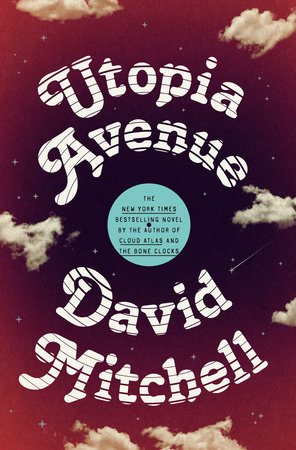
David Mitchell's "Utopia Avenue": Book Review

 Utopia Avenue by David Mitchell
Eight novels into his career, David Mitchell's established himself. You can count on his fiction to take you into a multicultural space, a cultural clash, and (nearly always) a spiritual--or at least supernatural--encounter. Engagingly told by either first or third-person narrators, his plots unfurl to keep any reader turning the pages. Which can add up, given the heft of most of his tales speculating on the grey areas between this realm and other ones.

If you've come to Utopia Avenue fresh, I'd suggest a detour. You need to start with The Bone Clocks (2014), and maybe the spin-off novella from the following year, Slade House. (Both reviewed on PopMatters). These will prepare you to step back into Mitchell's oeuvre. His first book introduced his modus operandi. Ghostwritten (1999) lives up to its title. It shuffles through various lives in different places across many centuries. The characters merge subtly with one another. Tellingly, the substance of the novel adds up to nine lives. The manner of how their essences may be transmitted in turn floats into a vast Cloud Atlas. 

Probably Mitchell's best known effort to date, Cloud Atlas creates an ambitious narrative which follows similar themes as his debut. But in this 2004 effort, Mitchell amps up the energy and the invention over a wider range of prose styles and six-times-two extended set-pieces which draw one into: the mind of a nineteenth-century notary at sea, a poor musician's journal early in the next century, a whistle-blower's thriller, a dystopian robotic Asia, and a wittily sour publisher on the lam. These nestle into one another like Russian dolls, burrowing into the central tale in post-apocalyptic Hawai'i before emerging to repeat the cycle of the previous five sections in reverse, by resolving each interrupted story.

However, even then a reader will not be ready to appreciate fully the backdrop of Utopia Avenue unless he or she finishes first the sprawling (even by Mitchell's standards) 2010 historical saga set at the turn of the eighteenth-century in Nagasaki, The Thousand Autumns of Jacob de Zoet. These prerequisites will prove enjoyable, and none will feel like assigned homework to catch up on. Nevertheless, this short stack of tall tales will take a while, so those opening Utopia Avenue need to know they'll be expected to have kept pace with prolific Mitchell over two decades. This leaves out, all the same, his remaining two novels.

The frenetic number9dream (2001) conjures up a chaotic sense of modern Tokyo; Mitchell lived in Japan for many years. Its own nine chapters thread together an imitation of Haruki Murakami rather than Mitchell's genuine voice, although the practice he gets in eclectic structures and experimental settings prepares him for Cloud Atlas. Finally, there's one charming outlier, his semi-autobiographical reminiscences of a thirteen-year-old on a housing estate in the middle of Worcestershire. It's told straightforwardly, and movingly.

Black Swan Green (2006) evokes powerfully Thatcher's England of the Falklands War, the New Romantics, synth-pop, stuttering, and all things British and/or annoying circa 1982. The audiobook performance by Kirby Heyborne will reward; many of Mitchell's works transfer well to the spoken word, although I'd make sure one has already a firm grip on the printed version of Cloud Atlas, given its dialects, intricate references, and inventive terms.

Back to the future for Mitchell fits. His storylines unravel chronology. In fact, the eerie Horologists who try to bottle up human life-forces so as to distill the Oil of Souls thrive on defying linearity as they strive to apply their energies to a vampire-fueled immortality. If this sentence makes sense, then one can follow Utopia Avenue. But one of its main characters, Jasper de Zoet, discovers his lineage traces back to 1800 Nagasaki, and that unfinished business then accounts for the mess that destroys the settled life of another protagonist at the start of The Bone Clocks, which ticks off from 1984 through its cast of misfits into 2043.

So, slot in Utopia Avenue between The Thousand Autumns of Jacob de Zoet and The Bone Clocks. In the spirit of Ghostwritten, characters face strange enemies. Connections appear subtly between these and more. For in Utopia Avenue as in all his works, Mitchell scatters "Easter Egg" appearances or allusions to his previous--and one presumes--future fiction. Characters and their works survive and echo as their stories already told reverberate softly.

It's difficult to convey the pleasures within Utopia Avenue to the uninitiated who enter David Mitchell's universe. Suffice to say that unless spoilers get revealed, only the gist of the work can be related. A few PopMatters faithful will know of the English folk-rock pioneers Fairport Convention. Well, take Sandy Denny (who appears as do many musicians of the psychedelic era in cameos or small supporting roles), one of its talented vocalists. She's channeled into Elf Holloway, a keyboardist from the folk scene, and one of three singer-songwriters. Second, Dean Moss hails from Gravesend, on the Thames estuary where the owners of the local pub will reappear as The Bone Clocks begin ticking. This bassist hails from the working-class in London itself. The class-consciousness plays a role in establishing the tensions and the diversity that enriches the new ensemble. They're joined by jazz-trained drummer Griff from darkest Yorkshire, and Jacob himself, a sort of Richard Thompson scarecrow figure on amazing guitar. Similarities ensue with real bands such as Fairport.

Car crashes, tragic passings (Mitchell excels at death scenes, premature or final), bleary touring and international hassles, sexist pop-show hosts, and smarmy manipulators all scheme against the three men and one woman (this group battles leering come-ons and baffled reaction in times not as advanced yet as some from sixty-odd years on may assume).

Mitchell's done his homework. The mmersion into not only London but a trucker's stop where ruffled and velvet-clad foppish musicians recharge after being on the concert trail, the wonder and danger of San Francisco's allure as seen through the eyes of members of the Grateful Dead and Jefferson Airplane, the dense terror and drive of Manhattan appear vividly as Utopia Avenue, the scrappy titular band, struggle up the charts and on blurred tours.

Laurel Canyon, Amsterdam, the Chelsea Hotel, and the less-heralded backwaters of Britain receive affectionate, insightful, and well-detailed depictions. Mitchell gets his rhythms right. Even a prison cell in Rome benefits from this writer's careful eye for all of the senses. Being born the start of 1969, he nonetheless benefits from his short distance from one who "really remembered the Sixties." He's old enough to have grown up with its musical legacy and cultural heritage. He's young enough to have been educated about the Aquarian Age's follies, its political naivete, and its bouts of impotence against endemic hate that trumps peace.

Woven into this revival of an age of expectation, Mitchell stitches a subtle critique of the impacts of the pot-heavy, lysergic-immersed, and heady music's ambitions on pop culture, moral choices, and even tripping itself. One watches the creation of verses; the novel is cleverly arranged to illustrate how each song on each album began its life--and Mitchell comes up with convincing lyrics too. The force of music as it emerges mysteriously or insistently in the mind of a capable (or baffled or stoned) composer gains clout as Mitchell expresses how notes stick on frets. The author examines deftly the ideals which force and beckon the four musicians and their circle to confront choices for good and evil. Amidst the slogans and chants, the violence (emotional and physical) exacted and inflicted around the band's predicament to stay true to their ethos makes them all mature into better people.

And that's the encouraging lesson of Utopia Avenue. The way to a better world, Mitchell quietly emphasizes, demands that responsibility not be shirked, and that cant or rhetoric fails to solve human loneliness or hereditary alienation. His composed, existential view may not please all, but his own Buddhist-inspired contemplation amidst the carnage and ecstasy of this romanticized era reminds us today of the caution needed when messages get blared.

"Music + Mind-Bending" at PopMatters 6/9/20 with hyperlinks to the cultural mentions. And a very trippy artwork that graces the review. Better than the galley (?) cover shown....

Monday, March 20, 2017

Herman Melville's "Redburn": Audiobook Review

Redburn
"A leisurely if perplexing voyage "
What did you like best about Redburn? What did you like least?
I liked the hints of the themes Melville would elaborate in Moby Dick. The start was promising, if heavily "based on a true story" and I presume heavily autobiographical. The Famine emigrants in Liverpool and at sea gain some attention, perhaps notable in fiction of this mid-19th c. era. But I disliked the "Harry" diversion and the latter part of the story weakened the plot. It reminded me of how Huck Finn also falls apart after a strong start, a few decades later.

If you’ve listened to books by Herman Melville before, how does this one compare?
I have not heard any (yet).

What aspect of Kirby Heyborne’s performance would you have changed?
I liked Kirby Heyborne dramatizing David Mitchell's own "heavily autobiographical" coming-of-age Black Swan Green. So I purchased this on that strength. But Kirby H. mispronounces hillocks, shillelagh, Lothario, Hecate, indefatigable, and over and over tarpaulin, to name but a few words he surely should have known, or checked. My [three-star] rating reflects this shortcoming.

Was Redburn worth the listening time?
It unfolds more slowly than any other audiobook I can recall outside of, say, the dense Thomas Sowell treatise on Marxism. Not unpleasant, and I fell asleep (with the timer) many nights as I listened to segments. Melville does put you at sea with him vividly. Despite the clunky plot, this is mostly worthwhile. I assume it's not the highest-ranked among his canon.

Any additional comments?
It's a strain to hear the perorations to Carlo the Italian organ-grinder boy (yes, that's him) as well as the paeans to the "girlish figure" of the narrator's pal and bosom (?) buddy Harry. Their relationship and his backstory are occluded, but scholars now must have devoted feverish scrutiny to what Melville's alluding to. But the novel "goes south" and never returns. (Audible US 3-18-17)

Tuesday, February 28, 2017

David Mitchell's The Bone Clocks: Audiobook Review

The Bone Clocks Audiobook | David Mitchell | Audible.com
Overall
Performance
Story
""I've seen the future, and it's hungry""
Would you consider the audio edition of The Bone Clocks to be better than the print version?
Yes, having read the novel first. The characters come alive and the prose sharpens. The plot is clearer to understand, too.

Who was your favorite character and why?
I liked Hugo Lamb. Not to spoil anything, but he bore a difficult role in the storyline. Harder to cheer him on, but his choices are understandable and add depth to the impact overall.

Which scene was your favorite?
Hard to pick, but the last chapter with the Irish encounters appealed. The accents were a nice change from the predominantly English ones and the setting deepens as it's set where the author has chosen to make his home, away from his own island.

Was there a moment in the book that particularly moved you?
The scenes between Hugo and Holly are very human. Despite their differences in class and outlook, their attraction softens the harsher edges of the story, and we need to see these characters in a vulnerable predicament. This also sets up some key themes later on.

Any additional comments?
This book is imperfect, but hearing it, after you read it, is recommended. David Mitchell is a great storyteller and the performances of all six readers keep you engaged. Not a book to be heard in the background. I listened to this late each night, and this enabled full attention...
(Audible 11/21/16)

Tuesday, December 22, 2015

David Mitchell's "Slade House": Book Review

The title gives it away. A narrow alley near the Fox and Hounds pub opens into Slade House. Here, the last Saturday of October, every nine years, a visitor is beckoned in. What a young violinist, a police inspector, a pudgy college student, and her journalist sister will find comprises a companion piece to the mysterious forces swirling around the humans gathered up into David Mitchell's The Bone Clocks.


Published a year ago, that ambitious novel set in the recent past and near future tracked supernatural entries into everyday British life. Desperate to sustain immortality, a cabal lured a few chosen mortals into what this sequel of sorts explains as "their life-support machine, but it's powered by souls". Akin to a bearers of a rare blood type, those selected enter a "Theatre of the Mind" where their "birth-bodies" encounter in Slade House their dreams come true.

Avoiding spoilers makes an extended review difficult. However, as I have read all of Mitchell's novels, I assure you that familiar elements return. In easygoing style, Mitchell catches the rhythms and diction of his English narrators engagingly. Drawn from 1979 to 2015, tellers speckle pop song titles, then-current events, and trends into their respective chapters. As with all of his fiction, Mitchell sprinkles references to his past work. Here, nearly all of them point to The Bone Clocks, logically.

That novel, as my PopMatters review "I've Seen the Future and It's Hungry"noted, constructed a complicated realm of spectral intervention. Familiarity, therefore, with the Shaded Way, Dusk and the Blank Sea, the Engifted, the Operandi, and Horologists will be necessary to fully follow action here. Additionally, Mitchell expands his concepts of the Lacuna and orisons in Slade House.

The orison, as defined, gives readers a notion of the mechanism Mitchell inserts into the tales. It is a "live, 3D, stage set, projected by the Lacuna in time". This makes more sense in context, but for readers of some of Mitchell's earlier novels, however spatially and chronologically sprawling they may be, the liminal goings-on in The Bone Clocks paled slightly compared to the intricate, apocalyptic adventures of Ghostwritten, Number9Dream, and Cloud Atlas. Rather than taking on a new genre, refining the matter-of-fact coming-of-age semi-autobiographical chronicle of Black Swan Green, or the historical epic of The Thousand Autumns of Jacob de Zoet, Mitchell for the first time in his oeuvre gives us a story that connects directly, with allowance for a few tangents and loose ends, to its previous text.

Rumor has it that Mitchell began this novel as a series of tweets. By far the briefest of his novels, this takes only five chapters, building upon each other in his typical format, to build a narrative. The first-person narrators, in reliable fashion, speak to us in confidential terms, common to Mitchell’s strategy. They prove engaging, and their intimacy encourages readers to trust in them.

Their congenial voices, furthermore, gain their power over us as readers puzzle out the construction of their common situation. Some readers, like myself, may be slower to catch on, but this only enhances the enjoyment, and the emotional impact, of their paranormal predicaments. All the same, Mitchell here falls into his own small trap. He captures well the voices of his characters, but the stage upon which they are placed can overshadow their actions. 

That is, as with the predecessor to Slade House, the creaky construction of a novel that enters the well-trodden territory of the Gothic, the spirit-plagued, and the occult mystery can loom so high that the human fates become subsumed into a secondary world that requires its own explanations. As with much speculative fiction, the added effort Mitchell must take on as he tries to explain his blueprints beyond also blurs the sharpness of those he draws from among us, everyday people. He downplays why his narrators are chosen to enter the haunted House, and this disappoints. As the novel builds to its climax, the same slight letdown common now to audiences of many entertainments returns. We realize that this is part of a longer series to come.

Slade House races along, but on Bone Clocks' familiar ground. Mitchell grants more space to ghosts. This fits into that niche best. The author likes this genre, and his tone—as always in his previous fiction-- can win us over. There remains a steady delight in letting Mitchell’s imagination carry one along over hundreds of pages without us even noticing the time. I read Slade House with the same pleasure. Still, I ended it with the same frustration.

For it all stops too suddenly, with to me an obvious nod to its own sequel. While I enjoy Mitchell's novels, I keep having the nagging sense that, with his talent, he could do more with it to dazzle us than he has already. I feel this more strongly, after finishing Slade House.
(Amazon US 10-27-15)
[Expanded for my PopMatters 10-28-15 review.]

Wednesday, January 14, 2015

Patrick O'Donnell's "A Temporary Future: The Fiction of David Mitchell": Review

While often classified as a postmodernist, David Mitchell's novels fit better into other categories. Patrick O'Donnell, in the first full-length study of all six of this English writer's innovative works to date, begins by considering cosmopolitan and anthropological contexts as better suited to this protean storyteller. His books tackle the complexity of how people approach mortality. These tales blur genres, leap across time and space, and dramatize disruption, individually and communally, as threat nears.

Mo Muntervary, an Irish nuclear engineer, observes in Mitchell's first novel, Ghostwritten (1999): "Memories are their own descendants, masquerading as the ancestors of the present." Her comment reveals her creator's interest in quantum physics and relativity theory. Mitchell applies what O'Donnell labels as the tense of the "future anterior" as past events are linked to a possible future, "on which the past event depends for its significance".

This can be a difficult subject to explain. O'Donnell's study, aimed at an academic audience, focuses on temporal conditions to highlight Mitchell's contribution to current fiction. This critique, as with its sources, challenges easy explication.. Multiple perspectives and genres across the globe mix, while "both human connections and the brutal intransigency of events sporadically collide and conspire in time streaming toward what will have been". While the novels demand close attention, and while they often nonetheless prove more fluid and compelling than a scholarly representation of their contents may express, O'Donnell and Mitchell agree that the events they dramatize matter, far more than as entertainment. They articulate human predicaments, and they confront our planet's danger.

In the unpredictable island nation of monster quakes, sudden death, and mob reprisals, Number 9 Dream (2001) pays tribute to the Japan where Mitchell taught English for eight years in Hiroshima, and where he met his Japanese wife. He also pays homage to Haruki Murakami, for this unstable narrative layers disruptions across Tokyo, as encountered by a young man who may be at different moments or chapters in a James Bond-type of caper, an avatar's fantasy world, a manuscript, or a video game, to name only a few possibilities. As its title indicates, it floats about and jumps around.

Cloud Atlas (2004), Mitchell's best-known novel to date, wraps five dispersed stories, at first partially completed, around the core of a post-apocalyptic adventure set on the Big Island of Hawai'i. Then, Mitchell continues each interrupted account, concluding them in reverse order. O'Donnell relates the "character chains" which not only enrich the novel's formal innovation, but the 2012 film adaptation's own casting choices which tinker further, if fittingly, with Mitchell's fluid representations of characters who repeat in different guises over the centuries. Mitchell's subtexts of reincarnation and shape-shifting reoccur in nearly all of his novels. Pasts and futures shuffle. Narratives progress and regress. His human and post-human figures confront the depravities of capitalism, the constraints of conformity, and the notions of one's own society as the most civilized of all possible worlds.

While Black Swan Green (2006) certainly proves the most streamlined of his narrative models, it shares his scrutiny into the situations which oppress everyday people, nearer our own time. It is based loosely on some elements from Mitchell's own upbringing, for he and the protagonist were both aged thirteen in 1982, in suburban Worcestershire. Both stammer, both face divorce as their parents separate, both seek to fit into what appears an alien atmosphere, and both share a fascination with the onslaught of popular culture as experienced by ordinary men and women. Yet, this novel nonetheless resists any reduction to a straightforward coming-of-age saga or thinly disguised roman à clef.

Contrary to the treatment many give Mitchell's most accessible and apparently most ordinary novel, taking its events as a satisfying, straightforward recounting of a boy's jitters, O'Donnell finds elements recalling Austen, Dickens, and Joyce. Beneath a chronological depiction of thirteen months in a boy's maturation, the fairy-tale, initiation story, and the novel or manners appear. So do historical chronicle, fantasy touches, and hundreds of brand names, song titles, pop song lyrical snippets, books, and television programs from the early 1980s. O'Donnell places the adolescent narrator into this milieu, as his commodified and oppressive reality. Set as the Falklands War and late-Cold War NATO-Warsaw Pact tensions clouded even a lonely English schoolboy's perspective, this novel continues the pattern Mitchell has woven, one in which everyday people get tangled up in history.

As well as mystery, for as one young man had viewed "a row of screaming Russian dolls" in Tokyo, so another visitor to Japan finds himself, too, in another labyrinth, where possibilities overlap and crush. The Thousand Autumns of Jacob Van Zoet (2010) enlivens another familiar genre, that of the historical epic. O'Donnell moves beyond the critical reactions which place this long tale, set in 1799 in Nagasaki harbor as a Dutch trader tries to open up the mainland to trade, within a "stereoscopic" overlay of Asian and Western meetings, or as a post-feminist take on the Orientalist trope of an eager white man falling in love with a, coy, exotic woman. Instead, the personal and the political trip up progress. Translation garbles commercial and intimate exchanges. The lust for profit and the rush for conquest play off against confounding Japanese attempts to manipulate European delegations. Road trips, melodrama, gothic, science fiction, and romance all merge and drift apart in this vast story.

The same ingredients in The Bone Clocks (2014; see my review for PopMatters 16 Sept. 2014) swirl across six decades in the life of another English narrator from the 1980s on, as Holly Sykes finds surprises within mundane circumstances. O'Donnell again shows how Mitchell makes time elastic. In his latest novel, he dramatizes the difficulty of translating concepts, emotions, and points-of-view from one person's perspective into another. Mitchell adds a supernatural dimension. Here, he takes up religious debates, depictions of the sociology of power, late twentieth-century pop culture as trends come and go. He predicts how (a minor but relevant aspect which merited more detail in O'Donnell's critical analysis) reading audiences and literary recognition shift attentions in our own near-future.

Other critics, not cited by O'Donnell in his positive appraisal of Mitchell's fiction, regard some of the writer's efforts as not paying off in their conclusions. His novels all keep a reader turning their pages, they remain honest in their narrative sleight-of-hand, and they offer convincingly drawn protagonists. Yet, some readers and critics shut Mitchell's novels with a sensation of let-down, as if after all the dazzling legerdemain, the magical tricks fail to linger after the performance has ended. O'Donnell diligently finds in each novel the connections which link characters and events across them all (one of the best reasons to read them all in order, I advise) in subtle and playful ways. But if O'Donnell had addressed reader reception by those of us in Mitchell's audience who continue to open each of his works with hope but close them with a nagging feeling that an added effort could be made by their author, this consideration would have strengthened what is an understandable if telling weakness in this work of literary criticism. O'Donnell offers only praise for David Mitchell's diverse set of novels.

Granted, this is not to detract from a considerable achievement. Given he is only forty-five, Mitchell may likely better his present success as an author respected by critics and welcomed on the bestseller lists by readers worldwide. He continues as one of the most talented storytellers and most rewarding fabulists in contemporary fiction. The Bone Clocks handles a very intricate narrative with verve. Mitchell enlivens Holly, telling her life's story, one which for the first time in a Mitchell novel takes precedence throughout the narrative as a female presence. (Typically, this novel's cast of characters and settings overlaps, as we see Mo Muntervary reappear in her Irish home turf, fifteen years after her debut in Mitchell's fiction.) Colliding with what begins the novel (shortly after Black Swan Green) as Holly's daily routine, the clash of the Horologists and Anchorites as they wrestle over "decanting" immortality sharpens Mitchell's depiction of what may be our species' inability to match a utopian concept to a human set of weaknesses, given doubt, lust, temptation, and the profit motive.

Mitchell regards impermanence as the condition in which men and women must endure. He can present this with detachment, another reason some critics and readers get uneasy with his stance. Time, topography, and plot accumulate. They force readers to realize their implicated guilt along with that of characters like us, but as if a few decades later. The plight of the planet, weakened by ecological decay and predatory commercial, political, and social practices we encourage, implicates audiences into Mitchell's dire warnings. Crucial characters cannot be written off as escapist or as alarmist. They face an evil era. While it is close in time to ours, it is one we wish to fend off forever.

Summing up Mitchell's ambitions, O'Donnell charts patterns in six novels which may serve as models of how we can adapt to globalizing circumstances. Individually and collectively, the vexing question of how our lives may continue impels the risks Mitchell takes in each protean narrative. These demonstrate the "clearest sign of his imaginative investment in having a future" we want to create. 
(PopMatters 1-6-15; 1-8-15 Amazon US)

Monday, January 12, 2015

David Mitchell's "The Bone Clocks": Book Review

Gaining front-page coverage in the New York Times and the Los Angeles Times, and the feature review in The New Yorker, this much-anticipated novel delivers a sprawling, exciting, otherworldly epic. However, to keep my own reactions fresh, I have not read any of these reviews before writing mine. I preferred to savor this novel myself, for over the past year I've enjoyed each of David Mitchell's five fictional tales to date. But immensely satisfying as they are, most nag me a little.

Given Mitchell's knack for inventive plots, appealing characters, engrossing lore, and fantastic adventures, at the end of all but one of his six novels so far, I wanted more. Is this a sign of satisfaction, then? Or a hint that a bit more push was needed by Mitchell --rather than me-- to break through from the ranks of a series of impressive tales told with abundant energy and delight, to get to that higher level, where we can agree that his novels will endure as dazzling classics, decades hence?

To begin with, how does The Bone Clocks compare with what's gone before? Eerie machinations of a global conspiracy that stretches past time and place from Ghostwritten (1999) return. So does Mo Muntervary, an MIT-trained physicist. Roughly fifteen years after her appearance in that novel, she lives in County Cork, where The Bone Clocks concludes. Similar to Ghostwritten and Mitchell's next work, Number 9 Dream (2001), shape-shifting scenarios entangle logic and reality, if not those novels' Asian settings. Some of best moments in The Bone Clocks come in exotic locations, but it settles down for most of its six-hundred-plus pages in England, North America, and finally, Ireland.

In Mitchell's semi-autobiographical coming-of-age story set in the early 1980s, Black Swan Green (2006), Jason Lamb told how he grew up in the shadow of the Falklands War and his parents' divorce in suburban Worcestershire. In The Bone Clocks, we meet his cousin, Hugo Lamb. This callow yet likeable "scholarship boy" studies at Cambridge. He learns of a magical offer. He finds out about the "psychosoterica of the Shaded Way". This quest comprises the backbone of this novel. The details of confrontations and "decanting" demand attention, but a careful reader will find that Mitchell embeds much of this key material early on, even if makes more sense many pages and many decades later. Atemporals seek to outwit mortality. These beings drain "psychovoltaic" charges from mortal souls. Humans live merely as "bone clocks". Our hearts tick away a few years in decaying bodies.  Anchorites disdain humans as Normals, who unwillingly and suddenly may feed the "syndicate of soul-thieves", the few who "under terms and conditions" strive to sustain a provisional immortality.

These sinister forces are countered by the league of even fewer immortals, Horologists who unselfishly seek to protect Normals. As Returnees or as Sojourners, these entities transmigrate into human bodies to continue "metalives". This faction fends off the Atemporals, who as Carnivores feed off of the living. The novel begins with teenaged runaway Holly Sykes. Leaving Gravesend on the Thames estuary, she crosses paths with this cosmic conspiracy one memorable "time-slip" day in 1984. Her predicament brings her into the company of Dr. Marinus, who featured in The Thousand Autumns of Jacob De Zoet (2010). Nearly two centuries after that saga of a Dutch trade mission at Nagasaki set around 1800, the doctor's back. He "returns" as an African Canadian psychologist.

Marinus seeks to penetrate the Swiss fastness where the Atemporals congregate to energize their "twisted version of resurrection" as the Shaded Way. They "consume the psychovoltaic souls of innocent people in order to fuel their own immortality". The battle between this company of Anchorites and the secret society of Horologists who for four centuries have sought to counter these soul-killing "animacides" leads to spirited displays of unpredictable alliances, betrayals, and mind-games at which Mitchell excels. As in episodes of Japanese combat, secret societies, natural wonders, dystopian breakdown, harried idealists, and teenaged desire in earlier novels, so here: Mitchell merges set-scenes of imaginative showdowns with intellectual reflection which will reward the keen and alert reader. Some exposition may seem slow at the time, but varied pace and tone build up suspense gradually. While arguably a few sections might have been trimmed, the experience Mitchell creates for the reader, to revel in the immediacy of unexpected events, benefits from leisure.

I have left out much of an extremely dense plot, so as to avoid spoilers. Much of what may seem baffling when first seen through Holly's teenaged perspective in part one begins to clarify, if gradually. Meanwhile, we learn through Hugo's tutelage in part two what the psychic campaign conducted on a different plane than the mundane means to those in this world who as "Engifted" during a period of their own psychological vulnerability find themselves open to suggestion by the Atemporals. They are lured to a Swiss fortress at Sidelhorn, rich in Templar tradition. "I'm looking through time's telescope at myself." So Hugo reflects as he visits an old pensioner, for frustrated Hugo seeks meaning in life. Shown by a Carnivore how to press "the pause button of time", he faces temptation. An Anchorite promises: "The impossible is negotiable. What is possible is malleable."

Part three, set a decade ago, shows a more mundane if more deadly conflict for millions. Mitchell portrays the Iraqi chaos from the perspective of Holly's partner, a driven journalist who calls himself a "war-zone junkie". This section introduces a Script followed by the Horologists. Later, we learn how "The Script loves foreshadowing." Most what Mitchell scatters will coalesce, if much delayed.

Part four, with my favorite character, the writer Crispin Hershey, delights. In Cloud Atlas (2004), the foibles of hapless author Timothy Cavendish regaled many as they showed Mitchell's satirical send-ups of literary self-promotion engagingly and imaginatively. Similarly, we view a reading at the book festival at Hay-on-Wye through Crispin's jaundiced narration. Doomed to rouse sales for his books, he must face "a contingent of securely pensioned metropolitans stuffed with artisanal fudge and organic cider". Using the conceit of successive literary conferences, junkets, or a professorship from 2015-2020, Hershey's progress and his grumbling maturation reveal Mitchell's sympathy for a middle-aged mid-list writer's plight. "Love may be blind, but cohabitation comes with all the latest x-ray gizmos." Plagued by divorce and driven by ego, through his journeys all over the world, we learn how redemption can be sought, even by a figure of fun. In this section, Mitchell's talent shines.

Marinus in part five deepens the confrontations as the Horologists square off against the Anchorites. We learn through Holly how this strife has continued for centuries. We get a glimpse of what Mitchell has promised in a 2010 interview. He intends Marinus to be the central figure (rather than one of five protagonists here) of yet his next novel. Still, this nimble glimpse late in The Bone Clocks of possible fates for him in other "metalives" makes his present fate less satisfying. Presumably Marinus'  temporal status and immortal shapes, vaguely hinted in Thousand Autumns, elucidated in The Bone Clocks, will gain from the clarity of Mitchell's novel to come. Meanwhile, one leaves this section, for all of its energy and excitement, with a sense that an escape clause has been left open for Marinus.

As lively and thought-provoking as the final chapter proves, there remains a further letdown. This comes amidst a very dramatic scenario. As a major character confesses: "I've seen the future and it's hungry." She speaks for us. In her mid-seventies, in 2043, she attests to our present folly: "my feckless generation trusted our memories to the Net, so the '39 Crash was a collective stroke". The costs of convenience, as skills were left to tablets and mental powers of recall to a Cloud, result in an apocalyptic payback. What we fuel every time we fill up our tank --the hastening of economic collapse and planetary chaos as the "law of the jungle" returns to plague the survivors on Earth-- shows how greed today leads to plagues tomorrow. As Mitchell shows for those struggling in the Irish West in a neo-colonial system where the yuan gives way to barter and banditry, not even the Chinese capitalists can keep the world together. At last, nature pays back humans for the greed we earlier in the century have indulged in. We're selling off our descendents' future, for present pleasure.

A deus-ex-machina arrives, clunkily. A novel of speculative fiction could be defended as saving such contrivances for retrieval by an author. Yet, I felt it was too facile. Still, many may welcome it, as it eases a harrowing chapter. This arrival promises faint hope, if for very few. For, the final section depicts a dismal dystopia of post-Endarkenment. By 2043, we watch in rural Ireland the breakdown of Western society without electricity, the Net, or transport as we know it. "Civilization's like the economy, or Tinkerbell: if people stop believing it's real, it dies." Global warming triggers a lapse into the first stages of Earth's collapsing culture in Cloud Atlas, three centuries on. Overall, despite those two places where I felt disappointed, Mitchell succeeds in spinning out his complex plot. In retrospect, The Bone Clocks fits together neatly. I anticipate its ambitious storyline may open up nicely into future novels. Then, more past characters, along with Marinus, may return to surprise us.

(In shorter fashion at Amazon US 9-13-14; revised as above to PopMatters 9-17-14. I recommend  Jill Owens' interview at the Powell's website with Mitchell about how and why he constructed this novel such; I did not read this or any other discussions of the new novel before I wrote my review.)

Saturday, January 10, 2015

David Mitchell's "The Thousand Autumns of Jacob de Zoet": Book Review

Certainly, the ambitious tales David Mitchell tells, by this his fifth novel, involve dreams, culture clashes, and searches for immortality, creepy or seductive. As parts of "Ghostwritten" and "Cloud Atlas" took place in Asia, so "Number 9 Dream" emerged within Japan. As with "Cloud," a British adventurer and Low Countries contexts appear, and as with "Black Swan Green," a study of an empire at war hovers in the margins, and here these contexts become the center stage, 1800 Nagasaki.

"The Thousand Autumns of Jacob De Zoet" follows an ordinary Zeelander clerk in the employ of the Dutch East India Company to Japan, to clean up the books of Dejima, the trading outlet kept apart from the Japanese mainland, an outlet in the harbor, for the rulers strive to keep Christian impacts away, after the natives had eradicated the converts from well over a century earlier (Shusaku Endo's "Silence" (Amazon; see blog) powerfully conveys this era, when Portuguese Jesuits tried to colonize the proud islands.)

Mitchell opens this novel with one of two great set-pieces, a childbirth operation and then a removal of a bladder stone, with graphic imagery, tense medical action, and well-elaborated, gruesome details. His research, as with the many stories told by sailors pressed into Dutch service, adds verisimilitude. I admit the title does not seem to apply: "a thousand autumns" sounds nice, but it doesn't match the duration. The pace moves cleanly, and Mitchell as with his other novels does not show off his prose. He employs it diligently to elaborate characters in believable fashion, and he juggles a lot of factual knowledge that must be inserted into the narrative adroitly, although a few scenes find even garrulous sailors or conniving diplomats reciting lengthy explanations that seem to stretch credulity just a bit.

You get to know those on the ship gradually, and like Jacob, you are introduced step-by-step to the predicament faced by the Dutch traders as forces on the mainland and in Britain encircle their outpost. Mitchell keeps the pace of this sprawling historical narrative relatively brisk. The first parts alternate between Jacob and a Ogawa, a Japanese noble, for reasons that I cannot divulge, but which draw in Orito, a midwife, and a mysterious monastery with suitably eerie rituals and menacing presence. Mitchell enjoys the machinations that he sets in motion, and you will too, in a old-fashioned story full of longing, adventure, backstabbing, and court intrigue. While some parts slow down, the latter third, as one key character's fate is left dramatically hanging, opens up more perspectives, such as the slaves, and allows one to see more into both the Japanese setting often left at a distance from the Dutch and onboard the British vessel which enters to complicate matters far more.

It's always fun to trace character lineages from novel to novel in Mitchell. Here, I caught an ancestor of "Number 9" protagonist Eiyi Miyake, a housekeeper from the same island whom Orito knows. Also, Mo Muntervary of "Ghostwritten" finds a Co. Cork ancestor who roams very far from Ireland.

Suffice to say that this remained a lively, often tense, story. I might have trimmed a bit from the final chapter, which felt compressed and rushed, although Mitchell limns mortality well in more than one character's brave fate, and he hones a deft touch which expresses emotion and ethics insightfully. He does not preach, but he lets moral considerations come forward as the characters debate their fates, and he enriches an expansive story when in many parts you have no idea what happens next with a reflection on enduring themes of loyalty, fidelity, aspiration, and determination: always relevant ones.
(Amazon US 5-27-14)

Thursday, January 8, 2015

David Mitchell's "Black Swan Green": Book Review

As an American reader about eight years older than Mitchell and his somewhat alter-ego, stammering, nearly-thirteen Jason Taylor in "muddy Worcestershire" in 1982, I found this story compelling, and the musical and cultural, slangy references entertaining if of course sometimes baffling. Combining familiarity with distance, dealing with what's now thirty years ago, makes for an engaging narrative, full of the torments which adolescence causes, and vividly related in ways that will revive long-buried memories of similar youthful distress for many.

That's the secret of "Black Swan Green." It revives in great, loving, anguished detail what it's like to be a picked-on boy in school, in his village, and by his family, at least in his eyes. We never take our eyes off of Jason, and his presence wins us over, for all his gawkiness. Mitchell's skill shows as he keeps us always in the vivid present tense of Jason, and we adjust to his pace as he tries to better himself by winning respect from his tormenters, revenge on a few in particular, and to act ethically in a convincing scene when nobody else is looking to see how he will resolve his temptation. That this is followed soon by Jason's own act of vengeance makes the juxtaposition all the more convincing.

Similarly, scenes which might have come off as mawkish or contrived don't feel other than out of the ordinary routine for our narrator. These can be dramatic, most of all as we learn about the Falklands War via broadcasts, rumor, and then fact as the community's jingoistic air fades to a more measured reaction to that campaign once its costs are felt in his village. The Cold War, we are reminded, is still alive, and Reagan and Thatcher square off against foes nearer to Southern Britain and so all the more frightening to an imaginative, sensitive boy. But Mitchell can also enrich the small scale shifts in daily life for Jason.

A conversation about old watches with an American saleswoman, another with an Irish emigrant who helps him out one day in town, and a third with Gypsies all unfold to offer information and context without seeming as if Mitchell's dumping data in or simply trying to shake us out of any plot doldrums. He also hints, in retrospect, at a key development off-stage which will effect the narrator at the novel's conclusion. Mitchell plays fair, surprising us while not tricking us.

It's not all whining. A clever vignette offers an eccentric art teacher, Mr. Dinwoodie, whom Jason stumbles upon one day after class. The teacher's reading George Bataille's "Story of the Eye." Deadpan in the audio reading I heard, he assures the boy that as is clear from its title, it's a book about the history of opticians. Mitchell conveys this deadpan too, from the perspective of Jason at 13.

Praise for Kirby Heyborne's audiobook. At first, hearing 11 discs as opposed to reading "Cloud Atlas" and "Ghostwritten" (both reviewed earlier in 2013; in 2014, "Number9Dream" and "The Thousand Autumns of Jacob de Zoet"), the domestic and small-town drama felt overwrought, too peckish, too preoccupied with slang, trivia, and petty disputes. It may in retrospect feel too digressive, but others may counter that this length allows much more character insight than a tidier, quicker narrative would afford. Gradually, as Heyborne portrays hesitant, confused, eager-to-please Jason, we warm to his predicament. His inner conflict with his own naysayers, nicknamed by him "maggot" if echoing his schoolyard bullies, "hangman" if mocking his stammering, and "unborn twin" if indulging in sarcasm or irony, widen the consciousness of Jason, beneath the written register.

Finally, although this is only the third Mitchell novel I've finished, it's fun to see his interconnections again. Neil Brose, here a "golden boy" of the school, will get an early comeuppance akin to that in "Ghostwritten" about fifteen years later when he's a financial trader in Hong Kong. Madame Crommelynck, from Belgium, will invite Jason to her estate, and we hear a hint of a composer's tale which will become Robert Frobisher's own in "Cloud Atlas" fifty years earlier. At his first dance, Jason will at last be happy while hearing John Lennon's "Number 9 Dream," the title of the previous of Mitchell's finely observed novels--which are less deceptively low-key and "ordinary" as is this coming-of-age tale. (Amazon US without hyperlinks or 2014 novels, 8-19-13)

Sunday, January 4, 2015

David Mitchell's "Number9Dream": Book Review

This is my fourth David Mitchell novel, and by now, the pattern's familiar. I enjoy once again Mitchell's fidelity to a young narrator's voice. He evokes in Eiji Miyake, twenty and fresh to Tokyo from an idyllic rural setting where nothing ever happens, the raw shyness and perpetual uneasiness of a fine coming-of-age story. The title, of course, alludes to John Lennon's pastoral, warbling song, and no surprise, Miyake's a big fan. Late in one of the many, many dreams, Lennon tells him: "The ninth dream begins after every ending." Mitchell aspires to re-create the dream patterns in his typically overlapping and interlinked (more or less) narratives, as in "Ghostwritten" and "Cloud Atlas"; it anticipates the troubled teen in "Black Swan Green" and the continuing look into Japan's past, torn between modernity and tradition, which will be "The Thousand Autumns of Jacob De Zoet."

The challenge is, like dreams themselves, when they comprise so much of the storyline, their appeal dissipates when set down. Reading those inspired by the Goatwriter series is dull. Those sparked by the protagonist's fearful bowling alley and card game run-ins with the Yakuza are more apropos. But, as the novel goes on, inevitably reality and fantasy blur and it's hard to care much.

However, the strength for Mitchell in his second novel remains from "Ghostwritten" as he loves interlinking stories, and the mingling of quiet ones about growing up insecure, and falling in love, and liking music or video games or films, make Miyake one of us. Still, betraying some formulaic moments in the thriller sections, there is a deus ex machina, labeled as such, and a hi-tech revenge that is far too neat. Perhaps these elements borrow from films themselves? Flights of fancy, shown off well in the Panopticon opening sections, shift into films themselves, and it's unclear at a first reading where that storyline stops or resumes later on, a typical fudge factor for the writer here. Such tricks--and no wonder Haruki Murakami is mentioned as a book half-finished that Miyake found in the unclaimed items of his railway job--can weary over the course of a novel. But, the terror of some portions, when Miyake faces cruel fate and moral retribution, and the haunting, powerful subplot of his forebear, on a doomed mission as a human torpedo late in WWII, balance the feel of the hellish pizzeria where Miyake toils at night, in scenes that again feel real. Mitchell uses a very British slang to portray his narrator, and this may seem odd for us, but he tries to evoke the differences in dialect and register, avoiding overtly Japanese imitations of conversation or idiom, probably a wise move.

The tale feels true in much of the everyday sections: "I like the glimpses of commuters in parallel windows--two stories being remembered at the same time" speaks not only for subway travelers but for the shape of the novel itself. The main plot, a boy's search for his father, is classic, and although his mother's laments wore me down as they did her son here, the quest does again seem realistic, and sometimes mundane: "A dirty rag of bleached sky-- the morning forgets it is raining, as suddenly as a child forgetting a sulk she planned to last years." This seems more Mitchell than Miyake, but it shows his ability for fresh phrases.

Ending suddenly, and here recalling Mitchell's first novel in similar evocations of possible doom emanating from an ecologically wrecked, materialistic, paved-over Japanese society with few redeeming aspects, the novel may not please anyone wanting a clearly delineated read. What kept me on was Miyake's winning presence, the power of the WWII subplot and the thrill of the Yakuza scenes, and the natural curiosity sparked by a quest for origins. Out of such elements, Number9Dream mostly succeeds. (See earlier Mitchell reviews linked above; Amazon US 5-18-14)

Friday, January 2, 2015

David Mitchell's "Ghostwritten": Book Review

After enjoying Cloud Atlas (Amazon US 3-13-13; see an expanded reflection on my blog), I resolved to read David Mitchell's novels in order. I find the same strengths in his 1999 debut, and some of his slight weaknesses. The challenge Mitchell's fiction embeds is his genre. If it takes its energy and ideas from speculative styles, it also contains that genre's flaw. Ideas dominate, and compelling characters or plot coherence may lag, or flag as thriller elements and mass-market tropes (evil government, financial chaos, conspiracy, terror, thievery, struggling artists or writers, mythic messages, globalization) mingle with more elevated reflections from literary fiction (quantum physics, time and space loops, transmigration, and still more conspiracies and collusions). Mitchell's skill keeps him juggling the reiterating images, and it's fun to watch. Camphor trees, for some reason, prove to me the most enduring of these. You'll also find glimpses of characters/themes in his later work.

That aspect, for an author beginning his career, intrigued me: one reason why I am moving backwards in Mitchell's oeuvre to watch the dots connect. As many summations of these nine interlinked stories of Ghostwritten can be found, I will limit my review to  a favorite snippet from each that captures its essence. "My last defense is my ordinariness." (27) So confides a Japanese fugitive hiding on Okinawa, in a first chapter inspired by real events unleashed, where Mitchell was living in Hiroshima when this was published. We find people seemingly like us in this book, but of course, all hold some secret or are tied to a larger destiny, as elusive as the meaning of camphor trees.

Another Japanese man, barely out of his teens, falls in love. He's a jazz aficionado and sax player.. At the record store he clerks in, he finds his destiny in a comely customer. "The her that lived in her looked out through her eyes, through my eyes, and at the me that lives in me." (54). Satoru's account draws you in: a literate and thoughtful register that sets off the paranoid devotion of his countryman in the previous chapter effectively. You get the sensation as does he you as a reader are in a story written by another: a casual note that lingers in this novel.

Neil Brose, an Englishman in Hong Kong and a lawyer enmeshed in the markets sector, finds himself noticing what the title of the novel portends, in everyday terms. "Her coming was the coming of a fridge. A sound you grow accustomed to before you hear it." (80) His tale, also set in Asia, overlaps slightly with that of Saturo, as that one did with the man we know as Quasar in the opening.

Moving inward, more Chinese terrain is seen, if from the limited vantage point of an old woman who converses with her "Tree" on Holy Mountain, a site where Nationalists, warlords, brigands, Communist cadres, and finally PRC capitalists contend to control and despoil over the past century. "Nobody owns the land, so nobody made sure it was respected." (125) Cleaning up the messes men make, the anonymous tea shack guardian watches over a patch of the world trying to evade those who seek to cleanse it for greed, ideology, and power. She sees through all her persecutors. "Nothing often passes in men as wisdom."(128) So goes the folly of collectivism. Buddhism enters these tales at a tangent, as does the creation of entities and the apparent transfer of souls; Mitchell glances at these notions more than obsesses on them, and they're filtered by the culture and background and understanding of each of the protagonists.

This wobbles all over the next chapter, the unsteady center of the narrative. We appear to be told by the guiding spirit its origins with a Chinese brigand in Mongolia in the 1930s, and a Tibetan Yellow Hat monk seems to have played a role in its conception or generation. "Slowly I walked down the path trodden by all humans, from the mythic to the prosaic. Unlike humans, I remember the path." (155) Recalling for me (pp. 194-5) the bardo in the Tibetan Book of the Dead, this quest stays dim; this part follows the narrator as she travels from person to person trying to learn of her own creation.

A security guard at the Hermitage in St. Petersburg enters, cocky of her connivance. "As exquisite as being shot!" (204) So she savors a cigarette early in her chapter. The relentless struggle continued from Soviet Russia into capitalist thuggery gets its time on stage, in a section reminding me of pulp entertainment--the heist itself, I might add, as elsewhere in Mitchell, works on its own merits, too. They may be limited intentionally or by the conventions of the genre, but they keep you engaged.

Tim Cavendish will star in his own chapter (and Luisa Rey who appears in a later one) in Cloud Atlas, five years after this novel appeared, and they have cameos here. Tim meets with Marco, a drummer for a loose band The Music of Chance, and Marco conveys the downside of downscale Cool London from the late '90s effectively. He reflects tellingly (on pg. 283) on fate vs. chance. Fate is when your story is read by one on the outside, as in a novel. Chance is when you are in that novel, with no idea of how your story will conclude, or why it's yours at all. This begins with an episode tying this to chapter three, and from here on, characters will begin to enter each other's stories, if perhaps as extras or walk-ons, until the end of the novel. As Marco wonders about memories and actions: it's as if they're "pre-ghostwritten by forces around us." (287)

Mo Muntervary's predicament as forces unleashed precisely in the First Gulf War lead her to confront the security state as a physicist who rejects using knowledge for weapons of mass destruction. "Technology is repeatable miracles." (329) I liked how Mitchell delays the revelation of the teller's gender and of the spouse's condition, but I did not like two errors. "Seventeen counties of Ireland" (317) from a native of that Republic in recollection falls short of the mark, partition or not; also, wouldn't a scientist measure the time it takes the sun's radiated light to hit a retina on earth at eight rather than "twenty-six" (343) minutes? And, on Clear Island off Cork (Mitchell later moved to Clonakilty), inhabitants feel more as if from some Brigadoon in fake-Celtic details than as real.

I doubt anyone in Ireland inherited surnames such as Mrs. Cuchthulain (sic) or Tourmakeady. Also, Mo's surname, Muntervary, is a garbling of nearby Sheep's Head in the original Irish. Something's up, as Daibhi O Bruadair appears (he was a Gaelic poet centuries ago) and so does a dead Gabriel Fitzmaurice (a living Irish poet) as islanders. Given Mitchell's usual command of detail, this chapter feels awry. He left it in two errors, or he erred twice, Mo's chapter rests on unreliable facts, or Mitchell's parodying an "airport paperback" mass-market genre resting on flimsy or bad backstory.

With Mo's foes such as The Texan, Heinz Formaggio, and Mr. Stoltz on behalf of Homer Quancog, one suspects Pynchon territory by now. The penultimate chapter features d.j. Bat Segundo's Night Train call-in show for the New York graveyard shift. The Zookeeper warns listeners: "You are all lapdogs, believing your collars to be halos." (414) This proved engaging, but as another caller explains (?), "I'm speaking through an ingrown looped matrix, Zookeeper." (417) That caller may or may not be the teller of the final vignette, therefore.

Is this legerdemain or talent? Mitchell sets up the kind of postmodern circularity that his predecessors and influences pioneered, and which contemporaries pursue. Borges, Pynchon, De Lillo, or later Roberto Bolano (as the following decade after this novel appeared has brought him international acclaim) and naturally Haruki Murakami fit onto this same eclectic shelf. This slows at times and in the middle and the end you feel the attempts to make links either match or not, and this playfulness can get too sly; you sense a young writer straining to make his mark originally. He comes close, however, and it's a deserving if somewhat uneven entry into his lively imagination.
(Amazon US 8-18-13)