Showing posts with label Judaism. Show all posts

Thursday, January 5, 2017

Christopher Hitchens' "The Portable Atheist": Book Review

Details about THE PORTABLE ATHEIST - CHRISTOPHER HITCHENS (PAPERBACK ...

As many reviews on Amazon precede mine, I will offer a sample of the places I found most engaging. Christopher Hitchens received plaudits from some and suspicion from others, even fellow travelers, for what seemed in the wake of his "god Is Not Great" bestseller a cash-in with not as much editing of the inclusions as a rapid assemblage. Too many of the 47 excerpts drag on; a careful compiler would have excised portions and given overviews, while translating passages from other languages and footnoting arcane references as so much material is drawn from sources long ago.

His introduction, on the other hand, pleases. It's a joy to read Hitchens, whether you agree with him or not. Early on his contrast between god-like cats and dogs who treat us like gods (15) establishes his point memorably. His frank question why "semi-stupified peasants in desert regions" receive revelations of their Creator vs. those among the rest of mankind resounds. (18) His humility that whether innate or inexplicable, we can still laugh at our folly of invention humbles us against such faith-claims. (25) As he cites his friend Richard Dawkins, we are all atheists of some sort, for who among us still worships Jupiter? (20) Hitchens thunders against theocracy as the original totalitarianism, the tyranny exerted against anti-theists who take on a more active stance of opposition against the despots determined still alive among us who exact punishment against thought-crime. (23)
Hitchens pithily and typically sums up the struggle: "the main enemy we face is 'faith-based.'" (29)

Among the entries, I perked up with Thomas Hobbes' examination of the four causes for the "natural seed" of religion. (45) David Hume's extended foray into the contradictory elements of a deity demanding both praise and terror serves as an early examination of the force that compels our fealty. (61) Then the poet Shelley tackles both the argument by design (89), and the fact that even two centuries ago, "men of genius and science" championed atheism (94) attests to this venerable legacy.

Leslie Stephens' name may be less familiar than the three mentioned above, but he responds to Cardinal Newman's appeal to conscience for belief in God with the plain admission that such an appeal "has no force for anyone who, like most men, does not share his intuitions." (155) Anatole France wittily captures the conundrum at Lourdes, full of crutches "in token of a cure." His friend points "to these trophies of the sick-room and hospital ward" to whisper: "One wooden leg would be more to the point." (168) Emma Goldman reasons how in every age, God has been forced to adopt himself to human affairs, a petty meddler rather than an eternal, awesome force for goodness. (186)

Bertrand Russell earns his allotted span in this anthology. He encourages the dogmatic reader to read papers of opposing views, good advice still. "If an opinion contrary to your own makes you angry, that is a sign that you are subconsciously aware of having no good reason to think as you do. (275) Carl Sagan wonders logically why God is so visible in the biblical world while so obscure in ours. (318) Dawkins conjures up Mt .Improbable, where the seeker can climb by a gentler back slope towards rational discovery rather than a leap up the front precipice, as a way towards clarity. (387)

Victor Stenger's chapter 37 on cosmic evidence is lengthy but rewarding, as he dismantles arguments. A zero energy universe, rather than a miracle, is exactly its "mean energy density" for one appearing "from an initial state of zero energy, within a small quantum uncertainty" initially necessary. (314) While John Updike's rambling conversation in his novel Roger's Version puzzled me at first, the explanation of how quantum fluctuations or tunnels via Higgs Bosons sparked what became time and space prepared the way helpfully for the learned astronomical discussions by scientists in later pages.

Ibn Warraq's in-depth exegeses from Why I Am Not a Muslim similarly fill out a need here to get away from a steady attack on the Jewish and Christian versions of an Almighty. He also debates the principle within Islam of supersession, a series of revelations urging departure from earlier forms of belief to higher and then single ones. "If there is a natural evolution from polytheism to monotheism, then is there not a natural development from monotheism to atheism? is monotheism doomed to be superseded by a higher form of belief, that is, atheism--via agnosticism, perhaps?" (396) Wise words.

H.L. Mencken, for those contemplating pagan or pantheistic retreats, lists outmoded powers above and below to illustrate the dead voices of forgotten or outmoded forces once called upon by millions of our ancestors. Michael Shermer's discussion of the legend of the Wandering Jew seems superfluous, but Sam Harris' "In the Shadow of God" states a fundamental warning. "Whenever a man imagines that he need only believe the truth of a proposition, without evidence--that unbelievers will go to hell, that Jews drink the blood of infants--he becomes capable of anything." (457) A twist on the Grand Inquisitor of The Brothers Karamazov (the latter tale not here) as to God and morality?

Back to Dawkins, he notes how the Bible fails as a "truly independent guide to moral conduct," serving instead as a "Rorshach test" where people pick out what reflects their own morals and interests. (341) The God in this volume fails, he adds, to ultimately care about his creation. (336) Steven Weinberg seconds this. "But the God of birds and trees would have to be also the God of birth defects and cancer." (372) Salman Rushdie reflects: "Only the stories of 'dead' religions can be appreciated for their beauty. Living religions require much more of you." (381) A.C. Grayling denies that an atheist should label him or herself as one. "The term already sells a pass to theists, because it invites debate on their ground. A more appropriate term is 'naturalist,' denoting one who takes it that the universe is a natural realm, governed by nature's laws." (475) This spins back to Hitchens' start.

That is, he broadens the other contested term. "Religion is, after all, more than the belief in a supreme being. It is the cult of that supreme being and the belief that his or her wishes have been made known or can be determined." (loc. 393) This may be reductionist for scholars of the philosophy of religion. I aver so, but Hitchens tries to focus on the disputes among atheists over an "intervening" divinity. Men and women will continue, he avers, to create such. "We are unlikely to cease making gods or inventing ceremonies to please them for as long as we are afraid of death, or of the dark, and for as long as we persist in self-centeredness." (loc. 385) One last reminder, from the introduction again. "If anything proves that religion is not just man-made but masculine-made, it is the incessant repetition of rules and taboos governing the sexual life." (loc, 418) Hitchens, for all the scattered evidence marshaled here untidely at times against the presence of such a querulous God, endures as a presence. (Amazon US 1/5/17)

Sunday, December 20, 2015

Primo Levi's "Complete Works": Book Review


Forever marked as a survivor of Auschwitz, known for his unflinching account If This Is a Man, Primo Levi wrote much more than that. Gathering for the first time English versions of his fourteen books over four decades, The Complete Works of Primo Levi retranslates all but one of them. And that one, If This Is a Man, has been revised by Levi’s first English translator. The Primo Levi Center in New York City claims that Levi is the first Italian author in history to have had his complete oeuvre published this way into English, “from the first to the last page.”

Prefacing this review with an indication of the scope of this project is necessary. For these three volumes exceed three-thousand pages. Memoirs, short stories, novels, essays, commentaries, and poetry are included, with nine translators working alongside the editor, Ann Goldstein. Textual notes and appendices, and an introduction by Toni Morrison, enhance this collection. (These were not made available in print galleys provided.) Serving as an equivalent to the 1997 Italian edition of the works, this enables readers and scholars to assess the whole of Levi’s career.

Born in Turin in 1919 to an assimilated Jewish family, trained as a chemist, arrested at the end of 1943 as a partisan, sent to the death camps in February 1944, Levi returned from Germany and started writing. However, his 1947 report on his experiences did not gain wide recognition until another decade in Italy. Its follow-up on his long return back from imprisonment to Turin, The Truce, appeared in his homeland in the mid-1960s. This pair occupies half of the first volume; the rest is his science-fiction stories written mainly from the same time as The Truce. These tales lack the power of his memoirs. Collected as Natural Histories and Flaw of Form, they feel slight by inevitable comparison. However, chronological order places them where they are.

Turning to the second volume, more successful stories and vignettes build the chemical structure of The Periodic Table. Basing chapters on analogies to various elements, Levi applies his laboratory expertise and rational scrutiny to his own life and that of his family. Broadening the view beyond his two memoirs, this 1975 “autobiography-in-stories” starts with a Yiddish phrase “it is good to tell past troubles.” Goodness and trouble mingle, in a book that resists easy classification, but which captures the strengths of Levi, in his steady, calm gaze, and hints of his weakness. He favors a detachment that renders humans clinically, more often than warmly.

Two-thirds of the texts in these books were written after Levi retired from his managerial post. They sustain his characteristic attention to detail, but in the novel The Wrench, the stories he collects from the working world of hands-on labor stay too inert on the page. Similarly, his shorter fiction in Lilith and the uncollected stories and essays from 1949 to 1980 were often brief columns for newspapers or book prefaces, of interest more to specialists. Their presence here testifies to the completeness of this edition, but the content can drift into the ephemeral.

Volume three opens with his poems. It continues with The Drowned and the Saved. In 1986, Levi returned to considerations of the Shoah after it appeared a generation was passing and the impact of the terror was fading from memory. He enters the “grey zone,” the ambiguity of those who survived. Disturbed, he confronts those who had to compromise to cling to life in a realm of extinction. This darker element tinges his later work, as he wrote more and more as he aged.

Rather anticlimactically, after the tension of The Drowned and the Saved, the edition gathers various essays and stories. Other People’s Trades begins with Levi’s admission that these essays “are a product of a decade and more of vagabond and dilletantish curiosity.” On writing, chess, science, and insects, among other topics, they are readable and pleasant, intended for the general audience of La Stampa. But as with his works on the camps, these lighter pieces touch on Yiddish and the Reich, if in the same conversational tone. It can be unnerving to find tonal consistency across so many pages, but Levi tended to prefer the object to the subject, the physical or the verbal as opposed to the spiritual or the human. This assertion challenges humanists who champion Levi for his life-affirming message. Yet when he concentrates on facts, Levi steadies himself. This may be a defense mechanism, given his endurance of inhuman conditions engineered by his fellow humans. It may corroborate the success of his fact-based explorations of this predicament, as a fragile man encountering wonder and chaos, more than his fictional forays. The latter leave the reader with a weaker impression of Levi’s skill as a patient observer. This had been honed by a style based on his chemical reports, efficient and precise.

Perhaps a collected works might best serve his legacy, for a wider audience at an affordable price. The cost of this edition keeps it beyond the reach of many who wish to learn from Levi. Levi’s last moments, in April 1987, still spark debate. Whether or not he chose to commit suicide, he was on anti-depressants after a prostate operation. His death, from a third-story fall in the home where he had been born 67 years earlier, marked another ambiguity in a life full of them, from a man who faced evil and who reflected in many of his works collected now upon the ability of goodness to endure within frail humans and humanity, after his own brutal encounters. (Amazon US 12-15-15; Spectrum Culture 12-06-15)

Friday, December 18, 2015

Franco Mormando's "The Preacher's Demons": Book Review

The Preacher's Demons: Bernardino of Siena and the Social Underworld ...

Bernardino of Siena was an extraordinarily popular preacher during the first half of the thirteenth century. His fame exploded suddenly, and his sermons drew in many all over Italy. In spirited, earthy, conversational language, he urged his listeners to reform their lives in fidelity to the Catholic faith.

So far, nothing unsurprising. But Harvard historian Franco Mormando delves into the archives to go beyond hagiography. In this well-researched and accessibly narrated 1999 study, he presents a Franciscan friar who sought to suppress the freethinkers, whom he condemned as heretics and as witches--a latter category that his contemporaries in the crowds seemed less worried about than him.

Also, he combated the "sodomites," a blanket term that seems to call into scrutiny and damnation any who violated the strictly procreative and marital relations permitted the faithful. As with heretics, Mormando demonstrates how these relatively small elements threatened the social framework and religious power which orthodox teaching inculcated. He studies the sermons within their context and rather than selecting portions out of context, as many scholars do, he seeks a total understanding of the circumstances, despite a sketchy record of much of the saint's life and career, to relate this to us.

Finally, Mormando looks at the anti-semitic depictions Bernardino promoted. He finds a more varied picture. Some portions call on Catholics to love (in a general way) their Jewish neighbors and to help them; other sections castigate them in the all-too-familiar fashion. But the historical portrait is more nuanced here than Mormando's predecessors and indeed some of Bernardino's confreres in the mendicant orders have perpetrated. The saint wavered, thus. in how he advised regarding the Jews.

In closing, the historian finds the anxiety Bernardino conveyed emanated from his own heart. Left orphaned at a young age, raised among four domineering women, left to the care of the Franciscans, these factors may have marked him deeply. "Undisguised animal fear" drove the men and women of early Renaissance Italy, despite its many achievements, in ways that all of us also know all too well.
(Amazon US 12-9-15)

Tuesday, December 8, 2015

From Venice

In Venice, we saw a striking image. The near distance in the haze looked entirely drained of depth, and we thought it for a moment a matte painting or overlay. The Rialto, unfortunately, under repair, featured such a fake archway, with a gender-bending Asian fellow posing in a full-frontal (if clothed) stance, under a Diesel slogan "This is a guy sitting on a bridge." For me, that lost a helluva lot in translation. None of the thousand (!) photos I searched demonstrates this flattened perspective, but I tried to mimic it if slightly at the left, via this photographic view.

At Santa Croce in Florence, Stendhal had a similarly unsettling sensation. Overcome by the art, he fell into dizzy disorientation, called since then the Stendhal Syndrome. If you ever want to earn credit for this malady on an insurance form check off the box "hyperkulteremia." When reading his account, earlier this year, however, his psychosomatic reaction in his narration for me so muted that I had to check when in his tale it happened. A modest endnote referred to it offhandedly. Our encounter was probably less bewildering, but still, gazing out in the open on a vast sight you are not sure is real or contrived remains memorable. Venice, for many, appears a mirage, a place conjured up from magic.

Certainly, this city, built on sticks and marshes after refugees fled Attila, has no roots of its own from ancient times. No ruins, no Roman forum, no archaeological treasures. Instead, a true creation of the collision between Byzantine and Romanesque, the blur between Renaissance and Baroque, these islands separated from the normal cause of events cause its residents as well as its tourists to mingle. As Mary McCarthy's 1963 Venice Observed remarks, cohorts must jostle, and there's no place that is undiscovered and left only to the locals. I would pass the shop girl who with a British accent sold me a shirt, and the man who ran the gallery where we'd find our souvenir mask, both later walking along from work, to a meal, or to their home. With no cars, all are pedestrians, for once, reduced as equal.

Well, to a point. She also loosely links the flight of the founders of Venice to that of the Exodus, to another people who seek to start over, to another group involved in trade and mercantile enterprise. But, in the Old Foundry where the word ghetto originated, as we visited there our first full day, the situation of the Jews confined there nightly, as the gates and bridges closed them up on their island, attests to the other legacy of this realm. While the theme-park air draws all, permanent or transient, to jostle its dank passageways and navigate its funnelled paths over the Rialto magnetically, the isolated ghetto represents the hidden Venice. Not one only the locals know, but one the Most Serene Republic for centuries contended with, the raspy underside, the irritant beneath carnival masks or gilt mosaics.

This raspiness hit me on arrival. A loud woman materialized out of the Piazza S. Bartolomeo, the first stop in our video pilgrimage (see the paragraph after the next). She zeroed in on pale blue-eyed me, tugging two suitcases and hoisting a backpack, bent over like Simon of Cyrene helping Christ carry his cross. Somehow I was selected out of the crowd to sign her petition against drugs. A second day, she accosted me, this time mocking my disdain in Italian "insegnate" and then in broken English, "teacher" (how did she know?) and "No terrorist" post-Paris. A third time, she singled me out. By now, I let loose, telling her this was the third time (as in Jesus falls, although by now I bore no burden on my trudge through streets recalling those of old Jerusalem I imagined), and that I was not interested. She apologized slightly, and then Layne chirped "We like drugs." Believe it or not, on our departure that same day (we get around the same places, this being Venice), a man now accosted me, this time with a British accent. I speculated silently if this was not part of a certain "church" founded in Hollywood and part of a tax-avoidance scheme filling its coffers in ways that made Peter's Pence look angelic by comparison. The "faith communities" may change, but a pilgrim's still an easy mark.

Back to the other center of a far older faith, we saw scowling rabbis on a Chabad poster, a windowed guard kiosk, a few shops selling Judaica or kosher snacks, and plaques to those murdered. A series on a stone wall, faded in bronze to verdigris, depicted the torment of the Shoah. One portrayed two figures crucified. We traversed the center square where schoolchildren ran to visit, and we went the whole half-circle into and out of the district barely speaking. It seemed, as we'd seen in Siena and Florence in miniature, a testament to European Jewry today. And after the recent Paris murders, it felt stained. (When I got home, I learned on the radio that the Bataclan was targeted as its Jewish owners had hosted pro-Zionist gatherings. Why this was absent from any press, BBC or CNN coverage we'd been inundated with for a week was somehow telling. I add that snippet here, to an funereal litany. Even as I revise this, headlines of more innocents targeted by fanatics, perpetrated an hour's drive away, near the college my wife and older son attended, fills airwaves, papers, and the Oval Office.)

Our stay had begun with a video we'd watched over and over, downloaded to the Kindle. The hotel warned one had to learn the way to it, and we did. So much that over three days, we could traverse it on our own. But one false turn and you end up at St. Mark's Square. Instead, after a train from Florence and hauling our luggage a ways, we made it at nightfall to the Ca' Bragadin Carabba, where none other than Casanova lived from 1746 to 1755. Strangely, only a plastic sign in the bare lobby on the first floor told of this connection, and there was no other context. Talk about underselling a place.

Curious, on arriving home, I sought to find out more. My Penguin Classics abridgement of Casanova's voluminous memoirs lacks an index or timeline, but a visit to Wikipedia reveals that the young libertine saved the life and came under the patronage of the household of a scion of the noble Bragadin family. Perhaps he used their quarters largely as a base, for in this decade he roamed Paris, Dresden, and Parma among other locales. 1755 marks of his arrest as a Mason and freethinker by the tribunal and his incarceration in the Leads atop the Doge's palace, from whence he escaped to Paris.

The Ca' overlooks the small square of Santa Marina, nearer the Rialto than San Marco. As with the nearby Santa Maria Formosa church and square, these appeared neglected (even if the restaurant on the former was overpriced yet full) much of the day and night, and bereft of allure. A logical novelty of Venice is that it often lacks visible landmarks. You wind around alleys, under tunnelled passages and suddenly it's a tiny piazza or a vast square, a dead end at a canal with no railing, or a memorable vista of gondolas, water taxis, and motorcraft under clouds or gray skies, full of churches and fading facades. While many illustrations, painted or photographed, display Venice as very colorful, we encountered chillier weather, so I was glad for the change in temperature, although the humidity as I expected persisted. We even had to bundle up for the first time since Ireland. Around us, whether sporting man-buns or scarves, mini-skirts and leggings or wool overcoats, chic pedestrians strutted.

We ate at Mani, a little pizzeria that turned out once we got our bearings on the same route we came in on. Full of tourists as anywhere, but the food was fine. Lots of British, lots of noise. By the time we ate, and left, the lines were out the door and we were glad that the stereotype held for early birds.

I tried finding other news, but except for a BBC segment that kept covering Africa, no matter the language, news seemed all about Paris. Instead, I peered at the two maps I had, as they did not match in the streets covered, as they changed every twist and turn across the city's labyrinth, and tried to get a spatial sense. Once I imprint this, as elsewhere on my thousand miles driven in Ireland and the thousands of steps in Italy, I can function better. Not that I don't make a first-timer's mistakes, still.

But these were fewer. After the ghetto, we crossed a bridge and went into the flow. Look around you and see where the others walk. Out of a square, therefore, you get the hang of the main direction, even if it is a three-foot-wide cranny, it will expand into a street lined with shops and restaurants. The fish market offered a lot I'd have loved to try, and the vegetable vendors enticed Layne's eye too.

The stickiness of the climate persisted even in cooler times, so we headed back to our room. Later, we sought out the Basilica of San Marco and marvelled in the dim twilight at every inch covered in gold tile. The present structure is over a thousand years old and claims to have the body of the evangelist, stolen back from Alexandrian infidels. As in Florence and Siena, the darkness inside made the church more rather than less appealing, although to the finicky smartphone snapper, probably not. We sat in the side chapel awhile, taking it in, among worshippers. No craned neck or diligent archivist could do it justice. Plastered and fussed over, it symbolized the enviable position the city occupied, a portal for the plunder from the failing Greek empires and Ottoman successors, combined with the crusading avarice and the financial acumen under the Doges, and their uneasy terms of rule.

Somewhere along our walks, we'd seen on the Calle Guerre a cat mask that reminded us of Gary. That proved too big and too pricy, but the owners ran a studio making such for carnivals and movies. Ron Wood had shopped there, a small cutout of a newspaper on the front door noted. We were able to give a photo of our black-and-white feline to the painter, and she a day later produced a small papier-mache replica, sans green eyes, of our companion. Layne had to protect it, so she bought an owl-patterned bag to do so, and with the room left over, found an orange leather purse to suit her. I completed my magnet collection; Venice was by far the best and the cheapest of vendors for souvenirs. Even if I supposed all else was much ore, as all had to be brought in by dolly carts and porters. We made the same check-out mistake at another CONAD, forgetting to weigh the onions and tangerines, but a stop at the grocery stand across the lane on St. Lio near our hotel made up for that.

That second night, we had intended to find a more Venetian place to eat. But the "oldest" such restaurant near the cat artists did not appeal as much as the Osteria Antica ai Tre Leoni. The fish there was outstanding, and the gnocchi the tastiest we'd had. Layne watched through a gap at a Chinese couple. They never looked up from their phones, they slurped their noodles, they never conversed.

We talked, and she asked me if I'd live in Venice. The waiter at that moment came with our food, but if you want to know, I'd say, yes, if I had a lot of cash for upkeep. I'd also "divide my time" with Siena. Or maybe Lucca and Ravenna but they must wait for a return ticket and a cheap exchange rate. I'd read in Tim Parks about his adopted Verona, and Layne wants to visit the fashion and design mecca of Milan. For me in my romantic daydreams, the seaside of one location and the hilltop of the other balance well. As for Ireland, I keep responding that I have not as yet seen enough to call it, but somewhere in na Gaeltachtaí entices me. I'd take classes there to bring my Gaeilge up to fluency--even if my Californian accent would likely never vanish. So I imagine an ideal retirement.

Layne remarked from the moment we saw the Campo dei Fiori in Rome how the country instantly resonated with her. She warmed to its food and its ambiance, and indeed the weather did her well. She looked radiant, walked until she could no more, and loved window-shopping and dining (well, sometimes, but far more often than in Ireland). For me, I guess it's as atavistic as it is Layne as she surmised to her "swarthy" complexion ("olive" may be more anodyne) and her Levantine attraction. My skin enlivens and my nose sniffs out the turf. My older son, as I entered the house back home the other night, marvelling how it smelled outside of fires and chill like Ireland, sniffed, "you mean, like shit and sheep"? Deadpan. Perfect timing. He inherits my mordant wit and his mother's culinary joy.

Our final full day in Venezia, although we were "churched out" as Layne accurately diagnosed our affliction, we walked to the Scuola de San Rocco with its splendid fifty-plus Tintorettos. Too much for me, but Layne admired their contrasting colors and imposing angles. The wood carvings in the choir stalls intrigued me more, each contorted and realistic. The church across the lane, where we'd later reward the fiddler who'd been playing all day into the night, featured more of the same, as well as the Basilica dei Frati. Since about 1230, Franciscans have preached there, and the mish-mash of tombs, plaques, paintings, and ornament proved engaging if confusing, as again, the efforts of centuries combined into a jumble. Consider the reliquary, with so many tiny labels affixed to so many little bits of bone and skull that they were illegible. Some lacked any identification. Oblivion is their fate, perhaps, as holy relics and pious crafts, unless scholars better skilled than I summon miracles.

For the quotidian demands, pizza and pasta satisfy me. At our second pizzeria, Pommodoro, as avoiding beasties and birds means carbs abroad, we sat next to an Antipodean couple with a very well-behaved and articulate two-year-old, Rowan. They told us they'd been holed up in a Paris hotel for days, and were glad to have gotten out. In retrospect, I am glad Layne and I made it out of Istanbul before the subsequent tensions between Turkey and Russia. But I might see Turkey one day. U.S. security currently advises travellers now to avoid "crowds": how a tourist does this is a mystery.

Our departure, this time with a porter, and the train proved smooth. Again I contended with an Italian newspaper on political parties and Parisian terror, and we stayed in Rome at an Hilton airport hotel. Its plugs had been bashed into the wall by countless chargers, its staff seemed indifferent, and its ambiance was undistinguished. But unlike in Dublin, we could walk to the terminals. I watched a channel from the Middle East. Women in hijabs praising Tide. Pampers. Pert. KFC. "Pearl Harbor" played, as I tuned in on a scene of American sailors drowning under CGI Japanese bombardments. It seemed ill-timed and ominous, given the global jitters. Layne and I found a Cuban station. A young woman with a lovely voice even as an opera-phobe I liked sang as cats (again) or kids in masks (again) as such cavorted without reason. A video followed, an elderly folksinger with "Amigos" as his pals kissed the camera lens to show off their certificates from school or work, not sure which. B/w photos of them as younger comrades on labor details or at parties contrasted with them now. This was followed by a documentary on native plants. I wondered how long such fare will fare in today's Cuba.

Up early, we left on Turkish Airlines. Layne had calculated that one-way fares saved us a lot, so we flew counter-intuitively from Rome to Istanbul, and then back from Istanbul over the polar route to LAX. Our layover plunged us into a maelstrom, complete with a vast bazaar as chaotic as that outside the terminal, I feared. I later read that a Detroit woman on a layover here in 2013 had vanished, found dead in time, or not in time. (She "scuffled" with passport officials there, never a wise idea in this Midnight Express realm.) For my needs in time, there was one unisex toilet open in the whole wing. It had the standard functions and it was clean enough. Around me, half the world trundled past, until the near El-Al-level of a security triple check slowed us to board. I stared out a window by the gate, the strait not far away, trying to find which of the minarets and domes signalled Hagia Sophia.

On the flight, I learned from a documentary that there are at least eight grand mosques in the city. So, I had no idea which I surmised. I needed to stay awake to fight jet lag, so much of the marathon fourteen hours were spent gazing at the screen. A documentary about invisible Rome, another on Istanbul, another on owls. I chose rather than Skyfall to watch Goldfinger. Layne called up Boyhood for the fourth viewing, but I opted for the one Irish film, Jimmy's Hall, Ken Loach's biopic about leftist James Gralton's attempt to import jazz and modern mores into 1935 Leitrim. It tried, but could not rise above its conventional showdown of scandalized parish priest and indignant activist. To its credit, it did feature Jimmy back from Depression NYC to lecture his flock on the dangers of what we could relate to as avaricious bankers and precarious labor, and it attempted to complicate a simple story of good rebel vs. evil clerics with finally a little nuance. But I realize the love scene, that had been rapidly terminated with "the other woman" lamenting in gauzy dusk, cut to the next day without transition. Turkish censors made sure everything we watched was "formatted." I wondered what the well-upholstered, glaring old women under scarves watched on their little screens under hawk eyes.

We came home to find a dead bonsai (Nestor could not handle SoCal drought) and a dying cat. Gary had held out but three days before our arrival, he lost his appetite and retreated away from humans. We spent the equivalent of a flight and took him three times to the vet, but the fourth time was his last. I held him until the end. His green eyes gazed out, and his fur remained soft and sleek. One of the best memories of my Venetian promenade was seeing a cat-and-dog chess set, all hand-painted.

Window displays in Venice's small lanes prove magnificent. Paper, pens, fashion, glass, leather, crafts. I kept lingering over the faces on the little porcelain pets. They almost made me cry. They conjure up innocence and play, childhood and dreams. Impractical as a chess set nobody even would play with against me, expensive as it was, it represented a loving attention to art and beauty--even dignity. So, our mask in Gary's honor proved prescient. It will hang in the room where we loved him. 

Friday, December 4, 2015

At Siena


The train was jammed on Sunday afternoon. Upon arriving at the central Rome station. Layne found out our packet of reserved tickets procured online were partially invalid. One had needed to be printed out, no cellphone image, but the others had not. It did not matter much, as she had to stand in two lines for nearly an hour while I stood stolidly. I watched the hustle. Immigrant men, mostly younger but one very grizzled, tried to chat up travelers who looked foreign like me or simply bewildered like more. I expected they wrangled tips, but I could not see cash exchanged. Some of them "helped" at the ticket machines, others pointed to the right platforms in the distance, and both yelled at an Italian pair, as if an older man and his son, who appeared to commandeer them. I leaned against the back of a chrome rail, tried to meditate on the transience of transit, and watched the numbers slowly climb on the electronic readout until Layne's was called. Two nuns had been before her, but she was seen first. But the nuns left, I noticed, having been served, while she still lingered.

On the stifling train, we settled into the first seats we could. Layne's suitcase being too heavy to hoist, we set it in the doorway nearby for the moment. An old woman glared at us from her pink iPad across from us. Then, we had to move. We learned in halting English that all seats were reserved. We tucked our bags as best as we could by the diner car and went a few cars' length down, to find our seats. I tried reading my Italian lessons on my Kindle, determined while in linguistic boundaries to struggle along. I made it through a short piece on the Balthus exhibit we'd just seen in the in-train magazine.

Past Bologna, with its post-war housing towers, until we changed for Siena and headed into the sunset on a much less congested train. Soon we got our taxi and landed at the Camporeggio, the steep steps that faced the Alma Domus. A converted convent next to the house of St Catherine of Siena, this austere hotel nonetheless was set out well enough (if a no-nonsense booklet prohibited food brought in, not that it had a microwave or mini-fridge let alone mini-bar anyway) A fantastic view. A vantage point many stopped at to look uphill at the greenish black-and-white Duomo cathedral's nave and steeple to the right, the peak of the Palazzo Publicca in the center, and what must have been a square block tower of the Salimbeni fortress edging over the brown, earth-colored houses with green shutters that made up the intact medieval core of this former republic, and still a "commune."

Siena occupies a slanted city center, as no ground (as the Duomo's builders found) is that flat for long. Il Campo itself tips in as if a modest ampitheater, while the slopes of the city core rise so steep above the miniature "valley" of Fontebranda, lower down the steps of the Camporeggio, that it's quite a hike, although a short climb, up to the ancient arched ways of the Via della Galluza or Via Fontebranda. Around there, as I learned later from Siena: The Gothic Dream, Catherine was born to a dyer and a washerwoman. Until recently, the arches below the Alma brought water to Siena. and from these humble beginnings, the girl who at sixteen vowed to join the Dominicans became a correspondent and counselor of the mighty, named in 1970 the first female Doctor of the Church.

For such a compact city, Siena boasts nearly twenty "condada," or local guilds who compete in the famous horse race at the Palazzo, the Palio. Our first night there, strolling the streets that can be confounding in their similarity and curvaceousness to the newcomer, we decided to eat at the first place that looked appealing. I never had risotto as delicious as I did at Il Taverno di Cecco. On the dark lane named after Cecco Angiolieri, haunt of a local poet who never made it into the Tuscan pantheon, I later learned from the book above that this was the lair of La Civetta, the Owl's guild.

The next day, fortified by the hotel's muesli and yogurt if not much more, I found while staring at my shoes awaiting Layne's emergence from a gourmet shop that my stalwart Croatian walking shoes were fraying on the other foot as well as the one that a kind redhead glued to hold back the danger back in Drogheda for free. I despaired, but we found a Bata store, and I purchased grey suede desert boots. I'd have liked the Italian green ones we saw in another window, but these were about 40% less. Although I learned after the fact they were made not even in the EU but Bangladesh, unlike others at Bata I'd peeked into, they held me up. A shoemaker the clerks directed us to glued my other shoe's crumbling rubber sides back for two euro, but I figured this attempt was as doomed as its sole mate.

But the panforte Layne bought on the Piazza Independenzia proved a true boost to my spirits. We saw the baptistry of St John the, uh, Baptist at the Duomo. We looked at a majestic painting of an ascendant Jesus, while angels' baby faces twisted under his weight below his feet, peeking up from the orange clouds. A crypt revealed fragments of frescoes, and the sanctuary itself took me in by the individual busts of hundreds of popes high over the nave. Like R. Crumb's many progenitors of the patriarchs in his illustrated Book of Genesis, the artist took pains to make each a real, distinctive face.

The ambitions of the artists commissioned to make the Duomo the cathedral without equal in the late Middle Ages nearly succeeded. But, only ten out of the fifty thousand inhabitants survived the Black Plague, so they had to scale back their plans to extend the nave in another direction. We climbed up, after touring the museum. inadvertently having entered the stairwell, the Facciamente. This is the remnant of what would have connected this retaining wall to the extant sanctuary in the distance. From it, we looked down on our Alma Domus' window and much more. Although not as tall as the Palazzo's soaring tower, given my feet were developing blisters, we concurred that this was enough.

Our dinner that night at a little place just around the corner from that domicile, named after the Il Compaccio for which the passageway was known, was more nouvelle cuisine, but we liked it. Our friendly server and we talked about our cats and dogs, and the meal was tasty and elegant, if far more affordable than at home. Our wine, a red Il Paggio from a Castelnuovo Berardenga vineyard nearby, tasted far more expensive than ten euro. For an hour, a night at least, we pretended we lived here.

The next day, we needed to do laundry. Having passed a place while we visited the Pinacotecha Nazionale, we returned. After the bargain price of a four euros brought us a surfeit of the most complete collection of gold-tinged altarpieces, frescoes, paintings, and sculpture from Siena ever, we needed a break from so many breastfed babies, pierced virgins, upside-down crucified, and grumpy saviors. By the way, one of the easiest jobs ever must be an Italian museum guard. Grab a plastic seat, pick up your paperback (those Einaudi editions are elegant) or cradle your tablet or smartphone. You're set, sitting for the next few hours, and barely casting a glance up. For the automatic video whirs and sense detectors emit klaxons any time you accidentally lean in (sorry Sheryl Sandberg).

Tasty pairs of panini and potato pizza by the slice accompanied us as we sat later on metal chairs ourselves a few yards away. We kept our eyes on the laundromat, as a decidedly sketchy character seemed its purported attendant. I needed to stretch, so I sauntered up a steep incline off V. S. Pietro.

It took me sharply up to the Via San Quirico, into a neighborhood nearly empty. Many dwellings seem deserted, for no windows allow evidence of life, but the heavy doors do open or are left so now and then to afford glances into dark interior passages. Behind them, immigrants lived, families played, and children, by their toys sometimes resting in entrances, thrived. What was it like to live in such an old place? The prices in a tellingly titled German-named real estate window selling it seemed retirement or second (third?) homes to European gentry were very steep, but these were for villas. I supposed the upkeep on such as these flats in the city, like the ones we stayed in at Rome and would in Florence next, was considerable. How did the Moroccans make it, selling selfie sticks to us?

After resting, we took another walk, this time to the Camollia district. We looked at the mummifed head of St. Catherine at the massive church of St. Dominic which looked down on the Alma Domus, another monument to that Order's might, we passed the Piazza Antonio Gramsci, and we entered the auto zone, for the heart of Siena is blocked off--although taxis, trucks, and a suspiciously high number of cars that are neither still shove you aside on its cobbled thoroughfares nonetheless. After I had to dash into a thousand-year-old church that was once home to Templars and still now the Knights of Malta's sway, I imagined the pilgrims who wore out their shoes on these same steps. We found a dusty place, a cozy relic of the 1970s hippie trail, but its pasta and house wine satisfied us.

That edifice from the Crusading era, and the fervor it represented, lingers in Siena's shadows. These may entice those of us who visit, but closer attention reveals a haunted and disturbing resonance. When I got back home, I checked out from the library a 1999 scholarly study of the preacher whose sermons were celebrated in his hometown. Inside, The Preacher's Demons includes one of the two pieces paired by an artist whom I admired for his odd geometry at the Pinacotecha, Sano di Pietro.

Although most of what he painted seemed conventional (more Madonnas), I admire the angles and composition of two depictions of St Bernardine of Siena, one at the Il Campo, the other in front of the Church of St. Francis. (Gloomy when I visited, brown stripes barely visible in the murk, paintings indiscernible, its vast convent now the economics and law part of the municipal university, a plaque commemorating a Midwestern professor who lectured there for years, after a thesis critiquing Marx. I passed a begging student on the way down the V. del Rossi, but he was gone on my return, so I gave my change to a shawled woman playing the accordion on the Banco de Sopra from whose tables, broken if the lenders proved unfaithful, our term bankruptcy originated. The world's oldest bank survives here despite scandal, and has always been a formidable patron of the arts in Siena, too.)

Off the Via Salicotto, a sign points to Sinogoga Ebraica. On a sign nearer Il Campo, the latter word was erased. Plaques outside the door commemorate two events. The first, those murdered in 1944. The second, the burning of the ghetto in 1799 by an "Ave Maria" riot. Franco Mormando of Harvard recounts the terror that Franciscan friar levelled upon his triple threat. His axis of evil revolved around the Jew, the witch, and the sodomite. We marvel today at the splendid sights at which he summoned the faithful, but who is there to notice the beggar, the busker, the alley to the little shul?

Wednesday, September 23, 2015

Never Work? Nevermind

 Never Work
Today is a day of no work, according to Jewish injunction. I suppose even non-observant MOT's take off for this. My wife reminds our older son, as they both work in Hollywood (in the greater geographical sense as well as the metaphorical one), that the High Holy Days mean time off work. Despite the rest of the economy, siestas and holy-holidays persist, within the margins.

The notion of what we are to do on this day off varies nowadays. Kol Nidre, with its plaintive chant of collective guilt, and its haunting melody, ushers in the night of Yom Kippur, the day of atonement. We ask pardon of each other, and together in temple, of God. As a relevant aside, I'd hate it when I'd hear a priest's sermon, as a child, and the labored exegesis on a post-Vatican II, guitar mass at-one-ment rattled out as if a marvel of deep thoughts.

However, the prospect of taking a break from everyday life is commendable. When I was in college, I worked at J.C. Penney. The mall opened at 11 or noon (can't recall now) and closed at 5. This meant some semblance of a nod to time off remained. At least in cities, nothing seems to shut down 9-3/5-ish except banks, medical offices, and schools. The pressure to follow fast-food and gyms to stay open all night seems to grow, but I wonder if has diminished a bit when Amazon now promises one-hour delivery as of this month, in my native city as well as other hectic, Type-A or hedonic urbs.

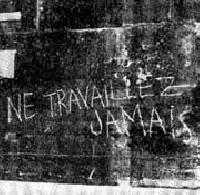
The Situationists, of whom I've been reading lately with mingled interest and contempt, celebrated "ne travaillez jamais": the new commandment riffing off the First, to keep the day holy by never working. Yet not one day, but all week. Is this really possible? Can you get by doing what you please? Outside of a generous dole in a welfare state, can one do this in a capitalist system that demands one look for work, and provide one's biopower, as Foucault phrased it, to run for profit?

The then-youthful collective at CWC tried this around the late last century. They emerged from anarcho-punk's stubborn idealism, Ten years after, amidst our Great Recession, they debriefed.
It’s tempting to brush this off as mere performance art. Yet we have to understand it as an early attempt to answer the question that still faces would-be revolutionaries in the US and Western Europe: What could interrupt our obedience? Contemporary insurrectionists are attempting to ask this same question now, though the answers many of them offer are equally limited. By themselves, neither voluntary unemployment nor gratuitous vandalism seem to be capable of jerking society into a revolutionary situation.[2] Despite everything, we stand by our initial hunch that it will take a new way of living to bring about such a situation; it’s not just a matter of putting in enough hours at the same old tasks. The essential fabric of our society—the curtain that stands between us and another world—is above all the good behavior of exploited and excluded alike.
They criticize the situation more recently. "It turns out capitalism has no more use for us than we have for it. This doesn’t just go for anarchist dropouts, but for millions of workers in the US." What had been praised as voluntary refusal for a few misfits became for many, a involuntary predicament.

I've been called out as "wanting to be with the cool kids" by hating this economic and social system we labor under. Hard work, after all, we're all schooled, is our ticket out and up. I made schooling my way out of a bleak existence, where a dog kennel represented the future, I came from a blue-collar family, living in an industrial zone in a faceless sprawl of dust and concrete east of L.A.. If not for boosting GPA and blowing off lots of fun in my earlier years, I'd never had made it to this level of education preparing me for my career. Back then a Cal and a Pell Grant, work study, and scholarships could cover a lot more than the inflated tuition everywhere now. I had no safety net, no rich uncles.

Speaking of which, when hedge-fund manager Martin Shkreli jacks up the anti-parasitical medication Daraprim he controls from $13.50 to $750 a pill overnight, one wonders about moral free markets. Under investigation for insider trading "irregularities." Claiming "altruistic motives" for this 7500% increase in the medicine he now owns, this Turing Big Pharma CEO represents the shadow under the bright benefits of enterprise where the winner takes all, and the rest can go to hell. Makes me sick.

(Update: he did renege the next day. Bernie Sanders and Hillary Clinton used this case to push for drug reform. Americans can pay 10 times what Canadians do. I'd put up with more taxes wisely spent than the medical, housing, educational, transportation, and other debt burdens we increasingly bear. But as the GOP rushes to remind us, and HRC too, we must instead invade Syria and return to Iraq.)

Some praise this system as affording the lowliest opportunity. The kid from Somalia who enters Harvard is an inspiring story. But for most of us, a global race into the havens of the elite means a lot more left beside the gates than getting in. Bill Gates did drop out of Harvard, but he made it in, and that's what counts. I am more an auto-didact than a proud product of what I did for homework, and I will give my opponents their due by reiterating there's a lot out there to help anybody near a library. Let alone online, with Duolingo, the Khan Academy, and Open Culture. So, I see the other side. I was brought up to witness the treatment of the little guy, and to beware of fat cats and golden handshakes.

The imbalance of ambition to its rewards rankles. It may seem silly to some that I carry a chip on my shoulder. My mom always hoped I'd become a lawyer. On a humbler note, I found out I make, after two decades, about the same as Kim Davis, the controversial anti-gay county clerk in Kentucky, who inherited her mother's sinecure. I know. I have no naivete that the humanities pays off like a jackpot.

I realize I am lucky to have full-time employment in an occupation where now three-fourths of us are teaching on non-tenure, often part-time "contingent" tracks. Assisted by digital delivery, the nature of my work has changed dramatically since I began over three decades ago. I am in front of a class less time than before, at least in compressed fashion, eight rather than fifteen weeks. But I also work more at home. I am online every day. E-mails replace phone calls, but I am still on call, and monitored too.

So, as this 24/7 nature of work expands over the past two decades, I also feel drawn to suss out those who articulate alternatives to our malaise. The escape from work that our ancestors had, when at least they attended a church or temple to leave their peasant troubles behind a few hours, is gone. Perhaps along with the illusion of a Stern or Loving Presence, we have abandoned the ability to settle down. That is, away from our cubicle and on our couch, the luxury of shutting out media, alone in thought. Some, cast off to search, lament this status. In dead-end jobs, underemployed, not doing what they want, they face the anguish of getting food, finding shelter, meeting the bills. They must accept any work on the offer, and they lack any choice or any privileged disdain of how the hoi polloi toil.

Unless we have the nepotism or inside connections Kim Davis or colleagues enjoy, we have to battle to keep our positions. It's easy from some Oregon squat to mock Joe Lunchpail or Jane Assistant, but dumpster diving and shoplifting will not pay my mortgage. Rent isn't cheap, credit is as alluring as quicksand, and despite our attempts at savings, many of us are near the edge if disaster strikes. We face a sharing economy where we are told to drive our cars or rent out our spare rooms to support each other. Pensions vanish, loyalty of boss to worker evaporates, and bottom-line decisions rule. Unions fade, the helping hand withdraws, and all-but-open borders enable global competition. The rooted lives some of our families had, working decades in one career in one place, are swept away.

While nostalgia is dangerous, the dissolution of family ties and the imposition of economic imperatives minimize our individual status even more. Outsourcing, offshoring, offloading. We do the work of more, if we are considered valuable enough, or work far less, if we are not. Either way, the job turns precarious. Automation and cheaper labor somewhere else combine to shove us down.

CWC elaborates: "Now erratic employment and identification with one’s leisure activities rather than one’s career path have been normalized as an economic position rather than a political one." They go on: "Capitalism is also incorporating our assertion that people should act according to their consciences instead of for a wage. In an economy full of opportunities to sell one’s labor, it makes sense to emphasize the importance of other motivations for activity; in a precarious economy, being willing to work for free has different implications. The state increasingly relies on the same do-it-yourself ethic that once animated the punk underground to offset the deleterious effects of capitalism." That is, volunteers clean up after a BP oil spill, or I might add, take in refugees in the EU from Syria on their own. The State, in the CWC reaction, expects more of us to do its dirty work. But, a left-libertarian might reason that this agency, in the hands of everyday people, is also liberating. Why should we wait for the State to help each other out?  CWS wants subversion and resistance, and end to the conditions creating poverty--and ecological ruin, and imperialist slaughter, all the same.

This all seems twisted to me into a New Age or corporate-sponsored slogan. T-shirts are peddled with Situationist art and phrases. "Do what you love and never work a day in your life," we are urged. I like teaching, but the administrative tasks and additional responsibilities can wear one out. In my tenure at LAUSD, I'd bristle at the clause "and other duties as assigned" which gave a principal total command over what a teacher could be made to do. The union must have capitulated there. Yet I find even in my own profession, how once a review is commissioned (if gratis, furthermore) or a research project assigned, it turns into homework. That discipline can motivate me, and editors excise me of the tortured or verbose tendencies of my prose and my thought-process, a necessary surgery.

But I also like roaming on my own, learning whatever I want. Duolingo for Irish, Italian, French. The Net for ideas. FB for book recommendations from my friends, or films and music to catch up on. A.S. Byatt's novel Possession was one I abandoned years ago, for in grad school I hated reading of the more privileged, less attenuated and generously grant-funded stints of my British counterparts in English Lit. Yet I remember fondly Byatt's evocation of a life where one's research and one's passions mingled, and one's reading encompassed (still pre-Net then) the immersion into thought and action. The two blended, and in that moment, a glimpse of the imagined radical future can be prefigured.

Friday, August 7, 2015

John Neeleman's "Logos": Book Review


Extrapolating the accounts of the Jewish War by Josephus with what we know of Saul-turned-Paul, the tension between his mission to the Gentiles with the Hebrew-centered Christian cult of James, the brother of Jesus, the ministry of the man born as Yeshua himself, and the influences of Philo of Alexandria, the Sicarii rebels against Rome, and the Essenes, as well as imperial machinations, this novel takes on a complicated situation. Perhaps gleaning hints how a pre-synoptic ur-gospel [called Q if not here but by German critics 160 years ago] came to be imagined and composed, John Neeleman presents his reconstruction in a sprawling tale. He makes a clever case for his bold theory of origins.

Jacob ben Aaron rises up in the higher ranks of those centered around Temple ritual in Jerusalem. Starting around the year we know as 46 when he was born, this focuses on the great revolt which for a time drove back the Romans who sought to crush Palestinian resistance. Frustrated by Hebrew intransigence, the rulers who collaborate with Rome make a convincing argument for capitulation, so as to keep a limited form of autonomy. But radicals take the lead and spark insurgency, hating Rome. Jacob learns to carry this revenge himself after sufferings hit home. To avoid spoilers, let's say that he is affected deeply and, caught up in the revolt, he survives partially driven by his own desire to fight back. He wanders from the fallen Temple around Roman territory. This allows Neeleman to introduce him and us to the teachings of the Essenes, the thoughts of the Persian Magi, the ideas of the desert Ishmaelites, and the philosophy of the Hellenized Hebrews who studied in Alexandria. All these, with a hint of Egyptian myth, build upon Jacob's childhood preparation in the Torah and the classics alike.

Neelemen cleverly creates a protagonist eager for knowledge of both great systems, sacred and profane, Greek and Hebrew, and by taking them in, he can integrate them, while remaining somewhat doubtful about the power of his traditional beliefs. At one low point, the theodicy he challenges "all seemed contradictory and an extended rationalization for failure." The "same formula," as he is told by one mentor of many, repeats the story of a nobleman anointed before being cast into the wilderness, only to overcome deprivation to be revealed "as the savior of humankind and the bearer of a word and bringer of a new and better age." This realization enables him to be open to syncretic patterns, as Jacob watches the Christian sect grow, and witnesses when Rome tries to come to terms with this restive message of liberation from outmoded ways. Jacob is well-placed to take advantage. 

"Logos is order. Logos is balance, measure for measure. Wisdom is understanding the Logos." Jacob hears this translated from lofty concepts to clever realpolitik by one well placed to put this into effect. The demand is that while "the will to power, desire, money, sex" may all be "stigmatized" as passions unbecoming the new world order, the fulfillment will entice many into the embrace of "good news."

Neelemen lines up many personages, and while their conversations as in such accounts may imitate the didacticism and erudite tone of the classic and ancient tellers in his own prose, this stately pace does blend with the feel of an antiquated chronicle. The expository content, as many doctrines, disputes, and dissidents have their lengthy say--often with citing Scripture as readily as does Jacob the epics--slows modern expectations. But judiciously dramatized battle scenes, frank but honest sexual encounters, and a determination to endure make Jacob's journeys worthwhile, especially after he must leave his hometown of Jerusalem. This mixes a coming-of-age saga with an novel of ideas, too. To sum up, if you wish an expansive but thoughtful examination of how Christianity might have evolved in its earliest days, as one man in the flesh became the creator of the word as Logos, it's here.
(Amazon US 3-10-15)