Showing posts with label San Francisco. Show all posts

Tuesday, February 21, 2017

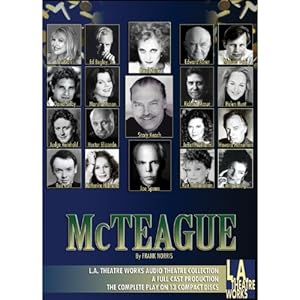
Frank Norris' "McTeague": Audiobook Review


"Melodrama from old San Francisco"
What did you like best about McTeague (Dramatized)? What did you like least?
I liked the melodramatic flourishes of McTeague and his fellow rogues. The naturalism of Frank Norris a century-plus ago comes off very strong here, and the narrative feels very dated. That is its strength, as it captures the down and outs of S.F. well, but it's repetitious and heavy-handed.

Would you recommend McTeague (Dramatized) to your friends? Why or why not?
It's probably more entertaining to hear the novel dramatized by an enthusiastic cast. But you need patience, for at eleven-plus hours the plot goes on and on, wearing out its welcome.

Have you listened to any of the narrators’s other performances before? How does this one compare?
I liked the L.A. Theatre Works' "Babbitt," done in similar form by a cast of (as of the late 1980s) respected actors. Sinclair Lewis' was a bit more skilled at narrative than Frank Norris, but the social message type of novel both men favored is suitable for such radio ensembles.


Was McTeague (Dramatized) worth the listening time?
It was fun, as I chose it for a drive across the California desert. Let's just say it remains in The City for most of its running time, as I cannot give away any plot spoilers. It's a period piece I always meant to read, and hearing it kept me entertained despite repetitious prose.


Any additional comments?
Perhaps this was published as a serial? The novel keeps repeating the same phrases for certain characters, and passages verbatim or near it come again to remind readers of the action or the characters. Still, for all its moustache-twirling menace, it's a reminder of the harsher conditions endured by ordinary men and women in urban California, little romance at all! (Audible US 2/16/17)

Tuesday, February 2, 2016

Alex Ogg's "Dead Kennedys: Fresh Fruit for Rotting Vegetables: The Early Years": Book Review

Intended as liner notes for the 25th anniversary of this punk album, Alex Ogg's project had to wait five more years for what turns into a longer book on a thirty-eight minute 1980 LP. Legal disputes over songwriting credits, added to the protracted resentment between singer Jello Biafra and his bandmates, notably guitarist East Bay Ray and bassist Klaus Flouride, tested the patience of the author and the Dead Kennedys, past and present. This story, told efficiently by a veteran chronicler of punk, reveals that the American underground in the late 1970s could match the best of the British punks when it came to political commentary paired with feisty music. Furthermore, unlike so many righteous punks before and after the DKs, this San Francisco outfit retained its sense of humor. However, as an Angeleno, growing up a near-contemporary of the band, I challenge Ogg's claim that this was the peak of proto-hardcore. To me, the band's debut resembled the blur and buzz of the Germs' first LP. I'll admit that unlike that short-lived L.A. band, the DKs outlasted Reagan's first term. Ogg as the subtitle shows narrates the start of it all, but he stops very soon after the album's release and their first tour.

How the DKs scaled the summits of the American independent label punk scene so rapidly, Ogg reminds readers, can be credited to their discipline. More on the intellectual influences informing the band members might have answered the question of how they managed so quickly to create two classic singles, "California Über Alles" and "Holiday in Cambodia". Within this milieu, few dared to roam beyond a few "provocative" topics. Most punk bands preached against racism, some against sexism, many against conformity, as expected for spiky non-conformists to conform.

Biafra, raised in Boulder, Colorado, and apparently embittered at delivering pizzas to smug lefty college kids his own age (he dropped out of an equivalent institution early on, the University of California, Santa Cruz, tellingly), decided to widen his target range. He spoke for an overlooked echo-boomer generation, coming of age during Watergate, too young to be hippies, but who had to listen to those not much older ramble on over and over about how great it was then and how dismal it all turned out by 1980, as youth woke up from years of Carter's malaise on the morning after, snuggled or smothered by Reagan's revived or reviled "values".

Although now a balding, gray statesman in cahoots with the state's prison guard union, cutting deals with corporate sponsors, while managing in his return to rule to convey a pale-Green image in keeping with his earlier gubernatorial reign, Jerry Brown for the late 1970s represented to this band a "Zen fascism". Risible though this seems to this Californian critic in retrospect if not to Ogg, who takes this (semi-)seriously from the mouth of Jello, this song roused "the suede denim secret police" who were bent on arresting "your uncool niece". Evoking Nazi imagery if spinning the shock value trafficked in such regalia by certain punk colleagues, "Come quietly to the camp/ You'd look nice as a drawstring lamp" conveys its own uneasy message. Biafra's message, within the jerky anthem's campy medium, either strengthens or weakens its lyrical conceits. The song lives on, covered often.

Its follow-up, "Holiday in Cambodia", has garnered fewer cover versions and parodies. It's a darker song, as its Pol Pot theme dramatizes, and it's more disturbing. It castigates those smug Boulder or Berkeley collegians, those who curry favor with bosses, those who pretend solidarity with the masses. It contrasts this mindset with what would happen when the self-proclaimed progressives of the West go East: "Well you'll work harder with a gun in your back/ For a bowl of rice a day/ Slave for soldiers till you starve/ Then your head is skewered on a stake." Ogg skirts extended exegesis of these two songs, assuming that readers as listeners probably know them well, but he does take pains to, in true rock journalist fashion, tell us about the vintage tube microphones used to capture this song's roar.

Without the churning, Echoplexed, surf-tinged guitar of East Bay Ray, Klaus's doom-laden bass, and drummer Ted's bashing backing, these songs, for all their lyrical baiting, would not have succeeded. Ogg credits Jello's voice as a "human theramin" and attributes a Kabuki-like ranting and wailing for impact. Many listeners to the band, myself included, have found Biafra's self-consciously theatrical delivery trying, but in live shows as on record, the DK's sought to stand out from punk yammering.

Boosted by Geza X's production of "Holiday", these singles remain arguably the band's best vinyl moments. Geza X (member of the L.A. band the Bags, on production he crafted early releases from Black Flag, Weirdos, and the Germs, as well as San Francisco's Avengers) labored to make this song wail, so it's a shame that Jello's wish for him to produce their first album was rejected by the rest of the band. To me, this decision dulls the sonic power of Fresh Fruit, and it feels muffled as a result.

Recorded for $10,000, the album appeared in 1980 on the British indie label Cherry Red. Ogg reminds readers that between the Dickies signed by A+M in 1978 and Husker Du by Warner Brothers in 1985 (and by then, they were not really part of this scene anymore), no American underground band had been issued on a major label. The DKs started Alternative Tentacles to issue their records.

Distributors IRS had balked, due to a distant Kennedy acquaintance, from releasing the album, for the barbed band name (amazingly or inevitably, preceded by a Cleveland band who then declined to go on with the same moniker) led to many double-takes and dead-on-arrival rejections by the record industry. Tracks included hints of musical influences as diverse as Duane Eddy's guitar, Buddy Holly's vocals, MC5's slogans, and Sparks' lyrics, attesting to the band's affection for their childhood idols. It ends with a throwaway cover of Doc Pomus and Mort Shuman's "Viva Las Vegas", made famous by Elvis Presley. True to the LP's prickly, brooding, snarling vibe--part Travis Bickle, part Mothers of Invention--the production was credited by the band to the friendlier of engineer Oliver DiCicco's two cats, Norm. Neither Lester Bangs nor Robert Christgau welcomed the record; the latter critic disdained its "Tiny Tim vibrato". Biafra sneers throughout the entire record, true, but this "sustains" Ray's guitar tremelo; it suits the frenetic delivery Jello Biafra adopts for his stage persona.

The original band was already splintering during the making of the record, with second guitarist and oddball even by DK standards 6025 soon departed. A new drummer stepped in--later to claim some of those songwriting royalties which have earned the ire of Jello vs. Klaus and Ray, one learns if in diplomatic fashion via the long-suffering journalist Ogg who patiently hears each side out as they argue. This underlying subplot, still rankling these early band mates today, provides a telling coda to the ambitions of many in the punk era to make a career out of their passion, vs. the compromises the original lineup fended off in their attempt to remain independent of corporate tentacles and truisms.

"Yakety Yak" compiles quotes about the band and album by celebrities in and beyond the rock scene. A closing chapter by Ogg's co-author of The Art of Punk, Russ Bestley (reviewed by me 22 October 2012), titled "Grafical Anarchy" shows how collaborator Winston Smith (who legally changed his name to that Orwellian protagonist) conspired with Biafra to create collages inspired by Situationists.

The LP cover never got the reproduction Judith Calson's San Francisco Chronicle photo deserved. This was taken during the "White Night Riots" following the short sentence handed down to Dan White after his "Twinkie Defense" for the shooting of Harvey Milk and Mayor George Moscone in 1979. The front cover shows three police cars on fire; the back cover shot of a hokey music combo led to lawsuits by one of its members, so this image was defaced or replaced on later pressings. This pattern would repeat during the band's career, although Ogg avoids much mention of more litigation.

The political subtext of the band gains some attention by Ogg, but how the members gelled to create these singles and the album from a perspective tinted by their predecessors from the 1950s and 1960s whom other punks might have disdained needed more elaboration. Bestley gives a nod to this crucial continuity as context links what the San Franciscans were doing, with jarring détournement (literally "re-routing): cut-up montages from ads, photos, and pamphlets arranged to shake the viewer up. Smith's Fallout Magazine helped rally recruits to the DK cause, but its contents and range do not earn the coverage that could have explained how printed texts and posters widened the band's DIY appeal. Certainly AT's mail order reach, and diligent product placement in indie record stores, accounted for the international audience the band garnered early on, into their heyday, and up to today. Given Bestley and Ogg's knowledge of these multimedia within political punk, more coverage was needed.

Jamie Reid for the Sex Pistols and Gee Vaucher for the English anarchist collective Crass served as counterparts in this guerrilla art form of collage as cultural critique. This packaging boosted the Dead Kennedys' impact. The band and Smith wrapped its records in striking artwork and album inserts. Among punks today, their red-and-black logo endures, but Ogg and Bestley glide past how those two symbolic colors might or might not stand for the band's principled assertion of anarchy. The band's commitment to radical politics as well as pranks and poses needed more elaboration.

Yet, as Biafra (an eventual Green Party presidential campaigner, he came in fourth in a nine-way race for S.F. mayor in the fall of 1979 to replace Moscone) reminds Ogg, Jello mused on what the DK's might achieve: "imagine if Crass was funny". The DKs were. Whether this ensured their success or failure, you are left to ponder, given the eclectic evidence Alex Ogg, Bestley, Smith, and photographer Ruby Ray present for our inspection. (6-13-14 to PopMatters + edited to Amazon US)

Tuesday, January 6, 2015

David Mitchell's "Cloud Atlas": Book Review


I'd been meaning to tackle this over the past decade; I wanted to see the adaptation by the Wachowski siblings released in late 2012. In of all places Park City, Utah (home of Sundance), in the off-season, Layne and I missed it and so opted for "Argo" (cheap ticket) in an exurb faux-Western mall. I tried that Christmas to rally my family after we bickered over Zero Dark Thirty and Django Unchained and I held down my paternal foot as I wasn't in the mood for either to celebrate the mythical birthdate of the purported Prince of Peace. We chose neither, settling on On the Road. Rarely do I venture into a theater these days, grousing as I do at people. prices, popcorn and promotion, but when I do, I want to see a spectacle enhanced by the big screen. I'd heard that ambitious adaptation of a sprawling narrative was met with bewilderment or annoyance; I'd reckoned the po-mo structure of the Booker Prize finalist (not for the first time for this 2004 entry) would baffle viewers as it did some readers. I left it unseen and still shelved.

Then, investigating "Buddhist Fiction," I found UU World nominated it for its shortlist. Dozens of copies (credit post-Matrix buzz!) were checked out of all L.A. and Pasadena libraries, but South Pasadena had it. I grabbed it. I took it along on too-brief an out-of-town trip, and I enjoyed it. Not sure if I loved it. The uphill climb for its first half is more rewarding: the challenge invigorates you to keep going. It accelerates into the curve, and through its central section. Out of that turn, it's downhill. The novel's easier to read, moves rapidly, but there's a sense of anti-climactic ennui. That may fit well the nature of David Mitchell's investigation of repetition and reincarnation, all the same.

This entry covers the passages explicating the themes I found most intriguing. It doesn't delve into the "Russian doll"-structure inspired by Italo Calvino's If On a Winter's Night a Traveller (as I suspected long before learning Mitchell in 2010 via The Paris Review credited that novel I loved thirty years ago) for the 1-2-3-4-5-6 then reversed arrangement--as this is now common knowledge. 

"The Pacific Journal of Adam Ewing" features a Melville tone: Typee is mentioned later on. South Seas are visited by an American notary from the new city of San Francisco as the Gold Rush erupts. Afflicted by a worm entering his brain carrying a mysterious malady, Adam falls into the care of one Dr. Henry Goose on the voyage on the Prophetess. The style flows easier than much of (the later) Melville: "As Henry & I ate supper, a blizzard of purplish moths seemed to issue from the cracks in the moon, smothering lanterns, faces, food & every surface in a twitching sheet of wings." (39) We later find a typically casual recurrence of an image in the central story on the Big Island of Hawai'i: "Papery moths blowed thru her shimm'rin' eyes'n'mouth too, to'n'fro, yay, to'n'fro." (264)

"Letters from Zehelgem" might have been penned by John Banville or Julian Barnes. It's the type of contemporary novel that's shortlisted for a Booker Prize--as Mitchell a two-time nominee may know well. In the early 1930s, composer Robert Frobisher flees Cambridge, debtors, and justice by presenting himself in Belgium as an amanuensis to his elderly counterpart, and soon rival of sorts, Vyvyan Ayrs. Frobisher's flight from apprehension to Calais sums up his spirit: "Dover an utter fright staffed by Bolsheviks, versified cliffs as Romantic as my arse and a similar hue." (46) 

The tattered book he finds in Ayrs' manse, or half of it, is Ewing's journal, published by his son. In turn, "'Half-Lives': the First Luisa Rey Mystery" continues the saga as the recipient of Frobisher's letters back to England, Rufus Sixsmith, returns at the age of 66. He's a successful nuclear physicist in the late 1970s in California. But he's restless in Buenas Yerbas (a reversal of an early placename for S.F., by the way.) "West, the Pacific eternity. East, our denuded, pernicious, enshrined, thirsty, beserking American continent." (89) His career and his stance on this energy does not please a sinister (naturally) Seabrook corporation. Out of this, one "Hilary V. Hush" generates a pulp thriller, full of chases and conspiracies.

"The Ghastly Ordeal of Timothy Cavendish" takes us to that middle-aged, put-upon middle man, in contemporary England, who runs a feeble "author partnership" press: in its slush pile lands the first Luisa Rey mystery. He deals with the aftermath of a cause celebre where the writer of Knuckle Sandwich meets sudden notoriety, and the attention generates fame and profits for Cavendish. Flush with the proceeds, all seems it will go well, until it doesn't.  Kingsley or Martin Amis might be at home here. Consider this look as Timothy must flee from London: "you sly toupeed quizmaster, you and your tenements of Somalians; viaducts of Kingdom Brunel; malls of casualized labor; strata of soot-blackened bricks and muddy bones of Doctors Dee, Crippen, et al.; hot glass buildings where the blooms of youth harden into aged cacti like my penny-pinching brother." (161) 

On his journey north, Cavendish raises a theme common to Mitchell's characters: "we cross, criscross, and recross our old tracks like figure skaters." (163) His story stops suddenly (as do others), and we leap into an indeterminate post-apocalyptic future where a Korean superstate dominates a blighted planet. "An Orison of Sonmi-451" in the fashion of Haruki Murakami or Philip K. Dick follows an engineered fabricant's entry into sentience. Escorted out of her climate controlled confines, she confides to her listener the strangeness of a natural reality: "Trees, their incremental gymnastics and noisy silence, yes, and their greenness, still mesmerize me." (202) In such phrasing, the beauty of Mitchell's observations freshen the familiar. 

"Sloosha's Crossin' an' Ev'rythin' After" occupies the core around which the other stories are mirrored in two, or tucked into. Zachry's telling recalls the altered language of Russell Hoban's Riddley Walker, as well as the dialect and the quest of Huck Finn as one society's fragility is shattered by the arrival of tension, disruption, and unsettling values and ideas. These, filtered via Meronym from an enclave beyond the insular Valleymen, force Zachry to come of age in a brutal clash of cultures and enemies. The Valleymen are visited by Meronym, and Zachry learns why they have ventured so far across the ocean. What has happened after the demise of Nea So Corpros as the Korean hegemony is little understood; Meronym and a few Prescients guard a few factual or mythic gleanings against predators and plague that roil the globe and the miniscule remnants who've survived Earth's collapse.

The Old 'Uns have died off, and ignorance is their legacy to the stragglers who struggle after the meltdown. "Smart mastered sicks, miles, seeds an’ made miracles ord’nary, but it din’t master one thing, nay, a hunger in the hearts o’humans, yay, a hunger for more.” (272) Civilization vs. savagery tears apart the survivors: it's as if delayed gratification eliminated the consumers and capitalists, the warlords and the masses unable to wait and think before rushing to buy, spend, fight, grab, grasp. "Old 'Uns got the Smart o' gods but the savagery o' jackals an' that's what tripped the Fall." (303)

The novel then proceeds to wrap up Zachry's chronicle and propel us back the same way we came in. Although Cavendish sniffs: "As an experienced editor, I disapprove of flashbacks, foreshadowings, and tricksy devices; they belong in the 1980s with M.A.'s in postmodernism and chaos theory." (150) Of course, such devices long predate what was my own long slog through this at just this time in grad school and my own collegiate reading in and out of class. Mitchell applies these through such images as the moths cited earlier. It's not that difficult a novel to follow as some grousing readers and critics lamented; anyone who can read Calvino's tale can handle this. The second half, however, moves rapidly and feels often somewhat less engaging as the puzzle-pieces neatly snap together in turn. 

One device that audiences apparently needed a visual guide and a screenplay reboot for in the (unseen as yet by me) film version was the comet-shaped birthmark used by Mitchell to suggest reincarnations or rebirths of protagonists.  On pg. 85, Frobisher introduces his; Luisa finds this
and matches it to her own despite "I just don't believe in this crap" (120) and she tries to talk herself out of it as a coincidence. (122)  Zachry sees on Meronym her "whoahsome wyrd" one just below her shoulder blade in the light of Lady Moon (303); Cavendish reasons such an image "will have to go" if the Luisa Rey "young-hack-versus-corporate-corruption-thriller" will succeed on its potential. "Far too hippie-druggy-New Age"--a sentiment I've found echoed by some resenting the storyline as a novel or a film. (357)

Given as the UU World site and its counterpart study include this on a list of "Buddhist fiction," and granted the Cambridge-trained, now County Cork resident writer married to a Japanese woman and immersed via his fiction in Asian settings, there's no escaping placement of this novel into this niche. Yet, it rests there lightly. 

In "Orison," Sonmi hears from an Abbess (this rank continues among the Valleyman's cult of ancestor worship by icons in barrows on the Big Island) from the ranks of "recidivists" in a cave hidden as a safe house for her and other "tapeworms" who huddle off the corporacratic grid. For "fifteen centuries," nuns have persisted there. A stone figure (resembling of all people Cavendish) named Siddhartha "is a dead man a living ideal." (330) Little is known of the man; his "names" tellingly as well as his doctrine have been forgotten, after the Abbess's elder mentors had been eliminated when "non-consumer religions were criminalized." (The prediction made by the Buddha that after 2500 years his own message would gradually fade comes to mind; the rule of the Corporation-State forming around us may presage "Maitreya" ending the next span of five thousand years as the Buddha's successor. But such speculation lies outside the margins of Mitchell's ambitious narrative.) Sonmi manages to wish for reincarnation in the "colony" and on departure, the Abbess promises to relay her wish to Siddhartha. Later, Zachry will unlock an orison brought by Meronym that reveals Sonmi, whose cult will spread until she has been elevated to a goddess status by the Valleymen.

Progress, these shifts in belief and power, and earthly fate concern others in this novel. Earlier, Frobisher remarks on an aquatint of a Siamese temple. He compares its lore as it's relentlessly ornamented and improved: it will one day be equal to "its counterpart in the Pure Land" (81). Then, humanity's purpose fulfilled, Time will conclude. Frobisher offers an alternative analogy. Like Ayrs, the edifice rises upon the backs of ignorant and anonymous labor, and civilization claims its resplendence through those statesmen and artists who take the credit for themselves, as "architects, masons, and priests."

In the fittingly titled "'Half-Lives': the First Luisa Rey Mystery" Isaac Sachs contemplates the actual vs. a virtual past. The Nietzschean will-to-power enters Vyvyan and Robert's verbal sparring, and by this later section, the Sixsmith Report of Frobisher's correspondent stands for the threat to this humanist resistance against the machine men and women build (like that Siamese temple?). Sachs proposes a virtual past (as in the legacy in story of the Titanic outlasting the memories of its "real-time" survivors) and wonders how corporations and governments will co-opt this. 

Sachs continues to sum up the greater novel he's part of unwittingly. "One model of time: an infinite matryoshka doll of painted moments, each "shell" (the present) encased inside a nest of "shells" (previous presents) I call the actual past but which we perceive as the virtual future." (393) Naturally, comparison of this structure to a Buddhist (or post-modern) conception of impermanence and instability within the stories we tell and which we tell of ourselves opens this up to a neat critique***.

A few pages later, Luisa and a boy, Javier, discuss what if one could see the future. Javier asks: would you want to? Luisa hesitates, wanting to know if the future so seen could be changed or not. (401) She ruminates that acting now in the expectation of what the future holds may trigger that future scenario. "What happens in a minute's time is made by what you do." She leaves the conversation wondering inside her head about this "great imponderable." "Maybe the answer is not one of metaphysics but one, simply, of power."

Necessarily inconclusive, this novel of ideas in its last segment, a reprise of "The Pacific Journal of Adam Ewing" deals with civilized incursions across the globe, and how power forces change and alters presents and futures. "Ships bring disease dust here," Mr. Wagstaff observes to Ewing as they land at a Christian settlement on Rataoia in the newly named Society Islands. The natives die off, slaves are imported from other islands, and the natives decline in fertility as religious fervor does not inspire fecundity. "To kill what you cherish & cure," Wagstaff smiles, "that seems to be the way of things." (486)

Countering the missionary endeavor and its social Darwinism with humanist reasoning, Adam denies any rules in history. He affirms only outcomes. "Vicious acts and virtuous acts" spur results. (507) These acts emerge from belief. To fight "the 'natural' order of things," confidence in human qualities beyond selfishness impel idealists such as Ewing. He vows to become an Abolitionist (we glimpse this cadre in Sonmi's fearful realm), and he vows to become a force for change, even if but "one drop in a limitless ocean." (509) With that promise, we place back the novel's last nestled doll, or its first. 

(Amazon US 3-5-13 in shorter, depersonalized, slightly rewritten version. ***I've expanded the Buddhist and post-Buddhist, Marxian and anarchistic associations spun out of the encounter between Sonmi and the Abbess about Siddhartha in comment #2 replying to "A Spectre Is Haunting Buddhism: Give Marx Some Credit," by Glenn Wallis at Speculative Non-Buddhism on 3-7-13. I extended that into more countercultural contexts on 3-9-13 in comment #11 and virtual realm applications on 3-8-13 in comment #6,)

Sunday, November 23, 2014

The Aislers Set's "Terrible Things Happen" + "The Last Match": Music Review


The Ronettes cover Joy Division. This was my first impression when, a decade ago when browsing at Amoeba Records in Hollywood, I heard this San Francisco band playing over the speakers. Their third CD had just been released. I asked the clerk, I found it, and I bought it. 

What I heard, when I sought out the previous records by Amy Linton and her colleagues, was a sound that endeared me to their post-punk indie pop blend. However, when I downloaded many of tracks I liked best, I also skipped over a few on each album. For, The Aislers Set dashes between atmospheric or jaunty evocations of longing and love, and chirpier, more twee tunes that left me less moved, if respecting their craft.

The Suicide Squeeze CD and Slumberland Records LP reissues (no rare or bonus tracks, unfortunately) of The Aislers Set demonstrate how much of the Set's impact comes from singer-songwriter Amy Linton and how much from her nimble band mates. They began to enter the line-up halfway into the making of her self-recorded debut. Terrible Things Happen (1998) had started in Linton's lodgings, and it keeps some of the homespun drone-pop of her former band, Henry's Dress.

"Friends of the Heroes" opens the first album typically, with downbeat post-punk guitars and Linton's forlorn presence. "California" mixes in well-paced acoustic textures, but it sours its summer setting with whirring electronics, ominous bass, woozy vocal backing, and thundering drums. "Holiday Gone Well" similarly, plays its title against its start, as industrial rhythms hammer. They fade into a passage reminiscent of Joy Division, careening down into a voice rising from somewhere deeper. A blend of delicacy ("I fell in love again") and uneasy emotion, as the track chugs along, introduces true talent.

Slowing down, "Alicia's Song" roams into girl-group turf from more than thirty years before. (Critic Jack Rabid has compared Amy Linton to Shirley Alston Reeves of the Shirelles.) Measured drums and a sparer use of keyboards accentuate the texture of this, as it uses traditional arrangements to pay tribute, but not to imitate, Linton's forebears who sang of love, lust, and loss as they all reverberated.

This segues into "I've Been Mistreated" in similar fashion. The guitar swirls down into a melodic drain. Here, Linton's songwriting continues to reveal a knack for combining old and new, as if 1966 Motown met 1977 Manchester. Critics have found traces of groups as diverse as Belle and Sebastian, My Bloody Valentine, and The Who in her modest but impressively constructed productions, but to me, The Aislers Set, whether more of an early solo project or the later band, cuts out a fresh template.

"Mary's Song" shuffles along, indicative of the varied pacing on the band's albums. All three tend to fall off in energy as they progress, but on this first release, the energy sustains itself longer. The tracks move from early delight or delusion into delicacy and dissipation. Wyatt Cusick, a multi-instrumentalist, takes over the mike for "Why Baby"; his voice reminds me of Will Schwartz, from another inventive, sometimes surprising, queasy pop band from The City, Imperial Teen.

Mathematical wordplay enlivens "Long Division"; the remaster improves on the warped, appealing, if very lo-fi production on the 1998 disc. Reminiscent of Lou Reed's guitar in its more relaxed mood, "London Madrid" allows Linton another round of tambourine and plucked bass. Some songs on this album feature Cusick and drummer Yoshi Nakamato, stalwart support for the stolid or sly Linton.

A very minimal "Cocksure Whistler" uses only a subtle strum to back up Linton's lyrics. Returning to the depths where the bass digs in and voices strain to rise above, "Army Street" imitates its title, as if a regimented stretch beneath a tall concrete wall, or a hundred barriers. The attempts at cheer in "Falling Buildings" again clash with the title, as the lyrics seem to scrape out an admission of defeat. Whether its of Linton or her rival remains uncertain in her blurred articulation. The atmosphere of "Jaime's Song" filters from a distance Linton's chimes and voices, overlain in elegant, languid layers.

Finally, "My Boyfriend (Could Be a Spanish Dancer)" ambles along in catchy style, as if a garage-band's hit from the era so much of this album captures, yet does not mimic. For instance, the drums careen about, throwing off playfully the jaunty beat, and upending it just for fun. In this way, updating the sounds of the past, post-punk and girl-group, on this reissue, these songs remain some of Linton's best. Critics tend to assume she and her band, as she expanded her solo project, improved in range and execution with other two albums, but they both spin away with many downs as well as ups.

Keyboardist and bassist Alicia Vanden Heuvel joins for The Last Match (2000). While this is ten minutes shorter than the first CD, its uneven sequence, and wider influences as others contribute to the Set's sound, make it a challenge  that perplexes as well as pleases the listener. 

The punchy "The Way to Market Street" boasts improved production as it compresses the old-new influences of the first record into an organ-backed, percussive, civic celebration. More retrospective than previous songs, "Hit the Snow" recalls what the Beach Boys might have penned if they lived in more frigid climes. Cusick's "Chicago New York" delivers what many may interpret as an homage to Belle and Sebastian. More typical for the band, "One Half Laughing" roars with organ fills, sighing la-las from Linton, and spirited guitar-bass-drums crunch. Here, the girl-group sashay mingles with the surf-speckled strut, in a closely miked combination of two 1960s genres for a forceful pop tune.

Blondie might have been jealous of "Been Hiding". It brings that band's female-dominated perkiness into a more aggressive guitar arrangement, but one still recalling that patented Phil Spector Wall of Sound. The crunchy interplay of instruments over Linton's soft voice in the lofty "Balloon Song" (from fellow Slumberland act 14 Iced Bears) shows off the band at its most effervescent, and how it works best in short bursts with sturdy riffs. Back for "Lonely Side of Town", Cusick offers a lighter, piano-based contribution to balance our the ambitions of his band mates on the louder, denser tracks.

The title track soars as if effortless. Over, or under, an orchestrated instrumental bank of rising sounds, Linton incorporates horns to highlight her graceful appeal to "tell me something nice".  Continuing the tribute to the power of the keyboard, "Christmas Song" integrates sleighbells over another construction of sounds, as the band proves it can deliver a satisfying track without a singer.

Sidling into spaghetti-Western territory before wandering back to the haunts described above, "The Walk" lags, by comparison. The surf-guitar and punk bashing of "The Red Door" revive memories of Linton's roots, as well as a reminder of the band's ability to kick in amplification and feedback over what can be quite an atmospherically diverse CD. Only 35 minutes, it can feel epic, if uneven, too.

As proof, the skittering "Fairnt Chairnt" while better in its remastered version still lacks the staying power of the album's best riff-laden selections. None of the songs on either album fall flat, but if a handful had been originally cut, these albums might near classic status. Cusick shows on "We Give Up" that he can handle a more aggressive song as frontman, but as it lacks the depth and intricate structure of some previous standouts, it remains by comparison satisfactory and not a standout. Yet this attests to the strengths of these two imaginative albums. With a title like "Bang Bang Bang" closing this second CD, one has no idea what to expect. It's a gentle, spare coda, as Linton reflects.

These remasters pound the instruments into your ears. They deepen the vocal separation from the percussion, bass, and guitars. The original CDs had a tinny, warbled charm, but they also wore one out as Linton's appealing if mannered delivery worked best in three-minute doses. So, you may find yourself compiling, as I have, an Aislers Set playlist. I often play it in the starting stages of a long jet flight: the tones fit departure, and its giddy balance between pressure and its release. Many of the Set's moods prefer melancholy. They mass guitars behind a yearning woman's small, echoed voice which demands attention. After all, it first caught my ear above the clatter of hundreds of CD cases thumbed through by hundreds of customers in a cavernous, cement floored, Hollywood record store. 
(PopMatters 10-24-14)

Sunday, September 7, 2014

Lewis Buzbee's "Blackboard": Book Review

A product of the golden age when California's postwar public schools were ranked first in the nation, now a writer of children's books, Lewis Buzbee returns to where he started, nearly a half-century ago. From kindergarten, he moves through his elementary, junior high and high schools, before summing up his stint at three institutions of higher learning, and then his career teaching writing to extension students. Throughout, he briefly explains how education has developed, and he blends light analysis with his own quest as a student.

In the Santa Clara, pre-Silicon, Valley, he began in 1962 at Bagby Elementary, one of many sprawling, open-aired, low-slung, baby-boom, suburban schools, this one built a year before he was born. He finds much the same expanse today, and he juxtaposes his younger self as he stands in the same classrooms. The poet and creative writing instructor that he is now surfaces, as in this passage: "Mrs. Babb would be grading papers at her desk, and I would be standing just outside the classroom door, thwocking the erasers together, teacher and student working in concert somehow, me watching the words and numbers and ideas from the previous week as they drifted across the playground." While whiteboards and dry-erase markers replace the chalk-dusted, eraser-powdered, durable black or green boards, those lasted two decades, he tells us, while today's stolid computers may be turned over every two or three years now.

He shows how kindergarten, as a garden to cultivate the minds and bodies of children, grew from German reformer Friedrich Froebel in 1837; the roots of "school" burrow back to the ancient Greeks, who used the word for learning together as derived from the one for "leisure time", denoting what for millions of children elsewhere in the world may still be an unachievable dream, the freedom to learn.

This opportunity, when Mrs. Babb called upon young Lewis to show his work at the black or white board, comes with struggle. "School can, in its best form, allow us to move beyond our terror."  Buzbee relates his own fear of "showing" math problems, and he reminds us how school, with supportive teachers (one can never fully account for the same patience in one's classmates), can overcome our uncertainties. He reveals how not only at Ida Price Middle School but in his bass guitar lessons on the side, being a successful learner demands one take risks. He mastered skills by memorizing times tables, musical scales, or French conjugations. These mental exercises, as with a guitarist figuring out riffs, cut grooves into the mind by repetition. These years of drill and discipline, as he recounts from lessons in junior high and at Branham High in San Jose, turned him away from a working-class household, where he struggled with doubt, into a confident, college-bound student.

Part Two tells of his shift from orientation to matriculation. While the transformation as a young adult in the mid-1970s was less swift than the two years of junior high, where he entered liking Bobby Sherman's sappy "Honey" and left humming the Beatles' menacing "Helter Skelter", Buzbee kept testing himself. After a year at the University of California, Santa Barbara, he returned to the Bay Area to be near a girlfriend while attending the local junior college. He praises evenly the highlights of both places, followed by the completion of his degree as an English major at nearby Santa Clara.

After that, he rejected a career as a high school English teacher for one as a writer. Successful enough to live in San Francisco, he returned to the classroom to teach creative writing, first at Berkeley and then the University of San Francisco in extension programs. He adds his own continuing education as a student, this time learning how to draw. Meanwhile, he compares the progression of his daughter, Maddy, with his earlier journey through California's public schools. They have changed, certainly.

Educated at a Montessori kindergarten, a French immersion grade school, and a Friends junior high, Maddy represents a generation raised by parents unwilling to commit their children to decaying city schools even as they wish they could improve. As my wife and I are the product of Californian public schools in that golden age (and former teachers in the Los Angeles schools ourselves in a far more tarnished era full of cutbacks, unrest, population growth, and declining standards among both faculty and students), we had sought alternatives, however rickety or utopian, for our children, educated within our city's similarly declining system. So, I understand Buzbee's dilemma. He may sidle past certain problems; he tries to solve others. He concludes with seven strong recommendations.

First, he would halve K-12 class sizes. Doubling salaries, while tripling those in junior high, he would have new teachers mentored, giving sabbaticals every fifth year. He'd happily, showing his NoCal leanings, tax away to pay for this, as well as classrooms reliably hot in winter and cool in summer, stocked with supplies, and surrounded by open space. (One casualty of urban overcrowding on many Californian campuses is the loss of fields and P.E. for overstuffed two-story, rather than open-plan, classroom structures resembling motels, by the by. He does admit that desks have increased in size, to account for the spike in childhood obesity.) Finally, Buzbee would enable daily time to stare out the window. He'd also abolish bake sales to raise funds for strapped schools.

This ambitious plan, with a touch of Swift's "Modest Proposal". pivots around the simple fact that schools are not factories, and mechanization is not the answer to what human enterprise can do. As a father of a private high school student, Buzbee assures us he will be happy to pay higher taxes so that the rest of the public school youngsters in California (and the nation) can enjoy the golden age of education which he, myself, and millions once did. If only my sons, his daughter, and millions of our neighbors' children (and adults) could do so now. (Author's website; PopMatters 8-5-14/ Amazon US)

Tuesday, August 19, 2014

William T. Vollmann's "The Royal Family": Book Review

After I read the gloomy obsessions of love or lust in the companion piece for this novel, in the briefer "Whores for Gloria" set in the Tenderloin and "The Butterfly Stories: A Novel" in Thailand, a sustained immersion into, as of the early '90s, the not-quite-tamed streets where Vollmann lived and wandered takes its time as it draws you in. Whereas the two earlier novels followed a misfit narrator into the lairs and bars where women plied their trade and sought to secure his affection, for this 2000 noirish tale, we get a gumshoe protagonist and sly antagonist who are brothers, to square off. 

Yes, Cain and Abel, good and evil, are early on referenced via the Gnostics. Vollmann sets up well in its early stages the predicament of another forlorn woman whom the main character longs to comfort and keep, but cannot. Whereas Jimmy (he gets a cameo here, and so does the author as a "moon-faced" journalist) for Gloria and the "journalist" for Vanna in "Butterfly" found their fevered quests dragging them deep, Tyler (Hank to his louche lawyer brother, John) loses his brother's wife, Korean-American Irene, to death. Her plight, like that of other bereft men and women Vollmann tends to listen to and dramatize (such as John's mistress Celia), lingers. We miss her. Accepting his depictions of these beaten down folks, we side with Hank, Celia, and Irene. These, to me, proved more engaging than the tales of grimy johns.

Into this seedy situation, Tyler's sent by one Brady (a cartoonish conveyance of greed and prejudice, reminding me of the White Power + Light villains in "You Bright and Risen Angels") to seek out the Queen of the Whores; his brother is also hired by the same tycoon, so the two stare each other down. John is a wonderfully boorish greed-is-good type, akin to the photographer in "Butterfly"; against him, Vollmann uses the familiar for him perspective of the bullied boy turned hesitant man as Tyler.

Not only San Francisco's fog and vistas but Sacramento's railyards and dust gain attention, too. There's a pleasure in viewing California through Vollmann's eyes, and after the urban clang and urine smell evoked in the Tenderloin, the Tyler brothers' overlooked hometown (now Vollmann's) gains probably one of its first depictions by a major novelist. He avoids cliché about the Golden State, as one who while born there grew up as a child of a professor in Indiana and New England, so his p-o-v is deepened by his travels and his experiences before he came back to explore Californian byways.

There's powerful moments, often in scenes that may not push the plot along much, but which reveal characteristic observations of the author filtered through his put-upon protagonists and those they seek out for support. In a bridal registry at Macy's on Union Square, Irene and John's brother Hank go to pick out bone china. The oddness of that itself stands for their relationships, and Vollmann enhances this tilt by a matter-of-fact observation about how the acquisition of goods such as porcelain gravy dishes but who cannot enjoy them, no less than any product, dispirits those who value value. John seems to stand in that category; Hank resists this classification; Irene and sensitive souls give in.

Vignettes also help enrich characters such as Beatrice, a Mixteca whom we follow in Mexico before coming to San Francisco establish her survival skills as she is reduced to earn a living by prostitution. The Queen whom she and others circle about gains a predictably (given also Vollmann's knack for insect and biological analogies) hive-like domination, and after she is introduced a fifth of the long way in, the novel invites some allegorical interpretations. It also enters disturbing considerations, true to the nature of Vollmann's moral calculus in "Rising Up and Rising Down", of Dan Smooth's sexuality when judged illegal or immoral, and book X offers a similar sidestep into the injustice of bail, as the author observes in Sacramento. This section could have graced RURD particularly well.

After the bail interlude, we return to the Queen and her minions; Tyler gets sucked into her web, and this section, while less inventive as what preceded it, brings a "false Irene" among those under sway. Two-thirds into the novel, John too finds himself lured to the Tenderloin, as Brady's Boys, a vigilante faction purporting to want to clean up the streets, seeks to take down the Queen and her royal coterie.

Vollmann peeps in, via an aside about his agent's complaints about the manuscript, and in section 476 he provides a clever elaboration of a theme which, by canonical and apocryphal Scriptural colophons he inserts throughout. The Mark of Cain on Tyler and others under the Queen's sway proves their membership in the Canaanites, whose practices the Hebrews and their moral heirs the Christians and in this case, Jonas Brady's capitalists, seek to eliminate as immoral, if only to boost their profits from a strange even by Vollmann standards Feminine Circus in Las Vegas, staffed by freakish sex workers. Some of this set-up never gets fully explained, but its veiled mystery suffices to set up odd scenes.

Near the end, as Henry "Hank" Tyler sentences himself to destitution, selling off first gun, then car, but toting a bible, he roams not the Tenderloin but Coffee Camp near Sacramento's vast railyards. Vollmann's experience riding the rails heightens his scenes set among the migrants and misfits. Tyler's travels take him to Miami, Seattle, and Slab City, where Vollmann explored this desert sprawl later in "Imperial". This last tenth of the book accelerates as Tyler's increasingly unhinged quest finds him battling Jesus, if at a remove, and searching for the Queen, Irene, and his lost sense of belonging. Vollmann will return to this milieu a decade later through his travelogue, Riding Toward Everywhere.

In one of his typically revealing endnotes, Vollmann comments that his editor at Viking, Paul Slovak, advised him to trim the book by a third. He refused, but he took a third cut in royalties. This dogged commitment to ensuring his works, big as they can be, remain faithful to his vision may annoy some with less patience for some of the chatter between the whores and some of the habitual roaming Tyler engages in, but in parts on the vagaries of bail, the chapter on Geary Boulevard and Street's sudden run-in one-way at the Tenderloin, or the Buddhist and Christian-Canaanite allusions, a patient reader will forgive some of the excess. Not to mention fine metaphors--my favorite compares a blackening banana to a "scrambled tiger." Amid yellow hills and fog, this novel pairs off brothers contending for the attentions not only of Irene, but for many women who endure a world that diminishes in its pity. (Amazon US 7-14-14)

Sunday, August 17, 2014

William T. Vollmann's "The Atlas": Book Review

For newcomers, this provides a 1996 odds and ends analogy to a musician's compilation of b-sides, demos, cuts that did not fit an LP, or alternate takes on familiar songs. For instance, "The Butterfly Stories" appeared as a novel, but a section here repeats that same narrator's search for Vanna in Thailand. The scenes do not perhaps add a lot to what the novel depicted, so like a compilation not of greatest hits but of assorted miscellany the artist wants to share, this may please fans more than those meeting Vollmann for the first time. Yet, if a reader wants to learn about his signature concerns, whether trying to wrangle for liability with a rental car agent in Sarajevo after the author had been wounded and his two friends killed, rescuing a mosquito-ravaged woman from the side of a Canadian road, or elucidating a familiar theme of loneliness--an empty diner reflected in a spoon in one vignette as the protagonist sitting in a corner musters up the courage to ask out the waitress--this assortment surveys a sampling of insights. 

This works best when it allows Vollmann to roam, as the title indicates, away from his Asian and San Franciscan haunts to those of a cold Toronto, or among the Inuit. A portion here called "The Rifles" reprises that novel's doomed Reepah, or places other books of his (to date at least, given his prolific output) have not wandered into, such as Mauritius, Switzerland, and among the Australian aborigines. As in his recent "Last Stories and Other Stories," we get Mexican magic realism infusing "The Hill of Gold." As with his Asian journeys, we get an elusive object of desire, followed in the surreal search for a coin with a hole by the mortal narrator entangled with a mysterious "The Angel of Prisons." 

A few sample passages express the prose at its peak. "In hitchhiking as in so many other departments, the surest way not to get something is to need it." Loneliness permeates so much of these stories. "As the mathematician C.H. Hinton wrote: '. . . we are accustomed to find in nature infinite series, and do not feel obliged to pass on a belief in the ultimate limits to which they seem to point." Yet Buddhism speaks to a few here who seek, and a longing for meaning impels quests. "Her life was like some cold wide shallow pond rushing straight at her with fan-shaped waves, the wind picking up now, not yet strong enough to throw more than foam in her face." Among the Inuit, destiny looms. "Living means leaving, going on trying not to hear the screams." That speaks for itself, as does the title "Disappointed by the Wind." In such terrain, bleakness compels Vollmann's characters to break the ice, to try to grasp some sense of surety and comfort, even if the melt "tasted like burned desolation." 

I also liked the drug trip that reveals near Big Bend, CA a search for God which nonetheless finds that presence following the narrator like the sun behind one's back all day, never quite entering him. Instead, the "Traveller's Epitaph" here confesses "I fear death." That presence hovers over many of the figures here; unsafe sex with Thai prostitutes takes one character into a forbidding fate, while all over the sprawling centerpiece "The Atlas" with dozens of locales traversed, we find one of Vollmann's most erotic passages, a relative rarity, in his account of a narrator smitten by a married lover who will die of leukemia. The poignant emotion the author allows us to fully feel, for me, succeeds to display better the impacts Vollmann can deliver, freer from the restrictions of city streets. 
(Amazon US 7-20-14)

Wednesday, August 13, 2014

William T. Vollmann's "Butterfly Stories: A Novel": Book Review

This short (for Vollmann) novel displays a mood both frenetic and dispirited. Taking place as much of his early 1990s fiction in the realm where bodies are traded and sex or love is pursued, it shows us within the musky humidity a familiar depiction for Vollmann of loneliness and obsession in a Thai and Cambodian setting. It's another man drawn to risky behavior and danger. But it expands, midway, to provide a bit of the Tenderloin's pre-gentrified milieu, when the streets were still dangerous, and another section drifting through the Canadian Arctic setting where The Rifles took place.

Drifting is appropriate. The third-person narration filters everything through a narrator introduced as the picked-on butterfly boy in school. Bullying and taunts stunt him. He becomes the boy who wanted to be a journalist, amidst restless youths, and then a journalist, paired up with a counterpart identified only as the photographer, on assignment in Southeast Asia to try to drum up a story as the Khmer Rouge apparently soldier on in terror, and as the Thai sex trade flourishes amidst the echoes of yet another war, when tourists seek out the company of girls and boys in desperate conditions. Vollmann does not moralize, refreshingly. He uses instead a focus on the journalist, a loose stand-in for himself as in much of his fiction, an observer who lacerates himself with criticism while attempting to make a practical and ethical contribution to better the lives of those exploited.

A typical comment: "interesting that the photographer, who wanted to break as many hearts as possible. and the journalist, who wanted to make as many happy as possible, accomplished the same results...! Does that prove that the journalist was lying to himself? (loc. 1283) "You boyfriend me, or you butterfly? If you butterfly, we finit." (loc. 1880) So asks a "sweet rice girl" of the caddish photographer, but this metamorphosis, for an author of Vollmann's broadly biological interests, stands of course for the flitting that the photographer prides himself in and that the journalist tries to evade.

The main plot becomes the mad search for one the journalist knows as Vanna, and she seems to have returned to Cambodia from when he met her in Thailand.  After all, in a painfully rendered treatment of the journalist's breakdown of his marriage back home in America, his (ex-)wife complains of his depression and predilections: "I'm normal. I'm tired of being married to a freak." She castigates his friends as more freaks. She cries as tears "were snailing their accustomed way down the furrows in her cheeks which all the other tears had made, so many others, and so many from him-- why not be conscientious and say that those creek-bed wrinkles were entirely his fault?" (loc. 2169) In such moments, Vollmann lets us look at disintegration and self-loathing. His protagonist will become consumed by a quest to find that other woman, and even as he laments his guilt silently, "he could hardly wait to tell the photographer what she'd said and listen to him laughing." There's truth here within the phantasms and fevers that consume the narrator as they did the similarly driven Vietnam vet and alcoholic Jimmy in the streets and dives of San Francisco. The novel ends as suddenly as did Whores for Gloria; like that companion, it tallies unsparingly the costs of desire. (Amazon 6-20-14)

Thursday, August 7, 2014

William T. Vollmann's "13 Stories & 13 Epitaphs"" Book Review

This collection's title, as Vollmann "explains" in an author's note, reverses itself. "These stories are all epitaphs; these epitaphs are all stories. (A good story is only a hearse to carry you to the ending where the epitaph waits." Clever even if the meaning eludes me a bit. I find it noteworthy that over two decades later, he returned to title his giant story anthology "Last Stories and Other Stories," all about the blurred lines between graves and tales told beyond them which hover back over all of us. 

Fittingly, this ends with a Poe-homage, "The Grave of Lost Stories," and it begins with one titled by a phrase Poe might have used well, "The Ghost of Magnetism." These two bookend familiar concerns of Vollmann: prostitution in Southeast Asia and San Francisco, the Afghan-Russian war, and life among the down-and-out not only in S.F. but among those a bit more well-heeled but also filled with sorrow and doubt. "Ghost" shows how the narrator, in an "On the Road"-type of stream-of-consciousness reverie, goes in each compass direction, so you get glimpses of the frozen North, the desert, and Asia along with Hawai'i (not a locale explored in other works I can recall to date), Belize and Central America, Sacramento and Las Vegas (two places he returns to with "The Royal Family"). We glimpse Elaine Suicide, to whom we return in "The Handcuff Manual." That didn't grab me as much as I anticipated, but Abraham's immersion into the subway of "Gun City" may reflect Vollmann's own residence in New York City as this section captures its grit and noise and tension. 

The story "My Portrait, My Love, My Wife" as in "Royal" conveys one of Vollmann's strengths. He characterizes unfaithful men sympathetically and the lonely women they court if in vain movingly. As the wandering protagonist in "Ghost" is told by the omniscient narrator" "everything was nice only because you beguiled yourself into standing, so to speak, on one leg, with the idiotic self-confidence of the flamingo, who will 'not' realize that any passerby could kick the remaining leg out from under him". (24-25)  When the narrator of "My Portrait" confesses "My happiness was as green as English apple juice," we can relate, but we also sense as in many stories here a short-lived joy. Vollmann's concerns in 1991 consistently play out in his work before and since, if with caution.
(Amazon 7-18-14)

Tuesday, August 5, 2014

William T. Vollmann's "Whores for Gloria": Book Review

Appearing in 1991, this short novel conveys some of the stories Vollmann gathered during his time among the San Francisco Tenderloin, pre-gentrification, around Jones St. While a familiar topic for this author, and one which his readers will have learned much about given his many stories set in this milieu, this is his first attempt to make a longer work out of episodes. He alludes in the preface that these are true, as told to him by prostitutes, within the fictional framework, typical of Vollmann's blending in much of his books, between fiction and fact.

The grittiness is there. You see via Jimmy, a Vietnam vet on disability living in a claptrap hotel, the lesions and bruises on those with whom he mingles, and while he's out for sex, he's also in search of the titular Gloria. Almost like a sister to him as they grew up, he longs for her and whether he makes up these stories for an imaginary character or a real woman he's loved and lost, this impels him to keep paying for sex and for stories from those around him.

This reminded me of Holden in The Catcher in the Rye, and like that novel, this method Vollmann favors does risk familiarity and sentimentality among the proverbial subjects with hearts of gold. They are tarnished and tawdry here, but Vollmann makes the effort and forces us to take the time to hear their tales from past and present, and we see them as fellow human beings. This intention, the ethical motive underlying his career before and especially since this early novel, keeps him readable even when the material, as here for me, is not what I'd gravitate towards, compared to his historical and political themes in his later books (which I've been slowly reviewing, as this on Amazon 6-1-14).

"The light was very red and warm; the girls were beautiful, and everything was beautiful until later when the girls got anxious and started demanding their tips." That sums up the mood. He and his pal Code Six, also a vet, watch coverage of the past war, with the sound off to block flashbacks for his friend. "The long lean bombs went swimming slowly downward like fish, until they came to the towns and became orange flowers." Not much happens. Jimmy is going downhill, the city draws him down, and everyone's on the make--as the opening vignette with Laredo, who's undercover, introduces efficiently.

His downcast mood permeates this. "He knew life was going to get worse. Maybe stories weren't enough, he thought. But no, they have to be. Stories and hair." He collects both, the latter to make a sort of snipped tribute to the elusive Gloria. This all lacks resolution, and stops suddenly, as if to jar the reader out of a stupor shared by Jimmy and those who surround him. It's a low-key narration, but Vollmann captures the feel of the down and out with his typical mix of detachment and compassion.

Saturday, August 2, 2014

William T. Vollmann's "The Rainbow Stories": Book Review

This 1989 collection, his first, represents an early foray into a world he explored, in fiction set in San Francisco, especially the Tenderloin of the first half or so of that next decade. Gentrification has not yet invaded, but it hovers, as Vollmann investigates sordid crime and high times among low lifes. What differentiates this a bit from his "prostitution trilogy" to come is Vollmann's broader look at groups such as hospital patients, white supremacists, and a larger countercultural contingent than the sex trade, itself. Many of these cultures, still, overlap somewhat with it, in poverty and drugs.

The stories, grouped along a spectrum inspired by the haunting Poe quote Vollmann chooses, roam common misery in a rainbow of hues spread across the earth's landscape. Brandi, who entered his previous book, his debut novel You Bright and Risen Angels, appears, and Jenny, a Korean woman whom the narrator loves, points as do The City's prostitutes do to Vollmann's next books, whether set in California or Southeast Asia, involving longing love.

However, as with Mark Pauline's Survival Research Laboratories depicted in "The Indigo Engineers," we also see a wider panorama of intricate, sinister, and odd diversions. Vollmann skillfully documents the experiments done on machines "killing" machines, juxtaposing this with memories from his friend Pawel, a child who survived the Warsaw front, 1944. The SRL performances enticed many, but Vollmann seems to hesitate at their ambition to make machines as "intelligent" as we are when it comes to combat, as SRL staged a theater of props meant to cause unease at a spectacle of cruelty.

Similarly, earlier on, ethics and terror, whether from the "Red Hands" account of "Seamus" an IRA operative on the run in the U.S., or its more mild-mannered researcher in a lab killing a mouse for experimentation, cause the narrator to draw us in, as complicit in the small decisions we make daily to kill organisms, too. "We are all of us technicians and researchers in ethical laboratories." (76) Like readers of his characters, studied for the author's occupation (and he records in "Ladies and Red Lights" how much he had to pay sex workers for their acts or their stories), this anthology provides a meditation on what we seek as entertainment. It assumes a measured, world-weary, jaded sensibility.

Some tales link, as when the narrator's courtship of Jenny in "Yellow Rose" mingles in "The Blue Wallet" with the earlier skinheads featured in "The White Knights." Other stories, such as "Yellow Sugar" set among India's Thugs or "Scintillant Orange" telling anachronistically the story of the three lads cast into Nebuchadnezzar's fiery furnace, play with the prose experiments Vollmann often uses. However, both of these at length seemed to drain the themes of vibrancy. Likewise, "The Blue Yonder" among his favorite haunts of the Haight and Buena Vista or Golden Gate Parks with its own depiction of life on the streets among derelicts and their murderer, who uses the blue crystals of Drano, takes quite a while to unfold. "Yellow Hair" may represent another of many Vollmann attempts to "idealize" women but I found it sluggish, and when the Heidegger terms appended are livelier than the chapter, that says something. "The Green Dress" cleverly dramatizes a man in love with not a woman but a dress, and this displays Vollmann's literary conceits played out, akin to (as various chapters remind me of) Poe, Borges, and Lovecraft. "X-Ray Stories" wraps it all up quickly.

As usual, Vollmann finds wisdom, and for a writer who had this published in his early thirties, he sometimes sounds older than he was. "We are always waiting for something new to happen. So time passes, and so do our opportunities." (226) "A happy death is as difficult to imagine as a happy life." (333) The opening vignettes as "The Visible Spectrum" conclude by revealing the patients waiting for admission to the E.R. could discern their fate if they looked down at the colored line for their gurney.
(Amazon US 8-4-14)