Showing posts with label Jung. Show all posts

Saturday, December 10, 2016

"The freedom to be left alone"


Reminded by my friend who found a typically endless rant by this addled pantheist during research at the Huntington, I pulled my copy of Porius: A Novel of the Dark Ages off my shelf and picked up somewhere near the two-hundred page mark I'd left off a while back. For this meandering narrative takes eight days in late October, the year 499, and stretches it into a reading experience demanding weeks, at least. John Cowper Powys remains as Morine Krissdottir's Descents of Memory (2008, reviewed by me) attests a difficult, elusive figure to grasp and not always an appealing one to like.

I suppose I was one of the few who checked that bio out of the library never having read the subject. I'd see at the old Bodhi Tree used bookstore on Melrose a big paperback of his earlier A Glastonbury Romance but the silly names within (a deal-breaker for me with Dickens as well as nearly all fantasy save that of the one linguist who knew of what he invented, J.R.R. Tolkien) discouraged me from it. (I have since learned that JCP changed names to protect himself against lawsuits by real Glastonburians.) The Grail and the Arthurian corpus never excited me in grad school, although I did like Excalibur. John Boorman considered filming this novel, fittingly. And, come to think of it, I did not mind Malory's realms at all. But I atavistically favor the Celt and the pagan, the resisters to Saxon rule and Catholic imposition, more than I do magic-kal conjuring, dodgy cant, fiery horses or swords.

At least in my fiction. But finding two years ago David Goodway's Anarchist Seeds Beneath the Snow (2006; reviewed by me) revealed what Krissdottir's study had not: the promise of Portius as a hold-all for a lot of my own pet pursuits. Anti-statist/ anti-capitalist libertarianism, Celtic lore, British origins, Welsh resistance, and Joycean immersion. Goodway had I think found some key connections. He compared what Kevin Birmingham has more recently credited as Joyce's "philosophical anarchism" to Powys' retreat from any political fray (which caused differences with his friend Emma Goldman). He assumed that inevitably that freer outlook would prevail--but not for a very long time.

And as for liberation, so far in my return to the 1951 tome, the restoration of a new Golden Age surfaced. The freedom to be left alone, Myrddin Wyllt surmises, is to be desired. No priests, no emperors, no governors, no druids even. This "pagan" yearning, as with Powys and so now, may be quixotic. Where would I be without a dentist (even if my plan fails to cover my teeth; don't get me started on my "vision plan;" Cal Grants and scholarships to cover college, or the ability to stay afloat post-"recession" if not for some nanny state)? Few of us grew up in the comfort afforded the gentrified class of Powys, a vicar's son and a Cantabrigian. Most of us coddled in this world, 1616 years after Merlin, need help to live, not in the glade, but in a toxic megapolis that consumes our soul.

Still, this odd fictional volume, standing by the voluminous epics of Glastonbury and its less-heralded successor Owen Glendower which I've ordered and half keep asking myself why, poses a nagging question that left-libertarians, cranks such as JCP, and misfits like me keep pursuing. Why are some of us born discontented by the system we labor for and live under? Given many of this contingent are soft intellectuals like me rather than hardy folk of the soil like I presume my drizzly Connacht kin, what realistic chance do we have of proclaiming any self-sufficiency when surrounded as JCP was not, of his privileged choosing, once he claimed to inherit his Welsh corner and make himself its returned ruler? I suppose this "lordship" was not entirely in jest. We all bear our own inconsistencies.

Therefore, I will press on. After all, Powys' notion however unverifiable of an "ichthyosaurus-brain" recoverable by concentration as a proto-Jungian mind-memory, a collective guide and individual vision, appeals to me in a VR-sort of literary way (not sure about a real one). Lawrence Millman in The Atlantic admits: "One doesn't read Powys so much as enlist in him." Of Porius (and he wrote in 2000): "it is, I think, Powys's masterpiece. It calls to mind novels as diverse as One Hundred Years of Solitude, Finnegans Wake, and Alice in Wonderland. At times it reads like an extended study of what Powys called 'the three incomprehensibles': sex, religion, and nature. At other times it reads like a magical mystery extravaganza." That promise will keep me plodding along, as Millman in his Arctic.

P.S. Amber Paulen blogged back in '08 about this novel: "It gives me great pleasure not to be finished yet." I wonder how long it took her? Andrea Thompson, in for her a mercifully allotted "briefly noted" slot in The New Yorker, reminds us that over five hundred pages were cut from the original, restored in this 2007 edition. (He preferred little editing, and less as he aged, which can bedevil the most patient of his cult following.) Margaret Drabble (whose surname JCP could have used) begins her review in The Guardian: "The realm of John Cowper Powys is dangerous. The reader may wander for years in this parallel universe, entrapped and bewitched, and never reach its end. There is always another book to discover, another work to reread. Like Tolkien, Powys has invented another country, densely peopled, thickly forested, mountainous, erudite, strangely self-sufficient. This country is less visited than Tolkien's, but it is as compelling, and it has more air." In an undated online entry of what I assume is the original text, Kirkus Reviews sums it up: "Among those who enjoyed the author's previous novels in this historical sequence, there may be some who will find themselves at home in the midst of the tangled beliefs and superstitions of the Persians, the Romans, the Greeks, and the Druids with which these early Welshmen spiced their Christianity. But others will find the obscurities of both diction and dogma almost impenetrable." For the willing bold few, seek ye here .

Thursday, November 17, 2016

Demographics + DNA


Éamon de Valera, President of the Irish Republic, made an honorary chief of the Ojibwe-Chippewa people, 1919
The Jarnsaxa Scale  was devised by a heathen practitioner who goes by Jarnsaxa Thorskona, a while back. She explains at the link that she devised this to differentiate between 1-6 a rough continuum or division between those who affiliated with Ásatrú. As I've been exploring the claims and contexts of this and other native European as well as Celtic Reconstructionist movements, I am posting the link to bring back the scale, which its creator admits she tried to erase during a time of separation from her spiritual path, and since more than one search engine's results, I found, attested to the dead content a seeker might encounter now.

"Rags" at this blog under "Divisions, Intensified" notes that the scale is not perfect, of course. For "many people (including the scale's creator) find that they fit somewhere in between numbers on the scale, showing further how complex the issue really is. However, in general the scale is a fairly balanced way of gauging where a person fits in the endless discussion of ancestry." You can scan too a summation of the folkish-universalist/adoptivist debate there, for FAQ reference.

Suffice to say I've set this down as notes of my own reflective study lately. This folkish controversy--if inevitably you want to label it as such in a year where "whiteness" sparks campaign clickbait--makes me wonder how applicable its adherents see it in Celtic cultures. For as the Paganachd CR site's authors explain, the construct of Celt is that of linguistics and not bloodlines. This to my admittedly general understanding differs from the importance on pedigree that tribal membership, whether among Native Americans or Ásatrúar, looms as fundamentally crucial to who gets to stay and who has to go, when ceremonies and rituals begin.

I think back to my visit to Taos Pueblo. Parts of the settlement were blocked off with signs and sawhorses for sacred purposes. I doubt any of us visiting felt excluded or discriminated against as a result. Their Blue Lake origins demand protection, after a century-plus battle to preserve a sanctuary. Sarah Merfeld explains: "Due to the persistence of the Pueblo and all who assisted in their campaign, the native people are now able to enjoy their sanctuary in privacy. The area is currently accessible only to the Taos Pueblo and outsiders are not allowed entrance. This secrecy and stick ban of any non-Pueblo members is certainly a reaction to the abusive treatment the Pueblo have received."

Therefore, I understand the analogy. Folkish rituals celebrate and commemorate ties to the ancestral roots of one's kin. They can also put up a protective barrier, a palisade, against the intruder or gawker. It's not popular now to extend this right of tribal inclusion to those of European descent, but as Stephen McNallen asks in a 2014 interview, why is one group alone not allowed to assert this claim? We live in a multicultural society, but as tensions reveal this election year, this inquiry skirts taboo.

And, logically although I have yet to find anyone arguing this at length at least on the net, that may be why the CR band opens up admission to all fellow-travelers called to that path, opposed to McNallen's AFA  indicating in its declaration their cautious approach, higher on that Jarnsaxa Scale. The proto-Celts formed a looser conglomeration; the Nordics a tighter troop committed to the core? Certainly the local stress on "where are your family from" connects, say, Iceland and Ireland. I regard these indigenous ideas as fascinating. In a nation where "demographics" stirs us into a tossed salad, it's wise to resist the "we're all mutts" resignation cutting us off from our inherited wisdom tradition. Yet I can contemplate this counter-reaction, to invite others to share our legacy, if they're sincere in it.

The argument folkish folks make is that in us, we gravitate towards our accustomed ways of affinity. The monotheistic elimination of such ties being very recent, compared to millennia among one's own. A few feel the urge to connect, as re-ligio or re-binding denotes, with this attenuated or severed flow. It may be inexplicable, and to me as intellectually uncertain as AFA's "metagenetics" claim that I doubt any biologist would accept any more than he or she would the Jungian archetype, but that tug back to recover what has been demolished persists in me, too. I recall cheering on the Druids, not St. Patrick, as I read the chronicles of my native land, and its surrounding islands, struggling for identity.

We all face forces of assimilation. Capitulated, my pre-Catholic family, and many more, 1600 years ago. What happens when the language is lost is more recent, just a century past, for my mother's father's household on the East Mayo border. Scars can be inside one's soul; trauma passed down to us to nurse. Recognizing the losses of a common tongue, a shared outlook, a cherished mindset need not expose us to charges of romanticizing a harsh existence under feudal lords and rapacious clergy. Deeply rooted, as when we hear the pipes or taste a whiskey, there persists a moment of recognition.

Yes, that does complicate it, too. If Ásatrúar argue for common bonds of the Northern peoples, this is more ancient than the Celtic-Roman-Norman-Viking-Saxon-Pict mishmash that divided up the North Atlantic Archipelago during the ages of invasion and destruction of the old heathen ways. Celts, too, I suggest, might have been more open to a less restrictive idea of unity, given the mythic nine waves of invaders, Fir Bolg and Tuatha De Danaan, Formorians and Milesians and All That. Who gets accepted as Irish simply means who lives there after a while. And a roll call of rebels and Fenians lists surnames de Valera, Pearse, Kent, Gonne, Plunkett, Tone, and Colbert, no O/Mc clans these.

Judaism is not a missionary faith, but converts after screening and preparation can prove their bona fides. Zoroastrianism, on the other hand, forbids conversion and risks dying out among the Parsees in India, let alone its persecuted homeland of Iran. DNA as I have mused before suggests intriguing results. My 93% score indicates a definite "Celtic"(sic) haplotype marking me as Irish as Paddy's pig.

But it's that 6% Central Asian, perhaps going back to 25,000 years ago and more, and maybe with bits of Neanderthal and Denisovan strains, that also makes me wonder. And that 1% East Asian tint. In shamans and in divination, in spirit-searches and transmigrations of all kinds, my family tree stretches back to ice and fur, incantations and inspirations I strain to glimpse, part of my own quest.

(Photo: Éamon de Valera, President of the Irish Republic, made an honorary chief of the Ojibwe-Chippewa people, 1919. Find out how and why at: "The Irish Revolution and Native America")

Wednesday, November 9, 2016

Post-Election Day 2016

Cartoon

George Packer warned, on Halloween, in the New Yorker of the folly of the Whole Foods cadre who looked down on their Wal-Mart neighbors, likely distant ones, as the great unwashed. I teach many who live, for facile ease of reference, in the latter contingent. They aspire to the Costco level, and are reaching it, often having had served in the military. A few far surpass my own niche on the tax bracket, in lucrative cybersecurity and forensics. Others spend shifts at fast-food jobs or the TSA or Homeland Security or Social Security tasks part of the bureaucracy and the post-9/11 State. Some have lost their jobs in real estate and the meltdown of banking and loans in 2008. And still more are the "single moms" and dads, who try to raise kids, hold down a paycheck, and attend night classes.

The popular vote went to Her, but the electoral college to Him. Many in my FB feed from the NPR echo chamber now call for the elimination of that apparatus, although I suppose if the vox populi sounded out for the reactionaries and the rednecks, the majority of my "friends" would have happily urged the constitutional fidelity to the wise protections of our Founding Fathers against all tyrants. I received the news calmly, although my wife is in shock, as also seemed every talking head as MSM. My older son and his girlfriend, marched in their new home, Chicago, and told me they were on Fox. My younger son texted from his ultra-liberal college in upstate New York that classes were cancelled.

I am not sure why She dismissed her throngs rather than concede, and I reckoned the popular votes in narrowly contested states would take days to settle and then appeals for recounts would weigh down the courts, as neither candidate reached 270. But suddenly, the concession call came, earlier than expected, and we turned off the news. I had been reading Jung's Man and His Symbols and learned only that my frequent dreams of flying, or slight elevation above my students, superiors, and whomever filled my imagination were but portents of hubris, and foreshadowed a fall I'd better heed.

Maybe that's a warning the nation can also take to heart. Many are shattered, but this mass retreat to safe spaces, where the lashing out against the forces of fascism, the Cross, and the Standard (if not of Gold, that he who gets the gold makes the rules) appears indulgent. There's no room in Canada for a latte-drinking creative-class mob too uptight to accept a notion of a heartland that differs with "us."

My wife told me I lacked empathy and that while my circumstances would not change, her business depended on foreign customers more and more, and that many around me in our majority-minority city would suffer the wrath of an Administration bent on overturning abortion, gay rights, and fun. I responded that I felt the memes equating now to post-Weimar times were facile, and that hyperbole did not match the reality that many of all backgrounds had shifted since the Reagan Revolution towards socially liberal positions a Court could not upend without repeating the failures of Prohibition. Neither of us slept very well, however, and while I resist the siren call of CNN that has captivated her for the past year and a half, I do insist as does she that if we'd have had Bernie, well...

Monday, November 7, 2016

Rule book or blank pages?


The Hedge School 

Five hoot-calls of an owl awoke me this dawn. Regarding this long in my life as my "totem" despite my recent Apache student's warning that this in her culture reads as a death message, I took this as a pre-Election Day harbinger. Sure, the entrails drawn and stars scryed read victory for Her, but our motley He-men loom, "useful idiots" manipulated for those, the shadow government who pulls our nation down.

Such rhetoric may be hyperbole, but the prophecies emitted over this "long national nightmare," to lift a phrase from the recent past which formed my coming-of-age, meant for me, as I've written before here, a skeptical bent towards the claims of power. Originally I looked to "put not my trust in princes, in man in whom there's no salvation/On the day he departs, his spirit returns to dust/On that day his plans die," to summon up a song from my youth taken from the Psalms. I suppose I toss that world-negating cast within my own prognostications, as I've always been drawn to those abnegating Mr. Dryasdust's norm or the stultifying Laputan, from my Confirmation patron St. Francis to the Irish republicans whose "blood" flows in me from a great-grandfather I discovered less than a decade ago was "drowned in mysterious circumstances" on a Land League 1898 delegation from Co. Roscommon to the city on the Thames.

The past few years, since Occupy, have found me delving into left-libertarian and anarchist thought. I did not know the typological niche in poli-sci where my non-state-socialist-sympathizing (but very suspicious of any political machine's machinations) leanings led me, for while some I respect chose Marx, I wanted a simpler, more egalitarian, transformating energy with room for misfits, seekers, and introverts. Even the milennarian schemes of the democratic left, for me, left not enough space for ambiguity, for a quest into the earthy, the numinous, the intellectual, the intuitive all. I suspect authority and recall the first grade meeting with my mom and my teacher, when she castigated me for the look on my face when criticized or disagreeing, a quirk I'm unable to shake. Even when I think I have a poker face, I don't, according to chagrined colleagues who chuckle, chiding me too late.

But I also mistrust the common herd. They're misled, and voting and democracy while ingrained in me betray the machinations of Her against Bernie, the evasion of ethics, the will to power consuming our people and our planet. Too many capitulate. I'm from the once-lauded, now despised "working class," oddly, the "scholarship boy" defined by Richard Hoggart and then popularized by Richard Rodriguez when I was in college on Pell and Cal Grants. But mortás cine, the pride I felt in Montana among those committed to passing on the ways of the heritage in a climate shunted aside for its lack of shade, is lacking in the city where I was born, far from the centers of the community the diaspora tries to grasp. No less than the bien-pensant elites with whom my more modest wife and my college-educated sons associate with, I suppose my own humble liberal arts pursuit churns me out into a chilly milieu, where nothing the DNC ever does can be equated with Him and His, and where flyover countryfolk are mocked and memed, in ways that these elites would never dare due to those of any other category or identification. Where surnames are summed up and approved lineages calculated and promoted. We're charted, boxes to check for Uncle Sam, and inevitably "identity politics" is used to generate gains for some and losses for others, in a society where nobody's the majority anymore.

Getting students to think about this tires them out. I've tried to integrate subversion, different points of view from an ideological range against the norms, but my students and colleagues are career-driven. As my institution symbolizes, one attends not to ask Big Questions, but to get tidy answers. Few then, want to undermine the paradigms by which they secure careers. The humanities attracts the discontents, but even there, most of those studying them today choose their own conformity of non-conformity, where every standard must be overturn. Instead of reading Shakespeare or Milton to appreciate or attack them, it's expedient to abandon them, and analyze Lady Gaga or the Simpsons. I show the five-minute tale of terror that's Hamlet for Bart, but I also include the play itself, first...

We're all able to enter the liberal arts. But now we're told it frees none; it's for the dead, tainted by a certain complexion or class, that it reeks of privilege. Yet out of it, sullied as it is, emerged those all around the world who wrestled with its tensions, and out of them, responded with their own informed creations. On my native island, some in my family tree might have learned Virgil in a hedge school.

As Daniel Mendelsohn asked in Harper's of his own realization of his same-sex attractions as a teen, a man almost exactly my own age: "Do you identify with what separates you from others, rather than what links you to them?" I paraphrase, but this ranking is one by melanin and genitalia on us, that delegates to the front of the line or relegates to the back, the first last, the last first, on Judgment Day.

Othala

(O: Ancestral property.) Inherited property or possessions, a house, a home. What is truly important to one. Group order, group prosperity. Land of birth, spiritual heritage, experience and fundamental values. Aid in spiritual and physical journeys. Source of safety, increase and abundance. Othala Reversed or Merkstave: Lack of customary order, totalitarianism, slavery, poverty, homelessness. Bad karma, prejudice, clannishness, provincialism. What a man is bound to.


This précis brings me round to the past few months. This blog's found me in hiatus. I've continued to archive new entries as book reviews, but I had to beg off after the end of February, vowing to rearrange my stored-up posts in my spare moments. These proved elusive due to heavier teaching loads, tendonitis, longer commutes, and audio books putting me to sleep after drives, rather than in print. I had also piled up as is my wont a lot of titles to review, and these turned into book reports of sorts, one always waiting due to remind me of my academic production line, and my need to please.

One project, which will be a chapter on the evolution of Irish folk-metal for a forthcoming anthology edited by my friend, Dr. Jenny Butler (now lecturing in Folklore at Univ. College Cork, to the delight of many), kept reminding me of procrastination's Sword of Damocles dangling over my greying head. It also kept in the back of my mind her chapter on neo-Druidry. And my drift to the North, videlicet. 

Finishing that task Mid-Summer's Day, I faced then increased teaching online in two courses of about three-dozen students each the past two terms to consume me, along with onsite courses. These online assignments are heavy, and take up a considerable amount of attention. The failure of my work PC (twice now) led to further tsurris, compounded by slow routers at home and the evasion of storing up much on an older laptop resurrected in a pinch (twice now). And I confess, for pleasure and profit in teaching, that FB has taken me onto its engineered conveyor line (no two times the same, thanks to its design, as we pursue likes, seeing our name over and over, and beckoned to share more "moments").

With my talk on anarchist reactions to the Rising timed for the ACIS-West conference in Missoula, I rushed to finish grading as the rush of finals grew during the gathering. Meanwhile the failure of my PC taken with me to Sea-Tac Airport found me reduced to pecking my Kindle for all things electronic. But I was not as despairing as before, for I'd backed up nothing again on the perfidious, aging PC replacement work issued me, all our laptops, it seems, going down around me in the other cubicles from my fellow toilers. Again, a portent of readiness: a call to hunker in, to stay alert now.

For a few friends I trust, from FB and some crossing over from there or to there from "real life" the past decade of change (what else?) in my quest, have all counseled me separately and lately. Prepare for what is to come. Remember my "warrior" side, shown not in battle (for I who was in the first cohort to sign up for Selective Service, who at 17 wrote to put myself on the record as a C.O. opposed to any state-induced induction, who remains committed to rejecting the order to kill even as I teach those who will never hear of my late-teen choice, my classes of 30-70% veterans, who in turn often must go to the nearby VA, to treat their wounds of body or mind.) but in commitment to justice, to a search for meaning, to a suspicion of cant and an intolerance for imposition of algorithms.

Why I am so comprised, due to nature or nurture, the fates or some genealogical resurgence, I'm stumped by my luck or lack in the DNA lottery. I woke up a few summer months ago with a firm resolve in my mind to pull down the copy of Halldór Laxness' Independent People from my shelf. Maybe as an inbred reaction to counter a hundred-degree heatwave here, but I rapidly decided, after enjoying the first few pages, to halt it to find out more about the Icelandic context. That led me to his biography, and his novel The Atom Station, and then Wayward Heroes, newly translated and reviewed. I like that take-down a lot, of the medieval Christian ethos and of group-think, penned as an adaptation of two sagas during the height of the Cold War, written in the last years of Stalin by a committed Communist who had begun to waver in his own faith substituted for his early Catholic conversion, but who remained, cranky, driven to yearn for rebellion in his fiction, and in his career.

A suitable figure to accompany me, Laxness' other fiction will continue to beckon me. I've also been listening to Saga Thing, a nicely punned podcast devoted to great length of the Icelandic corpus. Think of NPR's "Car Talk" but with discussions of the mechanics of kennings and the breakdowns of order rather than transmissions a thousand-plus years ago, related by skalds of their doughty forebears. I also followed along with Njál and Egil in their titular adventures, getting a sense of the guiding forces propelling their compatriots along. While Jane Smiley's The Greenlanders proved a let-down, at least I finally ended that, as I'd hoped to get insight into the failure of that Norse lot. She also stumbled when updating the Decameron into Ten Days In the Hills, so I guess despite her useful summation of the Middle Ages as great for the creative spark as they combine imagination with rigor, Smiley lacks the knack of vivid depiction of this era. Laxness similarly contended four years against depression in the creation of Wayward Heroes, and its appearance in 1952 was during dark Red hues.

Swinging into the long stretch, I've been musing how Norse ideals and a Northern mythos can or cannot align with a cantankerous mindset of mine unwilling to submit to divine creeds or to entertain the notion of deities revealed to us anymore than they are published by DC Comics or churned out as Marvel blockbusters. My students flock to manga and FPS and cosplay more and more, and I tell them that the gods do live on around us, even as churches dwindle and "nones" increase among them.

My exposure to the North gets me curious. My mother's surname although an Co. Mayo-originating clan--able if in legend to track itself back to not only the brother of Niall of the Nine Hostages but the root of their allies as the Northern Uí Neill, Conchobor Mac Nessa from the Táin itself-- I learned a few days ago may betray a Scandinavian tinge, confusingly. For "fionn" connotes a fair or bright one, conjectured by one antiquarian to derive from the lighter appearance of the "Viking" blow-ins. Not sure how this aligns with the definitely indigenous strain that's 93% of my DNA test, but that 6% Central Asian tinge lingers with a distant confirmation of the shamans and the steppes before the Ice Age receded and Doggerland became drained enough to separate the isles from the Continent. And that 1% East Asian may playfully explain my scholarly and personal curiosity about Buddhism, too.

All this circles round to the past few weeks. I'd naturally gravitated in my reading to see, before this surname find, if the revival of Ásatrú I knew of from Michael Strimska's chapter in Modern Paganism (where Jenny B has her valuable observer-participant account of Irish neo-paganism) might be worth a revisit. I reviewed the book a few years ago, and it struck me that only stregheria, the sorcery line in Italy, had arguably survived the Christian crackdown, despite the earnest claims of many that their so-and-so had sustained the Craft in the so-called Burning Times with the romantic or rhetorical excesses that accompany that epoch in New Age tellings. My medievalist training may mean I'm inoculated against rose-tints. I found Strimska's subsequent disavowal of the American folkish contingents of "the native European spirituality" advocated as Ásatrú instructive. As my next document, Stephen McNallen's eponymous primer and survey, confessed if between the carefully phrased lines, the end of the last century found those seeking this controversial path divided between those encouraging all, the universalists, and those folk restricting entry to those descended from the Germanic, Scandinavian, or a bit strangely to me, the Celtic peoples. As the Celts have never been a "racial" (sic) but a linguistically related congeries, the argument of "bloodline" gives me pause. My review elaborates on this and related issues. McNallen's Ásatru Folk Assembly stands for this stance.

I've been mulling this over, as is common for me, the intellectual and the personal quest entangling. The Israeli historian Yuval Noah Harari's Sapiens reminds us of the power of "invisible fictions," the concepts sparking links beyond the forager that make our modern realm possible. His subsequent Homo Deus warns of a post-modernism too eager to make us into immortal gods, a reification of the aura that entices heathens towards a hallowed promotion into a deathless realm. Harari suggests the appeal of polytheism for the ancients lay in its corporate loyalties and branding opportunities for the Assyrians, say, or Egyptians, a clever concept. I suppose pantheism, for their own ancestors, felt too diffuse, too localized. The imperial implications of the warrior cult, the Indo-European migrations, appear to complicate the ur-path of the pagans. An anarcho-primitivist critique ends with a boost for the animists. The short-lived Circle Ansuz attempted to take down McNallen from an Antifa angle.

Where I stand on this is under construction, as the sign says. I oppose open borders and approve population reduction for ecological and moral reasons. This puts me at odds with the left. I recognize multicultural realities and encourage exploration of knowledge by whomever wishes to learn. This may distinguish me from the right. But as Harari gently admits, the discredited "evolutionary humanism" of the past century, no less than the "socialist" version attacked, merits consideration, alongside the dominant paradigm of the Whole Foods crowd, liberal humanism. While I took a quiz to find I'm "93%" humanist, as my friend, a fervent atheist if of the Irish Catholic strain also got the same score. So even he mused what might lurk within him, as with me, to tug me towards the mystic.

I understand the consequences of assimilation into our current tossed salad (and this non-meat eater hates lettuce), where even if a European flavor's evident, it's swallowed up in spice and rice, so to say! Monocultures loom, as we're schooled to embrace the Other and we're getting used to portrayals of blends of families and couples never seen aired a few years ago. My students and my neighbors reflect this process. If I teach a story by Joyce or the myth of Plato's Cave, I'm not expecting those only who share my genome or continental origins to be enlightened by their revelations. In fact, I'm increasingly the only one "not of color" in my working environment. Still, I feel the legacy weaken.

That is, for whomever wants to find it, I sense an abandonment of this storehouse of folly and wisdom. Listening to David Hyde Pierce's masterful reading of Gulliver's Travels, the raw disgust and sly satire cutting back any pastel tints of its "children's book" set-up, I reflected I'd read it in high school. I couldn't imagine my current college crowd handling this, even with generous footnotes.

The capacity for comprehension of this, of Huck Finn, of 1984, of Mary Wollstonecraft and Zora Neale Hurston for that matter, seemed distant. If I was teaching where my sons earned their degrees, it'd be different, but even there, reading dwindles. The haunting scene of Marcel Theroux's Far North comes to mind. The heroine, representing the last of our progeny in this era, begins to forget the few constellations she can dimly discern. Civilization collapsed, she faces her fate in the ignorant dark.

So, who gets first dibs on admission to the word-hoard, the barrow-treasure, the sea-chest? For my choice, anyone who wants it, for we all pay homage to that enrichment. So, is that any different for following a way attributed, or more realistically to me, reconstructed from the shattered remnants of what's known to "our extended kin," as a welcome companion--on the bus ride through Irish traces evident still in Montana, to my inbred surprise and inner spark--phrased our common vision-quest?

As a long-suffering adult learner of Irish, one who tries from a great distance to recover my own meaning in part from my island's lore, I recognize the isolation of the seeker. Nobody around me shares my longing, nor communes with my invocations. A few out there advise and commiserate, mostly from the homeland, and two of them have in fact emigrated there from here, for that decision.

My family around me's from another upbringing, and one I accept and value as do my wife and sons. But mine's a different variegation. Its tendrils wind around me alone. I've been called silly for my search, as if for some 'red-haired colleen,' and chided for my inattention to my Los Angeles reality. But I'd never have been here if not born here. As dodgy "metagenetics" as McNallen phrases it, if in fealty more to Jung than science, does resonate despite reason. That Montana encounter endures as what the Swiss magus might label a "meaningful coincidence," of what calls within the lost soul beneath the pessimistic, analytical, and scrutinizing mind. Within, I also shelter an "anima," after all.

My internal jury's out debating this. (I can hear the strident tones of the likely ruler of a nation I increasingly feel disenchanted from, coming down from the t.v. above me. The promise of a midnight rally with Lady Gaga emanates. After sixteen months, there's eight years to go. Twitter tweets and fat-shaming, blaming and railing, comedy appearances and SNL gigs constitute what Lincoln and Douglas debated in their high-falutin' tones, albeit schooled in the classics.) I sit here and type away, in thought. I also recognize the othala, the inheritance rune I've seen in net searches popping up for a reconstituted clan, the "vikelt." While my post-Catholic affinities cause me not to adapt its Scandinavian design as a cross-flag, I recognize the green-and-gold colors that remind me of a land only once-removed from me. It's a construct I've not been able to trace, but it signals some echoes.

John Moriarty, whose voluminous and verbose texts ranged across the stories of cultures all over the world, nevertheless attempted in his Ireland in his last years to establish 'a Christian monastic hedge school' in his native Kerry. I imagine given his formidable eclectic mysticism it'd have defied that classification. His final attempt at convincing his countrymen and women, Invoking Ireland, sought to recover that fragile, thin voice as one like mystic him must have heard, not only at Samhain. My one generation is all that's here and the rest, for hundreds of such spans, rested and roamed in other lands and over another island, even before maybe it was an island. Drawn backwards to that dreamtime, one the scholar turned gardener Moriarty penetrated diligently if densely, I think of what's deemed The Hidden Lives of Trees and I imagine them as "fossils of time" even if a sensible FB pal sneers at my Robert Graves-like position. When lemon orchards fell in my childhood landscape, and tract homes and a freeway replaced where I'd played, I felt a loss as if a parent died. That gap in my youth may gash me in dreams tonight. Overcoming divisions of geography, class, and "race," do I gravitate back for grounding in the nature-nourished? What can an egg-head like me recover there?

As the definition demonstrates above, that Othala rune carries in it both affirmations and inversions. Germanic peoples know the cost of the latter towards the twisting of concepts for evil. Our ancestors likely labored as thralls, or slaves, some sent from Ireland to Iceland. Kings and heroes fill the chronicles, but as Laxness characterizes, stupidity and superstition accompanied voyages and accumulated plunder snatched from the suffering, our probable true bloodline, those defiant against power and then made, as the Odin Brotherhood purportedly commemorates, a persecuted and murdered line of "pagans" refusing the crozier's domination or the crown's domain. This may be a clever conceit for those too elevated to open Dan Brown (myself included).  Given how I resent order not chosen: can one be happy in a pre-modern regimen one undertakes to carry on? Can I--who reckon deities as emanations of our common yearnings, and our inbred projections for making sense out of the confusing, the depressing, and the perplexing-- find fulfillment in alliance with kinfolk?

Last night, before beginning my return, this time on audio, to a attenuated and sinister evocation of secret societies in David Mitchell's ambitious tale The Bone Clocks (I anticipate from the start it'll improve in the hearing as I found the reading of it engaging but enervating), I listened to Méti investigator Mark Wolf's interview about his 2013 follow-up to Mark Mirabello (see above link) on the Brotherhood. It rambled, but Wolf's acknowledgement of the blank pages opened for an adept in heathen paths as opposed to the monotheistic "rule book" conjured a useful metaphor. Increasingly, as with left-libertarian or Buddhist, anarchist or conventional ideologies, I seek the dim light between their cracks, the marginalia, the empty spaces. That may hearken a more solitary quest for me ahead.

Sunday, November 11, 2012

Karl Marlantes' "What It Is Like to Go to War": Book Review

I recommend reading "Matterhorn" first. This non-fictional companion narrates many of Marlantes' real-life incidents around Christmas 1968 on the Laotian border near the DMZ which inspired that masterful Vietnam War novel. Those who immersed themselves in that epic work's detail and mood will see how Waino Melles stands in as a counterpart for Karl Marlantes--even if a few of the most daring moments of his real life (as in hanging on outside an overloaded chopper so he could make his R+R) service gain in the true telling even more than the fictional fashion.

As previous reviewers noted, this follow-up lacks the seamless quality that at its best (which was often) carried one through six-hundred plus pages of "Matterhorn: A Novel of the Vietnam War" [see my brief Amazon review in Aug. 2012]. It's much choppier: he integrates recollections of his Oregon coming-of-age among Finnish fishermen, his Yale and Oxford studies, and his difficult re-entry into civilian life. These reminiscences alternate with topical chapters on aspects of warrior culture. These in turn explore in tangents or directions many moments gleaned from his Marine tours of duty, his literary and cultural studies, and his experiences at integration as a man who understands the costs of sending nineteen-year-olds to fight in an era when such duties will be done more and more at a distance, via a drone from a Nevada base and not as hand-to-hand taking a hilltop from the NVA (memorably recounted in both "Matterhorn" and "What It Is Like to Go to War," understandably).

He emphasizes recommendations for rituals that ease the transition from life to death, battle to peace, killing to harmony, which are necessary in an age when compassion for both the fighter and his or her enemy may be more difficult to sustain. Mass killing and not individual duels may add to this societal and cultural switch, and our psyches may not handle the transfer. Marlantes shows how "natural aggression," as with our sexual drive, needs not to be denied or suppressed, but comprehended, cared for, and disciplined. He does not shrink from honesty, and he mingles justice with mercy adroitly.
He draws upon religious analogies intriguingly. He locates the spiritual in combat. He finds "constant awareness of one's own death, total focus on the present moment, the valuing of other people's lives above one's own, and being part of a larger religious community" [loc. 159] in the contrast of the mystic's heavenly ascent and the soldier's hell descent. Both enter a sacred space; respect must be paid. Unless young men and women learn to deal with initiation, the realization of compassion, the balance of justice with mercy in doling out punishment in the field, the shift into this fearsome space and their sudden retreat from it by jet or video, they will not reach healing and wholeness within.

This higher cause appears akin to the "semper fi" commitment he vowed to never leave behind his comrades and to make their needs a priority above his own. Marlantes tells how, in a humble but inescapably dramatic fashion, his first Bronze Star emerged out of such a willingness. He applies Jungian notions of the shadow via Joseph Campbell to explain this imperative.

War ideally is like mercy killing: done out of necessity, but with respect and sadness. Marlantes tackles the "touchdown" cheerleading, the innate reaction we share with apes to kill and take pleasure in it, but he also sees that this alone, the "white heat atrocity" of logically premeditated killing or the "red" of unleashed bloodlust, cannot control those whom we send to fight for us. Evil, as with good, can be summoned out of the energies around us, like we turn on a television.

Transcendence, he boldly argues, can come with frenzy in war. Homer, Cúchulainn, the Bhagavad Gita, video games show this pattern over centuries. We need to channel this energy. Out desire to fight for our side cannot be eliminated. Those who ignore it within our nature do so at a destructive cost. This common drive, as he shows with a vignette from British and Germans pitched against each other in North Africa's desert, can reveal respect that connects the souls of sworn enemies.

I am not sure I agree with his implied stance that if one is not for one's own side in a war decided by national policy and detached politicians, one is aiding and abetting the enemy, but my experiences have not been tested as have been his and his successors, and to be fair, Marlantes aims this book more at them than me. He concludes with ethical suggestions and ways to blend his idealism into practical programs and rituals for those who fight. I teach many veterans (near a VA hospital). I see young men starting college with physical and psychological damage. As I read "Matterhorn" I discussed it with some students, and I will guide more to this companion volume, and their classmates, for this will benefit them all. (Amazon US 9-3-12)

Wednesday, December 1, 2010

Pilar Jennings' "Mixing Minds: The Power of Relationship in Psychoanalysis and Buddhism": Book Review


As an analyst and analysand, who since her unconventional childhood has meditated and studied Buddhism, Pilar Jennings brings her professional expertise and personal experience into this rewarding, if challenging, study. Her background in both insight (vipassana) and Tibetan approaches to Buddhism enriches her clinical case studies and psychiatric applications. The result opens up methods where dialogue--and confrontation with the self amidst others in the journey towards psychic healing and spiritual integration--presents advocates of these traditions with possibilities of how they may co-exist more harmoniously. In Buddhism and psychiatry, interpersonal relationships matter most for her.

She begins with her own story. Dr. Jennings emphasizes that no mature understanding of psychoanalysis or Buddhism can rely on facile summaries. Her study, grounded in theory but alighting on her everyday life, delves into both approaches. Here a student and teacher, patient and doctor, come together to help the injured recover a sense of wholeness. She favors emptiness, a fundamental dharma concept, as essential. She suggests that counselors open themselves and their clients up to a more playful, open-ended evolution of their psychic encounters into the "pregnant void" where the fluid Buddhist model, of no-self and impermanence, allows more freedom for both the expert provider and the searching supplicant.

Jennings advises psychoanalysts to learn from the confusion that accompanies--and not only precedes as is conventionally assumed--the entry into enlightenment. While aware of the suspicion with which traditional Freudian analysts have regarded religion (and she defends Buddhism as such in a flexible manner), she seeks to incorporate a scattered, uncertain aspect into the realistic which analysts may pose for their analysands. Coming apart within, she reasons, for a Western psyche, may be more realistic a steady state than an Eastern supposition of going beyond strife caused by culturally and intellectually very different experiences than those which lamas and gurus may have had to contend with in their original cultural and familial milieux.

Coming to terms with a self which learns not to trust in fixed goals or settled moods may help fragmented Westerners, whether or not Buddhist practitioners, to understand as lived behavior these arcane concepts of "no-self" and "emptiness." About emptiness, she observes "that all phenomena, including healing systems, are empty of inherent meaning and are rather a constant flux of changing causes, circumstances, and conditions. What Buddhism and psychoanalysis are and can provide will mix with the setting, the consciousness, and the unconscious of the practitioner." Her wisdom, as a professional and as a student, a Buddhist and a clinician, appears hard-won, and sometimes easily lost. That is, Dr. Jennings wrestles with the material she teaches here. Fixed answers and pat theories elude her grasp.

Heinz Kohut's empathetic model of analysis relies on equally fluid responses by the pair involved in taking on this journey within one's psyche and through one's companions; Jennings adapts this dyad into the ancient set-up by which, ever since the historical Buddha lived 2,500 years ago, the dharma has been taught, by word of mouth, from teacher to student in a direct chain of transmission. The Tibetan tradition Jennings now practices follows this time-tested method. The trust that the student must place in his or her "spiritual friend," she explains, reflects that of an analysand. Such resonances provide ways in which the cultural impacts, when the dharma becomes exported and sometimes distorted when impatient Westerners seek to escape psychic struggles by plunging into meditation, may be more fully respected by those fully aware of the nuances of Asian Buddhist cultures and how these do and do not transfer into Western applications.

Many of her Western Buddhist peers, she cautions, run too rapidly away from psychological healing into spiritual techniques, while these seekers may fail to appreciate the damage they may do when they misinterpret what "no-self" and "emptiness" may truly mean. Jennings skillfully navigates between these Buddhist teachings and psychological inheritances. She sums up basic dharma well, and she contrasts and compares its instructions with Freudian-influenced schools of psychiatry deftly.

However, she refers to Jungian insights into the numinous more in passing; she offers enough to spark curiosity, but then skips away from the resonances that remain. She intervenes, imposes Cartesian limits upon such psychic suppositions as Jung entertained, and she veers off sharply for a hundred pages before mentioning his more open-ended suggestions again. Appearing to favor Freudian-derived responses, Jennings reveals her own preferences, but the appeal of Jung for many Westerners also pursuing Buddhism leaves this fruitful topic underexamined. The relationship of Buddhist-inspired applications to Western analysands from a New Age or Eastern-tinged background, as well as Asians growing up in the global diaspora's modern mindsets, signals a realm for inquiry that Jennings' pioneering work may direct future researchers to investigate.

Meanwhile, she pursues the dangers along with the rewards. She speaks often of her own combative relationship with ''her lama" and intersperses glimpses of her own frustrations as an analysand as well as an analyst in hectic, post-9/11 New York City. From her years as an insight (vipassana) meditator, Jennings now finds that its practitioners may confues its much-touted "mindfulness" with a realization of psychological well-being that itself may prove illusory. Spiritual freedom, she muses, may mask unresolved anxieties that the practitioner has fled or masked within the unconscious. The power of the unexamined mental constructs within us, Jennings warns, may be worsened if anger persists but is glossed over or sidestepped. Instead, she suggests, the Buddhist parallel of taking on anger to break it apart--rather than averting one's gaze from it and its effects and its objects--may be the only way to gain a difficult, perhaps endlessly delayed, wholeness that comes from not so much ending anger as coming to terms with its psychic energy and practical impacts.

For desire, as with suffering and with anger, she compares Buddhist responses with those studied by her colleagues. The gap between what one wishes to gain and the mundane knowledge that nothing gained lasts forever represents real life. Dependent origin, the cause-and-effect relationship at the heart of dharma, connects with the student learning from the lama: a model of interdependence rather than self-reliance (taught to Westerners as their assertive, secular ideal ever since the Enlightenment) becomes for Jennings the aspiration better fitted to humbler, spiritually yearning, and psychologically broken people today.

Therefore, Dr. Jennings offers analysts a space where limits of any model can be acknowledged. Rather than grasping one theory, one outcome, one regimen, she urges the pair to shed mental delusions that enlightenment or wholeness precludes a continuation of the psychic struggle. No blissful end of days awaits, for her mind. Jennings cannot accept this entry into detached contentment as a viable, probable, or practical resolution.

By studying the causes of suffering, suffering can be understood. It cannot be escaped or overcome. Instead, how one reacts to suffering proves the solution. Shedding delusion means to grow up and realize that enlightenment may be, for Westerners accustomed to salvific journeys, the only happy ending, and one less free of care than one may expect. For Pilar Jennings, the Buddhist perspective, sharpened over thousands of years, intersects a century of psychological theories and clinical trials and case studies. For the informed analyst, who may increasingly be cognizant of Buddhism among his or her Western patients, and who may even practice it, the augmentation of dharma with analysis serves as a harbinger of the meeting of true minds, as these venerable energies mix and blend. (Published at New York Journal of Books 12-1-10; shorter version on Amazon US & Lunch.com 12-5-10.)

Saturday, March 20, 2010

Better than a horoscope? Personality Test


I took the Jung-Myers-Briggs Typology test for the third time (different questions however each time) over the past year or two, and it's the same results. So, I guess it's really me. Link at: "Personality Inventories". I had my frosh Critical Thinking students try this, so I dived in again. Scroll down a bit at that URL for the test.

This may be our era's version of phrenology, mood rings, theories of the humours, or Ouija for all I know. But, out of 16 categories, I keep hitting the same target, so here 'tis. The Human Metrics site ("Try Your Traits Before Trying Fate") explains:
According to the Jung - Myers-Briggs typology all people can be classified using four criteria:
Extroversion - Introversion, Sensing - Intuition
Thinking - Feeling, Judging - Perceiving
Different combinations of the criteria determine a type. For example:
ISTJ - Introvert Sensing Thinking Judging
Upon completing Jung Typology Test you will obtain your type formula, strengths of the preferences and type description. It may help you to identify your life style in general and with respect to specific fields of activity. You will also obtain a list of the most suitable career choices based on your personality, along with some educational institutions where you can receive a relevant degree or training.


INTJ
Introverted Intuitive Thinking Judging
Strength of the preferences %
100 25 50 67


A pragmatic perfectionist, a mastermind, but a rather quiet and obsessively organized character. Here is a good link to the logic behind the types. I find its attached description scarily accurate for my type: INTJ Profile

I liked these compiled attributes, even if they relegate me to sidekick. Novelty's a good one, preferable to freak. Enigma definitely, to myself as to others. Anima matches Jung neatly, but many people I know might peg me pedagogue. Or pedant.

Type Relationships for INTJs:
Identity
Pal
Complement
Contrast
Supplement
Anima
Suitemate
Cohort
Companion
Tribesman
Advisor
Pedagogue
Enigma
Novelty
Neighbor
Counterpart

Who fits these? The results suggest these INTJs, inter alia: Arnold Schwarzenegger, Chevy Chase, Ike, Nietzsche, General Grant, Lance Armstrong, Colin Powell, Stephen Hawking, Michelle Obama, Hillary Clinton, Jefferson, JFK and Hannibal Lecter.

No idea how shrinks figure out historical figures who match me such as Jane Austen, Julius Caesar and the other Hannibal. Not to mention fictional figures: Professor Moriarty, Cassius (in Shakespeare), Mr Darcy, Gandalf, or Clarise Starling, A definite "Silence of the Lambs" vibe going here. What did some of you find out?

Photo: More intriguing than the usual pie charts from an image search. Those are neither my stockings nor my legs. Taken by "ATENCION" and labelled "Jung Typology." Captioned:

64.

After prolonged socializing you feel you need
to get away
and be
alone

YES / NO

Monday, September 28, 2009

Jung, Hildegard & Beatus: 3 Bold Visions

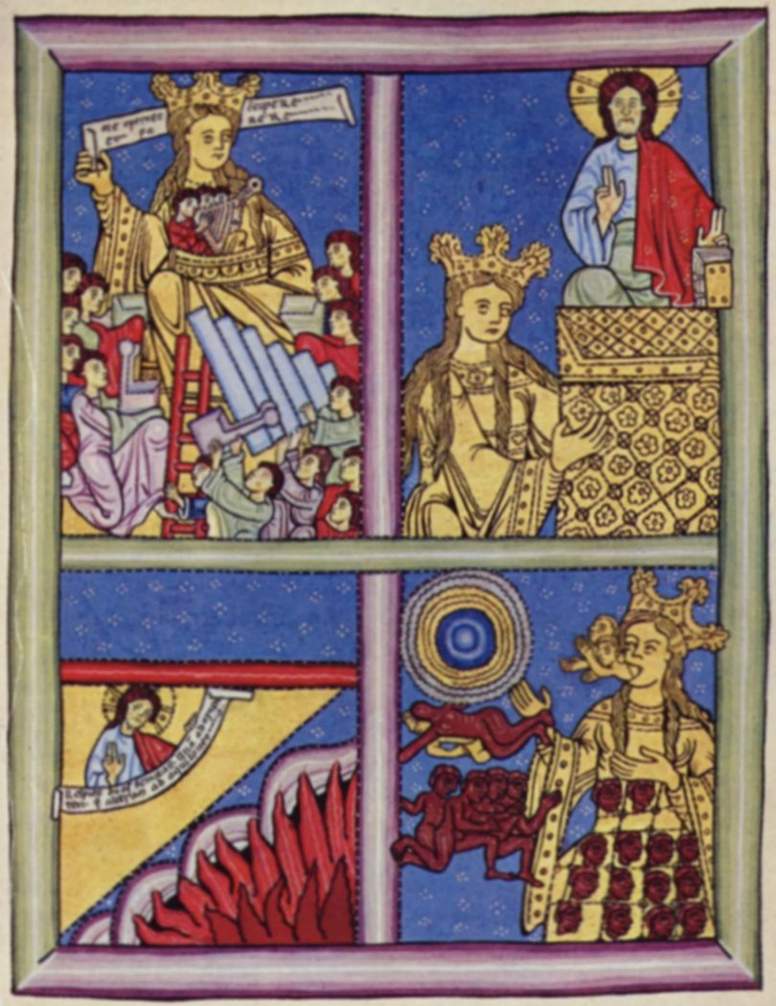
"The Holy Grail of the Unconscious" Sara Corbett 9-20-09 New York Times Magazine. Click on image for higher resolution. I found out about this forthcoming "Liber Novus" of Carl Jung, which he inscribed and illustrated, ca. 1916-30 It reminded me of another Germanic artist, and a Spanish one: both from medieval times, but sharing vivid colors, bold graphics, and memorable craft. What do you think of their juxtaposition? I have better comparisons for Hildegard-related illustrations in my mind; I wish I could provide closer examples, but Web image variety's quite scanty. Visions stay elusive.


"The Dragon Gives His Power to the Beast" Beatus de Facundus (folio 191v). 1047, Spanish commentary on the Book of the Apocalypse. These illustrations inspired passages in Umberto Eco's great novel about medieval learning, "The Name of the Rose."


Hildegard of Bingen's been elevated practically to New Age Goddess rank the past twenty-five years, but she's a formidable defender of orthodoxy, even if she stood up to a pope. Her visions made her famous, if belatedly; so today her music. Her writings earned visualization as in this codex of her "Scivias.""Der mystische Leib." Meister des Hildegardis Codex Scivis: 1165, Germany.