Showing posts with label john banville. Show all posts

Tuesday, March 14, 2017

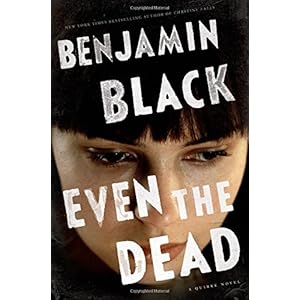
Benjamin Black's "Even the Dead": Book Review

Even the Dead: A Quirke Novel
This seventh entry in the Quirke series set in mid-1950s Dublin satisfies. It circles back to elements of the first installment, Christine Falls, but it does not feel stale. You could begin here, but as only asides to the increasingly complex inner life and love affairs and family traumas the protagonist endures emerge, it's better to read Benjamin Black's evocations of the dreary city and the coroner's office in order. Again, we find David Sinclair at the latter, while Inspector Hackett accompanies Quirke on what he reasons is his desultory quest for justice, given his intense "absence of a past" felt.

This emerges at the climax. As before, whether as Black or John Banville, this writer prefers a slow pace. In these mysteries, much work is done by others, and although the three coincidences tallied by characters do defy probability, Dublin's a small place where many of its people cross paths, for dark purposes. Quirke, battered in a previous account (reminiscent of the aging Jack Taylor in Ken Bruen's equally fine Galway noir contributions to this genre), suffers a brain lesion and feels increasingly fuzzy-headed. His confidant Mal also faces weakness, and in a typically eloquent passage common to this writer's works, he makes a poignant analogy. Facing onset of mortality, Mal opens up to Quirke.

"It's like discovering that all along you've been walking on a tightrope, and suddenly the end of the rope is in sight. You want to get off, but you can't, and you can't stop or retrace your steps, you just have to go on, until you can't go any further. Simple as that." (142) The stoicism they share continues.

But as always, there lurks beneath the power and corruption of Church and State glimpses of comfort. "And still the day refused to end. At ten-thirty the sky was an inverted bowl of blue raised radiance, except in the west, where the sunset looked like a firefight at sea, a motionless Trafalgar. He stood at the open window of the flat, craning to see, up past the tall houses opposite, a single pale star suspended above the rooftops, a dagger of shimmering light. It was a long time since he had felt so calm, so untroubled. Serene: the word came to him unbidden. He felt serene." (68) Quirke has solace.

There's also bits of gallows humor, given the trade. "Amazing the number of people who drive into trees or stone walls by accident in the middle of the night, or fall into the Liffey with their pockets full of stones." (17) So Sinclair opines. He leavens the growing sorrow of his senior, Quirke the pathologist. He battles drink, the memories of abandonment and betrayal and guilt, and the drudgery of his tasks. He seeks romance, and even if "love" is but the term people use, he reasons, when they run out of other words to express their predicament or their yearnings, it may comfort him--for now. (Amazon US 12/2/16)

Tuesday, January 6, 2015

David Mitchell's "Cloud Atlas": Book Review


I'd been meaning to tackle this over the past decade; I wanted to see the adaptation by the Wachowski siblings released in late 2012. In of all places Park City, Utah (home of Sundance), in the off-season, Layne and I missed it and so opted for "Argo" (cheap ticket) in an exurb faux-Western mall. I tried that Christmas to rally my family after we bickered over Zero Dark Thirty and Django Unchained and I held down my paternal foot as I wasn't in the mood for either to celebrate the mythical birthdate of the purported Prince of Peace. We chose neither, settling on On the Road. Rarely do I venture into a theater these days, grousing as I do at people. prices, popcorn and promotion, but when I do, I want to see a spectacle enhanced by the big screen. I'd heard that ambitious adaptation of a sprawling narrative was met with bewilderment or annoyance; I'd reckoned the po-mo structure of the Booker Prize finalist (not for the first time for this 2004 entry) would baffle viewers as it did some readers. I left it unseen and still shelved.

Then, investigating "Buddhist Fiction," I found UU World nominated it for its shortlist. Dozens of copies (credit post-Matrix buzz!) were checked out of all L.A. and Pasadena libraries, but South Pasadena had it. I grabbed it. I took it along on too-brief an out-of-town trip, and I enjoyed it. Not sure if I loved it. The uphill climb for its first half is more rewarding: the challenge invigorates you to keep going. It accelerates into the curve, and through its central section. Out of that turn, it's downhill. The novel's easier to read, moves rapidly, but there's a sense of anti-climactic ennui. That may fit well the nature of David Mitchell's investigation of repetition and reincarnation, all the same.

This entry covers the passages explicating the themes I found most intriguing. It doesn't delve into the "Russian doll"-structure inspired by Italo Calvino's If On a Winter's Night a Traveller (as I suspected long before learning Mitchell in 2010 via The Paris Review credited that novel I loved thirty years ago) for the 1-2-3-4-5-6 then reversed arrangement--as this is now common knowledge. 

"The Pacific Journal of Adam Ewing" features a Melville tone: Typee is mentioned later on. South Seas are visited by an American notary from the new city of San Francisco as the Gold Rush erupts. Afflicted by a worm entering his brain carrying a mysterious malady, Adam falls into the care of one Dr. Henry Goose on the voyage on the Prophetess. The style flows easier than much of (the later) Melville: "As Henry & I ate supper, a blizzard of purplish moths seemed to issue from the cracks in the moon, smothering lanterns, faces, food & every surface in a twitching sheet of wings." (39) We later find a typically casual recurrence of an image in the central story on the Big Island of Hawai'i: "Papery moths blowed thru her shimm'rin' eyes'n'mouth too, to'n'fro, yay, to'n'fro." (264)

"Letters from Zehelgem" might have been penned by John Banville or Julian Barnes. It's the type of contemporary novel that's shortlisted for a Booker Prize--as Mitchell a two-time nominee may know well. In the early 1930s, composer Robert Frobisher flees Cambridge, debtors, and justice by presenting himself in Belgium as an amanuensis to his elderly counterpart, and soon rival of sorts, Vyvyan Ayrs. Frobisher's flight from apprehension to Calais sums up his spirit: "Dover an utter fright staffed by Bolsheviks, versified cliffs as Romantic as my arse and a similar hue." (46) 

The tattered book he finds in Ayrs' manse, or half of it, is Ewing's journal, published by his son. In turn, "'Half-Lives': the First Luisa Rey Mystery" continues the saga as the recipient of Frobisher's letters back to England, Rufus Sixsmith, returns at the age of 66. He's a successful nuclear physicist in the late 1970s in California. But he's restless in Buenas Yerbas (a reversal of an early placename for S.F., by the way.) "West, the Pacific eternity. East, our denuded, pernicious, enshrined, thirsty, beserking American continent." (89) His career and his stance on this energy does not please a sinister (naturally) Seabrook corporation. Out of this, one "Hilary V. Hush" generates a pulp thriller, full of chases and conspiracies.

"The Ghastly Ordeal of Timothy Cavendish" takes us to that middle-aged, put-upon middle man, in contemporary England, who runs a feeble "author partnership" press: in its slush pile lands the first Luisa Rey mystery. He deals with the aftermath of a cause celebre where the writer of Knuckle Sandwich meets sudden notoriety, and the attention generates fame and profits for Cavendish. Flush with the proceeds, all seems it will go well, until it doesn't.  Kingsley or Martin Amis might be at home here. Consider this look as Timothy must flee from London: "you sly toupeed quizmaster, you and your tenements of Somalians; viaducts of Kingdom Brunel; malls of casualized labor; strata of soot-blackened bricks and muddy bones of Doctors Dee, Crippen, et al.; hot glass buildings where the blooms of youth harden into aged cacti like my penny-pinching brother." (161) 

On his journey north, Cavendish raises a theme common to Mitchell's characters: "we cross, criscross, and recross our old tracks like figure skaters." (163) His story stops suddenly (as do others), and we leap into an indeterminate post-apocalyptic future where a Korean superstate dominates a blighted planet. "An Orison of Sonmi-451" in the fashion of Haruki Murakami or Philip K. Dick follows an engineered fabricant's entry into sentience. Escorted out of her climate controlled confines, she confides to her listener the strangeness of a natural reality: "Trees, their incremental gymnastics and noisy silence, yes, and their greenness, still mesmerize me." (202) In such phrasing, the beauty of Mitchell's observations freshen the familiar. 

"Sloosha's Crossin' an' Ev'rythin' After" occupies the core around which the other stories are mirrored in two, or tucked into. Zachry's telling recalls the altered language of Russell Hoban's Riddley Walker, as well as the dialect and the quest of Huck Finn as one society's fragility is shattered by the arrival of tension, disruption, and unsettling values and ideas. These, filtered via Meronym from an enclave beyond the insular Valleymen, force Zachry to come of age in a brutal clash of cultures and enemies. The Valleymen are visited by Meronym, and Zachry learns why they have ventured so far across the ocean. What has happened after the demise of Nea So Corpros as the Korean hegemony is little understood; Meronym and a few Prescients guard a few factual or mythic gleanings against predators and plague that roil the globe and the miniscule remnants who've survived Earth's collapse.

The Old 'Uns have died off, and ignorance is their legacy to the stragglers who struggle after the meltdown. "Smart mastered sicks, miles, seeds an’ made miracles ord’nary, but it din’t master one thing, nay, a hunger in the hearts o’humans, yay, a hunger for more.” (272) Civilization vs. savagery tears apart the survivors: it's as if delayed gratification eliminated the consumers and capitalists, the warlords and the masses unable to wait and think before rushing to buy, spend, fight, grab, grasp. "Old 'Uns got the Smart o' gods but the savagery o' jackals an' that's what tripped the Fall." (303)

The novel then proceeds to wrap up Zachry's chronicle and propel us back the same way we came in. Although Cavendish sniffs: "As an experienced editor, I disapprove of flashbacks, foreshadowings, and tricksy devices; they belong in the 1980s with M.A.'s in postmodernism and chaos theory." (150) Of course, such devices long predate what was my own long slog through this at just this time in grad school and my own collegiate reading in and out of class. Mitchell applies these through such images as the moths cited earlier. It's not that difficult a novel to follow as some grousing readers and critics lamented; anyone who can read Calvino's tale can handle this. The second half, however, moves rapidly and feels often somewhat less engaging as the puzzle-pieces neatly snap together in turn. 

One device that audiences apparently needed a visual guide and a screenplay reboot for in the (unseen as yet by me) film version was the comet-shaped birthmark used by Mitchell to suggest reincarnations or rebirths of protagonists.  On pg. 85, Frobisher introduces his; Luisa finds this
and matches it to her own despite "I just don't believe in this crap" (120) and she tries to talk herself out of it as a coincidence. (122)  Zachry sees on Meronym her "whoahsome wyrd" one just below her shoulder blade in the light of Lady Moon (303); Cavendish reasons such an image "will have to go" if the Luisa Rey "young-hack-versus-corporate-corruption-thriller" will succeed on its potential. "Far too hippie-druggy-New Age"--a sentiment I've found echoed by some resenting the storyline as a novel or a film. (357)

Given as the UU World site and its counterpart study include this on a list of "Buddhist fiction," and granted the Cambridge-trained, now County Cork resident writer married to a Japanese woman and immersed via his fiction in Asian settings, there's no escaping placement of this novel into this niche. Yet, it rests there lightly. 

In "Orison," Sonmi hears from an Abbess (this rank continues among the Valleyman's cult of ancestor worship by icons in barrows on the Big Island) from the ranks of "recidivists" in a cave hidden as a safe house for her and other "tapeworms" who huddle off the corporacratic grid. For "fifteen centuries," nuns have persisted there. A stone figure (resembling of all people Cavendish) named Siddhartha "is a dead man a living ideal." (330) Little is known of the man; his "names" tellingly as well as his doctrine have been forgotten, after the Abbess's elder mentors had been eliminated when "non-consumer religions were criminalized." (The prediction made by the Buddha that after 2500 years his own message would gradually fade comes to mind; the rule of the Corporation-State forming around us may presage "Maitreya" ending the next span of five thousand years as the Buddha's successor. But such speculation lies outside the margins of Mitchell's ambitious narrative.) Sonmi manages to wish for reincarnation in the "colony" and on departure, the Abbess promises to relay her wish to Siddhartha. Later, Zachry will unlock an orison brought by Meronym that reveals Sonmi, whose cult will spread until she has been elevated to a goddess status by the Valleymen.

Progress, these shifts in belief and power, and earthly fate concern others in this novel. Earlier, Frobisher remarks on an aquatint of a Siamese temple. He compares its lore as it's relentlessly ornamented and improved: it will one day be equal to "its counterpart in the Pure Land" (81). Then, humanity's purpose fulfilled, Time will conclude. Frobisher offers an alternative analogy. Like Ayrs, the edifice rises upon the backs of ignorant and anonymous labor, and civilization claims its resplendence through those statesmen and artists who take the credit for themselves, as "architects, masons, and priests."

In the fittingly titled "'Half-Lives': the First Luisa Rey Mystery" Isaac Sachs contemplates the actual vs. a virtual past. The Nietzschean will-to-power enters Vyvyan and Robert's verbal sparring, and by this later section, the Sixsmith Report of Frobisher's correspondent stands for the threat to this humanist resistance against the machine men and women build (like that Siamese temple?). Sachs proposes a virtual past (as in the legacy in story of the Titanic outlasting the memories of its "real-time" survivors) and wonders how corporations and governments will co-opt this. 

Sachs continues to sum up the greater novel he's part of unwittingly. "One model of time: an infinite matryoshka doll of painted moments, each "shell" (the present) encased inside a nest of "shells" (previous presents) I call the actual past but which we perceive as the virtual future." (393) Naturally, comparison of this structure to a Buddhist (or post-modern) conception of impermanence and instability within the stories we tell and which we tell of ourselves opens this up to a neat critique***.

A few pages later, Luisa and a boy, Javier, discuss what if one could see the future. Javier asks: would you want to? Luisa hesitates, wanting to know if the future so seen could be changed or not. (401) She ruminates that acting now in the expectation of what the future holds may trigger that future scenario. "What happens in a minute's time is made by what you do." She leaves the conversation wondering inside her head about this "great imponderable." "Maybe the answer is not one of metaphysics but one, simply, of power."

Necessarily inconclusive, this novel of ideas in its last segment, a reprise of "The Pacific Journal of Adam Ewing" deals with civilized incursions across the globe, and how power forces change and alters presents and futures. "Ships bring disease dust here," Mr. Wagstaff observes to Ewing as they land at a Christian settlement on Rataoia in the newly named Society Islands. The natives die off, slaves are imported from other islands, and the natives decline in fertility as religious fervor does not inspire fecundity. "To kill what you cherish & cure," Wagstaff smiles, "that seems to be the way of things." (486)

Countering the missionary endeavor and its social Darwinism with humanist reasoning, Adam denies any rules in history. He affirms only outcomes. "Vicious acts and virtuous acts" spur results. (507) These acts emerge from belief. To fight "the 'natural' order of things," confidence in human qualities beyond selfishness impel idealists such as Ewing. He vows to become an Abolitionist (we glimpse this cadre in Sonmi's fearful realm), and he vows to become a force for change, even if but "one drop in a limitless ocean." (509) With that promise, we place back the novel's last nestled doll, or its first. 

(Amazon US 3-5-13 in shorter, depersonalized, slightly rewritten version. ***I've expanded the Buddhist and post-Buddhist, Marxian and anarchistic associations spun out of the encounter between Sonmi and the Abbess about Siddhartha in comment #2 replying to "A Spectre Is Haunting Buddhism: Give Marx Some Credit," by Glenn Wallis at Speculative Non-Buddhism on 3-7-13. I extended that into more countercultural contexts on 3-9-13 in comment #11 and virtual realm applications on 3-8-13 in comment #6,)

Saturday, October 5, 2013

Benjamin Black's "Holy Orders": Book Review

With the sixth installment in John Banville's busman's holiday writing as Benjamin Black, pathologist Quirke with a side pursuit as amateur detective risks resembling a brooding houseguest intent on staying. Banville's erudite, Continental-style novels of ideas, with characters trapped within history by their own haunted compromises, continue to differ thematically from his mysteries set in 1950s Dublin. However, as Black's "Quirke novels" have met with a wider following than his mannered, dour ones, loyal readers such as myself may sense Quirke merging with Banville's louche protagonists. Black's prose which initially appeared to distinguish "genre" from Banville's "literary" fiction has evolved by now more similarities than contrasts. What still may set this protagonist apart from his creator's other characters may be his troubled, resilient self. It sustains Quirke through more tales than those given Banville's anguished men--although some of those revive or reappear in Banville's novels, which continue apace.

Still, the Quirke franchise needed a jolt. The setup in Christine Falls introduced Quirke, and the delayed reaction by Phoebe as they meet again, long after Quirke's decision to pass off his daughter to his sister and her husband to raise as their own. The Silver Swan, of the five my favorite, met with muted enthusiasm among some, but I enjoyed its tawdry evocation of deluded Dubliners craving esoteric wisdom. Secrecy represses Irish society, often amidst those seeking status or having obtained it trying to keep it, and the whiff of corruption remains pungent, more than the chemicals within Quirke's morgue--where as Black's novels progress the doctor appears to spend less and less time.

Phoebe's doctor friend April Latimer vanishes in the poignant Elegy for April (see my PopMatters review). Midstream in this series, cub reporter Jimmy Minor assumes a supporting role, along with Phoebe's boyfriend and Quirke's colleague David Sinclair. The predicament of those marginalized within Catholic culture, the few Jewish citizens such as Sinclair, and in Elegy the plight of international students, receive probing attention as Black scrutinizes the cutting or cruel mores of the economically troubled and very suspicious nation which at this period raised him as Banville.

Dislocation follows in A Death in Summer (see my PopMatters review), and it opens splendidly. But I found its elegant saunter languid compared with the previous two city tales. Black starts off strong, lets the energy simmer, parades a series of suspects for Police Inspector Hackett and his part-partner  to seek out, and then solves the puzzle in the final fifteen pages adroitly. Even if Death succeeded in its arch tone as it pursued skulduggery among the gentry, I prefer the down and dirty Dublin settings. The darker alleys force Black to peer at the grime where he must confront a dismal postwar malaise.

Vengeance (see my PopMatters review) again begins with brio, as Black finds a suitably vixenish foil to unnerve Quirke. In advanced middle age, he's resigned to the arms of an aging actress, Isabel, after his wife's death. Battling the bottle, worse for wear, he's determined to continue his tiring avocation.

Jimmy Minor, April and Phoebe's friend, had worked as a junior reporter for a Dublin paper. His boyish corpse, fished out of the River Liffey, opens this latest novel. With the suggestive title of Holy Orders, the connivance of a compliant, cowed government with the lordly Church in this oppressive era of postwar Irish history looms; it's very difficult to shake the sensation that this novel is not happening over a half-century later, amidst continued revelations of clerical abuse and conspiracy.

In a dramatic, harrowing scene, overcome at a priests' gloomy residence by his childhood memories at a feral Catholic orphanage, Quirke's heart seems to burst. As if a bird fluttering from inside his ribcage, the bewildered sufferer peers out at thieving magpies and hovering blackbirds. Black conjures doom compactly. It resounds through the calmly told chapters of this confident novel.

Quirke's vertigo and hallucinations pierce this novel to prickle to the reader's response to mystery. "He went out to the living room. A parallelogram of insipid sunlight lay on the floor under a window like the parts of a broken kite. He stood and looked about himself, feeling dazed. The morning's watercolor tints lent a novel sheen to familiar surfaces. Everything was as it always was, yet somehow he could recognize nothing. It was as if all that was formerly here had been swept away in the night and replaced with a shiny new version of itself, identical in every aspect, yet one-dimensional and hollow, like props in a fantastically detailed stage setting." (160)

Phoebe notices her father's altered state, accentuating his habitual tendency to peer out at the world as if through the eyes of the disappointed child he was in the orphanage. While the novel relies on an indirect omniscient narrative via Quirke, Black sidles into her perspective. Through her unease with Jimmy's twin sister, Sally, Phoebe's own self fractures. "She felt as if one whole side of her life was shearing off and toppling into the sea."

Hints of Joyce's Ulysses linger: cocoa, cinnamon, and pineapple entice Dubliners from their slump. Beckett's inquiring light which troubled some of his own trapped characters enters, too, more ominously, onto Quirke's mental stage to illuminate his enigmatic inner vision. By now, readers of a sixth book need no sixth sense to be told why. Quirke simply soldiers on, with handmade Italian shoes trudging the mud of a down-and-out campsite, tracking down if not legal justice than moral recompense, despite his ennui.

Deceit, suspicion, jealousy, doubt: Banville and Black join, through Quirke and Phoebe, the ageless concerns of storytellers. Holy Orders freshens them. May my lack of plot details encourage you to encounter their treatment for yourself, for their evocation proves this to be the most powerful Quirke novel yet. Black's return from gentry pursuits to Quirke's inward search, and his concern for what Quirke's former lover tells him he has, not her husband's "heart" but the rarer quality of a "soul", endures to enrich this sixth tale of this haunted Dubliner's lonely hunt for answers--or partial clues. 
(Amazon US in briefer form 8-20-13; as above to PopMatters 8-15-13)

Monday, March 11, 2013

John Banville's "Ancient Light": Book Review

This may be my favorite of the nine novels I've read of his, and the five as Benjamin Black. John Banville evokes sexual desire and adolescence with jittery energy, crossing the story of Alex Cleave (note the surname--even as with his wife Leah and their dead daughter Cass, resonances linger) as an actor in his sixties with himself as a fifteen-year-old who took on his best friend's mother as a lover. Alex recalls: "It was a confusion between the categories of the verb to know."

What results reminds me of Nabokov's "Lolita" from a tilted perspective. Both share a linguistic precision and an erotic charge, intensified by the passage of years and the narrator's inability to recover a doomed relationship. Every Banville novel provides passages that leap out, demanding to be taken in and lingered over. Here, many more pages contain them. More than any of his other works I've encountered, if still unevenly given Banville's preference for sly and determined confusion, "Ancient Light" succeeds. It combines the frisson of tension in a sexual attraction with the psychological complications and intellectual considerations that characterize Banville's erudite, oblique fiction.

For instance, to take only two examples early on, as Alex nervously wanders in Celia Gray's house, wondering what's next in an otherwise empty living room, he recalls from his later years how "quick with portent they always seem, the things in rooms that are not ours: that chintz-covered armchair braced somehow as if about to clamber angrily to its feet; that floor-lamp keeping so still and hiding its face under a coolie's hat; the upright piano, its lid greyed by an immaculate coating of dust, clenched against the wall with a neglected, rancorous mien, like a large ungainly pet the family had long ago ceased to love. Clearly from outside I could hear those lewd birds do their wolf-whistles." It's almost comic, a Disney cartoon animated in real life, but tinged with foreboding, and the hints of "grey" and lasciviousness, of pets and the end of affection, permeate this reverie.

Hints of Joyce--"tundish breasts" in a Old Masters painting being Alex's only previous glimpse of the female form--do not prepare for the sight of a middle-aged woman before a mirror, unclothed. "Instead of the shades of pink and peach that I would have expected--Rubens has a lot to answer for--her body displayed, disconcertingly, a range of muted tints from magnesium white to silver to tin, a scumbled sort of yellow, pale ochre, and even in places a faint greenishness and, in the hollows, a shadowing of mossy mauve." This appears appropriate for a time about fifty years ago, with Irish reticence ("scumbled"?) about flesh confronting its exposure, mirrored mirror that Alex passes, as he in amazement glances her way.

His emotions take over. The novel juxtaposes his near-retirement with his long ago complications with Mrs. Gray. After they first join, he cannot figure out why she puts herself in such a compromising and dangerous position. He is overwhelmed: "engrossed in what I felt for myself, I had no measure against which to match what she might feel for me. That was how it was at the start, and how it went on, to the end. That is how it is, when one discovers oneself through the other."

It's a rewarding if elevated novel which demonstrates the legacy that John Banville sustains from Irish and Continental writers working at a high level. Not that it's an easy read, but it satisfies for an aesthetic quality inherent in Banville's earlier writings, but the introspection typical to his anguished and longing protagonists here finds more of a physical release, if for a while. The momentum of Alex's adolescent adventure carries along the reader, through the more languid passages of his later life, which typify Banville's preference for a tamped-down, introspective yet restless tone. Against his hormonal outbursts, he stares down his fate in the mental prison where Banville likes to lock up his narrators.

They enter a place where the exploration of the psyche intersects with the erotic and artistic drives that pull Alex into maturity. Fittingly, these filter into Beckett after the "day of the incident," their initial coupling. "First love the cynic observes, and afterwards the reckoning."

This half-century of slow, but engagingly obsessive reckoning spans the intervening passage of time between the teenaged boy and the man in the twilight of his acting prime. This section, inspired likely by the recent filming of Banville's Booker Prize winning "The Sea," feels less controlled, more weightless. Banville shuffles satire in. It lessens the burdens of Alex's state, at least for a short while, among the power that the past, summoned up again, exacts. I've set up, to avoid spoilers, in detail only the first fifty pages.

Much later, Alex feels baffled. Ghostlier, gothic elements enter as he visits Italy, and the site (a bit too neatly) where Shelley drowned, and Cass died. This in turn flows into two novels of Banville published about a decade ago, corresponding to ten years earlier in Alex's experience. Yet, he tells us that the very man he played in the film to be, Axel, knew his daughter, Cass. Moreover, this admission comes as a casual aside long into the narration, after he finishes the role. Odd.

Banville triangulates this with "Shroud" (2003). This told of Axel Vander, the enigmatic fraud (inspired by lionized literary theorist and, much later unmasked as fascist collaborator, Paul de Man) who Cass pursues before her suicide. "Eclipse" (2001) dealt with Alex's anguished reminiscences of Cass, and his reaction to the news of her demise. Recollections in "Ancient Light" shift. Channeled through Alex, they turn less reliable as the plot unfolds, and this subtle challenge to the reliability of his tale as classical references and dream elements hover moves the second part into a milieu closer to past Banville explorations--in "The Book of Evidence," "Ghosts," and "Athena"-- into perils of trust.

This later journey into the echoes of Alex's youthful initiation into "this enigma of estrangement" as the intimacy of sex collides with the distance of autonomy continues into the present. Here, a lighter element, a send-up of the art house film scene, and Alex's opportunity to act on screen for the first time, blurs with a coming to terms with (or an avoidance of) why his daughter died. The elegant, if attenuated and uneasy, results will draw in any patient reader eager to meet Banville at his best. [As above with no hyperlinks, to PopMatters 9-28-12; on 8-21-12 slightly altered and a perfect example of why I hate ratings and stars to pin me down, to Amazon US]

Saturday, September 1, 2012

Benjamin Black's "Vengeance": Book Review

Dublin pathologist Garrett Quirke's investigations in the dreary 1950s bring him, an orphan, into many situations where families hide secrets of paternity, maternity, loyalty, and betrayal. John Banville's alter ego Benjamin Black shares Banville's acclaimed command of atmosphere from his erudite, dense, and intellectual novels; this fifth installment of "Quirke Mysteries" moves into similarly complex motivations. Yet their focus upon a repressed and dingy Irish city under the grip of economic malaise, political corruption, and ecclesiastical dominance enables Black to craft a explore Quirke's evolution as a flawed character, battling drink and searching for solutions to the lives of others if not his own, which unravels even as he carries on, like all the living.

Not trained as a detective, Quirke relies on Inspector Hackett, the typical up-from-the-country recruit to the police turned supervisor of hapless trainees. The two meet and reckon with the deaths that come their way. This time, in "Vengeance," business tycoon Victor Delahaye, from the Protestant gentry, shoots himself while sailing with his Catholic (on paper equal but in reality subordinate) partner Jack Clancy's son, Davy. Quirke handles Victor's corpse, and probes into why he came to such an end.

"I have a great curiosity," Quirke explains to an uneasy wife. "If I were a cat, I'd have been dead long ago." His travels keep him mainly in Dublin, but a journey shows him the rest of a rundown Ireland: "The huge sky over the Midlands was piled high with luminous wreckage." Even nature looks grim. 

Quirke and Hackett's half-driven, half-detached forays, along with interludes by Quirke's daughter, Phoebe, propel much of the plot. The feline, much younger widow Mona Delahaye, along with Victor's sullen sister Maggie, and Victor's glacial twin sons Jonas and James, complicate the proceedings. So does a woman who hints at a James Joyce allusion or two in the shadows, Bella Wintour. We also meet British-born Sylvia, and her husband, Jack himself.

Without giving away the storyline, this novel moves smoothly, more so than the previous "A Death in Summer." Black as in the best of the series, "The Silver Swan," excels at conjuring up eccentrics. While Quirke's debut, "Christine Falls," set up standard procedure as Quirke faced his own family secrets and learned to untangle those of other Irish caught in their own deceit, it turned so intricate that it lacked energy to sustain its conspiratorial, clerical machinations. Number three, "An Elegy for April," worked better, as it more gracefully told a maturation of Quirke with his reconciled daughter Phoebe, as well as capturing the danger of being an outsider--this time an African student--in insular postwar Dublin.

Similarly, while outliers in "Vengeance" appear more tame if sly, the class distinctions between the gentry and the common folk persist. For instance, the bearish, middle-aged Quirke dallies in these pages with a mistress, the actress Isabel Galloway, whom he had abandoned in a previous novel. "Their lovemaking had felt to him more like a surgical procedure. Isabel had thrust herself angrily against him, all elbows, ribs, and bared teeth. Now she sat there furious in her painted gown like an Oriental empress about to order his beheading."

Black as Banville keeps that writer's ability to indirectly express a character's body and mind, revealing Quirke's unease out of his element, in social situations or in his physical demeanor. After making love with Mona, Quirke on leaving her estate "saw himself as a kind of clown, in outsize trousers and long, bulbous shoes, staggering this way and that between two laughing teams of white-clad players, jumping clumsily, vainly, for the ball they kept lobbing over his head with negligent, mocking ease. Yes, he would find out." It takes him a while, as it always does in the Black mysteries, and often it appears things fall into place around him as he observes or reacts to them, rather than him serving as the catalyst. In his sly way, he determines, with Hackett, to get the twins, and to break the funereal bond that silences those who know among both Delahaye and Clancy clans.

Phoebe, Quirke's reconciled daughter, agrees. But she holds those families, Hackett, reporters, and any--even her own father--who root out the causes of the two deaths which ensue as suspect. "They pretended, all of them, to be after the facts, truth, justice, but what they desired in the end was really just to satisfy their curiosity," As one mordant witness muses after a burial: "The dead get so much more than their share of praise, she thought, and all just for being dead." Jack Clancy's son, Davy, makes the most telling observation: "You don't put a bullet in your heart unless there's something seriously the matter." This acerbic tone sharpens the book in typically Irish fashion, as backbiting shoves into indirection and caroms off of bluntness.

The questions hidden in Delahaye's motives and those of whomever killed off the second character keep three-hundred pages turning smoothly. As with earlier Quirke mysteries, a death opens it, a hundred-odd pages gradually connect those around the cadaver, and at the halfway point fifty pages later, a complication happens. The weakness of certain Quirke tales--of two-hundred pages of coasting past rich settings and engaging conversations yet filled with dead-ends and red-herrings, ending in fifteen pages with a sudden climax and hasty wrap-up--is less present here, if not entirely absent.

While I suspect he played out a well-worn dodge to explain the mystery, this may betray Black's send-up of the genre. The steady pace of this series and the relative detachment of Quirke in this showing may betray his weariness as well as the author's in producing not only his "Banville" Continental-style fiction but his quirky mysteries on a yearly basis. All the same, number five in the series proves, alongside "The Silver Swan," a solid read.

(See my Amazon-linked reviews above to "Christine Falls" and "The Silver Swan" in Sept. 2008; "An Elegy for April" in March 2010 and "A Death in Summer" in July 2011. This slightly altered there 8-7-12. And as here, more or less, at PopMatters 8-27-12)

Tuesday, September 13, 2011

Sebastian Barry's "On Canaan's Side": Book Review

Lilly Bere flees the Irish war for independence with her hunted beau; they hurry in disguise to Chicago. From there, his fate and hers propels this compact but leisurely told narrative rich in mood and depth. Sebastian Barry, as with his plays and earlier novels, draws loosely on his own family's stories to thread into his plots. In "A Long, Long Way", Lilly's brother Willie fights the Great War in Picardy as well as witnesses the Easter Rising back in Dublin; "Annie Dunne" follows into mid-century the situation of her sister, "a hunched unmarriageable girl" according to Lilly. 

Between his countrymen John Banville and Joseph O'Connor in age, Mr. Barry shares the elegant fictional craft of the former and the immersion in Irish American overlaps of the latter storyteller. In this account of one of the Dunnes, less attention to America itself is given than may be supposed from the summary. While the novel takes place largely in American cities, the memories evoked by Lilly over seventeen daily entries at the age of eighty-nine delve more into her own reactions to the action around her than they do her own depictions of the twentieth-century trends and changes another novelist might have highlighted. This inner direction takes Mr. Barry's characters into their own psychological torment and the failure of their hopes rather than an easy grasp of the dreams promised so many whether in Ireland seeking freedom or America promoting liberty. 

As Lilly admits early on in her recollections: "I am dwelling on things I love, even if a measure of tragedy is stitched into everything, if you follow the thread long enough." Certainly the fatalism woven into this novel may weigh it down for those expecting a lighthearted romanticized celebration of a pair of newlywed immigrants who triumph over adversity. Soon, Tadg Bere will be gone, and his wife will flee again to Cleveland. There, she meets her second husband, Joe Kinderman, from the city's police force. His own ambiguities will shadow their relationship, while her son Ed and his son Billy will also confront the complications caused by wars, which in Europe, Asia, and the Middle East keep pulling away those whom she loves and befriends. 


Most of the narrative, told in journal form, depends upon capturing interior states, so when Lilly looks out, the scenes sharpen. Spring in Ohio comes as "the poor huddled trees suddenly like a thousand girls, all gold hair and ribbons, and the rows upon rows of blossom-trees in the streets shook out their colours on the air." 

As for Ireland, unlike her American friends and employers of Hibernian descent, Lilly holds no sentiment: "People love Ireland because they can never know it, like a partner in a successful marriage." This oblique comment shows Mr. Barry's own angular presence, for his novel refuses a straightforward approach to Lilly's perceptions. Instead, "On Canaan's Side" shows what happens after a fugitive crosses over the Jordan, not to find deliverance, but more pursuit from those she thought her trans-Atlantic flight had outrun. 

Therefore, the novel darkens as violence from war, past and recent, reverberates into the lives of those around her. Not everyone she befriends can be trusted. This unease turns her legacy as an arrival in America. 

She moves first to Washington D.C. (with a curious cameo appearance by Martin Luther King), and then to the Hamptons in domestic service to earn her keep. Mr. Barry does not let the Furies off their own race to catch up with Lilly. "The Celestial Handyman tends to let the house fall." Her marriages derail, and as she tries to make ends meet, she cannot help but lapse into gloom. "We ride to our doom, like the cowboys, we surely do." A few pages later, we hear, "as they used to say in Ireland, the devil only comes into good things." 


While this reviewer, as a first-generation Irish American, is not immune to fatalism, Mr. Barry's placement of its constant weight upon Lilly may weary readers wishing for levity within this well-told but stoically endured account of the past near-century. Her surname may be symbolic of the Easter lily, the signifier of hope for the new Irish republic amidst the war that drove her away from it, and of "The Old Woman of Beare", a medieval Irish lament told by one once a lovely lady, now an abandoned crone. Certainly this recent American era has not lacked for woe, but Lilly's eloquent reveries do not inspire much relief from the darker shades that hover over nearly every page of the long life she summons up on paper one last time. 


That being said, as with John Banville, a daunting fictional representation of a tormented, lonely struggle by one in recollection struggling to make sense out of chaos and to impose order upon chance does make for a rewarding if sobering experience. As with Joseph O'Connor, the inherent interest in an immigrant's encounter with America also enriches this narrative, even if unlike Mr. O'Connor, the energy of the Irish entry into a new continent is muffled by domestic settings and introspective concentration. Mr. Banville often rescues wandering plots in the final sections of his novels; similarly, Mr. Barry revives Lilly's reflections for one final burst of wonder. 


Its climactic pages glow with wonder and terror. They reach a catharsis of prose poetry as they mingle dramatically, as "the sun was falling away under the table of the world, like a drinking man." This last scene turns a bravura performance reminiscent of Samuel Beckett's torrents of frank existential dazzle. Here, Mr. Barry bestows as a merciful creator his long-suffering heroine with her final reward.


(Featured 9-8-11 at New York Journal of Books.)

Tuesday, July 5, 2011

Benjamin Black's "A Death in Summer": Book Review

Detective Inspector Hackett early on finds to his disappointment not a murder but a seeming suicide, but then not one, "for the corpse was holding the gun in his own hands." The ensuing narrative shows, again, Quirke entangled in love, but a bitter, harsh, sulpheric sense of it never goes away. This novel ties together somewhat with themes of abandonment at an early age, first surfacing in "Christine Falls." While this story can be followed  independently, it's enhanced by familiarity with the motifs of betrayal, deceit, and institutional corruption in the book that introduced us all to Quirke.

I liked this as much as the other installments. It lacks the oddly enticing, if dreadfully faux-exotic whiff that enlivened dreary, postwar Dublin in "The Silver Swan" but it continues the relationships opened up in "Elegy for April" with daughter Phoebe and with Quirke's new lover. I'd missed pathologist assistant Sinclair in "Elegy," but in "A Death," he plays a major role. We find out about his past, and about his connections with yet another shadowy association of Ireland's leading figures in another conspiracy. This familiarity, as it recalls "Christine," slightly weakened the impact of similar revelations in "A Death." Still, John Banville writing as Benjamin Black satisfies with a solid story.

There was a bit less of the breathtaking prose that always can be found in this writer's fiction. Characters enter (many from past encounters with pathologist Quirke) and their reports, rendered as an indirect voice shifts in Joycean fashion subtly from consciousness to consciousness, move the story of three-hundred pages along neatly if somewhat schematically. The steady tone rarely departs from a detached, impassive viewpoint. Many characters do sound a bit too often similar, even a French one, a foreign entrant added as in earlier novels to show how the Irish respond or do not respond to outsiders. The situation of the Jewish residents of Ireland is part of the context here, if in passing more than deeply explored, but again, as with other novels, this deepens perspectives.

Responses of the characters convey welcome imagery. Sinclair recalls Phoebe who "looked like nothing much, with that stark little face and the hair clawed back from her face as if it were a punishment that had been imposed on her for an infringement of some religious rule." (49) The half-sister of that corpse Hackett finds is regarded by Sinclair as if with "the air of a debauched virgin."

And, no Banville or Black creation can come free of a gorgeous passage. I've reviewed most of Banville's fiction and the three earlier Black novels and for each I've cited a favorite snippet. So, Quirke "imagined them, hordes of enraptured lovers down the ages, millions upon millions of them, lashing at the poor old globe with the flails of their passion, keeping it awhirl on its wobbly axis like a spinning top. The love that people spoke of so much seemed a kind of miasmic cloud, a kind of ether teeming with bacilli, through which we moved as we moved through the ordinary air, immune to infection for most of the time but destined to succumb sooner or later, somewhere or other, struck down to writhe on our beds in tender torment." (183)

While I remained less convinced than Quirke of the charms issuing from object of his desire in this installment, that may be my cooler reaction as angled against his chastened one. As before, Quirke manages to unlock yet another grand scheme against the innocent and the defenseless. As his nemesis warns, stirring up the depths of the water can be fatal. "Remember," his foe threatens, "the little fish, and the big fish. And the mud at the bottom." (168)

Yeats' line about "the blood and mire of human veins" cited here contends against the vision of what Quirke glimpses as he falls in love: "Twin stars of light from some far window glowed in their straw-colored depths." (62) The pure contends against the profane. Quirke sums up his efforts to his police counterpart in investigation, Hackett: "We haven't grown up yet, on this tight little island. But we do what we can, you and I. That's all we can do." (307)

(As above, to PopMatters 6-23-11; Posted to Amazon US & Lunch.com 6-1-11)

Sunday, July 3, 2011

Christopher Murray's "Samuel Beckett: 100 Years": Book Review

Thirteen scholars revisit his work. They each have 29 minutes on Irish radio. They sum up why we still read his often baffling fiction and watch his sometimes plotless plays a century after his birth.

Drama professors Christopher Murray, Anthony Roche, Gerry Dukes, J.C.C. Mays, Katherine Worth, and Declan Kiberd represent leading scholars. Historian Terence Brown, actress Rosemary Pountney, actor Barry McGovern, philosophers Dermot Moran and Richard Kearney, and novelist John Banville offer equally elegant entries. None of these are weak; despite the time constraints and implicit expectation that the listener's already familiar with Beckett's formidable work, the essays avoid cant, jargon, or tedium.

I'll briefly sum up each contribution. Murray introduces the collected Thomas Davis RTÉ lectures by emphasizing Beckett's notion "never less alone than when we are alone." (7) His anti-heroes "aim for Nirvana and miss." (3) They're captivated by the captive voices we all have within, the consciousness which never rests, which "is really conscience in disguise."

Dukes explores the early, unpublished play "Eleutheria" alongside "Waiting for Godot" to attend to the evolution of Beckett's most famous work. "En attendant Godot." Dukes notes how 'attentistes' as those who (in French) wait had been used during the Resistance in WWII as a put down for those who (unlike Beckett), put up with the Occupation rather than fight against it. Beckett chose to act, to resist authoritarianism, at great risk.

His characters attempt to understand life's cruelty. Kiberd finds in "Murphy" a protagonist enamored by The Other, in an insane asylum, but in this relationship, he fails to escape his own mental and physical isolation. The novel attempts to delay such reckoning, and as an aside, Kiberd finds in a convoluted sentence a delay shared "with many Irish politicians" Wylie's "ability to rob his own sentences of the meaningful climax of a finite verb." (38)

Later, Kiberd looks at Murphy's relationship with the prostitute Celia: "He fears, like many men, that his partner wants to change the very thing in him with which she originally fell in love." (42) Beckett's often unfairly targeted by casual readers for his inhumanity, but as this theme reveals in this early tragicomic novel, beneath the odd learning and puzzling jibes, the ideal of emptiness, of utter self-sufficiency, beckons as its moral and its caution.

Both Mays (on poetry and prose poems) and Moran (on philosophical contexts) quote the same early verse, "Gnome," and who can blame repetition of: "Spend the years of learning squandering/Courage for the years of wandering/Through a world politely turning/From the loutishness of learning." Beckett's cutting of what his mentor Joyce compiled, his gradual whittling away in his prose and drama of easy resolutions, thematic digressions, and plots themselves, makes him astonishingly central to the past century's confrontation with our legacy of learning.

Anthony Cronin, in a magisterial lecture on the prose trilogy, speaks of how Beckett "by reducing his characters to the extremer simplicities of need and satisfaction and the grossness of its perhaps necessary illusions."(88) "Molloy," "Malone Dies," and "The Unnamable" strip away narrators and leave us with voices. But, how can we relate to such severity?

Cronin-- whose masterful biography "Beckett: The Last Modernist" (reviewed by me on Amazon US) remains my favorite of the three lives to date for Beckett-- concludes that he exaggerates to make his comic, tragic point. Heroes and lyrics fade, and poetry leaves empty air.
"Deep in our collective soul is a collective unease about the contrast between the traditional ecstasies, nobilities and romantic passions of literature and what most of us actually feel, the state of mind in which most of us actually live most of the time. And indeed between our portraits of our supposed selves as decent, kind, caring and unselfish and what is actually our psychology, actually our outlook. In its exposure of these gaps, Beckett's trilogy has a profoundly cathartic effect." (91) It may not say all that must be said, but what it says may liberate us from pretension.

Other academics share Cronin's careful estimation of Beckett's difficulty. Anthony Roche tells how he saw "Breath" as a teen on tv, and how its strangeness contrasted with the enjoyment of seeing "Godot" on stage. He later connects talking on RTÉ about the intriguingly titled "Krapp's Last Tape" the afternoon he learned of the 9/11 attacks. Somehow even the emotions buried in that play managed to inform Professor Roche's review on the air that day.

Beckett's power can unsettle. Rosemary Pountrey describes her own stage performance of "Not I," requiring her to be bound into a dark box. Richard Kearney compares his student reactions to Beckett as a "pompous bore" with his encounters with the plays performed live. Barry McGovern as a skilled speaker of Beckett's lines shows their energy in his plays for radio. Katherine Worth reminds us of their global impact, and the battle between the estate which demands fidelity to Beckett's directions with those who wish to free his drama for interpretation to keep it relevant.

John Banville, whose novels combine often hints of Joycean abundance and Beckettian austerity, can be as serious and unstinting as Beckett. But Banville sees humor within our habitual unhappiness, and so does Beckett. He's not a pessimist any more than an optimist, Banville decides after pondering his work: "like all true art, it simply is." (127) He adds, in a fashion Beckett would have admired: "By its very existence it affirms, but affirmation is not always positive."

Kearney stresses "Beckett's own refusal of easy solutions to life's ultimate questions-- life and death, theism and atheism, meaning and absurdity, self and other" as "one of his most abiding gifts." (121) The more I reflect on him, the more Buddhist (a term I have not found mentioned explicitly in his 1929-40 letters or any of his texts published [but see my speculations]) he seems. Perhaps by his honest elision of what constitutes the conscience, the voice, the mind, the self, Beckett in his passing over any conceptual definition or conventional approach (such as Buddhism, appropriately) proves truest to those few authors who attempt to articulate what noise and what silence lies within us all.

P.S. Posted to Amazon US & Britain, and Lunch.com 9-16-10 But without those hyperlinked speculations to their source, my "Beckett, Buddhism, and the Void" from Horizon Review 4 (2010).

Saturday, October 16, 2010

Stuart Neville's "Collusion": Book Review

This sequel to The Ghosts of Belfast takes its time. Jack Lennon's character's expanded and although not quite likable, his predicament softens you to him. In Irish noir fashion, he's caught between who he should trust in a place where nobody's secrets stay so. He's from a Catholic family who's rejected him after he joined what was, fifteen years ago, an overwhelmingly Protestant Northern police force. Jack sought to do his share to heal a community who trusted the cops less than the thugs and paramilitaries who controlled the streets with their own clumsy and cynical justice, and the injustice that set up Jack's brother, Liam, as the informer he was not.

Jack struggles now, after the bloody events of the first novel continue as witnesses to its considerable slaughter (even by Troubles thrillers standards) are killed off. At 37, he's still trawling the pubs in search of companionship. "He wasn't quite old enough to be anyone's father, but maybe a creepy uncle." His years in the tangled loyalties and betrayals of Northern Irish hatreds, after the uneasy peace, rankle him. "Some say that when you're on your deathbed, it'd be the things you didn't do that you'd regret. Lennon knew that was a lie."

Resented by his colleagues and alone in a gentrifying city: "Belfast was starting to grate on him, with its red-brick houses and cars parked on top of one another. And the people, all smug and smiling now they'd gathered the wit to quit killing each other and start making money instead." Similar to Ken Bruen's Jack Taylor series set in Galway today, Neville's Jack must deal with an Ireland eager to leave his sort behind in a rush for greed.

Detective Inspector Lennon still must do what he feels right, despite official opposition. A shady lawyer reasons: "Look, collusion worked all ways, all directions. Between the Brits and the Loyalists, between the Irish government and the Republicans, between the Republicans and the Brits, between the Loyalists and the Republicans." The connections extend, after the peace process, into this novel set in 2007.

He must protect the lives of his daughter, Ellen, a curiously cognizant little girl, and of her mother, Marie, from whom he's been long estranged. Without divulging too much, they need safety as the aftermath of the events in Ghosts, (published in Britain as The Twelve) escalate and dueling killers converge for a dramatic showdown in an echoing country house.

As with Ghosts (see my review on Amazon US & this blog), Neville starts off his story strongly. In a plot driven by straightforward dialogue and efficient pursuits, he does not lavish the small details, so when they do enter the telling, they linger. The fear of being pulled over on a rural road, the sight of a fox in headlights, the stealth of sneaking into an apartment stick with you. "More village lights ahead, and beyond them, the town of Lurgan with its knotted streets and traffic lights and cops. He took a left down a narrow country road to avoid them. The world darkened."

This novel succeeds for a simpler structure. Given the twists and turns, the direction moves clearly. The Ghosts of Belfast may have garnered acclaim, as did recent noir by fellow Irish writers Tana French (In the Woods, then The Likeness, and recently A Faithful Place) and John Banville as Benjamin Black (Christine Falls, then The Silver Swan, and recently Elegy for April-- I reviewed the last title for PopMatters and all six for Amazon US & this blog), but as with French and Black, I'd argue that the second installments work better even if the first ones gained awards.

Characters are studied, the pace calms, and reflection eases tension. There's a mystery haunting more than one figure we follow, and this increases the interest in their hidden knowledge. The brutality's again here for Neville, but it feels as if there are fewer chases and shootouts, so the sinister atmosphere needs less emphasis. The showdowns may lack a bit of originality and the arrangements may be schematic, but this concentration on a streamlined plot assists comprehension. The natural suspense set up runs its own steady course, so the pace seems more controlled. As with Bruen, French, and Black, I predict from the strength of this second novel that Neville's proven himself capable of a great third novel that takes us deeper into the Northern noir to match his Dublin and Galway-based fictional and factual peers in this Celtic noir genre.

(P.S. I also reviewed Requiems for the Departed for PopMatters, Amazon, and this blog; Neville's "Queen of the Hill" was one of the strongest stories in this crime collection inspired by Celtic myth. This review posted to Amazon US & Britain 9-11-10 and then Lunch.com in slightly edited form, and submitted in another slightly revised version to PopMatters 10-1-2010.)

Monday, July 12, 2010

Benjamin Black's "The Silver Swan": Book Review

"The world has fallen asunder" in Dublin still paralyzed. Many readers appear to be disappointed by this follow-up, but I liked it much better. The only drawback here is the reliance on coincidence, but this in Joyce's city where everyone knows everyone's business may be less of a fault than I found the set-up for Quirke's début. Here's why.

I reviewed recently the first installment of John Banville's sideline from his more philosophical novels. Quirke returns as an driven, yet awkward, amateur investigator into another series of murders in middle-class 1950s Dublin. The pace here quickens from "Christine Falls," which I found murky and plodding. The characters here gain energy, and their depth expands and sinks into the pages more satisfactorily, and disturbingly. Mal and Rose and of course Phoebe all join Quirke, along with closer attention to Inspector Hackett. Sinclair, Q's assistant coroner, lurks intriguingly in the background, but I'd like to learn more about him.

Similar to Jack Taylor's battle with the bottle in Ken Bruen's "Galway noir" series of mysteries, Quirke finds himself starting this narrative sober and haunted. The raffish Leslie, the creepy Hakkim Kreutz (I sense a Nazi "crooked cross" buried in this name), the elusive Kate, and thuggish Billy Hunt all surround the doomed Silver Swan, Deirdre-Laura, in her attempts to enter a more exotic and daring realm of the body and imagination than that afforded her by her mundane Irish prospects. The author moves from one character to another, and this kaleidoscopic presentation allows greater detail and variety than the monochromatic and to me more monotonous prequel.

As with my reviews of most of Banville's fiction, I always highlight a chosen passage. Banville here reaches his mark more readily as Black, closer to his erudite and ambitious character studies under his given name. Here's two excerpts. Rose comes on to Quirke, and he hesitates as his daughter watches. "Rose took a cigarette, and he held the lighter for her and she leaned forward, touching her fingertips to the back of his hand. When she lifted the cigarette from her lips it was stained with lipstick. He thought how often this little scene had been repeated: the leaning forward, the quick, wry, upwards glance, the touch of her fingers on his skin, the white paper suddenly, vividly stained. She had asked him to love her, to stay with her." (141) Quirke elsewhere has noted that the touch of man's fingers to another man's can happen also sharing a light; one of the only permissible times.

Quirke later comes upon a crime scene. The plot has been cleverly choreographed, and the payoff's better than in "Christine Falls." The author plays fair with you, hinting at all that transpires, but unless you're smarter than Quirke or most any mystery writer, chances are you will be entertained by how rapidly Banville-Black has shuffled the pea under the shell before your eyes. The climactic scenes crackle with intensity and they'd make a great film, so visually are they described.

"Over every scene of violent death Quirke had attended in the course of his career there had hung a particular kind of silence, the kind that falls after the last echoes of a great outcry had faded. There was shock in it, of course, and awe and outrage, the sense of many hands lifted quickly to many mouths, but something else as well, a kind of gleefulness, a kind of startled, happy, unable-to-believe-its-luckness. Things, Quirke reflected, even inanimate things, it seemed, love a killing." (248-49)


As Deirdre-Laura puts it on her death-day, "The world has fallen asunder." The author takes you into her mind, drugged and erotic, and as with other characters, you pass from Dublin's stilted shabby-chic facades into fevered lust, hatred, or inarticulate longing. The author here excels at pitting the real-life dullness of his dramatis personae against their dreams of escape, as if Joyce's "Dubliners" still were paralyzed in post-war Ireland, still struggling to break free of the city.

But, they cannot. Irish complacency shrouds this novel. As American Rose critiques: "The way you go about in a cowed silence, not protesting, not complaining, not demanding that things should change or be fixed or made new." (256) Quirke, in a magnificent long single paragraph of an epilogue, achieves the level of Banville's best creations, and I look forward to another encounter with him and his ineradicable meddling.

P.S. On Amazon I've since recently reviewed the third installment, "Elegy for April." "Swan" and "Christine Falls" I've earlier posted on over there but I only found I forgot to post "Swan" here thanks to my finding yesterday Sheila O'Malley's thorough and insightful "Swan" review at her own great site,"The Sheila Variations."

Sunday, March 28, 2010

Benjamin Black's "Elegy for April": Book Review


Family ties, as a verb, here. Fog shrouds Dublin, secrets shame, and again intimacy curdles into revenge, hatred, and murder.

"Christine Falls" I liked better for its characters and mood than its rather mundane, if convoluted, plot. I favored "The Silver Swan" for its more exotic touches, and its elaborated focus on Quirke's battle with the bottle. (In this and in the evocation of portside Irish cities, it reminds me of Ken Bruen's Galway noir Jack Taylor series; I've reviewed all of the novels mentioned on Amazon US and both Blacks on my blog too.)

John Banville as Black enriches this third installment with meditations on mortality, night terrors, dreams gone wrong, and always the fog creeping in, staying inside after it sneaks in a door so a wisp stays like an "ectoplasm." The tug of families and their indiscretions, the public face hiding the private sin, as in so many Irish stories, blankets this mystery.

"Grains of mica glittered in the granite of the steps; strange, these little secret gleanings, under the fog."(4) Some of the author's best writing as either Banville or Black can be found here, which is saying something. Quirke grows on you, and you want his own fumbling reaching out for love from his daughter and from his new lover to succeed. I miss his co-worker Sinclair's jibes, and there's comparatively little time at his job at the morgue this time, but you gain more appreciation of his domestic life, or its lack: "Quirke's flat had the sheepish and resentful air of an unruly classroom suddenly silenced by the unexpected return of the teacher."(33)

Black moves among a few characters for indirect first person narration in Joycean style. This helps widen our familiarity with 1950s Dublin, and the tone shifts subtly. Via Patrick Ojukwu from Nigeria, we imagine what it was like to live in Ireland then. No bribes exacted by the natives, "but neither would they take you seriously. That was what puzzled him most of all, the way they mocked and jeered at everything and everyone, themselves included. Yet the laughter could stop without warning, when you least expected. Then suddenly you would find yourself alone in the midst of a circle of them, all of them looking at you, blank-eyed and silently accusing, even though you did not know what it was you were being accused of."(210)

The first third sets the scene and sets up the mystery; the second part broadens the suspects; the final third accelerates and the last fifteen pages hasten to bring it all together. It's done briskly but without any cheating, and I found it rather hasty, but in the spirit of many mysteries, such is their pace. I recommend it and while it can be read on its own, those who enjoyed the earlier books will benefit the most from another few hours with Quirke, Phoebe, Hackett, and their new circle among the "little band" and those it widens to encompass in another circle. (Posted to Amazon US 3-27-10; and to "Re:Print" at PopMatters.com 4-23-10.)