
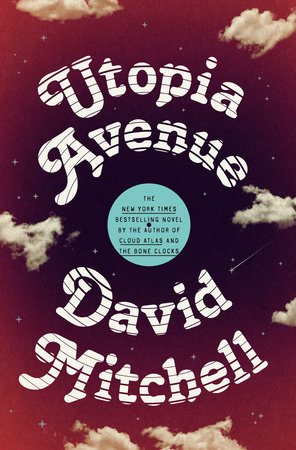
Eight novels into his career, David Mitchell's established himself. You can count on his fiction to take you into a multicultural space, a cultural clash, and (nearly always) a spiritual--or at least supernatural--encounter. Engagingly told by either first or third-person narrators, his plots unfurl to keep any reader turning the pages. Which can add up, given the heft of most of his tales speculating on the grey areas between this realm and other ones.
If you've come to Utopia Avenue fresh, I'd suggest a detour. You need to start with The Bone Clocks (2014), and maybe the spin-off novella from the following year, Slade House. (Both reviewed on PopMatters). These will prepare you to step back into Mitchell's oeuvre. His first book introduced his modus operandi. Ghostwritten (1999) lives up to its title. It shuffles through various lives in different places across many centuries. The characters merge subtly with one another. Tellingly, the substance of the novel adds up to nine lives. The manner of how their essences may be transmitted in turn floats into a vast Cloud Atlas.
Probably Mitchell's best known effort to date, Cloud Atlas creates an ambitious narrative which follows similar themes as his debut. But in this 2004 effort, Mitchell amps up the energy and the invention over a wider range of prose styles and six-times-two extended set-pieces which draw one into: the mind of a nineteenth-century notary at sea, a poor musician's journal early in the next century, a whistle-blower's thriller, a dystopian robotic Asia, and a wittily sour publisher on the lam. These nestle into one another like Russian dolls, burrowing into the central tale in post-apocalyptic Hawai'i before emerging to repeat the cycle of the previous five sections in reverse, by resolving each interrupted story.
However, even then a reader will not be ready to appreciate fully the backdrop of Utopia Avenue unless he or she finishes first the sprawling (even by Mitchell's standards) 2010 historical saga set at the turn of the eighteenth-century in Nagasaki, The Thousand Autumns of Jacob de Zoet. These prerequisites will prove enjoyable, and none will feel like assigned homework to catch up on. Nevertheless, this short stack of tall tales will take a while, so those opening Utopia Avenue need to know they'll be expected to have kept pace with prolific Mitchell over two decades. This leaves out, all the same, his remaining two novels.
The frenetic number9dream (2001) conjures up a chaotic sense of modern Tokyo; Mitchell lived in Japan for many years. Its own nine chapters thread together an imitation of Haruki Murakami rather than Mitchell's genuine voice, although the practice he gets in eclectic structures and experimental settings prepares him for Cloud Atlas. Finally, there's one charming outlier, his semi-autobiographical reminiscences of a thirteen-year-old on a housing estate in the middle of Worcestershire. It's told straightforwardly, and movingly.
Black Swan Green (2006) evokes powerfully Thatcher's England of the Falklands War, the New Romantics, synth-pop, stuttering, and all things British and/or annoying circa 1982. The audiobook performance by Kirby Heyborne will reward; many of Mitchell's works transfer well to the spoken word, although I'd make sure one has already a firm grip on the printed version of Cloud Atlas, given its dialects, intricate references, and inventive terms.
Back to the future for Mitchell fits. His storylines unravel chronology. In fact, the eerie Horologists who try to bottle up human life-forces so as to distill the Oil of Souls thrive on defying linearity as they strive to apply their energies to a vampire-fueled immortality. If this sentence makes sense, then one can follow Utopia Avenue. But one of its main characters, Jasper de Zoet, discovers his lineage traces back to 1800 Nagasaki, and that unfinished business then accounts for the mess that destroys the settled life of another protagonist at the start of The Bone Clocks, which ticks off from 1984 through its cast of misfits into 2043.
So, slot in Utopia Avenue between The Thousand Autumns of Jacob de Zoet and The Bone Clocks. In the spirit of Ghostwritten, characters face strange enemies. Connections appear subtly between these and more. For in Utopia Avenue as in all his works, Mitchell scatters "Easter Egg" appearances or allusions to his previous--and one presumes--future fiction. Characters and their works survive and echo as their stories already told reverberate softly.
It's difficult to convey the pleasures within Utopia Avenue to the uninitiated who enter David Mitchell's universe. Suffice to say that unless spoilers get revealed, only the gist of the work can be related. A few PopMatters faithful will know of the English folk-rock pioneers Fairport Convention. Well, take Sandy Denny (who appears as do many musicians of the psychedelic era in cameos or small supporting roles), one of its talented vocalists. She's channeled into Elf Holloway, a keyboardist from the folk scene, and one of three singer-songwriters. Second, Dean Moss hails from Gravesend, on the Thames estuary where the owners of the local pub will reappear as The Bone Clocks begin ticking. This bassist hails from the working-class in London itself. The class-consciousness plays a role in establishing the tensions and the diversity that enriches the new ensemble. They're joined by jazz-trained drummer Griff from darkest Yorkshire, and Jacob himself, a sort of Richard Thompson scarecrow figure on amazing guitar. Similarities ensue with real bands such as Fairport.
Car crashes, tragic passings (Mitchell excels at death scenes, premature or final), bleary touring and international hassles, sexist pop-show hosts, and smarmy manipulators all scheme against the three men and one woman (this group battles leering come-ons and baffled reaction in times not as advanced yet as some from sixty-odd years on may assume).
Mitchell's done his homework. The mmersion into not only London but a trucker's stop where ruffled and velvet-clad foppish musicians recharge after being on the concert trail, the wonder and danger of San Francisco's allure as seen through the eyes of members of the Grateful Dead and Jefferson Airplane, the dense terror and drive of Manhattan appear vividly as Utopia Avenue, the scrappy titular band, struggle up the charts and on blurred tours.
Laurel Canyon, Amsterdam, the Chelsea Hotel, and the less-heralded backwaters of Britain receive affectionate, insightful, and well-detailed depictions. Mitchell gets his rhythms right. Even a prison cell in Rome benefits from this writer's careful eye for all of the senses. Being born the start of 1969, he nonetheless benefits from his short distance from one who "really remembered the Sixties." He's old enough to have grown up with its musical legacy and cultural heritage. He's young enough to have been educated about the Aquarian Age's follies, its political naivete, and its bouts of impotence against endemic hate that trumps peace.
Woven into this revival of an age of expectation, Mitchell stitches a subtle critique of the impacts of the pot-heavy, lysergic-immersed, and heady music's ambitions on pop culture, moral choices, and even tripping itself. One watches the creation of verses; the novel is cleverly arranged to illustrate how each song on each album began its life--and Mitchell comes up with convincing lyrics too. The force of music as it emerges mysteriously or insistently in the mind of a capable (or baffled or stoned) composer gains clout as Mitchell expresses how notes stick on frets. The author examines deftly the ideals which force and beckon the four musicians and their circle to confront choices for good and evil. Amidst the slogans and chants, the violence (emotional and physical) exacted and inflicted around the band's predicament to stay true to their ethos makes them all mature into better people.
And that's the encouraging lesson of Utopia Avenue. The way to a better world, Mitchell quietly emphasizes, demands that responsibility not be shirked, and that cant or rhetoric fails to solve human loneliness or hereditary alienation. His composed, existential view may not please all, but his own Buddhist-inspired contemplation amidst the carnage and ecstasy of this romanticized era reminds us today of the caution needed when messages get blared.
"Music + Mind-Bending" at PopMatters 6/9/20 with hyperlinks to the cultural mentions. And a very trippy artwork that graces the review. Better than the galley (?) cover shown....


