Showing posts with label France. Show all posts

Tuesday, June 6, 2017

Jean Raspail's "The Camp of the Saints": Book Review

The Camp of the Saints - Wikipedia
Recent flotillas of refugees from Africa and Syria caused a few bookworms and pundits to name-check this 1973 novel. Liberals practically put "scare quotes" around a mention of what they term a racist screed. Conservatives may praise it as a "classic." I knew of it way back via the maverick Garrett Hardin's perspective; he appealed if in different aspects to both ends of the political spectrum.

It popped into my mind the other day so I sat down and read it. It took two sittings. Raspail, as here translated by Norman Solomon, has a feverish, testy style that Michel Houellebecq, in his formative years in France, I suspect may well have come across. However, as Houellebecq's mordant fiction gains the same condemnations in bien-pensant right-thinking and left-leaning circles as Raspail's book, readers familiar with H. may find an encounter with R. bracing, infuriating, or baffling.

Raspail is credited on the blurb for The Camp of the Saints as a prize-winning author in his native land. Yet this novel flails from the get-go. The end of the story, or near it, jumbles up chronology. The sneering tone of the misanthropic narrator, the overabundant detail, the cardboard characters, the fact you don't care about anyone in the entire storyline: Raspail has scores to settle, but whether you'll be cheering him on or chasing him away depends not only on your own ideological bent, but your tolerance (a theme put through the wringer herein) for prattling. Raspail has it in for his countercultural era of the slightly aging hippies and the faux radicals of the early 1970s. He also despises the press, and some of the admittedly best barbs come as his narrator skewers the posturing.

I thought of the New York Times, for instance, when I found a similar send-up of earnestly PC journalists, who lambaste capitalism and despise corporations and capitalism in the same pages whose sponsors are those fat cats, and whose underwriting, so to say, supports the fulsome claptrap.

The key criticism, as Hardin reminded American readers decades ago, is that the "lifeboat" (here not symbol but story itself, multiplied all over the ocean as refugees set sail for Europe and the rest of whatever is the Western world circa 1973) cannot hold everyone. Either the rich have to share, and become poor themselves as such largess will not balance but tip over everyone into poverty, or they have to defend their realms with force, and "contempt" as Raspail later put it, lest they lose it all.

Odd tangents speckle this work. Clement Dio, a preening poser of the Third World solidarity his own bloodline allows him to capitalize on in more ways than one, is the best of a bad lot. But Raspail's mouthpiece hates worker-priests (back when there were enough clergy to go around), and the Dominicans (not for once the Jesuits) come in for comeuppance. Funny that one Benedict XVI reigns. Along with the Church, the unions, the press, and the military all get their turn at this "roast."

Yes, Raspail makes some points early on about the hypocrisy of the West, the implosion of its value system in a secularizing (well, not quite as it's still France in the post-Vatican II guitar mass phase) and skeptical society, and the contradictions inherent in the post-colonial world supported by the five (now more like six and a half) billion whose labor and losses prop up the seven hundred million whites. "The Last Chance Armada" makes a few at first hesitate but the pressure to welcome the human tide from over the sea leads many addled or idealistic Westerners, guilt ridden and excited to expiate their sins of neglect and greed, to proclaim "We Are All From the Ganges Now" as the first wave from India crests and others then join the exodus to the Northern Hemisphere, at least the wealthy part.

The narrative, such as it is, lurches through scenes of the army, a strange tangent with Benedictine monks, the chattering classes, a token couple from the working class, and those in factories and offices who find, as all anticipate the Easter Sunday mass landing of the sordid ships and their cargo, the early advantages taken by those in France itself who have earlier emigrated, and who maneuver their own prospects, eased by the care or fear taken by their "host nation," as it capitulates to them too

Interesting idea. Promising set-up. Fumbled execution. Fizzled climax. Ho-hum resolution as the narrator and Raspail seem too wearied or jaded to bother carrying on after so many pages of rants.
However, the relevance of this scenario cannot be gainsaid. Look at headlines. (Amazon US 6/5/17)

Sunday, January 10, 2016

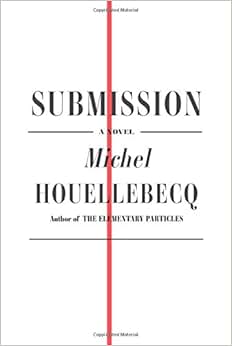
Michel Houellebecq's "Submission": Book Review


Amazon.com: Submission: A Novel (9780374271572): Michel Houellebecq ...While the release of this book in its original French will be inevitably tied to the article about its author, Michel Houellebecq, featured in Charlie Hebdo the week of the Parisian murders of its staff and other innocents last January, the novel itself merits attention.

Readers of Houellebecq's previous fiction will recognize familiar elements. The discontent of his early middle-aged, educated, ornery French narrators in Whatever and The Elementary Particles repeats. The unease in {Platform} that lust brings to those with sagging bodies and ebbing desire persists. The longing for an escape from a declining European culture returns after The Possibility of an Island with its utopian fantasy, and aesthetic debates dramatized in The Map and the Territory.

After this newest novel's French publication, critics sought to blame, once again, its satirical author. Inevitably, Soumission entered the bestseller charts in first place. Some on the left regarded its themes as needlessly provocative. Many called them racist, appealing to baser instincts among French nationalists. Taken by English-language audiences at more of a distance, these issues may recede.

If treated as another in a series of Houellebecq's jabs at coddled liberal sensibilities, Submission loses some sting. Houellebecq proves rather, once again, he delights in the novel of ideas. He places his narrators within unbearable situations. We then watch them try to wriggle free. Within a French situation where the thought-police seek to patrol the sensibilities of all who reject secular platitudes as much as they may religious ones, the topics Submission investigates enrich its suggestive title.

Suffering from "andropause," our forty-something narrator encounters the steady decline of literature, values, culture and his libido. The teller of Submission is an expert on J. K. Huysmans, who over a century ago startled an earlier French readership with decadent novels, considered "sodomitical" and Satanic. Like Houellebecq, Huysmans' erudition enhanced his fiction's barbed, bohemian contents. Unlike Houellebecq, Huysmans began a gradual conversion to Catholicism; he eventually lived, if in less than austere style, as a lay oblate attached to a Benedictine monastery. Houellebecq had drafted this novel with a template of a protagonist emulating Huysmans' path; this story becomes in the revised version we have its sub-plot. Meanwhile, the main plot dramatizes French Islamization.

For an acerbic author regarded as unsentimental, Houellebecq begins this novel with a tender, if bitter, homage to the power of literature. It channels for the living the voices of the dead. Directly, by no other means, a reader can enter by a book into the mind of its creator, the spirits of the departed.

The narrator loves this quality. In his dissertation on Huysmans, he sums up an outlook in common with Houellebecq. "Even as he grew to despise the left, he maintained his old aversion to capitalism, money, and anything to do with bourgeois values." The professor avers that "the only thing left to people in their despair was reading," but that solace is chosen by far fewer than in Huysmans' era.

Instead, much of the initial action in this fiction, concerned more with lofty concepts than realism or politics, takes place in languid dialogue or heated exchanges between the narrator and a louche colleague at the University of Paris, Steve. The protagonist spars with him often, in "that odd ritual,. part buggery, part duel" that is "conversation between men." When the teller is jolted enough by the violence breaking out as the far-right spars with Islamic factions during the Presidential primary, the empty rural roadscape he sees, static on the radio, a clerk shot dead at a convenience store, feels less real and more contrived. It is akin to horror as glimpsed in a J.G. Ballard novel, drained of emotions.

After all, Houellebecq detaches himself from his narrator--and through him. He leaves enough of the Huysmans-driven plot to move him along, as he attempts a retreat himself at a Catholic monastery. But this fails. He has no deep contempt for his former "fellow believers" who cling to the Church. Rather, he blames "laicism" and "atheist materialism" for the death rattle of Western European values. This critique carries more weight in France than in the U.S. Despite Lorin Stein's flowing translation, readers of Submission distant from the issues that divided France after the Charlie Hebdo shootings and those limits or liberties of freedom to mock any religion may feel that this novel's impact fades.

What international readers, who may be baffled by the dense if understandable references to French media pundits and political maneuvers, are left with is a more classic contribution to a French model. The narrator who employs satire to comment on his homeland from abroad, reporting from a fabled or foreign land, emerges. As Montesquieu's Persian Letters or Voltaire's fiction transported French concerns to imaginary lands, to sidestep censorship and clerical reaction, so Houellebecq places his nameless narrator within a French polity a few years into the future. In Submission to counter a threat by Marine LePen and National Front, other French parties cast their lot with the Muslims. We hear far too little about what follows in practical terms. This lack weakens the novel's impact. Yet the tale-teller laments, typically, the loss of the ability to admire women, now that so many are veiled.

The indulgence granted such a sly teller of edgy commentary enlivens comparisons between French and Muslim mores. Late in the story, the scholar's supervisor--who has converted to the faith that has bought the Sorbonne with Saudi money and rewarded those faculty who give in--links "woman's shamanism to man, as it is described in The Story of O, and the Islamic idea of man's submission to God." The appeal of bonus brides as recruited from two or three female students from the realm of Islam, who are the few remaining who enroll in literature classes at the University of Paris, beckons the narrator to contemplate joining the favored elite of Muslim converts. Huysmans' path diverges from those 120 years later in this French novel, but Houellebecq and his narrator agree. If he submits to God's call, this dissolute intellectual will find favor in the eyes of the pious, and the well-endowed.

We leave this predicament as the protagonist mulls over his choice. Will he embrace "a chance at a second life with very little connection to the present one?" He admits, "I would have nothing to mourn." Christian France is dying. With the nation under Muslim leadership, in a coalition with the Socialists and a center-right party, such are parliaments in a strange land of the near-future, those who wield power and issue paychecks have changed. At this point, the novel sidles away. Submission chooses to remain chary about the full force of such momentous transitions. It prefers to stay coy, and like the delights of the women hidden behind gowns and veils, it retreats into its own fantasy again. (Amazon US 10-20-15; Spectrum Culture 11-8-15 a few days before the [latest] Parisian massacres.)

Saturday, June 20, 2015

Tír na mBascach


Tá súil buaine agam faoi An Bhascais agus an Tír na mBascach. Foghlaim faoi na Bascaise fadó, ar ndóigh. Léigh mé an leabhar le Mark Kurlansky, "An Stair Bascais ar an domhan" agus an úrscéal le Bernardo Aztaga, freisin, ina dhiaidh sin.

Go fírinne, is nasc láidir idir na Bascaise agus an muintir na hÉireann anois. D'fhás sé seo leis na trioblóidí. Féachaint ar múrmhaisiú seo in hIarthar Bhéal Feirste, mar shampla.

Is "askatasuna" an bhrí na saoirse as Bascaise. Tá siad daoine an-ársa ansin. Tá muid gaolmhara sa Bhreatain Bheag agus i Éirinn go na Bascachaí ansiud an chuid is mo gar, fós, de réir gíneolaíocht.

Tá inimircigh Bascachaí ina hIdaho, Nevada, agus Califoirnea ó dheas ag imeall Bakersfield agus in Chino, gaire dom. Tá béilí mór acu ar chéile. Go minic, bhí aoirí anseo sa lá aois san Iarthar.

Bá mhaith liom ag dul go an Tír na mBascach go luath. Tá mé ábalta labhair i Spáinnis beágan agus tá mé ábalta léamh roinnt Fraincise, mar sin féin. Gan amhras, tá an teanga an Bhascais ro-deacair do achan duine ann lasmuigh den talamh ársa.

The Basque Country.

I've had an enduring interest in Basque and the Basque Country. I learned about the Basques long ago, of course. I later read Mark Kurlansky's book "The Basque History of the World" and a novel by Bernardo Atxaga too.

Truly, there is a strong link between the Basques and the people of Ireland now. This grew during the Troubles. Look at this mural in the West of Belfast, for instance.

"Askatasuna" is the meaning of freedom in Basque. The people are very ancient there. We are relatives in Wales and in Ireland to the Basques over there as our share is closest, still, in terms of genetics.

There are Basque immigrants in Idaho, Nevada, and Southern California around Bakersfield and in Chino, nearer to me. They have great meals together. Often, they were shepherds here in the old days of the West.

I would like to go to the Basque Country soon. I am able to speak in Spanish somewhat and I am able to read a share of French, all the same. Without a doubt, the language of the Basques is very difficult for everyone outside this ancient land.

Friday, January 16, 2015

Je Suis Charlie depuis deux jours


Only the Independent targeted the mix of defiance and puerility that combined in Charlie Hebdo's fatal art. That paper's front page illustrated a middle finger lifted from out of Hebdo's yellow background, its own bold frame ready to be dramatized by an inker's touch. That touch died, digit extended, surrounded by blood spilled into or as if red ink.

The New York Times refused to reprint Charlie Hebdo's often juvenile, if sometimes clever in startling or unsettling ways, determinedly satirical cartoons that led to the murders of eight artists, three police (one of Algerian descent), two more dead, and two days later, four Jewish hostages. A Yale UP book on the 2006 Danish cartoons did not dare to include those depictions. With such hesitancy by publications purporting to critically investigate this issue, I fear this leads too much to caution. While understandable, this failure of nerve lest nervousness grow may erode our liberty due to too much tolerance. Inviting discussion, as I sort through journalism, memes, and commentary I've compiled, in ‘Je Suis Charlie depuis deux jours’, (‘I Was Charlie for Two Days’), I share here an array of perspectives as I watched and participated in the spirited discussion and debate. The whole episode spanned two-plus days, but it warped rapidly online.

Jonathan Freedland at the Guardian also asserted that his paper should not reprint the images. From what I can gather, neither the Irish Times nor the Telegraph printed any of them as well. More on that as this essay continues. For now, at least Freedland also covered what in the aftermath of the attacks remains to me tellingly an under-reported aspect. Freedland asks why innocent Jews at a kosher supermarket should be held as if guilty of crimes in Gaza by the IDF. This reductionist ‘blaming the victims’ was also being marshaled to spin the Charlie Hebdo cartoonists' fate. This direction, as far as I could follow, emerged soon after the initial shock many testified to on hearing about the attacks.

First, I noticed my FB feeds and profile photos or friends fill with ‘Je Suis Charlie’ and fellow cartoonists' responses in solidarity. But, a few hours later (at least in the time lag given my ability to call up coverage and my own delay keeping up with the media blitz, for at work I had not even learned of the incident--indicative of my multicultural milieu, for better or worse, avoiding any such discussions), I found another twist. This asserted that while of course we do not justify violence, we feel sorry for those who found the caricatures offensive and racist and despicable, and we deplore their promotion, just as we would any which once darkened the pages of Der Stürmer or a tabloid.

Jay Michaelson issued a progressive's call for ‘maintaining composure in the face of anger. We should not deny the rage we feel at Jews being targeted in a kosher grocery store while they buy wine for Shabbat. That would only make the anger worse. But we should channel it into effective responses with cold, clear reason.’ This is how I first learned of the hostages taken, as this aside. I found no other posts on it, and when I scoured the NYT and LA Times websites, ‘grocery store’ in the latter led the sub-heading. After the sad standoff was over, three killers gained their martyrdom. Four Jewish shoppers had died for the sin of being caught in an ordinary business doing ordinary things hated by those who captured them; nobody else remarked on this directly in media or FB that I saw.

Christopher Hitchens took a nuanced turn on what is not found in a kosher market, and how we live with competing impulses between control and abandon. Back in 2006, he discussed the reaction to ‘the Danish cartoons’ and the refusal of most media to risk sharing them: ‘The innate human revulsion against desecration is much older than any monotheism: Its most powerful expression is in the Antigone of Sophocles. It belongs to civilization. I am not asking for the right to slaughter a pig in a synagogue or mosque or to relieve myself on a “holy” book. But I will not be told I can't eat pork, and I will not respect those who burn books on a regular basis. I, too, have strong convictions and beliefs and value the Enlightenment above any priesthood or any sacred fetish-object.’ Wise words.

Giles Fraser, speaking of sacred fetishes, linked the terrorists to the cartoonists: both as iconoclasts. As for the Enlightenment values, two days before the attacks, the cover star of that week's CH issue,  Michel Houellebecq was interviewed about his new novel (released the day of the attacks and at #1 already), which dramatises the buildup to an election in 2022 France when ‘Mohammed Ben Abbes handily beats Marine Le Pen with support from both socialists and the right.’ He claims that those ideals are lost amidst dead consumerism and capitalism, as Islam rises and perhaps Catholicism might join forces with it against secularism. It has lost its appeal as a counter to the fundamentalist upsurge.

Houellebecq goes on to tell The Paris Review: ‘My book describes the destruction of the philosophy handed down by the Enlightenment, which no longer makes sense to anyone, or to very few people. Catholicism, by contrast, is doing rather well. I would maintain that an alliance between Catholics and Muslims is possible. We’ve seen it happen before, it could happen again.’ And, ‘Islam is an image of the future. Why has the idea of the Nation stalled out? Because it’s been abused too long.’ No stranger to frank satire, I hope he is safer in Ireland than in his native land these intolerant days.

Jeff Sparrow in Australia considered a satirical cartoon published and then apologized for there during last year's Israeli incursion into Gaza. He asked how many would cheer its anti-semitic stereotypes. He distinguished defense of free speech from condoning the dissemination of such imagery: ‘you don't have to like the project of Charlie Hebdo to defend its artists from murder, just as you can uphold media workers' right to safety without endorsing the imagery they produce’.

Nigel Duara explained that this imagery reveled in a rather sophomoric intent to rankle and irritate, but being French and secular, it tried to raise everybody's hackles. In 2012, The New Yorker’s cartoon editor, Robert Mankoff, offered what was the only inoffensive cartoon possible. ‘”Please enjoy this culturally, ethnically, religiously and politically correct cartoon responsibly.” It was four black lines. An empty box.' When spaces are illustrated, how much do readers and publishers collude in doing harm by stereotype? In Irish, NÓS recalled the precedents of the Third Reich and of Punch in Victorian England in spreading depictions that we acknowledge as worthy not of satire but contempt.

The Electronic Freedom Foundation balanced the tradition of Swift and Voltaire with a caution about the restriction of rights online and off. The speed of dissemination of the cartoons complicates the role of the press, as no censors or filters can shield journalists in a ‘global field’ where they are now vulnerable. Buzzfeed showed how many British and American press outlets have cropped or blurred CH covers, while others, as noted above, refused to reproduce them.

Michael Deacon at the Telegraph suggested the terrorists did not care about the cartoons themselves, but were using this as ‘bait’ to tempt counter-measures in turn guaranteed to stoke more support for Islamic extremism. Juan Cole popularised a similar thesis that the attacks were part of a canny agenda: “'Sharpening the contradictions' is the strategy of sociopaths and totalitarians, aimed at unmooring people from their ordinary insouciance and preying on them, mobilizing their energies and wealth for the perverted purposes of a self-styled great leader.’ In passing I must testify that some on the fringes of the media had accused Israel [and the U.S.] of responsibility under a ‘false flag’ operation smacking of the Reichstag Fire, as the attacks followed France MPs seeking national recognition of Palestine. I wonder if this accusation persisted after Jewish hostages were executed.

Naomi Wolf on social media urged restraint. She shifted blame back at Western hegemony for the anger expressed against CH. Others castigated ‘white privilege’ as indulging in unwise cruelty, goading on Muslims who then lashed back out of pride and solidarity. Others wondered why American policy was not held culpable, and the pro-Israel lobby. These retorts seemed to convince many progressives. For, once the sense of what the cartoons conveyed had been (if briefly) spread on the net (if less so in much of the mainstream press), the insistence that the freedom to publish provocation was weighed against--and found wanting by many on the left--fears of impending crackdown on Muslims by Europeans beholden to NATO and the U.S.

Wolf’s rhetoric and rush of words transmitted expresses this counter-narrative: ‘So now Hollande [thanks, typo corrected] is saying “France is at war with Terror” and this exactly echoes the “global war on terror” and “we are in a war footing” language that let Bush and Obama strip an open civil society at peace of every liberty and launder billions into untraceable “War” black holes. Worst of all is the way the open peacefulness of Europe is going to be shifted into constant terror hype fearmongering and militarization with continual attacks on civil society from the state. Beware beware France you have a far worse threat facing you than terror attacks!’

Oireachtas Retort listed a litany of ‘recent curtailments of freedom of expression’ in Ireland by the media and the government, exemplifying how nations less directly involved in the struggle between Islamism and secularism also encourage compliance to the norm as imposed by censorship and ignorance. For me, having the ability to seek out offensive content is as important as having the option to choose not to seek it out. I want to decide for myself, not thanks to a mullah or mogul.

Socialist Worker issued a SWP statement: ‘The media present Charlie Hebdo as simply a “satirical magazine”. But it is not the French equivalent of Private Eye as some commentators have suggested. It may have been once, but it has become a specialist in presenting provocative and racist attacks on Islam. That does not justify the killings, but it is essential background.’ This summed up another line of counter-attack, placing the Parisian crimes within a wider geopolitical, and right-wing dimension and equating Islam with a ‘race’-based polity. This to me feels at odds with what Malcolm X saw on his hajj to Mecca, when he witnessed blue-eyed and fair-skinned pilgrims join those of many ethnicities to fulfill their Islamic duty, I note in passing.

Simon Schama reminded readers of the history of satire against potentates, pontiffs, and princes as part of European progress. After all, the liberating dimension aligning humanist opposition and secular confrontations against those who rule in the name of gods from above or of the market also merits mention. ‘The horrifying carnage at Charlie Hebdo is a reminder, if ever we needed it, that irreverence is the lifeblood of freedom. I suppose it is some sort of backhanded compliment that the monsters behind the slaughter are so fearful of the lance of mirth that the only voice they have to muffle it is the sound of bullets.’ He upholds a ‘right to ridicule’, against those who send in clowns.

Joe Sacco began by mourning his fellow cartoonists. Then he reflected on their foolhardiness. This caught the double-take of many like him in the media, a day or so after the attacks, when initial ‘Je Suis Charlie’ posts and candlelit rallies with ‘Not Afraid’ blended with the second opinions of those who realised that the responses of Muslims angered by the cartoons might be taken more seriously than those of a more privileged, and therefore suspect, class of intellectuals and humanists, and those on the right who sought any opportunity to stoke anti-Islamic slogans and actions, from the Western ‘white’ world. This did, however, tend to polarise responses, as if none in the Muslim world, wherever that spans, objected to the murders and celebrated dissent.

Andy Borowitz tweeted: ‘I guess one part of their plan that the terrorists didn't think through is now Charlie Hebdo's cartoons are being seen by millions around the world instead of a few thousand in Paris.’ While this tweet was shared by those pleased by this, others reacted that mockery had met with revenge. And some of these did not seem overly displeased by this, even as they averred that the cartoonists did not merit death for art. Their riposte echoed: what right does the colonial have to ridicule the colonist?

David Brooks at the NYT may differ from that paper's editors. He chided a double standard. ‘Americans may laud Charlie Hebdo for being brave enough to publish cartoons ridiculing the Prophet Muhammad, but, if Ayaan Hirsi Ali is invited to campus, there are often calls to deny her a podium.’ I made this same point before I read Brooks. I also wonder: many Irish a fortnight ago were angry at the BBC proposing a comedy about the Famine. How far can we push the limits of what we may find funny, but not others? Americans usually have fewer legal restrictions than elsewhere but socially, pressure continues to discourage many ‘offenses’. In Britain, ‘incitement’ is illegal for speech deemed leading to racial hatred; also, laws applying to all must be distinguished from codes applying, fairly or not, on a campus that tries to police itself apart from rest of society.

Ross Douthat takes up a defense of blasphemy. Although he and Brooks are the conservative minority at the New York Times, their stance encouraging opinions and depictions with which they disagree sustains a type of principle many liberals back away from taking to its uncomfortable limits, in a time when tolerance and sensitivity are urged, and when everyone is jittery about spreading hate. Yet, for reasons of public order and concomitant discretion in diplomatic rhetoric, this divergence from frank talk can echo when our politicians decry in Paris ‘terrorism’ without naming its context more specifically. This is another way we dance around the suppression of freedoms in the Islamic heartland. There is a ‘squeamishness,’ as Douthat's article links to in other journalism, about how many react. Part of the problem is that culture, religion, identity are all wrapped up into a massive package labelled ‘Islam’ differently than much of the secular realm, where many of us try to set religion into a category apart.

Here we turn to those not from Europe but from the Islamic world who have protested its ideology. While I raised this in exchanges with those on the left who took the ‘CH had it coming’ side, my claims that those in Islamic regimes also faced incarceration, torture, and death met with no reply other than that free speech used in such excess unwisely egged on those who, outraged, lashed back. I also challenged those sympathetic to Islamism to account for the crackdowns on those from Islamic nations who expressed opinions similar to CH. Could they be denigrated as ‘racist’ or ‘imperialist’? The pro-Islam, and somewhat anti-secular response, from those who some on the left supported is typified by this blog post, shared from Al Javieera: ‘One can condemn violence and at the same time sustain a critical stance against Charlie Hebdo. One can condemn the “asymmetric warfare” of masked gunmen and also reject racism, tyranny, and hate. One can denounce cold-blooded massacres while also unsubscribe from the horrible, orientalist titillation of Charlie Hebdo cartoons and the mental passivity of liberalism.’

Ayaan Hirsi Ali, who knows firsthand the price paid by those who provoke Islamist power, fled her Somali homeland and then from the retaliation she faced after Theo Van Gogh was murdered and she went into hiding in her adopted Holland. Therefore, she feared capitulation once more. She urged the media to reprint the cartoons. It was our duty to stand up against forces sympathetic to jihadists: ‘The more we appease, the more we indulge, the more emboldened the enemies of freedom become.’

Salman Rushdie, who escaped a sentence of death, invoked as if in Islam's name, concurred in his statement. ‘Religion, a mediaeval form of unreason, when combined with modern weaponry becomes a real threat to our freedoms. This religious totalitarianism has caused a deadly mutation in the heart of Islam and we see the tragic consequences in Paris today. I stand with Charlie Hebdo, as we all must, to defend the art of satire, which has always been a force for liberty and against tyranny, dishonesty and stupidity. “Respect for religion” has become a code phrase meaning “fear of religion.” Religions, like all other ideas, deserve criticism, satire, and, yes, our fearless disrespect.’

Maryam Namazie agreed. She cites Raif Badawi's flogging with the first round of 1000 lashes in Saudi Arabia as one of many abuses and threats against those in Islamic heartlands who speak out. ‘With the focus now on Charlie Hebdo and the crucial need and right to criticise Islam and religion, though, let us not forget the many across the globe who face execution or imprisonment for “insulting the prophet” and criticising Islam. Below you will find some examples which include Muslims, believers and atheists; the charges aim not to protect “Muslim sensibilities” as we so often hear in the west but to protect the status quo and the political power of Islamists’-- As an Iranian activist now in London, this data verifying oppression may counter the ‘racist’ or ‘imperialist’ charges brought by some on the left who decry the Charlie Hebdo content as akin to Nazi, Klan, or orientalist caricatures.

And at least some outlets like the Huffington Post printed enough of the cartoons to let us judge, rather than editors or activists or clerics, about what we could reflect upon, laugh at, or cringe from. The Daily Banter went further, showing some other outlets would not due to explicit content. The Onion, as true satire, merits a reprint of their 2012 sketch: ‘No One Murdered Because of This Image.’ Still I note that that satirical site did not include the Prophet in their send-up of holy images desecrated gleefully.

Finally, the staff at Charlie Hebdo issued this simple remark: ‘Les caricaturistes sont morts dans l'exercice de leur métier et pour notre liberté. Leur plume était leur arme.’ (‘The cartoonists are dead in the course of their trade and for our freedom. Their pen was their weapon.’) May peace prevail.
The Pensive Quill Jan. 12th 2015. Thanks to Anthony McIntyre and Carrie Twomey for publication.

P.S. Inevitably, more to share: Nick Cohen emphasises the necessary awareness to battle self-censorship: ‘European liberals ought to have stopped, as the lash fell on Badawi’s shoulders, and wondered about their queasiness at criticising the religions of the “powerless” and “marginalized”. The Saudi Arabian monarchy is all too powerful, as are the other dictatorships of the Middle East. Power depends on where you stand and who stands below you. The unemployed man with the gun is more powerful than the Parisian journalist. The marginal cleric may have a hard life, but if he sits in a sharia court imposing misogynist rules on British Muslim women he is to be feared’.

Olivier Tonneau offers a valuable insight into CH’s mission and equal-opportunity satire from its French contexts: 'A wave of compassion followed but apparently died shortly afterward and all sorts of criticism started pouring down the web against Charlie Hebdo, who was described as islamophobic, racist and even sexist. Countless other comments stated that Muslims were being ostracized and finger-pointed. In the background lurked a view of France founded upon the "myth" of laïcité, defined as the strict restriction of religion to the private sphere, but rampantly islamophobic - with passing reference to the law banning the integral veil. One friend even mentioned a division of the French left on a presumed "Muslim question".
            As a Frenchman and a radical left militant at home and here in UK, I was puzzled and even shocked by these comments and would like, therefore, to give you a clear exposition of what my left-wing French position is on these matters'….Tonneau's whole Mediapart essay merits reflection, as does this presentation, Le Monde journalist Nabil Wakim's explanation 'to my American friends'.

Max Fisher at Vox continued their critique of what they chide as Islamophobia, and also pointed out as does Tonneau the double layers at work, for better or worse, in the CH satire and 'news-mixing'. The Understanding Charlie Hebdo site places various cartoons in this perspective, as a corrective. Meanwhile, Olivier Cyran, a former staff member, confronts CH: '''Muslim bashing" dressed up as “intransigent defence of freedom of expression” has become your front-window showcase, which you take care to replenish regularly.' This stance 'allowing you to occupy a non-negligible segment of shameless Islamophobic opinion on the left.' Cyran, in a long letter documenting many cartoons, concludes: 'The machine for refining crude racism isn't just profitable, but also extremely fragile'.

Daily Kos shared a few of Cabu's CH cartoons, targeting French reactionary and state icons. See also at DK 'On not understanding 'Charlie": Why many smart people are getting it wrong.' About the sneering that replaced sympathy rapidly among some critics on the Anglophone left, Leigh Phillips at the Canadian site Ricochet takes on the standard reproach voiced as I noted above within a day or two: 'Of course the killing of journalists is a bad thing, so the argument goes, but come on, Charlie Hebdo is "a racist publication." So what do you expect? is the implicit, victim-blaming conclusion.'

Kenan Malik at the Marxist site Redline avers to the past two decades, when many leftists may promote 'a moral commitment to censorship, a belief that because we live in a plural society, so we must police public discourse about different cultures and beliefs, and constrain speech so as not to give offence'. David Riley at the Buddhist blog The Endless Further frames this hesitation for free speech within that system's fundamental aspiration to right speech: 'Where do we go from here? Do we encourage journalists to censor themselves? And if so, is it an act of tolerance, or is it just doing what the terrorists want us to do? Or, perhaps, the outrage, the defiance, the condemnation is exactly they want to see. Are we only displaying our wounds for their pleasure?' Out of another definition of the right to pleasure and to autonomy rather than conformity, Suzanne Moore takes a feminist stance. She retorts: 'don’t ask me to have respect for these kinds of fundamentalism that have none for me'.

My wife and I differ. She insists that if the cartoons targeted Jews, it'd be a very different matter, and besides, try as she might to reconcile the need for free expression with the magazine's images, she does not find them funny. For now, let's let survivors at CH have the last word, or pictures saying more than my past four-thousand or so words above, in their new issue (summed up in English).

Tuesday, June 17, 2014

Ag fhoghlaim Fraincis

Tá mé ag fhoghlaim Fraincis faoi láthair. Thósaigh mé nuair chuaigh Léna agus mise go Ceanada ar feadh fomhair seo caite. Bhí dith orm a thuiscint beagán ansin.

Mar sin, fhéic mé ar an Leabhar Aghaidh post le chara ag fhoghlaim Spainnis leis Duolingo. Ní chuala mé faoi seo riomh. Chuir mé an suíomh anseo. 

Tá mé ag dul go mall ann. Measaim go mbeadh ag gabhail suas céim amhain gach mí. Is féidir liom ceacht laethúil.

Insint an h-am, iarraidh faoi an h-aimsir, nó labhairt triu réamhfhocail: tá siad deacair. Níl easca a cloisint na fuaimeannaí, go fírinne. Ina theannta sin, bím ag obair a thuiscint nathannta cainte leis Duolingo.

Mar sin féin, is maith liom a dhéanamh dul chul cinn. Gan amhras, tá sé beag. Ach, beidh brea liom é nuair tús a chur Duolingo le Gaeilge an bhlian seo chugainn.

Learning French.

I am learning French lately. I started when Layne and myself went to Canada during last autumn. I wanted to learn a bit there.

Therefore, I saw on Facebook a post by a friend learning Spanish with Duolingo. I had not heard of this before. I accessed the site here.

I am going slowly. I reckon maybe getting up one level every month. I do a lesson daily.

Telling time, asking about the weather, or speaking through prepositions: these are difficult. It's not easy to hear the sounds, truly. Furthermore, I'm working to grasp idioms from Duolingo.

Nevertheless, I like making progress. No doubt, it's small. But, I will love it when Duolingo begins in Irish next year. (Grianghraf/photo: An Sionnach Fionn.)

Monday, August 19, 2013

Laurence Cossé's "A Corner of the Veil": Book Review

Very elusive, fittingly or ironically, about the actual proof of God that floors a few Casuists (read: Jesuits) and a French prime minister during the year before Y2K. The Parisian setting is underused, the characters probably stand ins for politicians or pundits that the original audience might recognize, and the tone's droll as you'd expect. Linda Asher's translation captures the worldly-wise ambiance of the original, I assume, and the results entertain.

Able to be perused (small size, big margins) in a single evening, the plot naturally keeps you guessing. As to the proof, the idea that God the Father is exposing Himself by imposing Himself upon man via Christ and the Spirit so people figure out (presumably) that the divine "becoming" permeates all of God's creation sums up the gist of the daring breakthrough. The difficulty is that Laurence Cossé teases us as she does the characters who try to penetrate the mystery of the document's contents. She, too, lifts up the veil's corner but she refuses to let us peek. We must watch others look inside.

This distancing, while it makes sense for her revelations, or their lack for the reader, may please some who wish like some in the pages not to know it all. The advantages of doubt articulated by prominent figures make for an intriguing meditation. I never thought of the shift that would happen if people could know God and how that might diminish rather than increase goodness.

You get some discussion of this scenario as the advisors in elite clerical and state realms battle over the social impacts of this proof. Cossé appears to believe that people would generally favor frugality and compassion, but she along with certain figures warns that brutality and cynicism could grow as "everything is permitted" in the calculating eye of some determined dissenters. I think she gives people too much credit for the positive aspects of a revelation like this, for in a secularized era, it seems many would not fall for this message from above, if theorized by one from below.

It may be a nod to popular sensibilities, but I am unsure the plot needed the thriller aspects that it enters later on. A Corner of the Veil reminded me in its substance, however coyly, of the Jesuit French maverick Teilhard de Chardin's immanent concept of the Incarnation entering the cosmos and the mentality of all created lives and souls. Curious why nobody among the learned mentioned this vision from a bold predecessor who met with his own censure from the powers that be. (Amazon US 5-20-13)

Saturday, March 9, 2013

"The Letters of Samuel Beckett: 1941-1956": Book Review

This second volume of letters "having bearing on my work" elegantly compiles Samuel Beckett's postwar correspondence. Limited as it is by his estate to literary contexts, nonetheless, with forty percent of his total letters published in over eight-hundred carefully edited pages, this 2011 title allows readers to follow Beckett as he matures. The often pleading, imploring frustration of a struggling Irishman trying to land a publisher for his poems and tales has faded. After his tense time working as a farmhand and for the French Resistance in the countryside, Beckett returns to Paris and then goes away to Ussy-sur-Marne to confront himself--and to create his breakthrough prose and drama.

As he had done in the first volume of his letters to Thomas McGreevy, so he opens up to Georges Duthuit from his new residence. Easing if not replacing the acerbic, dyspeptic tone of his youthful letters, he blends his unease into a mellower, if no less rueful, distillation of himself. He begins the sunset of the first day of June 1949 walking back to Ussy, accompanied or nagged along the road by mayflies. "In the end I worked out they were all accompanying me towards the Marne to be eaten by the fish, after making love on the water." 

This remarkable vignette exemplifies the quality of his insights. Like the first volume, the second teems with artistic and philosophical interests. A rare talent in both the novel and the play, Beckett's decision to enter into French as his primary mode of literary creation demonstrates his command of the idiom beyond his thirty years first in Ireland and then abroad. As the edition's French translator George Craig explains, Beckett made France his milieu. 

Ireland recedes, where his older brother and his mother lingered before dying. In another moving passage, he writes to Duthuit in 1948 after he watches his fading mother's blue eyes. "Let us get there rather earlier, while there are still refusals we can make." Here you can discern the powerful mood which will grace or unsettle Molloy, Malone Dies, and The Unnamable. 

His visits back to Dublin appear to have caused less contention than those in the pre-war decade, yet he rankles at the censorship there and in London. When Godot was slated to appear on the West End in 1954, the Lord Chamberlain "got going." So, "coat" replaced "fly," "backside" replaced "arse," and "guts" replaced "privates." 

Such asides speckle Beckett's writing, to one person in his letters, to the few but discerning readers of his increasingly confident fiction, or his sudden exposure with the fame that he had courted for so long with so little success. Waiting for Godot was advertised in Miami as "the laugh sensation of two continents." Socialites walked out in droves.

Dan Gunn introduces this collection by noting its "rhythm of approach and withdrawal." One wishes more had survived, and that the lacunae of the wartime years had been replaced with evidence of his life, but the silence speaks for his and bravery as an Irish citizen working against fascism and under the threat of death. Such commitment provided Beckett with more equanimity and compassion in the difficult years during and after the war as he reconstructed his own life and career in France. 

Beckett comes to terms slowly with his celebrity, granted as he nears the age of fifty. Already sensing the diminution of his physical powers, ironically he enters into his literary prime in this second volume. He, who had urged so often others to read his works and to publish them, now begins to find himself elucidating or correcting others who seek out his advice.

Despite his French allegiance, he remains Irish. Craig as a fellow countryman senses the Irish-English persistence in Beckett's phrasing, and its pitch to the breath and spoken word rather than the semicolon or period. He castigates silly critics of Godot: "Like a lot of seaside brats digging for worms people are." 

Within whichever language he chooses, Beckett finds himself agonizing over the right word, the key phrase. In the struggles documented here, he separates his voice in French, with its discipline and narrower range, from his native English, with its temptations to wander. Either way, this annotated and durable edition attests to his skill, his fluency, and his humanity. (Edited to 600 words 6-1-13 for Slugger O'Toole As above 2-17-13 to Amazon US)

Thursday, March 7, 2013

"The Letters of Samuel Beckett 1929-1940": Book Review

The editors began this project around 1985. Changes in ownership of Beckett’s works, negotiations over publication of his correspondence, and the winnowing down of 15,000 letters to 2,500 to be reprinted in four volumes, along with another 5,000 from which excerpts would be used for annotations, demonstrate the care with which this endeavor has been compiled. Beckett may be the last major writer to have his correspondence extant in an entirely non-electronic form. The range of his letters, two-thirds written in English, 30% in French, and 5% in German, attests to the cosmopolitan range and erudite ambition of his determination to imagine himself, early on, into a literary life.


Fehsenfeld and Overbeck explain how they sought a middle way between the minimalist editorial approach of Richard Ellmann for James Joyce’s letters, and the maximalist approach taken by John Kelly for W.B. Yeats’s letters. Restricted to reproducing those letters that drew directly upon Beckett’s writings, the editors nevertheless seek a liberal interpretation of this control. They explain how their first examples display Beckett’s desire to connect to correspondents. He delivers less information, and more solidarity, or intimacy, as he tries to forge a literary career – and to keep his distance from one.


As Beckett’s confidence grows, and as Murphy finally gets published after nearly two years of rejections, his language takes flight. Their content and style soar like kites, above his cities. His words may relax, energize, or recoil. No wonder “rectal spasms,” as the editors note, characterize the physicality of later 1930s letters, with analogies between the act of writing and primal, raw functions within the body.


He begins with coiled frustration. “I am looking forward to pulling the balls off the critical & poetical Proustian cock” (36). His monograph on Proust he regards more as duty than pleasure. He struggles to separate himself from his fellow and elder Irishman in Paris. “Sedendo et Quiescendo” to Beckett “stinks of Joyce in spite of most earnest endeavours to endow it with my own odours” (81). He then promises an editor at Chatto & Windus a scatological comparison to the precise shape of his bowel movements.


Thomas McGreevy received many of the letters included here. They speak of Beckett’s indolence: “even if I succeeded in placing something and getting some money I don’t think I would bother my arse to move.” (158) He would rather lose the world for stout “than for Lib., Egal., and Frat., and quarts de Vittel.,” (159) he tells McGreevy in May 1933. Yet Beckett wonders why Man of Aran lacked any poteen, and soon he spends more time in London, looking toward Paris rather than Dublin for his future.


A year later, he tells Morris Sinclair of his fears, that “no relationship between suffering and feeling is to be found,” and any joy comparing his own fortune to those with less “begins to look deceptive” (204). He observes himself as if “through a keyhole,” and feels at a distance well away from his own self. “Strange, yes, and altogether unsuitable for letter writing” (205).


He finds the attitude that will infuse his mature work. In Autumn 1934, he informs McGreevy that the dehumanization and mechanical nature of the artist extends to the portraits he studies so intently: “as the individual feels himself more & more hermetic & alone & his neighbor a coagulum as alien as a protoplast or God, incapable of loving or hating anyone but himself or of being loved or hated by anyone but himself” (223).


Still, humor lurks. A spider has two “penes.” The “Kook of Bells” gets a nod. T.S. Eliot spelled backwards stands for toilet. Beckett contrasts the art, plays and concerts he views with English literature. It remains mired in “old morality typifications and simplifications. I suppose the cult of the horse has something to do with it”(250).  He tires of vices and virtues. This mood may, in Spring 1935, account for his difficulties with Murphy. After analysis with Bion, Beckett rages to McGreevy. “If the heart still bubbles it is because the puddle has not been drained, and the fact of its bubbling more fiercely than ever is perhaps open to receive consolation from the waste that splutters most, when the bath is nearly empty” (259).


Yet, he watches the old men as kite flyers at Kensington’s Round Pond that autumn, and he observes them in his letter with the same detail that will enrich his novel. He tells McGreevy of a friend’s comment: “‘You haven’t a good word to say except about the failures’. I thought that was quite the nicest thing anyone had said to me for a long time” (275).


Tedium shrouds 1936. Working for his brother back in Dublin tempts him briefly. “I am thinking of asking Frank does he want stamps licked in Clare Street. Though I fear my present saliva would burn a hole in the envelope” (320). He informs McGreevy: “I do not feel like spending the rest of my life writing books that no one will read. It is not as though I wanted to write them”(362).  Frank asks him after Murphy is turned down again:

‘Why can’t you write the way the people want’, when I replied that I could only write the one way, i.e. as best I could (not the right answer, not at all the right answer), he said it was a good thing for him he did not feel obliged to implement such a spirit in 6 Clare St. Even mother begins to look askance at me. My departure is long overdue. But complicated by owing them £10 apiece (366).


Beckett cannot please possible publishers. “Do they not understand that if the book is slightly obscure, it is because it is a compression, and that to compress it further can only result in making it slightly obscure?” (380). He vows that his next work will be “on rice paper with a spool, with a perforated line every six inches and on sale in Boots” (383).


He roams Germany, refining his fluency, in early 1937. His letter to Axel Kaun in German represents a breakthrough. “It is getting more and more difficult, even pointless, for me to write in formal English. And more and more my language appears like a veil which one has to tear apart for me to get to those things (or the nothingness) lying behind it” (518). While this exchange is well-known, within the contexts of travel and growing unease as the Continent’s fate entangles with his own uncertain future, this letter gains resonance. In 1936 he had noted how at the Hamburger Kunsthalle, “all the lavatory men say Heil Hitler. The best pictures are in the cellar” (384). He shifts from London to Paris to Dublin, unsettled.


Recovering from the 1938 attack upon him by a Parisian assailant, Beckett contemplates an offer from Jack Kahane’s Obelisk Press to translate Sade’s Les 120 Journées de Sodome. He hesitates, not wanting to do the predictably censorable work anonymously, but reluctant “to be spiked as a writer” (604). He as always needs the money, but the project fades away. His later letters document the rejections given to Murphy, and Beckett’s reluctance to stay in Ireland. “All the old people & the old places, they make me feel like an amphibian detained forcibly on dry land, very very dry land” (637).


Even in 1933 he felt an “unhandy Andy” around his family. Frank suffers his own malaise, “with the feeling all the time in the not so remote background that he is strangling his life. But who does not” (369). In 1938, Beckett learns from his brother that their mother is ailing. “I feel sorry for her often to the point of tears. That part is not analysed away, I suppose,” he tells McGreevy. From Paris, he “returned to the land of my unsuccessful abortion,” but only to “keep my mother company” before he goes back for good “to the people where the little operation is safe, legal & popular. ‘Curetage’” (647).


For Beckett’s own intimacies, this compendium remains discreet. Lucia Joyce and Peggy Guggenheim garner proper mention. Beckett stays reticent regarding his relationship with Suzanne Deschevaux-Dumesnil. He introduces her to McGreevy in 1939 as “a French girl also whom I am fond of, dispassionately, who is very good to me. The hand will not be overplayed. As we both know that it will come to an end there is no knowing how long it may last” (657).


By June 1940, Beckett wonders about their fate, “provided we are staying on in Paris.” He tells Marthe Arnaud how “Suzanne seems to want to get away. I don’t. Where would we go, and with what?” (683). He concludes, c/o the painter Bram Van Velde, with a characteristically resigned, yet defiant set of images and thoughts. As those around him await the Nazi occupation, Beckett cites Murphy, and mixes his own predicament with that looming over the recipients of his final letter.

Under the blue glass Bram’s painting gives off a dark flame. Yesterday evening I could see in it Neary at the Chinese restaurant, ‘huddled in the tod of his troubles like an owl in ivy’. Today it will be something different. You think you are choosing something, and it is always yourself that you choose; a self that you did not know, if you are lucky. Unless you are a dealer (683-684).


Presciently, an advance notice about More Pricks Than Kicks in The Observer opined: “Mr. Beckett is allusive, and a future editor may have to provide notes” (210). Notes expand here. Each letter earns footnotes; profiles of recipients total fifty-seven. Works cited, an index, and George Craig’s French and Viola Westbrook’s German translation prefaces supplement the letters. Contributors credited by the editors fill thirteen pages.

This is the first of four projected volumes. The diligence of those who have assembled this compendium attests to its thoroughness. Spot-checking, I could find only one small slip, an indexed reference that lacked a referent. The immense labor of Beckett, building up his own talent, is matched by the scholars who present his early correspondence, or at least a third of what remains, to an attentive audience. 

[P.S. As above, in html/pdf in Estudios Irlandeses 6 (2010): 183-185. Edited down and then expanded again for a different crowd at  Amazon US 2-17-13.  As is my Amazon review the same day of "Volume Two: 1941-1956"]

Wednesday, January 25, 2012

Michel Houellebecq's "The Map and the Territory": Book Review

Michel, appearing in his own fifth novel, has his artist-protagonist Jed Martin's father say of their creator: "He's a good author, it seems to me. He's pleasant to read, and he has quite an accurate view of society." He later's "a loner with strong misanthropic tendencies; it was rare for him even to say a word to his dog." His anodyne, but dryly witty summation characterizes the feel of Houllebecq's streamlined, yet often curiously detailed, fiction. I've admired his previous fiction, "Whatever,'' "Platform," and especially "The Elementary Particles"; "The Possibility of an Island" tried to be too ambitious, but it remained readable and thought-provoking as the first three novels. (All reviewed by me.)

Gavin Boyd's translation keeps the hermetic, slightly antiseptic feel of Houellebecq. For all his detail, here lavished upon the art world as well as the vagaries of male power and female "plenitude" marshaled as how our third millennium's establishing its time-tested control over we weaker consumers, he remains distant even as he digs into how we create, buy, sell, and ruminate, in everyday language and coolly observed branding. Transport, cuisine, shopping as in earlier novels earn his scrutiny and inclusion in efficiently conveyed prose. Naturally, the evolution of European sensibilities via the visual arts within a networked, high-tech world is discussed, in the academic tones of an historian. Therefore, the author's delivery usually keeps you at a safe remove from Jed--Houellebecq shrinks from predictable emotion or facile melodrama. He likes to stand back from indirect narration via Jed to adapt a stance of an art curator or critical scholar.

Taking photos of Michelin road maps, Jed finds a perfect title for their exhibition--"The map is more interesting than the territory." Typically for Houellebecq, this opens up a rigorously factual, while speculative, novel of ideas. Jed's efforts tie into making the French countryside "trendy" for the first time since Rousseau. Jed's relationship falters; after setting up background, Houellebecq in part two returns to the novel's opening.

Jed goes to the airport town of Shannon in Ireland (and then to his place in his native land) to meet and to arrange a sitting to paint Michel. He takes along a Samsung camera to shoot him first, a mechanism oddly described in typical terms, and ten years' gap shifts forward and back in expected form for this novelist. Damien Hirst, Bill Gates, Jeff Koons, and Steve Jobs pop up, subjects of other sittings. So do discussions of William Morris, Le Corbusier, silicone breasts, and Tocqueville. As in earlier novels, suicide of a loved one looms large as a revelation for the main character; his anomie and midlife ennui are juxtaposed with success by bourgeoisie standards. "Sexuality is a fragile thing: it is difficult to enter and easy to leave." Upending what you'd expect?

Well, I will leave part three to you. Suffice to say it's clever if not that unexpected, given it's from a French intellectual au courant not only police procedurals but with textual theory. (Amazon US 12-20-11)