Showing posts with label Germany. Show all posts

Friday, April 7, 2017

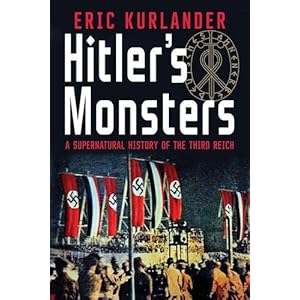
Eric Kurlander's "Hitler's Monsters": Book Review

Hitler's Monsters: A Supernatural History of the Third Reich
This Florida-based historian bases his investigation of the supposed supernatural in Nazi Germany on archival research, vast documentation, and a determination to produce a calm, focused, and sober study of an inevitably sensational topic. He seeks a "post-revisionist" balance to recent claims diminishing or explaining by other means the reasons so many under the Nazi regime sought guidance through "border sciences" of paranormal, Thule-obsessed, and other dodgy speculation.

In this galley, no index was provided. Looking at his admittedly impressive list of sources, one is aware of Eric Kurlander's steady ability to explain such arcane and often disturbing lore and its applications. Spot-checking, for instance, I was surprised not to find any mention of Julius Evola, as his role playing off or even against the German interpretations of esoteric theory is well-known. But within the borders of his narrower topic, this professor provides a surprisingly readable guide. Coming to this as a newcomer, wary of special pleading, instead Hitler's Monsters offers balance.

That is, Prof. Kurlander achieves a combination of the distance from the events that enables reflection, and a firsthand ability to handle primary sources which many who attempt to make claims about this subject cannot support, given their lack not only of the language, but the historical acumen. The "supernatural" takes in much, and astrology, paganism. Ario-centered myth-making, witchcraft are expanded to include "miracle weapons," "supernatural partisans," and unfortunately "racial science" as supporting experimentation, resettlement, and of course mass genocide.

Nearly every paragraph contains superscriptions to the documentation. There a few endnotes elaborate on the text proper. The care taken by Kurlander is evident. With so many continuing to challenge historical veracity on this emotive episode, this caution and meticulous defense from the work of previous colleagues is welcome. It's a valuable contribution to the study of pseudo-science, far-fledged theories, insistent fabrication, and ultimate devastation. Not the kind of power results the Reich wanted to achieve, but the kind it kept churning out in apocalyptic rhetoric and frenzied schemes, even as the enemy closed in around its own borders. Werewolves, vampires, and pre-modern cosmology all played dark roles.

Out of this "supernatural imaginary," as Kurlander calls this plethora of sinister powers, an appeal beyond anti-semites, fascists, and "racist imperialists" enveloped a broader support base. This is crucial to understand, for without clear economic solutions or political policies, Kurlander concludes, the Nazi party came to and maintained its rule by blurring the problems of social and economic reality with this concocted dust of mass media manipulation. Rather than forces unseen, the dictatorship drew upon illiberal conceptions which survived the end of the Reich. As we see...
(Amazon US 4/2/17)

Saturday, January 16, 2016

Fiosracht faoi na Gearmáine Thoir

Photo

Le déanaí, bhreatnaigh mé an scannán "Victoria." Tarlaíonn sé i mBeirlin inniu. Bhi chuimhne liom go raibh mé fiosracht faoi an hOirthear na Gearmáine ar feadh i bhfad.

Thósaigh mé a léamh úrscéalaí agus neamh-fhicsean faoi na DDR. Ach, níl sé leabhair go leor áistriú ag Béarla. Mar sin féin, fuair mé sinn roinnt sa leabharlann.

Nuair bhí mé óg, le linn an Chogadh Fuar, bhailigh mé stampaí. Bhí maith liom ag foghlaim faoi áiteannaí i gcéin. Chónaic mé an séala na Germáine Thoir lena casúr agus compás.

Machnaimh mé a thromchúisi. Bhí mé ar eolas faoi na daoine a bhí ina gcónaí ann. An raibh siad i ndáiríre cosúil le Stalin agus na cummainaithe, mar Gearmánaigh iad féin?

Ina theannta sin, rinne na Seápaine agus Germánaigh mhaith linn, áititheorí Mheiriceá? Thuig mé ag duine mar a bhí in usaid dom go stampa. Maith nó olc, bhí mé cosuil leis ó léi.

Curious about East Germany.

Recently, I watched the film "Victoria." It happens in Berlin today. It reminded me I have had a curiosity about East Germany for a long time.

I started to read novels and non-fiction about the DDR. But, there's not many books translated into English. Nevertheless, I found some in the library.

When I was young during the Cold War, I collected stamps. I liked learning about faraway places. I saw the seal of East Germany with its hammer and compass.

I pondered its severity. I wanted to know more about the people who lived there. Did they really like Stalin and the Communists, as Germans? 

Furthermore, did the Japanese and Germans like us, American occupiers? I realized a person like me had used that stamp. Good or bad, I was like him or her.

Tuesday, October 20, 2015

Johannes Fried's "The Middle Ages": Book Review

The Western world's "progression towards a culture of reason" over a thousand years, between classical decline and colonial ascendance, results in this dense but readable narrative. In about five hundred pages, Frankfurt historian Johannes Fried tells the story of the Middle Ages. He emphasizes the mental as well as material shifts necessary to understand this transitional epoch, even as he blurs its beginning and endings. Rejecting neat chronology, Fried favors the evolution of rational mentality.

He begins with Boethius, the last of the classical thinkers. A Christian but also a Neoplatonist, he was among the final generation connected to the legacy many in the Church sought to eliminate. Fried defines the Catholic replacement for thought by its avoidance of abstraction, a loss of systematic or categorical organization, and a lack of "mental acuity and of methodically controlled thinking". Visions and dreams swayed decisions for all.

Pope Gregory the Great exerted papal ambitions early on, even as he favored faith rather than the faint lessons of the crumbling classical learning which he inherited. Furthered by an alliance with the Franks, Rome's resurgent clerical power extended as its protege Charlemagne united the Christian West. Fried, in this very German-centric study, details from his native heartland the impacts of European unity. The Holy Roman Empire sought to continue Rome's complicated legacy, creating a lingua franca of Latin for its relatively educated court. Classical texts began to be preserved. The motto of "knowledge before action" inculcated order into the Carolingian schools. A rational modus operandi began, as time was studied and human activity within it was appreciated for its own sake. This nudged a retreat from portents and miracles as if guides for living.

This shift from divinely inspired to logical paradigms did not happen quickly. Fried's notable, if inevitably submerged, contribution in such an immense book comes from his attention to mentalities. Kings "would explain their motivations by means of signs, gestures, and rituals" in Carolingian times. Millenarian fears grew as the dreaded apocalyptic year of 1000 neared. Systems by which the living could remember the dead, and intervene to accelerate the entrance of the departed into heaven, spurred ecclesiastical renewal. Monastic innovations, legal classifications, clerical and royal reforms ensued. The "two powers doctrine" of separating priests from prelates to rule the Earth became contentious. Throughout, Fried tracks centuries of struggle as secular forces contend against popes.

"The world was out of joint. The papacy was split, the successor to the throne of Saint Peter was preaching war, the abbot of Cluny was embroiled in the dispute between the king and the pope, the mysteries of faith were being openly questioned, there were monks preaching on the streets, and fanatical mobs roaming the countryside slaughtering Jews." So Fried sums up the situation at the end of the eleventh century, as the Crusades commenced. "Everywhere, civil war seemed to be raging while Byzantium teetered at the verge of collapse, and many believed the advent of the Antichrist was nigh--where was peace in all this, and the power of prayer and salvation?" This passage demonstrates the verve with which Fried describes medieval events, and vigor helps offset many slow passages about Ottonians and Hohenstaufens, which his German audience may appreciate more.

Fried injects a dramatic style now and then, especially when praising those who advanced reason. "This heavily persecuted individual, whose only crimes were to have fallen in love with a woman and displayed consistent reasoning--and to have openly admitted to both--this thinker who was cast adrift by his peers, but who pioneered the whole concept of free will and paved the way for the expression of human freedom and must count as one of the great minds of the world": so Fried dramatizes the influence of philosopher Peter Abélard. Peter Lewis' translation reads fluidly in such moments.

As the later medieval period began, imperial hegemony, an urban boom, usury, debtors' prisons, Islamic and Jewish learning entered the Western European experience, as feudalism began to fade. What replaced this system were nascent empires and emerging nation-states, but popes fought back. As Innocent III phrased it, his papal reign shone like the sun. Secular powers could aspire only as far as the full moon, reflecting Rome's solar splendor. The laity and clergy, eager to emulate this illumination, popularized devotion rather than learning. But this move unsettled the popes, who implemented inquisitions and spies to root out heretics, the origins of our own persecuting societies.

"All profit can be turned to salvation", in the estimate of the zealous Franciscan friars who pioneered an "ethics of money". They served as confessors to the growing mercantile and bourgeois classes in the cities. These priests tried to "alleviate the fear" that the poor brethren's wealthy patrons "felt for their eternal souls" during confession on account of their business schemes. Rediscovery of fundamental truths about human destiny stoked rational inquiry as well as doubt among the faithful. Humanists investigated nature and plumbed law and logic. Jurisprudence, coherence, and a concern for the common good grew. Marsilius of Padua and William of Ockham gain Fried's acclaim as secular proponents who challenged papal politics. The Holy Roman Emperor Charles IV earns Fried's admiration for his emulation of Paris, as the ruler built Prague into a center of learning and of civility.

Such progress was slowed but not terminated by the Black Death. By the end of the fourteenth century, globalization dominated the European outlook. Still, old habits persisted. "Reason thirsted after secrets, belief, and miracles; enlightenment, it seems, always comes up against frontiers that frustrate it." Fried's snappish epilogue targets Kant as a purveyor of Enlightenment canards that demeaned earlier efforts to understand the world. Fried rejects this blinkered view of the Middle Ages "as a kind of self-inflicted intellectual immaturity". Instead, he champions Abélard's "systematic doubt" as a harbinger of the truer enlightenment whose origins arise far earlier. His erudite study traces our evolution towards reason, worldwide exploration, and rational procedures to a dynamic medieval period. This is the springboard to the modern era, as innovation won out against stagnation.
(Amazon US 2-7-15 and PopMatters 2-19-15)

Monday, May 11, 2015

"Anything to Say?"


Italian sculptor Davide Dormino unveiled three of his statues in Berlin's Alexanderplatz.They depict Edward Snowden, Julian Assange, and Chelsea Manning, all vilified in the U.S. by many of my fellow citizens and nearly all of those who claim to represent me as leaders in our government and military. “They have lost their freedom for the truth, so they remind us how important it is to know the truth,” Dormino succinctly states. The piece, titled, "Anything to Say?" invites our participation and perpetuation.

At the Free Thought Project, Jay Syrmopolous notes: "The artwork is not only an ode to the courage of these three whistleblowers, but also serves as a call to citizens to take a stand, as the three are standing on chairs with a fourth empty chair next to them." As this article mentions, it reminds me that a month before, New York City police removed within an hour a statue of Snowden. I think a hologram projection of him was, however, beamed onto the vacant pedestal, an eerie representation.

I'm not much for statues or pedestals. I've always had an iconoclastic streak. But I do, as a teacher of the humanities, appreciate the busts and monuments and public places that do dignify people, past and present, who bring more dignity and less hatred to our world--and promote that among ourselves.

Saturday, April 11, 2015

Is it immoral to serve?


We commonly heard it said "thank you for your service" in post-9/11 America. So, I ask my veteran or current on-duty students if they'd recommend their choice to others contemplating enlisting. They've returned to get degrees on the G.I. Bill; there is a V.A. hospital nearby campus that attracts many. At least a few after their combat come back disabled mentally, others physically. Many others are happy if a bit weary after their tours of duty, including a spirited woman tallying 37 years in the Army at present. Most say they'd encourage others. A "party girl" from Miami turned her life around by choosing to join the Coast Guard. A stalwart Texas student came back with a prosthetic leg and a year of therapy learning to walk on it, but also a determination to stay motivated; he landed a great job and convinced his cousin, also a veteran, to take classes from me a few years later; as different as the quiet, affable one, a young father and quite modest, and his boisterous, tattooed and orange-work suited and greasy pipe fitter booted relative were, they both succeeded, articulately and admirably.

As an aside, after I wrote this original post, in a threaded discussion this week with many high-achieving students in a class made up mostly of veterans, one wrote when we chatted online about the impact of globalization, competition among lower-waged workers with immigrants, the role our effort plays vs. the privilege or discrimination many claim for themselves, and the hardship of getting more than entry-level jobs (despite our government's and economy's much-touted "recovery"):
It annoys me to no end when people look for hand outs because they are X or they did Y. It reminds me of when my battalion was coming back from deployment and our Sergeant Major spoke with us before getting on the planes to bring us back. He told us with no question, but rather 100% certainty "No one cares." The speech is much longer and many other choice words are used but the main message is that no one cares. Not that people don't support the military, or that they won't be appreciative of what we did, but they can not begin to know what we went through. No one cares because they can only sympathize. No one cares because they didn't choose to do what we did. So to expect anything special is ignorant.

That full on hit me in the most when I applied at King's Fish House here in Huntington Beach. They had walk-in interviews and I started out as a server, and then a bus boy because I wasn't qualified to be a server, which I have no background as a server so I didn't blame them. But then got a call back asking me if I wouldn't mind washing dishes because I wasn't qualified to bus tables. Each time the next person would thank me for my service and tell me how much they appreciated what I did. I was very annoyed with them, and have never stepped in that restaurant since. And even though I could tell they sympathized and supported the military, they did not care and they were not going to make a business decision that would not benefit them.

A few disagree with enlisting in hindsight, but very few to date. I stumbled across this today when searching for a different topic entirely, and so I share it. Glen T. Martin argues with Three Reasons Why it is Immoral to Serve in the Military of Any Country. I'm reminded of Max Aue's words near the start of the immense epic by Jonathan Littell, The Kindly Ones. In my review of this novel a few years ago, I singled out key passages, as these have often been overlooked by critics of this story  told by a gay man, blackmailed, who then joins the SS. He narrates his unsettling version of events.

"If the State one must serve is made up of ordinary folks, some will find themselves on the wrong side of history, then as now, not by a chosen career path or personal preference, but by the pressures of bureaucracy and the exigencies of the moment that pressure people into acting. Not all victims are good and not all executioners are evil, Aue reasons.

The State, both sides agree as do we, must exist, must call its male citizens to take lives in its name and its female ones to serve its demands. Free will vanishes if a soldier is assigned to a concentration camp or mobile killing battalion: "chance alone makes him a killer rather than a hero, or a dead man." (592) We give up the right not to kill and our own right to life, if male, he warns, to do our wartime duty to our masters.

"The real danger for mankind is me, is you. And if you're not convinced of this, don't bother to read any further. You'll understand nothing and you'll get angry, with little profit for you or for me." (21)


The counter-arguments are legion. Google "pacifism" into an image search for angry memes. Despite them, a Quaker image I liked via my review of Nicholson Baker's Human Smoke, more controversy.
P.S. Thanks to Carrie McIntyre for noting "The Lives of Others" and "Barbara" as congenial with Aue, and to Matt Cavanaugh for urging me to "The Baader-Meinhof Complex," and Four Minutes.

Monday, August 25, 2014

William T. Vollmann's "Europe Central": Book Review

Having finished this a few minutes ago, I must record my reactions. I spent the last few weeks in its passages--on and off, necessarily--it's an overwhelming monolith as forbidding as its 1935 Deutschland, das Land der Musik stylized eagle cover image. Yet, like the somber image, it attracts a certain reader curious to part the curtain and enter. This mythic structure towers over the individual, whether in the storylines or ourselves, wandering into a great labyrinth.

The blurbs summarize the plots, but a few overall reactions may let you know if this book may be worth the considerable effort and investment of time. I was pleased to see that in the sources appended to the text, Guy Sajer's outstanding memoir (which I reviewed for Amazon) The Forgotten Soldier is cited first of all. This account of an Alsatian fighting for the Germans (although it's been charged with taking liberties) on the Ostfront came often to mind as I read Vollmann. The author's scope and research simply is not the type we expect to find so evidently scaffolding even "historical fiction," and this involved me more in the result even as it distanced me from the conceit that I was listening to fully-realized narrators rather than, as Vollmann gives away in one footnote, a "fabulist."

The musical themes I found appropriate, but lacking knowledge of Shostakovich's ouevre, the exacting attention given to them left me floundering for long stretches of an already nearly endless work. (My wife was reading Anna Karenina simultaneously, and we kept pace with each other!) Unlike the earlier Russian writers, Vollmann's epic does not unfold so easily. Even with background knowledge of the conflicts (in no small part thanks to Sajer), the panoramas, like the Ostfront serving as the focus for so many scenes, astonish but diminish you as a reader, struggling to keep up with the events. Perhaps this reaction is intended by Vollmann as the appropriate response?

My favorite parts were those of Kurt Gerstein, Van Cliburn, Vlasov and Paulus, and Hilde Benjamin, the GDR's "Red Guillotine." Vollmann takes on a very intriguing narrative style imitating the leaden justifications of Soviet propagandists well for many vignettes, and his energy often seems more expended on the side of the USSR rather than the "German Fascist" entries, leaving the book a bit more lopsided than the design of paired stories would suggest. This probably, given the determinism of the Soviets as well as actual events, nonetheless may convey the force--in so many ways--of the Russian over the German ideology in the struggle for Europe Central--which tends to get overlooked, actually, in the novel in favor of the Russian steppes.

If you're somewhat familiar with the contexts already, this is in my opinion a fitting and challenging work that will force you to enter into the minds of people that you may have only glimpsed at a distance in grainy documentaries--this itself serves as one of many motifs--the humanity is less directly perceived than in more accessible, sentimentalized, or tidy novels.

Yes, the work needed an editor. A lesser author would have ironically earned another star! But a writer as intelligent as Vollmann should know that he needs to keep his reader in mind, and not expect us to labor for so long on what his labor needs to compress into a more comprehensible form. The Shostakovich-Elena-Karman triangle makes its point and encapsulates the question of "can art fight evil" well. But it goes on three times longer than needed in an already stuffed narrative that needed more concentration upon, say, Zoya. Ties with the Nibelungenlied, Tristan, and the Germanic myth are excellent, but I think these could have been tightened and honed. You also sense that Stalingrad, Dresden, the gulags and lagers all are filtered through book-learning. Vollmann for all his impressive research tends to let it sit on the page as "facts that need to be made into fiction to make it a WWII story" rather than to incorporate what's been published as memoirs and first-hand interviews, say, into vividly rendered experiences transferred into the plight of his imagined protagonists.

For many authors, this would have been the work of a lifetime. For this prolific if admittedly prolix writer, it's an immersion that seems to have been, more or less effectively in parts rather than the whole--within who knows what shorter time. And what's Vollmann getting at in blaming "wartime paper shortages" for the lack of the supplement's chronology? Perhaps a sly relevance for us today? (7-17-05 to Amazon US in slightly altered form as the first of his books I'd reviewed, years before...)

Friday, April 5, 2013

Bill Ash's "Under the Wire": Book Review

Growing up in Dallas when it still echoed from the Wild West, following the boxcars as a hobo during the Depression, Bill Ash prepared for far tougher times ahead. Rejected the first time he tried to cross the border to join the RAF in Canada, he beefed up (literally) on stew and bulked up enough to be accepted two weeks later. As the U.S. had not entered WWII, Ash had to renounce his citizenship, so eager he was to serve not the Crown itself but to fight the Nazis. That he did--in the skies over the Channel--before his beloved Spitfire plane crash-landed. After a series of brave French families and Resistance fighters harboring him, he found his door kicked in and himself a doomed prisoner. 

Tortured and sentenced to death by the Gestapo in Paris, he luckily was traded off to the Luftwaffe, who could benefit from him as a bargaining chip for their own downed pilots' welfare. Imprisoned in Stalag Luft III among other camps deeper inside the Reich, he used his skills learned from privation, hunger, isolation, and survival during hard times to endure solitary in the "Cooler"--before again he tries to escape--whether in Occupied France, Germany, Poland or Lithuania. 

I wondered for a while reading this what the prisoners of war had to bargain or bribe with, to get information from the guards. Their Red Cross packets with chocolate and cigarettes did the trick. The details of how prison life led to socialism and liberation promoted as such enlisted men soon turned out Churchill after the war in Britain gains insight; one can only wonder how Ash and officers might have fared if they were not officers, who did not have to work, and so found time for reading, writing, and escaping. 

There's not the sentimental tales of how the Germans were just like us etc., however. You get a few notices of decency on the other side, if mainly when the forced march drives them all out of their last camp as the Russians close in. The chaos of the end of the Reich reverberates in Ash's telling. It's a spare story, as Ash possesses an inherent loyalty to oppose abuse--his torment under the Gestapo sobers him. Meanwhile, he'll take chances to keep sane, as when he scrambles into a huddle near a guard's site, as that man listens on the radio to the same Bach and Beethoven which have comforted Ash often.

Certainly, the inherent drama in Ash and comrades' constant, instinctive "resistance" to the Axis impels their drive to escape and the thrust of this unprepossessing narrative. The tension of being beneath the dirt, the scraping into muck and sewage with a tin scoop attached to a bedframe stick in a two-foot square confinement where only one hand can reach into the absolute darkness, the sludge and grime, the brisk breath and a sight of light that signals a breakthrough beyond the camp: this all emerges in Ash's modest style. At the Polish camp of Schubin, Ash joins dramatic tunneling: the results of what he and 33 others met after they met fresh air on the other side of the fence is compelling. Back at Stalag Luft, he's in the cooler when others make their true-life Great Escape.

He tells his tale clearly, and energetically. Educated at the U. of Texas before the war, Ash possesses his learning quietly, preferring for a straightforward approach. Yet, this passage shows the eloquence he can attain: "Human beings are surrounded by a universe many sizes too big for them and the ability either to shout out in anger or to laugh in the face of chaos are the only truly noble options available to us. That shout, or that laughter, even in the black infinity of the universe is an absolutely new and pure thing filling the void and going on, echoing off among the nebula, with an entirely human significance."

This isn't my usual genre, but an offer from Brendan Foley, who contributes the forward, enticed me. I agree with a previous reviewer that a map or two would have helped; the snapshots add faces to some names. It can be rather breezy in tone despite the brutality: certainly officers were spared much of the pain of the war, as Ash notes, even as he tried to escape. 

Adding value to this re-issue on Kindle e-book is the afterword; Ash follows up on those who helped or hindered him, from information gleaned when the book was published in hardcover. Foley and Ash join well to provide a compelling tale of how one man and his comrades felt so driven not to surrender, and to reject the meager security of life behind the barbed wire to rush towards free air. (Amazon US 4-3-13)

Wednesday, April 3, 2013

Nicholson Baker's "Human Smoke": Book Review

Without a preface, as if a dramatically told and chronologically arranged series of note cards, he spends nearly 500 pages laying out historical cards, from WWI to the end of 1941. They reveal a hard-hearted Hitler and many Nazi minions, naturally. Baker hears Kristallnacht applied "because the word 'crystal' simultaneously distracted from, and raised a toast to, the ferociousness of the rioting," as well as echoing Edward Bernays' Crystallizing Public Opinion, a favorite book for Goebbels' propaganda model. They also attest to a childish, conniving Churchill (no surprise to any who knowing the fate of the Irish sent over to deal with Winston as part of the British diplomatic team outwitting the republican raw recruits given the task of hashing out the Anglo-Irish Treaty of 1921-22) and a firm FDR opposed to doing much to allow many Jewish refugees in or out.

Rabbi Stephen Wise is quoted as preferring that Jews meet their fate in Germany rather than be resettled in Tanganyika, so tainted is that former German colony; pacifist Gandhi opposes Zionism as counter-productive to Arab interests and as sustaining poorly implemented British colonial aims; American Quakers travel in vain to Goebbels to try to talk him out of intransigence; Huxley insists: "An evil act always produces further evil acts." (61) In the context of mass aerial bombardments carried out in Yemen by Britain and Italy in Ethiopia, his Peace Pledge Union rejects "collective security" to threaten dictators with violence. He opposes war totally. Yet, presciently, Huxley confronts the logical difficulty of dealing rationally with a mad dictator, or one so Machiavellian that total war looks a better gamble than submission to foreign governments. Milton Mayer muses that Hitler menaces America in 1939 "not because he won the last war, but because he lost it." (150)

While one may argue Baker arranges his notes to advance only his side of the argument, he does take pains to include outrages from both sides. This itself, for those of us used to a tilt given our own national involvement, can be unsettling and may not convince those who may rightly claim the Axis and fascism is far more culpable. But, I read this presentation as determined to address the Allied rush to war and its refusal to negotiate, unpalatable or uneven as this direction may be for today's audiences. Baker advances the cause of retribution as the fault of all involved, who get caught up in hate, revenge, and the lust for profit.

One advantage of this study is that Baker, as he says on its final page, reminds us of the Quaker pacifists and others opposed to war: "They failed, but they were right." An unpopular stance, as Jeannette Rankin, Montana representative and the first woman elected to Congress, demonstrated. Along with fifty colleagues she voted against the U.S. entry into WWI; alone, she did the same the day after "the day of infamy" nearly twenty-five years later.

Courageous opponents such as Himmler's Finnish masseur Felix Kersten, the German dean in Berlin the Rev. Bernhard Lichtenberg, and the Union Theological Seminary's Eight who were jailed a year and a day for refusing the call-up to the military merit mention. What Vera Brittain decried as the worst possible way to deal with Hitler, "reciprocal violence," rules as the British scrap for another fight, whether with France or with Germany, from Versailles on. The "merchants of death" fuel bombers dropping munitions on civilians. The Nazis blame the Jews for this.

Hitler's belligerence finds its match with Churchill's petulance. He shuts off food relief to Poland, enforces a blockade against supplies to the lands Hitler has conquered, and he pushes RAF attacks on cities, vowing to terrorize a term he revives, the Huns. He laments to DeGaulle the delay in the German attacks against Canterbury, Oxford, and Coventry, hoping they will draw the U.S. into the war. When Coventry is about to be bombed, English intelligence intercepts the Nazi transmission. Yet, hours ahead, no warnings are called in to the city. "Winston Churchill asked for heavy publicity to be given to the Coventry raid. He did not visit." (254)

The steady slide into patriotic cant, falsehoods phrased as truths by ministries and politicians,  conscription by the U.S. for the first time other than when at war, jailing of draft resisters follows. Baker cites Hitler on January 30, 1941, vowing to fulfill his "prewar threat: If international Jewry pushed Germany into a world war, the Jews would be finished in Europe." (283) Roosevelt, eager for any "incident" justifying entry to back Britain, is revealed as an impatient ally itching for a scrap. Churchill, as seen by Australian P.M. Robert Menzies, falls victim to his knack for the "glittering phrase" that compels Churchill to believe his boasts.

Baker shows how the RAF, soon under "Bomber Harris" would continue its remorseless retaliation as retribution (these three terms appear over and over in his sources by late summer of 1941). "The bombing offensive fed Hitler's wrath, in direct connection with his concept of the 'Jew's war' against him, and helped unite his nation behind him and justify further Nazi atrocities against the remaining Jews." (qtd. 391) Historian Schlomo Aronson's assertion supports Baker's cause and effect. Churchill's bellicosity and his courting of FDR's lend-lease of weaponry to Britain implies that the Allies were partially responsible for the mayhem and backlash of the Shoah. This view inspired Baker's Harper's May 2011 essay "Why I Am a Pacifist," which continued the story after the end of 1941, and predictably sparked a firestorm of controversy. (Amazon US 3-25-13)

Thursday, March 7, 2013

"The Letters of Samuel Beckett 1929-1940": Book Review

The editors began this project around 1985. Changes in ownership of Beckett’s works, negotiations over publication of his correspondence, and the winnowing down of 15,000 letters to 2,500 to be reprinted in four volumes, along with another 5,000 from which excerpts would be used for annotations, demonstrate the care with which this endeavor has been compiled. Beckett may be the last major writer to have his correspondence extant in an entirely non-electronic form. The range of his letters, two-thirds written in English, 30% in French, and 5% in German, attests to the cosmopolitan range and erudite ambition of his determination to imagine himself, early on, into a literary life.


Fehsenfeld and Overbeck explain how they sought a middle way between the minimalist editorial approach of Richard Ellmann for James Joyce’s letters, and the maximalist approach taken by John Kelly for W.B. Yeats’s letters. Restricted to reproducing those letters that drew directly upon Beckett’s writings, the editors nevertheless seek a liberal interpretation of this control. They explain how their first examples display Beckett’s desire to connect to correspondents. He delivers less information, and more solidarity, or intimacy, as he tries to forge a literary career – and to keep his distance from one.


As Beckett’s confidence grows, and as Murphy finally gets published after nearly two years of rejections, his language takes flight. Their content and style soar like kites, above his cities. His words may relax, energize, or recoil. No wonder “rectal spasms,” as the editors note, characterize the physicality of later 1930s letters, with analogies between the act of writing and primal, raw functions within the body.


He begins with coiled frustration. “I am looking forward to pulling the balls off the critical & poetical Proustian cock” (36). His monograph on Proust he regards more as duty than pleasure. He struggles to separate himself from his fellow and elder Irishman in Paris. “Sedendo et Quiescendo” to Beckett “stinks of Joyce in spite of most earnest endeavours to endow it with my own odours” (81). He then promises an editor at Chatto & Windus a scatological comparison to the precise shape of his bowel movements.


Thomas McGreevy received many of the letters included here. They speak of Beckett’s indolence: “even if I succeeded in placing something and getting some money I don’t think I would bother my arse to move.” (158) He would rather lose the world for stout “than for Lib., Egal., and Frat., and quarts de Vittel.,” (159) he tells McGreevy in May 1933. Yet Beckett wonders why Man of Aran lacked any poteen, and soon he spends more time in London, looking toward Paris rather than Dublin for his future.


A year later, he tells Morris Sinclair of his fears, that “no relationship between suffering and feeling is to be found,” and any joy comparing his own fortune to those with less “begins to look deceptive” (204). He observes himself as if “through a keyhole,” and feels at a distance well away from his own self. “Strange, yes, and altogether unsuitable for letter writing” (205).


He finds the attitude that will infuse his mature work. In Autumn 1934, he informs McGreevy that the dehumanization and mechanical nature of the artist extends to the portraits he studies so intently: “as the individual feels himself more & more hermetic & alone & his neighbor a coagulum as alien as a protoplast or God, incapable of loving or hating anyone but himself or of being loved or hated by anyone but himself” (223).


Still, humor lurks. A spider has two “penes.” The “Kook of Bells” gets a nod. T.S. Eliot spelled backwards stands for toilet. Beckett contrasts the art, plays and concerts he views with English literature. It remains mired in “old morality typifications and simplifications. I suppose the cult of the horse has something to do with it”(250).  He tires of vices and virtues. This mood may, in Spring 1935, account for his difficulties with Murphy. After analysis with Bion, Beckett rages to McGreevy. “If the heart still bubbles it is because the puddle has not been drained, and the fact of its bubbling more fiercely than ever is perhaps open to receive consolation from the waste that splutters most, when the bath is nearly empty” (259).


Yet, he watches the old men as kite flyers at Kensington’s Round Pond that autumn, and he observes them in his letter with the same detail that will enrich his novel. He tells McGreevy of a friend’s comment: “‘You haven’t a good word to say except about the failures’. I thought that was quite the nicest thing anyone had said to me for a long time” (275).


Tedium shrouds 1936. Working for his brother back in Dublin tempts him briefly. “I am thinking of asking Frank does he want stamps licked in Clare Street. Though I fear my present saliva would burn a hole in the envelope” (320). He informs McGreevy: “I do not feel like spending the rest of my life writing books that no one will read. It is not as though I wanted to write them”(362).  Frank asks him after Murphy is turned down again:

‘Why can’t you write the way the people want’, when I replied that I could only write the one way, i.e. as best I could (not the right answer, not at all the right answer), he said it was a good thing for him he did not feel obliged to implement such a spirit in 6 Clare St. Even mother begins to look askance at me. My departure is long overdue. But complicated by owing them £10 apiece (366).


Beckett cannot please possible publishers. “Do they not understand that if the book is slightly obscure, it is because it is a compression, and that to compress it further can only result in making it slightly obscure?” (380). He vows that his next work will be “on rice paper with a spool, with a perforated line every six inches and on sale in Boots” (383).


He roams Germany, refining his fluency, in early 1937. His letter to Axel Kaun in German represents a breakthrough. “It is getting more and more difficult, even pointless, for me to write in formal English. And more and more my language appears like a veil which one has to tear apart for me to get to those things (or the nothingness) lying behind it” (518). While this exchange is well-known, within the contexts of travel and growing unease as the Continent’s fate entangles with his own uncertain future, this letter gains resonance. In 1936 he had noted how at the Hamburger Kunsthalle, “all the lavatory men say Heil Hitler. The best pictures are in the cellar” (384). He shifts from London to Paris to Dublin, unsettled.


Recovering from the 1938 attack upon him by a Parisian assailant, Beckett contemplates an offer from Jack Kahane’s Obelisk Press to translate Sade’s Les 120 Journées de Sodome. He hesitates, not wanting to do the predictably censorable work anonymously, but reluctant “to be spiked as a writer” (604). He as always needs the money, but the project fades away. His later letters document the rejections given to Murphy, and Beckett’s reluctance to stay in Ireland. “All the old people & the old places, they make me feel like an amphibian detained forcibly on dry land, very very dry land” (637).


Even in 1933 he felt an “unhandy Andy” around his family. Frank suffers his own malaise, “with the feeling all the time in the not so remote background that he is strangling his life. But who does not” (369). In 1938, Beckett learns from his brother that their mother is ailing. “I feel sorry for her often to the point of tears. That part is not analysed away, I suppose,” he tells McGreevy. From Paris, he “returned to the land of my unsuccessful abortion,” but only to “keep my mother company” before he goes back for good “to the people where the little operation is safe, legal & popular. ‘Curetage’” (647).


For Beckett’s own intimacies, this compendium remains discreet. Lucia Joyce and Peggy Guggenheim garner proper mention. Beckett stays reticent regarding his relationship with Suzanne Deschevaux-Dumesnil. He introduces her to McGreevy in 1939 as “a French girl also whom I am fond of, dispassionately, who is very good to me. The hand will not be overplayed. As we both know that it will come to an end there is no knowing how long it may last” (657).


By June 1940, Beckett wonders about their fate, “provided we are staying on in Paris.” He tells Marthe Arnaud how “Suzanne seems to want to get away. I don’t. Where would we go, and with what?” (683). He concludes, c/o the painter Bram Van Velde, with a characteristically resigned, yet defiant set of images and thoughts. As those around him await the Nazi occupation, Beckett cites Murphy, and mixes his own predicament with that looming over the recipients of his final letter.

Under the blue glass Bram’s painting gives off a dark flame. Yesterday evening I could see in it Neary at the Chinese restaurant, ‘huddled in the tod of his troubles like an owl in ivy’. Today it will be something different. You think you are choosing something, and it is always yourself that you choose; a self that you did not know, if you are lucky. Unless you are a dealer (683-684).


Presciently, an advance notice about More Pricks Than Kicks in The Observer opined: “Mr. Beckett is allusive, and a future editor may have to provide notes” (210). Notes expand here. Each letter earns footnotes; profiles of recipients total fifty-seven. Works cited, an index, and George Craig’s French and Viola Westbrook’s German translation prefaces supplement the letters. Contributors credited by the editors fill thirteen pages.

This is the first of four projected volumes. The diligence of those who have assembled this compendium attests to its thoroughness. Spot-checking, I could find only one small slip, an indexed reference that lacked a referent. The immense labor of Beckett, building up his own talent, is matched by the scholars who present his early correspondence, or at least a third of what remains, to an attentive audience. 

[P.S. As above, in html/pdf in Estudios Irlandeses 6 (2010): 183-185. Edited down and then expanded again for a different crowd at  Amazon US 2-17-13.  As is my Amazon review the same day of "Volume Two: 1941-1956"]

Saturday, November 3, 2012

Jonathan Sperber's "Karl Marx": Book Review

During our current economic crisis, a handful of prominent critics if far fewer politicians acclaim Marx's relevance. For example, Terry Eagleton's Why Marx Was Right--expanding his briefer "Marx" monograph--champions a social-democratic visionary rather than a heartless prophet. Hauling donations to Occupy L.A. encampment's lending library, I noticed Marxian pamphlets scattered, underfoot, piled up, neglected.

This leads to the theme of Jonathan Sperber's biography. Rather than promoting a spokesman for our times, he argues that Marx's ideas have run their course. More a product of the French Revolution and Hegel, early English industrialization and political economies of the emerging modern age, than any avant-garde inspiration, Marx "is more usefully understood as a backward-looking figure," who from his own century's first half took the facts "and projected them into the future."

As a professor of history at the University of Missouri, Sperber aims this work at a general audience. I welcomed this approach. I'd been searching after Eagleton's lively if rapid apologia for a popular, if more in-depth, entry to Marx's work within the perspective of "a nineteenth-century life" and his times.

Sperber draws upon the MEGA edition of Marx and Frederick Engels' writings--a project inherited from the Soviets by the newly unified German nation--which includes correspondence of all sorts (notes scribbled on envelopes) and letters addressed to the pair as well as from them. He widens contexts beyond the usual political and economic texts into more idiosyncratic works. He opens up Marx's public and private complexities to show him as an intellectual and an activist, not always in the most flattering light. His ties within the underground of the time blend with interactions with prominent men such as a lord, king, emperor, and chancellor--as well as David Ricardo and Charles Darwin.

This professor follows today's scholars who downplay the singular impact of the Industrial Revolution. They prefer to integrate the French Revolution, religious ideas, nationalism, and family life and gender relations as widening the perspective established by Marx and Engels in their own historical moment. Capitalism has changed: it's not the bourgeoisie but global forces which activate it, so translations need updating. Sperber does not support projecting later formulations back on Marx, nor does he try (as quasi-religious reformers attempt) to purge an ideology of accretions to cleanse a purified founding figure's glow. He emphasizes our distance from Marx's era, not (as in 1989 or 2011) a few "moments of familiarity."

Beginning in Trier, a Rhineland Catholic pilgrimage center, Sperber charts the forward path of Marx's father Heinrich, who worked first under Napoleonic forces, then for their Prussian conquerors. He converted from Judaism to Protestantism to leave behind the subordination of his people, in a "society of orders" under autocracy. He advanced his legal career, and sought to act on his own beliefs in rational Enlightenment values. Within this context, in 1818, one of his nine children (within eleven years to Henriette, of Dutch Jewish stock) inherited his ambitions and drive. Karl added irascibility.

Karl's first rebellion, Sperber shows, came before his heady exposure to Hegelian theology or atheist philosophy as a law student. He became engaged to Jenny von Westphalen, four years older: this was sufficient radicalism to outrage Heinrich. Karl's doctorate on Epicurus demonstrated his classical education, while his enthusiasm for the biblical Higher Criticism foreshadowed his confidence in a human transcendence, based not on divine revelations but scholarly analyses and robust exegeses.

Sperber packs a lot into this hefty volume, ensuring that we can follow the rivalries, theories, and upheavals which caused Marx to move back and forth, not always by choice, from Cologne to Paris or Brussels, before spending the last half of his life in London exile. Sperber delivers this story efficiently. He rarely steps aside from the long historical and biographical narrative to offer his own judgment explicitly. He prefers to let a close reading of the documents--combined with primary sources from correspondence, archives, and accounts--tell the tale. It provides a sober and careful study, for the general reader as well as scholar curious about how this combative figure triumphed.

Marx's involvement--more by goading than participating in the insurrections of the later 1840s as radical ideas sparked populist fury against Prussian and French rule--led to the pamphlets and books which gradually evolved his concept of an Hegelian framework. This depended not on appeals to reform by elevated idealism, but a reliance on the working class. Sperber demonstrates how this proletariat emerges more as an invention of Marx to advance the dialectic materialism he concocted than an actual milieu within which he moved at ease.

For, his journalism in Germany and then France and Belgium--as he was hounded as a subversive--tended to be crammed so full of erudition that the laborers it meant to direct found it too heady to figure out. Compare the radical literature strewn on that autumn campsite of Occupy L.A. Funded at one desperate moment by Cologne capitalists when he had to decamp for Paris (one of three escapes there), Marx cultivated carefully his allies who'd support him and his growing family as his journalism failed and he lacked steady work otherwise. But, he thrived on alienating his comrades.

Even as he crafted his vision of a future when communism would bring about amity, the necessary war and class revolution before that attenuated age of peace seemed to reify--in his backbiting and putdowns. He liked to put into the mouths of his often equally radical if insufficiently enlightened foes anti-communist critiques. He held no scruple about deploying anti-semitic jibes against his opponents of the same Jewish background he renounced. He managed self-criticism of his earlier, more compromising positions by attributing them to his enemies--of which he made many, goading him on the move, still unsettled. His letters display a dominance by ideology, via petty score-settling.

One of many intellectual refugees who would be cast adrift from Central Europe in the wake of 1848 and the crackdown after the Manifesto he and Friedrich Engels conspired to issue would emerge, Marx found in London's comparative isolation a safer asylum, if an even more destitute shelter. Then, Engels agreed to manage his family's textile mill in Manchester to pay the bills for Karl, Jenny, and children. Engels also aided Marx when he (Sperber agrees this happened as far as we can surmise) fathered a child by his maid--Engels took the claim of paternity to save Marx's marriage in a situation which despite archival searching remains understandably obscure. Three of his children born in Soho by Jenny died, including a beloved son at the age of eight. When Marx returned from his 9-to-7 stint in the British Library's Reading Room, one acquaintance noted how he'd be met by not Marx's compliments but discussion of economic categories. Marx lived in close quarters with his growing family, but his mind, as far as can be followed on paper, sought comfort in dense calculations gleaned from relentless theorizing.

During the 1850s, as repression returned and reactionaries regrouped, Marx's expectation that the masses would seize control ebbed. Sperber comments: "At least temporarily unable to change the world, as he aspired to do in his theses by Feuerbach, he had to settle for interpreting it." His financial worries and his separation from Continental contacts impelled Marx to return to freelance journalism.  Much of this was for editor Horace Greeley's New York Tribune, nearly 500 pieces--if but a quarter of the total under Marx's name. Engels ghostwrote the rest after Marx ailed. Marx continued to trade in irony and satire as he covered the Crimean War, European politics, and parliamentary debates in his adopted city. His domestic debts eased, enough for him to move to an unfinished suburb, but his isolation from the German community increased. Engels had to step in to bail out the family once more. (They kept not only at least one maid but a governess no matter their income, typical of their genteel status if not cash flow.)

The biographer reminds us that Marx had in the late 1840s called for a unified Germany to fight tsarist Russia. The 1853-56 Crimean War generated his enthusiasm: he anticipated an insurgency across the Continent would better that of the French in 1789. He hated capitalist hypocrites. Britain would not back a total war, so Marx railed, unlike his followers, against the "Peacemongering Bourgeoisie." Marx in his coverage of British India balanced condemnation of imperialism per se with an acknowledgement of the benefits of world markets which colonization introduced. Marx followed Victorian social scientists who judged the East as static and despotic; the West for all its woes forced progress. Of course, in his model, this historical process led to global uprising--under a Eurocentric vanguard.

The coming socialist revolution, he and Engels assumed, would burst out of their own Continent. He cheered, as another destabilizing force, the first world-wide recession, starting in America in 1857. His activism renewed, Marx resumed vigorous agitation and journalistic investigation of tumult in Italy, Austria, America, and Germany, culminating in the Paris Commune and then the Franco-Prussian conflict of 1870-71.

However, continuing troubles over finances, health, and worry distracted Marx and scattered his concentration over the two decades after his flight to London. So, Engels had to assist with the massive Capital as a demonstration of Marx's culminating synthesis. As Sperber sees it, Capital builds upon Hegelian structures applied to economics. It partially integrates positivist and Darwinian theories linked to David Ricardo's readings of Adam Smith's capitalism. These connections, Sperber concludes, keep Capital within a 19th-century framework, looking back to 1800-50 for political and economic grounding. While later labor socialists took up the countercultural aspects of Marx, the marginal utility economists emerged, late in Marx's career, to push ahead past him. Therefore, his great attempt to tie scientific and materialist structures to economy remains historically much more a part of Marx's formative years than he and his followers might have wished.

Marx's last years forced him--wearied by financial worries, family stress, the deaths of Jenny and one of his three surviving children (all daughters), and failing health--to recognize that the revolution would not happen soon. He continued to rely upon Engels for bailouts. He opposed whomever called for gradual reform. He demanded among the fractious and finally failing First International that his comrades adhere to violent overthrow as a prerequisite. While his theories altered over the decades, his opposition to the Prussian and Russian regimes remained perhaps his ultimately only unchanged orientation. This directed his Central and Eastern European followers, under Engels' interpretations (he survived his partner by enough years to matter more, when it came to editing Capital and establishing Marx in a particularly defiant stance) to dominate the  Second International. Finally, as a German, Marx continued his defiance of the occupying and surrounding powers of his homeland. Given his hatred of the tsar as well as kaiser, he advised late in life Russian dissidents struggling to apply Marx's model to what would become the Third International.

In his 1883 obituaries, three identifiers persisted: Marx was a scientist applying positivist principles to a materialist basis for social transformation, class war, and economic upheaval to usher in a proletariat harmony ruling over a changed earth. Sperber diminishes this perspective by reminding us of the ambivalent and only partially favorable ways in which Marx viewed positivism. Next, the "Jewish folk hero" concept tagged Marx and won over many adherents in Russia and Europe, generations as disenchanted with Judaism as were Heinrich and his family. Sperber reckons how, negatively or positively, the identification of the baby Karl baptized a Lutheran with the people his parents rejected continued to tag Marx as Jewish. Marx appears from the letters more culturally Jewish now and then, if not much overall. Given his public aspersions against Judaism, his private reactions, if sometimes slightly nuanced, do not change his overall position that he wished Jews, as with any other religious group, to assimilate.

The most persistent label, of an "intransigent revolutionary," endured. Engels popularized this stance in his partner over the dozen years he survived Marx. This ensured that Bolsheviks and German insurgents would perpetuate it into the twentieth century's appropriations of Marxism's founding icon. This icon, moreover, perpetuated itself as a giant bust, a monolith similar to the graven image that replaced a humbler stone to memorialize him and Jenny at their plot in London's Highgate cemetery. For Sperber, this fossilized Marx and limited his direction: to look back to 1789. What now proves arguably a telling coda is that the British Communist Party that had erected the monument did so in the year of Hungarian repression by Stalin's forces, 1956, and that the Party in Britain now is defunct.
(3-1-13 to PopMatters with slight editing. Amazon US 3-4-13. The Pensive Quill 9-6-13 by kind reprinting. Publisher's website)

Wednesday, September 19, 2012

Susanna Moore's "The Life of Objects": Book Review

A young lacemaker, in 1938, meets a "foreign lady in Ireland for the hunting." This exotic woman, Cuban-born, proves to be a countess. She invites Beatrice to accompany her back to Germany. So begins this novel, which will transport this girl into womanhood, during the next six dramatic years.

The countess requests Beatrice's passport for safekeeping. Soon they reach the estate of the countess' former lover, Felix Metzenberg. He and his wife, Dorothea, take in Beatrice and soon the events of the war overtake them all. Susanna Moore filters the results of "hundreds of journals and memoirs" into this novel, which keeps Beatrice as its observer, the center of the events in the Metzenbergs' house in Berlin and then their estate, the Yellow Palace, with the Night Wood surrounding its park.

This situation leads Beatrice to wonder if she's been bewitched; she feels as if the Countess Inéz Hartenfels takes her off into "a distant kingdom where I would live in an enchanted forest and spin flax into gold." The next year, one of her first sentences spoken to her Jewish tutor in his native language of German turns out: "It's the beginning of a fairy tale." Herr Elias warns: "Don't think that you'll escape every time, fräulein." Beatrice watches her predicament as the Reich increases in power.

She assists as the lord of the manor, Felix, begins to take advantage of his storehouse of art to help the refugees--escaped slave laborers and prisoners of war, displaced persons, widows, conscripted workers--who begin to gather around the estate. The Yellow Palace in a night of bombing is destroyed: "statues lay in a tumble of arms and heads".  A Berlin visit leaves Beatrice in no steadier surroundings. "Black devils stood in silhouette before the burning buildings." Yet, another dwelling in the Metzenbergs' ancestral demesne of Lowenberg survives for shelter, and the household of Beatrice and those working on the estate finds protection as the Reich totters and the Gestapo hovers.

Each chapter of her tale spans a year. At first, the war remains distant, eerie by its effects more felt by others rather than those on the estate. Gradually, the forces increase in volume and terror until the Nazis flock around the Night Wood and the manse in disarray, and then the Red Army thunders in. The Pavilion, the holdout for the family, succumbs. "Not Ovid, but the Brothers Grimm," Beatrice reflects. "We are rat catchers, bewitched swans, witches." All are reduced to poverty and want.

However, she insists that she has come of age, out of her shell of lacemaking and needlework, by taking the chance to leave Ireland for this chaos. "The war had given me a life," she concludes. She learns why her passport was safeguarded, and the uses to which Felix's treasure trove had been put. Out of these compromises with what war exacts, Beatrice learns the costs of her hard-won maturity.

Susanna Moore employs a spare, stoic tone as Beatrice tells her experiences. The Life of Objects lacks the frenetic, first-person wallowing in triumph, sentiment, or despair which dominates many war narratives. Perhaps Ms. Moore has so thoroughly interspersed the fears of the hundreds in the memoirs she has scoured, filling Beatrice and her comrades with their indirect pain until the anguish eases into scrutiny and calm tones of endurance.

This detached quality may direct its appeal more towards readers of nuanced, careful fiction. A distance remains even as Beatrice tells of a litany of horrors and an erosion of beauty. For that audience, this steady, coolly conveyed report from the collapse of the Reich and the coming of the Communist regime to East Germany will reward a patient, reflective reader. (New York Journal of Books 9-18-12)

Sunday, December 11, 2011

Péter Nádas' "Parallel Stories": Book Review

Robert Musil, early last century, tried to bring a modernizing and warring Central Europe into a massive work; he left its second volume unfinished. Péter Nádas picks up the saga a few decades later, as another war brings a neighboring nation into the struggle, and follows Hungary through its revolution in 1956 and its predicament in 1961 through to 1989, the year of its liberation. This enormous novel combines, as its title promises, different characters and various approaches towards exploring personal and political survival within this sprawling, intricate story.


The scenes set at Buchenwald, and among those surviving the Nazi terror, recall a socialist realist form of narrative, heavier on action and, if not heroism, than revenge. For other segments during and after the war in Germany as well as Hungary, a inwardly focused novel of manners and subtler tensions shifts overlapping tales into revelations of betrayal, appropriately conveyed in asides, incriminations, and hesitations as much as confrontations. The opening section which begins the investigation of a murder in 1989 Berlin follows the edgy, swaggering, uneasy mood of a mystery, full of diversions and evasions.

Imre Goldstein, who translated Nobel laureate Imre Kertész’s works set in and after the same world war in similar situations, brings to Mr. Nádas’ work the same fluidity. (See my review of Fiasco) The challenge of expressing Hungarian, a slowly spoken language full of heavy long words with opening stress, into conversational English has eluded many. Mr. Nádas’ prose carries in Mr. Goldstein’s rendering the sensation of solidity and density, and this creates the pleasure and the pain within this epic work.

That is, the commitment to over eleven-hundred pages of serious writing that roams from character to character without warning, and which depends upon an alert reader able to appreciate the considerable demands that a work eighteen years in the making and four in the translating expects may make this encounter a rarified one, for those able to navigate these confusing and chilly depths. Mr. Nádas rarely has his characters laugh, and only one scene here made me chuckle. For a work concerned with eugenics, conspiracy, anguish, lust, evasion, and compromise under a variety of oppressive regimes, levity may be a rare commodity, after all.

Jewish and Gypsy, Catholic and Protestant, fascist and fanatic, Nazi and Hungarian characters, many of which themselves are of mixed parentage, contend. They are almost never happy. Those in power resent those beneath them. Sex enters many relationships, but it never connects people beyond such moments. The explicit nature of this detached novel, conveyed with its intricate and extended descriptions of the aroused males and their pursuit of sexual release, less often in its fulfillment than its postponement, makes for a very difficult book to enjoy.

The blurb portrays this as the story of three men, spies in the Cold War era, but only two of them play large roles: Hansi von Wolkenstein aka János Kovách, and Ágost Lippay. Hansi was sent, as a bastard child, to a Nazi school where such youths were studied—this plays off other characters, including his mother, involved in eugenics schemes which employ Mengele among others, in Hungary as well as the Reich. One scientist muses over “independently inherited narratives” as intertwined within heredity, and this theme extends its tendrils over much of this work’s construction and intentions.

For instance, Ágost will entwine with his lover Gyöngvér, whose coupling takes most of seventy-five pages, certainly among the liveliest in this colossal story. Even here, however, Mr. Nádas refuses to give the reader a conventional narration.  The mechanisms of the male member earn great elaboration—both male-male and male-female pairings elicit clinical observation combined with if not soothing than enervating bouts rendered over many pages and many places, most of which are decidedly less than romantic. An underground pissoir, a cockroach-infested bathhouse, rough trade in the park of dark Margit Island, and a dismal room in a dreary flat typify the settings where men, with or more often without women, pursue their release. Even the shadows of Buchenwald for a brief moment become a place full of such a possibility.

Mr. Nádas interrupts that precisely narrated encounter (and the semi-humorous interruption by a dim old lady of the dimly lit couple makes for my chuckle) with Ágost and Gyöngvér’s memories, which drift off and come back. “Stories about the soul and about social relations scarcely touch each other; rarely is there a direct connection between them; they are two different categories written side by side.” So a neighbor reflects, in an interlude during the couple’s lovemaking.  Nobody in this novel has their time on stage for long, even if dense chapters may roam over dozens of pages.

The lack of tonal difference among many who enter this story to articulate their unhappiness, beyond the genre shifts earlier mentioned, discourages easy progress. Mr. Nádas prefers to cloak hundreds of scenes and many characters (an appended list would have helped, as this novel exceeds even Tolstoyan lengths) within an elongated, distended, wandering style which tucks revelations and explications within its narrative as if asides. This demands attention, and this attention flags over so long a book.

However, certain moments persist. As in 1961, when young Kristóf Demén pursues Klára from the counter at the candy store where she works across Budapest. This segues into a recollection of his burrowing into a bombed-out cellar as the Soviets crushed the 1956 rebellion; this then blends masterfully into a tense re-creation of how a bread line created competition and then panic, heightened in turn by the arrival of tanks. One points its turret straight at those in line.

The resolution of this showdown, as is typical, will be delayed for many more pages, and then it will be related in passing. (By the way, the translator’s footnotes now and then do assist the reader less versed in Hungarian references about politics and history.)  Péter Nadás may infuriate readers accustomed to a Tolstoyan resolution of a series of interrelated stories and characters and times and settings. The author refuses to resolve his unhappy stories.  Each will remain open-ended. Time and space, for him and his modernist creations, create a human and social longing to flee elsewhere, free of backbiting and spying, secret societies and endless bickering. Hungary represents a hopeless realm, confined between German power and Russian control.

The impersonal flesh contends with the personal imagination, the omniscient, if not exactly straightforward, impersonal narrator reflects. Neither passionate lovemaking nor desperate pick-ups will satisfy these men and women. They stay predators. They fail to find rewards across these restless decades.

Murder, sexual assault, backstabbing figural and actual, and the insistence upon compromise for surviving these brutal times occupy the actions for most of these characters. When Providence is invoked, it is more likely by a Nazi eugenicist than a devotee, for few in these pages praise any power higher than their own desperate struggle to stay alive. Fulfillment stays distant, and self-hatred curdles. For more than one of those condemned to be born when and where they are, betrayal becomes the promise, if not the realization, of liberation from regimes and police states. (Featured at New York Journal of Books; published 11-5-11.)

Friday, December 10, 2010

Ag dul go hIarsmalann na gContae

Chuaigh Léna agus mé go hIarsmalann na gContae inné. Choniac muid saothair ealaíne éagsúlaí ar ndóigh. D'iarr beirt uainn ag dul amach le linn an lá breá.

Bhí sí ag iarraidh ag feiceáil taispeántas fótografach le William Eggleston. Is grianghrafadóir é ag teacht aneas ina Meiriceá Thuas. Rinne sé grianghrafái cuma dhearóil de radhairc tíre agus saol ina mbailte tuaithe. Shíl mé go raibh siad mír ag plátáilte ach bhí sé ag usaid sáithiú go maith air.


Is maith liom seo uaidh is fearr. Níl sé teidealta chomh an chuid is mó le Eggleston. Ach, ceapaim go bhfuil an gort go halaínn ann.

D'imigh siad go gailearaí ealáine eile. Fuair siad foireann troscáin Tibéadach. Bhreathnaigh siad fideo géarr le Ladakh. Abair go mbheimis ina Hiomaleatha ag cur cuairt mainistreachaí ornáideachái, ag ól tae leis im gheac.


Ansin, d'fhág siad go ealáine lucht an lae inniu. Thosaigh muid leis na líníochtaí fadó riamh le George Grosz. Pictiúir sé duine cathrachaí scigdhealbhaímaithe ina Ghearmáin agus ar feadh Chogadh Dhomhanda an chéad a tharraingt.


Duirt Léna fúthu go raibh siad cósulacht "Chagall leis P.M.S." Nílim ábalta fáil níos mó i rith idir 1910-20 go cruinn, ach faighim seo. Is cuimhne liom é faoi ag léamh Céline im bParas le dó seo bheith ar siúl go díreach.

Rug orainn saothair ealáine le Bauhaus agus Mothálacht Gearmánach. D'éirigh seo go tobann ina aghaidh mise féin. Phéintáil é Ludwig Meidner i 1912 . Feic Radhairc Apacailpteachaí eile air anseo.


Bhí maith léi í, rud atá le céill. Bhí maith liom í fós, mar sin féin. "Dia ag ainliú le hathaint na uiscí," dealbh a ghearraidh as plástar le Hans Barlach i 1922.


I ndeireadh na dála, shiúl muid suas go taispeáint le saothair ealáine Mheirceánachaí. Ag dul thart trid na gailearaithe, d'fhoglaim mé an chuid is fearr a thoghadh ormsa. Is "Cluain Poipín i gCalifoirnea" (1926) é. Tá cárta poist seo le ealaíontóir féin, Granville Redmond, tamall fada os cionn mo deasc ag oibre agam.


Ní fhaca Léna togha uirthi. Bhí "An Baisteadh" le Julius L. Stewart i 1891 ag curtha as taisce. Thoilleadh sé ar aon láthair, phioc mé maighnéad beag sin uaidh nuair ag raibh sáite ag feiceáil ceann le Redmond ina siopa ina ndiath! Ní raibh fhios agam go raibh an dealbh céanna féin go raibh breá go deo le Léna!


Going to the County Museum. 

Layne and I went to the County Museum yesterday. We saw various works of art, of course. The pair of us wanted to go out during a fine day.

She wanted to look at a photographic exhibition by William Eggleston. He's a photographer coming from the American South. He took forlorn photographs of landscapes and life in country towns. I considered that they were a bit stereotyped but he was using saturation well. 

This one pleases me most. It is untitled as most of those by Eggleston. But, I think the field's lovely.

We went off to another art gallery. We found a set of Tibetan furniture. We looked at a brief video from Ladakh. Imagine ourselves in the Himalayas paying a visit to ornate monasteries, drinking tea with yak butter.

Then, we went to the modernist share of art. We started with the early line-drawings by George Grosz. He depicts caricatured city folks in Germany and during the First World War.

Layne told of these they were like "Chagall with P.M.S." I'm not able to get more examples from the era 1910-20 precisely, but I find this. It reminds me about reading Céline in Paris at the same time this was happening.

We caught Bauhaus and German Expressionism artworks. This leaped out at me suddenly. Ludwig Meidner painted it in 1912. See his other Apocalyptic Landscapes here.

She liked this better, as is her nature. It pleased me too, all the same. "God hovering over the waters," image sculpted from plaster by Hans Barlach in 1922.

Finally, we walked up to an exhibit of American works of art. Wandering the galleries, I studied the pick of the lot for me. It's "California Poppy Field" (1926). I have had a postcard of this by the artist, Granville Redmond, for a long time above my desk at work.

Layne did not see her choice. "The Baptism" by Julius L. Stewart in 1891 was put into storage. But amazingly, I picked that very magnet when browsing to see one by Redmond in the shop later! I did not know that that same image was the one beloved always by Layne!

Sunday, August 29, 2010

Tobsha Learner's "The Witch of Cologne": Book Review

A mass-market epic romance combines philosophical radicalism (Spinoza's secularism), political upheaval (Dutch rebellion against the monarchy), and Catholic suppression (the Inquisition extends its long bony hands towards the German frontier). The later 17th century's full of power, lust, and greed, and Learner intersperses erotic scenes that make her characters seem much more like contemporaries than our ancestors, if their uninhibited tastes were indulged.

Reviewers appeared shocked or unsettled by Learner's ambitious tale. However, as the author of Quiver: a book of erotic tales, one might expect her application of steamier interludes into an often sobering dramatization of how liberal ideals were hunted down by enforcers of Church and State. I sought this out curious about the portrayal of Sephardic Judaism in a modernizing Europe, and this element, especially in the earlier sections, enriches this story. The question of whether she's a witch, interestingly or annoyingly, appears understated: we see evidence of such, but details soon get skimmed over and obscured, perhaps reflecting the way Ruth would wish to distract others from her acquaintance with amulets and spells.

The novel's chapters are named for kabbalistic levels, but as the story goes on, the actual connections between the Zohar and the plot seem to recede and vanish. Later chapters find Ruth, once with her lover, a Catholic canon who turns Protestant preacher, seemingly abandoning her Jewish heritage, if understandably due to clerical and judicial persecutions which never seem to end. This grim tone of oppression permeates the whole novel. Judaism and skepticism both seem thought crimes. I felt the pressure upon freethinkers that must have terrorized so many who dared to consider revolutionary conceptions in such an oppressive climate.

For me, that struggle to articulate humanist ideals proved the most memorable aspect of this narrative. Learner also writes for the stage and screen, and the cinematic perspective of many scenes enlivens her novel. Here is a plague hospital:
"Oblivious to the human agony below, a swallow tends to the mud nest she has wedged precariously between two wooden rafters. Beneath the industrious bird lie row after row of the infirm. Thrown on the dirty straw, the sick are contorted and delirious, like the victims of some massive shipwreck, their eyes already flooding with the resignation of the drowning. Nuns in the brown habit of their order scurry between their patients, removing pails of diseased slops, many wearing cotton masks packed with herbs in a desperate attempt to ward off the extraordinary stench of disease." (284)


She takes time to characterize even walk-on figures, and you glimpse their complexity. Her skill at rendering scenes (as what I've quoted) enlivens her novel. Her research generally works smoothly. Perhaps inevitably some dialogue lags didactically given what we must comprehend about the machinations of Austria, Holland, and the German entities. Towards the end, the narrative energy flags as some main characters weary; passages tell us rather than show us the progress of the pursued, hunted characters. (One aside: I don't think Kaddish for the dead would have been recited in "perfect Hebrew"; it's traditionally in a literary Aramaic.) Given our unfamiliarity with 17th-century history, there's a few notes appended, a list of characters (many taken from real life) with annotations, and a helpful glossary.

Learner's learning's generally blended well, but this may be a daunting read for the squeamish, the prim, or the easily distracted reader. It takes about a third of the way into the plot for the key players to square off, but after that, the pace steadies. The conclusion did not wrap up the way I thought, while the fate of one foe and the general denouement seemed too hasty after so long a story. I suspected a sequel either was altered and edited into this novel, or that the character triumphant at the conclusion may earn another tale to come.

So, it's recommended for an adventurous reader. The lively couplings and gruesome tortures jibe with Learner's wish to make us feel the fleshly fates of her characters, as moments of grace and depth enter nearly every figure she introduces. She's nimble at telegraphing traits to help us identify with these distant people and their thoughts and fears. Our protagonist seems by the end overwhelmed by it all, and we may be too, but that's the force of the encounter between frail humans and ideological forces that try to crush, rather than liberate, everyday folks who dare question what seems to have always been true. (Posted to Amazon US 6-13-10)