Showing posts with label American Catholicism. Show all posts

Wednesday, July 15, 2020

"Burn down the mission"


Three-fourths of this mission, which was founded in 1771 and had been refurbished for its re-opening this week, after considerable investment, burned in a fire at 4:20 AM on Saturday the 11th.

The roof is gone and the interior charred; however, much of the furnishings were not installed yet after the site was fixed up. "The cause is under investigation" goes the statement in the media. Yes, it has been hot, as usual; unsure if this is by an "act of God." (Many of my formative years were spent in the next parish over....)

A neighboring mission at San Fernando up the "chain of the 21" founded a day's journey apart in the late 1700s and early 1800s in California by Franciscan friars, has been targeted after protests by "Indigenous activists" who called it a "concentration camp." A statue of the newly canonized saint, as posted by me a few weeks ago, had been destroyed similarly, downtown in Los Angeles at the site of the city's founding in 1771. The statue of Fr Serra at San Gabriel Mission a few years ago was removed from the street side (which is named for Junipero Serra) to the garden after someone tried to decapitate it with an electric saw, and who poured red paint on it. Similar tactics as which felled Serra's this past June. Apparently the statue at the SG Mission now has been placed in safekeeping.

Thinking of St Kateri Tekakwitha whose feast day was yesterday, and all the "lily of the Mohawks" suffered, for her dogged decision to side with her convert mother's faith. About the hardship her nation all endured, as the thoughtful film based on Brian Moore's novel Black Robe dramatizes, hearing out all sides. When I visited the site of Sainte-Marie-among-the-Hurons mission in Midlake, Ontario, I noted how "evenhanded" (if unsurprisingly, still a change from how this material might have been framed in an American museum if in pre-"woke" times) the Canadian government's presentation was, as it showed wisely as a preview to us visiting the restored "mission" the complex predicament of three embattled factions there among the Wendat: those who'd accepted Christ, those who remained traditional believers, and those caught in the middle, as plagues came, in the wake of the French, and blame games proliferated.

A timely message. I only hope as a native myself of the region where Franciscans marched in the vanguard of the Spanish empire that sites and symbols of their presence will not be burned or erased in the name of "justice." (See a "progressive" piece in Religion Dispatches written just before destruction at S.G. Mission.) That parish had been preparing for a remodel to display Fr Serra's threatened statue in a context to address the curricular criticisms now standard in the coverage of the missionaries, which admittedly is not that I got in public school fourth-grade (that lesson we few "native Californians" fondly recall is making a model out of flour and water, sugarcubes and popsicle sticks, at least prior to today's kits, which take the fun out of choosing among 21 missions one's favorite inspiration. Not sure if this survives fiercely contested instruction nowadays, given controversies "racist colonialism" generates.)

I was surprised, and moved, by simple plots in dirt, almost popsicle-stick markers, where some Jesuits had been first buried. Contrasted with the Catholic Canadian Martyrs church-shrine down the road, the provincial museum had such unobtrusive signs of the resting places of the missionaries you might miss -- or step on-- them. Reflecting on my visit 12 summers ago, both tributes appear appropriate: the modest simplicity and multi-ethnic ethos of the "secular," and the shrine's legacy where Jesuits continue their apostolate, in the tradition of Ss. Jean de Brébeuf and his companions.

For all the contested attempts of Canada to do justice to First Nations communities and Catholic history, they educate visitors, one may argue or at least hear out, given our Church's complicity. Ontario conservative writer-artist (educated three years in a Catholic hostel for an Inuit boarding school where abuse occurred in the early 1960s) Michael D. O'Brien's novel A Cry of Stone on mid-20c artist Rose Wâbos tells this troubled tale, in his faithful, probing style.

P.S. The parish website: ""We are so grateful for the outpouring of support from our Mission family during this devastating time. We are renewed in our 'Mission' to rebuild our historic Church and will very soon celebrate its restoration. If you would like to make a contribution, please go to our DONATE NOW page and designate your donation to the 'Fire Restoration Fund' or the 'Old Mission and Gardens' tab."

P.P.S. Blog title from this Elton John 1970 song title.

Sunday, June 28, 2020

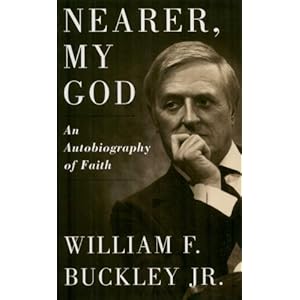
William F. Buckley's "Nearer My God": Book Review

Nearer, My God
I chose this on a whim as it was so far out of my usual orbit. No recollections of the old sod or stickball, and barely any for altar boys and fearsome clergy. Instead, a patrician account and series of reflections and reactions to the course of Catholicism from the venerable era in which Buckley was elegantly raised and the postconciliar malaise which has affected so many in the less certain Church.

His noblesse oblige permeates. There's a couple mentions of devout black butlers, but that's about it for class consciousness. It's rather astounding to follow this chronicle, so removed from the reality most of us share when it comes to education, privilege, or sailing at every opportunity at a summer home. This elevated lifestyle unfolds, and Buckley surely as he's accustomed to the manor/ manner born comports himself as he's been raised. It makes for a very curious spiritual autobiography/ FAQ.

For Buckley turns this midway into a novel experiment. He interviews a few of his friends, mostly converts, and all conservative fellow-travelers, often at the National Review, naturally. They also feature priests who've transferred to Catholic clergy from Protestant denominations. Buckley surveys their takes on many questions he raises about dogma, belief, and practice. Although as a cradle Catholic I must confess none of the statements he compiles would have convinced me to join "Rome," it's instructive to learn the mindset of those coming to "the faith" without being raised in it.
I could follow the theological details, but for many who admire Buckley, this granular examination may bore or bewilder. There's far less of his famed politics, and not much of his wit or rhetoric either.

It does all make for an oddly paced book. It's more a series of explorations and reflections, although the central theme of examining what persists post-Vatican II as the liberals often left the clergy and left the administration to overworked and understaffed priests and laypeople is important. For it demonstrates the rebound, if by default given the numerical advantage of the diminished remnant in control, of the traditionally minded episcopate and papacy, of what's a dwindling number of cradle-born congregants in America and Europe. This does all tilt in Buckley's view, as expected, to slant away from a global awareness of how the Church will fare as its center slides towards the "South."

As a result, this work will appeal to the small coterie of like-minded sympathizers with both Buckley's worldview and likely his class and background. The name-dropping may come without hesitation to this author, but it does remind the hoi polloi of our place among the pews and practically as peons. Few of the rest of us may be able to enter this intimately connected and convinced realm even via print, but it's a document to this reaction to what was meant as a reform to appeal to millions presumably reluctant to accept a pre-modern Church, even though the results in sweeping that aside enchanted far fewer than anticipated, at least among Buckley's entitled cabal. (Amazon US 12/12/17)

Thursday, May 21, 2020

Wendell Berry's "Questionnaire"

 WanderLost: Wendell Berry

How much poison are you willing
to eat for the success of the free
market and global trade? Please
name your preferred poisons.

For the sake of goodness, how much
evil are you willing to do?
Fill in the following blanks
with the names of your favorite
evils and acts of hatred.

What sacrifices are you prepared
to make for culture and civilization?
Please list the monuments, shrines,
and works of art you would
most willingly destroy

In the name of patriotism and
the flag, how much of our beloved
land are you willing to desecrate?
List in the following spaces
the mountains, rivers, towns, farms
you could most readily do without.

State briefly the ideas, ideals, or hopes,
the energy sources, the kinds of security;
for which you would kill a child.
Name, please, the children whom
you would be willing to kill. 

~You can hear this piece, by Wendell Berry, the eminent Henry County, Kentucky, farmer-poet-agrarian philosopher, (photo above) read in inimitable love-it-or-hate-it style by Garrison Keillor, pre-cancel culture, via this public radio link to his "Writer's Almanac."  I learned of this through a Front Porch Republic link on the American Solidarity Party. I learned of this movement based on distributism, in the spirit of Dorothy Day, Mennonites, Catholic Worker or a "consistent life ethic" through grassroots non-sectarian organization. And that finally came through this "weird" article in the NY Times my friend alerted me to.

In turn, FPR updates the poem for the "pseudo choice, a choice that is no real choice at all."

~FPR deigns that "Wendell Berry’s provocative 'Questionnaire' might be put into prose and updated for the 2020 election with these new, dismal choices:
  1. What is your preferred method of killing babies: abortion, pollution, or ICE detention?
     
  2. Do you want the US to pursue endless wars abroad, or do you want the president to lurch spasmodically into and out of conflicts?
     
  3. Do you want the US to respond to climate change with head-in-the-sand denialism, or do you want a Green New Deal that would empower our federal government to manage the entire economy?
     
  4. Do you want the national debt to grow quickly or very quickly?
     
  5. Do you want to fund our medical bureaucracy through private insurance companies that extort more money from you each year in premiums and other fees, or do you prefer to be a helpless pawn in a vast, government-run healthcare system?
     
  6. Do you want free trade with countries that put their citizens in re-education camps, or do you want the US to impose tariffs in haphazard fashion on various foreign countries? (Alternatively, you might prefer to leave moralizing about foreign governments to NBA players and the successors to Steve Jobs.)
     
  7. Do you want the president to use Christianity as a cover for his racism and misogyny, or should the president tax all churches and nonprofits whose theology he disagrees with?
     
  8. Do you want the president to be a blatant nepotist and hire his children, or do you want the president to rely on foreign governments to enrich his children?
     
  9. Should the president get interest groups and foreign governments to patronize his businesses while in office, or should the president wait until after his term of service to receive scads of money from foreign governments and corporate executives? 
Me: Yeah, I know that "unprecedented events, uncertain times, unanticipated challenges etc." all upturn the world as we knew it again, since this was revamped last November. But the choices appear the dismal same, with the incumbent vs. the blue-state's safe corporate mouthpiece. For better or worse, latter party chose to reject a more radical choice, and here we are, another election with the lesser of two evils insisting he cares about us, every 4 years.

Friday, October 4, 2019

Patricia Applebaum's "St. Francis of America": Book Review

  St. Francis of America – How a Thirteenth-Century Friar Became America's Most Popular Saint | North Carolina Scholarship Online

St. Francis of America

How a Thirteenth-Century Friar Became America's Most Popular Saint

Patricia Appelbaum
  • Chapel Hill, NC: 
    The University of North Carolina Press. October 2015.
     288 pages $20.00.
     Hardcover. ISBN 9781469623740.
     For other formats: Link to Publisher's Website.

Review (for Reading Religion/American Academy of Religion)

Before the birdbaths, before the pet medals and the spurious sayings, Francis of Assisi stood for whatever first preoccupied Americans more than a century and a half ago. Devotees of the fine arts admired the challenges to convention by the little poor man. Rather than a refined scion, Francesco Bernardone represented a raw rebel. Today’s consumers at any gardening outlet may check him out, if reduced to a cast mold with a bar code. Both reactions to Francis remind patrons or shoppers of “what one lacks and perhaps longs for—a life free of possessions; a life that is not dominated by money or property or, in fact, consumerism (4). Religious historian Patricia Appelbaum thus introduces this well-researched and engagingly written survey of Francis’s crossover reception within a predominantly Protestant polity and now a secular, acquisitive culture. Appelbaum explains the Poverello’s enduring appeal.

Appelbaum encourages readers to widen their perceptions of her subject. She investigates how sainthood takes on or shunts aside meaning for those who do not include such a formal category in their faith or worldview. Assisi itself is elevated into a tourist site energized with an aura. The fact that Francis lived there allows seekers of any allegiance to identify with a defiant dropout who begged on medieval streets.

In nine chapters, Appelbaum surveys how Francis has been socially constructed. After placing his initial attraction within a revival of interest in Catholic aesthetics and Walter Rauschenbusch’s Social Gospel movement, she examines the impact of Paul Sabatier’s 1894 biography of Francis. The first account of Francis to reject hagiography, Sabatier’s archival effort resembled Ernest Ronan’s 1863 critical scrutiny of Christ. Appelbaum then situates this reforming impulse within the careers of Quaker Rufus Jones and socialist Vida Scudder. Their advocacy of Francis as a pacifist pioneer eased his acceptance by Progressive Era non-Catholics. These impacts sparked Catholic ripostes affirming the saint’s fidelity to the papacy and to Roman rulings.

The next section examines the era between world wars. The social activist side of Francis appealed to many, even as his advocacy of voluntary poverty hit close to home for most Americans during the Depression. The 1940s popularized the “peace prayer” erroneously credited to the saint. Meanwhile his statues spread throughout gardens across the country. Appelbaum grounds the birdbaths within a love of place. “Like the prayer, they could be private; like the hymn [‘All Creatures Great and Small’], they could be used in a small community.” This admiration set the sylvan scene for Earth Day in 1970 and the promotion of “the patron saint of ecology” (88). Postwar prosperity generated many versions of the odd man out from Assisi. Robert Lawson’s children’s tale Rabbit Hill and Bernard Malamud’s urban Jewish parable The Assistant gain in-depth analyses as they reveal narrative responses to the saint’s firm rejection of attachment to the things of this world. That such a reaction co-exists with Francis’s celebrated love of nature complicates his contemporary depictions.

Unfortunately, the hot pink and mustard yellow vibrancy of a San Francisco Summer of Love poster with an offbeat, mixed message from its municipal namesake to its hippie versus straight heirs is reproduced only in monochrome. But as with visuals throughout this study, it reveals Appelbaum’s range of references. About eighty pages document her fieldwork, list sources consulted, and include endnotes. These appendages combined with two indices enhance this book’s value. Any scholar of material Christianity or popular culture will find St. Francis of America a welcome resource.

The rise of the Jesus People and evangelicals who recast Francis as a hippie; the embrace of his spirit by environmentalists; the attempt to capture his charisma on film; and his conversion into “creation-centered spirituality” by post-Christian skeptics and New Age adherents typify recent trends. Shifts in American attitudes to Francis anticipate Appelbaum’s thoughtful inquiry into the “blessing of the animals” ritual across ecumenical or sectarian lines. Appelbaum edits replies to her 2013 questionnaire. She sifts testimony from over forty “living voices” about what Francis means personally and spiritually. These sensibilities expand into diverse contexts: Islam, postmodernism, and folklore. “Artist, poet, clown; traveler, camper, farmer; leper, street person, prisoner: the list goes on and on” (181). Sly guises illustrate disparate roles played in nine centuries of the odyssey of Francis from Assisi.

Date of Review: August 19, 2018
About the Author(s)/Editor(s)/Translator(s): 
Patricia Appelbaum is a historian and independent scholar of American religion.

Sunday, April 15, 2018

Ross Douthat's "To Change the Church: Pope Francis + the Future of Catholicism": Book Review

To Change the Church: Pope Francis and the Future of Catholicism by [Douthat, Ross]As the token Catholic/ conservative columnist for the NY Times, Ross Douthat, is a journalist I've enjoyed reading even when much of the rest of that paper of record I want to toss at my dog. (I refrain, strengthening my patience.) Douthat may be better at short opinion pieces than in-depth reporting, but as he's a central spokesman for the right-leaning Church, he's well informed to look at how the current pope is caught between a liberal rock pushing Francis towards more reform and more renewal, and the conservative hard place refusing to budge on doctrine and liturgy.

"To Change the Church" looks at the split. He does not have the rosy patronizing view many non-Catholics, less in the know about the Vatican and its global reach, have had about Jorge Berglogio SJ. Therefore it's instructive to learn about his stint as the Jesuit provincial during the times of dirty war and the disappeared in Argentina. Douthat has access to some insiders and he uncovers sobering truths. Some issues are dealt at length which those unfamiliar with the higher levels of the Church and intricate details of the bible and teachings may feel are exaggerated.

Douthat examines the compromises made by Pope Benedict to keep the traditionalists faithful, the growing rift between Vatican II advocates who demand more changes, the younger clergy and bishops who favor caution instead of chaos, and the recent pronouncements hinted regarding re-examination of the "nullity of marriage" vs. the indissolubility of the bonds which Jesus affirmed, within the German-Austrian episcopate's "Kaspar debate." These provocative topics reveal teachings that Pope Francis could not budge on without undermining fidelity to the Gospel. I hadn't considered before this how central this stance proved, whereas as Douthat documents, many other recent debates on tricky issues have not depended on this fundamental grounding in the Gospel. He digs into some "sources" who reveal how complicated this astute and considerably diplomatic (take that word in more than one sense) pontiff's maneuvers are. This is a corrective, again, to popular misconceptions and media.

Abuses we all are unfortunately somewhat cognizant of take up many headlines by outside writers investigating the Church. So it's refreshing to turn to other topics which tend not to gain serious attention in the mainstream press. Douthat, like John Thavis' "The Vatican Diaries," is a good guide. Douthat is not the resident correspondent Thavis has been in Rome, but he shares that reporter's understanding of the Church from the inside.

I am not sure I buy into Douthat's rather dire predictions of a schismatic division within Catholicism. Yet if it wasn't for massive Latino immigration, parish pews would be even emptier than they tend to be now. It looks as if the future Church will shift to African power, away from Europe, as in turn it moved from the Mediterranean and back to Jerusalem. The "developing world" with its burgeoning populations has skirmishes between Protestants, Catholics, and in some places Islam or as in China the secular regime. Here are the battlegrounds and the launch pads for a form of the Church which may soon overtake the "spiritual but not religious" West. After Francis, who knows what will follow?

Douthat also wrote a sprawling 2011 narrative-survey about the shifts of U.S. religious currents over the past generation, "Bad Religion," espousing not the ethos of a SoCal veteran punk band, but what Rod Dreher's "Benedict Option" has since popularized (?) concerning the role the Church will likely play in the changing American polity. This takes on the wider variety of Christian denominations within recent American culture and history, but it's recommended for those wanting more from this welcome voice. I reviewed "BR" at length a few months ago on this site. Amazon US 4-12-18
(Reprinted at The Pensive Quill 9-26-18.)

Friday, November 3, 2017

Ross Douthat's "Bad Religion: How We Became a Nation of Heretics": Book Review

Bad Religion Audiobook | Ross Douthat | Audible.com
No, the venerable (and atheist) L.A. punk band does not figure in this learned recounting of how accommodationalists of both major Christian versions, evangelicals, conservative Catholics, and Mainline Protestants have multiplied and dwindled over the past few decades in America. But Ross Douthat strives for a punchy presentation of data which threaten to weigh down his pages. As the token Catholic/ conservative New York Times pundit, his columns benefit from his pithy remarks.

How does Douthat manage the shift to a long-form format? I felt very early on that this unfolded as if a dutiful, well-researched, but rather by-the-numbers tallying of the bull and bear markets as applied to Christian America's gains and losses, among the varying denominations and recent "para-church" endeavors. While I admit I was being educated, as a reader, I wondered if the pace would pick up.

Bad Religion begins with Douthat's refinement of his subtitle. He's not celebrating the demise of faith. His title refers to "the slow-motion collapse of traditional Christianity and the rise of a variety of destructive pseudo-Christianities in its place." (3) The past fifty years finds the orthodox Catholic and Protestant bulwarks eroding, having "entered a state of near-terminal decline." The churches connected most to the past fade; the elite abandons its at least measured sympathy for Christian ideas. Hostility or indifference, as surely this former editor of The Atlantic knows, characterizes this culture.

While the U.S. remains an outlier in its high rates of reported belief among the "advanced" nations, a growing segment of its Christian majority, as it weakens overall in numbers, waters down traditional theology. Conservative or liberal, these factions appeal to the political and pop-cultural marketers. Often "spiritual" without being "religious," some seek a wider set of options for faith. Others distort, in Douthat's estimation, what has been the accepted dogmas and doctrines of conventional churches.

Neither conservatives nor "their secular antagonists" (4) recognize this drift. The religious right blames all flaws on explicitly anti-Christian elements. Secular stalwarts denigrate every form of belief as equally foolish or fanatical. Douthat explores those enclaves of our nation where teachings of Christ "have been warped into justifications for solipsism and anti-intellectualism, jingoism and utopianism, selfishness and greed." (4) Here, neither papal encyclicals nor New Atheists are perused.

For a hundred pages, Douthat takes us through a vanished world of post-war confidence in religion, which fifty-or-so years ago began to implode as accommodationists hastened reforms which wound up, for many believers, leaving them to wonder "why show up on Sunday after all" if the ecumenical denominations earnestly insisted that deep down they were all the same, and that divisive details overcome were all that was needed to satisfy and stimulate the faithful. Yet the accommodationists in Mainline Protestant and Vatican II Catholicism almost immediately found their pews emptying, as the disaffected rejected religion, preferred spirituality, or most tellingly, defected to the evangelicals.

Douthat, writing in 2012, reminds those keen to denigrate evangelical and Catholic voters that now there is no "Catholic bloc." That broke up under Bill Clinton. Both Catholics and evangelicals span the range of income and professions as Americans on average. They both edged ahead, by the 1990s, when it comes to income and education. Long derided as the backward bullies of the rural heartland in the Midwest and South, evangelicals now are likely to fill the megachurches of Sun Belt and Mountain West suburbs and exurbs. While Catholics have only Latino immigration to thank that their totals have not dipped more, a tenth of all Americans have left that Church; these departed would be the country's second-largest faith cohort, if definitions were tinkered with. Evangelicals hold at about 20%. Douthat does not harp on his fact: evangelicals accept "limited inerrancy" rather than slavishly literal readings of the bible which fundamentalists cling to. This means that while science in scripture may be accepted as outdated, that the transcendent truth of God's will remains forever without fault.

"He who marries the spirit of the age is soon left a widower." Douthat quotes Anglican Ralph Inge (106) aptly. As one who grew up in the very first batch of post-Vatican II Catholic children indoctrinated in the "Kumbayah" mindset, I can attest even among kids raised on The Monkees as we watched hippies delay adulthood, that the novelty of guitar mass for hand-holding congregants wore off fast for many with whom I was raised; few of them sustained this fervor well into their maturity.

Given his talent for cultural critique, Douthat documents well this transitional period when the counterculture strove to become the ecclesiastical norm. When he turns to the deconstruction of the Gospels by scholars who prefer the rabbi rebel Jesus to the Pauline redeemer Christ, I feared that Douthat would fumble. This tricky terrain challenges any to keep up. But he remains steady. I liked his comparison of the Bart Ehrman and John Dominic Crossan, Elaine Pagels and Jesus Seminar crowd's "historical Jesus" shorn of his halo to those dogged claimants who assert they've found the "real" Shakespeare. Both "turn out to be masters of detection and geniuses at code breaking, capable of seeing through every cover-up and unpacking every con." (171) No wonder we wind up with conspiratorial Dan Brown. The power of magical thinking and the relativism of po-mo profs blur.

Resisters dig in and strike back against the humanists and their Christian fifth column. Whereas mainstream seminaries diminish, a parallel evangelical and conservative Catholic set of colleges, institutions, and scholars emerge. The alliance between those once damned as papists and their former "holy rollers" foes looms larger, as the fight against abortion and for 'values' rallies both.

As the chronology catches up with recent events, the analysis sharpens. In the wake of the bursting of the 2007 housing bubble, Douthat notes in passing a telling truth. Hispanic, black, and white working class adherents of a prosperity gospel were most likely to have been swept up and over by the burst.

His chapter on this "name it to claim it" proposition, as filtered through Joel Osteen's lucrative ministry, makes God "seem less like a savior and more like a college buddy with really good stock tips." (189) Yet, the author cautions, the "crudeness" of the wealth-theology rhetoric "can obscure the subtlety of its appeal,"for it reassures followers that the sin of avarice can be assuaged by overcoming with stock phrases of credulous tit-for-tat "a simple failure of piety." (191) Rather than send down angels to prove His love for you, Douthat paraphrases, "He can just send you a raise." Similarly, Douthat delves into "financial ministries" and remains nuanced on the suitability of capitalism and its good works undertaken with the donations funding charitable endeavors. I wanted to read more on the megachurch entrepreneurial "outreach" and franchising, but this gets passed over perfunctorily.

Still, he's clever on seguing into the related New Thought-derived business empire. For it shares with the prosperity preachers an emphasis on "the social utility" of belief, an eagerness to define spiritual success in worldly terms, a hint of utopianism, and an abiding naïveté about human nature." (205)

Theodicy nestles not only within the wealth-faith, but in "the God within" predilection inherited from similar concepts of exchange with the powers above. Deepak, Oprah, Sam Harris, Eat Pray Love, Avatar, and even earnest apologist Karen Armstrong demonstrate the profitability of such pitches. Both affirm that humans figured out how the universe works, and how the spiritual forces respond. The "quest for God as the ultimate therapy" dominates. Not "I believe" but "one feels," to paraphrase prescient 1966 psychologist Philip Reiff, cited by Douthat. (230) This generates narcissism, infidelity, and a lack of empathy. The results can be tracked over the permissive period evolving in this purview. We wind up with a "spirituality of niceness" (234) Charting this among youth, as he does, is sobering.

Another congenial solution arrives with a universal God which outlasts petty local deities and clans. Drawing on Franz Rosenzweig and George Steiner, employing promised lands to polarized if both favored tribes, shows Douthat's erudition applied intelligently. Lacking the European penchant for blood-and-soil ties, Americans worship the exceptionalist, "city on a hill" civic religion of patriotism. Messianic, apocalyptic, reactionary crusades such as Glenn Beck's conflate populists with patricians. Paranoia, conspiracy theories, jeremiads of doom invigorate both extremes on the political spectrum. Angst, backlash, hubris, and adulation for whomever occupies the Oval Office produce craven American kitsch peddled for both parties and their anointed leaders ready to rescue despairing flocks.

That penultimate section of the book I found agreeable if not surprising, having lived under Reagan-through-Obama regimes. It's what you'd expect Douthat to expand upon from his columns. I do applaud his "heresy of nationalism" and his distrust of "religious faith" married to "political action."

He concludes with four "potential touchstones for a recovery of Christianity." Global, rootless life may seek an antidote to power plays and exhausted ideologies. Douthat suggests separatists offer a second route, withdrawing from the arena so as to regroup and reflect. Or, the massive movements bringing immigrant churches and missionary zeal back to America from the Third World might energize more at home. Diminished expectations, finally, might restore humility along with rigor.

Being political but non-partisan, ecumenical but also confessional, moralistic but also holistic, and last of all, oriented toward sanctity and beauty. I aver this final aspect may inspire a "saving remnant," regardless of creed, to appreciate the "great wellspring of aesthetic achievement" that unfortunately persists more as relics and canons rejected by most in schools and nearly all in culture.

Literature, architecture, film and television certainly display a dearth of Christian creative achievement. Douthat chides, correctly, that "many Christians are either indifferent to beauty or suspicious of its snares, content to worship in tacky churches and amuse themselves with cultural products that are well-meaning but distinctly second-rate." (291) This muffles the impact of a legacy.

While naysayers will dismiss Bad Religion as stale superstition or sinister priestcraft, open-minded audiences concerned with the stability of a post-Christian polity will benefit from this balanced judgement from within the Christian intelligentsia, and they may concur that those two terms are not oxymorons. Douthat backs his side, but he's poised, professional and alert to all in the faith game.

P.S. Pp. 152-3 collect a deft summation of the paradoxical models of Jesus that believers affirm and scholars may debate. This exemplifies journalist Douthat's knack for mediating scholarship for a wider readership. I admit that many who'd benefit from his book will never hear its timely message.

Sure, there are places I'd have preferred more elaboration. For instance, the tacit influence of Teilhard de Chardin on Vatican II, to me at least, is a fascinating aside begging for more. But on key topics as how evangelicals adopted the pro-life campaigns of Catholicism even as its own members dissented, or how the excesses of flower-power liturgy hold up, if in retrospect to those of us who as youngsters barely recall them (like me) or weren't around yet (like the author), are worthwhile. Certainly his judgment that those who chased reform wound up a half century on looking as if graying curators of  dated curios, overseeing a little attended museum (I extend his metaphor) rings true, when one does the math on the evaporation of vocations to those very orders that figured the only thing holding them back from really appealing to more young men and women was more Bob Dylan, far fewer hymns. (Amazon US 11/3/17 a bit altered)

Thursday, March 16, 2017

David M. Emmons' "Beyond the American Pale: The Irish in the West, 1845-1910": Book Review

Beyond the American Pale: The Irish in the West, 1845-1910
"Beyond the pale" originated from the limits, the palisades that the Normans erected around their incursions encircling Dublin. Outside of that tamed territory, Hibernian natives lurked, uncivilized according to the conquerors' suppositions. David Emmons, historian at the University of Montana, adapts this title cleverly. For in the American expansion, the immigrant Irish were also seen by Protestant counterparts as inferior, and relegated to the margins socially and spatially. In the growing U.S., contrary to stereotype, some “two-boat” Irish Catholics settled for neither shanty nor tenement. 

Industry demanded cheap, expendable frontier labor. The mines and mills erected, often by Protestant capitalists, attracted desperate Irish. Outnumbered, they formed communities and institutions to secure themselves in hostile territory. Having studied this phenomenon in the Irish-dominated enclave of Butte, Emmons in this follow-up expands his focus to eight different concepts of "the West" in the American imagination and fact. He compares or contrasts Irish Catholic experiences with those of black slaves and Native Americans, broadening this 2011 book's relevance today. 

It rewards careful reading. It's accessible, with folk stories and testimonies drawn from archival research. Its hundred-page list of documentation attests to Emmons' scope and discipline. Attention to detail regarding his claims, therefore, is expected.

The local insistence on camaraderie given dangerous jobs and social prejudice meant many Irish newcomers rallied together in their camps and towns. Emmons suggests that in a land where the future meant to go West, the Irish for their own survival might have cut themselves off from joining this enormous juggernaut. Faced with anti-Catholic discrimination and anti-Irish sentiment, they found themselves beyond the pale again, gathered in their clans, defensive against an all-too-familiar aggressor. (Spectrum Culture for "Our Favorite Books Read in 2016" staff list 12/18/16; Amazon US 11/16/16)

Thursday, December 24, 2015

Michael Mott's "The Seven Mountains of Thomas Merton": Book Review

After a visit to the Abbey of Gethsemani, I wanted to find out more about where Merton had spent half of his life, and how the famous depiction of his first half, in 1948's The Seven Storey Mountain, differed from or confirmed what Michael Mott learned in his diligent research for this 1984 biography. Mott's documentation makes this the authorized biography, for he had access to primary sources and archives which previous scholars and biographers did not, and as he had the cooperation of the Order to enhance the interviews and correspondence he incorporates into a comprehensive representation. Luckily for all involved, this is no hagiography. It fairly analyzes what Merton wrote and what we know, apart his many writings in print or not, as judged in the context of his friends and his lifetime.

Highlights for me began with Mott's eloquent parallel of Merton's troubled year at Caius College, Cambridge, reading Dante with Professor [Edward] Bullough. But Mott does not give the professor's first name, presumably relying only on Merton's unpublished notes, and such small details, despite the meticulous attention the author devotes to his subject, sometimes disappoint slightly. For instance, while this is meant as a biography rather than a critical work, one finds many of the three-dozen-plus titles and countless essays or reviews Merton published in his lifetime mentioned as if in passing. A few gain from Mott's insightful excerpts or summaries, but more context on the rest of them, even if minor by comparison, would have enhanced the value of this book. Admittedly it's already long, but it's not dull or rambling. Snippets on Buddhism, for instance, late in the narrative could have also benefited from elaboration, as Mott compresses complex and disparate intellectual and spiritual contexts which Merton expanded. The shift of Merton towards the East is not an easy one to reduce to a few pages. The focus on main events is understandable, but again, the endnotes could have extended discussion.

He was full of contradictions. Gregarious, he chose a cloister. Restless, he wanted to be a hermit. Affable, he withdrew from a wide circle of friends. Proud, he resented his monastic discipline. Mott handles the tensions calmly, illustrating how Merton's early infatuation with his Trappist community gave way, as he matured, to conflicts with his fellow monks. However, when by the mid-1960s his dream of a hermitage on the property came true, Merton kept appealing for chances to travel, and opportunities to chat with visitors. He swung back and forth, longing for solitude but wandering back to the world, with dangerous results as have been revealed concerning his affair with a student nurse in Louisville when he was around fifty years old. I kept noting how Merton, vowed to poverty, somehow accumulated his beloved LPs by Dylan and Joan Baez and Mozart, so many books he needed a big set of shelves, and beer and brandy (the latter might have been sneaked in by visitors).

Certainly, he felt after a quarter-century of service as novice master, and as a productive if sometimes too prolific author, he generated attention and income indirectly or directly (how did royalties work out? Another area I puzzled over, as I figured the Order garnered the sales but somehow Merton had money to spend inside and outside the monastery during his later years at least there as a hermit...). So, he figured he had earned his keep. But I understood how his fellow monks may have rankled at his barbed wit and quick tongue, and also how Merton tried to make right some of the wrongs he inflicted on his confreres and his friends, given the pressures of living so long in such close quarters.

Mott delves into such difficulties well. "It was a voice breaking the silence to praise silence." (251) As acclaim for Merton made him a celebrity after his autobiography appeared, he sought the attention but also retreated from it, if it was not from those closest to him, perhaps. Some of the liveliest passages here are about the monastic hubbub that ensued when unwanted callers tried to crash in, or apply as postulants, drawn by Merton's fame. For a while, the abbey had to house monks under a circus tent, so great were the numbers. But that passed, and Vatican II itself, with the renewal Merton helped progress, led to the diminution of much that made religious life in the Cistercians so austere.

Social changes drew Merton into the conversation in the rest of the world beyond the walls, as the late-1950s agitation filtered into his reading and correspondence. Marco Pallis and Merton wondered in letters if the atrocities attributed to WWI sparked WWII propaganda, and Mott shows how Merton evolved from a Cold War proponent to a more balanced observer and challenger to capitalist cant. Opposing the Vietnam War, in 1965 he wrote "The Answer of Minerva." If the question is "Why must this pointless war go on?", then the goddess' response is: "You must fight on, for if now you make peace with the enemy, you will offend the dead." (qtd. 416) A perennial, if unfortunate, exchange. 

The reforms that changed Catholicism, I always figured, would have been supported without delay by Merton. But Mott shows more ambiguity in Merton as the 1960s revealed immaturity among clergy freed from restraint, and as a rush to improve liturgy and architecture and ritual threw out some of what made the Church so cherished by many. A letter in 1968 finds him at odds with both extremes. "Paralyzing incomprehension--what does one do when he realizes he is part of an organization whose members systematically try to 'make a fool of God'? I suppose I begin by recognizing that I have done it as much as the best of them." A characteristic note, for Merton in his private journals strives to meet the nuanced note, less combative or preening than some of his public proclamations betrayed.

He took a long time to get over the priggish or self-righteous attitude. After all, he was an intellectual probably more than the playboy his youthful memoir made him out (despite censorship from within or outside himself) to be. He talked his way around and in the monastery, where a promise of stability and discretion overruled his natural ebullience, if not his concomitant despair and self-loathing, the balance between good conduct and righteous morality never lasted long. He lived in tumultuous times, and he continued in one of those years, 1968: "But then a 'God is dead' Church is no better, or are the 'God is dead' Christians are an improvement over the others. Just the same established flippancy and triviality. And even more successful." He ends with "They make a good living out of God's death." (527)  A fitting sample of Merton's ability to turn a phrase, to cut through pretense. 

I liked the hints of how Merton related to his friend, the artist Victor Hammer (whose drawing of Merton graces the back of the dust jacket) as an "unbelieving believer." I would have liked more about this, as to how friends of Merton managed to align their own beliefs or lack of such with his. (Some material here, as in his affair, was redacted or limited, as at the time Mott prepared this, it was less than the quarter-century moratorium that Merton requested for release of his private documents. Since Mott's book, some of the journals and letters have been published, for better or worse, maybe.)

An "existentialist contemplative," Mott avers on the next page, beckoned as ideal. Not only for the hermit-despite-himself, as he prepared to depart for the West Coast and then a tour of the Southeast Asian landscape and monasteries who increasingly loomed as his final set of mountains to argue with, in Mott's construct (playing off of Merton's title and that Dantean depiction of Mt. Purgatory). Merton wanted not only to write about life, but to live it. He wanted to demonstrate his contemplative commitment and to withdraw (at least some of the time, him being Merton), from all the attention. 

In his Asian journal, his last set of writings, he muses over what he has learned after living with himself, itching to travel but insisting he was called to a vocation apart from even his fellow monks. "Our real journey in life is interior: it is a matter of growth, deepening, and an ever greater surrender to the creative action of love and grace in our hearts. Never was it more necessary for us to respond to this action. . ." (qtd. 543)  He was open to this spiritual evolution, and he struggled to progress. 

Mott can lighten the mood. As to the journal Monks Pond in its last year of the monk's life, "Merton made the mistake as editor of including the work both of poets who were friends and of friends who claimed to be poets." (503)  While his last recorded words in public have been taped in Bangkok, that day nearly twenty-seven years exactly from the time he entered the monastic life at twenty-seven, many cite the eerie premonition of the first clause. The second one also shows Merton, in his everyday side, that made him so much a figure of devotion or imitation or even excoriation by many.

"So I will disappear from view and we can all have a Coke or something." Then, a "Thank you very much" concludes his final address, preceding his electrocution by a faulty fan's wiring in his hotel bathroom. (564) That "you may know the Christ of the burnt men" in premonitory fashion also serves as the last phrase of his autobiography, another circle rippling across many decades and mountains. (Amazon US 12-17-14)

Monday, October 12, 2015

Diana Walsh Pasulka's "Heaven Can Wait": Book Review

What happens to a belief in a doctrine once those who teach that try to sidle past it, in hopes of moving on? For purgatory, the Catholic concept has always been elusive to pin down. Diane Walsh Pasulka excavates its concrete aspects. In this short but well-documented work, she reveal practitioners' views of the afterlife, of their attitudes towards the dead, and of their interpretations of Catholic history. The chapters treat the evolution of the purgatorial dimensions, over many centuries.

Pasulka examines devotional and popular culture as they intersect to inculcate and elaborate this puzzling notion. For, since it was first formulated in the Middle Ages from vague suggestions found in Scripture, to meet the demand for a transitional stage of cleansing a sinful soul before it could enter heaven, purgatory presented a problem. How to align earthly time within a waiting-room into the eternal after the specified duration of a soul's sentence has been carried out challenged the Church.

First, Catholicism long defined purgatory as "a physical place of real, not symbolic, suffering". Second, it has been clarified in the post-Vatican II era as a condition, rather than a tangible state or site, of purification. Its position in the afterlife has been occluded. Growing up, I heard my family often urge us to "offer it up for the Poor Souls". This notion captured the expectation one's own sacrifices on earth were transferred to the faithful departed. Over the past half-century, this concept has faded for the majority of Catholics now. Those who aim for an afterlife expect they'll make it into heaven, with little or no preliminary cleansing from sin. But a few Catholics try to remind others of the poor souls, who seem to have been placed there by a harsher, more judgmental, more sin-concerned Church than the one that has replaced it with cheerier assurances of divine love and God's forgiveness. Pasulka investigates those today who revive apostolates aimed at succoring souls needing earthly assistance. She precedes this section with a detailed look at the one place where medieval Christians asserted an underground cave entering purgatory existed, Lough Derg in Ireland.

As a religious studies professor, Pasulka places the concrete manifestation of purgatory within what Pope Benedict elaborated in 2005 as a "hermeneutic of discontinuity and rupture". Purgatory, facing nearly the same fate as the now-discarded otherworld of limbo, languishes. The Vatican, stressing a "hermeneutic of renewal" as it reforms what it deems outmoded teaching and ritual, leaves those still believing in purgatory in a neglected niche. The bulk of this book explores these niches, as they were made real for believers in the past. These existed outside the official dogma dispensed by medieval and early-modern Rome. Whether purgatory was a literal fire or not, whether its punishments had to take place after death or during life, and the nature of the punishments as physical, mental, or spiritual were all left, in Pasulka's narrative, open to conjecture. Pilgrims to Lough Derg flocked to a place where they could endure fasting, kneel on rough rocks, and cleanse themselves of their sins.

She diligently collates archival data and scholarship on this place. However, the experiences of the thousands who still make the "stations" on this small island in Donegal today gain far less attention. The narrative favors scrutiny of previous Lough Derg events, whereas the subtitle or her book promises a focus on "devotional and popular culture". Her narrower perspective, dominated by Lough Derg's history, does not provide the reader with enough instances of how purgatory's physicality has emerged in the material practices of many Catholics, not only in Ireland but beyond, over the centuries. Instead, most of this book places Lough Derg within sectarian debates, within the Church, documented in periodicals between 1830 and 1920. These also influenced Protestant opponents.

An engaging look at the Museum of Purgatory in Rome, purporting to display proof of those who have received messages or encounters from the Poor Souls, prefaces the chapter about those desiring to revive attention to the plight of those left languishing. Pasulka summarizes a recent attempt to figure out how many of the departed need prayers. "The Mission to Empty Purgatory" uses calculations to tally how many remain in that purging place, and how many prayers are needed for their release. She adds: "The calculation also takes into consideration the number of future souls who will be in purgatory and publishes the number of prayers needed to account for the current birth rate."

Here, the tone lightens. Pasulka speaks of those she interviews, and of her own uncanny brush with the inexplicable connected to her research. If more of this study could have been given over to contemporary attitudes towards purgatory, as it recedes from many memories, the narrative would have increased its relevance for today's audience. Some typographic errors remain. The scope of this welcome view of a concept many Catholics once knew well and many non-Catholics once derided is narrower than the title promises. Perhaps other academics or theologians will return to this subject, which reminds us of how many or how few Catholics nowadays counter the "anti-materialist bias" of the Church as they insist on the reality of relics, imagery, rituals, concrete structures, and empirical evidence to support their traditional beliefs in purgatory and the connection it has with life on earth. ("How Do You Pin Down the Concept of Purgatory" to PopMatters, 7-21-15; Amazon US 8-1-15)

Tuesday, June 2, 2015

"Worse than the pagans"


Cardinal Raymond Burke may not have used the exact phrase "worse than the pagans," yet that is how the media have headlined their reporting on his disappointment with most Irish voters. As a child, my sympathies lay with the pagans, for I felt the zeal of Patrick and his followers destroyed much that was good in ancient Ireland. I may be accused of romanticizing the serfs and slaves who more likely than kings and lords are my ancestors, but I hated to see Druidry damned.

The Tablet reports on May 28, in the week after Ireland's 62% yes vote. Katherine Backler and Liz Dodd explain, in an article I reproduce here to capture Burke's address and anguish best:

Ireland has gone further than paganism and “defied God” by legalising gay marriage, one of the Church’s most senior cardinals has said.

Cardinal Raymond Burke, who was recently moved from a senior role in the Vatican to be patron of the Order of Malta, told the Newman Society, Oxford University’s Catholic Society, last night that he struggled to understand “any nation redefining marriage”.

Visibly moved, he went on: “I mean, this is a defiance of God. It’s just incredible. Pagans may have tolerated homosexual behaviours, they never dared to say this was marriage.”
 
A total of 1.2 million people voted in favour of amending the constitution to allow same-sex couples to marry, with 734,300 against the proposal, making Ireland the first country to introduce gay marriage by popular vote.

The Archbishop of Dublin, Diarmuid Martin, told RTE afterwards that “the Church needs a reality check right across the board [and to ask] have we drifted away completely from young people?”
Cardinal Burke, who speaking on the intellectual heritage of Pope Benedict XVI, went on to say “liturgical abuses” had taken place after the Second Vatican Council, after which he said there had been “a radical, even violent approach to liturgical reform”. Quoting Pope Benedict, he said that the desire among some of the faithful for the old form of the liturgy arose because the new missal was “actually understood as authorising, or even requiring, creativity, which frequently led to deformations of the liturgy which were hard to bear.”

On Tuesday Cardinal Burke presided over Mass at the Oxford Oratory, and on Wednesday he led Vespers and Benediction for the intentions of the Order of Malta.

Speaking at the lecture afterwards Cardinal Burke stressed the continuity between liturgical forms before and after the council. “The life of the Church is organic; it is a living tradition handed down in an unbroken line from the apostles,” he said. “It does not admit of discontinuity, of revolutions.”

Paraphrasing Pope Benedict, Cardinal Burke said that after the council, there had been a battle between a hermeneutic of discontinuity and rupture, and the hermeneutic of reform. This was because the nature and authority of the council had been “basically misunderstood.” Apparently departing from his script, the Cardinal voiced his own concern about similar misunderstandings around the upcoming Synod. “There seems to be a certain element who think that the Synod has the capacity to create some totally new teaching in the Church, which is simply false.” He went on to speak of the damage caused by “an antinomianism which is inherent in the hermeneutic of discontinuity.”

Though the talk consisted primarily in an overview of Pope Benedict XVI's chiefest intellectual contributions, Cardinal Burke adopted a more personal note in his answers to questions at the end. Responding to a question about the marginalisation of faith in the public sphere, he stressed the primary importance of fortifying the family in its understanding of how faith “illumines daily living”. ‘The culture is thoroughly corrupted, if I may say so, and the children are being exposed to this, especially through the internet.’
 
He told the audience that he was “constantly” telling his nieces and nephews to keep their family computers in public areas of the house so that their children would not “imbibe this poison that’s out there.”

Irish Central expands the way such influences affect Catholics. I cite this verbatim for its catechetical language and chastising tone. Dara Kelly on May 30 reports in her lead that: "a prominent American canon lawyer has branded all Yes voters in the recent marriage referendum potential 'heretics.'

Dr. Edward Peters, who was appointed a Referendary of the Apostolic Signatura by Pope Benedict in 2010, has described the outcome of the constitutional referendum on marriage in Ireland as 'a disaster.'

'Any Catholic who directly helped to bring about Ireland’s decision to treat as marriage unions of two persons of the same sex has, at a minimum, arrayed himself against the infallible doctrine of the Church and, quite possibly, has committed an act of heresy,' Dr Peters wrote on his Canon Law Blog this week.

The technical term for voting to allow same sex marriage is 'sin', wrote Dr. Peters, 'and the consequences of sin are always spiritual and sometimes canonical; and the solution for sin is repentance and Confession.'

Dr. Peter's [sic] counsels his readers not to pursue potential excommunications for the political leaders who led the nation toward the referendum, instead he suggests they focus their efforts on 'righting' the result 'as soon as possible.'"

The image I chose for me captures the Church's predicament, Looking at the tired faces of the feeble nuns, you can see that the traditions of Irish fidelity to the Magisterium may remain, but among fewer, and likely many elderly, congregants and clergy. My relationship to how I was raised is nuanced, as I lack the feral hatred a lot of my peers have for Catholicism. I teach comparative religion and meditate over two comments I have from online students about my critical approach. "They should hire a Christian so the course is not biased." "He compared consulting the Bible to a Ouija board." The truth might be more subtle, after all. Many resist any challenge to long-held belief.

I hold respect for certain elements of the Church, for I do counter that it did lead many people to care more about the needs of the less fortunate more than their own wants and desires. It reminded people of their limits within a short and difficult life. It encouraged a degree of intellectual exploration, and it curbed the excesses some of us had, in many directions, which led to the harm of ourselves and others. Many clergy as well as laity gave up careers and success in the secular world to give us a solid schooling, and in dark times, priests and those under their guidance assisted me. I doubt if a working-class kid could have received for so little money such a preparation for the life of the mind. 

My parents and family were devoted, and made sacrifices for me to attend such institutions. But I don't miss the shame, repression, and guilt that still haunt me in middle age, after such a traditional upbringing, even in the decade after Vatican II, a confused time for many Catholics. The future, as I blogged last week, seems to be with those who, rejecting the "reality check" called for by Archbishop Martin, find its dogma and doctrine wanting. This recalls Dan Savage, sex columnist, ex-Catholic, and gay rights advocate, back in 2013 as he reviewed Jeff Chu's "Does Jesus Really Love Me?":

"Chu worries that gay people like Mr. Byers have been ;pushed out of the church.' That’s not true for all of us. My father was a Catholic deacon, my mother was a lay minister and I thought about becoming a priest. I was in church every Sunday for the first 15 years of my life. Now I spend my Sundays on my bike, on my snowboard or on my husband. I haven’t spent my post-Catholic decades in a sulk, wishing the church would come around on the issue of homosexuality so that I could start attending Mass again. I didn’t abandon my faith. I saw through it. The conflict between my faith and my sexuality set that process in motion, but the conclusions I reached at the end of that process — there are no gods, religion is man-made, faith can be a force for good or evil — improved my life. I’m grateful that my sexuality prompted me to think critically about faith. Pushed out? No. I walked out." My own nation has now 13% ex-Catholics. For every convert, six others leave. The U.S. since 2007 has 8% fewer Christians. Change may be rapid for other nations too, like a thief in the night. 

Photo caption: Carmelite sisters leave a polling station in Malahide, County Dublin, Ireland, Friday, May 22, 2015

Saturday, May 23, 2015

Reality Check

After the historic Irish vote, the first where a nation (or 3/4 of one) and not a legislature approved same-sex marriage, Diarmuid Martin, Dublin's archbishop, called for a reality check amid this "social revolution." According to today's Irish Examiner:
“We have to stop and have a reality check, not move into denial of the realities. We won’t begin again with a sense of renewal with a sense of denial,” he said.
“I ask myself, most of these young people who voted yes are products of our Catholic school system for 12 years. I’m saying there’s a big challenge there to see how we get across the message of the Church.”
As a product of more than that time spent in the school system one nation removed from Ireland, and who started in kindergarten with Mexican Poor Clare nuns a year after the conclusion of Vatican II, I watched as IHM sisters gave up their habits, in more ways than one, and then left, as priests suddenly disappeared, as women took off mantillas, as altars turned around. My mom wept when the new design, stripped of decoration, appeared. "It looks like a Protestant church." Not long after, despite Dylan or Simon and Garfunkel replacing hymns in my denuded parish sanctuary, many of my classmates and friends drifted off from Church. We are the last to recall, outside of traditionalist enclaves, an American practice, derived often from Ireland, of indulgences, spiritual bouquets, novenas, rosaries, Mary Day, benediction, going to confession behind a screen in the dark, and lighting real candles. Many of my teachers were Irish, direct or a generation or so distant, and the ties were strong and lasting to this ancient way of life, where we identified ourselves by what parish we were from, and Mass going was as automatic on Sundays as was crossing ourselves, or praying to so many saints, or a Marian litany.

Sure, sometimes I miss that, but do I miss the fear I still wrestle with in the dark, middle-aged, about sin, about my mortality, about death? That was all instilled in me at a formative age, and even if I was born as Vatican II commenced, I am old enough to carry the pre-conciliar, Tridentine legacy of doom. I carry a lot of guilt, inhibition, and difficulty with speaking up on my own behalf. Was this instilled? I inherited the cultural patterns of the Irish, one generation removed. I share many of these attitudes. The Irish, as with many of us across the world, seem now starting to break out, to think and act freely.

So, I wish my Irish friends well. It's a sign of how in my own lifespan, the leap from a blinkered to a bright acceptance of gays and lesbians in partnership and equality has happened in a country that still in the Nineties was bound, far more stronger, to the Church. I do wonder, however, if the lurch to secularization and massive consumerism, as the boom years showed to Ireland's weakness, reveal that whatever has replaced the Faith of Our Fathers leaves many with their own search, amid the gap opened by the loss of trust in the clerical establishment and its dogma, for meaning that can reward us without pointing to supernatural intervention, clerical suppression of thought, and a cowed laity. Blessed with more liberty and abundance than our forebears, how do we conduct ourselves wisely?

That, to me, is the struggle that we confront. The Pew survey, as I blogged this week, shows an 8% drop between 2007 and 2014 in Christian identification in the U.S. That is massive. As in much of the developed world, the decline in faith is balanced, all the same, by the upsurge in poorer regions. So, we will face a richer North, and a poorer but more pious South, it seems, in the century ahead. And, I suspect that many of us, and our children from whatever arrangement biology and the law allow from now on, will ask the same Big Questions as me and my ancestors. But at least now, we have choices.

Tuesday, May 19, 2015

Fewer believers, more consumers?

The recent Pew survey on American religion shows a rapid decline, from around 78% to 70% in Christian identification since 2007. Catholics are dropping, as are evangelicals. While 10% of all Americans were ex-Catholic then, now it's 13%. Tim Rutten wonders how much evangelical and right-wing politics may be to blame for this decline. Unaffiliated respondents have increased by 6.7% the past period, to nearly 30% After all, independent-leaning, alienated, skeptical voters (like me) are often repulsed by pious rhetoric and cant. "Well over one-third of all Americans under 49 now are unaffiliated and a substantial number of them profess a complete disinterest in religion or its values."

This surge transcends the usual ethnic, class, regional, or traditional boundaries. If not for relentless immigration and concomitant population growth, the Catholic and probably some Pentecostal and fundamentalist churches would show deeper drops. The tilt of the Church in my region tips now about 70% Latino, for instance, with large Filipino and Vietnamese contingents. Sure, the South does still boast more believers, and cities more their cohort of "spiritual but not religious," a phenomenon now spreading beyond the privileged pockets on the East and West Coasts and I suppose college towns. The report sums up: "People who self-identify as atheists or agnostics (about 7% of all U.S. adults), as well as those who say their religion is 'nothing in particular,' now account for a combined 22.8% of U.S. adults – up from 16.1% in 2007. The growth of the 'nones' has been powered in part by religious switching. Nearly one-in-five U.S. adults (18%) were raised as Christians or members of some other religion, but now say they have no religious affiliation." This cheers me, if oddly for me.

For I study religion, I value its contributions, I suspect its assertions, and I analyze its functions. I teach a course in its comparative aspects, open to students online nationwide whom I will never likely meet. I ask them to discuss their own orientation. Most do so happily, revealing usually about one or two articulate but disenfranchised voices, maybe half who are more or less observant of some form, and the rest divided between those who have been raised Catholic, Baptist, or Methodist but who have a wavering or flexible attitude towards the tenets with which they were inculcated. Sometimes I get a pagan or two, a Jewish or Muslim student, too. A Buddhist, too, but so far all who blend a vague sort of aspiration with New Age, from a Christian background. So, they match Pew data above.

But some often bristle, being mainly mainline Christians still, when I challenge them about the growth of "nones," or when I confront them to move out of a comfort zone and critically respond to those who address the drawbacks of, well, every religious system we study over the eight weeks. I offer the positive and the negative aspects of the major faiths--even if the textbook and lectures on the online shell try to be very neutral, I cannot be so as a teacher who wants students to stretch their limits. Therefore, the new data I will have to offer my next class will continue to push their boundaries. As we turn a less religious nation, however, as Rutten concludes, we must all question another transformation: autonomic absorption of so many Americans into the consumer society, as we face a consumerist, capitalist force "that so often seems more powerful than any religion."

Rutten asks: "If you live in a world that begs you to choose from among 600 types of potato chips and 400 brands of hummus, why not faith? Whether a society that idolizes that kind of choice really is a better place than the one we’re struggling with now, will be something we’ll all discover." Amen.

Tuesday, August 27, 2013

Flannery O'Connor's "A Good Man Is Hard to Find": Book Review

Thirty-odd years after I first read these stories, I heard them read aloud. Marguerite Gavin, who often brings her supple, adept voice to mysteries, is well suited to dramatizing for Blackstone Audio the eccentrics, bigots, and drifters of Southern Gothic, who populate these stories published in the mid-1950s.

Many of Flannery O'Connor's stories were assigned in my college course on Religious Themes in American literature, and Theology and Literature, unsurprisingly. Those in the know with Scripture, and also with Protestant down-home versions of how it's interpreted as opposed to (at least pre-Vatican II) Catholic orthodoxy can draw out strands of the rich intellectual and spiritual traditions inspiring O'Connor, which her letters document well published as "The Habit of Being." Some also are in the handsome Library of America edition of her writings.

Yet, these often lively stories remain entertaining and thoughtful for all. They're accessible for those without religious grounding, even if such an audience will miss many references and allusions, in a time when fewer are raised with such literacy. I've tried to teach "A Good Man Is Hard to Find" with its grim, bespectacled Misfit and its desperate, caricatured, but in the end oddly endearing if no less annoying grandmother. It worked to put off more than it won over. The dark humor of "Good Country People" might be appreciated for those with a taste for bad taste, rather than those mystified by satire with an edge and a disturbing sense of how the transcendent descends. Perhaps such stories are better recommended than analyzed in a classroom--they may lose some energy when taken apart too diligently, however well intended the dissection may be.

O'Connor's craft in such stories, getting us to laugh at those she satirizes, like Hulga in "Good Country People," before going on to reveal her protagonists' vulnerability, reveals O'Connor's considerable talent. Gavin's skill works to enhance those in stories that on paper held less interest for me. "The Artificial Nigger" (Amazon rejected my review when I wrote that noun out) with its relentless evocation of a terrible Atlanta cityscape as seen by a cruel old man and his grandson sizzles. Racial themes simmer in many contexts here, even if they rarely boil over: this tension O'Connor exploits deftly. "A Late Encounter with the Enemy" with its old Confederate as in a museum trotted out works better as a vocal performance than a story, for me; similarly, "The River" felt very symbolic and predestined with its ending, and for me this (as with some others included here) lacks the lighter touch of O'Connor's best stories, but listening to it, it kept my interest more.

"The Life You Save May Be Your Own" cannot be topped for sheer meanness; "A Circle in the Fire" and "A Temple of the Holy Ghost" were both solid stories, even if their plots failed to intrigue me as much as others. "A Good Man Is Hard to Find" with its comedy turned terror by skillful foreshadowing and "Good Country People" with what feels like Flannery's basis in gleeful yet poignant semi-self-caricature remain for me the standouts.

All the same, Gavin's navigation of Irish and Polish as well as diverse Southern accents for "The Displaced Person" enriched this lengthier story. The last in the collection, it tackles issues of alienation, unbelief, and conversion in a more sustained, character-driven manner which displays an intriguing application of Cold War paranoia, post-Holocaust repulsion, and relentless poetic or divine justice as felt by an insecure white woman running a motley crew of field hands. Some stories sticking in the memory more than others. But all merit attention. It's a recommended introduction to her storytelling, followed by the ambitious, tense ones she was working on when she died, "Everything That Rises Must Converge." (Amazon US 7-29-12)

Thursday, May 3, 2012

Cory MacLauchlin's "Butterfly in the Typewriter": Book Review

As an admirer of "A Confederacy of Dunces" when it appeared (in mass-market Grove paperback for me), the little I found that was marketed back then about John Kennedy Toole tended towards the tortured artist. Walker Percy's promotion of his fellow Southern Catholic (if, being obviously of Irish descent, cradle and not convert) helped launch Toole's novel as if he was a figure as odd as Ignatius J. Reilly, his memorably offensive and irascibly brilliant protagonist. Toole's suicide in 1969 at 31, and the long delay before the novel was championed and won the Pulitzer in 1981, became associated with Toole's failure to get his novel published.

Cory MacLauchlin corrects this misattribution. He separates the novel's fate in publishing from that of its author three years later. He handles the coverage of Toole in the "popular media" and places it against the legacy that his mother took on of protecting her son's reputation. He notes the sympathy of the critics who found in Toole's tragedy a ready myth. He removes blame from Simon and Schuster editor Robert Gottlieb; he does not speculate as many have about Toole's alleged homosexuality. Necessarily, he patiently delves into the mental illness which perhaps, left undiagnosed, hastened Toole's inability to cope. Confronted with his demanding mother Thelma and his namesake father's own decline, Toole could not endure the future. He came back from Puerto Rico where he had taught Army draftees. The freedom he had in New York City during grad school, in traveling, in teaching, was contrasted with his family and his responsibility. He looked at his parents; he left after his Christmas break from teaching. The road trip through the South appears mysterious. But, two months later as Mardi Gras came and went, apparently on the way back towards New Orleans, he ended his life.

As a fellow English instructor at a perhaps less-heralded institution (as am I),  MacLauchlin finds a match in Toole. Those of us who teach others how to read and write better in modest classrooms understand the challenges and the satire inherent in these daily duties. (As an aside, it shows how talented Toole was--without finishing a Ph.D. at Columbia, he was offered a professorship, at 22, at Hunter College.) The correspondence and the mimicry about his earnest or hapless peers recall Flannery O'Connor (even if he did not enter her house alas, on his last journey, contrary to rumor); the academic send-ups of his medievalist colleague Bobby Byrne who teaches Boethius to every class, even frosh comp, certainly shows how Toole found ready humor and a model for Byrne and his New Orleans misfits who populated his fiction, his work, and his leisure in his hometown.

Toole could be cruel; MacLauchlin quotes, for instance, from a letter to his parents insulting two "haystacks": the "gray-white, sandy, freckled, powdery" skins and awful dinner from the skeletal, "appalling" parents of his fellow instructor. McCauchlin notes how sustaining Ignatius Reilly took a tool on the novelist. His own arrogance as he balanced military assignments and mundane teaching with investing so much energy into what became far too late a cult novel demonstrates the uneasy relationships he had with others, male and female, and the frustrations with modern life endured by him and his colleagues and creations.

The biographer takes the novelist on his own terms. Drawn from five years of archival research and enhanced by many photos, this merges a straightforward account of his restless life with his swerves between confidence and despair. As a "self-marginalized intellectual," Toole seems to have inherited some of his parents' ambition (his father for school, his mother for the stage) along with the thwarting of early promise. Raised in the off-beat New Orleans scene, Tulane, boho and Beats-era New York, and Army life in Puerto Rico shaped him. The novel he started in 1963 drew his friends and experiences into his fiction. Inextricably, its fate overshadowed his own journey, paranoia grew, and he ended his suffering on a back road,  at the end of March 1969, outside Biloxi.

MacLauchlin tells the story efficiently, if at times with his own overly effusive prose championing his subject. After all, the absurd and caricatured in Toole's vision about a fat man in his native city obsessed with the decline of humanity since the Middle Ages lends itself to its own eccentricity. That inventive quirk is why we remember Toole and his preening, overbearing, and defiantly literate creations today. (Amazon US 4-20-12 in slightly shorter form; 4-23-12 PopMatters; author's website)

Tuesday, April 24, 2012

Gregory Boyle's "Tattoos on the Heart": Book Review

Listening to Fr. G's audiobook, as he recovers from leukemia treatments, I hear his affable but no-nonsense voice with a touch of strained effort, a human frailty. This enhances, movingly, his dry wit and carefully modulated rendering of such sentences as "Carmen was a dusty blonde, surely not the color God had given her," to introduce one of dozens of characters drawn from those men and women among whom he ministers. I've known about his work at Dolores Mission and Homeboy Industries, which is less than five miles from my home. But, even as I watched from the light rail line Homegirl Cafe being built near Chinatown and downtown L.A, a few years ago, I did not know the deeper tales.

A family friend of ours got her gang tattoos removed by the outreach efforts helmed by this author; while his apostolate to the "homies" remains controversial from some, his advocacy of compassion making us see the world from another perspective is challenging and convincing. I came from hearing the audiobook today on my commute (past the Mission, at least on the freeway closest by) to hear that a former colleague had her 17-year-old daughter shot by a 16-year-old gang member. Fr. Boyle might ask me, as my friend who's a grieving mother trying to find strength in her own faith, to consider the tragedy all around--not only the blinded girl who had straight-A's now with a bullet in her brain, but the boy who shot her as she sat in a car at night, wrong place, wrong time. Fr. G. notes being glib can be a danger. Yet, he patiently hears out those who suffer, no matter their culpability.

I find myself learning lessons from this book. I teach many students who grew up in similar neighborhoods and who have tried to leave the streets behind. Sharing the gist of some of the stories of redemption here, and endurance within adversity, enriches the power of simple parables. Whatever one's own belief, this is one inspirational book that avoids platitudes. Hafiz or Rumi is cited along with Dorothy Day or Al Sharpton; Fr. Boyle keeps alert to influences. Although I disagreed with a particular advocacy breaking one law which he asserted, he elicits respect, and he returns it richly. He holds, after all, the message of a higher power as paramount, and he fights injustice in his own diligent, understated way.
 
One quote sums up this Jesuit priest’s mission. “Jesus stood with the outcasts, until they were welcomed, or until he was crucified, whichever came first.”

Full of barrio lingo thrown in, this may not be the usual devotional reading for many, but be patient, and even if not every Spanish slang is translated, you get the flavor of East L.A. life as its diction is rendered--even more when read aloud. Fr. Boyle can capture the drawn-out cadences of those he "conversates" with, and hearing this can be funny and sad.

He asks us to see the narrow gate through which we are called to pass by Jesus as leading to salvation. It's not one that would shut even a sniper out, but which would open up to mercy, while (I trust) not surrendering justice. The gate, he says, is one that makes us focus, not which excludes us.

He does not romanticize the "crazy life," and he makes his Homeboy-employed charges work with their enemies as they learn to handle responsibility, accept orders, and learn to stop making excuses. Despite the broken hopes of many he ministers to and listens to, Fr. Boyle urges us to see how as in the Gospel the church needs to have its roof ripped open, so all can enter, and all can find restoring peace and abundant mercy from a "God greater than God," in the narrow sense too many have of the divine when they have been shut out from its love for so long. (Amazon US 3-8-12)

Thursday, January 5, 2012

Keith Kachtick's "Hungry Ghost: A Novel": Review

A dissolute photographer, well-meaning but wayward, almost forty, falls for a Catholic convert thirteen years younger who's determined to save herself for marriage. Carter Cox's travels take him to shoot glamorous models worldwide for upscale magazines and ads that mirror his own conspicuous consumption in his Manhattan apartment. But--as the title shows with its Buddhist reference to the realm where unsatisfied "pretas" must wander until they gain liberation when they realize that their parched, greedy, tormented existence is an illusion--Cox's own journey will take him for his latest assignment to Morocco, and there, he and his new companion, Mia Malone, confront the meaning of their existence.

Kachtick brings ambition and range into this narrative, as Carter integrates, half-successfully, his growing commitment to Buddhism with his louche bedding of more women in his thirties than the time Mia's been kissed. We find this and all information conveyed in a daring, and initially off-putting, voice in the second person. Carter's taken this on "to fully disassociate" awareness "from the obstructing, lower-self 'I' that thinks in terms of 'me' and 'mine' and 'may I unbutton your blouse now, please?'" (14)

He attempts to desire to be without desire, and this telling of his tale as he tries to overcome his passions shows how he fails, and how he succeeds, in a book combining character studies with adventure, and social commentary with spirituality. This narrative voice, we later find, is the omniscient one we readers recognize, but with a deepened dimension I will leave you to discover.(I found a similar approach in Wilton Barnhardt's novel "Gospel" years ago, and it works as well here as it did there.)

Because of and not in spite of Carter's weaknesses, I cringed at and cheered him on, as a caddish fop, but also a struggling dharma practitioner, engaging with Mia's own formidable belief system. (Even if she claims to volunteer with a "Jesuit nun," inaccurately.) He grew up wondering what many may in a rather worldly, vaguely Christian upbringing: "Where was I before I was born? Why does my body feel like a guest house?" (51) He meets Mia at a Tibetan retreat at a former Catholic monastery upstate. She "possesses the milky-white skin and praying mantis beauty of someone who haunts museum archives and listens to Chopin while baking bread." (65)

Kachtick has a challenge in giving us a twenty-six year-old determined to wait for Mr. Right. She regards sex as sacred, so much that it is worth the wait to make it a sacrament. She disagrees with what she regards as a Buddhist contempt for the world and the flesh: "The work of heaven is material, the work of hell is entirely spiritual." (83) She then bums one of Carter's cigarettes, a sign of her own links to the body. They debate their differences and find similarities. They discuss Thomas Aquinas, cite Thomas Merton, and mull over St. Francis. Then, they make out. "She can't decide whether God has sent you into her life as a test or a gift." (88)

The tension within Carter goes beyond the bedroom, as he courts Mia, to a degree, while after she goes back to school, he beds others more compliant, if less intriguing. Later, as his Morocco jaunt brings him and her into conflict over their relationship, he reflects: "You'd long fancied yourself as a talented juggler of pleasure and ethics" (216)-- but this balancing act fails, as he must face what his teacher, Christopher Wolf (a skillfully depicted, poignantly captured character), warns him of: for bachelors perhaps in particular, the abyss where middle-aged lust leads into fear.

As the Buddha taught, drinking saltwater never quenches one's thirst. Whether in a New York City nightclub or binging on Entenmann's cookies, prowling for porn DVDs or amassing more gadgets, seducing tourists in Mexico or dealing with a temperamental model or vain windsurfer on a shoot, Carter faces his demons, even if disguised as long-legged angels: "you're like an alcoholic who punishes himself by drinking more." (232)

The novel takes a daringly imaginative twist. I feared Kachtick would let me down, but he does a deft fake-out and save and he pivoted gracefully, in more ways than one. If you lack a grounding in Buddhism, some of this novel may stall, but as a committed Buddhist himself, Kachtick's trying to merge his own compassion into a novel that entertains and instructs. He may switch to the former mode, almost as in a script made for Hollywood, later on, as if to make up for the earlier discussions that Mia or his teacher, Christopher, have, but for a thoughtful story that demonstrates right and wrong in scenes that take place in the bedroom or bar as well as on retreat or in meditation, this fairly conveys what a modern urban seeker, Catholic or Buddhist, may face when testing their faith against their works. Kachtick wants a wide audience for this novel, so he accommodates all these elements.

I will leave it for a reader to discover where the plot roams as Mia and Carter arrive in Morocco. The second half accelerates, and the pace moves rapidly. Conflicts thicken as the spiritual collides with the social, the Third with the First World.

Kachtick's to be commended for his energy and his range, and with Christopher as well as Mia and Carter, he creates characters you care about, no matter their own weaknesses, which endear them more rather than make them contemptible. He makes out of our urban, unhinged, dehumanized, web-obsessed, consumer-driven, sex-and-drug-and-media hookups a tale of morals and choices as profound as that of Henry James, if far more fun for me to read, as it's branded in the latest (as of 2002!) fashions, gizmos, and labels. (Posted to Amazon US & Lunch.com 3-6-11. See review by my friend Tony Bailie on his "Ecopunks"blog. )