Showing posts with label folk music. Show all posts

Thursday, May 11, 2017

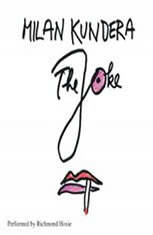
Milan Kundera's "The Joke": Audiobook Review

Overall
Performance
Story
"It's not funny anymore"
Would you say that listening to this book was time well-spent? Why or why not?
My mind wandered a lot. I can see why as the Author's Afterword complains the earlier translations (#1-4) edited and streamlined the original. Despite Kundera's protests, it needed revision. It's far too sprawling and disjointed. It turned tedious early on and rarely engaged.

What do you think your next listen will be?
I am taking on a revisit to Tolstoy's "Anna Karenina" as a reminder of quality literary fiction.

Did Richmond Hoxie do a good job differentiating all the characters? How?
He tried. He has an avuncular style similar to George Guidall. But for the females, he could not modulate his delivery much. For the protagonist, he sounded too boorish and gruff.

Was The Joke worth the listening time?
A toss-up. While it did give you an insight into Moravian folkways and music, it lacked the detailed impact of, say, how working in a mine would feel for one sentenced to a "black insignia" unarmed contingent of politically suspect comrades in early 1960s Czechoslovakia,

Any additional comments?
This confirms my unease with Milan Kundera's work. While "The Joke" by some is considered a debut (1965-7) second only to "Unforgettable Lightness of Being," I am annoyed by his seemingly slapdash manner of plot. Yes, he weighs in with the philosophical musings early in his career, but this novel frankly merited at least some of the excisions he predictably decries. The 7-part structure is promising but the results are verbose and dull. 

Sunday, December 1, 2013

Mazzy Star's "Seasons of Your Day": Music Review

Hope Sandoval's narcoleptic air, her drowsy voice and waifish demeanor, infused three albums by this loose lineup, under the direction of guitarist David Roback, from 1990 to 1996. Roback's previous band, Rain Parade, inspired many in the Los Angeles area with their own subdued, yet insistent, update on psychedelic textures as part of the Paisley Underground movement. Sandoval, then a teenager and a fan of the band, joined the successor to Rain Parade, Opal. They morphed into the enigmatically named Mazzy Star. Roback and Sandoval formed a romantic and musical partnership, that lasted until (it gets hazy) the connections faded and the formula of sticking to alt-rock successes such as their hit "Fade Into You" wearied the duo.

This back history of Sandoval, Roback, and the other members (who often are shadowed and less credited unless one does some searching) must preface this return, seventeen years later, to form. Recorded since at least the mid-1990s in London, California, and Norway, these ten tracks at fifty minutes show a perfectly timed and thoughtfully chosen sequence of simple songs, played sparely. Seasons of Your Day grows on you and demands repeated listenings. At first, as with Rain Parade and Opal and the band's previous recordings, the songs may feel too airy, too evanescent.

With exposure and scrutiny, the atmosphere around Sandoval's voice emerges. Co-producer Roback's finicky style, one senses, accounts for the long years of assembling this album. He echoes classic AOR rock. I hear far less the psychedelic swirl of his 1980s phase and much more the acoustic styles of "Wild Horses", "Going to California", and "Wish You Were Here", which would have featured, I suppose, among his LPs as he grew up in balmy Pacific Palisades in the early 1970's.

During that time, any coastal Californian teen could not escape The Beach Boys as the endless summer soundtrack. "In the Kingdom" immediately evokes this ambiance with its organ introduction, and Roback's bluesy guitar drops in to carry this into Sandoval's slow-burn mood, enhanced by soft wave-like splashes of brushed drums, slightly jazzy percussion, and noodling, then sharper, guitar progressions. This structure demonstrates Mazzy Star's gentle control of their direction, and it's a promising indication of the craft underlying and unifying this album.

"California" conjures up Led Zeppelin's early-1970s strummed guitar. Roback creates tension in the upward riff, and Sandoval's steady delivery, as she sings about the ocean's call to draw her in, works well to balance the pull of the slightly edgy music, as it overlays her dreamy spell. As if a lost song off of the Rolling Stones in this same time, in their country-shaded period, "I've Gotta Stop" shuffles along into dust. Weariness lyrically and musically pervades this, and the middle of the album hushes.

The acoustic, folksy "Does Someone Have Your Baby Now" brings back Roback's overlooked band between Rain Parade and Mazzy Star, Opal. That ensemble tended towards a darker, more spooky side, under singer Kendra Smith (ex-Dream Syndicate); it's great to hear the band enter this slyly haunted, ominous space, graced by Roback's slide guitar.

"Common Burn" returns to a harmonica and guitar, twilit scenario. It's not a weak song, but it feels straightforward and does not veer much from its initial start. The title track, halfway in, lifts up by violin into a richer, poignant song so Sandoval can moan and long for love in a convincing fashion. The interplay of strings and percussion returns at the end to cap an affecting song with conviction.

The Western amble of "Flying Low" enriches the progression of the album, which leans much more in a country-rock style than Mazzy Star's earlier work, until it rises slowly into a muted chorus over slide guitar. Sandoval uses this rustic preference to glide along over either Roback's guitar alone or the band backing. Both arrangements work, and at best, they trade off. Best of all on the already lovely "Swallow", when at 2:30 in its four minutes, this sidles into an elegant, baroque keyboard fill.

Longtime collaborators of Roback, most predating Sandoval, deserve mention for their disciplined, subtle, and measured contributions as backing members. The late William Cooper offers violin on "Seasons of Your Day"; Suki Ewers on keyboard, Keith Mitchell on drums, and Paul Mitchell on keyboard appear once again to be Mazzy Star's musical foundation. The Long Ryders' Stephen McCarthy plays pedal steel guitar on "Lay Myself Down"; Sandoval's partner in her longtime side project The Warm Inventions, Colm Ó Cíosóig of My Bloody Valentine, is credited as a multi-instrumentalist, while early Paisley Undergrounder Paul Olguin adds bass on "Lay Myself Down".

The recently departed, legendary folk musician Bert Jansch on "Spoon" (recorded in the late 1990s in London), provides his trademark ringing guitar, with its novel, always innovative modal tunings, to another track displaying Roback, Sandoval, and band's ability to know when to feature the voice and when to let the instruments play, and when to combine them. "Lay Myself Down" concludes with more slide guitar, and this longer song lets the band join in another harmonica-backed, edgier and crabbier bluesy excursion into sexual frustration and, we sense at last, long-awaited release.

This long-awaited album release will please faithful fans. As one who has followed Roback and his band mates for thirty-odd years now, I judge this fulfills expectations. Its lyrical understatement and deliberately minimalist presentation may not excite newcomers, but those familiar with the languid delivery of Hope Sandoval and the teasing alternation of holding back and letting go that characterizes David Roback's music, with and without his band mates, will recognize in this record Mazzy Star's perch between celestial elevation and shrouded descent. (As above 10-24-13 to PopMatters.. Altered a bit for Amazon US 10/11/13)

Friday, November 1, 2013

Donna Weston and Andy Bennett's "Pop Pagans": Book Review

Paganism and popular music share a love of physicality. Rooting this scholarly anthology not in beliefs constructed by modern society referring to nature, but arising rather from earth's own manifestations by cultural contexts, co-editor Donna Weston introduces thirteen contributions to the study of Pagans and music now. (The capitalization is significant: convention prefers a "P" for modern followers and a "p" for pre-Christian adherents.)

This usage in turn informs how today's Pagans regard technology not in opposition to a natural construct, but as an interplay of vibrations within earth-based awareness. After a suitably spirited preface by Graham Harvey promoting a proper polyphony of primitive and progressive practices, co-editor Andy Bennett offers a brief survey of counterculture influences, e.g., Woodstock, Led Zeppelin, Black Sabbath, and Pink Floyd. While as with some entries Bennett's quick essay feels truncated, its thesis matches the scope. For progressive bands of the Aquarian Age, heavier and lighter elements mixed, demonstrating eclectic harmonies that evaded blues-dominated chords, to color darker metal themes or pastoral lyrical hues with a British folk shimmer.

Black Sabbath's own 1983 debacle at Stonehenge, confusing metric measurements for stage props with imperial feet, fueled Spinal Tap's satire. The reverberations of these immense pillars, for hippies, Goths, Guitar Hero, and neo-Druids, beckon many from the ranks of the "postmodern homeless self". Rupert Till credits the reverberations resounding in its stones. This mysterious monument reifies the yearning shared by ancient with contemporary pagans: ancestral communion and ritual celebration.

Donna Weston's chapter glances at five "exemplars" beginning with Paul McCartney's "Mother Nature's Son" and ending with XTC's "Greenman" but with only a page devoted to all five songs, her theory-laden analysis demonstrates the limits of academic publications on popular culture. When authors tend to turn to other scholars first and singers and musicians and performers a faraway second, the energy of this topic dissipates. However, Weston reminds us that paganus derives from the Latin "people of place" to designate those who clung to land, locale, and nature for their faith.

This territorial connection sustains Pagan metal. Native landscapes, with cover photos favoring icy or forested scenes, typify the imaginative realm which emerges as massive guitars mingle with hints of folk instruments and, beneath the mighty roar, lyrical flow. Especially in Scandinavia and the former Soviet bloc, Deena Weinstein discovers, within an engaging mix of sociological statistics and targeted interpretation, that the two lands share resistance (to the European Union and to the USSR respectively) which erupts as protest against cultural, linguistic, and ideological assimilation.

For Jason Pitzl-Waters, this exploration continues into three "waves" of Goth music. By the mid-'90s, British promoters used "Goth" and "Pagan" interchangeably. The older island tradition, of folk, revived with the past century's romantic, ruralist, and religious seekers combining idealism with instrumentation. While guitars by the mid-century were imported from American genres, archivists enlivened rock music with an amplified blend of back-to-nature aspirations and more danceable, or raucous, tendencies. As Rob Young's Electric Eden (2010) elucidates (see my PopMatters review), the blend of rock's marketing power and folk's sensitive aura simmered into many musical genres.

A post-folk musician, Andy Letcher, mingles his own avocation with his scholarly training to deny folk's roots in any pagan British tradition. However, keen to explain why this search for meaning has lingered so long among his colleagues, he guides us to understand how the song "John Barleycorn" or the film The Wicker Man typify from the 1970s pagan origin myths for the British counterculture. He locates the tension of allegiance to a "common man" as a durable aesthetic, contending against "irrational superstition" within folk music and its surrounding culture. For instance, even if scholar Ronald Hutton proves the Morris dance originated in Tudor court, its current association with pre-Christian mummers endures on its own terms. "Folk was never pagan," he argues, "but the twentieth century made it so".

Dance and music accompany each other often. From Australia, Douglas Ezzy applies "somatic awareness" to a "collective ritual" at Pagan gatherings. He shares his own "flow" as the music takes him and many away at such venues. This affirmation enables Pagans to leave the "broom closet" where for fear of discrimination and persecution many still lurk.

Identity solidifies in other far-off locales. Graham St. John tells of the awe of standing in the path of totality at the "sweet spot" of an solar eclipse. Globalization, cheap travel, and eco-tourism mesh with raves and New Age rituals to establish a unique convergence. Unlike other sacred spaces, the 100-mile-wide swath cast by the conjunction of sun and moon ensures each event "will rarely if ever transpire in the same space again". Within this "cosmic mandala", Pagans convene to celebrate.

They also flock to EDM raves, where shamanic ecstasy (and perhaps the chemical variety) converge to offer Pagans a "primordial religious experience" in a secularized, non-Christian setting. Alan Nixon and Adam Possamai contrast if in passing evangelical and Pentecostal predecessors with Pagan assemblies to call down spiritual transformation. "Techno-shamans" try to tap an elusive force.

Communities comprise the concluding section. History, genre, and performance while gaining their own sections earlier, here combine into electronically enhanced or enabled connections. Christopher Chase traces American "sacramental song" from Walt Whitman to Loreena McKennitt and Charlie Murphy among the eco-critical, pluralist ethos.

Celtic Pagan websites break free of genealogy or geography to encourage a membership by desire. Family trees do not matter; for a "cyber-diaspora" as Narelle McCoy surveys, the conflation of "Irish" and "Celtic" while incorrect exemplifies the marketing of such identifiers in a global marketplace. (Apropos as an unwitting indicator, a couple of Irish-derived names are misspelled and some Irish-language accents are absent in this section.)

Moving from the layered gloss of Enya to the "esoterrorism" of Genesis P-Orridge proves a leap. Christopher Partridge delves into the "occultism" perhaps coined by this crafty provocateur. His performance art, his industrial music as jolting installations and disturbing video with Throbbing Gristle and Psychic TV among other manifestations attests to his violent, morbid, and erotic visions. These,"designed to perplex" as the late DJ John Peel phrased them, evoke a true "Heathen Earth" not found in a meadow but a "menacing urban space". Brutal, not bucolic; "free-thinking, hard-headed".

With that jarring transition from rustic reverie to concrete chaos, Pop Pagans: Paganism and Popular Music ends suddenly. Its best entries encourage the reader to imagine the channeling of black metal vocals into words that even if inarticulate, allow the singer to dramatize his or her passion; to wonder at the moment of a total eclipse on a faraway landscape with hundreds of fellow Pagans; to dance with them at an Australian rave; to understand the appeal of the natural hum or roar beneath the city.

Friday, August 2, 2013

Jonathan Lethem's "Dissident Gardens": Book Review


Radicalism rattles three generations in New York. Dissident Gardens dramatizes this disruption. Rose Angrush, her lover’s son Cicero Lookins, and her half-Irish grandson Sergius Gogan, when pushed far enough, fight conformity. How long they can stand their ground?

Rose lives in the Sunnyside Gardens housing project in Queens, in the decades when Reds were hunted.  In turn, Reds hunted those deviating from the Stalinist party line. Ostracized for not only her political stance but her affair with a married black policeman, Rose broods after the policeman leaves her and his son Cicero matures. Unhappily married to her own husband, Albert Zimmer, Rose bristles. She resents their daughter Miriam. Her late beatnik-early hippie days in Greenwich Village unfold as she and her husband, Irish folksinger Tommy Gogan, watch the Beats ebb and Bob Dylan rise. Their son, Sergius, will grow up to witness the 2011 advent of the Occupy Movement, as embodied in one girl half his age, in a tiny sit-in at Cicero’s own college town in coastal Maine.

Jonathan Lethem's family saga recalls Saul Bellow or Philip Roth’s urban intellectuals battling Jewish angst.  Fewer protagonists in Bellow or Roth, however, held out so long against capitalism. Embodied by Rose, her headstrong affirmation of an idealized communism which never happened leaves her adrift in the later part of the last century. Lethem’s characters reject their faith and traditions. They all pursue progressive causes. The Old Country offers no solace; neither does any affinity with a Chosen People. Whatever binds Rose, from a background in the ghettos and villages of the featureless Pale of Settlement, to Albert with his urbane German Jewish upbringing, remains attenuated and brief.

Filtered through the indirect, omniscient voice which dominates Dissident Gardens, Rose reflects on her marital and ideological discord: "Unlike every comedy ever devised by Jewish writers mocking class difference from the sanctuary of Hollywood, these were divisions that exactly couldn't be closed by the bonds of love. This wasn't ‘screwball, it was 'you're screwed.' Not It Happened One Night, but It Happened Never."

Assimilated vs. shtetl Jews, allegiance to Communist purity vs. hero worship of Honest Abe or Uncle Joe, Irish, African-American, and bohemian diversification of an American lineage: these tensions provide rich material for Lethem. Yet, this account betrays an awkward voice. For instance, "these were divisions that exactly 'couldn't' be closed by the bonds of love" may retain Rose's irritable opposition, but that stilted phrase sounds at odds with her earthy, frank personality. Lethem inserts his narrative voice into her silent reflections on her tetchy marriage, but Rose remains a brittle, grumbling protagonist. Her prickly, ornery self, until old age alters her wits, keeps her a dire, forbidding materfamilias.

Albert and Rose's similarly stubborn offspring Miriam; her partner and erstwhile Dylan rival Tommy Gogan; their drifting son Sergius; Rose's wayward nephew Lenny (short for Lenin); cranky, obese, and gay Cicero: all fight the power as America snoops on dissenters from WWII, through the Cold War and counterculture, then up around the East Coast, ten years after 9/11.

Letters by Rose and Miriam to Albert in East Germany and a quiz show transcript from contestant Miriam offer a bit of variety in prose and diction, given Lethem’s tendency to sustain an epic narrative style which elides distinctions for many key characters. It also grinds down much in a sprawling plot. That roams widely and at whim. In retrospect, its highlights linger longer than its addled protagonists. At his best, Lethem sharpens his gaze as he peers around the teeming streets he creates, so he can penetrate the hard heads of his blunt characters.

Tommy Gogan tries to break free of a Clancy Brothers-type of musical bond with his clan. Emboldened by his love of Miriam, he fears the leap away from his siblings will leave him, a solo artist with only one LP in him, having to compete with a rising folksinger in from Minnesota, who sparks a buzz in their beatnik neighborhood. Tommy predicts to himself his recorded fate: “A second album will never exist and Verve Records wants free of the contract and are willing to front you a suicide room at the Chelsea to be shed of you.”

That album fails, sunk by a review. At twenty-seven, Tommy observes with detachment both his own irrelevance and Bob Dylan’s electrification. “Dylan, having shrunken a whole world to his sole person, was terrified by the isolation.” Instead of fame, Tommy chooses activism, and with Miriam, they march on into radical causes, long past the Sixties. They tempt fate. So will their son, Sergius.  In their tales, as the energy of the era matches the passion of the characters, the novel succeeds.

Lethem invents affectionate scenes, often within his native city. Dylan’s arrival at MacDougal Street complements the Mets' arrival soon after at Shea Stadium. A figure nicknamed “The Last Communist” flees by subway from a conspiracy he may or may not have conjured up. Sergius’ anarchic quasi-Quaker school and Cicero’s tony, vapid Baginstaff College spur Lethem to sharpen his sly wit. Rose entertains visits from an imaginary Archie Bunker, which overlap with her lifelong veneration of Abe Lincoln. From East Germany, Albert documents the Allied bombing of Dresden. Other characters will blunder into an imminent Sandinista triumph.

Yet, nearly every character bent on reform suffers from self-righteousness. Impassioned speechifying veers into sit-com parody. Ambitions beginning wryly or in a quirky manner soon wind up for most protagonists and antagonists (interchangeable in many cases) as humiliating. 

Lethem may aim at social critique. Yet some set-pieces can feel rickety. Rose is called a “ziggurat”: so feared is her towering presence by so many. A symbolic scene when she puts her own head in the household oven to try to win an argument against teenaged Miriam lingers, but more as an author’s labored contrivance than a powerful vignette.

However, most of these earnest radicals earn sympathy more than satire by trying to better each other, and us. Rose laments to Cicero, who she mistakes in her dotage for Albert: “Capitalism wouldn’t get out of the way. We couldn’t breathe, we couldn’t begin to exist. It filled all available space.” That’s about as incisive as this narrative gets regarding the failure of alternatives to the present economic and political system. Lethem shifts any sustained discussion of ideology off-stage; he brings in casual asides and bitter (or parroted) comebacks. 

Lethem attempts to join the novel of critique with the novel of ideas. Characters think too much or act too quickly. Then, trapped by machinations, they find themselves too compromised to escape or outwit their many foes. Zimmers, Angrushes, Gogans, and their progressive comrades fumble. But they try to "speak truth" to power--and to themselves. This dogged impulse to argue and agitate for a better world, transmitted by nature over three generations or by nurture in “red diaper” nurseries, nags at these impetuous New Yorkers.(Amazon US 7-29-13; revised as above for PopMatters 10-9-13)

Monday, July 2, 2012

Richard Thompson @ The Rio, Santa Cruz CA: Music Review


Where my gray(ing) hair blends in rather than singles me out, I guess I’ve met my demographic. I had celebrated my birthday a few days ago on this very vacation, but I was one of the youngest at this sell-out gig at an intimate theater (converted movie palace) on the west side of this famously counterculture, but comfortably accommodated and settled, bastion in this balmy coastal college city.

Nothing wrong with that; I had seen Richard Thompson probably twenty years ago at McCabe’s, a tiny club-music store in the guitarist-singer-songwriter’s adopted home of Santa Monica and that silvered, bearded, still often hirsute as well as balding crowd would have matched this, even if my hair was reddish-brown then. I wondered, yet, from the calls of the crowd how much they knew of his tremendous back catalogue, and especially his (pre-)history with one of my favorite bands (at least from the early period with his contributions), Fairport Convention.

As we waited in line outside the Rio, a college-aged kid, bleary-eyed, hang-dog, hung out of the backseat of a car. Traffic slowed, and he leaned out to yell: "Who's playing?" We pointed up at the theater marquee: "Richard Thompson. 6-29." He asked who he was. I yelled "guitarist. Folk." I added perhaps dogmatically: "British, since the 1960s. Fairport Convention. Solo. Famous guitarist." He answered, a bit bleary: "I'll check him out." I heard a voice in the crowd, perhaps my friend Chris, mutter, "Go back to Bob Marley." (Oddly, RT would mimic a few bars of his "Freedom" that night.)

The fellow next to us in line and behind us directly in the seats (we sat in perfect center, fifteen rows back) chattered on and on. He needed no introduction, but was happy to give one. Must have been a military brat as he said he grew up in England but he had no accent; saw them thirty years ago, went to every show within two hundred miles; going to Cropredy (the annual reunion of Fairport and associates to be held as Thompson noted on stage “in a muddy field in Oxfordshire in a couple month’s time”). I reflected to our hosts, locals and fellow fans Bob and Chris, how I never could rhapsodize even over a musician I admired. I felt as if an anthropologist studying the mores of Santa Cruzians gathered for a tribal ceremony to honor a visiting potentate who possessed magic spells.

As a fan more of Fairport, who ranks in my Top Five Ever for the overlooked, gawky, but innovative sophomore LP What We Did on Our Holidays from the amazing three albums in ’69 preceding the one that pioneered British folk-rock, Liege + Lief, I liked Thompson’s acerbic, wintry playing. He'd turned nineteen that annus mirabilis, and the band were his age or barely older. Amazing. After Sandy Denny left after the breakthrough of Liege – as the band reached its heights—to pursue a less antiquarian tangent, critics wondered how fans would respond to the new leader Thompson’s vocals.

In concert here, I admired his Scottish-inflected (not in accent so much as rhythmically chanted) delivery. His forebears were from over Hadrian’s Wall, and I know he grew up listening to what back in the late 50s and early 60s was unfashionable, compared to the R+B and blues favored by Keith Richards, Pete Townsend, the Beatles, and their ilk. This distinguished him from his English colleagues, who tended to turn to Chicago, Memphis, or the Delta for inspiration. Folk defines Thompson’s songs (Chris as a guitar player noted Thompson’s slack-key and “Texas chords” incorporated into his lines, staccato and fluid in turn or mood) yet as with Denny does not limit them. 

Well, Thompson to his eternal credit came on sharp at 8 p.m. I could see him straight ahead, and after an awful reverb marred his first song, the balance kicked in and I watched his fingers move and his face contort with pleasure, energy, attention, and wryness. Layne thought him less snide than before and Bob found him looser in approach. I have seen him (I think I may have attended his 1000 Years of Popular Music tour but remain uncertain, although I bought the record!) at least twice, at McCabe’s and as part of the Harry Smith American Folk Song tribute at UCLA quite a while back, so I did not have much to go on. 

The songs I figured he’d play he did, except for “Beeswing” which despite calls from the crowd he did not do. One errant man shouted out late on for “The Barbie Song,” to the singer’s befuddlement; the heckler meant Brittany Spears’ “Oops, I Did It Again.” This had been covered by him on 1000 Years, and he playfully did it as if Pepe Le Pew first a bit and then all the way seriously. It reminded me of how interpretation makes a song memorable. Thompson forces us to hear, even if some there may have not, the illusion, and the label we attach to artistic quality and not pop quantity. If Thompson had written this, or if it was a forgotten Cecil Sharp archival track from Northumbrian pit chants he’d excavated or refurbished, would we have admired Thompson's command of the idiom's  lyrical terseness, his ear, his ability to sum up the vagaries of flirtation, love, and abandonment? 

Certainly, Thompson can capture these amorous and/or cruel tensions well. He had the crowd sing the chorus of one of his many put-down songs, “Crawl Back,” and I am sure given his own choppy navigation of emotional waters hinted at in another, more wistful admission that despite his infidelities and betrayals, “I’m saving the good stuff for you,” he sang to his latest love.

A highlight for me of his show was his promised “Beret of Randomness.” He had an audience member plucked (female naturally, and this show as Fan #1 behind us remarked if correctly for a guitar god had a large amount of the distaff sex present—I credit Thompson’s humor and affable snarkiness as well as an almost cuddly manner that he sets off against his “this is one of the most depressing songs I ever wrote. Well, all of them are depressing, aren’t they?” patter) from row one where the $75 seats were. (Concerts even at the humblest venues mimic plane boarding where first class precedes steerage.) She drew out a slip with an album. Luckily it was not Mirror Blue or You? Me? Us? (I admit I never got around to one of his last, Sweet Warrior, although The Old Kit Bag had its moments once he left the Hollywood-lavish production of Mitchell Froom which to me had swamped his spare music with effects. He has returned post-Froom tellingly to stripped-down, live-in-studio or acoustic selections. His later albums from his California residence largely lacked the exciting testiness of his English ones, testimony I bet to Santa Monica's lotus-land's zephyrs.)

Three pre-announced choices were played from the slip indicating one of his albums. I admit it only went as far back on his site as Liege and two out of those three tunes from it were not my favorites. He lasted only one album post-Denny before he, too, fled Fairport’s increasingly determined folk-revival direction in 1970. I liked his combination of English brass-band and busker styles that deepened the timbre of his also overlooked 1972 first solo LP, Henry the Human Fly, legendarily the worst-selling Warner Bros release from the days of the marketing madness of those Loss Leader samplers (Shlangers! Perhaps my introduction to Yiddishisms? Liner notes by Dr. Demento) and the days when that label at its eclectic and doubtless doobie-inflected phase signed real singer-songwriting talent in the otherwise woeful days of the early 70s in L.A.

An offbeat selection that Dr. Demento might have played, Thompson joyfully regaled us with. Frank Lesser, of Guys and Dolls fame, penned a ditty from the 40s, full of hepcat jive, summing up Hamlet. Thompson's jaunty quality demonstrated itself wittily: "Better muzzle that Great Dane!"

Anyway, solo, speaking of when his own theatrically British strains began to enter his music if in a touch of brass band accompaniment, I like Thompson’s early 70s period best, Henry, and then with Linda Pour Down Like Silver and I Want to See the Bright Lights Tonight. These balance the Henry astringency and growing social commentary with the couple’s allusions to their new Sufi Muslim faith and, even if the rail-thin, long-faced (I should talk) Thompson looked better shaggy than shorn, the harmonies that for a while enriched their position as leaders of mature British folk-rock. 

This too-sharp an apex, documented in Rob Wright’s Electric Eden (PopMatters and Amazon US reviews), ended too soon as punk and tragedy combined to dent the charts and the hopes. Any folk-rock pedigree is incestuous. Fairport’s bassist founded Steeleye Span (another My Top Five, Please to See the King) before perversely he left to turn to reviving the English folk tradition. A revamped Steeleye forged an electrified amalgam of rock and folk to diminishing results by the later 70s. Denny fatally fell down the stairs; Linda and Richard’s disintegrating marriage led to Shoot Out the Lights, accomplished for its song craft and guitar intensity but far from WB singer-songwriter L.A. '70s comforting as her vocals were spliced from bits of her shattered voice into a mournfully great album that I leave more to be respected from a distance than returned to over and over. It was a pleasure to hear the comparatively lighter (!) track from it, “Wall of Death,” as his first encore. 

That beret’s random slip opened to Bright Lights, and so “End of the Rainbow” (“one of the most depressing…”), the title track, and then “The Great Valerio” featured as fitting highlights. I liked the rest of the set. Thompson looked fit and in good form, entertaining himself as I always wondered how a minstrel must with the same songs every night for decades. He did not vary them much as I could tell, but Bob felt he’d taken more liberties than usual in concert with them. The pace of the show moved smartly and it ended precisely two hours on. For me, too sensitive to hearing, I welcomed no over-amplification and the chance to see as well as hear one of the world’s best guitarists (and a great singer) not in a muddy field or on my usual manner of transmission, a tinny car stereo with my CDs.  

Thompson spoke tellingly of Cropredy’s impending arrival, and the 45th anniversary of Fairport. He mused about getting on stage with his former bandmates. Half an hour of what we Irish might call grand craic, and then you’d remember why you’d left the band, he pointedly remarked. He also appealed for us to seek out Sandy Denny’s legacy, and I found this touching. He played her “Who Knows Where the Time Goes.” Like Denny, I figure Thompson's paid more bills by others covering him. He told us how Americans had taken fifteen years to rediscover Nick Drake, so….(Thompson had contributed to Drake’s albums, Denny’s, and countless more, he refrained from adding, so I will.)

The genial audience certainly liked joining in on the metaphorically middle-fingered “Crawl Back.” They cried out for the usual tunes I’d predicted he’d play or they’d yell. It was a solid set, and certainly Thompson has many to choose from, although unlike say, Dylan, he does not mix it up too much as to arrangements. The solo nature of this performance, however, allowed us to attend to his vocals better. These carry a bleak, resonant quality. He may not have aspired to sing as much as play, given the early talents that Fairport featured (originally a male and female vocalist), but he suits song to voice nimbly.

As anticipated, the mini-saga and fretted workout “Vincent Black Lightning 1952” earned the loudest applause. I appreciated learning how “Walking the Long Miles Home” came from his teenaged trek twelve miles to farthest suburban London when the buses had ended, the tubes had closed, and he’d seen the second show by The Who. I was happiest with the close of his second encore, “Dimming of the Day” from Pour Down. To me, that plaintive appeal to the bonds of affection forged against the coming of night remains for me his signature statement from an eminent career. I wish him well.

(Wikipedia. Photo by Tom Adams via Thompson's BeesWeb site. Not that concert 6-29-12, but same dress sense, same guitar, same beret.)

Saturday, December 3, 2011

Charalambides' "Exile": Music Review

Tom and Christina Carter celebrate twenty years making music together. This husband and wife duo produce tunes jittery, reflective, ornery, and contemplative. This eclecticism may mirror their relationship as well as their craft.

Tom plays guitar, along with Christina, who sings. With only minimal backing by two string players on one track in the New England studios where Exile was recorded over five years, her direct, rather unadorned voice dominates this spare disc. Their prowling, restive guitars wander and burrow, strum and storm.

"Autumn Leaves" opens with patterns of simple chords over the hiss of amplification before halting. "Desecrated" takes this buzz and layers it with more instrumentation topped by Christina's gentle, but insistent delivery of poetic longing. "Words Inside" tucks hints of piano into its depths, as her voice howls and moans above an angrier arrangement.

"Immovable" recalls a restless, haunted mood, as the strings vibrate and tense and release over and over, again showing the pair's characteristic repetition of silence among the guitar shapes they construct over a very "live in the studio" ambiance. "Before You Go" features a chant of "Maria" within massed guitar overdubs, rising to an uneasy climax that recalls moments of John Cale's exertions captured in "Black Angel's Death Song" by the Velvet Underground.

Some label Charalambides as psychedelic, more for the squall they sometimes raise than the quieter, reflective moments that may surge and ebb in the same song. "Into the Earth" builds from softer to sizzling tones in a few minutes, defining their chosen method which amasses their force in structures resembling those of traditional folk tunes, matched to a love of carefully sequenced distortion. "Wanted to Talk" almost strains Christina's vocal register, over a circular riff gently repeated until the tension of such plucked energy threatens to madden, instead of sooth, the listener.

Fourteen minutes long, "Pity Pity Me" as the refrain cyclically revolves as the final track. (A double-LP adds two bonus tracks not on CD). Christina tells of liberation from the factory's drudgery in the company of her lover, until ten minutes in, the guitars begin to stretch and scream. The tensile nature of the recording highlights the threat within the music, until it too, stops without warning, as did the first song on this album.

The unexpected shifts of the sounds here are not played for novelty, and are more subtle than shocking. The organic quality of this intimate, disturbing as well as comforting record for me conveys the meaning of its title well. After two decades as a couple on stage, in the studio, and in life, this anniversary record may capture the feel of how an intimate relationship mellows, tempers, and toughens. (Featured at PopMatters 11-14-11 & Amazon US.)

Saturday, August 27, 2011

Mekons' "Ancient & Modern": Music Review

This starts, the subtitle tells us, in 1911. Edwardian hopes emerge from the tinkling and creaking sounds opening "Warm Summer Sun": "Firelight and toast after I come home from playing cricket", the narrator muses. But, this is no Village Green preserved from a sunny afternoon on a Kinks record. "I look out on corpses, skeleton trees" reveals the "unimaginable hell in front of my eyes."

For their twenty-sixth album, this Leeds-founded ensemble in their thirty-fourth year can look back themselves on a career from heaven to hell and back (to paraphrase their titles from a live LP or two), of raucous merriment and searing sorrow in their diverse, punk-folk rooted approach. The CD is cleverly packaged as if an old phonograph record, with witty band member monikers and period illustrations, but this presentation plays against, or off, the serious contents of its untidy moral tales.

Mekons embody the stories of people caught up in the gap between the idealized and the real. Their political outlook incorporates, on this album as many before, references to diverse struggles: "it's really just a story that's been told", they conclude on "Arthur's Angel", only to add as the final line, "a story that's been sold".

A reflective album of diverse melodies, these nine Mekons share a varied soundscape. The promotional tour for this release alternates between "a quiet night in" and "a wild night out"; this album balances these two moods. Acoustics dominate "Warm Summer Sun" but clash with the warbling, anguished vocals that follow the pastoral opening. "Space in Your Face" recalls the louder, radio-friendly (if subversively themed) stage of the band twenty-odd years ago, as if the Clash learned better lyrics and articulated less facile politics: "I'll make the world think light is dark and maybe just convince myself" goes this song, starting with the anarchist bombing of the Los Angeles Times building and ending with a bitter verbal blast from a betrayed lover.

The personal and political swirl in this martial, brittle rocking tune. Next comes a tipsy, woozy "Geeshie" vamped in earthier manner by Sally Timms. Her insinuating vocals suit a teasing style--if with a more anarchic and existentialist lyric than may have graced a music-hall once. "Gonna build another bomb and hope the doctor comes while there's still time." The enigmatic singer toasts: "To the splendor and the crimes, Nothing happens twice. Raise a glass of wine and try to still time."

"I Fall Asleep" continues in this vein of bitter reflection, a stately ballad with simple piano. Jon Langford's voice, strained if yearning, captures well the method of Mekons: they combine the amateur singer striving for poignancy and emotion, backed by a professional band that matches their vocal capabilities to the challenging, dense, carefully composed lyrics. Here, "I fall asleep when I should pray" dissolves, after male and female renditions, into a swirl of distortion and repetition as if left like a needle on a gramophone, until strings return and the chorus builds to a hymn-like resignation.

"The head of John the Baptist sitting on a tea tray" proves a memorable image, as "Calling All Demons" summons up some haunting spirits, starting off as if Captain Beefheart, in voice and guitar, before smoothing out into a very David Bowie delivery from his "Scary Monsters" period. It tells of a man home from India to the "East Side Irish slums" with "a filthy city river and bubbling sedition"-- this murk drifts into "Ugly Bethesda", the Welsh counterpart, the mining town during a strike. with slate stone contending against "muslin curtains" with a hint of the exotic and erotic in this song, which hints of the Orient in percussion and strings edgily set off against another vocal by Timms, hesitant and trapped in its desire and pain.

The title track begins a three-song stretch that shows the band's music at its best. It mingles the folk with the rock as if the British electric and eclectic styles of the late 1960s and early 1970s simmered into the punk generation ten years after. "Ancient and Modern" spans much in a few minutes. Its lyrics speak of both the "sepia glow" of nostalgia and the "mask of nothingness" that represents the coming, or past, century. Atrocity and "imaginary rites" contend against "slow trains" and "horse races" and cricket again. The war looms: "crawling up the muddy hill, dropping like flies"-- as if Thomas Hardy's poems about modern brutality found fresh and weary voice in this miniature epic, on an album recorded in Devon, with this song featuring a Welsh male chorus.

Langford's warped vocals carry "Afar & Forlorn" back to a singer who "laughs and wakes up smiling on the grassy mound a hundred years ago" even as the song emphasizes the distance and the loneliness of one who has strayed into sadness. The accordion and the guitar, the drums and the fiddle combine to convey this isolation.

"Honey Bear" prolongs this search for the end in the beginning, a rousing straightforward rock song that belies another complex parable. "The further the story is from the truth, the more you need propaganda": Langford's warning proves how relevant this album is for our times as much as any past century's application. The speaker flees the village green and blue sky, as if madness or frustration impels him to "have a long conversation with the honey bear" far from Pooh Corner.

Disturbing scenes of poisoned sheepdogs and pale eyes fading segue into "The Devil at Rest"--which may be a misnomer. This tiptoes through a tune that hesitates and sneaks around. Timms pokes about the song, telling of a balloon rising with "black burning smoke" until a promise emerges. Typically, it holds off a calmer world until first the apocalypse. "We'll cut the grass after the bombardment."

"Arthur's Angel" closes this suite with a mid-tempo electric tune that sighs at the folly of it all. A soldier trapped in No Man's Land articulates his last thoughts, wondering "if you see the same as me?" The wires mark boundaries, the lines on maps. Treasures once sought for salvation tarnish, as they are replaced by "the guns, the manufacturer" who produces the "national treasures of their age."

This could smack on paper of the Marxist seminar or agitprop pamphlet, but Mekons after a third of their own century know better than to peddle catchy slogans or facile rhetoric. As mature music that sweeps up intelligent, elusive imagery into compact songs through this well-sequenced delivery of radically traditional tunes, this album redeems itself as both a tribute to the forgotten men and women of the past and to this band who makes their voices and thoughts come alive in a time of necessary reflection and direction, 1911-2011.

(Featured 10-7-11 at PopMatters-- slightly altered for Amazon US 10-7-11)

Thursday, August 25, 2011

Márta Sebéstyen's "I Can See the Gates of Heaven": Music Review


She's one of my favorite singers. Her work with Muzsikás, the Hungarian folk ensemble, and her soundtrack and world music collaborations brought her deserved acclaim, but not as much as she deserves. I hope Márta Sebestyén’s newest record brings her success. It may surpass even her distinguished track record these past few decades.

The leading singer of Hungarian music, renowned for her decades with Muszikás as well as her contributions to Deep Forest and the soundtrack for “The English Patient,” Márta Sebestyén’s first album for her own label may even surpass her impressive track record. This album, for listeners as this reviewer who have admired her work, so long into her career, impresses by its experimental quality and melodic range.

Balazs Dongo Sokolay (bagpipes, shepherd’s flutes, tárogotó, saxophone, and zither) and Matyas Bolya (“oriental fretless lute” and zither) accompany Sebestyén expertly. They provide a sound less based than her former bandmates in Hungarian folk and more reminiscent of Central Asian and medieval Christian influences. As this album adapts eight Hungarian songs from secular and sacred sources, it surprises by its ability to stay rooted in the past while eager to play with the present world music possibilities in a deft, inventive, and energetic fashion. Each song tells a story any listener may visualize, beyond the Magyar lyrics.

“Vision” starts harshly, as if blustering in from Siberian steppes, and then relaxes into a folksy tune; “Heritage” reminds us of the Central Asian origins of the Hungarian nation and stretches into the Far East with a delicate melody; “Flower Gatherers” may conjure up with its winding guitars a song from Pentangle.

“Driving Away Sorrow” wanders back to a hunter on the icy plateau with its overlays of throat-singing and deep chanting. “Invocation” offers a Eastern European touch with woodwinds and plucked, jazzier moodiness. “Valiant Knights” continues this tone. Fittingly for its title, horns massed usher in a dramatic introduction of a wall of Renaissance sound. Then, klezmer joins lute, into a danceable tango. This precedes a gentler interlude full of stringed plucking, and then a gentle Japanese rhythm, before it circles back across the Asian continent towards Hungary.

Two Christian tunes conclude this journey. “Good King Matthias” turns part-troubadour in its flutes, part-dance floor with frenetic strums. “Evening Prayer” blends the “Kyrie Eleison” and “Gloria” smoothly into an elegant hymn that any listener, no matter his or her creed, will admire.

This highly recommended album merits praise. Care shows in its rich production, its French-English liner notes, its attention to the controlled energy and its expression of the elegance of its sources. These features make this one of Márta Sebestyén’s best recordings to date, and that is a very impressive feat.

(I wrote this review except for the italicized paragraph for "CDRoots.com" and their "RootsWorld Bulletin" site, the great online magazine and store for world music. Also posted to Amazon US 5-13-10.)

Tuesday, August 23, 2011

Willie Clancy's "The Gold Ring": Music Review


"Uilleann piping from Co Clare," this features a champion player of traditional Irish music's most challenging instrument. They say seven years to learn, seven to practice, seven to master, but Clancy sped up. In that amount of time he made the pipes his own, and influenced the greats after him.

These two discs released by RTÉ expand the previously released tapes made for Irish radio of one of the greatest pipers ever. This release blends some of these tapes with others unreleased, from a widely known yet perhaps under-recorded master of Irish music. Influenced by two travelling players, Garrett Barry and Johnny Doran, this Co. Clare native epitomizes its often mournful, often celebratory “open,” plaintive style that the combination of chanter, drones, and regulators can make in skilled hands.

Disc one features the varied styles Clancy mastered. Thirty-four tracks mix radio session recordings with private tapes made in the field as well as in the studio. Disc two serves in archivist-compiler (and piper with The Bothy Band) Peter Browne’s phrase as a “musical biography,” from 1947 to the early 1970s, of thirty-one examples of how Clancy’s playing evolved on its own, as well as his integration of Doran’s example. Browne’s thorough liner notes enhance these remastered and restored tapes.

These selections, for fans of later players such as The Chieftains’ Paddy Maloney, Moving Hearts’ Davy Spillane, Paddy Keenan, and Planxty’s Liam O’Flynn, will attract listeners to the formative decades when Irish traditional music began to leap from the pub and local session to wider acclaim. Many of these tracks sound familiar only because students of Clancy’s took them and recorded them in later decades to wider acclaim. Hearing them in their abbreviated, unadorned, raw setting enhances the original encounters listeners would have had with this music, emotional and raw, from this standard Irish instrument, the bagpipe’s lap-held cousin.

The premature death of Clancy in 1973 robbed Irish music of this link between its itinerant, wandering practitioners and today’s studio-skilled students. Clancy asserts his delicate touch, mimicking bleats, cackling beasts sometimes and fiddles, voices, and the wind at others. He in this tribute to his legacy demonstrates how one of the most complicated of instruments turns into one of the most direct expressions of how smooth melody can come from a few pounds of wood, bellows, and leather bag.

(I wrote this review except for one added paragraph for "CDRoots.com" and their "RootsWorld Bulletin" site, the great online magazine and store for world music. You can hear Clancy's double jig "The Rolling Waves" from the CD there. My review also appeared on Amazon US 5-12-10)

Saturday, April 23, 2011

Rob Young's "Electric Eden": Book Review

What Becomes of the Oaken Hearted? Rob Young’s quest spans the last century’s search for pastoral evocations and folk recreations of a British quest to summon its lingering “ghost memories”. Over 600 pages, narrated with verve and ease, this editor at The Wire music magazine conjures up the contradictions of sound technology harnessed to rural moods, and an urban audience longing for antiquarian lore. In a nation built along Roman roads, the lure of open space limits the adventurer. In a land so long civilized among landscapes tamed, modern freedom seekers turn to the imaginary tale, the mythological ritual as liberating paths. For the British listener, nostalgia and fulfillment lurk in a golden age before machines, yet one which plugs into electricity, and exotic instruments and moods, to convey a retelling of the elusive past.

He begins with the “inward exodus” by singer Vashti Bunyan, whose 1968-69 trek away from London by horse-drawn caravan up finally into Gaelic-speaking Scotland symbolizes this era’s idealism. Young’s discography lengthens as hippies crowd out folksingers; Bunyan’s search brings her to Donovan, producer Joe Boyd, and his clients The Incredible String Band, who epitomize the fashions and styles she imagined but did not know. In “the dual landscape/ dreamscape of Britain’s interior”, rock met and blurred and blended with folk.


The preliminary section, “Music from Neverland”, efficiently explains the contexts for this Aquarian Age. Young charts the contributions of Cecil Sharp and Francis Child as song and ballad and dance collectors. Gustav Holst and Ralph Vaughan Williams enriched classical forms with folk melodies drawn from the last remnants of the oral tradition, its untutored composers from the peasantry. Invented characters as composer Peter Warlock and bard Ewan MacColl enliven this stage. Tension arises between music of a people as Child and Sharp had compiled vs. music from the people as favored by interpreters of the proletariat, often Marxist and radical themselves, in the industrial, trade-unionized post-WWII decades.

This period ends as Bob Dylan enters. He preferred his own words to those in archives, field recordings, or transcribed lyrics. This Americanized approach clashed with MacColl’s class-conscious fidelity to the oral tradition. By the end of 1962, when Dylan visited England’s folkies, revolution looms. But, unlike the uprising predicted by 60 years of diligent researchers, leftist agitators, and earnest re-creators, British Eden would be electrified. The cultural rebellion “would take place not on the streets, but in the head.”

Dylan met fellow guitarist-singer Martin Carthy. Carthy’s renditions of “Lord Franklin” and “Scarborough Fair” impressed Dylan so much that he reworked them for The Freewheelin’ Bob Dylan, as “Bob Dylan’s Dream” and “Girl from the North Country”.  In 1965, Simon & Garfunkel, after learning the song from Carthy, copyrighted their version (with no credit to Carthy) of what had been a tune nobody had taken credit for authoring, “Scarborough Fair”. Such American ambitions, clashing with the anonymity in which many folksongs had been passed down, reworked, and tinkered with, edged many British singers and songwriters away from jazz and the blues into a more indigenous, yet eclectic, compositional style.

As Dylan and the British Invasion emerged, beatniks returned from abroad with a North African oud or Balkan bouzouki. The DADGAD tuning of Davy Graham’s guitar, the modal music of Bert Jansch, and the coffeehouse stylings incorporating electrification entered folk. Early Music masters David Munrow and Christopher Hogwood revived old instruments that enriched what had been sparer tunes often passed down a capella. While “pop” derives from mass spectacles manufactured for the Roman urban populi, Young reminds us, volk derives from the Germanic peasantry, villagers and vagrants bearing songs from the wood, the forest, the barbaric heath where rituals endured and perplexed their heirs.

Shirley Collins defines for Young the essence of “an ideal folk voice, sounding as though it was grappling with the words for the very first time, and yet equally as though it was so inured to the pain and suffering so often portrayed in the songs that it had insulated itself from them”. Symbolically, Collins no longer worked with American folklorist and musicologist Alan Lomax by the Summer of Love. Her new producer, via Elektra Records, arrived to run London’s UFO club. During 1967, Joe Boyd hosted Pink Floyd (producing their “Arnold Layne” single) and lysergic luminaries, accompanied by acid-rock lightshows. Nearby if not always blended into this heady milieu, folk-rock fermented.

Boyd had already produced The Incredible String Band. He continued with Fairport Convention, as jazz, jug-band, and rock-schooled rhythm sections joined with a sprightly sets of singers and guitarists. For Pentangle, their “aerated play of light” fragmented into “a sonic mirage” with “a curly line between a courtly medievalism and the enlightened foolery of Haight-Ashbury”.  Vocalist Jacqui McShee, acoustic guitarists Jansch and John Renbourn created above Danny Thompson’s string bass and Terry Cox’s brushed drums a typical tune which patters “like butterflies trapped in a balsa-wood box”.

Boyd’s Fairport played their first gig in May 1967 and two months later opened for Pink Floyd at UFO, before cutting the first of four increasingly daring records. They often covered Dylan and followed an eerie parallel. After Dylan’s motorcycle accident required The Band to retreat to Big Pink and regroup as a rooted ensemble, so Fairport faced a fatal van crash. Survivors recouped to refine their sound.

They departed from their genial West Coast harmonies. “A Sailor’s Life” from Unhalfbricking featured the first recorded use of sticks with drums to back up a folk tune. Dave Mattacks earned percussive credits on countless sessions. His “funky plod” provided “the ideal foil for the mushy instrumental palette of English electric folk, propelling its accordions, fiddles, abrasive guitars and astringent harmonies forward without denying their bulk and grit”.

Liege and Lief, under the influence of venerable folk interpreter A. L. “Bert” Lloyd, transferred the century’s leftist, proletariat, song tradition to the flower children. While Pentangle’s members grew up with folk transmitted on the BBC and taught in classrooms, Fairport matured with skiffle and Elvis. Richard Thompson’s and Simon Nicol fuzzed their guitars, over Sandy Denny’s ethereal voice, Dave Swarbrick’s slashing fiddle and Ashley Hutchings’ thumping bass guitar. Fairport, at the center of this book and this tale, epitomized the late-60s evolution.

These musicians fueled the next decade of folk-rock. But their heyday rushed by. Advertising copy for 1969s Liege promoted it as “documenting a (very brief) era”. Even during “A Sailor’s Life”, Young asserts that Denny tired of folk’s limits; she went solo after Liege. Young explains her neediness and her search for companionship as she pursued a singer-songwriter pop-folk muse whose comforts eluded her.

Hutchings also left then, hastening backwards to ‘70s sonic fidelity, if that makes sense for his leadership—in its first and boldest two of many incarnations—of a plugged-in Steeleye Span, grounded in archived ballads and decked in burnished apparel.  Their first two albums “are textured with a loamy, atavistic grit.” Tellingly, while Mattacks played on their debut, their follow-up left out drums but added Martin Carthy’s power chords distorted across a “massive Fender amplifier”, to mesmerizing and exhilarating effect on Please to See the King. But, the fireworks dimmed. Hutchings left to revive with his new wife Shirley Collins and then The Albion Band an “English country music” reviving Morris dance and performance, delivered in acoustic intimacy as intricately plotted and researched presentations.

Another of Boyd’s protégés, Nick Drake, shared this gentler, erudite approach. Young takes us, as with Denny, cautiously along as we watch the demise of another talented troubadour, soon reduced to a “withdrawn, solipsistic, shrunken seer”.  John Martyn’s existential pain earns a chapter, as his Echoplexed guitar, full of distortion, adapts free-jazz and dub techniques to his “boiling electric lyre”.

West Coast psychedelia celebrated summer meadows, but for the British, this could be a brief picnic. “When Joni Mitchell sang of getting back to the garden, you felt she pictured a lot of naked longhairs disporting themselves in love games off the coast of Big Sur. For Brits, the image that springs to mind is a cheeky reefer in the potting shed before getting back to work on the allotment”.

The period 1967-71 earns the most entries in the appended discography arranged by timeline. Its highlights, as with Pentangle, Fairport, and Steeleye, flickered and flared rapidly. Pioneers of folk-rock expansion, Boyd’s first clients The Incredible String Band, concocted a “global village” world music sustaining an ecumenical if acid-driven vision quest. But their records, for all their “very cellular” song structures and shape-shifting scope, could not sustain a career, given the heady vistas and drug-driven nature of their ambitions. After the bonfires collapse, as Young asks: “What becomes of the oaken-hearted?”

The book’s cover shows a semi-acoustic band, Heron, in a Berkshire field the summer of 1970. A piano nestles in a meadow, as pastel-shirted, long-haired musicians sit and play. Pye Records miked them to “capture the ambiance of the great outdoors.”  Booms surround them. This depicts an “electric Eden” created by an idealistic, disenchanted middle-class whose dreams and (lack of) ambitions mirrored Withnail & I, Bruce Robinson’s 1986 film of two unemployed actors fleeing to the Lake District in 1969.

Weariness pervades the songs of Drake and Martyn. Folk’s early-‘70s singer-songwriters woke to a comedown. Tiring of their past, Young argues, glam emerged with David Bowie and Marc Bolan as these gnomic performers reinvented themselves for the future, turning away from “warped Victoriana”. The riots of 1968 followed “Strawberry Fields” and an endless summer filled with “vertiginous trippiness and crooked-mirror Anglicana”. Mr. Fox, trained folk archivists and musicians, briefly kept the firmest hold on electric pastoralia that followed Steeleye and Fairport’s ascent. 

Fittingly, all three were guided by the enduring “Bert” Lloyd, whose book Folk Song in England (1967) was the first commission for Hipgnosis. They gave Pink Floyd and Led Zeppelin “classic” rock album covers, while Young excels at explaining how urban-pastoral sepia tension seeps into artwork gracing Fairport’s Unhalfbricking, Sandy Denny’s The North Star Grassman and the Ravens, and the album Denny sang on, Led Zeppelin’s fourth.

A Shattering of the Rosy Lens

Magic and the supernatural beckoned bands away from confessional ballads towards often twee and fey attempts (Young possesses admirable patience as he sums up their efforts) to channel invented forces. Young pinpoints currents joining Wicca and folk as artificial energies. This does not diminish their organic power. “The Cruel Mother” may be sung with different lyrics by various voices, but she “will continue to be haunted by the guilt-inducing spectre of her child, because, whether sung by a Highland crofter, an acoustic duo in a folk club, an electric rock band at an outdoor festival or in a home studio with an electronic ambient backing track, the song itself is undead, a ghost that refuses to be forgotten”.

Festivals link neatly with Young’s survey of the British inheritance of the commons; unlike Greil Marcus’ over-determined Lipstick Traces, Young constructs his argument modestly and carefully. He shows how anti-authoritarian responses transmitted over the centuries persisted in debates over access to land. The ecologically-aware Glastonbury Fayre and its charity donations outlived the massive freak-outs which doomed the Isle of Wight’s festival. Disenchanted city dwellers tried to create, if for a weekend, alternative communities. New Age and environmental causes benefited greatly from cross-promotion.

Diminishing returns meant folk fans met with caricature, all bearded, clogged boffins with pewter flagons desperately seeking real ale. The ‘70s bring economic recession and political gloom; later chapters convey this strain in the realm. Arthurian and medievalist films flourished in the first half of the decade. The Wicker Man (the original version) still haunts with its imperious pagan revival. But, as Monty Python’s Camelot collapsed into stage sets of canvas and plywood, the English fascination with a manufactured soft-focus past ended.

Musically and culturally, the rise to prominence lasted only a few years. After 1972, Steeleye Span in another incarnation had, as with similarly successful musicians, outgrown the small folk music circuit. They opted for glossier, amplified stadium rock, while Richard and Linda Thompson spent the decade struggling “with a sense of hard-won knowledge, a literal dis-illusionment, a shattering of the rosy lens. It was as if the music permitted a wallowing in an imaginative world of filth from which Sufism might elevate and insulate them”. The String Band departed for Scientology, while Young passes over intriguingly if quickly such micro-genres as the Jesus People’s incorporations of operatic or mystical folk.

Young delves into the underground, but when its musicians emerge to Top 40 success, they fade from view. As a boy, I first heard Sandy Denny as a guest on “The Battle of Evermore” on Led Zeppelin’s new, fourth LP. I discovered via a dim recollection of Denny her folk-rock lineage much later. I imagine for fans of Ireland’s Horslips (mentioned once), Scotland’s Runrig, or England’s The Oyster Band (both unmentioned) as these bands merged traditional folk into louder rock, the impulses to track back to British “visionary music” trickled down from the top of the charts rather than up through cult releases.

Similar shortcomings arise when The Kinks get one sentence for the title track from 1968’s concept album The Kinks Are the Village Green Preservation Society. Surely this LP encapsulates the sylvan chronicling and macabre components of British invention that define Young’s project. Jethro Tull’s “kitchen prose and gutter rhymes” may earn contempt from folk purists, but their ditties opened ears to search out venerable melodies. Pink Floyd explored experimental pastoral electronics in their later-‘60s and early-‘70s albums, but Young understates their popular impact.

In this massive compendium, I found some slips. Donovan’s songs here and there are jumbled as to what appeared where. “A twelfth-century Saxon church” is a misnomer. Robert O’Flaherty’s documentary Man of Aran filmed fishermen off an Irish rather than a Scottish island. Marshall McLuhan, while he taught for a time in the US, should be identified as Canadian rather than American.  Irish-born Chicago police chief Francis O’Neill’s Music of Ireland “bible” contains 1,850 pieces of music but it was not published in 1850. It debuted in 1903. Young’s black-and-white illustrations (at least in the proof copy) often strain the eye; many telling details reduce to thumbnail-sized reproductions of LP covers.

One album cover for Young depicts the downward spiral of ‘70s folk-rock. Steeleye Span’s fortunes crashed in the year punk hit, 1976. Their Rocket Cottage in free fall (its hideous art as fatal portent) frames a quirky semi-fictionalized chapter where Young allows a skewed sensibility freer rein. Diminishing returns meant folk fans met with caricature, all bearded, clogged boffins with pewter flagons desperately seeking real ale. While Young ignores Robyn Hitchcock, who with and after The Soft Boys applied hallucinogenic, hyper-natural lyrics to rambling folk tunes wired with new-wave vibrations, he does champion admirably another survivor of these end of the ‘70s mash-ups, Julian Cope.

Cope’s The Modern Antiquarian gazetteer near the millennium surveys his native landscape aligned with soundscapes of “attritional and introspective rock.” Young tells how “Cope sings, speaks and writes in the voice of the heathen—the aboriginal ‘people of the heath’ who worshipped the earth as a mother goddess”. In this “alternative, humane heritage movement”, room for the dissenter must be built: “no poetry without heretics”. Cope and his monumental concerns seek to separate the pagan substrata from the non-Christian detritus. Delightful as the hobby-horse set can be, cobbling together patchworks of tunes and dress, Cope seeks what he hears as “mysterious and tortuous” beneath these motley fabrics.

Kate Bush floats past steampunk, David Sylvain into alchemy, while Talk Talk’s Mark Hollis finds solitude. Their connections appear tenuous. For all I know The Skids and Big Country merited worthy analysis. What goes missing is in-depth discussion of contemporary electric folk. Young never cites Britta Sweers’ 2005 study. He neglects Gaelic-influenced bands. Scotland fades early, while Ireland earns diminishing returns, typified by the odd absence of Mark J. Prendergast’s 1990 history of its folk and rock, The Isle of Noises.  Nic Jones and June Tabor, John Tams and Home Service, Fairport’s Cropredy reunions, fanzines and the Net, the Free Reed label, the revival of English dance bands: such topics may or may not earn but a sentence. Inclusions of bands and musicians add often only lists of names.

Later chapters, reflecting instead Young’s own tastes rather than providing a comprehensive survey of post-‘70s trends, may appeal to fans lured here by personalities from the video era. The sounds do not linger as long on the page, and readers who aren’t listeners may struggle to figure out the sonic appeal of the poetic songwriters profiled. Young displays the private, personal evolution of a few malcontents, as they drift away from the new-wave charts and MTV publicity to burrow into uneasy moods. These tunes seem to resist Young’s capture in print. The tradition of backwards sight as a forward direction for cultural and musical progression among these self-marginalized seers endures.

Martyn Bates exemplifies this complex contemporary stance, inheriting the legacy of those with whom this narrative commenced. After singing in the post-punk duo Eyeless in Gaza—which included avant-folk—he released in 1994 Murder Ballads (Drift). He paired with Mick Harris, drummer for thrash-metal exponents Napalm Death. Harris and Bates sought, as had earlier hippies and folksingers, a quieter if no less disturbing way to conjure darker tones. Bates later worked with Max Eastley, cohort of Pentangle’s John Renbourn and of Donovan. And, with the latter paisley pop star, we return to the destination Vashti Bunyan sought. Donovan had opened up his land bought in the Isle of Skye for artists and musicians to settle. By the time Bunyan reached Skye, traipsing north across Britain by horse-drawn caravan, a year and a half had passed. Donovan had long left what was now his half-deserted fiefdom, for Los Angeles.

Young concludes with a sobering message. Misfits and a few progressives still gravitate towards the volatility of unconventional folk. Its dream of rural self-sufficiency, for an overpopulated and suburbanized island nation, cannot sustain itself. Wilderness shrinks. Sixty million Britons may long for their national symbol, their own enclosed garden. Yet this collective dream must endure. Young proclaims that “to preserve the sense of enchantment with British landscape that is hard-wired into the nation’s psyche it will become even more important to screen out modernity, to not quite see what is actually there, but to distort through the antiquarian eye and the mental scrying glass”.

This enchanting and engaging, if uneven, contribution to cultural musical history deserves to grow dog-eared. It will be opened by a contemporary reader turned informed listener, rather than shut up by an antiquarian.

(PopMatters featured April 21, 2011; in shorter and altered form on Amazon US & Lunch.com)