Showing posts with label philology. Show all posts

Sunday, January 25, 2009

Lathophobic Aphasia: EFL Teacher's blog

This greater Birmingham-based EFL teacher reminds me of two other instructors. Mix erudite "Bo" over at "The Expvlsion of the Blatant Beast" and "The Cantos of Mutabilitie" echt-Oxbridge sites (see blog links at right hand bar) with beleaguered me in the polyglot provinces, educationally rusticated if simultaneously consigned a concrete campus in a bleak conurbation. That vocational blend concocts "Vilges Suola"-- his nom-de-plume's from the Sami vocalist Mari Boine's song translated as "white thief." He earns his keep in a classroom honing fine points of grammar; he grinds them into woefully, inevitably clueless greenhorns.

Any difference from me? He's in Britain, with a U.N. roster that I'm not sure comprises students there for the short term, or, as in my Californian case, here for the bachelor's degree. Matriculatory distinctions aside, I laughed out loud (a rare occasion, unless at unintentionally humorous news or my inherited schadenfreude) at his accounts of what it's like to be trapped in a climactically challenged room for hours on end, overeducated and likely underpaid, drilling callow youths with drudge lessons reminding me of Joyce's "is this an umbrella?" Berlitz tutoring in Trieste.

However, just as Joyce met Svevo and earned eventual redemption for his herculean labors, freed if not much richer from his Augean stable mucking, VS-- I was not far off when I thought his moniker was Finnish-- appears to enjoy himself and gets away enough to the Mediterranean. He's a Greek ex-pat (he fooled me-- see comments box for his kind clarification), furthermore, scattering about his blog that different alphabet (translated) alongside explicit art of "handsome males." I admit they are, but I eschewed opening his entries catalogued "homosex."

I did, however, plunge into VS's reflections on uses and abuses of language and teaching. His latest entry that popped up, on Babelfish's misuse, reminded me of Malcolm Bradbury's send-up "Why Come to Slaka?" Such manglings of globalized, agonized English in turn echo those in "Molvania: A Land Untouched by Modern Dentistry," a satirical travel guide I reviewed on Amazon US a while back.

I'll leave his entries under "language" and "teaching" for you to savor. They also have what I have never seen: a rating box for both/or "funny" and "interesting" after each blog post. I cast my vote for those classified under teaching or language; some earned both serious and humorous boxes checked.

Chortling aloud from his posts to my wife-- like me she's a former ESL teacher to adults in L.A.U.S.D.-- I distracted her from watching her Billy Wilder film on cable yesterday, "The Fortune Cookie." (I liked the prop, for personal reasons, of a poor box for "unwed mothers" in the hospital.) 1966, but I wasn't expecting Jack Lemmon to yammer "bitch" and "bastard" about his slovenly ex. You know she's a slut when she's filmed in a rumpled bed, hair post-coitally askew like the winningly lacquered Miss Indiana who won later last night our nation's beauty crown. She, the blonde in the film and not the brunette on stage, also smoked, while a man took a shower in the background, his bare bottom faintly discernable behind the frosted door of the open bathroom in her equally dishevelled flat.

VS links to language blogs such as David Crystal's. I wonder if "Bo" has ever met him-- meaning both the eminent linguist and the Greek British instructor of hapless learners-- at Cambridge? Certainly one wonderful feature of ferreting out bloggers like me: trivia. Next visit to Nick the Dentist, fluent first-generation scion from Ikarian parents, I may assert before novocaine: "I have a small dick" in hesitant koine, perhaps. But that'd be a lie. So I'm told, if not by "handsome males."

Illustration: No shots of handsome males. (Already dog-faced Walter Matthau was a year younger than I am now when he filmed this first comedic pairing with Lemmon! He had a heart attack during the making of it, and seems to drop out of the plot for long stretches. The reason I was surfing the Net while the film was on? I'm not a fan of Lemmon, but I kept my wife parlor company with my laptop.)

No stills of Judi West en deshabille appear extant. This is the only image I found of Miss West prominently displayed. Via an Italian blog; maybe you linguists can figure it out, in the absence of tutor Joyce & native Svevo? "Fortune Cookie" poster

Monday, December 24, 2007


Asterisk Reality

Scott Kleinman in his medievalist-oriented blog "Mern Þonke" explains Tom Shippey's employment of this seductive (well, you're reading yours truly, a bona fide if underused --to adapt Steve Malkmus' song lament for my/his/our generation from "Brighten the Corners"-- doc in Old & Middle English lit too!) concept which I mentioned in an already rambling end to my Newgrange post immediately preceding this one. I figured this needed clarification for those of you not aware of how a philologist differs from a philatelist. Let alone what's PIE. Here's SK on TA (around p. 15 in Road to Middle Earth) on JRRT:

The term "refers to the philological technique of reconstructing aspects of cultures of the past based on surviving linguistic and narrative materials. In philology, comparison of, say Latin pater, Sanskrit pitar, and English father (along with a few dozen other languages) enables us to suggest that each of these languages is descended from a common ancestor, called Proto-Indo-European. Further, we can conlude that the word for father in Proto-Indo-European probably began with a p-. Further reconstruction allows us to suggest that the Proto-Indo-European word was probably something like *pater, with the asterisk indicating that the word has been reconstructed rather than attested from surviving evidence. And yet still further, we can take a word like English feed and trace it to the same Indo-European root. This gives us a window into the cultural consciousness of a lost civilisation. But, like its asterisked linguistic forms, this civilisation does not exist in reality. It is an asterisk reality, reconstructed from evidence surviving in cultures (and sometimes multiple cultures) from later periods in history. Shippey's argument in The Road to Middle Earth is that J.R.R. Tolkien's Middle Earth is a sort of asterisk reality; Tolkien has taken surviving evidence to reconstruct languages and cultures unattested by any historical record but possible given the languages and cultures that are attested.

mernthonke.blogspot.com/2004_06_01_archive.html

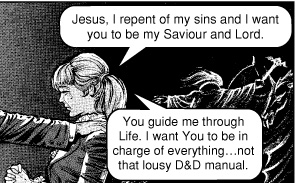
Image credit. You try finding the right image for "asterisk + Tolkien." A cartoon pamphlet in Jack Chick's ubiquitous series, 1984's "Dark Dragons," attacked among its D&D targets not only Tolkien but C.S. Lewis, according to this fascinating entry at The Escapist: In the first printing of Dark Dungeons, this particular panel included a footnote that has since been removed. The words "occult books" had a double asterisk next to them, and the corresponding note below read "Including C.S. Lewis and Tolkien, both of which can be found in occult bookstores."

The story behind this footnote is detailed in Secrets of Dark Dungeons by P.D. Magnus, which tells us that the bit about Lewis and Tolkien was submitted to Chick by a man named John Todd - a preacher who "claim(ed) to have been an important figure in international witchcraft before his salvation" and often spouted rants and sermons about massive satanic conspiracies. . . .

Strangely enough, the footnote was removed by Chick Publications because their policy is that they "must be able to prove what is printed by more than one source." http://www.theescapist.com/darkdung12.jpg

Newgrange Winter Solstice 2007: Webcast

Live, from this World Heritage site built over 5,000 years ago-- and hundreds earlier than Stonehenge-- part of the Brú na Bóinne complex of standing stones and passage tombs at Knowth and Dowth that mark the sun's rise and fall precisely. I found this hour-long watch at a chilly (about 1 degree Centigrade) morning at 9. This dawn patrol reminded me how short the winter's day can be in Ireland. I thought last night about how long last midsummer's light stretched at Biofan as I hiked to its misty-sloped summit. On the video, watch around 47:48 as the sun forms a lovely star-shape distorted by the lens of the camera: a seasonal gift for the whole world incarnated, thanks to the Net.

This is the fortieth year since Professor Michael J. O'Kelly discovered the alignment; he had first to wait two years for good weather to confirm his hunch. As Professor John Patrick remarked-- after emerging from the chamber where he and (out of 28,000 lottery applicants) 50 guests (with a few government cronies) witnessed the sun's first light penetrate the roof-box to let the ray pierce 17 minutes into the slot across the carved stone floors-- this is one of the only experiences we can share with what the awed video presenters called "our Stone Age ancestors" so long ago. It combines sexual symbolism with potent energy. It keeps us humble and happy.

This celebration of warmth in the womb, stone turned molten, light amidst darkness moved me. I watched on a tiny corner of my laptop. Still, I sensed the wonder. The crowds outside cheered as the gold filled the sky. Children romped and elders hushed. The quartzite walls glowed with what in Irish we call grian-cloch, "sun-stone."
www.heritageireland.ie/en/Solstice2007/

This sharp image is from last year, courtesy of the 22.12.06 Irish Independent. Posted on a site essential for preservation of another monument: Save Tara.
tarawatch.org/?m=200612

P.S. Verbal detour. Perhaps there's a reason why I was born the week of mid-summer, a couple of days after the feast of the mother goddess. Oddly, Celts did not observe a major holiday then, as their main four seasonal feasts fall about five weeks after those solar markers which Christians appropriate from Roman Saturnalia for Christmas and pagan solsticial bonfires for St. John's Day. Sukkot for autumnal and Passover/ Easter for vernal equinox show how ancient these traditions had been when Hebrews chose these times for their pilgrimages. I found that only two out twenty-four in my Advanced Comp class knew why Christ's mass was moved to this time of year by Pope Julius in 350, confident enough to plant baby Jesus as the Son of God where Mithras the God of the Sun once reigned.

I associated voluptuous, venerable Ishtar/ Esther/ Astarte with the harbinger of Easter, but it seems that the Son-Sun accidental homophone may be closer to the truth of those who hail the Resurrection. Eostre suggests Eastern, as in where we turn to see the sunrise! Eos, Aurora, Austria! Proto-IE root *aew-s: to 'illuminate, especially of daybreak,' according to Wikipedia. Back to PIE *Hausos, goddess of dawn. "As a love goddess, she was also called *Wenos 'lust.'" Venus: morning star. *wen=PIE 'to desire.' So, we long looked to the sun, it seems, and women, so to love them both. As I delight in what T.A. Shippey's book on Tolkien labels as "asterisk reality" among philologists. (See today's separate entry on this phrase.)

P.P.S. At the estimable Julian Cope's also monumental Head Heritage/ Modern Antiquarian, I found more etymological insight, from "Rune."(N.B.: It's countered in the thread's next reply, however; Anthony Murphy & Richard Moore's new book "Island of the Setting Son: In Search of Ireland's Ancient Astronomers" on pp. 302-3 n. 11 admits debate but appears to favor the monastic "grange" as its place name. They acknowledge the "hallowed and enduring denotation" of the nearby hill over which beckons rosy-fingered "ruadh" dawn garbled as "Roughgrange" townland on p. 140.) Newgrange (which name comes from the Irish "An Uamh Greine", meaning "The Cave of of the Sun") "Lios na Grainsi" ("Stones of the Sun) The word "Grange" is an English rendering of the Irish word "Grian", which means "Sun".http://www.headheritage.co.uk/headtohead/tma/topic/28384/threaded/343646