Showing posts with label Learning Welsh. Show all posts

Friday, February 20, 2009

De ghlór an bháis?

Scríobh Caitríona Ní Dhonghaile ina nuachtan "Eireannach Neamhspléach" 20 Feabhra faoi tuarascáil nua le UNESCO. Duirt siad go bhfuil Gaeilge "ag cur i gcontúirt go cinnte" é. Mar sin, ní fhoghlaimíonn sé mar príomhteanga ina bhaile leis duine ar bith.

Ar scor ar bith, insíonn UNESCO go raibh ag cur "i mbaol" mar Baisceis, Gaeilge na hAlban, agus Breatnais. Níl é seo chomh olc. Faigheann an triú na teangachaí bás atá ag druidim leis anois. Chuala mé go imeacht leathan na teangachaí ar fud an domhan sa céad againn féin.

Ar ndóigh, tá bron ormsa féin go leor faoi an tuarisc seo. Ar feadh an seachtain seo caite, léigh mé freagra ó Nigel Ó Ceallacháin orm. Is foghlaimeoir fásta é na Gaeilge (Oideas Gael chomh mise!) agus Breatnais níos formhór. Chonaic mé alt go scríofa leis Nigel ina leabhar go léamh mé anois, "Breatnais sa Bhliain" leis Jen Llewelyn.

D'fhoglaim sé Breatnais go foirfe. Tá sé i gcónaí ina An Bhreatain Beag anois. Oibríonn sé leis ducháis Breatnaise gach lá. Is é leathanach baile anseo. Tá Nigel go bhfuil duine dea-shamplach go raibh muineadh dúil ar aghaidh againnsa eigin.

Bhí seanathair Breatnais airsean féin ina bhaile. Bhí seantuismeitheoraí Gaeilge acu mise féin. Ní déanfaidh duine níos mo i bhfad ó láthair nó de chóir baile fiú amháin an dushlan mór a foghlaim teangachaí Ceilteach amárach. Níl deireadh dúile bainte de agam fós. Tagann muid briathra deireanacha.

In a dying voice?

Katharine Donnelly wrote in the newspaper "Irish Independent" 20 February about a new report by UNESCO. They say that the Irish language's "definitely endangered" [="put into danger surely"]. That is, it is not learned at home as a primary language by anybody.

However, UNESCO tells that Basque, Scots Gaelic, and Welsh are put in the "unsafe" category. This is not as bad. A third of languages find death approaching now. I heard half of languages all over the world will go away in our own century.

Of course, I myself was very sad about this report. During the past week, I read a reply to me from Nigel Callaghan. He's an adult learner of Irish (Oideas Gael like me!) and moreover Welsh. I saw an essay that was written by Nigel in a book I am reading now, "Welsh in a Year," by Jen Llewelyn.

He learned Welsh perfectly. He lives in Wales now. He works in the Welsh-language homeland every day. Here is his homepage. Nigel is a fine example of a person who may inspire an expectation to progress within some of us.

He had a grandfather with Welsh himself in the home. I myself had grandparents with Irish. Fewer people from afar or even close at home will make the great struggle to learn Celtic tongues tomorrow. I have not yet given up hope of it. We revive dying words.

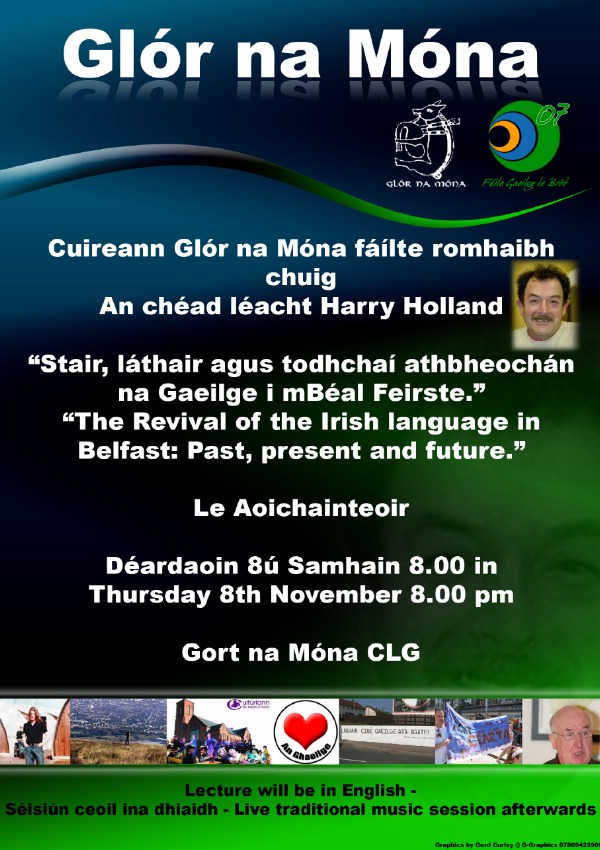
Photo/ Griangraf: "Stair, Láthair, agus Todhchaí Athbheochan na Gaeilge i mBéal Feirste" le/ "Past, Present, and Future Revival of Irish in Belfast" by Harry Holland, Glór na Móna, (="Voice of the Turf"= lost in translation?) 2007. Tá muid ag plé faoi Gaeilge as Béarla. Tosaíonn muid go mall. Caitheann muid cloí leis an bhfírinne. We discuss Irish in English. We start slowly. We must stick to reality.

Monday, February 16, 2009

Lexicelt: Gaeilge<>Breatnais Foclóir & Cleachtannaí

Fuair mé an suíomh seo. Go raibh maith ag Dr Adrian Price go Ollscóil Swansea ó Bhreatain Bheag. D'inis mé faoi an nasc seo. Is "Lexicelt" é. Is foclóir é ach go bhfuil níos mo freisin ann. Inseoidh tú beagán faoi inniu.

Tá foclóir Gaeilge<>Breatnais saor in aisce ar line. Breis is 3,000 focal le ranna cainte agus uaimreacha iolra. Tá tú ábalta a cliceáil go furasta idir canúint ó Uladh, Connacht, agus Mumhan as Gaeilge, agus idir An Thuaiscaint agus An Deisceart as Breatnaise ann.

D'fhoghlaim mé faoi an roinnt na frasaí seo ann. Rachaidh tú ionad cé beidh íomhanná agus ábharannaí éagsulái isteach. Mar sin é: Comhrá, Saoire, Caithimh Aimsire, Bia agus Síopadóireacht, An Aimsire agus Am, Teicneolaíocht, Mé féin, An Corp agus tSláinte, An Bhreatain Bheag, Ainmneacha, Amhráin, agus Gramadach ansuid. "Seo é leabhar frásaí Lexicelt áit ar féidir an Bhreatnais a fheiceáil, a chluinstin agus a chleachtadh, agus áit ar féidir ullmhú do thuras chun na Breataine Bige."

Faighim go déanta dearmad bídeach nuair go scríobh as Gaeilge faoi An Bhreatain Bheag. Mar shampla, léigh me go bhfuil an cás ghiníuneachta "Bheag" ina fóclóir mór agam go mbeidh "Bige" ag Lexicelt ann. Agus, rinne mé dearmad leis "Breatnais" go cosúlacht anseo. Measaim go raibh "Bhreatnais" ach chonaic mé "Breatnaise" freisin faoi an teárma sin. B'fhéidir, is docha ormsa féin...

Ar ndóigh, is acmhainn dhátheangach í go iomlán ann. Ní fheicfear abairt as Béarla ansin, ar chor ar bith. Rinne scólairí rogha úsáideach a tairg againn. Bainfaidh sult é asainn go coitianta ar fud an domhan Ceilteach-- agus ar an ghréasán fós!

Lexicelt: Irish-Welsh Dictionary & Lessons.

I found this site. Thanks to Dr. Adrian Price at Swansea University in Wales. He told me about this link. It's a dictionary there but there's also more. I will tell you a little bit about it today.

There's an Irish-Welsh dictionary free of charge on-line. There's more than 3,000 words from the spoken verse and plural numbers. You're able to click easily between dialects from Ulster, Connacht, and Munster in Irish, and between the North and the South from Welsh there.

I learned about this phrase section there. You'll find a location where there will be illustrations and various topics. That is: Conversation, Holidays, Hobbies, Food and Shopping, The Weather and Time, Technology, Myself, The Body and Health, Wales, Names, Songs, and Grammar over there. "This Lexicelt book of phrases is a place where it's possible to see the Welsh, and to hear and to practice, and a place where it's possible (to) prepare for a journey to Wales."

I see that I made a tiny mistake when writing in Irish about Wales. For instance, I have read that the genitive case in dictionaries of mine of "Beag" (=little as in "Little Britain"!) should be "Bige" on Lexicelt. And, I made a mistake with "Welsh" (as in the language) likewise here. I think that "Bhreatnais" may be but I have seen "Breatnaise" also about that term. Perhaps, probably from me myself...

Of course, it's a totally bilingual resource. One will not find any word in English there at all. Scholars made a useful alternative to offer to us. It will be enjoyed by us regularly all over the Celtic realm-- and on the web too!

Sunday, February 15, 2009

Pangur Bán, Breatnais & naisc focail leis Gaeilge

Chuir mé dhá nóta ar ais go Barra Tóibín ó Caerdydd ina Bhreatain Bheag faoi naisc focail idir Gaeilge agus Breatnais. Scríobh mé ortsa féin ar ais mar sin go raibh ag feicthe mise leathanach baile leis iris "Dragún Glas" ina trí teangachaí, Béarla, Gaeilge agus Breatnais aige! Is cosúil é go cruinnithe ar an leithead ormsa.

Bheul, fhragairt sé litírín agam. Cóipím seo leis buíochas ort. Gabh mo leithscéal mar sin leagan bocht agam. Ni raibh mé a leagan an liosta séadsan féin. Tá sé anseo:


Tá sé tábhachtach a thuiscint, mar a dúirt mé cheana, nach ionann brí an fhocail sa Ghaeilge agus brí an fhocail sa Bhreatnais gach uile uair. Ach bíonn ionannas nó cosúlacht éigin i gceist i ngach aon phéire acu.

Marr bharr ar sin, tá cuid de na focail sa Bhreatnais seanda as dáta fileata, ach is fearr iad sin a chur san áireamh chomh maith maraon leis na cinn atá beo sa lá atá inniu ann...

**********************************************************************************
Máthair = modryb ('aintín' sa Bhreatnais, 'mam' an focal Breatnaise do 'máthair'); athair = ewythyr ('uncail' sa Bhreatnais, 'dad' an focal Breatnaise do 'athair'); carraig = carreg; mór = mawr; beag = bach; glaoch = galw: garbh = garw; tarbh = tarw; marbh = marw; capall = ceffyl; marc = march; dreoilín = dryw; fear = gŵr ('g' in áit 'f'); bean = benyw; fíon = gwin; fíor = gwir; fiú = gwiw; faoileann = gwylan; feamainn = gwymon; trá = traeth; muir = môr; feo = gwyw; doras = drws; críon = crin; uisce = dŵr ( cf: 'dobhareach'); roth = rhod (focal fileata); eaglais = eglwys (Laidin); Aifreann = Offeren (Laidin); scadán = sgadan; abhainn = afon; much = mochyn; lao = llo; cumar = cymer; inis = ynys; úr = ir; glas = glas; glan = glan; drom = drum; tulach = tyla; leitir = llethr; cnoc = cnwc; féar = gwair; cailc = calc; diseart = dyserth; cibeal = cybalfa; manach = mynach; pobal = pobl; deich = deg; dó = dau, trí = tri; minic = mynych; ór = aur; coróin = coron; airgead = arian; cos = coes; láimh = llaw; craiceann = croen; bó = buwch; néal = niwl, coinín = cwningen; scamall = cwmwl (Laidin); tír = tir; cú = ci; coileán = colwyn; buachaill = bugail ('aoire' cf: 'buachaill bó'); mín = mwyn; caoin = cu; mí = mis, bliain = blwyddyn; Luan = Llun; Máirt = Mawrth; Satharn = Sadwrn; bord = bord; long = llong; claíomh = cleddyf; bráthair = brawd; neamh = nef; caol = cul; leathan = llydan; Ruairí = Rhodri; Siobhan = Siwan; Seán = Sion; Máire = Mair.
*************************************************************************************

Dán (tallann) = dawn; bard = bardd; marcaíocht = marchogaeth; dealbh = delw; dílis = dilys; Lúgh (an dia Ceilteach) = Llew; loingeas = llynges; slad = lladd; Máire (Muire) = Mair; coll = collen; eiscir = esgair; dair = derwen; doire = deri; práis = pres; airgead = arian; iarann = haearn; oidhear = eira; cathair = caer; príomh = prif; scoil = ysgol; eascair = esgor; lios = llys; cruit = crwth; lann = llafn; -lann (cf: 'leabharlann')= llan; cill = cil; aer = awyr; moladh = moliant; bán = pan ('Pangur Bán'); túr = tŵr; trasna = traws; canadh = canu; im = ymenyn; cailc = calch; cam = cam; léim = llam; lár (cf: 'urlár') = llawr; lán= llawn; do = dy; mac = mab; bradach, bradaí = brad; aimsir = amser; bolg = bol; coileach = ceiliog; éan = edn ('dofednod' = éanlaith chlós na feirme); teine = tân; cluain = llwyn, sean = hen; síon = hin;
********************************************************************************
Nóta: 'Pangur Bán'.

Is dócha gur 'pan-gŵr' ('bán-fear') atá i gceist anseo. Sin é an míniú is fearr liomsa air mar scéal.

D'imigh an manach ainaithnid a scríobh an dán álainn sin as Eirinn go dtí Caergybi ('Holyhead') chun dul ar aghaidh go dti an Eoraip.

Ar a shlí ó dheas dó is cosúil gur chuir sé aithne ar an gcat bán seo sa Bhreatain Bheag. Bhí an t-ainm 'Pan-gŵr' ar an ainmhí ionúin cheana. Ghlac an manach leis mar chompánach bóthair agus ghlac sé leis an t-ainm Breatnaise chomh maith.

Éireannach dílis ab ea é, áfach, agus do bhain sé feidhm as an aidiacht 'bán' chun cruth na Gaeilge a chur ar 'Pan-gŵr' mar ainm!

Pangur Bán, Welsh & Word Links with Irish.

I got two notes back from Barry Tobin of Cardiff in Wales about word links between Irish and Welsh. I had written to him myself as I had seen his "Green Dragon" site in three languages, English, Irish and Welsh! It seems designed for the likes of me.

Well, he answered my little letter. I copy this with thanks to him. Excuse my poor rendering. I did not translate the list itself. Here it is: (see above)


It's important to understand, as I said already, not to liken a meaning of a word in Irish and a meaning of a word in Welsh every time the same. But there can (usually) be some likeness or similarity in question in every pair of them.

It's foremost considering that there's a share of the words in Old Welsh from poetic material, but they are regarded as good examples of including the best of whatever's surviving daily there today...

Note: Pangur Bán.

Probably it's "'pan-gŵr' ('bán-fear')" [="white-man"] that's in question here. That's the best meaning for me according to its story.

An unknown monk went out to write that beautiful poetry from Ireland towards Caergybi/ Holyhead from where he set out towards Europe.

On the way to the south it seems that he got knowledge of this white cat in Wales. The name "'pan-gŵr'" was from the dear animal already known. The monk called for companion for the road and he called it by the Welsh name as well.

He was a loyal Irishman, nonetheless, and he found no problem from the adjective "bán" ("white") to fit the Irish that's "Pan-gŵr" for a name!

image/íomhá (?!). Feic dán anseo/ See poem here: "Pangur Bán" poem/dán

Tuesday, January 20, 2009

Líonra Soisealta Breatnaigh-Meiricéanaigh

Cheangail mé an líonra soisealta Breatneach agus Meiricéanach faoi deireanach. Tá sé ar an idirlion anseo. Bhí mian agamsa a foghlaim faoi línte comhchumrachaí idir Breatnais agus Gaeilge.

Fuair mé amach faoi an ionad nuair go raibh ag cuardach le tuairiscí le bogearra (nó earraí boga) le "Rosetta Stone." D'iarr mé ag léamh léirmheasannaí le úsáideoirí Breatnaise. Bhuel, d'fhoglaim mé mír i dtaobh sé leis gasra fhoglaimeoiri ann.

Tá rud eile de suíomh seo ann. D'aimstrigh mé faisnéis mar gheall ar eolas a chur ar gníomharthaí cultúir Breatnaigh ina Stáit Aontaithe Mheiriceá. Ní raibh fhios agamsa féin ar chor ar bith fúthu. Anois, insíonn agaibh beagán faoi an áit sin.

Níl sé furasta a cuardaigh ann. Dhearc mé nascannaí go leor ar dtús. Ba mhaith liom amharc de dheas dom a fháil air. Tá blogannái ann; tá seomra cainte fós; tá nuacht freisin. Tá siadsan féin go bhfuil óstachaigh de "Eisteddfod ar chois an taobh clé"!. Tá stiúrthórí i gcónaí ina Stát Bhéabhar (=Oregon).

Tá líonra iontrálachaí líonmharaí a chur ina idirlíon a bhreacadh acu ann. Coinnigh scór siad an cuntas seo. Tá duine den lucht soisealta: 828; tá grianghrafaí: 3606; tá amhráin: 153; físeanaí: 198; comhráite: 227; imeachtaí: 248; agus altannaí bhlogannaí (leis alt nua agamsa) anois. Tá dream acusan féin bídeach go cuí ag caint faoi an finscéal Mhadoc! Scríobhfaidh mé faoi seo amarach as Béarla.

Welsh-American Social Network.

I joined a social network of Welsh and Americans recently. It's on the internet here. I had a need to learn about concurrent ties between Welsh and Irish (languages).

I found out about the location when I was looking for accounts of software by "Rosetta Stone." I wanted to read reviews by users of Welsh. Well, I learned a bit concerning it from a group of learners there.

There's another thing about this site. I discovered information regarding data out about Welsh cultural activity in the United States. Now, I tell you all a little about that site.

It's not easy to search there. I observed many links at the start. I'd like to get a closer view of it. There's blogs there; there's a chat room also; there's news too. They themselves are hosts of a "Left Coast Eisteddfod"! The directors are living in the Beaver State (=Oregon).

Their network has entered numerous entries put on the internet to post. Today, they tally ("=keep score") this count. There's 828 members; 3606 photos; 153 songs; 198 videos; 227 discussions; 248 events; and 330 blog posts (with a new one from me) there now. They even have a tiny group fittingly chatting about the legend of Madoc! I will write about this tomorrow in English.

Íomhá: "Do you have power to speak Welsh?"/ "An bhfuil cumhacht ag rá Gaeilge agaibh?"

Saturday, January 17, 2009

AmeriCymru: Welsh-American Social Network & Language Learners' Group

An American Welsh Social Network - Rhwydwaith Cymdeithasol i Gymry America. "AmeriCymru.com and Americymru.ning.com are an online social network for Welsh people and people of Welsh descent and a place online to find Wales and all things Welsh." Neither Welsh nor as far as I know of descent, I still liked this contingent, so I joined their friendly fray.

Since I needed to seek out those in the know, I thought this'd be a sensible place for my diasporic speculation about a language studied by me in isolation. Not needing to speak it really, I'm intrigued by seeing it. I asked my quixotic or misguided question about ties between Gaeilge & Cymraeg. Perhaps (despite "Bo's" erudite pair of rejoinders), I may find another deluded seeker scrabbling out a few pan-Celtic traces, however dim or palimpsestic fifteen hundred years hence.

I found AmeriCymru when tapping in a search for reviews of the pricy, enigmatic, but flashy and hypermarketed (for lack of alternatives for such as Tagalog and Farsi?) Rosetta Stone software for Irish and Welsh. You cannot even get it used; the company determines you purchase the license, not the product! Contradicting the right we have as buyers of a product to dispose of it as we wish! Seems discouraging. Not that I can afford it, but I am curious, yellow.

There's spirited, if combative and diffused, discussions by real RS Irish users at forums on Daltaí na Gaeilge, as opposed to ubiquitous blurbs, but I had trouble uncovering any for RS Welsh. Then, I substituted "Cymraeg," as even the yellow RS software box has that label. I figured I'd get more serious cross-over potential. And, up popped somebody's comments. That listing led me to wander around the rest of AmeriCymru. The learners gather at: Grŵp Iaith Gymraeg (Welsh Language Group)

This AmeriCymru-hosted (its sequestered guests can be hard to track down on the main site) Grŵp links to: Learn Welsh Podcast. I referred to this on January 8th. Thanks to all on the Net, who as I ranted to my MBA-aspiring son today, eschew commercial gain as they enter the web to promote the joy of knowledge rather than the accumulation of profit by garishly "sponsored" blogs and busily hectoring, Flash-animated, ad-riddled URLs.

Friday, January 16, 2009

Písciní ag cainteach as Breatnais?

Bhí muintir agam nuair ag tosaithe a foghlaim Gaeilge fadó. Dúirt Séamus Ó Dearáin againn go measaionn na foghar na Gaeilge is cosúil le dhá Sualannach ag rá as Eabhrais. Bhuel, d'eist mé le triu uair lena liom leis abairtí as Breatnais an seachtaine seo caite.

Bhí mé go raibh ag eiste Breatnais go nádúrtha ar an triu uair arú inné. Tosaíonn mé téip "Foghlaim Cainte Breatnaise ag tusa féin." Thug mé é ar an leabharlann.

Fuair mise féin ag cloisteáil Breatnais ar an dara uair i Toronto an samhraidh seo caite. Nígh mé mo lamha ina seomra folctha ina ollscoil ann. Chruinnigh ollunaí ar an comhdháil oideachas faoi leanntaí Breatnaigh. Bhí macalla Ceilteach ina shruth agus ina stad thart timpeall orm ann. Ní raibh mé ábalta aithint na agallamh sin ar feadh tamaill. Bhí ag tagtha gan fhíos orm.

Cad foghair cainte siadsan? Samhlaím go raibh dhá písciní ag cainteach as Breatnaise! Chuala mé focail beagán i dtosach nuair chuir cuairt go Abergwaun ina samhraidh na 1979. Bhí mé ocht mbliana d'aois deag faoi níos deireanach.

Bhuaigh mé i measc ocht mac leinn eile i gCalifoirnea iomaíocht. Scríobh mé aiste faoi Uasal Proinsias Bardal. Bhí ceathairceadbliain i ndiadh a ag dulta airsean féin go i dtír ansuid. D'imigh mé go Londain ar am gearr. D'fhan mé leis óstachaigh agam, an teaghlach Mhic Eoin i sraidbhaile Shír Eabhrac Theas níos fada.

D'fhág mé leis iníon Ráichéal go Bhreatain Bheag ar feadh leathanta deireadh. Chaith a athair a bheith i láthair ag cruinniu ann. Bhi ionad inar táirgeadh Learpholl air. Tháinig a chlann a bunaithe leis fréamhachaí Breatnaigh ann.

Chuaigh Ráichéal agus mé go dtí an port na Abergwaun. Rugamar orainn ag dul sall thar caladh go Calafort Ros Láir-- agus ar ais go díreach go tapaidh an oiche céann sin! Cheannaigh muid iasc agus scalleógaí prataí riamh ag fáighte an bád farantóireachta orainn.

Fhiafraigh dhá fír óg uirthi féin amháin: "Cá raibh cheannaigh sí iasc agus scalleógaí prataí?" Ach, d'iarr Ráichéal as Breatnais níos teagmhacasach. Cén fáth? Ceapaim mar sin dhearc sí fior-Breatnach orthu.

Ar ndóigh, ní raibh sí ábalta freagairt. Athdúirt beirt as Béarla ina dhiadh sin. Fhreagrair sí orthu. Mar sin féin, bhí iontach ormsa féin níos mo faoi an comhrá seo ar an straid. Bhí fhíos agamsa go tuigeann teangacha Ceilteach rionnt leathanta seo chugainn. Anois, tá an lá seo anseo agamsa féin.

Kittens Chatting in Welsh?


I had a teacher when beginning to learn Irish long ago. Jim Duran said to us that he thought the (linguistic) sounds of Irish are like two Swedes speaking Hebrew. Well, I listened for the third time in my life to sentences in Welsh this past week.

I was listening to Welsh naturally for the third time the day before yesterday. I started a tape "Teach Yourself Welsh Conversation." I brought it from the library.

I found myself hearing Welsh for the second time in Toronto last summer. I washed my hands in the bathroom at the university there. Professors gathered for an educational conference concerning Welsh Studies. An echo of Celtic in a flow and a halt all around me was there. I was not able to identify those conversations for a while. The knowledge was not coming to me.

What sounds of speech were they? I imagine that there's two kittens chatting in Welsh! I heard a few words first when I paid a visit to Abergwaun (Fishguard) in the summer of 1979. I was eighteen years old very recently.

I had won among eight other students in California a competition. I wrote an essay about Sir Francis Drake. It was the quadricentennial after he himself had gone to the land over there. I went off to London for a short time. I stayed longer with my hosts, the Johnson family in a village of South Yorkshire.

I left with daughter Rachel to Wales during a weekend. Her father had to attend a meeting there. His original family location was in Liverpool. His family came there beginning from Welsh roots.

Rachel and I went to the port of Abergwaun. We caught a ferry crossing over to Rosslare Harbor-- and straight back quickly that night! We bought fish and chips before we got the ferry boat.

Two young men asked only her: "Where did she buy the fish and chips?" But, they appealed in Welsh very casually. Why? I think that she looked true Welsh to them.

Of course, she could not respond. They next repeated the question in English. She answered them. Nevertheless, I was very much surprised about this conversation on the street. I knew myself that I would understand some share of Celtic languages in the future. Now, this day is here for myself.

Griangraf/Photo: Fishguard/ Abergwaun.

Thursday, January 8, 2009

Ag Foghlaim leis podchraoltaí as Gaeilge (& Breatnaise bheag)

Fuair mé paimfléad ó Oideas Gael ar an post inniu. Ba mhaith liom ag filleadh ar ais Gleann Cholm Cille ansuid aríst ar feadh an seachtaine seo chugainn, ach níl airgead agamsa féin anois ag dul go Dún na nGall. Mar sin féin, is mian orm a tógáil líofacht agam.

Is iontach orm. An bhfaigheadh mé ábhar go saor ar an ghreasan a cloisteáil Gaeilge ar mo h-IPhod? Ní íarraionn mé a íoc chun chinn chuig cleachtannaí níos fusa. Iarraidh mir Breatnais go luath triu podchraoltaí as teangachaí Ceilteach freisin.

Deir Foras na Gaeilge:
An Líonra Sóisialta: Craoltar an clár laethúil seo ar 7 stáisiún raidio in Éirinn agus ar fud an domhain, mar phodchraoladh (podcast) ón suíomh AnLionra.Com. Is HOST [óstach!] Conn Ó Muineacháin é.

Sonraí Teagmhála: Seoladh: ar an raidio, ar an idirlíon, thart timpeall ort, i do phóca! An Líonra Sóisealta
P.S.: Labhairt sé as Gaeilge leis blas go hiontach aigesan féin ann!


Tá sé bun-focail agus frasai furasta níos mo anseo: "Noimead Aon Gaeilge". Tá deich cleachtaí ann. Má bhéifea foghlaimeoir níos liofa, go dté tú go agallaimh agus cainte as Gaeilge le Séamas Ó Nuachtain. Tá sé i gcónaí ina h-Inis Fada, Nua Eabhrac. Cumann Carad na Gaeilge.

D'inis tú ariamh faoi Gaeilge na Seachtaine. Is banóstach é Kay Uí Chinnéide. Tá tíosach go fial fosta. Is maith liom ag eisteacht le a scéaltaí faoi aicesan féin.

Go críochnúil, is maith liom is mo Gíota Beag le BBC-NI. Rug mé ormsa féin blás beagán ó Thuaidh triu ag cloisteáil leis Fearghal Mag Uiginn ariamh ag dul go Oideas Gael arú anuraidh. Molaim go cuireadh cuairt agatsa féin an suíomh seo ar an idirlíon go minic.

Ní raibh mé ábalta fáil podchraoltaí éagsúlaí a cabhar mac foghlama Breatnaise. Ceapaim go mbheifi{?} go cruthaigh chomh mac leinn níos fearr leis ábhar níos flúirseach ar fad i mball ó Bhreatain Bheag le hais Gaeilge in Éirinn! Níor fuair mé chuig ionad nua-fhoglameoir fásta ar an BBC-Wales leis podchraolta.

Mar shampla, tá "Catchphrase" (leagan 2000) leis "na Lloyds" go brea. Níl slí a casadh clár craobhailte as comhad na h-iPod ann. Tá podchraoltaí amháin go bhfuil ar an leibheal níos ard chun chinn ag foghlaim Breatnaise: Pigion. Go cinnte, measaim go mbeadh seo níos hoíriúnach orm: Foghlaim Breatnais Podcraolta.

An mbíonn spéis i teangacha in hachan duine go hionduil? Tá Gaelgoirí beagán anseo: Podchraoltaí as Gaeilge. Tá nascannaí Gaelach eile na hAlbanach agus Éire a leithead anseo: Foghlaim Gaeilge ar an Idirlíon. Feicfidh tú eolas faoi teangacha eile ar an idirlíon anseo: Podcasting for Foreign- Language Education.

Learning with podcasts in Irish (& a wee Welsh).

I got a pamphlet from Oideas Gael in the mail today. I would like to return to Glencolmcille over there again during the next summer, but there is not money for me now to be going to Donegal. All the same, there is a need for me to build my fluency.

I wonder. Would I find material free on the web to hear Irish on my iPod? I do not wish to pay regarding easier lessons. I would seek also a bit of Welsh soon through podcasts of Celtic languages.

Foras na Gaeilge says:
"The Social Network: This weekly program's broadcast on 7 radio stations in Ireland throughout the land, through podcast from the site AnLionra.com. Conn Ó Muineacháin's the host.

Communication Details: Sent: on the radio, on the internet, all around you, in your pocket!" "An Líonra Sóisealta"
P. S. He speaks Irish with a wonderful tone himself there!

There's more basic vocabulary and easy phrases here: href="http://coffeebreakspanish.typepad.com/oneminutelanguages/one_minute_irish/index.html">"One Minute Irish". Ten lessons are there. If you would be a more fluent learner, you may go to interviews and talk in Irish at the Philo-Celtic Society, by Séamas Ó Nuachtain. He is living on Long Island, New York.

I told you before about Irish of the Week. Kay Uí Chinnéide's the hostess. She's hospitable too! I like to listen to her stories about herself.

Ultimately, I like most "A Wee Bit" from BBC-NI. I myself caught a slight accent from the North through listening to Fearghal Mag Uiginn before going to Oideas Gael the year before last. I recommend that you pay a visit yourself to this site on the net often.

I was not able to find varied podcasts to help a learner of Welsh. I think, however, that one might be better served as a student with far more abundant material from Wales elsewhere as compared to Irish in Ireland. I did not find a location for a new adult learner on BBC-Wales with a podcast.

For instance, there's a fine "Catchphrase" (version 2000) with "The Lloyds." But, there's no way to turn that program broadcast into an iPod file. There are only podcasts that are at the level for a higher learning of Welsh: Pigion. Finally, I estimate this may be for me a more suitable start: Learn Welsh Podcast.

Is there usually an interest in languages in every person? Here's a few Irish people: Podcasts in Irish. There are other such Gaelic links from Scotland and Ireland here: Foghlaim Gaeilge ar an Idirlíon. You will see information about other languages on the Internet here: Podcasting for Foreign- Language Education

Griangraf/ Photo: Lynette Fay, banóstach Blais/ host(ess) of Blas: BBC Raidió Uladh/Radio Ulster.

Tuesday, January 6, 2009

Ag Filleadh go Bhreatain Bheag

Scríobh mé bliain ó shin faoi ag foghlaim mír Breatnaise. Anois, tá sé aon bliain go deireanach go díreach agus tá mé ag scríobh fúithi aríst! Is iontach liom go meachnú faoi Breatain Bheag ar feadh an geimreadh dár gcionn! B'fhéidir, ar mbeadh macalla na h-Imbolc ormsa féin ann?

Críochnaím stair litríochta le Emyr Humphreys, "An Traidisiún na Taliesin." Insíonn Humphries faoi an measc Bhreatnach go bhfuil miotasach agus sóisialta ar chéile. Déanann sé nascannaí leis aigne ghéar aige idir eisteddfodau agus cruinnithe, draíochtaí agus Lloyd George, an teanga agus an bíobla, an Prionsa Madoc agus an seanmóiri Meitidistigh.

Measaim go raibh Breatnais níos laidir faoi láthair chomh teangacha Ceilteach eile. Tá dála staid agus suíomh anois níos daingean fúithi. Ar ghualainn leis Gaeilge, ár ndóigh, ar radharc fairsing leis Breatnais go raibh níos geal.

Is maith liom a feiceáil tairbsí Gaelach ina focail Breatnaise. Gheobhaidh mé cosulachtaí, go nádurtha. Feicfidh mé ar an gcuma chéanna. Tháinig ina beirt teanga dealramh bídeach, nó géarr, go raibh ceangail nó scarann na cianta cairbreacha ó shin. D'inis "Bo" fúthu: "Gaeilge & Breatnais" (9 Feabhra 2008) agus "Gaeilge & Breatnais 2." (10 Feabhra 2008).

Tá mé ar an ngannchuid a tógáil agam aithne níos mhaith Breatnaise bheag. Ba mhaith liom leid a thabhairt domsa fúithi. Ní bheidh sí socair. Níor tugfidh sí liom a dhéanamh ach beagán agam gan dua.

Mar sin féin, is iondúil seo go foghlaimeoir fásta! Tá ábhar go leor as Breatnais a cabhar linn. Mar shampla, feicim sé ar an BBC & S4C. Fuair mé altannaí go cabhrach le Janis Cortese. Chruinnigh sí eolas anseo: "Foghlaim Breatnais."

Tá sí bean áitiúla agam; tá sí i gcónaí ina gCalifoirnea Theas! Bheadh sí dea-shampla a thabhair uaim. Tá muid ag foghlamtha in leann Ceiltigh cónaí i bhfad ó láthair inniu. Fágann muid go dúthrachtach triu ár intinní go dtí tíorthái agus teanglachaí níos faide. Éiríonn muid go fonnmhar ar an taobh thoir go doifheicthe.

Returning to Wales.

I wrote a year ago about learning a bit of Welsh. Now, it's a year later exactly and I am writing about it again! It's a wonder to me reflecting about "Little Britain" during the following winter. Perhaps, may there be an echo of Imbolc [the Celtic solstice] in me?

I am finishing a literary history by Emyr Humphreys, "The Taliesin Tradition." Humphries tells about a Welsh blend that's mythological and social together. He makes links with his observant mind between Eisteddfods and rallies, druids and Lloyd George, the language and the bible, the prince Madoc and the preacher Methodist.

I think that Welsh may be stronger at present than other Celtic languages. The historical situation and the position of it now are firmer. In comparison with Irish, of course, the wide prospect with Welsh may be brighter.

I like to see ghosts of Gaelic in words of Welsh. I will find similarities, naturally. I will see a tiny, or sharp, resemblance in the pair of languages, shared and diverging in the distant past. "Bo" tells about these: "Irish & Welsh" (February 9, 2008) agus "Irish & Welsh 2." (February 10, 2008).

I have a desire to build up a better knowledge of a little Welsh. I would like to get a feel for it in me. It will not be easy. I cannot understand it even a little myself without difficulty.

All the same, this is ordinary for an adult learner! There's material galore in Welsh to help us. For instance, I see it on the BBC & S4C. I found helpful articles by Janis Cortese. She gathered information here: "Learn Welsh."

She is a local woman to me; she is living in Southern California! She should be a good example for me. We are learning in Celtic studies, living faraway today. We leave in diligence through our minds to lands and languages farther off. We rise in eagerness eastwards invisibly.

Iómhá/Illustration: le Senán Ó Ruanaidh/ by Simon Rooney. "Ceiltigh d'Aois Iarainn/ Iron Age Celts:" suíomh sraithe ar lion/ site of series on-line.

Saturday, January 3, 2009

Dafydd ap Gwilym: Poems (ed./tr. Rachel Bromwich): Book Review

Alexander Theroux in a recent L.A. Times critique of Burton Raffel's unnecessary rendering of Chaucer into contemporary English reminded me about the nearly exact contemporary across the island, Dafydd ap Gwilym. He's considered the equal of Chaucer's own versifying best, but far less accessible due to the intricacies of medieval Welsh metrics, the exceedingly alliterative and rhythmic demands of that musical language, and the inability to carry these heard harmonies into English. Still, I instantly ordered, mid-November from a seller in the book-laden Hay-on-Wye, an affordable copy of his work. I wanted a bilingual edition, so I could, as with Dante or Ovid, at least pretend I could gain an insight fleetingly into the original. Six weeks later, it arrived yesterday.

I had enjoyed Rolfe Humphries' 1969 "Nine Thorny Thickets" as a sample of Dafydd's love lyrics, and that American poet did attempt as the title shows to replicate the effects of the source. Gwyn Thomas, last month, had his own translations published, and I reckon these will be admirable. However, the sight of the Welsh facing the English in Bromwich's selections does have its own merits. The organization into topics departs from the standard 1952 edition by Thomas Parry (he gives a brief preface); Bromwich explains in her introduction how "I have arranged the poems according to subject matter, to bring out certain comparisons and resemblances;" these comprise about a third of the poet's accepted canon. (Richard M. Loomis & Dafydd Johnston translated all the originals without the Welsh text in 1982.)

Her introduction briskly surveys the little we know of his life, the metrics, the poetic craft, and the challenges of translation itself. Bromwich brought Dafydd to the attention of scholars earlier last century, and her familiarity with the author shows. She follows the example pioneered by Kuno Meyer with Irish medieval verse, in giving prose equivalents; she cites as one forerunner for her own project the versions from various languages given in Kenneth Jackson's "A Celtic Miscellany."

The fifty-six entries (cross-referenced with Williams' differently numbered originals) cover in turn love's seasons; various lovers the poet addressed; birds and animals; nature's messengers of love; love's frustrations; addresses to his friends; and meditations, a recantation, and a concluding prayer. The element of precision and incision characterizes his tightly wound, firmly grasped style.

Since I lack facility with the Welsh, I cannot give an complete estimate of Bromwich's success or failure to convey Dafydd ap Gwilym's intricacies. From what I can gather, nonetheless, this appears a valuable answer to the problem that other editions have: they lack both languages. The book's well-designed, with a readable typeface, handy size, and line references are keyed to endnotes. Leafing through the selections, the degree of compression into couplets of the Welsh does find an accessible echo in her line readings into serviceable English. She strives more for equivalents than eloquence, and her edition's geared both to somebody like myself with little knowledge of Welsh, and to the reader needing to learn more about this rarely noted (even in passing as with Theroux's review) writer who evades the attention of many of those who claim wider knowledge of medieval texts.

(All but paragraph one posted to Amazon US today.)

Friday, March 7, 2008


Janet Davies' "A Pocket Guide to the Welsh Language": Book Review

This little guide's only 125 pages of text, but packs an impressive amount of material into its compact size. Part of the U. of Wales Press series, it introduces you to the history of the language more than its features. The first chapter on its origins takes but ten pages, while "The Changing Fortunes of the Language" narrates its growth, flourishing, and shifting into modern times over sixty pages. The state of the current (as of 1999) language takes about the same space, and a short chapter comparing Welsh with 'other Non-state Languages in Europe" densely gives lots of facts in less than ten pages. Finally, "A Note on the Characteristics of Welsh" in a few pages gives only a hint of what I would have wished much more about: how the language works, not as a grammatical overview but a look at its distinguishing features.

Still, given the editorial constraints which undoubtably kept this a pocket guide, Davies manages to express her interest in this ancient language with erudition, insight, and control. Illustrations and charts break up the text; I found many of the latter helpful in visualizing the linguistic points. Maps also assist understanding of dialectal features and where speakers lived yesterday and at present.

A couple of examples of her comments demonstrate Davies' ability to transcend a dutiful recital of statistics, names, and locations. In the 1920s, for example, bus routes linked far-off places to tourists, and cars also began to enable Anglophones to enter where none may have gone so distantly before. "Remote villages where no language but Welsh had been heard for fifteen centuries, now resounded in summer for English visitors." (62)

As for Plaid Cymru's campaign to conserve Welsh Wales, she sees contradictions in preserving Welsh-speaking communities that need "economic infrastructure" to survive. If Plaid (judging from her perspective ten years ago) appeals more to the minority constituency, this may strengthen the language at the expense of the party's contraction from a wider national influence, so "it will be unable to become the party of Wales as a whole." (110) Davies guardedly holds optimism in the language's holding pattern, and its growth in schools, but fairly indicates its decline as a communal language in many places where it once dominated. On the other hand, unique to Celtic languages, Cardiff represents an urban enclave of speakers, and in such developments Davies sees hope for the future.

Finally, as her preface and afterword eloquently if briefly describe, Davies knows what it's like to be curious about the language while remaining on the outside looking, or hearing, in. As no book seemed to give an overview for such curious readers, she wrote one. "Wanting to read a book is the best reason for writing one." (viii) As an adult learner of Cymraeg, Davies convinces you of what she concludes is its characteristic as a "life-enhancing" emblem of culture and knowledge.

[Review posted to Amazon US today.]

Image (reproduced on cover): "Y Wyddor" (The Alphabet) ca. 1900, T.C. Evans."Y Wyddor"

Tuesday, February 5, 2008


Advice for Learners: Cynghorion i Ddysgwyr / Learning Welsh: Dysgu Gymraeg
Here's a feature today which I found out via Alan Jones' handsomely presented "Independence Cymru" (see my link at right) about Janis Cortese's net endeavors. She lives a mere dozen miles away from me, with a slew of pointers and lessons for hesitant beginners in Welsh. As in yours truly. I like, under her comments on the intriguingly titled "Soft Mutation," her comparisons to Spanish.

(As a coincidence, Bo over at another blog I link to, "The Expvlsion of the Blatant Beast," has news of an interview in Aberstywyth for a position on the staff of the Welsh Dictionary/ Geiriadur Prifysgol Cymru, the Welsh OED equivalent. Sensibly, he's a fresh Celticist Ph.D. from Oxford, so the trip to the U. of Wales makes symbolic and etymological sense. He apparently has to speak the language of heaven for the "prawf," or test, logically but undoubtably portentiously. His post on the language-- http://landofspices.blogspot.com/2008/02/welsh.html --has loads of additional suggestions from his own "gradus ad Parnassum." Maith thú, a chara! Adh mór ort! Da iawn, fy ffrind! Pob llwyddiant ti!)

I suppose it's a hairbreadth of a linguistic overlap indeed in any Venn diagram that ties such strands together, but it fits us eclectic lovers of arcana. For Janis Cortese and me, the mystery thickens: why so intrigued by faraway difficult tongues as Southern Californians? (Although she's a near-neighbor by adoption, a point we few remaining natives may parochially make.) Adding to our local stereotype, you can find on her homepages disparate concerns less applicable to me: long hair, left-handedness or "Sinistrality," "Hinouema" or Chinese astrology, firearms, crafts, and Marfa syndrome. Hope she gets back to Cornish one day, even if no translation of a Kernewek/ Curnoack "Harri Potter" complements the versions of volume one in Gaeilge & Cymraeg.

Janis Cortese's Welsh Pages-- http://www.io.com/~cortese/cymraeg/index.html

Image-- http://www.siop-siarad.co.uk The banner ad's titled "Learn to write and speak Welsh - Dysgu siarad ac ysgrifennu Cymraeg". A web site written by Welsh learners for Welsh learners - the terrified kind!" Count me in.

Friday, January 25, 2008


Smaointe faoi ag foghlaim Breatnais (as Gaeilge!)

Scríobh mé chuici G.R. Grove ar a bhlog Tre Gwernin faoi ag foghlaim Breatnais areir. Chuir sí orm cúpla focal a rá. Fhreagairt sí go gasta. D'imir cleachtadh intinn aici ag cruinniú briathra agus frásaí nuair bhí sí ag thiomanteáin thríd Deanvír. Is ionadh liom go bhfuil tig léi shileadh na teanga go dúshlánach agus ábalta sí tabhairt aithne uirthi an bóthar ar am céanna!

D'inis GRG scéala ar feadh meanaois go luath leis na cogadhái catharthaí Sacsanaigh agus Ceiltigh eatarthu. Chríochnaigh "Gwernin" dha leabhar le seanchas go An Bhreatain Bheag san ama atá i láthair. Thosaigh siad san am fadó. Níl fhios agam ma léighfeadh sí stair na "Porius" le John Cowper Powys fós.

Dúirt sí go raibh é a chreideamh go "Welsh in Three Months" le Phylip Brake agus Mair ap Myrddin (DK/ Hugo, 1999) go mbeadh ceannach ceart dom. D'imigh sí go Cymdeithas Madog a tógail a cumhacht as Breatnaise; is maith léi go hiontach. Ba mhaith liomsa féin ag dul ansuid lá éigin nuair deánfaidh mé airgead go leor agus gheobhaidh mé leathanta saoire. Tá dúil agam ag cloisteáil an teanga na Bhreatain Bheag Theas, mar sin chuala mé Breatnais ansin an am chead-- agus am amháin, freisin!

Níl foclóir dha teanga agam ag scríobh seo inniu. Tá ghéarrfoclóir agam mise amháin Ghaeilge-Béarla. Is mian liom ag obair tuilleadh inchinn Éireannach agam! Bhain aimsir dom go lag anseo. Bhí sé ag scriófa uair agus ceathracha noimead. Caithfidh mé ag dul ag muintir ar lar anois.

Thoughts on learning Welsh (in Irish!--somewhat of a literal translation)

I wrote G.R. Grove last night at the "Tre Gwernin" blog about learning Welsh. She sent me a few words in reply. She answered quickly! She was playing around mentally with gathering words and phrases while she was driving through Denver. I was surprised that she had the ability to think in a challenging language and to keep her knowledge of the road at the same time.

GRG tells stories during the early Middle Ages concerning the ancient battles between Saxons and Celts. She has finished two books on the old Welsh tales at present. They began long ago. I don't know if she has read the novel "Porius" by John Cowper Powys yet.

She told me that she believed that "Welsh in Three Months" by Phylip Brake and Mair ap Myrddin (DK/ Hugo, 1999) would be a correct choice for me. She went off to Cymdeithas Madog to build up his command of Welsh; she likes it wonderfully. I would like to go there some day when I will make more money and I will get a vacation. I desire to hear the tongue of South Wales, since I heard Welsh first there-- and the only time, so far!

I don't have a bilingual dictionary to write this today. I have an condensed Irish-to-English dictionary only. I need to work more my "Irish" brain! The time went away slowly here. I was writing an hour and forty minutes. I must now go downtown to teach.

Image/ griangraf: www.fletchersaga.net/LWCAD1.html

Wednesday, December 12, 2007


Sandi Thomas' You Don't Speak Welsh: Book Review

I could certainly relate to my fellow Californian craving spicy Mexican cuisine, enduring uncomprehending stares as she tried to explain why she was attempting to articulate baby-level sentences in a Celtic language, and generally making herself a giddy wreck in a class hours a day wondering if she'd ever make sense of mutations, tongue-twisting sounds, and smug polyglots.

While my Oideas Gael stint last summer was but a fortnight compared to her month at Pryfisgol Cymru, she did start from scratch. I wondered if my American classmates who had done the same came out better than me; they did seem much more at ease in class, and they had crammed in mere weeks with better blás (accent) what took me desultory years of self-taught detritus. And, I still cannot make myself understood 'as gaeilge.' Like Thomas with her Celtic, I love words. It's the grammar that confounds me, and the speech that stymies me. While "Cymry" means "the people," and carries an intimate tribal adoption absent from "Éireannach," there's the same tie between
tír agus teanga, land and language. So, like her, there's an atavistic but vibrantly resonant imperative that impels me to stumble on, if not always forward.

She discusses her writing of the book and later work with Welsh at the learner's site Clwb Malu Cachu (I will leave the site's name untranslated, but it's the same as
các 'as gaeilge')
http://www.clwbmalucachu.co.uk/features/sandi_thomas_interview.htm

No website for her, surprisingly. I wish her luck. Here's my Amazon review of her own story.

This Californian writer gives an unpretentious, straightforward, if occasionally vague account of her month in Abersytwyth studying from the absolute beginner's stage at an "Wlpan" intensive course. Most of the brisk narrative relates this with lots of meticulous self-reflection, in a manner that seems as if reworked from a journal she kept. Nothing wrong with this, but you do tend when reading to lack the wider context. I wondered how much the course cost, how more specifically the other learners and she bonded in and out of class in relation to the more advanced students, and especially the account would have been more useful if she had provided more about the exact tapes and lessons. Such details about learning materials might have helped curious learners understand more vividly how the grueling drills or entertaining lessons played out in class each day for six hours.

The middle of her story follows her as she dashes off on weekends for quick visits to the countryside. She's observant on how Americans appear to stand out without intending to do so, and as she notes, while she never was made to feel unwelcome, she was often treated with extreme scrutiny for her attempts to speak the bit of Welsh she knew or for her justification that she possessed as much as any Welsh native the right to reclaim an ancient heritage and vibrant tongue that many in Wales denigrate. This complexity reaches its peak in the incident that gives the book its title, when she meets her idol, folksinger and activist Dafydd Iwan, who tells her-- not meaning to insult her, but acknowledging the sad fact that so many of his countrymen and women lack their inherited language-- the damning phrase.

Thomas discusses this episode, and explains the tangle. One can reside in Wales but be regarded as a Saxon, "Saes," for not speaking Welsh. One can be from abroad yet learn the language to become one of the "Cymry"-- and a part of the fellowship, the people themselves. Out of such intricate markers of identity, as Iwan emphasizes, the Welsh have managed to convince not only half a million of their fellow citizens but intrepid intellectual adventurers such as Thomas and her cosmopolitan classmates. While she does tend to gush and overuse capitals in attempting to share her enthusiasm for the nation and its language, one may forgive her this bond, which pulls her through considerable challenges as mutations, strange sounds, shifting structures, and twisting orthography all threaten to daunt her initial optimism. For any language learner, the discipline and frustration she relates breathlessly, caught up in her own energy and its own rush and ebb, will be very familiar.

(For an Irish-language learner's memoir of a somewhat parallel travelogue and adult school stint, see my Amazon and blog reviews of Steve Fallon's "Home With Alice.")

Monday, December 10, 2007


So You Want to: Begin Learning Welsh?

As I say on this Amazon list, there's a new jokey title out these holidays "Scouts in Bondage," featuring inadvertently humorous titles from a used booksellers stash. Among them I recall mentioned "Welsh in a Week." So promised, in fact, a 2005 TV series over there in Cymru at http://www.acen.co.uk/s4c/welshinaweek/

However, cowed by eclipsis and lenition in comparatively easy Irish let alone the fearsome mutations in its venerable and more complicated cousin Welsh, I cannot say the same. Still, here's 40 helps for learners, of whom perhaps I may be one presently. I started, logically, by reading the last entry on the list, Sandi Thomas' "You Don't Speak Welsh!" to gain an idea of how Gaeilge compares with Cymraeg for an adult learner. She's also from California, and also missed Mexican food when gritting it out across the Irish Sea at her immersion course in Aberstywyth. I review Sandi's tale on this blog's next entry and over there at Amazon.

http://www.amazon.com/gp/richpub/syltguides/fullview/R2GKSL0NFGXA0B

Friday, November 23, 2007


Learning Welsh: Resources

Iechydd da! "Good day!" Dia duit. As if Irish isn't daunting enough. Mutations "go leor," fearsome changes, dialectical brawls that make Corca Dhuibne vs. Gaoth Daobhair look like a playground spat. Literary and spoken versions diverging apace with the red shift of the galaxies according to the Hubble constant. But, after thinking about R.S. Thomas and getting Byron Rogers' recent bio (still meaning to read Justin Wintle's one from last decade on the same) on this fractious nationalist vicar who, learning his native tongue (yes, I understand the contradiction) too late, could not write in it the verse which, many claim, makes him the pre-eminent poet of the last part of the last century in English, I figured perhaps returning to find out more about Cymraeg and Cymru would be inspiring. Or, at least make me appreciate my lack of Irish fluency better.

In 1979, staying near a village near the Pennine moors, Upper Cumberworth ("homestead of the Cymri" as one of their last interior North-Central outposts near the vanished realm about which Ted Hughes wrote a Yorkshire-themed collection titled "Remains of Elmet")-- with my decidedly raven-curled and dark-eyed hostess Rachel, whose father was Liverpool Welsh and had studied at Aberystwyth-- I heard on a jaunt to Fishguard (Abergaun= "mouth of the river") a Celtic sentence or two spoken for the first time.

Rachel looked Welsh, and although we had to look puzzled and wait for the question to morph again into our imperial form of address, I was taken by this interaction. The assumption entered into a casual exchange between strangers: that Rachel was Welsh and that she could speak a language other than English-- one that had endured 4,500 years in this part of the island. The bond that was offered chafed against the sundered tie. Emigration from Wales had dissolved ancestral link that connected her family to its roots. Yet, her genetic inheritance still attracted the gesture made by the lads who stopped her. (Me, I don't know-- I guess I was either Irish or American or German for that matter to them-- if not a Brit. Another reason why when travelling I tend not to speak up much, preferring to blend in and observe.)

It was one of those happenstance moments that defines a path for a lifetime. Two Pembroke (we were in Dyfed, formerly Pembrokeshire) Corgis walked with their owner on the shore. Dog loving me took this as a good omen. Locals asked Rachel where she'd gotten the fish & chips she carried as we walked along waiting for the ferry to Rosslare and my first, albeit brief, glimpse of Ireland.

On the middle of the night's return, I also recall being catcalled by local louts as I entered the Kingdom again. I hesitated. I was unsure if I could stroll in as easily as a subject of the Queen, but nobody seemed to care that I was an American in this unlikely port of (re-)entry. Crown security was much more casual back then about such matters, although we were held up an awfully long time before departure. The boat had been boarded and police wandered about amidst squalling megaphones. There were mutterings of the IRA's threats as we waited for the ferry earlier that day. The tension of the Irish campaign churned with dormant memories of what being regarded as English in the principality where holidaymakers meant. I had already enjoyed the lyrical if somewhat sentimental novels of Richard Llewellyn, and not only "How Green Was My Valley." "Green, Green Was My Valley" written in his grumpy retirement in the 1970s lamented not only the closure of the mines but the arsonists who attacked the vacation homes. My sympathies were and remain with the Meibion Glyndwr. Rachel and her innocently uncomprehending sort earned resentment from our Celtic cousins who remained behind, under such invasion by us outlanders for centuries. We forgot our mother tongues, and, like R.S. Thomas or myself (can't speak for Rachel), we labor all the more to regain what to a child comes so much easier.

Irony also entered that resort town. Fishguard's the location of "the last attempted invasion" of Albion. In 1797 a few clueless Gauls were apprehended on the same strand where the Queen's chosen breed trotted. The next "year of the French" resulted in the failed Rising of 1798 with thirty thousand dead Irishmen: history certainly remained relevant.

I was staying with the Johnsons for six weeks on a summer exchange program after I won an essay contest sponsored by the State of California on the quadricentennial of Sir Francis Drake's landing in the Bay Area. Later, the Manx held their assembly-- I think it was on the Fourth of July whose spectacular sunset over Denby Dale lingers in my mind-- and on the BBC I listened to a bit of that revived language also. Ned Maddrell, (arguably) the last native speaker of Manx, had died less than five years before. (See my recent review here of Mark Abley's "Spoken Here" and its chapters on both Manx and Welsh.) And, in the sunny July garden "off Carr Hill Road" (as the postal address went-- "car" comes from a P-Celtic "car[r]"), I read the now famous Jon Savage review, "Death Disco," of a nearby band's debut LP (Sounds, Melody Maker, NME all being my constant companions then along with gammon crisps, lemon curd & Bakewell tarts), "Unknown Pleasures" by Joy Division. Bilberries (blueberries to me) from the fields. Also, my first pints of Guinness at the Toss o'Coin. What a way to bridge my high school- into- college summer; I turned 18 in England! Yes, Rachel had a boyfriend already, Simon in the RAF; he and I went to Mass together in Barnsley, and he was quite a genial gentleman.

I reviewed on the British Amazon site a while back Pamela Petro's "Travels in Another Language" about her experiences trying to speak Welsh while visiting foreign places where, she reasoned, the conversationalists would be less likely to lapse into Saesnag. She had studied, as so many do, at the Wlpan (the only word in Hebrew likely to have been commonly adapted into a Celtic language, I reckon) and at courses at the University campus in Lampeter (whose site no longer has a link to the on-line tutorials, however). Surfing the Web today after a search for Sain Records revealed disappointingly little about their activist past, I wandered into language links.

I credit the post-colonial Beeb for great sites for adult learners in both Irish and Welsh. Following links, I noticed a second Californian writer who learned Welsh at an Wlpan. I guess it's like Oideas Gael, but financially larger and so grandly scaled. There's one year-round in the formerly deserted village of Nant Gwrtheryn. Again, the contrasts between the relatively intimate facilities for Irish learners and the extensive support for adults learning Welsh continues to astonish me; certainly Sabhal Mór Ostaig on the Isle of Skye has developed too a strong Hebridean presence. (I've read "A Waxing Moon"-- a history of SMO-- by Roger Hutchinson and meant to review it but cannot find my notes taken from the ILL copy.) The state sponsorship of Irish, contrarily, as letters continue to castigate Conradh na Gaeilge and the like for their lackadaisical efforts, makes the resurgence of Scots Gaelic and Welsh all the more admirable, undertakings that relied more on community energy than hidebound bureaucracy.

Here's a link to a review of what Thomas published (for the great publisher Y Lolfa, the Celtic cousin to Cló Iar Chonnachta "as gaeilge") about her joys and pains: "You Don't Speak Welsh." http://www.clwbmaluhttp://www.bbc.co.uk/wales/learnwelsh/cachu.co.uk/features/sandi_thomas_interview.htm

BBC's Learn Welsh: http://www.bbc.co.uk/wales/learnwelsh/
Mark Nodine's Welsh course on-line: http://www.cs.cf.ac.uk/fun/welsh/
Harry Campbell's Welsh Informationary: http://www.gwybodiadur.co.uk

Shariah Program: Language-learning links from all over the world (including Ulpan/ Wlpan): http://www.shariahprogram.ca/Resources3.shtml

P.S. Image on right= "I'm learning Welsh." Tá mé ag foghlaim Breatnáis. Tá beagan Breatnáis agam. In Irish, the surname anglicized as "Walsh" is really "Breathnach," or stranger/ outsider/ foreigner. Compare "Wallace" in Scotland, as in Braveheart's William W. who, of course, fights the lisping Normans from England via France, Normandy via their marauding progenitors the Northmen or Vikings. Not to be confused with Wallachia near Transylvania or the Galizianers from Galatia on the border of present-day Poland and the Czech lands. (Not to be confused with the Galatians in Asia Minor who received a letter from Paul.) Gaul was conquered as were those Continental Celtic bastions by Rome, who at least named Cambria for the Welsh, Britannia for England, and Alba for Scotland. Confusingly, "Galles" is French for the Welsh. The Welsh speak a Celtic language but not a Gaelic one. Theirs is P-Celtic, or "Brythonic." Welsh, in English, derives from a term for stranger in post-Roman days as Britain was invaded by the Anglo-Saxons. Thus their term "wealasc" (cf. "commonweal"). Contrarily, "Cymraeg" denotes one of the people, a true native and not a sissified Saes in Welsh/ sinister Sasanach in Irish!

P.P.S. Britain derives from Prydain-- the same word used by the late Lloyd Alexander in his splendid tales that revive the Mabinogi. Brittany comes from the flight of the Celts from Britain into non-Frankish "Armorica," as the Romans called it. When the Irish call for "Brits out," they really mean "English," but this is complicated by the Union and the fact that many of the soldiers who were stationed in the North were Scots, or Welsh. (See "Soldiers & Innocents," Russell Celyn Jones' novel.) Many of those who first invaded Hibernia in 1169 were Normans who had taken over Wales a century earlier. And you all know that the Scotti were Gaelic migrants from Ireland, right?