A month ago, I attended this gathering of scholars and supporters in Missoula. The American Conference of Irish Studies-West regional meeting coincided with the exhibit
"Her Exiled Children". In turn, to my surprise, these events dovetailed with a visit to Big Sky Country from the Irish Ambassador to the U.S., and the Governor of the state. The locals were out to welcome us delegates.
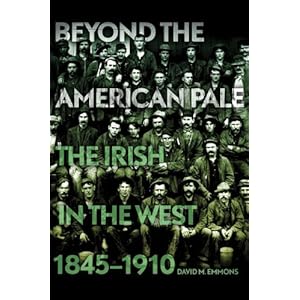
Professor David M. Emmons, Irish West expert and retired historian at the U. of Montana, guided our bus tour. We rode past the Clark Fork named after the explorer, and then the back way on Highway 1 to skirt more riparian valleys. The weather forecast was for rain, so I dressed the part, but I did not need to, as the climate was brisk but clear. Recent snowfalls speckled peaks. Far away from 90· L.A.
We stopped after an hour and a half in Anaconda, a copper mining town that stood out not only for its stack (my seatmate compared it to Sauron's tower) but its hardscrabble endurance as an Irish-managed production hub for that mineral much of the past century. It was a bustling region where the bosses were Catholic, as well as the workingmen and women. Little cabins attested to the life of the miners and their families, who walked out to the mines and back, by the railroad, self-contained.
The steadfast Corkonian, Dr.
Traolach Ó Riordáin, told me that the children of Seámus Moriarty only spoke Irish at home back then, but that such fidelity to Gaeilge was the exception. But I never heard such an amount of
an teanga beo in America before, for he and others chatted away in it, naturally. My two halting attempts failed to rouse responses. When I complimented his young son on his tweed hat, or when I warned him to be careful as he lugged a concrete block in the cemetery, both attempts at conversation were ignored by him. Will nobody ever understand my bleats, as exiled
Gaeilgeoir?
You can see me in this snapshot at the
AOH breakfast hosted for us at the Anaconda branch, one of the few west of the Mississippi, and one still, I am happy to report, thriving today after decades on. I never expected such a reception and it testified to unapologetic pride I felt during my too-brief visit. This
mortás cine is perpetuated by the
Friends of Irish Studies in the West, which I've happily joined.
Butte dramatically perches on the side of a massive pit. So much so that neighborhoods of Italians and Eastern Europeans were dug into, for the resources beneath outweighed the value of those on the top. The memorial to hundreds who died in one of many accidents is moving, with flags of many nations around to commemorate the losses of those from around the world driven to that far corner.
I heard the daughter of the famed poet Nuala Ní Dhomhnaill exclaim "there's Turkey!": land of her father, as we all entered the marker area. Sure enough, the lists of the dead were diverse, although mainly Irish. Back then, almost 100,000 lived there. Now as in Anaconda, far fewer: a third of that.
Montana boasts even today at 27% the highest percentage of Irish-identified U.S. residents. That cheered me. I knew historically there'd been many miners, but I did not realize how many stayed.
Vowing to return, to the Mining Museum, the town excited me. The downtown again struggles, but its buildings preserved from that boom era could entice the bold and brave today, to restore and care for them a mile high. Up by Walkerville, dwellings stretched out in precarious, attenuated, thinning lines, presumably to avoid the subsidence that would swallow them up from those voracious excavations.
The archives there attracted me. I wanted to scrabble in them, especially for Fr. Michael Hannan's diary where he lamented his stay among the squabbling clergy and all those non-recalcitrants from Hibernia not sharing his belief in a particular brand of Fenian payback. Professor Emmons showed me the scrawl of photocopies of the priest's diary: not easy to decipher. But he published his findings in
The American Journal of Irish Studies (2012 issue; abstract only, alas, online for we the curious).
The cemetery walk in Butte also alerted me to the many graves from the Spanish American War, next to a Mass Rock memorial. I wondered why the amount. The number seemed disproportionate for the city. I suppose to me, any death toll is more than it should be, going to fight in such dubious battles. A lesson for all who labor to resurrect the names and deeds of those rallied to a cause, and with arms.