Showing posts with label witchcraft. Show all posts

Sunday, December 4, 2016

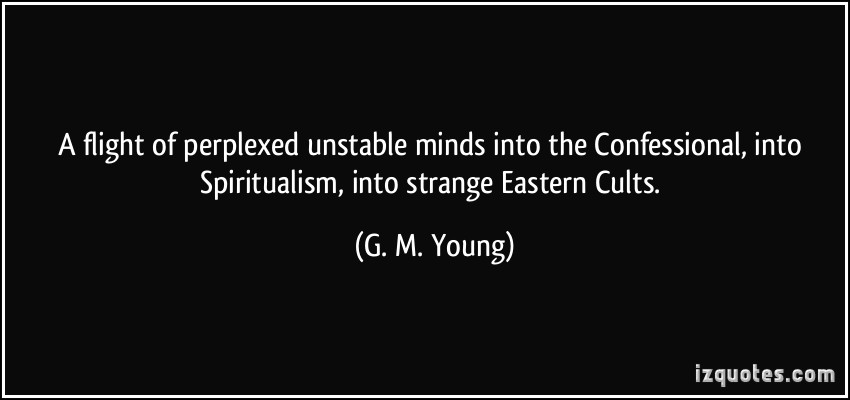
"A flight of perplexed unstable minds"

Perplexity Quotes
My wife and I watched a 20/20 show last night about a Christian couple in Tennessee. They had 18 children. They wanted more. The wife was 44 and had been pregnant for every one of the past 22 years. The husband ran a tree-trimming business and claimed he made ends barely meet. They insisted they did not get any government aid outside of the tax deductions. They shopped at Goodwill, got loans off their oldest son who had his own business, same as his father, and they welcomed the Lord's will if He deemed fit to give them more children. The interviewer asked why they judged birth control a sin, but not fertility treatments. I did not catch their rationale, however.

Not my normal fare, but it got us talking. I reasoned that while I was wired for religion, I understood its good and bad qualities much more as I aged. I figured some of us are predisposed by genetics as well as culture to seek out spiritual paths, even if they were by nature irrational or futile before facts.

As she got older, my wife's felt disenchanted with any organized religion. She's tired of the bickering, money grubbing and score-settling that makes groups deigning to seek the will of the Almighty look so petty as they divide over doctrinal minutiae and territorial land grabs and denominational dispute. I share her discontent, as a few years ago, I found I could no longer tolerate the services we attended. The God-fearing and God-submitting pleas, no matter how explained by ancient precedent, appeared to our mindset relics of an Iron Age sky-god's petulant demands upon beleaguered desert herdsmen.

Sure, none of this is new since if not Spinoza than Voltaire. But the Age of Reason takes a long time coming to many corners of the world and into many souls and/or brains inquiring. Only recently have we reached a third of the American population daring to admit that they are not religious, even if some among these "nones" might lean towards spiritual exploration personally. I wonder how our ancestors felt free to even entertain such thoughts freed from sin and guilt? My wife thinks that our own generation might be (at least in our family cases) the first, and I'd certainly concur as to my side.

It makes me notice, too, a detour that I sense a few around me taking. If the evolutionary process has driven many of us towards monotheism under political and social pressures the past few millennia, the lingering traces of magic, astrology, rune casting, divination, sorcery, witchcraft, and sortilege may appeal to some bewildered by the current rush to destruction. If we are passing now the tipping point of global warming, and if capitalism is hell bent on turning what remains of our planet into a wasteland, we lack political solutions; we face surveillance invading our minds as it has our actions.

Certainly, the rational scoff at this retreat to discredited traditions. If those teachings in scriptures are discarded as remnants of pre-modern superstition, all the more those whom the jealous God rejected before His reign appear suspect. Yet, there may be bits of common sense in how a rejection of the Lord may reveal a less assertive, more modest embrace of the scraps scrabbled from the flakes of ink, the dust from the palimpsest, the air infused with the enthusiasms of the older yearnings in our DNA.

My skeptical outlook dominates. The British Humanist Society's quiz tagged me at 93%. I've been academically trained to sift evidence, and to study the urges in literary culture of the seeker soberly. So, I am predisposed towards objectivity. But underneath, deeper maybe than that altar boy I once was, there's a sympathy for the home team, the old gang, those who looked to Ogham or rivers and trees for direction. I am very far from them, but the centuries intervening still sustain my own quest.

I reckon I will leave this life remembering a phrase from one with whom I have no other inkling in common. Where my consciousness will go I have no idea. I am no wiser than ten billion humans who have lived and then passed on before me. My ashes will or will not be scattered where I love, under redwoods. I will return as all does to dust. Aleister Crowley's last words were "I am perplexed." As one whose first "major band" was a teenage admiration for Led Zeppelin, I can relate to that reaction.

[P.S. Long ago I enjoyed G.M. Young's A Portrait of an Age (1936). Above I use a great quote from it. This historian of the era preceding him would have been about 25 when Queen Victoria died.]

Friday, December 18, 2015

Franco Mormando's "The Preacher's Demons": Book Review

The Preacher's Demons: Bernardino of Siena and the Social Underworld ...

Bernardino of Siena was an extraordinarily popular preacher during the first half of the thirteenth century. His fame exploded suddenly, and his sermons drew in many all over Italy. In spirited, earthy, conversational language, he urged his listeners to reform their lives in fidelity to the Catholic faith.

So far, nothing unsurprising. But Harvard historian Franco Mormando delves into the archives to go beyond hagiography. In this well-researched and accessibly narrated 1999 study, he presents a Franciscan friar who sought to suppress the freethinkers, whom he condemned as heretics and as witches--a latter category that his contemporaries in the crowds seemed less worried about than him.

Also, he combated the "sodomites," a blanket term that seems to call into scrutiny and damnation any who violated the strictly procreative and marital relations permitted the faithful. As with heretics, Mormando demonstrates how these relatively small elements threatened the social framework and religious power which orthodox teaching inculcated. He studies the sermons within their context and rather than selecting portions out of context, as many scholars do, he seeks a total understanding of the circumstances, despite a sketchy record of much of the saint's life and career, to relate this to us.

Finally, Mormando looks at the anti-semitic depictions Bernardino promoted. He finds a more varied picture. Some portions call on Catholics to love (in a general way) their Jewish neighbors and to help them; other sections castigate them in the all-too-familiar fashion. But the historical portrait is more nuanced here than Mormando's predecessors and indeed some of Bernardino's confreres in the mendicant orders have perpetrated. The saint wavered, thus. in how he advised regarding the Jews.

In closing, the historian finds the anxiety Bernardino conveyed emanated from his own heart. Left orphaned at a young age, raised among four domineering women, left to the care of the Franciscans, these factors may have marked him deeply. "Undisguised animal fear" drove the men and women of early Renaissance Italy, despite its many achievements, in ways that all of us also know all too well.
(Amazon US 12-9-15)

Saturday, October 10, 2015

Richard Kieckhefer's "Magic in the Middle Ages": Book Review

This book meets the needs of advanced students who need a introduction to this topic. Richard Kieckhefer specializes in medieval belief systems, so he is suited for this difficult subject to summarize in 200 pages. He examines magic as a "crossroads" where high and low, clerical and folk, popular and learned cultures intersect. He stresses a difference, however, between natural and demonic models.

He reminds us on pg. 16 that our data is tainted. Those attacking magic tended to record their critiques. Those practicing it tended to hide their lore from the persecutors and the client alike. And for the illiterate, their attitudes are difficult to recover, given the power of the elite over this knowledge, used both to suppress and to spread practices often outside the ambit of the Church. Yet here, too, overlap occurs, for clergy sought to learn secrets, and rituals involving magic took elements from the dominant as well as the indigenous suppositions still surviving from paganism and classics. Islam disseminated its own concepts, and so did alchemy, nascent science, and astrology. The author gives a cogent account of the last category; he captures the appeal of love charms well on pp. 81-3. (I cite the 1990 ed.)

"Historians can set up all the conceptual walls they want, but they should not be surprised when medieval people flit through them, like ghosts." (18) Magic was not the province of women, monks, or physicians. Kieckhefer follows distribution as a "common" type over much of medieval Europe.

Yet as he concludes, he turns to the witch hunts of late medieval and early modern times, and he notes how women were made vulnerable to attack. They lacked the power men had to resist, when the clerical and legal institutions were arrayed against them, and when suspicion by neighbors heightened the precarious condition of a local healer, a midwife, an herb-gatherer, or a quarrelsome village scold.

These everyday events were exaggerated into terrors perpetrated as a conspiracy of devil worshipers was imagined, and when those putting trust (and this itself is hard to measure) in spells or potions, charms or amulets, fearful of exposure, gave over the weaker among them to save their own skins. Reading Kieckhefer, as a counter to the more sensationalized depictions of this era, or the more romantic fictions, a balance for the reader will arrive, and one may want then to explore this deeper. (6-13-15 to Amazon US.)

Thursday, May 7, 2015

Stakeholders

How many were burned for witchcraft? Feminists in the 1970s asserted in "The Burning Times" that nine million women met this fate. Anne Barstow's Witchcraze estimated 100,000. However, recent historians lower this to 40,000-50,000. Also, about a fifth were men, further complicating figures on this controversy.

My FB feed today generated a Halloween 2013 essay  "What Witches Have to Do With Women's Health." In Salon, Soraya Chemaly links to Barstow as "the latest scholarship."
As Barbara Ehrenreich and Deirdre English explain in the 2010 revision to their classic book “Witches, Midwives & Nurses,” between the 14th and the 17th centuries, tens of thousands of people were killed as witches. Estimates range, but the latest scholarship puts the number at roughly 100,000 people, 80-85 percent of them women. By the mid-16th century there were villages where all but one woman had been killed for practicing witchcraft.
Looking this up, I figured nearly twenty years ago may not be the most recent research. In the preview of the Ehrenreich-English book online, on pg, 14, they explain in the 1973 original (only the introduction is updated) that they relied on figures of between 50,000-100,000, and that others have claimed as many as a million murdered. They cite the leading American historian of the witch hunts, John Demos, in a necessary aside, that those killed were but a fraction of those accused or suspected.

I did find in my reviews medievalist Jeffrey Burton Russell's 2007 revision of Brook Alexander's A History of Witchcraft. This expert on witchcraft reckons 60,000 victims hanged or burned for heresy. Russell and Alexander remind us of the difficulty of defining victims. "Sorcerers, heretics, and pagans" comprise a triple definition of a "witch". If 4:5 are women, this may align with the estimate  accepted by reputable scholars today. Relying on accusers, as on hearsay, may lead to devilish errors.

Saturday, August 30, 2014

William T. Vollmann's "Last Stories and Other Stories": Book Review

The title may mislead. In his mid-fifties, after a five-year grant which afforded him a break from frenetic typing and prolific publishing, William T. Vollmann given his work ethic presumably intends to tell more tales. His books blur globetrotting journalism, ethics, violence, sex, travels among the down-and-out, history, cultural critique, and speculative fiction. Michael Hemmingson's 2009 monograph explains: "Vollmann's collections are not compilations of random short stories written over a certain period of time, as many collections seem to be. Each is compounded on a high concept, a grand metaphor; the volumes are cycles of related texts with recurring topics and motifs." (22) In these thirty-two sprawling stories, composed apparently during the past decade, ghosts hover, spirits tell tales, and memories linger, to settle down.

A journalist now "fat and old" returns to Sarajevo two decades after the war. His story, told obliquely, labels him only by his nationality, bound by the dictates of an internecine conflict which reduced neighbors to their territory or tribe. That war shot down any Romeos and Juliets who tried to escape the snipers, as the opening vignette dramatizes. Attracted to the crossfire the natives try to flee, the protagonist echoes Vollmann's experience as it opened his critique of justifications for violence, Rising Up and Rising Down (2003), as one of "Three Meditations on Death". This event led to his serious wounding and the death of two of his companions when their jeep was ambushed on the way to Sarajevo. Driven to investigate this, and to make a living off of documenting pain, Vollmann reflects on such collusion by a curious, compliant war correspondent: "The American felt that slight sickness which always visited him on such occasions; in part mere adrenaline, which was intrinsically nauseating, that higher form of fear in which his mind floated ice cold, and a measure of disgust at himself for having voluntarily increased his danger of death. Over the years, the incomprehensible estrangement between his destiny as a risk-taking free agent and the destinies of the people whose stories he sometimes lived on, which is simply to say the people who were unfree, and accordingly had terrible things done to them, would damage him. Being free, however, he would never become as damaged as many of them."

Some of Vollmann's characteristic tics emerge in this representative passage. As his critics contend, it might benefit from editing. Vollmann to past criticism has responded that he submits exactly what he needs to, and he refuses many excisions requested by editors or publishers. Therefore, his books tend towards heft. (See my reflections 25 November 2013 on Imperial.) Does this latest volume need it?

Six-hundred-and-fifty pages of themed stories shift from Sarajevo to Trieste for part two, and then part three in Bohemia. The fourth section leaves Trieste for 1860s Mexico. Fifth, Norway, and sixth, Tokyo follow. The seventh setting is unspecified while the eighth roams further, into Kauai, Paris, Buenos Aires, and the unknown. Here, the ninth portion concludes, as spirits intervene. The success of these restless, spectral stories depends on whether Vollmann can sustain in-depth soul-searching.

Part one explores Sarajevo of two doomed lovers, then that city as revisited earlier this current decade by the "American". The relatives of one of those killed in the jeep distrust the reporter, as if he was a "leader." They resent that he survived and not his Croatian-American friend, although the "patient fatalism" of the journalist proved not a shortcoming but a survival technique for one long bullied.

Three twined tales, for those familiar with Vollmann's themes, fictionalize his reflections on the 1994 death near Sarajevo of his classmate and later interpreter, Francis William Tomasic. What's added for this anthology is the discomfort of a boy once bullied turned middle-aged teller, who with his weary wife revisits, with mixed results for friendship or fondness, his former hosts. One story ends as these two Americans rest by the "Yellow Bastion, with heavy, fragrant clusters of white elderflowers bowing the branches down before them, and then, far down through the greenness, a hoard of those other white flowers called tombstones, rising delicately and distinctly from the grass". Vollmann prefers to underplay such prosier sections, so when these appear, they deepen their emotional impact.

The next story reaches novella length, with purpled, prosy passages filtered through a storyteller from an vague time perhaps two hundred years ago, about Jovo Cirtovich. This Sarajevan wine trader in Trieste seeks arcana of how the spheres move and the earth turns. It deepens Vollmann's immersion into this region's lore and landscape. But its meandering pace recalls digressions within Don Quixote, or or a heady, epic recital, its ending postponed for what feels a thousand nights, from Scheherazade.

This wandering attention persists over part two, with a few stories set around the Balkans. First, a boy who desecrates a statue of Our Lady of Flowers. Second, a shaggy-dog saga dramatizes a plinth of bronze statues which come to life, and then fictionalizes a surrealist painter, doubling as a slinky cat goddess. Then, a haunting episode introduces a trench ghost. Golem-like, this eerie figure animates post-WWI figurines to fight at grave sites, recalling tales of corpses restored and spirits unable to leave their places of death. Vollmann's invention strengthens over these loosely linked Trieste tales.

Back to Bohemia, part three connects stories about a vampire husband and wife, a widow, and a witch-finder. These take place in the 1630s, but retain as many tales in the first sections do a timeless sense. The folk nature of their narratives suspends them, however. A resigned tread dampens them, and they smell musty. As the Trench-Ghost tale's teller averred, "eternal stories do have a way of becoming tedious". But the last, with its showdown "come the dark of the moon" as "a squad of Holy Bohemian Dragons stood ready with garlicshooters, buckets of holy water and arquebuses loaded with silver bullets every third one of which had been blessed by the Pope", enlivens this morbidity.

From Trieste, part four opens with the Emperor Maximilian and his soon-maddened wife Carlota embarking for Mexico. Soon defeated, the Hapsburg claimant to the Second Mexican Empire spends his last night in prison imagining, in a set-piece displaying Vollmann's skill, an eerie Aztec sacrificial ritual anticipating the pretender's humbler demise before a firing squad in 1867 Querétaro. Later, a folklore student in today's Mexico falls in love with the incarnation, or deterioration, of his subject La Llorona, once La Malinche the mistress of Cortes: her lips "were cochineal-red, like the teeth of an Aztec prostitute". Finally, a diabolical fable, in the style of a notary from the Inquisition and the length of a garrulous episode from Cervantes, accounts for Veracruz's reputation for the plague. This moralizes on the fate of the Amazons, producing an allegory for colonialism's deadly sins. While scenes, set in grim prison and then in grim fantasy, benefit from detail, it seems a never-ending story.

Norwegian tales, of a spider-love, a graveyard, and a churchyard, mire themselves in the icy macabre. Perhaps the climate can be blamed. Set on an emigrant ship to Québec, part five's longer story fuels a hellish excursion, concluding in a gruesome, if at least warmer, cannery run by trolls. Two more stories, one in the first person, also end abruptly, although this leaves them lasting longer in memory.

For Vollmann's meandering prose, followed for long stretches, blurs these ghosts with doom-laden narratives. Committed to these, the dogged reader must capitulate, following the protagonists on their decaying pursuits. "The reason I had first approached her," one man who longs to turn a ghost rationalizes, "was to overcome the defining human error of despising death's carnality". This articulates Vollmann's motive, and reveals his determination to pursue hermetic themes. Embracing what repels most of us, part six's shift to Japan reaches its peak in loosely paired stories: the lover of the ghost of Rainy Mountain haunts the slopes in the feudal era; in modern times, a "camera-ghost" sucks its title character into its inner mechanisms, perhaps a setting no previous epic of ectoplasm has explored. More tales waft about the floating world of geishas, and over all them there rises a miasma.

"Defiance Too Late" comprises the total of part seven. This dour story, about Abraham's connivance and capitulation to God's command, cannot free itself from too-dutiful a recital of biblical cadences.


Part eight saunters first to Kauai for an love affair between another mortal man and an increasingly formless presence. The narrator confides for her his "capacity for affection--I nearly wrote infection"; this proves too true. At first, courtship appeals. "Swimming in her foamy white petticoats and her long green seaweed hair, she sang me the same melody she'd sung Ulysses", but the fun fades. That siren song "made little impression on me; I'd heard it all before." Vollmann lets the bracing impact of her humid, tropical, and watery allure or disgust dissipate. "Wringing out her sea-black skirt afterward, on her tiny lava-islet decorated with skulls, she offered me eternal life beneath the water; unfortunately, I was already diseased by that curse." This jaded attitude does not keep pages turning as fast as most authors may desire. As this narrator saunters off mid-tale to pursue a Greek corpse in Paris, before his return to Hawai'i, the novelty of an extended pursuit of a siren fades into narrative lassitude. A gruesome Poe-type tale of corpse robbers and flesh-eaters turns humdrum.  A fable emanating from Toronto incorporates a time-altering view from a telescope perched high on its immense sky tower promisingly, as it allows the narrator to see past and present, but it peters out. 

"The Grave House"  refreshingly, conveys spiritedly not a haunted but a haunting house. Very brief and witty, it evokes by its inversions a spooky series such as Night Gallery or The Twilight Zone.

This section concludes with "When We Were Seventeen" which at over fifty sections nears another novella. Dying of cancer, a middle-aged man rummages through his desk to conjure up, through a witch's magic potion, not only the letters from a long-ago failed romance in his teens, but the woman herself, after she has died, also from cancer. This uneasy affair between a revenant and his past object of affection, who keeps humiliating the clumsy swain who in middle age repeats the failures of his teenaged dating gaffes, enlivens this epistolary encounter. But again, energy fades, over such length. 

Part nine by comparison moves this creaky compendium briskly towards a conclusion. In its entirety, here is the first entry, "The Answer": "I asked the grave why I must die, and it did not answer. I asked who or what death was, and it kept silent. I asked where the dead I loved had gone, and its earthen lips did not open. I begged for just one reply, to anything, and then its grassy lips began to smile. Moistening itself with its many-wormed tongue, it opened. Too late I realized the answer."

Returning to the site of one of the tales in part six, Kamakura, "Goodbye" recalls earlier entries of watery seduction, subterranean skeleton-lovers, and ghoulish embraces. Then, these stories fade away, with their protagonists. They recall H.P. Lovecraft, by conjuring sinister, sinuous elongations.

In the typically diligent endnotes explaining where fact (such as Jovo or Maximiliano, or feline-obsessed one-time Trieste resident, surrealist painter Leonor Fini, whose works decorate the dust jacket) departs from fiction, Vollmann lets his sly hand show. He claims that he "cut a few pages, out of compassion" for his agent and editor. "No doubt Last Stories will make us all rich, at least in those 'hell banknotes' at certain ethnic Chinese funerals in Southeast Asia." Out of paper, Vollmann constructs his own tiger, words to howl at death. (PopMatters 7/3/14; to Amazon US 7-18-14)

Friday, May 9, 2014

Alan Moore's "Voice of the Fire": Book Review

Shamans, heads, magic, a bridge, crossroads, dogs, pigs, flame: elemental and elusive, this powerful novel recapitulates the evolution of English and the growth of Northampton, Alan Moore's home city. Don't let the first chapter dissuade you. "Hob's Hog" may best Riddley Walker or the "Sloosha" chapter of Cloud Atlas, for Moore limits an adolescent boy's expression of a bewildering encounter with a "cunning-man" and his companion to four hundred words, these shattered and fragmented into Neolithic limitations, personal or linguistic+++. A wizard himself, Moore forces us into an altered state.

The narrator's mother dies. "Theys bits of bright is move out from she eyes and hang on trees." (17) The sun, hitting her eyes, fails to rouse her, and the boy realizes she is no more. More than once, we will follow a corpse pushed down into a grave, a body's bits looking back at us before they are tramped down and the dirt conquers the flesh. Yet, very late, Moore nods to and alters a notion of the Kabbalah, whereas we are God dispersed from the Big Bang into fragments, yearning for universal end to be reunited.

Twelve chapters recapitulate the progress supposed as paths turn into roads and roads into highways. A shifty young hustler in "The Cremation Fields" laments the new sky-gods who displace the earth-mother's worship. Yet, neither faith appears to ease the existential condition. As she justifies her own machinations: "If we in this world are cruel by harsh necessity, how much more wicked are the gods who want for nothing but torment us to the death?" (94) Exiled already ca. 2500 BCE, they "cook the blood from the earth and let it scab to crowns and daggers," as the world's energy already exhausts.

After "In the Drownings" post-AD 43 dramatizes the coming of the Romans from a fisherman's odd perspective, "The Head of Diocletian" post-290 introduces a foreigner's reaction. Sent by Rome to apprehend forgers of imperial coins, he sums up the culture clash and another decline: "There's few signs of the Empire to be seen out here, a scattering of villas where retired generals struggle to afford their mistresses." (140) Moore does not falter in creating recognizable characters for each of his dozen narrators. He stays poised, adjusting the tone to the manners and mentalities of the era.

By 1064, it's a jumble. Alfgiva, crippled beggar turned nun, morphs into martyred St. Ragener from 870 and then into a witness to a terrible emanation from the crypt of local St. Peter's in 1050. Jump to after the Conquest, where after 1100 the Church of the Holy Sepulchre rises roundly with emanations of the Templars and their fearsome rite once removed to a very different setting than the Crusades where Simon of Senlis encountered his own astonishing and similarly unnerving revelation.

Religion dominates the second millennium. The executions of Guy Fawkes and his Catholic conspirators in 1607 leaves one of the less fervent victims unconvinced of sectarian verities. He theorizes "that life is ordered by the principles of some religion so peculiar and obscure that it has no followers, and none may fathom it, nor know the rituals by which to court its favour." (197-8)

"Angel Language," its title a theme via magician John Dee filtered increasingly into the last third of Voice of the Fire, opens with six paragraphs from a judge in 1618 that rival Joyce's abilities. After crafting graphic fiction with its own restrictions placed on what an author may explore within its boundaries, this first novel enables Moore to stretch out. It may not please all, but it merits patience. It moves forward as our language does, into passages of beauty and terror. While this section for its neater patterning felt slightly schematic in its chiasmus, the echoes express confusion appropriately.

In 1705, one of the last two women. lovers and partners, sentenced to be burned as witches in the kingdom has her say. "We had our fun, and at the end of it they fetched us out and burned us both to dust. They had a stronger Magic. Though their books and words were lifeless, drear and not as pretty as our own, they had a greater heaviness, and so at last dragged us down. Our Art concerns all that may change or move in life, but with their endless writ they seek to make life still, that soon it shall be suffocated, crushed beneath their manuscripts. For my part, I would sooner have the Fire. At least it dances. Passion is not strange to it."*** (248)  Consider how this passage resounds with conviction, and clarity. Moore channels his intelligence into men and women we can understand, no matter their century, and he provides much to reflect upon about the clashes between nature, energy, and order.

As the voices overlap, and images such as blue beads, an odd beast, or the name of Eleanor repeat, the reader faces a commitment. Five years in the making, its detail convinces me. No chapter felt false. For those with less stamina for British minutiae via arcane lore, the concentration demanded by Moore to match his own scrutiny may weary. However, if you wish a bracing, and sometimes bewildering series of unreliable narrators beckoning you into the impossible conundrum of any author: how to escape the subjective when describing one's own reality--note an aside to Niels Bohr.

After a chapter on John Clare, the nature poet gone mad, recounted in suitably dispersed and chronologically scattered fashion, we move into the last century. Alfie Rouse's roguish testimony of his own manipulations updates that of the second chapter's scoundrel: how relationships--intimate or casual-- fall prey to greed and weakness exerted by the more scheming among us. But no teller escapes some sympathy. We learn of him in the Great War, and such an observation for its familiarity does not ring less true if from a returned veteran with a head wound, an calculating salesman and with an eye for the ladies: "Half those fellows in those trenches wouldn't be there if not for the way their girlfriends look at them when they're dressed up for war. Deny it if you can." (271)

Finally, it's Alan Moore, although he does not use the singular first person, but only appears as the author, in "Phipps' Fire Escape." He takes us around Northampton in 1995, a town with its mind "encased in concrete." Moore tries to align us with its hidden pulse. "The only constant factor in the local-interest photograph collections are the mounds of bricks, the cranes against the sky." (296) Barclayscard and Carlsberg loom as the present-day replacements for button factories, or those for shoes and boots. Debt and drink: the creations of his neighbors, as he witnesses municipal decay.

After so long with this novel, Moore's reluctance to let it go attenuates its last few pages. He reasons that "raising the dead to tell us what they know" (302) explains his endeavor. If you look at pp. 306-13 in passing they point you back to certain ideas, and Moore's mission: "Make the real a story and the story real, the portrait struggling to devour its sitter." (306) We all, he concludes, are caught in fiction. So, to me resurrecting the voice of Nelly Shaw the condemned witch, if not in magical or weighty analogies but cartographic terms: "Lacking any territory that is not subjective, we can only live upon the map. All that remains in question is which map we choose, whether we live in the world's insistent texts or else replace them with a stronger language of our own." {interview here}

One wishes every talented artist or writer had five years per project. Enhanced by Jose Villarubia's illustrations, appended so as to not distract but enrich the reading, the focus of this, so intense, may scare off the pale, but those tough-skinned enough to endure the plunge into fire and alphabets will find the brilliance of this memorable novel akin to heat itself, to comfort and to warn those who seek to come close to its flickers and smoke. Mirrors held by twelve men and women, we peer in. (Amazon US 8-10-13)+++Overwhelmed? Deciphering Hob's Hog Enticed?*** Moore's "Bog Venus"

Tuesday, January 3, 2012

Eric Weiner's "Man Seeks God": Book Review

"Confusionist,” reasons agnostic fellow traveler Eric Weiner, defines his "spiritual-but-not-religious" outlook. As a "gastronomical Jew" but not raised with any belief, this skeptical, neurotic journalist begins his global exploration by recounting a nurse's whisper to him as he lay on an operating table: "Have you found your God yet?" This inspires his search among eight "varieties of religious experience," as he credits William James’s pioneering study. He starts, as do many seekers, by going to California.

However, Mr. Weiner does not last long on the Mendocino coast at a Sufi camp. Falling down a "New Age rabbit hole," he laments that the establishment's more "camp than Sufi." As a National Public Radio correspondent, he had witnessed the darker side of Islam, and he wishes now to find the meaning of that word's core, "submission," in its more mystical manifestation. He departs for Istanbul, visits sites connected with the medieval visionary poet Rumi, and finds that surrender to Sufi's spell, as shown in the famous whirling dervishes, comes closer to the power of love than of capitulation to a cold creed.

His trek into Buddhist wisdom leads along a well-worn path, to Kathmandu. His guide, a Virginia-born investment banker who left Malibu to model in Asia before finding his fulfillment as a student of Buddhism, leads him first to ponytailed ex-pat Wayne from Staten Island, a fellow "middle-aged Jewish guy" in a baseball cap. From Wayne, Mr. Weiner learns to meditate, and not to do it as he does it. The process of self-examination as the way to liberation feels as if biting his own teeth, endlessly self-referential, but he perseveres a bit. He finally has a brief audience with a Tibetan guru. "Meeting a revered lama is like having sex with a woman you've fantasized about for a long time." That is, anticipation leads to anxiety, bewilderment and disappointment.

His breakthrough comes not with the guru, nor with an attempt to learn about the often-sensationalized Tantric approach. (That works less effectively for him than a visit to a massage parlor.) Wayne goads Mr. Wiener towards what gives him "pause." Between the moments, choices are made to attach or let go, and effects happen for better or worse. Buddhism elongates awareness of these moments, and allows practitioners to choose how to act and react to such endless situations daily.

Many Buddhists and a few Catholics praise fewer possessions as a way to increase spiritual maturity. With the grey-clad Franciscan Friars of the Renewal in the South Bronx, Mr. Weiner learns of their "radical dependency" on a life committed to poverty. Unlike most Franciscans today, these friars have returned to a rejection of most possessions, truer to the intent of their founding saint. They manage in their gang-plagued neighborhood to act as both "savvy and naive".  Accompanying Father Louis, who gave up a successful career in Manhattan, and Brother Crispin, Mr. Weiner witnesses their challenges, as they strive to detach themselves from their duty towards good works, doing tedious tasks to serve the poor, without congratulating themselves for doing so. 

As one friar confides: "You find yourself trying to love somebody who doesn't want to be loved." Mr. Weiner receives advice for his own skittish need to underline books, to analyze what he finds: "When in doubt, give thanks." Rarely thanked, these diligent if weary friars persevere.

Indulgences are discouraged for Franciscans, but encouraged by Raëlians. This, "the largest UFO-based" and IRS-registered as tax-exempt religion, glories in bonding, and hands out condoms. Founded by "a second-rate French journalist” who, for Mr. Weiner, espouses motivational-seminar speak as if "Tony Robbins in a space suit", Raëlism invites or expects less respect than the previous religions. One chant surrounds him at an enthusiastic meeting: "free your breasts free your mind."

To his credit, Mr. Weiner lets his prejudices ebb even as he keeps his critical acumen flowing. Talking to a convert, John, in a "gender-switching workshop," Mr. Weiner shares the appeal for many educated and scientific types of a religion based on a modern myth. He deftly connects strands of Raëlism with Jewish, Christian, Buddhist, and Muslim predecessors, even if he cannot commend, finally, its lack of rigor or lowered expectations, where easy pleasure dominates as its "theme-park" message.

Next, the search brings him towards not a myth but the ancient homeland of a five-thousand word "short ode to conciseness," the Tao te Ching. Traveling to China's Wudang Mountain (gifted with an mist generator after "The Karate Kid" was filmed there), Mr. Wiener learns from a fellow American on tour, Sandie, how smoking and drinking are fine as pleasures as long as one is "in the moment." Taoism may share something of offbeat Raëlism as well as affinities with Buddhism, and Taoism looks to this world and this body as the gateways to truth. They "shape their God-shaped hole with a hole-shaped God." Their elusiveness--that which can be defined as the Way, the Tao, is not the Way," as the Tao te Ching opens--intrigues him. Sandie goes with the flow, literally, at the heart of the Tao. Whereas most religious folks, Mr. Weiner supposed, care more, Sandie as a Taoist tells him she grows to care less.

Taoism lacks a center, however. What if a religion had not one doctrinal approach, one god, but hundreds? What if it allowed choice, and inspired invention of new gods and goddesses? Wicca, as Mr. Weiner finds in Index, Washington, offers Jamie the witch this chance to guide herself by an ethical system open to possibility. Magic can be channeled for good, and what is conjured up as if invented then takes on a real power for those willing to guide its forces towards healing and renewal.

Mr. Weiner imagines the passion and intensity of Wiccan ritual to echo that of the now-faded ceremonies at the start of Islam, Judaism, and Christianity. Freed of sin, compelling its makers to use the forces for goodness and not harm, Wicca's ethical component resonates with Mr. Weiner. 

Its demands for moral accountability gain careful explanation. He tells of this often caricatured religion's attempts to direct natural forces to generate righteous behavior and careful choices. Yet, as with other religions he has encountered, it fails to appease his own darker side, his melancholy. Figuring that paganism's "lowercase gods" would have little time for him, he turns towards perhaps the ancient ancestor of witchcraft, and religions that have evolved slowly since, that of shamanism.

Shamans, after all, were primitive psychiatrists. Today, Dana, a former executive in Beltsville, Maryland, hosts a drum-led circle: "now materialize your power animal." Participants fantasize and let go of their worries. guided into realms of the spirits. While all this pleases the "smart-ass" Mr. Weiner more than he may have expected, he cannot shake the mental image of one dream weaver's companion, Sasha the Poodle, whose eyes lock into his as they both wonder what those humans are up to.

Finally, he faces his ancestral Judaism. Dreading the meeting, he goes off to Tzfat (Safed) on the Sea of Galilee, settled by Kabbalists expelled by the Spanish Inquisition. This settlement, orthodox yet open to Jewish misfits, endures as a spiritual center. What makes a place such, Mr. Weiner wonders, may elude explanation: is it the place that imbues its residents with an aura, or do holy people wind up in such a hallowed place? 

This thoughtful section of his tale takes him deep into difficulty. His psychological unease grows. He finds that one can convert to one's "own" faith, but the memory of his brother who embraced Orthodoxy creates more rather than less tension. 

In Israel, Mr. Weiner faces the Jewish reverberations of a faith dimly known but evaded and avoided for a lifetime. His Jewish soul, his "nefesh," a variety of patient teachers show him, reveals itself by patience, and by "kavanah," intention, within such a soul. Shabbat in Tzfat, when time appears to halt, opens up the promise of living within space devoted to peace, worship, and community. Here, he glimpses the potential of the oldest of all the organized religions which he has participated in during his quest.

The wise observer of the hopes for religious harmony in Israel, writer Yossi Klein Halevi, tells Mr. Weiner that the Jews need him. Those who turn him off, by rules and rituals, will choke the life out unless Mr. Weiner brings what he has learned from Kabbalah--that such teachings open up life by its eternal forces. Mr. Weiner cannot agree with Yossi; he insists that he remains temperamentally a seeker who must wander. He convinces himself as he leaves Israel that he is not a dilettante, but a universalist. He argues with himself, and sometimes others, how his orientation transcends any denomination or affiliation. 

In conclusion, Mr. Weiner remains faithful to his convictions. This narrative moves smoothly between erudite quotes from James, Jung, Heschel, Chesterton, and Durkheim. (It also recalls strongly here and there a recent work, J.C. Hallman's The Devil is a Gentleman, that had its author travelling to sites founded by America's new religions over the past century. It mixed personal interviews with Hallman's own story, through an application of William James's sociological research from a hundred years ago.) 

God Meets Man: My Flirtations with the Divine scans rituals so venerable they lack inventors and doctrines so fresh he watches them evolve in Washington State and Las Vegas. True to Mr. Weiner's nature, he constructs a composite God. One that cobbles from all the faiths he's studied, and more, yet has an identifiably Jewish angle that he finds he can admire. Mr. Weiner confesses that out of small steps, progress towards understanding emerges. He no longer flinches from observing the Jewish holidays with his little girl. (Featured at New York Journal of Books 12-5-11 in condensed fashion--about half the length of above!)

Saturday, October 30, 2010

Philip Carr-Gomm & Richard Heygate's "The Book of English Magic": Review


Magician means “wise man.” The search for knowledge by which we can control the natural realm and learn scientific mysteries has lured people over millennia. All this time, England stirs such pursuits.  Philip Carr-Gomm, a leader in The Order of Bards, Ovates, and Druids, joins Sir Richard Heygate, a documentarian and author who studies “alternative worlds,” to offer this accessible history, guidebook, and how-to compendium. In a friendly, yet cautious, manner, the writers encourage readers to learn more about the traditions of England, as well as forms invented and revamped by hundreds of thousands of pagans, believers, and “Armchair Magicians” today.

(N.B. I am not a magician, but a medievalist, so my interest in this was more scholarly than as a grimoire. I am aware of the infighting that may rage here as among pagans about nomenclature, inclusion, and exclusion. But my review is for a general reader looking inside a realm that most of us on the outside know little about...)

Twelve fast-paced, illustrated and annotated chapters reveal this vast, handsomely produced, storehouse of lore. Ancient roots, starting with prehistoric cave-dwellers, dig down into pre-Celtic and Celtic foundations.  Saxon sorcerers displace and follow Druids. Their descendants become medieval Catholics with their own complicated relationship to their magical peers. The search for the Grail which they inspired may remind audiences of Indiana Jones, but John Matthews’ enthusiasm for what the Nazis might have handed over to their American interrogators does remind us of how much remains unknown to the average citizen about what a few adventurers report back from the borders.

Banished to the fringes as Protestants extirpated any trace of superstition,  witches were persecuted, but far fewer were condemned than some contemporary feminists have claimed. Between 800-2,500 in Scotland were burnt at the stake; 400-500 in England were hanged. Half of the latter death toll can be blamed on Matthew Hopkins, the Witchfinder General, a “Puritan fanatic” who held trials in Essex.

Two generations earlier, alchemy intrigued John Dee, Mary Sidney, Robert Fludd and “puffers” close to Elizabethan courtiers. Astrologers, cunning-men (akin to fortune-tellers or psychics today), wizards, Rosicrucians, scryers, Freemasons, Theosophists, Spiritualists, and mediums populate the chronicles of the past five hundred years. Emma Wilby elucidates why our ancestors might have been far more susceptible to charms, spells, potions, and rituals. Undernourishment due to famine, overwork, and fasting weakened the will. Suffering proved the norm when half of children died in infancy. Grief and bereavement altered the consciousness by their intensity. Darkness ruled outdoors and inside people dwelled within timid imaginations. Strong beer instead of tainted water shifted the body into a state where visions, trances, and stupors might haunt the desperate patient or maddened petitioner.

Even if most who feared or welcomed magic lived in isolation, one city grew in its allure. Enduring in its attraction for England’s spiritual and scientific explorers, London, the authors remind us, is better than Cairo or Calcutta, Paris or Prague, for anybody curious about the Craft. Treadwell’s, Atlantis, and Watkins booksellers have long enticed students and practitioners. Occult sites, mapped here in the City and throughout the kingdom, demonstrate how compelling the evidence can be for those who possess the skills and secrets that alert what historian Ronald Hutton estimates may be the one out of every four or five of us who may possess a readiness for magical powers. 

Essays by adepts enrich this volume. Adrian, a modern Druid in the Order Carr-Gomm helps to lead, admits how he sometimes asks himself “why I am standing in a field in the middle of the night, covered in sheep shit, but, for me, the spiritual experience of connecting to a sacred place is truly extraordinary.” Contributors often confess their early yearning for more meaning than organized religion or psychotherapies could provide; throughout this book, a calm sense of being at home within this realm pervades their testimonies. Far from the sensationalism of such as Aleister Crowley (who garners half of a chapter), those sharing their motives in these chapters profess an ethical rather than exploitative motive for their alliances with occult, hidden energies.

Brian Bates, a psychologist and shamanistic researcher, laments the superficiality of how magic is treated. “People nowadays will happily read Harry Potter, but are wary of the real stuff.” Vivianne Crowley (“no relation to the infamous Aleister”) tells how the modern pagan religion was invented by Gerald Gardner in the middle of the last century as Wicca. As with Professor Bates, she has a doctorate in psychology. A priestess, she reminds readers how as children, an openness to magic is often shut off when they enter school. Wiccans try to retrieve an innate connection with the spiritual plane where change can be enacted. She conveys the pleasures of Wicca, but not those that media misunderstand. “Nakedness, which is often dismissed as a license for sexual abandon, is in fact nothing of the kind. Instead it is a symbolic removal of barriers to friendship and intimacy.” The reclamation of what popular culture distorts, while protecting the secrecy of lore and rituals entrusted to true initiates, characterizes many who guard their mystery traditions.

Some still remain anonymous here. One, a member of the Order of the Golden Dawn that once attracted W.B. Yeats as well as a man whom he detested, Aleister Crowley, explains his search “for the mystery of being.” He reasons that magic is both objective and subjective. It is created by the imagination and then takes on its own life; it is real and separate from human beings at the same time. 

Few contributors claim, as earlier witches did a few decades ago, to inherit magical skills. Instead, they seek out the few who control them, who create them, and who teach them. One alchemist in Wales tells what he knows, but he remains nameless. Most identify themselves, but caution remains. Carr-Gomm and Heygate warn of the easy lure of spell-casting; the love charm they include should be used to bring love into one’s life, but not a particular lover. For, he or she once enticed may turn out to be the bane of one’s existence. Charlatans from Chaucer to now delude unwary newcomers. Plenty of others delude themselves, and certain practices, as the authors explain, are not to be taken up by the perfectionist, the obsessive, or those unable to take on the responsibilities that accompany entry into the other side.

Websites, reading lists of novels and manuals, experts, locations, and schools append each chapter. While some oversight may be inevitable (I missed James Blish’s erudite novel on medieval alchemist Roger Bacon, Doctor Mirabilis, and the fiction of J.C. Powys and Iain Sinclair), the authors succeed in navigating between the skeptical and the credulous among those whom they address and whom they include. For those wishing to find out about such lore, such guidance remains necessary. Nigel Pennick, a prolific scholar-practitioner, laments how people “no longer do things because their ancestors did them; it is no longer part of our culture to pass things on to the next generation.”

New generations concoct new practices. Gerald Gardner’s Wicca, Crowley’s “left-handed” manipulations of black magical powers and Dion Fortune’s “right-handed” control of white magic mingle in Tantric traditions. These twentieth-century characters, even if what some of what they claimed to know may have been invented rather than discovered, helped quicken the contemporary revival of paganism. The repeal of the Witchcraft Act in 1951, Swinging Sixties appeal, and the ecological threats that increased awareness of earth-based religious practices in the 1980s contribute to the shift in perception among many English people that welcomed pagan or alternative forms of ritual and belief. 

Music, touched briefly upon by Carr-Gomm and Heygate, plays a role. “Freemasons prefer classical music and opera, pagans folk rock, Wiccans Gothic music, with Chaos magicians and Thelemites preferring heavy metal and Punk.” Genesis P. Orridge (Throbbing Gristle, Psychic TV) with his own movement The Temple ov Psychic Youth and his involvement in Chaos Magic, epitomizes the gender-bending, utterly non-conformist models that confound even fellow magicians. Chaos combines Sufi, Buddhist, medieval, or scientific influences and then discards them, transcending any one belief system’s limits. It regards demons as mental projections, even as it may spark a raw force that may zap those not able to resist such a current. As with other challenging styles addressed in this book, all the same, Carr-Gomm and Heygate offer the neophyte gently phrased words to progress with care, patience, and commonsense into realms where the unwary may be at deep risk. 

This sense of adventure, for perhaps more wary seekers, accounts for the rise in public perceptions of esoteric, and formerly shunned or banned, practices. The impact of film and television portrayals of magic, oddly, is absent from this survey. Compared to Margot Adler’s magisterial account of American New Age and neo-pagan movements, Drawing Down the Moon, this English counterpart appears more grounded in the living history which connects the English varieties directly to their dolmens and fields, their hideaways and chambers. This, after all, is the strength inherent in the English magical legacy. 

The festivals that fill the English calendar of the ritual year--its two equinoxes, its two solstices, and the four quarter-days adopted from the Celtic reckoning--testify to the enduring power of revived respect for chronological commemorations. While most of the Western world clutches only at Halloween in a degraded form, every six weeks or so, English inheritors of charms and covens look locally for the world that they may not, after all, have lost. If long burned up or buried, it is revived, renewed, and reborn. 

This book closes movingly, acknowledging the eclectic, syncretic nature of the corpus of a resuscitated English magical tradition. Deep down, the authors advise, one knows if one or more of the paths sketched in this book may direct one to fulfillment. This magical quest draws on a depth of awareness that contemplation and study may reveal.

(P.S. Edited and reduced on Amazon US 10-30-10 & Lunch.com. Submitted at PopMatters 11-5-10 as above with the exclusion of the parenthetical second paragraph. Book website

P.P.S. Oíche shona Shamhna agaibhsa/Happy All Hallow's Eve's (eve) to you all, depending on your time zone when you read this. Cleas nó cóir/Trick or Treat.)

Sunday, June 13, 2010

Tobsha Learner's "The Witch of Cologne": Book Review

A mass-market epic romance combines philosophical radicalism (Spinoza's secularism), political upheaval (Dutch rebellion against the monarchy), and Catholic suppression (the Inquisition extends its long bony hands towards the German frontier). The later 17th century's full of power, lust, and greed, and Learner intersperses erotic scenes that make her characters seem much more like contemporaries than our ancestors, if their uninhibited tastes were indulged.

Reviewers appeared shocked or unsettled by Learner's ambitious tale. However, as the author of Quiver: a book of erotic tales, one might expect her application of steamier interludes into an often sobering dramatization of how liberal ideals were hunted down by enforcers of Church and State. I sought this out curious about the portrayal of Sephardic Judaism in a modernizing Europe, and this element, especially in the earlier sections, enriches this story. The question of whether she's a witch, interestingly or annoyingly, appears understated: we see evidence of such, but details soon get skimmed over and obscured, perhaps reflecting the way Ruth would wish to distract others from her acquaintance with amulets and spells.

The novel's chapters are named for kabbalistic levels, but as the story goes on, the actual connections between the Zohar and the plot seem to recede and vanish. Later chapters find Ruth, once with her lover, a Catholic canon who turns Protestant preacher, seemingly abandoning her Jewish heritage, if understandably due to clerical and judicial persecutions which never seem to end. This grim tone of oppression permeates the whole novel. Judaism and skepticism both seem thought crimes. I felt the pressure upon freethinkers that must have terrorized so many who dared to consider revolutionary conceptions in such an oppressive climate.

For me, that struggle to articulate humanist ideals proved the most memorable aspect of this narrative. Learner also writes for the stage and screen, and the cinematic perspective of many scenes enlivens her novel. Here is a plague hospital:
"Oblivious to the human agony below, a swallow tends to the mud nest she has wedged precariously between two wooden rafters. Beneath the industrious bird lie row after row of the infirm. Thrown on the dirty straw, the sick are contorted and delirious, like the victims of some massive shipwreck, their eyes already flooding with the resignation of the drowning. Nuns in the brown habit of their order scurry between their patients, removing pails of diseased slops, many wearing cotton masks packed with herbs in a desperate attempt to ward off the extraordinary stench of disease." (284)


She takes time to characterize even walk-on figures, and you glimpse their complexity. Her skill at rendering scenes (as what I've quoted) enlivens her novel. Her research generally works smoothly. Perhaps inevitably some dialogue lags didactically given what we must comprehend about the machinations of Austria, Holland, and the German entities. Towards the end, the narrative energy flags as some main characters weary; passages tell us rather than show us the progress of the pursued, hunted characters. (One aside: I don't think Kaddish for the dead would have been recited in "perfect Hebrew"; it's traditionally in a literary Aramaic.) Given our unfamiliarity with 17th-century history, there's a few notes appended, a list of characters (many taken from real life) with annotations, and a helpful glossary.

Learner's learning's generally blended well, but this may be a daunting read for the squeamish, the prim, or the easily distracted reader. It takes about a third of the way into the plot for the key players to square off, but after that, the pace steadies. The conclusion did not wrap up the way I thought, while the fate of one foe and the general denouement seemed too hasty after so long a story. I suspected a sequel either was altered and edited into this novel, or that the character triumphant at the conclusion may earn another tale to come.

So, it's recommended for an adventurous reader. The lively couplings and gruesome tortures jibe with Learner's wish to make us feel the fleshly fates of her characters, as moments of grace and depth enter nearly every figure she introduces. She's nimble at telegraphing traits to help us identify with these distant people and their thoughts and fears. Our protagonist seems by the end overwhelmed by it all, and we may be too, but that's the force of the encounter between frail humans and ideological forces that try to crush, rather than liberate, everyday folks who dare question what seems to have always been true. (Posted to Amazon US 6-13-10)

Wednesday, March 10, 2010

Jonathan Kirsch's "Grand Inquisitor's Manual": Book Review

Efficiently told, often convincingly argued, this surveys the late medieval and Spanish secret police, courts, and prisons where "heretical depravity" could lead to execution, a life sentence, ostracization, or exile and destitution. Kirsch extends the parallels with Stalinist, Nazi, and contemporary applications of authoritarian suppression of what an authority deems thought-crime. He strives throughout to alert us to the parallels that for nearly seven hundred years have perpetuated the crushing of what "heresy" means in its Greek derivation: "choice."

That this choice lies within the individual dissenter infuriates the forces seeking monotheism, and/or conformity of expressed opinion. Kirsch cites Kafka's "The Trial": "You can't defend yourself against this court, all you can do is confess." The show-trials and the torture were applied to not only punish resistance, but to exact the ultimate humiliation-- to reduce the accused to admit accomplices, among his or her family and loved ones.

"Fautorship," the aiding and abetting of heresy however unintentionally by one's circle of friends and family, itself could land any sympathizer, entirely uncomprehending or wholly aware, into prison as a heretic. Such pressure ensured that the eradication of some heresies in medieval Europe was nearly total. For those "guilty" of having one-sixteenth in Spain or one-fourth in the Reich degree of "Jewish blood," there was no way to escape sentencing for ancestral ties. A cadaver decades later could be exhumed and found guilty; its descendants could then be found suspected of heresy. The wealth accrued by such ambitious investigations to snare the guilty or excuse the innocent, funded by those found guilty or seeking exoneration, furthermore, corrupted the institutions that ruled all the citizens, and by such data the apparatus of Church and State grew into its modern reach and cruel imposition. Naming names, Kirsch shows skillfully, became the goal of every inquisition. To catch one guilty party, one early functionary gloats, a hundred innocents merit pain.

Kirsch touches on intriguing sidelines: the revisionist historians who finesse legal vs. moral niceties, the inability of monotheism to compel fidelity among humans hard-wired for diversity in thought and belief, and the "free-associative sexual libel" of the biblically based "impulse to equate theological error with sexual adventure." (40) As an aside, I remained curious if the legality that allowed the Church to "abandon" heretics once tortured and sentenced as guilty into the secular authority for the death penalty to be carried out had any asserted Catholic medieval parallel in the infamous scripturally justified separation by the Jewish authorities of Christ's fate at the hands of Pilate, but Kirsch does not cite any medieval predecessors of this rationale from earlier exegesis.

Reviewers on Amazon have noted the same flaws I found: uneven documentation, a wavering attitude resisting any firm tally of how many medieval victims resulted, and a slanted, if humanist and understandably offended, tone. I would add an over-reliance on a few studies about the medieval period, too rapid a glance at witchcraft in the pre-early modern period, and a tendentious attitude regarding the McCarthy era, given that later historians have unmasked some "real" spies who were working during that period in the US. Their undercover presence does not excuse the excesses of the HUAC proceedings, but as a scholar, Kirsch should have nodded towards revisionist data recently uncovered for Cold War Soviet espionage as he had for those challenging the status quo in medieval studies.

However, the bulk of his readable, brisk presentation focuses on the lack of actual guilt among earlier prisoners for deviation vs. the inquisitorial topsy-turvy rationale. Without any knowledge of one's accusers, the evidence amassed, or the charges weighed, the accused might be charged with heresy. A vulnerable woman, especially from fifty to seventy, eccentric, might be blamed for witchcraft after a botched midwife's case, a bucket of spoiled milk, a neighbor's illness. Out of such coincidences, the devil was seen to infect the social order.

The family of one arrested might find themselves homeless and penniless; the crime could be charged for one nine or ninety-six; any who refused to confess were then made to be tortured, for rarely could any escape sentencing. If one refused to confess, one hid one's stubborn, devilish motivation, If one confessed, one betrayed one's complicity. If one gave the names of others to save one's soul, one showed one's terrible connection to a sinister underground network of diabolic fifth columnists. Under the Soviets, the Spanish, the Gestapo, one finds the same set-up repeated as with the Holy Office. Eradication of any rebellion demanded total compliance, for one's own soul and to terrorize one's neighbors and community into submission. By such reasoning, "the victims of torture were the only ones to blame for the necessity of putting them to torture." (98)

Alonzo Salazar y Frias, a Spanish friar-inquisitor, noted: "There were neither witches nor bewitched, until they were talked about." (147) He hunted Jews and Muslims instead. "I have not found the slightest evidence, from which to infer that a single act of witchcraft has really occurred." (188) Perversity, however defined, meant that the forces of clerical and monarchical power would crush those accused. Mercy seemed extremely rare, and cruelty became the norm, for hundreds of years.

As a lawyer as well as historian, Kirsch navigates the intricacies of such "logic" in the name of crushing conformity deftly. He integrates scholarly predecessors smoothly, and while he may not offer as much original research, he presents in an accessible fashion the best of what's been researched and argued for hundreds of years. The fate of the Spanish Jewish converts, or holdouts, is demythologized by Kirsch deftly, for he shows how most were ardent Christians rather than defiant crypto-Jews, but also how "purity of blood" strategies inspired future Nazi outrages. Kirsch reminds us how far the terrible continuum stretches-- just over a hundred years after the last Spanish execution, crackdowns under Hitler commenced.

And here Kirsch keeps the lessons of the fragile prisoner and defiant rebel fresh, those unfairly burnt, those whose consciences could not give in to false confessions, those tormented into delusion, those beaten to death or driven mad. He also portrays those incarcerated and/or burnt alive for the "crime" of greeting a Cathar "perfectus" unwittingly, or sheltering a persecuted freethinker on the run. Ensuring that none evaded such "justice" meant that cities and towns needed to coordinate testimonies and confessions. These reports were carefully kept, humble or outrageous the faint words exacted by fear and torture as set down by scribes may seem to us today.

They form our first international database, as the medieval friar-inquisitors stored duplicate records that allowed neither the accused nor his acquaintances to escape scrutiny, for long years after. The ranks of the tainted grew as names were named, a prerequisite of arrest being this duty for the accused to accuse others. Not even corpses of those sentenced were safe from immolation. One rarely escaped the inquisition's penalties once they were extended, and the reign of terror, although somewhat exaggerated by a few, for many thousands accused or associated with those found guilty of such defiance against the norm appears to be horrifying indeed.

As Kirsch sums up: "The fundamental fact that real human beings suffered and died at the hands of the inquisitors for nothing more than a thought-crime-- or no for no crime at all-- is sometimes overlooked in the scholarly debate over the Inquisition. Now and then, we need to recall the ordeal of the Jewish 'converso' named Elvira del Campo, stripped naked and put to torture by the Spanish Inquisition in 1568 because eating pork made her sick to the stomach, if only to remind ourselves of the human face of the Inquisition: 'Lord,' she cried, 'bear witness that they are killing me without my being able to confess!'" (210) (Posted to Amazon US 1-19-10)

Monday, March 8, 2010

Colin Spencer's The Heretic's Feast": Book Review


My son asked if one could survive only on meat. Contrarily, I looked up this history of vegetarianism to find out. Orthodoxy and conformity long allied with the herding & consumption of animals. To those in control, those refusing to eat flesh posed a social and moral threat. Not eating meat equalled rebellion against the state, the faith, and the norm.

Spencer starts with early hominids and ends with fast food. He roams necessarily widely, if focusing most modern attention to the British take on vegetarianism. Egypt, Greece, Rome, China, and India all earn ancient testimony for a long-lived counter-cultural tradition. While Middle Eastern and Mediterranean cultures appear to have come down harder on what become known as "Pythagorean" practices, the Hindus seem to have had a more balanced approach. A "dharma-sutra" ca. 600 BCE counselled: "In eating flesh, in drinking intoxicating liquors and in carnal intercourse there is no sin, for such enjoyments are natural, but absention from them produces great reward." (qtd. 76)

For the West, however, resistance to meat-eating smacked more of deprivation than moderation. Spencer defends deftly the reputation of Epicurus as more principled than "epicurean" today connotes. Gluttony came from satiation which left one more deprived than before, Epicurus reasoned. So, as with any addiction or longing, the cure stemmed from avoiding anger, irritation, and lust. Pleasure, thus controlled, did not lead to overindulgence but to self-restraint as "the absence of pain."

But such subtleties were lost on many pagan and Christian critics. Sacrifice harbored in its action food plus energy to equal meanings charged with much more than merely roasting a beast. As with Jews, Muslims, or Hindus in their dietary choices, it was impossible to keep secret one's preferences: "the lifestyle is an unspoken criticism." (97) For a radical, it became a mark of humanity and higher standards that often "makes meat-eaters uneasy and they often react aggressively."

The heretical associations of vegetarianism in the Bogomil, Gnostic, and Cathar movements outraged the Church. The renunciation of meat did come out of a more negative refusal by the dissenters to separate themselves from the profane, rather than a celebration of the natural realm as deserving of its own rights. "It is a doctrine that expresses fear of humanity more than a love of God. With such ideas, animals became too easily associated with the devil and his evil minions, hence the domestic cat came to be seen as the witch's familiar."(161)

For most people now as then, vegetarianism may have been involuntary, furthermore. Not out of religious objection or ethical solidarity, but because of poverty. Only when surpluses exist can a community afford a minority to find alternative foods. For a few faithful Christians, monks and saints, renunciation of meat was not identical with vegetarianism, perhaps oddly to us. Heretics were linked to vegetarianism, but clerics were not. "For a vegetarian philosophy to exist, it needs an ethical system of greater power and significance than the prevailing code in society." (181)

The glimmers of this began for the West with those who chose, for ideological reasons, to eschew meat. The Renaissance alerted Leonardo da Vinci and Giordano Bruno to the options argued by classical predecessors. Here, as in Bruno's proto-holistic system, or Leonardo's rarely cited vegetarianism, a sympathy for animals within the cosmos begins to emerge. Suffering elicits sympathy, and rather than a Christian solution, humanists begin to compete with the Church for an earth-based understanding of harmony and kinship.

As modernity dawns, Spencer concentrates on Britain. The Victorian denial of flesh and its promotion of unadulterated, but often unsalted or unspiced foods, formed the common English stereotype of sandals and nutloaf, bland pablum as fare for pale aesthetes and bearded cranks. This was a wise reaction to the horrors of slaughterhouses, true, but one that went so far in its po-faced rejection that its grim, ascetic influence lingers nearly two centuries later. Dogmatic puritans, the 19c and early 20c proponents of vegetarianism often carried with them a severe air.

George Bernard Shaw, Edward Carpenter, and Leo Tolstoy, famously, symbolized the intellectual contingent. George Orwell fulminated in 1930: "One sometimes gets the impression that the mere words 'Socialism' and 'Communism' draw towards them with magnetic force every fruit-juice drinker, nudist, sandal-wearer, sex-maniac, Quaker, 'Nature Cure' quack, pacifist, and feminist in England." (qtd. 299)

Orwell objected to a vegetarian, for not being able "to relate to the working classes," in Spencer's interpretation-- as "a person out of touch with common humanity." Faced by such prejudice, our author wonders if Orwell's disgust is with the bourgeoisie associations; "If Orwell could have found a vegetarian coal miner he might well have written differently." (300) Orwell continues his own holy war against what Spencer labels a "secular heresy" for the Victorians. Immorality, sexual license, and fervent egalitarianism allied with it in popular opinion.

The book moves predictably if appropriately into an outcry against factory farming and ecological degradation. The examples are well-chosen, if again largely British. This is one shortcoming, perhaps, for readers expecting a global treatment; the book narrows as it nears the present into a study of British reactions to the vegetarian refusal. Spencer writes with verve and compassion, and has read widely. The book can be a bit repetitious, but he makes his claims and supports them well.

We face, he concludes, a dual challenge. Consumption of meat psychically for most of us still marks a celebration, an entry into affluence, a fine night out to cash in a bonus or impress a date. Yet, he reminds us that, despite the persistence of the off-beat vegetarian caricature, abstention from meat also runs through our history back to ancient times as a reminder of our higher nature, in league with Nature.

Today, the notions may persist of woolly-headed middle-class do-gooders, but Spencer, writing this in 1995 (reprinted as "Vegetarianism: A History"), also notes a sea-change in attitudes among those who came of age in the hippie era. Urbanization perhaps ironically or appropriately drove together the scattered rural-based resisters to the meat-eating rule, and the media and markets allowed people in cities to rally, shop together, and raise their own crops in gardens. The seeds of today's farmer's markets, locavores, and green cuisine might be planted a century ago in such alliances. (Posted to Amazon US 1-21-10)

Thursday, December 31, 2009

Jennifer Hunter's "Rites of Pleasure": Book Review.

Researching academic studies on neo-paganism, the title naturally intrigued me, so I checked this out. It's not scholarly but popular in its direction, although endnotes and sources are dutifully cited. A general survey interspersed with 22 accounts from (all but one) American "Witches, Wiccans, and NeoPagans," the result's certainly not nearly as sober or somber as other introductions to this charged and potent topic.

The subtitle's "Sexuality in Wicca and NeoPaganism." But it's not an anthropological treatise of a little-known subculture. It's meant to reassure those already inside (or peeking into) the emerging tradition. It's written in a very breezy-- if for me rather nudge-nudge, wink-wink tone of "we've all been there, we're all in this together" against the system-- tone of solidarity. Understandably given the caution that kept me, reading this at my workplace, to conceal the cover. The supportive, here rather coy, there very explicit style of the presentation may not surprise, on the other hand, the intended audience for this brisk work. I sympathize with the difficulties faced by those popularizing not only marriage and "fluid-bonded" relationships but "condom compacts," a "play party," polyamory and similarly if even more daringly open-minded sexual expressions among those long feeling persecuted for their right to pursue pleasure in life-affirming, yet dramatically subversive or imaginative new-old ways. Hunter's fair-- more than earlier reviewers on Amazon US may have given her credit for-- in appealing to everybody on the continuum from celibates to sex workers; she keeps in mind risks and challenges for all involved.

The author of two books previously on Wicca, Hunter reminds us how rare a religion which encourages open sexuality for all remains. As a researcher, that brought me to read this. That novelty accounts for interest many may have in this subject. Symbolism, relationships, rituals, magic, body-positive thinking, ethics and safety, gender issues, poly & queer paganism, and rites of passage follow a quick history of sacred sex. She tends towards works by pagans themselves but includes scholarship from primarily feminist and sexuality authorities also. Websites, a glossary, and the often frank comments from the informants themselves help orient the reader.

As I've mentioned, the book, despite its rapid pace, tends towards a compendium for practitioners and, it seems, experienced pagans rather than newcomers or academics. I think that the sources for what remains historically an elusive subject to account for solidly-- due to the prejudice and bias heaped upon it for millennia-- could have been stronger, but in time, a more subdued, less giddy text may follow. Hunter writes for her fellow circle, and this is a first start towards a needed conversation and elucidation of sacred sex past and especially present in a nature-based, magically and spiritually flexible context. That being said, the readership for it may be narrower or broader than I'd expected-- but in either case more than the esoteric sociological monograph I'd figured this for unseen, to be sure. (Posted to Amazon US 11-27-09)

Wednesday, December 30, 2009

Bob Curran's "A Bewitched Land: Ireland's Witches": Book Review

Ireland had few witch trials, no hangings, and two burnings that we can account for. Compared to England, Scotland, and the Continent, not many. Yet, Irish tradition tells of those rumored to be witches and sorcerers.

Curran, an educational psychologist and Ulster-based folklorist, has written many books on the uncanny in Irish lore. He tells vividly the most famous Irish cases of where witch beliefs overlapped with tales of demons and especially fairy dealings. I wish this book cited more scholarship; for instance, neither Joan Hoff & Marion Yeates' "The Cooper's Wife is Missing" (reviewed by me on this blog and Amazon US) and Angela Bourke's "The Trials of Bridget Cleary" are mentioned as recent and comprehensive studies regarding the sensationalized "Clonmel witch burning" of 1895.

Still, it's handy to have the accounts compiled. Curran relates events briskly, but with a grounding in folkloric, historical, political, and ecclesiastical tensions that appear as always to collide whenever an Irish scholar investigates. Alice Kyteler escaped death in her raucous 1324 show-trial in Kilkenny but her servant Petronilla of Meath did not, after being tortured, flogged, and burned. We don't know the ultimate fate of Florence Newton of Youghal in Cork, in 1661, but the stories of strange diabolically attributed goings on sound like a B-movie today. Her interrogator, the spendidly named if rather shady Alexander Greatrakes, credited himself not only with first-hand expertise on how to deal with witches, but with the touch to cure the "King's Evil" of scrofula.

Islandmagee in East Antrim long has been an eerie enclave of Presbyterian severity; the supposed coven uncovered there in 1711 recalls intriguingly concurrent goings-on in Salem, Massachusetts. Bridget Cleary's sad case gains verve and poignancy as retold in Curran's quickly paced yet sympathetic style. He then shifts to wise women, who often had to adapt for survival in difficult times, perhaps left alone as elders to survive in harsh village environments, as counter-forces to Catholic suppression or Protestant surveillance. That is, they may have cultivated as a defense mechanism a fearsome folk presence, so as to exact respect from their neighbors, who then kept their distance-- unless perhaps needing a potion or charm. This sinister aura then reinforced their own alleged powers in local tradition.

Eddie Lenihan of Clare has written well of the connections of those, especially Biddy Early, who operated in this fashion. Curran describes the scraps that have come down in local history about what she supposedly did. Her mysterious blue bottle through which she could foretell the future was thrown into a lake by the priest after being bequeathed to him on her deathbed, but its legend lives on. (For more on fairies, see my Amazon US/ blog review of "Meeting the Other Crowd," a terrifyingly convincing study of their presence even within modern times, as related by Lenihan.)

Moll Anthony may not share Biddy's renown, but she represents in Carlow another wise woman associated with witchcraft, one of the last, in the 19th c, of an antiquated number otherwise lost to history. The Irish ghost writer J. Sheridan LeFanu in "Sir Dominick's Bargain" adapted the Faustian bargain made, and remade, and extended ingeniously, by Anglican cleric Alexander Colville at Galgorm castle near Ballymena in Antrim. Colville managed to outwit the devil around the 1630s and '40s. The outcome of the pact I leave you to find out for yourself.

The book concludes with a few tales of others claiming powers. Gerald Fitzgerald "the Wizard Earl" after his 1583 death against the English haunted Lough Gur; "the Black Hag of Shanagolden" of the Earl's clan was seen as the spectral abbess around her abandoned convent where in 1640 happenings paralleling and nearly concurrent with those of the French convent of Loudon (dramatized in Aldous Huxley's book and inflated into Ken Russell's "The Devils") were said to have occured; after Cromwell's invasion, Leamanah Castle in Clare likewise boasted a lady now impoverished, the O'Brien's Máire Rua.

Curran figures such tall tales were propaganda spread by the English against the native clans. Mary Butters, "the witch of Carmoney," however, in Presbyterian Antrim long after the collapse of the clans shows the power of black rumor allied against a woman on the margins in 1808. Concluding, Curran reminds us of the "age-old wariness" many have of a crone, "just in case." (Posted to Amazon US 12-14-09)

Saturday, December 26, 2009

Michael Strmiska's "Modern Paganism in World Cultures": Book Review

A topic widely misunderstood, here explained mostly by insiders who are scholars, this collects essays on European-American revivals, reinventions, and reimaginings of ethnically based, traditionally rooted, and nature-based polytheistic practices. Although aimed at the scholarly audience-- for all eight chapters come heavily documented and occasionally sound more like lectures than articles-- it's an accessible collection. The subject's a new one; before the 1960s counterculture, few had known of seekers who shared ambivalence to the dominant "Abrahamic" faiths and who, common with neo-pagans, found their inner dissatisfaction with common religions shared by a few dissenters and visionaries. The past couple of decades, despite the "satanic panic" of the late 80s & early 90s, a growing number have come out of what the U.S. military contributor, Stephanie Urquhart, calls "the broom closet."

Commonly jumbled with Wicca, neopagans interviewed here disdain this confusion. Many seek a Reconstructionist approach founded on what can be gleaned from the fragmented practices left behind after hundreds or thousands of years of Christian suppression of native faiths and more "natural" religions. The languages, the myths, the rituals all demand serious discipline. Those who follow this initiatory path may debate, as in Asatru, with those advocating an Eclectic approach-- more akin to Wicca in a multicultural, willfully varied, if less rigorously historic construction. Generally, those in this anthology appear more sober than some discordants featured in Margot Adler's "Drawing Down the Moon," (reviewed by me) which by the way would provide for the American background as with Ronald Hutton's "Triumph of the Moon" for British neopaganism recommended prior reading before this volume. The difficulty of reconciling "Folkish" with universalist philosophies presents an intriguing counterpart, as editor Michael Strmiska and Baldur A. Sigurvinsson note, to the never-ending arguments in Judaism over "who is a Jew" and about conversion.

Nordic paganism in Iceland and America provides contrasts between homogenous and diverse nations where neopagan adherents strive to connect with ancestral cultures while dealing with how to admit those outside a "native" lineage or ethnic ancestry. The contributors address this, especially with the Irish, English and Asatru contexts, openly and honestly. The difficulties with stereotyping by the media and the tension of associations with white extremists also gain investigation. Similarly, the continuing prejudice against pagans within the military and comparison and contrasts with Goth, neo-tribal, extremist, and sexual subcultures provide a topic that enriches one's understanding of a truly diverse America.

The majority of contributors balance well academic rigor with the personal attraction that interviews convey for those engaged in expanding and debating their "invented religions." "Celtic-Based spirituality" in the "Hereditary Druid Tradition" of the Hibernian Order of Druids serves for participant-observer Jenny Butler as an Irish case study. As an initiate she cannot divulge the higher levels of what's practiced-- this may slightly compromise the scope of her essay. Still, as with many contributors to this volume, we hear what otherwise would be inaccessible to the general audience which needs to listen to the opinions and facts here compiled. Butler diplomatically places claims of Owl Grove group in Co. Laois within larger contexts of the Celtic Revival and the spirited (if now, sadly, outmaneuvered) protests over the Tara-adjacent M3 motorway earlier this decade.

Despite some detours into lectern-types of recitation-- notably in entries on British Heathenry and sacred sites by anthropologist Jenny Blain, and on Ukrainian "Ridnovira" or Old Faith by environmental scholar Adrian Ivakhiv-- the chapters remain uniformly informative. Blain's employs theory; Ivakhiv's a densely encyclopedic style. Yet, as with Ivakhiv's conclusion which parallels the Ridno Vira within the reorientation of British Wicca after its own origin myths had been revamped by scholars, they too deserve a place for their own devotion to careful research. "Romuva" as Lithuanian paganism in its homeland and in America earns the most attention from Strmiska and Vilius Rudra Dundzila, nearly sixty pages. Yet, it wisely strives to integrate the voices of its practitioners with those of academics.

One shortcoming: the generic, stock maps are at so general a level, such as showing the 50 States or a silhouette of Iceland in relation to North America with no detail, that their presence confounded me. The countries of Europe are so tiny as to be nearly indecipherable, crushed into the corner so the U.S. can share a map page with them. Dotting a few large cities in the British Isles does not inform many readers needing to know, say, where Stonehenge might stand. Similarly, the photographs may be of sub-par quality, black-and-white snapshots lacking definition. Close-ups of ritual items can be fuzzy, a few practitioners in ritual dress seem more souvenirs for the writer than a helpful representation of practices themselves that beg, for the uninitiated, a visual explanation. One example: a 1908 postcard with the familiar, and now tainted, swastika as a good-luck symbol's shown, but on the same page, one wonders in vain (unless visiting the URL provided) what an "Algiz rune" looks like. For an expensive purchase, the quality and inconsistency of these informative elements disappoints by their paucity and simplicity.

Yet, this subject has no comparable equivalent. Turn here next to find out more, especially about the European adaptations after the less-ethnic Americans in Adler and the insular English in Hutton. It's not quite a "World"-encompassing treatment (and the editor addresses this and countless other questions in his excellent introduction) but it opens up the Baltic, Norse, and to a lesser extent Italian and English-based movements. I came here first for the Irish material, and it does summarize much valuable scholarship in a cogent treatment.

Sabrina Magliocco's survey of "stregheria" and its tense relationship with Wicca speaks well for the challenges and excitement felt by many within these faiths as they are conceived and created. "For many second-, third-, and fourth-generation Italian Americans, the word 'strega' and the traditions surrounding it became little more than whispers in family legends-- decontextualized, marginalized, silenced, but still powerful fodder for the imagination. They were, in short, ripe for revival." (75) Magliocco's direction opens the book; Urquhart's panorama closes it with a complimentary range into a fascinating presentation of many non-ethnically grounded, multicultural and democratic campaigns to earn respect for pagans in the service. (Posted to Amazon US 12-24-09)