Showing posts with label Shoah. Show all posts

Friday, April 7, 2017

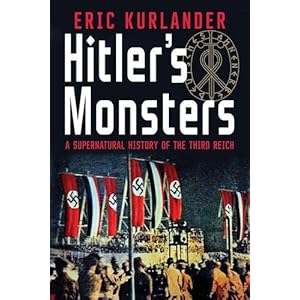
Eric Kurlander's "Hitler's Monsters": Book Review

Hitler's Monsters: A Supernatural History of the Third Reich
This Florida-based historian bases his investigation of the supposed supernatural in Nazi Germany on archival research, vast documentation, and a determination to produce a calm, focused, and sober study of an inevitably sensational topic. He seeks a "post-revisionist" balance to recent claims diminishing or explaining by other means the reasons so many under the Nazi regime sought guidance through "border sciences" of paranormal, Thule-obsessed, and other dodgy speculation.

In this galley, no index was provided. Looking at his admittedly impressive list of sources, one is aware of Eric Kurlander's steady ability to explain such arcane and often disturbing lore and its applications. Spot-checking, for instance, I was surprised not to find any mention of Julius Evola, as his role playing off or even against the German interpretations of esoteric theory is well-known. But within the borders of his narrower topic, this professor provides a surprisingly readable guide. Coming to this as a newcomer, wary of special pleading, instead Hitler's Monsters offers balance.

That is, Prof. Kurlander achieves a combination of the distance from the events that enables reflection, and a firsthand ability to handle primary sources which many who attempt to make claims about this subject cannot support, given their lack not only of the language, but the historical acumen. The "supernatural" takes in much, and astrology, paganism. Ario-centered myth-making, witchcraft are expanded to include "miracle weapons," "supernatural partisans," and unfortunately "racial science" as supporting experimentation, resettlement, and of course mass genocide.

Nearly every paragraph contains superscriptions to the documentation. There a few endnotes elaborate on the text proper. The care taken by Kurlander is evident. With so many continuing to challenge historical veracity on this emotive episode, this caution and meticulous defense from the work of previous colleagues is welcome. It's a valuable contribution to the study of pseudo-science, far-fledged theories, insistent fabrication, and ultimate devastation. Not the kind of power results the Reich wanted to achieve, but the kind it kept churning out in apocalyptic rhetoric and frenzied schemes, even as the enemy closed in around its own borders. Werewolves, vampires, and pre-modern cosmology all played dark roles.

Out of this "supernatural imaginary," as Kurlander calls this plethora of sinister powers, an appeal beyond anti-semites, fascists, and "racist imperialists" enveloped a broader support base. This is crucial to understand, for without clear economic solutions or political policies, Kurlander concludes, the Nazi party came to and maintained its rule by blurring the problems of social and economic reality with this concocted dust of mass media manipulation. Rather than forces unseen, the dictatorship drew upon illiberal conceptions which survived the end of the Reich. As we see...
(Amazon US 4/2/17)

Sunday, December 20, 2015

Primo Levi's "Complete Works": Book Review


Forever marked as a survivor of Auschwitz, known for his unflinching account If This Is a Man, Primo Levi wrote much more than that. Gathering for the first time English versions of his fourteen books over four decades, The Complete Works of Primo Levi retranslates all but one of them. And that one, If This Is a Man, has been revised by Levi’s first English translator. The Primo Levi Center in New York City claims that Levi is the first Italian author in history to have had his complete oeuvre published this way into English, “from the first to the last page.”

Prefacing this review with an indication of the scope of this project is necessary. For these three volumes exceed three-thousand pages. Memoirs, short stories, novels, essays, commentaries, and poetry are included, with nine translators working alongside the editor, Ann Goldstein. Textual notes and appendices, and an introduction by Toni Morrison, enhance this collection. (These were not made available in print galleys provided.) Serving as an equivalent to the 1997 Italian edition of the works, this enables readers and scholars to assess the whole of Levi’s career.

Born in Turin in 1919 to an assimilated Jewish family, trained as a chemist, arrested at the end of 1943 as a partisan, sent to the death camps in February 1944, Levi returned from Germany and started writing. However, his 1947 report on his experiences did not gain wide recognition until another decade in Italy. Its follow-up on his long return back from imprisonment to Turin, The Truce, appeared in his homeland in the mid-1960s. This pair occupies half of the first volume; the rest is his science-fiction stories written mainly from the same time as The Truce. These tales lack the power of his memoirs. Collected as Natural Histories and Flaw of Form, they feel slight by inevitable comparison. However, chronological order places them where they are.

Turning to the second volume, more successful stories and vignettes build the chemical structure of The Periodic Table. Basing chapters on analogies to various elements, Levi applies his laboratory expertise and rational scrutiny to his own life and that of his family. Broadening the view beyond his two memoirs, this 1975 “autobiography-in-stories” starts with a Yiddish phrase “it is good to tell past troubles.” Goodness and trouble mingle, in a book that resists easy classification, but which captures the strengths of Levi, in his steady, calm gaze, and hints of his weakness. He favors a detachment that renders humans clinically, more often than warmly.

Two-thirds of the texts in these books were written after Levi retired from his managerial post. They sustain his characteristic attention to detail, but in the novel The Wrench, the stories he collects from the working world of hands-on labor stay too inert on the page. Similarly, his shorter fiction in Lilith and the uncollected stories and essays from 1949 to 1980 were often brief columns for newspapers or book prefaces, of interest more to specialists. Their presence here testifies to the completeness of this edition, but the content can drift into the ephemeral.

Volume three opens with his poems. It continues with The Drowned and the Saved. In 1986, Levi returned to considerations of the Shoah after it appeared a generation was passing and the impact of the terror was fading from memory. He enters the “grey zone,” the ambiguity of those who survived. Disturbed, he confronts those who had to compromise to cling to life in a realm of extinction. This darker element tinges his later work, as he wrote more and more as he aged.

Rather anticlimactically, after the tension of The Drowned and the Saved, the edition gathers various essays and stories. Other People’s Trades begins with Levi’s admission that these essays “are a product of a decade and more of vagabond and dilletantish curiosity.” On writing, chess, science, and insects, among other topics, they are readable and pleasant, intended for the general audience of La Stampa. But as with his works on the camps, these lighter pieces touch on Yiddish and the Reich, if in the same conversational tone. It can be unnerving to find tonal consistency across so many pages, but Levi tended to prefer the object to the subject, the physical or the verbal as opposed to the spiritual or the human. This assertion challenges humanists who champion Levi for his life-affirming message. Yet when he concentrates on facts, Levi steadies himself. This may be a defense mechanism, given his endurance of inhuman conditions engineered by his fellow humans. It may corroborate the success of his fact-based explorations of this predicament, as a fragile man encountering wonder and chaos, more than his fictional forays. The latter leave the reader with a weaker impression of Levi’s skill as a patient observer. This had been honed by a style based on his chemical reports, efficient and precise.

Perhaps a collected works might best serve his legacy, for a wider audience at an affordable price. The cost of this edition keeps it beyond the reach of many who wish to learn from Levi. Levi’s last moments, in April 1987, still spark debate. Whether or not he chose to commit suicide, he was on anti-depressants after a prostate operation. His death, from a third-story fall in the home where he had been born 67 years earlier, marked another ambiguity in a life full of them, from a man who faced evil and who reflected in many of his works collected now upon the ability of goodness to endure within frail humans and humanity, after his own brutal encounters. (Amazon US 12-15-15; Spectrum Culture 12-06-15)

Tuesday, December 8, 2015

From Venice

In Venice, we saw a striking image. The near distance in the haze looked entirely drained of depth, and we thought it for a moment a matte painting or overlay. The Rialto, unfortunately, under repair, featured such a fake archway, with a gender-bending Asian fellow posing in a full-frontal (if clothed) stance, under a Diesel slogan "This is a guy sitting on a bridge." For me, that lost a helluva lot in translation. None of the thousand (!) photos I searched demonstrates this flattened perspective, but I tried to mimic it if slightly at the left, via this photographic view.

At Santa Croce in Florence, Stendhal had a similarly unsettling sensation. Overcome by the art, he fell into dizzy disorientation, called since then the Stendhal Syndrome. If you ever want to earn credit for this malady on an insurance form check off the box "hyperkulteremia." When reading his account, earlier this year, however, his psychosomatic reaction in his narration for me so muted that I had to check when in his tale it happened. A modest endnote referred to it offhandedly. Our encounter was probably less bewildering, but still, gazing out in the open on a vast sight you are not sure is real or contrived remains memorable. Venice, for many, appears a mirage, a place conjured up from magic.

Certainly, this city, built on sticks and marshes after refugees fled Attila, has no roots of its own from ancient times. No ruins, no Roman forum, no archaeological treasures. Instead, a true creation of the collision between Byzantine and Romanesque, the blur between Renaissance and Baroque, these islands separated from the normal cause of events cause its residents as well as its tourists to mingle. As Mary McCarthy's 1963 Venice Observed remarks, cohorts must jostle, and there's no place that is undiscovered and left only to the locals. I would pass the shop girl who with a British accent sold me a shirt, and the man who ran the gallery where we'd find our souvenir mask, both later walking along from work, to a meal, or to their home. With no cars, all are pedestrians, for once, reduced as equal.

Well, to a point. She also loosely links the flight of the founders of Venice to that of the Exodus, to another people who seek to start over, to another group involved in trade and mercantile enterprise. But, in the Old Foundry where the word ghetto originated, as we visited there our first full day, the situation of the Jews confined there nightly, as the gates and bridges closed them up on their island, attests to the other legacy of this realm. While the theme-park air draws all, permanent or transient, to jostle its dank passageways and navigate its funnelled paths over the Rialto magnetically, the isolated ghetto represents the hidden Venice. Not one only the locals know, but one the Most Serene Republic for centuries contended with, the raspy underside, the irritant beneath carnival masks or gilt mosaics.

This raspiness hit me on arrival. A loud woman materialized out of the Piazza S. Bartolomeo, the first stop in our video pilgrimage (see the paragraph after the next). She zeroed in on pale blue-eyed me, tugging two suitcases and hoisting a backpack, bent over like Simon of Cyrene helping Christ carry his cross. Somehow I was selected out of the crowd to sign her petition against drugs. A second day, she accosted me, this time mocking my disdain in Italian "insegnate" and then in broken English, "teacher" (how did she know?) and "No terrorist" post-Paris. A third time, she singled me out. By now, I let loose, telling her this was the third time (as in Jesus falls, although by now I bore no burden on my trudge through streets recalling those of old Jerusalem I imagined), and that I was not interested. She apologized slightly, and then Layne chirped "We like drugs." Believe it or not, on our departure that same day (we get around the same places, this being Venice), a man now accosted me, this time with a British accent. I speculated silently if this was not part of a certain "church" founded in Hollywood and part of a tax-avoidance scheme filling its coffers in ways that made Peter's Pence look angelic by comparison. The "faith communities" may change, but a pilgrim's still an easy mark.

Back to the other center of a far older faith, we saw scowling rabbis on a Chabad poster, a windowed guard kiosk, a few shops selling Judaica or kosher snacks, and plaques to those murdered. A series on a stone wall, faded in bronze to verdigris, depicted the torment of the Shoah. One portrayed two figures crucified. We traversed the center square where schoolchildren ran to visit, and we went the whole half-circle into and out of the district barely speaking. It seemed, as we'd seen in Siena and Florence in miniature, a testament to European Jewry today. And after the recent Paris murders, it felt stained. (When I got home, I learned on the radio that the Bataclan was targeted as its Jewish owners had hosted pro-Zionist gatherings. Why this was absent from any press, BBC or CNN coverage we'd been inundated with for a week was somehow telling. I add that snippet here, to an funereal litany. Even as I revise this, headlines of more innocents targeted by fanatics, perpetrated an hour's drive away, near the college my wife and older son attended, fills airwaves, papers, and the Oval Office.)

Our stay had begun with a video we'd watched over and over, downloaded to the Kindle. The hotel warned one had to learn the way to it, and we did. So much that over three days, we could traverse it on our own. But one false turn and you end up at St. Mark's Square. Instead, after a train from Florence and hauling our luggage a ways, we made it at nightfall to the Ca' Bragadin Carabba, where none other than Casanova lived from 1746 to 1755. Strangely, only a plastic sign in the bare lobby on the first floor told of this connection, and there was no other context. Talk about underselling a place.

Curious, on arriving home, I sought to find out more. My Penguin Classics abridgement of Casanova's voluminous memoirs lacks an index or timeline, but a visit to Wikipedia reveals that the young libertine saved the life and came under the patronage of the household of a scion of the noble Bragadin family. Perhaps he used their quarters largely as a base, for in this decade he roamed Paris, Dresden, and Parma among other locales. 1755 marks of his arrest as a Mason and freethinker by the tribunal and his incarceration in the Leads atop the Doge's palace, from whence he escaped to Paris.

The Ca' overlooks the small square of Santa Marina, nearer the Rialto than San Marco. As with the nearby Santa Maria Formosa church and square, these appeared neglected (even if the restaurant on the former was overpriced yet full) much of the day and night, and bereft of allure. A logical novelty of Venice is that it often lacks visible landmarks. You wind around alleys, under tunnelled passages and suddenly it's a tiny piazza or a vast square, a dead end at a canal with no railing, or a memorable vista of gondolas, water taxis, and motorcraft under clouds or gray skies, full of churches and fading facades. While many illustrations, painted or photographed, display Venice as very colorful, we encountered chillier weather, so I was glad for the change in temperature, although the humidity as I expected persisted. We even had to bundle up for the first time since Ireland. Around us, whether sporting man-buns or scarves, mini-skirts and leggings or wool overcoats, chic pedestrians strutted.

We ate at Mani, a little pizzeria that turned out once we got our bearings on the same route we came in on. Full of tourists as anywhere, but the food was fine. Lots of British, lots of noise. By the time we ate, and left, the lines were out the door and we were glad that the stereotype held for early birds.

I tried finding other news, but except for a BBC segment that kept covering Africa, no matter the language, news seemed all about Paris. Instead, I peered at the two maps I had, as they did not match in the streets covered, as they changed every twist and turn across the city's labyrinth, and tried to get a spatial sense. Once I imprint this, as elsewhere on my thousand miles driven in Ireland and the thousands of steps in Italy, I can function better. Not that I don't make a first-timer's mistakes, still.

But these were fewer. After the ghetto, we crossed a bridge and went into the flow. Look around you and see where the others walk. Out of a square, therefore, you get the hang of the main direction, even if it is a three-foot-wide cranny, it will expand into a street lined with shops and restaurants. The fish market offered a lot I'd have loved to try, and the vegetable vendors enticed Layne's eye too.

The stickiness of the climate persisted even in cooler times, so we headed back to our room. Later, we sought out the Basilica of San Marco and marvelled in the dim twilight at every inch covered in gold tile. The present structure is over a thousand years old and claims to have the body of the evangelist, stolen back from Alexandrian infidels. As in Florence and Siena, the darkness inside made the church more rather than less appealing, although to the finicky smartphone snapper, probably not. We sat in the side chapel awhile, taking it in, among worshippers. No craned neck or diligent archivist could do it justice. Plastered and fussed over, it symbolized the enviable position the city occupied, a portal for the plunder from the failing Greek empires and Ottoman successors, combined with the crusading avarice and the financial acumen under the Doges, and their uneasy terms of rule.

Somewhere along our walks, we'd seen on the Calle Guerre a cat mask that reminded us of Gary. That proved too big and too pricy, but the owners ran a studio making such for carnivals and movies. Ron Wood had shopped there, a small cutout of a newspaper on the front door noted. We were able to give a photo of our black-and-white feline to the painter, and she a day later produced a small papier-mache replica, sans green eyes, of our companion. Layne had to protect it, so she bought an owl-patterned bag to do so, and with the room left over, found an orange leather purse to suit her. I completed my magnet collection; Venice was by far the best and the cheapest of vendors for souvenirs. Even if I supposed all else was much ore, as all had to be brought in by dolly carts and porters. We made the same check-out mistake at another CONAD, forgetting to weigh the onions and tangerines, but a stop at the grocery stand across the lane on St. Lio near our hotel made up for that.

That second night, we had intended to find a more Venetian place to eat. But the "oldest" such restaurant near the cat artists did not appeal as much as the Osteria Antica ai Tre Leoni. The fish there was outstanding, and the gnocchi the tastiest we'd had. Layne watched through a gap at a Chinese couple. They never looked up from their phones, they slurped their noodles, they never conversed.

We talked, and she asked me if I'd live in Venice. The waiter at that moment came with our food, but if you want to know, I'd say, yes, if I had a lot of cash for upkeep. I'd also "divide my time" with Siena. Or maybe Lucca and Ravenna but they must wait for a return ticket and a cheap exchange rate. I'd read in Tim Parks about his adopted Verona, and Layne wants to visit the fashion and design mecca of Milan. For me in my romantic daydreams, the seaside of one location and the hilltop of the other balance well. As for Ireland, I keep responding that I have not as yet seen enough to call it, but somewhere in na Gaeltachtaí entices me. I'd take classes there to bring my Gaeilge up to fluency--even if my Californian accent would likely never vanish. So I imagine an ideal retirement.

Layne remarked from the moment we saw the Campo dei Fiori in Rome how the country instantly resonated with her. She warmed to its food and its ambiance, and indeed the weather did her well. She looked radiant, walked until she could no more, and loved window-shopping and dining (well, sometimes, but far more often than in Ireland). For me, I guess it's as atavistic as it is Layne as she surmised to her "swarthy" complexion ("olive" may be more anodyne) and her Levantine attraction. My skin enlivens and my nose sniffs out the turf. My older son, as I entered the house back home the other night, marvelling how it smelled outside of fires and chill like Ireland, sniffed, "you mean, like shit and sheep"? Deadpan. Perfect timing. He inherits my mordant wit and his mother's culinary joy.

Our final full day in Venezia, although we were "churched out" as Layne accurately diagnosed our affliction, we walked to the Scuola de San Rocco with its splendid fifty-plus Tintorettos. Too much for me, but Layne admired their contrasting colors and imposing angles. The wood carvings in the choir stalls intrigued me more, each contorted and realistic. The church across the lane, where we'd later reward the fiddler who'd been playing all day into the night, featured more of the same, as well as the Basilica dei Frati. Since about 1230, Franciscans have preached there, and the mish-mash of tombs, plaques, paintings, and ornament proved engaging if confusing, as again, the efforts of centuries combined into a jumble. Consider the reliquary, with so many tiny labels affixed to so many little bits of bone and skull that they were illegible. Some lacked any identification. Oblivion is their fate, perhaps, as holy relics and pious crafts, unless scholars better skilled than I summon miracles.

For the quotidian demands, pizza and pasta satisfy me. At our second pizzeria, Pommodoro, as avoiding beasties and birds means carbs abroad, we sat next to an Antipodean couple with a very well-behaved and articulate two-year-old, Rowan. They told us they'd been holed up in a Paris hotel for days, and were glad to have gotten out. In retrospect, I am glad Layne and I made it out of Istanbul before the subsequent tensions between Turkey and Russia. But I might see Turkey one day. U.S. security currently advises travellers now to avoid "crowds": how a tourist does this is a mystery.

Our departure, this time with a porter, and the train proved smooth. Again I contended with an Italian newspaper on political parties and Parisian terror, and we stayed in Rome at an Hilton airport hotel. Its plugs had been bashed into the wall by countless chargers, its staff seemed indifferent, and its ambiance was undistinguished. But unlike in Dublin, we could walk to the terminals. I watched a channel from the Middle East. Women in hijabs praising Tide. Pampers. Pert. KFC. "Pearl Harbor" played, as I tuned in on a scene of American sailors drowning under CGI Japanese bombardments. It seemed ill-timed and ominous, given the global jitters. Layne and I found a Cuban station. A young woman with a lovely voice even as an opera-phobe I liked sang as cats (again) or kids in masks (again) as such cavorted without reason. A video followed, an elderly folksinger with "Amigos" as his pals kissed the camera lens to show off their certificates from school or work, not sure which. B/w photos of them as younger comrades on labor details or at parties contrasted with them now. This was followed by a documentary on native plants. I wondered how long such fare will fare in today's Cuba.

Up early, we left on Turkish Airlines. Layne had calculated that one-way fares saved us a lot, so we flew counter-intuitively from Rome to Istanbul, and then back from Istanbul over the polar route to LAX. Our layover plunged us into a maelstrom, complete with a vast bazaar as chaotic as that outside the terminal, I feared. I later read that a Detroit woman on a layover here in 2013 had vanished, found dead in time, or not in time. (She "scuffled" with passport officials there, never a wise idea in this Midnight Express realm.) For my needs in time, there was one unisex toilet open in the whole wing. It had the standard functions and it was clean enough. Around me, half the world trundled past, until the near El-Al-level of a security triple check slowed us to board. I stared out a window by the gate, the strait not far away, trying to find which of the minarets and domes signalled Hagia Sophia.

On the flight, I learned from a documentary that there are at least eight grand mosques in the city. So, I had no idea which I surmised. I needed to stay awake to fight jet lag, so much of the marathon fourteen hours were spent gazing at the screen. A documentary about invisible Rome, another on Istanbul, another on owls. I chose rather than Skyfall to watch Goldfinger. Layne called up Boyhood for the fourth viewing, but I opted for the one Irish film, Jimmy's Hall, Ken Loach's biopic about leftist James Gralton's attempt to import jazz and modern mores into 1935 Leitrim. It tried, but could not rise above its conventional showdown of scandalized parish priest and indignant activist. To its credit, it did feature Jimmy back from Depression NYC to lecture his flock on the dangers of what we could relate to as avaricious bankers and precarious labor, and it attempted to complicate a simple story of good rebel vs. evil clerics with finally a little nuance. But I realize the love scene, that had been rapidly terminated with "the other woman" lamenting in gauzy dusk, cut to the next day without transition. Turkish censors made sure everything we watched was "formatted." I wondered what the well-upholstered, glaring old women under scarves watched on their little screens under hawk eyes.

We came home to find a dead bonsai (Nestor could not handle SoCal drought) and a dying cat. Gary had held out but three days before our arrival, he lost his appetite and retreated away from humans. We spent the equivalent of a flight and took him three times to the vet, but the fourth time was his last. I held him until the end. His green eyes gazed out, and his fur remained soft and sleek. One of the best memories of my Venetian promenade was seeing a cat-and-dog chess set, all hand-painted.

Window displays in Venice's small lanes prove magnificent. Paper, pens, fashion, glass, leather, crafts. I kept lingering over the faces on the little porcelain pets. They almost made me cry. They conjure up innocence and play, childhood and dreams. Impractical as a chess set nobody even would play with against me, expensive as it was, it represented a loving attention to art and beauty--even dignity. So, our mask in Gary's honor proved prescient. It will hang in the room where we loved him. 

Saturday, September 27, 2014

Curzio Malaparte's "The Skin": Book Review

Born Kurt Eric Suchert, this half-German writer castigates his losing side, as the Allies "liberate" Naples in 1943. Their new Italian allies take up the uniforms of the dead British they have recently killed in the defense of their Fascist nation. Italians now resolve to fight against the deposed Mussolini and the Germans. How the Napolitan natives feel about this has been rarely acknowledged by many who dramatize WWII. Malaparte, as his nom-de-plume indicates, takes the "bad side"; he shows the physical and moral costs of capitulation when one's own loyalties insist one was never defeated, and cannot surrender one's liberty unless once a slave. 


Such complex questions drive this 1949 novel. A work of fiction, but in its headlong prose rush and its tendency to indulge in set-pieces and tirades, I suspect this is better understood as thinly disguised or ambitiously elaborated vignettes from Malaparte's own experiences. The results fit better not as a sustained narrative but as episodic depictions of encounters between the Italians and those who now occupy their territory as erstwhile comrades, but also as avengers, judges, juries, and executioners.

Like Céline, Malaparte brings a complicated and shifty set of his own alliances into play, as he survives the shifts in regimes and ideologies. Similarly, this also needed an editor, for parts lapse into opprobrium, and the long conversations untranslated in David Moore's English version from French, between Malaparte's mouthpiece and his charge, Colonel Jack Hamilton, may slow the pace or dissuade a less cosmopolitan reader. But in the central section, "The Black Wind," one glimpses, finally, the power Malaparte can summon.  He had traveled to the steppes and witnessed the barbarities of the elite Germans (in this novel he appears slightly anachronistically already as "the author of 'Kaputt'"); he transforms this into a nightmare of crucified victims of the Nazis appealing for his assistance, before this segues into a tribute to his beloved greyhound Febo, and then a moving scene set in the last hour of a wounded American soldier. These three scenes, at first disparate, cohere as a meditation on death, and how we come to it ready or not. Malaparte takes dramatic license here, but the chapter works, as the central pivot in an otherwise metropolitan setting, to free the narrative from its concentration on the the demi-monde of Naples, of satire against the Allies, and lurid excess.

Rachel Kushner introduces the New York Review Classics 2013 reprint (with added passages expurgated from previous English printings) by calling Malaparte a plague or a pest, taking down all with him, and this fittingly finds an echo in the first chapter. On pg. 34, Boccaccio is cited appropriately, as compassion is felt for the afflicted of a great disaster, but this time, also by the Americans for themselves, as Christian benefactors. The trouble Malaparte finds is that such largesse cannot be reconciled with Naples' more pagan heritage, and the fact that Italian suffering predates Christian concepts. The last virgin in the city is shown intact, admission required for gawkers, and this emphasis on the grotesque (dwarf prostitutes, "Negro" soldiers hoodwinked by local "brides" and their scheming, black-market connected families despite smiles, merkins, "inverts" galore) may delight some, even if it soon gets tiresome. I get the point; Malaparte for 330 pages keeps making it.

He avers, in more provocative mood, that "capitalist society is founded on the conviction that in the absence of beings who suffer a man cannot enjoy to the full his possessions and his happiness; and that without the alibi of Christianity capitalism could not prevail." (63) Malaparte distrusts the civilizing mission of the Allies, he dislikes the craven bargaining of his false nation, and he seeks to distance himself from a Fascist past which despite partisans and reprisals does not recede so rapidly.

As with many European mid-century intellectuals, Communism hovers as a possible alternative. But Malaparte, true to his contrary nature, wonders if "pederasts" and "inverts" flocked to the red flag as if some pawns in a "Five Year Plan" hatched for easy marks among those who sought to deny their bourgeois nature and pretend to be proles, or to seek rough trade and fresh conquests among such who were driven by desperation and hunger to sell themselves to the "international community" of opportunistic coquettes and dilettante poseurs. A horrible interlude of the aftermath of phosphorus bombs in Hamburg conjures up a Dantean diorama, and innocents suffer horribly, cant and ideology aside. Children are sold to Moroccan soldiers, the Church connives, and the author speculates that this is not the inevitable outcome of moral breakdown so much as a sly campaign via Marxists to undermine the standards of a West they despise. Malaparte's suppositions may anger us, but he forces us to consider how popular or romanticized ideas generate unexpected, ugly impacts. People do not try to save their souls. all labor for good or bad only "to save their skins, and their skins alone." (129)

The rest of the book continues in the same mood. A bizarre birthing scene, a banquet of "fried Spam and boiled corn" for the Allies, a girl's death and her posthumous transformation, the eruption of Vesuvius, the entrance of the Allies into Rome--where a man welcoming the troops is run down by a Sherman tank, and a "flag of human skin" seems the appropriate icon for the Europe thus freed, reprisals against teenaged boys who fought for the losing side, and a recognition that it is a "shameful thing to win a war" (343) wrap up this journey into the rotten core of a continent as it is conquered.
(Amazon US 9-27-14)

Wednesday, January 29, 2014

Mark Larrimore's "The Book of Job: A Biography": Book Review

This biblical story's always troubled me, so Mark Larrimore's energetic and pithy survey of its "multiplicity of voices" and the puzzles this oddly edited text generates is a welcome introduction. The complex history of how interpreters (starting with the book's own Elihu and Job's friends who try to counsel him) have reacted to the legend, in Larrimore's understanding, resists "closure" no less than the themes it raises, of "providence and evil, the meaning of innocent suffering, the nature of God and humanity's place in creation." Rabbinical, early Christian, medieval, Reformation, Enlightenment, Romantic, fundamentalist, New Critical, and post-Holocaust readings of the text all gain attention, as well as how the book is "performed" in liturgy.

Chapter 1 looks at ancient interpretations--oral and legendary--and Larrimore wonders if Job himself is Jewish or a Gentile, for instance, another complication for a text with such obscure characters.  Chapter 2 looks at disputations, the medieval debates where philosophers (especially Maimonides but also Aquinas and Calvin) followed the example of Job and his friends as they disputed among themselves. Chapter 3 takes on the medieval burials of the dead and how the book of Job "enacted" itself beyond the text itself in liturgy and in a French mystery play, "La Pacience de Job."

Theodicy may not be as popular as it once was, but for centuries, Job's predicament allowed a confrontation with belief as "the model of an anguished but fervent modern religiosity." As the professor's previous book dealt with the problem of evil, Chapter 4 fits Larrimore's expertise. William Blake's illustrations show another way Job's story has been transformed, and Larrimore notes the uses of Blake's depictions on the covers of studies and novels, for instance, another point that even if an aside shows the perpetuation of Job's anguish. I wish more popular culture contexts such as this were delved into, as these spark much interest.

The post-Shoah struggle with Job's lessons, themselves a tangle of textual cruxes and confusing shifts, show the "exile" of Job for the fifth chapter. Not only Kant or Leibniz, Voltaire or Herder, but Elie Weisel and Richard Rubenstein, and a provocative comparison between G.K. Chesterton and Slavoj Zizek (albeit too brief a one for me for these last two pairings) demonstrate the range of Larrimore's examples. Similarly, his conclusion touches (I wish more here too was provided, as cinematic connections stimulate curiosity) on "The Tree of Life" and "A Serious Man" as two different, and typical, takes on the positive and negative aspects of Job's dealing with his troubles.

"In its jarring polyphony and its silences," Larrimore concludes, the Book of Job "speaks to and for the broken." Larrimore notes (he teaches at The New School) that the book has in the academy become detached from "monotheism which is now in exile in our secular age," a universalized one that we seek when "stepping outside the rest of salvation history" or the rest of Scripture. Again, these observations merited much more depth, but Larrimore finds provocative insights, a value to any inquirer. Therefore, as reacting to this morally troubling and poetically bold biblical book, both atheists and "the remnants of the covenantal monotheisms" might seek solace for their suffering as shared by Job and those in this tragic, bold, strangely conceived and unconventionally arranged story.
(Amazon US 12-14-13)

Monday, September 9, 2013

Jáchym Topol's "The Devil's Workshop": Book Review

Jáchym Topol deserves your attention. Through a punk-inspired, postmodern energy erupting from his Czech homeland against its oppressors, he conveys verve, intellect, and, beneath the trot of his clipped or galloping prose, tenderness: if in Central European precedent rationed out to each according to his or her own needs. From a dissident family, a poet and a reporter for a samizdat newspaper, he helped his nation topple totalitarianism, finally doing so in 1989 by the gentle but insistent Velvet Revolution.

Topol's debut fiction conjured up diabolical vignettes memorably. He started as a rock lyricist in the 1980s, so his affinity for potent imagery shows. Out of five hundred pages of closely printed, dreamlike, and dense scenes, Mr. Novak and his heap of bones at Auschwitz loomed largest in his hallucinatory, bewildering 1994 trilogy City Sister Silver--translated ably by Alex Zucker in 2000. Even in the original language, that first novel confounded native speakers with its disjointed assault. It lashed out at materialism.

Attacking both state socialism and market capitalism, expressing the rage of those growing up in one system and suddenly under another, its urgency reminded me of Joyce and Pynchon more than his Prague predecessor Kafka. Think of the linguistic upheaval of A Clockwork Orange and the demotic fury of Trainspotting: in both film and fiction. (You can sample its first chapter translated here.) Topol returns to English audiences for his fifth novel (it appeared in Czech in 2009), with his much more matter-of-fact, unnamed narrator's voice channeled again through his Brooklyn translator, who captures Topol's conversational, insistent tone intimately. Zucker dedicates the work to the author, "my brother from another mother".

This short novel extends Topol's political direction adroitly, and more calmly. It starts in the teller's native town of Terezín, constructed in 1780 under Holy Roman Emperor Joseph II, who named its formidable redbrick, stolid fortress after his mother. (While the narrator's father claims Maria-Theresa, the last of the Habsburg rulers, "founded" the massive installation, that attribution is open to qualification; she died the year it was built.) Under the Nazis, this became the "city for the Jews"-- to show off their supposedly humane treatment to the Red Cross. After Soviet "liberation", Lebo, himself born in the imposing camp just prior to its downfall, survives as its guardian, to protect the humbler garrison town against obliteration by the post-Soviet government, who compromises by preserving only the camp. Lebo and those who've grown up there, many children of the camp survivors, rally. "Lebo didn't want to see Terezín reduced to a Monument and a few educational trails. None of us wanted that."

A commune rises, a loose camp of its own. (As Zucker notes in an afterword, this anticipates Occupy and other movements: he translated this in the fall of 2011 in New York City.) This attracts "bunk seekers", the second and third generations who search in the camps and bleak villages for traces of their forebears who had outlasted the genocide, or more often, that vastly larger contingent: those who had died. Haunted, their descendants must ask: "If it happened here, can it happen again?"

When I visited Terezín a decade ago, my then-young sons came along. Just before I read this novel, they told me that their most vivid memory was a placard at the real camp's ticket booth portal for ice cream. The juxtaposition of a place of endless deprivation and a symbol of quick satisfaction matched my own recollection; its interiors had been nearly emptied, after a flood of the River Vltava, and the emptiness of the cells and the lack of signs, furniture, or even other visitors added to its silent impact.

In The Devil's Workshop, a similar lack of specificity or detail leaves the foreign visitor to the camp vicariously in these pages filling in imagined scenes, as the equivalent gap in interpretation remains. The narrator does not play the role of a tour guide. This may stem from the familiarity of this site to Czechs; it may deepen the detached nature of the narrator's recollections about refusing to play to sentiment, as well as Topol's preference for efficient, even dry, reporting rather than effusions.

Concerning love, pursued by the narrator on fortress slopes where he once herded goats and now takes up with Sara, a Swedish granddaughter of a child transported away to freedom from the camp: "a roll in the grass was simple enough. And that's all there is to say about it." Levity or gush comes rarely to those raised here and those who peer into the shadows, one senses. Some sober pilgrims, descendants of the Czech patriots and Jewish masses kept and killed there, turn communal dwellers. "They knew they weren't in a medieval castle, but in an abyss where the world had been torn apart, a place without mercy or compassion, where anything was possible."

The narrator--back from prison--and his comrades aid Lebo by appealing to the conscience or the bank accounts of the wealthy to sustain Terezín. They amass valuable contacts. For a while, this grassroots experiment in self-sufficiency flourishes: goods are sold to tourists and ingenuity brings in cash. Sara designs a popular t-shirt, altering a certain Czech writer's image with a gallows and a stencil. "Theresienstadt: If Franz Kafka hadn't died, they would have killed him here." (This is as lighthearted as the suitably titled The Devil's Workshop gets.) By such enterprise, and by restoring the mentally ill and recuperating the bunk seekers, the modest commune succeeds.

But, its commitment cannot fend off the jealousy of bureaucrats. Scandals around Lebo are concocted by an envious press. The narrator flees, soon after meeting an older arrival at the campsite: Alex from Belarus, often called Europe's last dictatorship. Alex wants to turn the clout of Terezín's online support network against the despots of his own post-Soviet homeland, still fighting amongst itself.

Sneaking away as Terezín succumbs to "cops and doctors all over the place on account of a couple of grannies" (shades of Occupy), the narrator escapes via Prague and flies to Minsk. There, Belarusians clash as the president declares martial law. In Khatyn, Alex, leading a team of seekers more feral and less coddled than those who could afford to frequent Terezín, unearths catacombs packed with corpses. Matuška, who had ferried the narrator to safety across borders, urges him to do the math.

Stalin's henchmen murdered ninety percent of her nation's intellectuals. Czechoslovakia and Belarus have equal populations, but over ten times as many of the latter people were killed by the Nazis--and their Russian, Ukrainian, and Lithuanian collaborators. Alex informs the narrator: "The devil had his workshop here in Belarus. The deepest graves are in Belarus. But nobody knows about them. That's why you're here." Publicity and donors will enable Khatyn to outdraw tourists to Auschwitz. 

The battle over who controls the remains of four million Belarusians, what such numbers mean to a divided and shamed country where some assisted and some resisted, and who grabs their share of the tourist trade and international assistance elicits Topol's understated but firm pressure as he explores a touchy subject. This is one subject that all Belarus can agree on, and besides the income, this may achieve what a wounded nation needs for the living: the ability to finally let the dead rest in peace.

But first, their stories must be recorded, lest we forget. Topol dramatizes this in the latter half of the novel. Under the determined vision of Kagan, who as a boy made it through the ghetto and the mass grave, and Alex and their team of excavators in a land where all are bunk seekers, we see the results. Alex constructs what will be a museum unlike any other, out of a "Jurassic Park of horror".

I leave the reader to uncover the resolution. Topol integrates real accounts of barbarity skillfully into the quick snatches of testimony, and to his credit for this difficult theme, he does not revel in the re-creation of suffering. Yet, this novel proves grim. The narrator stays fresh in Zucker's translation through his everyday language and Everyman persona. But he must scurry about the settings the author designs for him as if fated. Topol turns an approachable character into a portentous archetype. 

As with his debut fiction, Topol wants to merge ideas and symbols into his perspective on the current Central and Eastern European predicament, dealing with the aftermath of of pain and deprivation. In a literary tale as short as this, while the results are more accessible for first time readers of his work, the meanings threaten to loom too large for it to carry. As the narrator finds: "soldiers come into the village and kill, houses and people burn--repeating over and over" the terrible stories then and now.

(Amazon US 8-18-13 in shorter form. As above 8/27/13 to PopMatters. See my brief take on City Sister Silver 6-19-03 at Amazon US)

Wednesday, April 3, 2013

Nicholson Baker's "Human Smoke": Book Review

Without a preface, as if a dramatically told and chronologically arranged series of note cards, he spends nearly 500 pages laying out historical cards, from WWI to the end of 1941. They reveal a hard-hearted Hitler and many Nazi minions, naturally. Baker hears Kristallnacht applied "because the word 'crystal' simultaneously distracted from, and raised a toast to, the ferociousness of the rioting," as well as echoing Edward Bernays' Crystallizing Public Opinion, a favorite book for Goebbels' propaganda model. They also attest to a childish, conniving Churchill (no surprise to any who knowing the fate of the Irish sent over to deal with Winston as part of the British diplomatic team outwitting the republican raw recruits given the task of hashing out the Anglo-Irish Treaty of 1921-22) and a firm FDR opposed to doing much to allow many Jewish refugees in or out.

Rabbi Stephen Wise is quoted as preferring that Jews meet their fate in Germany rather than be resettled in Tanganyika, so tainted is that former German colony; pacifist Gandhi opposes Zionism as counter-productive to Arab interests and as sustaining poorly implemented British colonial aims; American Quakers travel in vain to Goebbels to try to talk him out of intransigence; Huxley insists: "An evil act always produces further evil acts." (61) In the context of mass aerial bombardments carried out in Yemen by Britain and Italy in Ethiopia, his Peace Pledge Union rejects "collective security" to threaten dictators with violence. He opposes war totally. Yet, presciently, Huxley confronts the logical difficulty of dealing rationally with a mad dictator, or one so Machiavellian that total war looks a better gamble than submission to foreign governments. Milton Mayer muses that Hitler menaces America in 1939 "not because he won the last war, but because he lost it." (150)

While one may argue Baker arranges his notes to advance only his side of the argument, he does take pains to include outrages from both sides. This itself, for those of us used to a tilt given our own national involvement, can be unsettling and may not convince those who may rightly claim the Axis and fascism is far more culpable. But, I read this presentation as determined to address the Allied rush to war and its refusal to negotiate, unpalatable or uneven as this direction may be for today's audiences. Baker advances the cause of retribution as the fault of all involved, who get caught up in hate, revenge, and the lust for profit.

One advantage of this study is that Baker, as he says on its final page, reminds us of the Quaker pacifists and others opposed to war: "They failed, but they were right." An unpopular stance, as Jeannette Rankin, Montana representative and the first woman elected to Congress, demonstrated. Along with fifty colleagues she voted against the U.S. entry into WWI; alone, she did the same the day after "the day of infamy" nearly twenty-five years later.

Courageous opponents such as Himmler's Finnish masseur Felix Kersten, the German dean in Berlin the Rev. Bernhard Lichtenberg, and the Union Theological Seminary's Eight who were jailed a year and a day for refusing the call-up to the military merit mention. What Vera Brittain decried as the worst possible way to deal with Hitler, "reciprocal violence," rules as the British scrap for another fight, whether with France or with Germany, from Versailles on. The "merchants of death" fuel bombers dropping munitions on civilians. The Nazis blame the Jews for this.

Hitler's belligerence finds its match with Churchill's petulance. He shuts off food relief to Poland, enforces a blockade against supplies to the lands Hitler has conquered, and he pushes RAF attacks on cities, vowing to terrorize a term he revives, the Huns. He laments to DeGaulle the delay in the German attacks against Canterbury, Oxford, and Coventry, hoping they will draw the U.S. into the war. When Coventry is about to be bombed, English intelligence intercepts the Nazi transmission. Yet, hours ahead, no warnings are called in to the city. "Winston Churchill asked for heavy publicity to be given to the Coventry raid. He did not visit." (254)

The steady slide into patriotic cant, falsehoods phrased as truths by ministries and politicians,  conscription by the U.S. for the first time other than when at war, jailing of draft resisters follows. Baker cites Hitler on January 30, 1941, vowing to fulfill his "prewar threat: If international Jewry pushed Germany into a world war, the Jews would be finished in Europe." (283) Roosevelt, eager for any "incident" justifying entry to back Britain, is revealed as an impatient ally itching for a scrap. Churchill, as seen by Australian P.M. Robert Menzies, falls victim to his knack for the "glittering phrase" that compels Churchill to believe his boasts.

Baker shows how the RAF, soon under "Bomber Harris" would continue its remorseless retaliation as retribution (these three terms appear over and over in his sources by late summer of 1941). "The bombing offensive fed Hitler's wrath, in direct connection with his concept of the 'Jew's war' against him, and helped unite his nation behind him and justify further Nazi atrocities against the remaining Jews." (qtd. 391) Historian Schlomo Aronson's assertion supports Baker's cause and effect. Churchill's bellicosity and his courting of FDR's lend-lease of weaponry to Britain implies that the Allies were partially responsible for the mayhem and backlash of the Shoah. This view inspired Baker's Harper's May 2011 essay "Why I Am a Pacifist," which continued the story after the end of 1941, and predictably sparked a firestorm of controversy. (Amazon US 3-25-13)

Monday, April 1, 2013

Pharaoh's hard heart

Commenting on my review last year of the "New American Haggadah," Matthew A. Levine asked c/o Amazon:
I just wonder about the version of the ten plagues that you mention, is the comparison to FDR, Truman, and Lincoln really applicable? Even though I personally don't believe that violent means are ever justified, at least, according to the official version of history, in these cases it was necessary to achieve a good end. According to the Passover story, the Pharaoh was ready to let the Jews go free, and then God "hardened his heart," so in this case liberation could have been achieved without any violence whatsoever. What was the point of that, and how can it possibly be morally justified?
This refers to my statement in the original review: "the Ten Plagues again by [Jeffrey] Goldberg find memorable comparisons. The power of a God who hardened the heart of the evil Pharaoh grows mysterious. Lincoln, FDR, and Truman all are shown as presidents who took the lives of many innocents in their determination to bring about a greater good. If emancipation ends or fascism succumbs, do the ends justify the means?"

I responded: "Matthew, that's precisely the type of question this Haggadah might inspire for a seder, or your own reflection. I recently re-read Nicholson Baker's 'Harper's' essay about the reaction to his own claims in 'Human Smoke' about the folly of violence even in WWII, and his remarks remind me of yours about the hardening of a heart, and how war might have done that to the Allied foes. Perhaps the collective authors strain for relevance and parts of this smack of appealing to a certain demographic, but if its contents can spark a question such as yours (and mine), it's worthwhile."

At the risk of ostracism as a wicked son (if without a Jewish father), this recent exchange stimulated my Pesach planning. My wife wondered if a seder could avoid a mention of "God," and given the spectrum of those attending this year spans secular to atheist, and skeptics with a healthy proportion of lawyers, I figured the timing was perfect for contemplating taking this on tour, if around my table.

(Update: it went well enough, given my own probable or inevitable lapse into professorial mode. After a viewing of the South Park episode, I didn't get into the WWII-Shoah context much which may have been just as well. The youngest son answered many questions from my older son's guest who did not know about the tale much. We skipped the Four Questions, but made up by our Maggid, the narrative we retold--I checked three guests' claim that Moses found out he was Hebrew from a garment shown him by sister Miriam. Not in Exodus; a charming but non-scriptural addition?)

My investigation--as a not-wicked but too-diligent son of my own has waylaid my (admittedly Reform, so perhaps while it may lean towards refuseniks even they may not agree with Baker's pacifism) Torah, detouring me from study of its gleanings--has led me to study Baker's Human Smoke: the Beginnings of World War II, the End of Civilization.  Levine acknowledged by his own glance at its Amazon raters (where my review at that link appears 3/25/13) a massive negative swell of criticism directed at it. I was dimly aware of it when it came out in 2007 but very attentive to "Why I Am a Pacifist" in Harper's for May 2011.

In the book, Baker cites Hitler on January 30, 1941, vowing to fulfill his "prewar threat: If international Jewry pushed Germany into a world war, the Jews would be finished in Europe." (283) Baker does not hold the Allies as free of culpability. The RAF, soon under "Bomber Harris," would continue its remorseless retaliation as retribution (these three terms appear over and over in his sources by late summer of 1941). The defiant British refused to negotiate and the more Hitler bombed their homeland, the more Churchill calculated FDR would send aid and be drawn into global war.

"The bombing offensive fed Hitler's wrath, in direct connection with his concept of the 'Jew's war' against him, and helped unite his nation behind him and justify further Nazi atrocities against the remaining Jews." (qtd. 391) Historian Schlomo Aaronson's assertion supports Baker's cause and effect. Churchill's bellicosity and desire for FDR's lend-lease of weaponry to Britain implies that the Allies were partially responsible by warlust of accelerating the mayhem and backlash of the Shoah.

Civilians displaced by carpet bombing were told the Jews were at fault, and German residences were appropriated by the Nazis who then sent their former occupants off to ghettos. This blame game, as American armaments intensified British raids on innocent Germans, may have hastened the Final Solution. U.S. entry spurred ever more destruction of the Jews, as they lost their hostage status as bargaining chips with the Allies. Death camps emerged, the first readied as it were the day after Pearl Harbor. Analyzing this escalation inspired Baker's Harper's May 2011 essay "Why I Am a Pacifist," which continued the story after the end of 1941, and predictably sparked a firestorm of controversy.

So far, reflecting on Pharaoh's tale, with little commentary--as a fundamentalist might advise-- Exodus makes me wonder about who's to blame. I can't avoid the mention of God, but he may share in the blame game, if not by venerable scholars; Biblical marginalia favor an Augustinian approach. That is, the Pharaoh could have chosen mercy, but he let himself act tough, as this fit a severe ruler in the Middle Eastern model and it showed all the more the comeback of the Hebrews against overwhelming odds and a Memphis home team's martial and mental advantage at Luxor Stadium.

In a 2011 Slate essay, "Sympathy for the Pharaoh," Michael David Lukas considers various rationales advanced by theologians and critics. He notes: "Towards the beginning of the story, Pharaoh hardens his own heart (or it "is hardened" in the passive voice). Following the sixth plague, however, Pharaoh seems to lose his nerve and God steps in, hardening his heart for him." While the likes of Martin Luther King and Erich Fromm aver that the hardening is due to Pharaoh's own defiance of compassion and his decision to use free will to defy Moses' appeal, Lukas reminds us that such apologists for justice and resistance to evil stay mute as to why God steps in to harden the heart that appeared to waver after the infliction upon the recalcitrant Egyptians of boils. (I confess this always impressed or repulsed me as particularly nasty, given my adolescent reaction to skin blemishes.)

My family's search for inspirational fare led to "Jewpacabra," aired March 14, 2012, episode 4, season 16. We join the action as Cartman's dream of being transported back to ancient times leads to why frogs are raining down, God's hand in this curious trajectory, and how that seems unfair to frogs. 

Kyle: It doesn't matter. Because God is going to harden the Pharaoh's heart!
Cartman: What does that mean?
Kyle: It means Jehovah is going to use his powers to keep the Pharaoh from letting us go.
Cartman: Well that doesn't seem very fair, Kyle. I mean, if God is going to make Pharaoh say no, then why would he punish him for saying no?

South Park's script is on to something, as satire snaps. A few minutes it devotes to the depiction of the plagues and Passover: here it hones in on this conundrum. Cartman continues to dream as P's son:

Cartman: Daaad, when's it gonna stop raining frogs?
Pharaoh: It'll be okay, my son. The weather will clear.
Cartman: But my friend Kyle, he says that the reason we've had all these plagues and stuff because you won't let all the Jews leave.
Pharaoh: [sighs] It's a complicated political issue, my son. An economic social issue that needs time. We can't let them leave, but is it really all that different from when the north didn't let the confederate states leave the USA?
Cartman: Wow, that makes sense. Don't think anyone can deny that. [a bloody frog lands over the edge]
Pharaoh: Poor frogs. I feel so badly for them.
Cartman: But dad, my friend Kyle says that if we don't do whatever the Hebrews want us to do, God is gonna kill little Egyptian boys.
Pharaoh: Hah, I don't think God would do such a thing, little one. No matter what happens, we can't let ourselves believe in the Hebrew version of God. We believe in a just Lord who would never murder innocent children.
Cartman: I love you, dad.
Pharaoh: And I love you son. And our love grows.

Speaking of dad, I've mused at DeMille-epic length about my own college-age antiwar stance four years ago at Pax Christi-Passover; the elevation of a pope named Francis may align with this spring's paschal ritual. In that 2009 entry, I raised many of recollections as a child hearing my dad remark "nobody ever wins a war; there are only losers" and my own naming after my mom's only brother dead on the shores of 1944 Saipan lingered. Raised with Vietnam footage on network t.v., I recalled to Niall the "Welcome Home POWs" bracelets worn by my hippie-spawned grade-school classmates from the far more liberal side of town. I credit as an teen my own surprised encounters via Thomas Merton's autobiography and J.F. Powers' incarceration to learn that Catholic Workers and pacifists during even the "good war" and the "greatest generation" existed as fellow communicants next to my presumably unaware mom and dad as they worked day and night in factories for the "war effort."

No, they were no saints, no Franciscans jailed as Fr. Louis Vitale has been (see "Pax Christi"). During the days of the Evil Empire and the contras, I showed my dad an article by L.A.'s Cardinal Timothy Manning decrying the "culture of war" and our local "defense industry." My dad and mom had worked at such factories (as did Layne's--both our dads were turned down for induction due to punctured eardrum and stuttering respectively); my machine shop, further-deafened by tool-and-die, dad looked the prelate's op-ed over with a glance and almost sneered: the Cardinal never had to worry about how his bills were to be paid or where his next meal was coming from.

Yes, I have seen the numbers cut into the arms of the elderly; Leo and I heard Dario Gabbai tell of his fate as a sonderkommando fueling the furnaces of Auschwitz. The more I study Irish republicanism over decades, the more attentive I am to what I didn't notice once upon a time: the perpetuation of "whataboutery." What about Hitler, what about the Battle of the Boyne, what about the Irish Civil War after the one that tried to gain independence, but left in the wake of a cleverly phrased and jerry-rigged treaty dividing the Free State a legacy of bitterness for generations. Baker's allies would insist any treaty brokered ought to be preferable to more death. It's hard not to disagree, despite my clan sympathies. I remain cognizant of perhaps cognitive dissonance here, but I state my case nonetheless.

Teaching PTSD vets, kids with plates in their backs and pins in their knees, wives with babies to care for while their husbands are off in Afghanistan, students called up for reserves, active duty, or desert training in the middle of a term; survivors of firefights in Fallouja who went three months without bathing in over a hundred lbs. of cloth and gear in 140-degrees: what some must undergo to qualify for an education on a GI Bill. I despise a nation and a mindset which rewards only those who may have risked their life and their sanity to cull a few thousand dollars for improving their livelihood and their mentality. I'm not naive enough to acknowledge my own desires lurk for revenge or reprisal; my Fenian blood can run deep. Yet, my maturity demands that I seek and support calmer ways to redress wrongs and right injustices. As Einstein challenged in 1930: "If only 2 percent of the men liable for war service were to refuse, there would not be enough jails in the world to take care of them." (23)