Showing posts with label Literary criticism. Show all posts

Friday, July 24, 2020

Joseph Bottum's "The Decline of the Novel": Book Review

https://www.bibliovault.org/thumbs/978-1-58731-198-7-thumb.jpg
First off, this author’s cousin Roddy was keyboardist for Faith No More and currently plays with the enduring indie-pop outfit Imperial Teen. Second, Joseph “Jody” Bottum hails from one of South Dakota’s leading political families, a long-lived line of legislators that goes back to 1840s Vermont. Neither factoid leaps out as germane to The Decline of the Novel’s literary critique examining classic long-form fiction’s cultural influence and modernist impacts. However, upon reflection, Professor Bottum’s background and milieu may subtly infuse this collection of essays.

As a leading voice of a neo-conservative silent minority teaching in the humanities, Bottum is determined to align the downhill slide of mainstream American Protestantism over the past six decades to the triumph of a fragmented pop culture and a loss of a common core of values. Which relates to Roddy’s first band’s name, and his relatives representing old-line Republicans.

Intriguingly, Joseph Bottum, who first lectured in medieval philosophy, then became a Catholic public intellectual embroiled in contrarian stances resulting in his ostracizing from culture wars. Also a poet, he now runs a think-tank at one of his native state’s flagship universities, to craft professional ethics for those in information technology. This eclectic experience may not directly enter The Decline. But it subtly enriches and supports his main thesis that we’ve lost our faith.

He explains this book’s title as it “reflects and confirms a genuine cultural crisis. This is not just the old crisis of the self, but a new crisis born of the culture’s increasing failure of intellectual nerve and terminal doubt about its own progress. We have to believe in a culture to employ that culture’s art: to be much entertained by it, and to be much instructed” by its novelistic creations.

While many still read books, genre-fictions, celebrity and political biographies or hobby and self-improvement bestsellers don’t meet Bottum’s standards for works that reach “the most profound expressions of psychological, sociological, and existential truths.” Even the remnant who prefer these classic exemplars “no longer have the ear of the general culture.”
Reading for escapism or “nostalgic indulgence” fails to recapture the fickle attention of those entranced by immersion in electronically-driven gaming, online fare, and, one would add, “prestige T.V.” binge-watching.

Parts of this study also feel on replay. The gist of what’s here compiled from previous published criticism and journalism concentrates on the Protestant foundation for the invention and elaboration of the individual as he or she struggles towards success in a middle-class society, energized by the rational promise of the Enlightenment, and separated from the Catholic collective to pursue one’s own moral and practical salvation within an increasingly urban setting.

This leads Bottum into fresh territory. He examines, for instance, Samuel Richardson’s 1748 epistolary epic of female resistance to male domination. Clarissa Harlowe “demands no real changes of heart in anyone else, and she seeks to modify the world only insofar as she needs the world to leave her alone.” Contrasting an admittedly tedious 1862 riposte to Daniel Defoe’s shipwrecked rugged proto-colonial colonist, the Reverend W.H. Amberdon’s The Catholic Crusoe “grasps the Puritan center of Robinson Crusoe and inverts it into a claim of Catholic superiority.” Although Bottum often expands his analysis of recognized titles, the academic bent of this book tends towards the arcane, justly or not overlooked by other scholars. The tone tends towards the dutiful recapitulation of plot points, quoted passages and passing glances at now-forgotten tales, but as the take on Clarissa reveals, he can turn a phrase when he wants.

Rooted in a sense of self, the British and Continental novel depended on its support among the Protestant society and the common-sense capitalism of its protagonists, progenitors and purchasers. Joseph Bottum, after two opening chapters which with some overlap set the scene for the success of the novel over less than the past three hundred years, focuses respectively on Walter Scott’s Waverley (with a look at Nikolai Gogol to enliven this scrutiny), Charles Dickens’ David Copperfield, Thomas Mann’s Doctor Faustus and the Tom Wolfe’s A Man in Full. He charts the arc of the novel from its workaday connivers in Defoe, through Romantic and Victorian heydays, and into modernism towards what sputtered out of Wolfe’s “failure of nerve.”

When this collective confidence in the self-made striver, and the economic engine and moral apparatus represented by this dogged ambition. finally imploded around the middle of the 20th century across the Western world, so did Bottum’s chosen type of serious narrative. Today’s shelves feature characters divorced from their medieval ancestors, who presented themselves as “pawns in, or merely spectators to, a great supernatural battle.” Now, as his final chapter roams about the middlebrow chart-toppers of Neil Gaiman, Herman Wouk, J.K. Rowling and Charles Frazier, the professor admits that since the early ‘90s, there have been no big writers producing must-reads. The excitement of re-enchantment, he laments, has faded away.

As Bottum alludes to in an afterword, the contents of this slim volume have been reassembled from past pieces. Upon close examination, chapters do connect with one another, but this takes steady attention for the reader to discern. Without end-notes or evidence of how to track down the quotes from his original sources, whether primary or secondary, the utility of The Decline itself diminishes as a resource to lead readers to learn more from creators or critics.

Therefore, this study’s value carries a proviso. If a reader does not need to imitate the scholar, and remains content to peruse the pages of The Decline of the Novel, it’s guaranteed to point to a few finds that not even the most determined or desperate academic might have unearthed. But the rummaging in these secondhand shelves of modernity and its predecessors keeps one wondering. Bottum’s examination of fiction reaches no happy ending; instead, he leaves the reader asking along with him: what’s the purpose of art now? What is left for us to do with ourselves? (Spectrum Culture, 5/25/20)

Friday, July 3, 2020

John M. Bowers' "Tolkien's Lost Chaucer" Book Review

 Cover for 

Tolkiens Lost Chaucer

While at least some who discover J.R.R. Tolkien’s works as young people go on to study medieval literature, very few have first approached Tolkien after having established their careers as experts in the British Middle Ages. Professor John M. Bowers, a seasoned scholar on the Gawain poet, William Langland and Geoffrey Chaucer, brings to his investigation of Tolkien’s “lost Chaucer” a variety of engaging strategies enabling those familiar with either writer to enjoy the other one.

Bowers confesses that he barely knew of hobbit fantasies when Bowers glimpsed Tolkien during his Rhodes Scholar stint at Oxford, shortly before the master’s death in 1973. Familiar, however, with Tolkien’s academic contributions, Bowers only caught on to the popular appeal of the author of The Lord of the Rings after his sister gave him the film trilogy as a boxed set at the start of this century. The previous century found Tolkien arguably more appreciated by millions, contrasted with those who had been assigned the opening of The Canterbury Tales in high school. Bowers made up mid-career for his delayed start. Having explored Middle Earth attentively and with deep appreciation, he provides a welcome, fresh foray into both medieval and modern lore.

With so much academic work devoted to Chaucer, and an increasing amount to Tolkien (both deep within and on the fringes of the academy), innovations elude many publishing on these writers. Bowers’ acumen with Middle English and Chaucer’s oeuvre enlivens his parallel adventure into the papers left behind by Tolkien from his work on the Oxford University Press Clarendon Chaucer edition. As a harried lecturer with a growing family to support, Tolkien struggled to balance his invention of Middle Earth and its burgeoning intricacies with his professional duties. He longed to expand his beloved imaginary horizons beyond the podium.

Finding that Tolkien may have often begged off duties to devote precious time to his fabulous fiction, Bowers turns to his former dissertation advisor, V.A. Kolve. He was one of the last in the undergraduate program to work for Tolkien as a research assistant, back in 1958. Kolve recalls his mentor’s confiding: “He confessed to me once that some were disappointed by how little he had done in the academic way, but that he had chosen instead to explore his own vision of things.” The ties binding students to masters at Oxford meant only a chosen few could attend Tolkien’s tutorials and lectures, but these scholars spread the reputation of Tolkien through their own specialized monographs and articles, quoting Tolkien often on Beowulf or Old English.

This represents the attention paid to Tolkien the scholar, compared with the fabulist-on-the-side. Upending the common method, by which Tolkien enthusiasts tend to look to his medieval inspirations to track sources and analogies, Bowers comes from immersion in Chaucer back to his erstwhile scribe. In his annotated proofs and diligent notes for the Clarendon project, Bowers uncovers affinities galore. Out of this at first unprepossessing material in the Oxford archives, the “grey box” of sheets scribbled in Tolkien’s fastidious if eccentric handwriting remind Bowers of Gandalf poring over “the slashed, stabbed, and partly burned Book of Mazurbal.”

Bowers avers that Tolkien’s selling point, which under his sponsor George Gordon elevated Tolkien from his position at Leeds to a professorship at Oxford, was the fact that, if hired, the academic could labor on their stalled edition of Chaucer. However, 30 years’ of intermittent labor never was published. Tolkien abandoned it in 1951. Three years later, his trilogy appeared.

All the same, his skilled efforts at textual studies and etymological derivations inspired key episodes in The Hobbit and The Lord of the Rings. Bowers pulls out such small details as Tolkien’s service as a signaling officer in the Great War or his fear of being outed as a Catholic, too. Bowers shows how Tolkien’s life and legends interweave, and how his status at Oxford fared compared to his counterpart C.S. Lewis. This takes a bit of shine off the glory bestowed by admirers of the latter chronicler, but it necessarily proves that Tolkien faced severe obstacles, looming or subtle, that complicated his Chaucer contributions and diminished his learned output. These biographical surmises, backed by letters and lectures unpublished from the same archives, enrich what previous admirers have devoted to Tolkien’s impact. Bowers possesses balance; he avoids hagiography. Instead, he compares Tolkien’s career at times to that of Chaucer himself.

This clever set of affinities creates the most engaging part of Tolkien’s Lost Chaucer. How the Oxford don reacted to yew trees, mills and millers or “felled elms” in his childhood echoes in his Middle Earth world. Bowers, in one of many instances, demonstrates how his close reading of Tolkien’s archived manuscripts and notes strengthened Tolkien’s compulsion to pore most of his energy into a realm emerging that rivalled and perhaps surpassed the ambitious, unfinished plans of Chaucer for his great book of many pilgrims relating many stories. A coda takes Tolkien’s own unfinished project forward, through the editing of his son Christopher. While neither Chaucer nor Tolkien could complete their greatest works, they leave plenty behind for steady pioneers such as John Bowers to unearth, revealing that riches still await men who dig deep for gold.
Spectrum Culture 3/5/20

P.S. Delighted to verify in print, in this title I review, that my diss. advisor name-checked in this review (who far earlier advised similarly the author of this study) was one of JRRT's last "probationary B.Litt students" at Oxford in 1958. He'd arrive for tutoring at 11 AM and the professor poured gin out for them both from rather soiled glasses. So I'm two steps removed from the inspiration for my own medieval studies, as a boy 6000 miles away in dusty, smoggy SoCal, who read The Hobbit when I was nine.

Wednesday, June 24, 2020

John Garth's "The Worlds of J.R.R. Tolkien": Book Review

 Image of The Worlds of J. R. R. Tolkien: The Places That Inspired Middle-earth
Atlases of Middle-Earth, guides and art, tributes and monographs, films and “cosplay” proliferate. What John Garth adds to the ever-proliferating pile of Tolkien-related media is a careful eye and steady step. He explores the intersections between this world and that of Tolkien’s “legendarium.” He traces inspirations from what the author saw, and how they may likely have evolved into what can be gleaned from his tales, letters, drafts, and sketches.

While not all made it into the published product, the effort Garth demonstrates attests to Tolkien’s visionary projection, his uncanny talent at what this scholar compares to a paint-box, in which the author dipped, daubed, and mixed layers of color, depth, hue, form, and drama into his vast legacy of narratives.

To begin, Garth logically starts with the hobbits’ Shire. Tracking parallels to childhood scenes in the village of Sarehole near Birmingham, Garth shows how Tolkien grew up amidst an almost-vanished rural setting. He then broadens the scope, viewing the “people, languages and cosmology” of Tolkien’s panorama, already emerging in his youthful imagination. It soon encompasses England itself, transformed into Lúthien, a name with lasting resonance, for it graces Tolkien’s tombstone. Topography expands abroad, with chapters devoted to features such as shores and seas, inland waters, mountains, forests, battlefields, and industrial wastelands. All are “places built or shaped by people,” Garth notes, and by Tolkien’s incessant cultivation of fussy details as a “natural niggler” whose seeding as a medievalist and linguist bore abundant fruit.

Garth reminds readers that what Tolkien began over a century ago described races and places as seen by medieval poets and chroniclers, not necessarily as they actually were. This astute caution defends the author’s works against detractors who, looking back and projecting contemporary critical theory upon Middle-Earth, distort its perspective.

What opens up to the viewer dazzles. Drowned lands, moving islands, and sea-caves first appear as Garth follows Tolkien’s explorations of the real and the fictional, and their blur and blend. Mountains loom, for Tolkien’s 1911 walking tour of the Swiss valley of Lauterbrunnen offered a “superfluity of inspiration,” in Garth’s estimation.

Peaks of fire, ice, and mist echo, as do Tolkien’s analysis incorporating volcanoes, geology, subterranean architecture, and craggy formations. Again, the 1911 travels had taken him two days down the Rhine towards the Alps. Germanic lore of dragon lairs and Wagner’s Ring-cycle leave imprints in his works. Rivers, pools, marshes and floods connect one section of this book to the next on “tree-woven lands.” Clumps, clusters, and circles of woods Garth compares to Tolkien’s wonderfully drawn maps, varied vistas, and even medieval cathedrals which have enriched his subject’s imagination.

Philology, archeology, cartography entered too, for the castles surviving, burial mounds, barrows, chalk-figures, and the ruins excavated across England turned into the citadels, fortresses, halls, and towers which endure or topple as ancient attestations to bloodshed. They populated Tolkien’s landscapes. As Garth’s previous book documented Tolkien’s experiences in, and reactions to, the “Great War,” this scholar’s scrutiny of artifacts of stone and iron, conflagration into ash, diaries, letters, and jottings comprise a significant portion of this superbly illustrated new volume.

While other writers schooled in the Edwardian age focused on the phantasmagorical, Tolkien’s balance with the grim realities of combat tempered his treatment. Panoramic desolation sears his pages, as does telling detail, that for instance of dead faces after a slaughter, submerged in miasmas as glimpsed from above by weary, parched marchers.
Tolkien’s sensitivity toward the eradication of the environment that nurtured his soul permeates his creations. This mirrored the hidden damage within those who survived the global carnage. As Tolkien recovered in 1916 from “louse-borne trench fever,” in and out of hospitals, he strengthened the scaffolding of his narrative constructions.

Returning to England, Garth corrects Tolkien’s pioneering biographer Humphrey Carpenter’s assertion that Birmingham equated to the dark and despotic Mordor. Garth examines that city’s toy industry, and its buildings preserving the Gothic Revival and William Morris’ Arts and Crafts Movement of Victorian times. Yet Garth somberly acknowledges the “swallowing of Sarehole,” as Tolkien’s beloved hamlet succumbs to a suburban “sea of new red-brick,” in his phrase.

John Garth concludes by evoking Tolkien’s ideals of “community, peace, freedom, craft and intimacy with nature.” These virtues enriched both his fictional and factual domains where he passed his long life, and its results endure to “reflect what he most loved and detested in his own world.”

Whether new to Middle-Earth or a veteran pilgrim, anyone will learn much in this book.
(New York Journal of Books, June 18, 2020.)

Saturday, November 25, 2017

Philip Larkin "The Complete Poems": Book Review

The Complete Poems | Philip Larkin | Macmillan
Reading an advance copy of Martin Amis' The Rub of Time (collected essays and journalism), his insights into his father's friendship with and his son's childhood memories of Philip Larkin kindled my checking out Archie Burnett's 2013 edition and commentary. Whereas Amis judiciously chose his pick among the hundred-plus poems published in Larkin's lifetime, Burnett shovels them all in.

Certainly for scholars it's welcome to have it all with detailed commentary and textual apparatus. Burnett combs the letters, novels, and reflections Larkin himself and some of his critics and biographers have aligned to the poetry. Aptly, Burnett cites his Boston U. colleague Christopher Ricks: to distinguish "between what went into the making of the poem and what went into the meaning of the poem." (xxvii) Ricks wrote this over two decades before about T.S. Eliot's similarly posthumous and more minor work collected as Inventions of the March Hare but it applies, with some overlap as Burnett asserts, to Larkin. I've always been intrigued by such minutiae when it comes to my favorite creators in any genre, but I've also been overwhelmed, as when the six-disc box set offers not only the remastered version of the great LP, but demos, live tracks, and innumerable outtakes and studio noodlings. This sort of assembly of all parts is Complete Poems, Larkin style.

Amis was correct to call out as it were his subject's early attempts as not quite on target compared to the best, mostly from The Whitsun Weddings (1964) and High Windows (1974). But he also reminds us that, rare for a poet of postwar renown, all four of Larkin's slim volumes still enjoy print, attesting to their demand and their quality. So, why the box set package here? Academically inclined as I am, I admit that the meticulous editing, very necessary given faults of past compilers of Larkin, is probably too much of more of a good thing than the general reader, who liked seeing the f-word in the first line of "This Be the Verse," or chuckled once at finding the Fab Four sparking "Annus Mirabilis" about 1963, expects or needs. I'd judge Amis is enough. He leans towards the later, certainly a wise choice.

Still, surveying the whole of Burnett's diligence, moments early on and off the printed record now and then merit mention. The North Ship (1945) features a series of mostly untitled poems headed in Roman numerals. I like this, for like listing "track 7" it keeps the focus on content revealed rather than following a reductive or encompassing title. "It is not love you find:/ You have no limbs/ Crying for stillness/ You have no mind/ Trembling with seraphim,/ You have no death to come." (XIII. p. 11, last stanza). The elegance of the fifth line settling into the gentle remonstration, or assurance, of grim mortality conveys Larkin's signature theme early on. All of XXVI condenses what many false starts and abandoned marathons in the uncollected, unpublished sections demonstrate as Larkin fumbling and experimenting; whereas most of the published contents of the four collections show his control.

"This is the first thing/ I have understood:/ Time is the echo of an axe/ In the wood." (p. 19)

Here Larkin gets it right: he presents the metaphor, frames it in imperious (would we call it "humblebrag" if Twittered?) or humbled persona, and leaves it there. Enough, no need for more.

By the time of The Less Deceived (1955), more inclusions begin to call out for attention. "Next, Please" channels the maritime theme of his first volume neatly into another (of so many) reflections on mortality, as the ship of doom comes each of our separate paths but shared destination of nothing. The end of "Church Going" eloquently lets a longer Larkin tell us that although, as many of us, his belief in the old ways withers, he acknowledges and respects the dead and their place of gravitas.

"This is the future furthest childhood saw" alliteratively captures the limits of our past perception, within "Triple Time." (p. 40, line 7) What has slipped away, what suggests itself ahead, and what passes as the moment we keep grasping as future turns to memory: this again Larkin expresses here.

The whole of "Water" as the essence of whatever faith Larkin might be called on in such a distant realm perhaps to conjure should be a corrective to the secular harshness which dominates his poems. Sure, it's imaginary, but like "Church Going" (a multilayered title), it offers humanist audiences of the later 20th c. onward a composed consideration of the solace which devotion has given many before.

No, Larkin's no dupe. The surreal "Essential Beauty" turns billboards of all things into a dazzling and disturbing contrast of what we see peddled around us, heedless of the real landscape and its sufferers. The "Whitsun" title entry depicts an English rush of wedding parties onto and away from trains, which Stanley Spencer might have depicted on canvas in elongated whirl. "An Arundel Tomb" with dignity notices the clasped hands of the venerable couple dissolved under its statutory tribute. This concludes his third volume with impressive grace, while never doting on the poet's own perspective.

His final collection works best when keeping to similar topics of balance and sangfroid amid death. "High Windows" swoops up in its last stanza from the f-word, the diaphragm, combine harvesters and "like free bloody birds" into contemplation where no words suffice, only thoughts before a vision of nowhere as everywhere. Set to music in one's mind may be the only correlative for this depth of focus. Given this collection was written around the time of his fifties, the expectation of his own termination was premature (he stopped his production officially more or less as he judged correctly that his talent was on the decline; would so many musicians and singers do the same these days).

But he prepared for it. "The Old Fools" wonders what goes on in the heads of the addled aged. "The peak that stays in view wherever we go/ For them is rising ground." (p. 82, ll. 43-4) The next one, "Going Going," and one after the next in High Windows, "The Building," depress as they document the decline of whatever beauty is left to the countryside as squalor and suburbia consume delicacy, and the sinister aspect of Hull's Kingston Hospital where some visitors may spark the tagline for American ad adepts of a Roach Motel where the inmates once they check in will never check out.

"I listen to money singing," the speaker in "Money" sighs, comparing it as probably nobody ever had before to looking down on a provincial town from french windows, saddened by slums and churches.
Yet, "Show Saturday" in detail equal to a Bruegel painting shows folks at their summer folly and fun. May it endure, the poet hopes, despite the fate of every one of its attendees, as a seasonal renewal.

Others in the published uncollected chapter, besides the deservedly much-anthologized standout "Aubade," number few. Larkin in letters seemed a fair adjudicator about the value of his odds and ends. He knows the arch and strained "Breadfruit" languishes within the subpar, but it's somewhat clever. (Too much of the castoffs resemble, as Larkin well knew first, Auden and Eliot inter alia.)

More hospitalized anguish fills "Heads in the Women's Ward," but after "Old Fools," merely switching genders and hairstyles seems superficial, and Larkin smartly let this one fall out of line. The tenderness of "The Mower" might have made my cut, as its composure when men destroy the natural and the fragile unknowingly resonates with the everyday threatened landscapes of "Going Going." Human encroachment upon the wild and the inarticulate reveals the agony when we play god. In the last batch, the scraps and drafts and failures, "To A Friend" keeps poise, "The Conscientious Objector" scorn, and for the veterans of "The Returned," care. None of these, including these three, meet the standards Larkin set, but they have moments of insight, if a sub-Auden slant.

A couple more would have broadened the scope of the oeuvre we know. "Compline" may not be needed given the reflections on religion already applauded, but it concludes with a nod to ritual and the trust this instills in the faithful which Larkin lets happen, free of either critique or platitude. It's a style that today's barbed wits tearing apart the "moth-eaten brocade" of religious certainty ("Aubade") might pause before, as an example of how their betters got there first, and how they found their foil.

Jazz captivated Larkin and created a whole other role he played, in essays and reviews. Little finds its way into his works and even in the fragments and rejections, there's less than I expected about music. "Two Guitar Pieces" is a bit of a lark, as the poet imagines life down South a romanticized time ago and an ocean away from Hull, and the library employing him. But it's lighter in tone and for that, fine.

I'm glad I perused this edition. It's overflowing when most readers will be content with a sampling. These definitive gatherings of the gifted artists around us keep us reverent, and also respectful of how much may lay on the studio cutting room floor, or the poet's wastebasket, before our digital erasures.
(Amazon US 11/25/17)

P.S.  Here's fifteen "Greatest Hits" from the poet. Like any such compilation, I'd make some change, but it's a starter. Same with this "Top Ten." 

Sunday, July 30, 2017

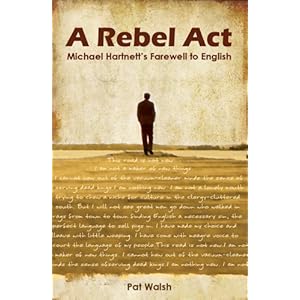
Pat Walsh's "A Rebel Act": Book Review

A Rebel Act: Michael Hartnett's Farewell to English
This biography covers all of this Irish poet's life and career. The subtitle may lead one to believe it's only about the period roughly from 1975-84 when Michael Hartnett's decision to no longer publish his poetry in English gained attention among Ireland's poetry, literary, and critical circles. But the tenth of the book devoted to this phase shows its importance and duration within the poet's 58 years.

Pat Walsh must have read everything ever mentioning Hartnett. His documentation records his consultation of the poet's manuscripts and notebooks, interviews, and press coverage down to quite rare small press publications or ephemeral journalism. He lets the poetry, the poet, and his contemporaries tell as much of the story as possible. Generous excerpts from Hartnett's verses, his own writings beyond poems, and his radio broadcasts also deepen any reader's appreciation of his work. Furthermore, while Walsh tends to stay in the background more as diligent compiler than as a critic with his own take on this difficult-to-categorize man, he judiciously includes criticism which calls Hartnett to task when warranted. For not all of his verses are up to the high standards of his best.

Complementing literary criticism produced on Hartnett, this fuller depiction of a dapper, erudite, coruscating, and forthright poet and presence during the 60s through some of the 80s reveals a deep care for the state of Ireland, regarding its heritage, its commitment or lack of to its long-denigrated "first official language," and Hartnett's determination to demonstrate by his own action his nuanced understanding of not only a language but a way of life and a manner of living and thinking which, for many in his Dublin audiences hearing him declaim his poems, must have been received with a mixture of reactions. Today when national identity, ethnic roots, international treaties, and corporate domination have markedly increased since Hartnett's era, this 2012 study is timely and trenchant. (Amazon Britain + US 7/30/17)


Thursday, May 25, 2017

Elif Batuman's "The Possessed": Book Review

 The Possessed , Elif Batuman (2010)
These garrulous 2010 anecdotes of this Stanford graduate student document how Russian literature permeates the imagination of her peers and mentors. It also shows how unhinged, conniving, and silly academia can be. Nothing new there, but Elif Batuman is also an intellectual, as her Harvard undergraduate preparation shows. She also displays her determination to market herself then as now.

Cadging grants for specious research into Tolstoy's death sets in motion one chapter. Another, the most coherent and slightly less rambling, precedes that in demonstrating how to pitch Isaac Babel in more appealing form than a display of manuscripts in the Stanford library. Here, you get the best example of how Batuman examines herself in relation to her young life's pursuit. She thinks of literature as "a profession, an art, a science, or pretty much anything else, rather than a craft." The tell-tale "pretty much..." signals her habitual preference for the chatty over the sober in her scholarship. It's present, but until the last essay analyzing Devils (fka "The Possessed" itself, it prefers to soft-sell the lit-crit for a coming-of-age assemblage of journalism originally appearing in separate form. It shows. Some information repeats, and the Samarkand stint that's interspersed with the Russian-oriented entries makes the collection lurch about, even if she also links events and thoughts together in revised sections. It's ambitious, and it's certainly more readable, if loquacious.

She's attempting to align her dissertation about "big" novels and the way that they try to make the author's life resemble his or her beloved fiction, as with Don Quixote. "The novel form is 'about' the protagonist's struggle to transform his arbitrary, fragmented, given experience into a narrative as meaningful as his favorite books." Many who do create out of this tension attempt and perhaps fail to answer some of her big "different, insoluble" questions: "Why were people created? Why are all people unhappy? Why are intellectuals even unhappier than everyone else?" No answers emerge.

What energizes Batuman she finds repeated in a reconstructed palace of ice, "the monstrous crystallization of the anxiety that made authors from Cowper to Tolstoy to Mann cancel out their most captivating pages: the anxiety of literature, that most solitary and time-consuming of arts, as irremediably vain, useless, and immoral." This is livelier than much of Harold Bloom, I do confess.

Some of the best parts show off Batuman's eye and ear. Natalie Babel turns "with the expression of a cat who does not want to be picked up." Another woman "spoke in a head voice, like a puppet." One more "chanted in a half-pleading, half-declaratory tine, like somebody proposing an hour-long toast." And, a "few times I saw a chicken walking about importantly, like some kind of regional manager."

As a critic, she attempts to push her education into the greater world, through an extended stay in Samarkand. Her own quest to see if her Turkish fluency and her Russian fascination overlap as she tries to learn Uzbek flounders, for "that didn't make it a reconciliation between the two. When you studied Uzbek, you weren't learning a history or a story; all you were learning was a collection of words. And the larger implication was that no geographic location, no foreign language, no preexisting entity at all would ever reconcile "who" you were with "what" you were, or where you came from with what you liked." A different type of anxiety of influence lurks within this outcome.

When she applies Rene Girard's theory, we return to the diligent doctoral candidate. "According to Girard, there is in fact no such thing as human autonomy or authenticity. All of the desires that direct our actions in life are learned or imitated from some Other, to whom we mistakenly ascribe the autonomy lacking in ourselves." As with ads that feature the beautiful or handsome possessor of the bottle of vodka, this supposed freedom that owner displays means that we are driven not "to possess the object, but to be the Other." This discourages her. Why not stop our pursuit? One novel would be all we needed to disabuse our self from illusion. Love and ambition, what Augustine posited as the "basic premises of literary narrative," would prove failures. Who needs any more scholars "in a world where knowledge, learning, and the concept of difference turned out to be a mirage?" Still, she ends the final entry by claiming if she did it all over, she'd "choose literature again. If the answers exist in the world or in the universe, I still think that's where we're going to find them."

Does this book of occurrences and contemplation succeed? It left me interested in Batuman's argument. It also left me somewhat bemused by her privilege (daughter of medical professionals, Jersey suburb, elite education, and a seeming knack at finagling her way into gaining funds), for she adapts the position of a six-foot-tall misfit. She cannot have been all that inept. I think she bobbles her attempt to parallel her unwieldy structure to Eugene Onegin's "strange appendix that doesn't make sense until later, out of order" but at least she tries to bridge the gap between the common reader seeking insight and entertainment, in what could have been a tired trope, the long march to the Ph.D.
(Amazon US 5/9/17)

Wednesday, May 3, 2017

Alex Beam's "The Feud": Audiobook Review

The Feud: Vladimir Nabokov, Edmund Wilson, and the End of a Beautiful ...
Fame came to Nabokov with Lolita as it ebbed from Wilson after his brief notoriety for the then-racy Memoirs of Hecate County. The two "frenemies" wound up as such, Alex Beam reasons, when the wealthy Russian exile found his comfortable critical and financial perch far above that of the also privileged Wilson. The neediness the emigre expressed to the the literary lion, Beam concludes, had made Vladimir uneasy decades later, and Wilson's attempts to speak truth to the power that became enshrined in VN led EW to try to hold his ground, and lash out, but VN gave better than he got back.

The titular feud began as VN's massive translation-commentary on the supposedly, to Nabokov, untranslatable Eugene Onegin by Alexander Pushkin appeared. Reviewing in the then-nascent NYRB, Wilson, an earnest devotee of Russian but a progressive who sided with the Soviets, rankled the refugee who recalled the Bolsheviks machine-gunning the ship young VN fled on. Not to mention that the Soviets did in his father. So, Beam steadily narrates (via Robert Pullar's at-first hesitant, than warming up to wit in over five hours that felt due to their detail much longer) the trajectory that lifted up VN and drove down EW, after many years of erudite friendship and intellectual banter and support

That support wavered, Beam shows, well before the Onegin fracas that consumed many of the literati of the mid-1960s. EW had little patience for the likes of Lolita; VN. Beam avers, would have had as scant interest in Patriotic Gore, Wilson's in-depth study of the Civil War. Beam introduces each protagonist, documents their alliance, and then dissects their falling out. He keeps the pace lively in spite of dense material. He employs "kiss off" twice, "kooky," and "frenemy" alongside "booted" and "contumacious" and he enjoys the wit that his subjects naturally delighted in as they conducted what VN typically if obliquely given his prickly nature early on called a "friendly" exchange. And it's fun to imagine as some playful Nabokovians do if it was all a game, with VN writing letters to the NYRB and its ilk as EW and he as him, to mock such battles conducted in these journals. Even if it's fiction. 
(Amazon US 4/21/17) 

Thursday, April 27, 2017

"The Enthusiasms of Robertson Davies": Book Review


The Harvard Classics: Enthusiasms of Robertson Davies
This anthology reminds me of the belletrist, when a newspaper or magazine could afford to host an erudite raconteur to relate his likes and dislikes. Robertson Davies' selected book reviews from the middle-on of the last century, originally published in 1979, recall the age of comfortable chairs and book reviews aimed at the discerning common reader. "Is there anyone who does not know something of the life and career of Sydney Smith"?

Well, I confess as with a few of the (once-)celebrated figures he praises, I knew nothing. I skimmed some entries, but I liked their brevity. One indulgence Davies displays is that he may only at the end of a piece mention the work under scrutiny, or its editor or particular features. He's often content to ramble on for a few pages about his own attitude towards the subject. He may rarely cite passages verbatim, and he prefers to meander.

Yet, glimmers emerge of Davies' preference for the twisted, the odd, the misfit, same as those characters he dramatized in his own offbeat fiction. Speaking of Mervyn Peake's "Gormenghast" as a "startling and meaty novel, if you happen to have tired of dreary tales of adultery in suburbia, of the despair of illiterates that have never known hope, of pin-heads who fear that they are incapable of love, or any of the other stock themes of modern fiction," (201), the critic and fabulist commingle.

The third part of this collection takes up Davies' own predilections, but it seemed flimsier than the reviews, and even these, for all their eclectic range, by their compact nature did not allow (as on his fellow muse John Cowper Powys) the necessary depth that would have allowed Davies the space to expand his glimpsed observations and extend his snippets of analysis. (Amazon US 2/3/17)

Monday, November 7, 2016

Rule book or blank pages?


The Hedge School 

Five hoot-calls of an owl awoke me this dawn. Regarding this long in my life as my "totem" despite my recent Apache student's warning that this in her culture reads as a death message, I took this as a pre-Election Day harbinger. Sure, the entrails drawn and stars scryed read victory for Her, but our motley He-men loom, "useful idiots" manipulated for those, the shadow government who pulls our nation down.

Such rhetoric may be hyperbole, but the prophecies emitted over this "long national nightmare," to lift a phrase from the recent past which formed my coming-of-age, meant for me, as I've written before here, a skeptical bent towards the claims of power. Originally I looked to "put not my trust in princes, in man in whom there's no salvation/On the day he departs, his spirit returns to dust/On that day his plans die," to summon up a song from my youth taken from the Psalms. I suppose I toss that world-negating cast within my own prognostications, as I've always been drawn to those abnegating Mr. Dryasdust's norm or the stultifying Laputan, from my Confirmation patron St. Francis to the Irish republicans whose "blood" flows in me from a great-grandfather I discovered less than a decade ago was "drowned in mysterious circumstances" on a Land League 1898 delegation from Co. Roscommon to the city on the Thames.

The past few years, since Occupy, have found me delving into left-libertarian and anarchist thought. I did not know the typological niche in poli-sci where my non-state-socialist-sympathizing (but very suspicious of any political machine's machinations) leanings led me, for while some I respect chose Marx, I wanted a simpler, more egalitarian, transformating energy with room for misfits, seekers, and introverts. Even the milennarian schemes of the democratic left, for me, left not enough space for ambiguity, for a quest into the earthy, the numinous, the intellectual, the intuitive all. I suspect authority and recall the first grade meeting with my mom and my teacher, when she castigated me for the look on my face when criticized or disagreeing, a quirk I'm unable to shake. Even when I think I have a poker face, I don't, according to chagrined colleagues who chuckle, chiding me too late.

But I also mistrust the common herd. They're misled, and voting and democracy while ingrained in me betray the machinations of Her against Bernie, the evasion of ethics, the will to power consuming our people and our planet. Too many capitulate. I'm from the once-lauded, now despised "working class," oddly, the "scholarship boy" defined by Richard Hoggart and then popularized by Richard Rodriguez when I was in college on Pell and Cal Grants. But mortás cine, the pride I felt in Montana among those committed to passing on the ways of the heritage in a climate shunted aside for its lack of shade, is lacking in the city where I was born, far from the centers of the community the diaspora tries to grasp. No less than the bien-pensant elites with whom my more modest wife and my college-educated sons associate with, I suppose my own humble liberal arts pursuit churns me out into a chilly milieu, where nothing the DNC ever does can be equated with Him and His, and where flyover countryfolk are mocked and memed, in ways that these elites would never dare due to those of any other category or identification. Where surnames are summed up and approved lineages calculated and promoted. We're charted, boxes to check for Uncle Sam, and inevitably "identity politics" is used to generate gains for some and losses for others, in a society where nobody's the majority anymore.

Getting students to think about this tires them out. I've tried to integrate subversion, different points of view from an ideological range against the norms, but my students and colleagues are career-driven. As my institution symbolizes, one attends not to ask Big Questions, but to get tidy answers. Few then, want to undermine the paradigms by which they secure careers. The humanities attracts the discontents, but even there, most of those studying them today choose their own conformity of non-conformity, where every standard must be overturn. Instead of reading Shakespeare or Milton to appreciate or attack them, it's expedient to abandon them, and analyze Lady Gaga or the Simpsons. I show the five-minute tale of terror that's Hamlet for Bart, but I also include the play itself, first...

We're all able to enter the liberal arts. But now we're told it frees none; it's for the dead, tainted by a certain complexion or class, that it reeks of privilege. Yet out of it, sullied as it is, emerged those all around the world who wrestled with its tensions, and out of them, responded with their own informed creations. On my native island, some in my family tree might have learned Virgil in a hedge school.

As Daniel Mendelsohn asked in Harper's of his own realization of his same-sex attractions as a teen, a man almost exactly my own age: "Do you identify with what separates you from others, rather than what links you to them?" I paraphrase, but this ranking is one by melanin and genitalia on us, that delegates to the front of the line or relegates to the back, the first last, the last first, on Judgment Day.

Othala

(O: Ancestral property.) Inherited property or possessions, a house, a home. What is truly important to one. Group order, group prosperity. Land of birth, spiritual heritage, experience and fundamental values. Aid in spiritual and physical journeys. Source of safety, increase and abundance. Othala Reversed or Merkstave: Lack of customary order, totalitarianism, slavery, poverty, homelessness. Bad karma, prejudice, clannishness, provincialism. What a man is bound to.


This précis brings me round to the past few months. This blog's found me in hiatus. I've continued to archive new entries as book reviews, but I had to beg off after the end of February, vowing to rearrange my stored-up posts in my spare moments. These proved elusive due to heavier teaching loads, tendonitis, longer commutes, and audio books putting me to sleep after drives, rather than in print. I had also piled up as is my wont a lot of titles to review, and these turned into book reports of sorts, one always waiting due to remind me of my academic production line, and my need to please.

One project, which will be a chapter on the evolution of Irish folk-metal for a forthcoming anthology edited by my friend, Dr. Jenny Butler (now lecturing in Folklore at Univ. College Cork, to the delight of many), kept reminding me of procrastination's Sword of Damocles dangling over my greying head. It also kept in the back of my mind her chapter on neo-Druidry. And my drift to the North, videlicet. 

Finishing that task Mid-Summer's Day, I faced then increased teaching online in two courses of about three-dozen students each the past two terms to consume me, along with onsite courses. These online assignments are heavy, and take up a considerable amount of attention. The failure of my work PC (twice now) led to further tsurris, compounded by slow routers at home and the evasion of storing up much on an older laptop resurrected in a pinch (twice now). And I confess, for pleasure and profit in teaching, that FB has taken me onto its engineered conveyor line (no two times the same, thanks to its design, as we pursue likes, seeing our name over and over, and beckoned to share more "moments").

With my talk on anarchist reactions to the Rising timed for the ACIS-West conference in Missoula, I rushed to finish grading as the rush of finals grew during the gathering. Meanwhile the failure of my PC taken with me to Sea-Tac Airport found me reduced to pecking my Kindle for all things electronic. But I was not as despairing as before, for I'd backed up nothing again on the perfidious, aging PC replacement work issued me, all our laptops, it seems, going down around me in the other cubicles from my fellow toilers. Again, a portent of readiness: a call to hunker in, to stay alert now.

For a few friends I trust, from FB and some crossing over from there or to there from "real life" the past decade of change (what else?) in my quest, have all counseled me separately and lately. Prepare for what is to come. Remember my "warrior" side, shown not in battle (for I who was in the first cohort to sign up for Selective Service, who at 17 wrote to put myself on the record as a C.O. opposed to any state-induced induction, who remains committed to rejecting the order to kill even as I teach those who will never hear of my late-teen choice, my classes of 30-70% veterans, who in turn often must go to the nearby VA, to treat their wounds of body or mind.) but in commitment to justice, to a search for meaning, to a suspicion of cant and an intolerance for imposition of algorithms.

Why I am so comprised, due to nature or nurture, the fates or some genealogical resurgence, I'm stumped by my luck or lack in the DNA lottery. I woke up a few summer months ago with a firm resolve in my mind to pull down the copy of Halldór Laxness' Independent People from my shelf. Maybe as an inbred reaction to counter a hundred-degree heatwave here, but I rapidly decided, after enjoying the first few pages, to halt it to find out more about the Icelandic context. That led me to his biography, and his novel The Atom Station, and then Wayward Heroes, newly translated and reviewed. I like that take-down a lot, of the medieval Christian ethos and of group-think, penned as an adaptation of two sagas during the height of the Cold War, written in the last years of Stalin by a committed Communist who had begun to waver in his own faith substituted for his early Catholic conversion, but who remained, cranky, driven to yearn for rebellion in his fiction, and in his career.

A suitable figure to accompany me, Laxness' other fiction will continue to beckon me. I've also been listening to Saga Thing, a nicely punned podcast devoted to great length of the Icelandic corpus. Think of NPR's "Car Talk" but with discussions of the mechanics of kennings and the breakdowns of order rather than transmissions a thousand-plus years ago, related by skalds of their doughty forebears. I also followed along with Njál and Egil in their titular adventures, getting a sense of the guiding forces propelling their compatriots along. While Jane Smiley's The Greenlanders proved a let-down, at least I finally ended that, as I'd hoped to get insight into the failure of that Norse lot. She also stumbled when updating the Decameron into Ten Days In the Hills, so I guess despite her useful summation of the Middle Ages as great for the creative spark as they combine imagination with rigor, Smiley lacks the knack of vivid depiction of this era. Laxness similarly contended four years against depression in the creation of Wayward Heroes, and its appearance in 1952 was during dark Red hues.

Swinging into the long stretch, I've been musing how Norse ideals and a Northern mythos can or cannot align with a cantankerous mindset of mine unwilling to submit to divine creeds or to entertain the notion of deities revealed to us anymore than they are published by DC Comics or churned out as Marvel blockbusters. My students flock to manga and FPS and cosplay more and more, and I tell them that the gods do live on around us, even as churches dwindle and "nones" increase among them.

My exposure to the North gets me curious. My mother's surname although an Co. Mayo-originating clan--able if in legend to track itself back to not only the brother of Niall of the Nine Hostages but the root of their allies as the Northern Uí Neill, Conchobor Mac Nessa from the Táin itself-- I learned a few days ago may betray a Scandinavian tinge, confusingly. For "fionn" connotes a fair or bright one, conjectured by one antiquarian to derive from the lighter appearance of the "Viking" blow-ins. Not sure how this aligns with the definitely indigenous strain that's 93% of my DNA test, but that 6% Central Asian tinge lingers with a distant confirmation of the shamans and the steppes before the Ice Age receded and Doggerland became drained enough to separate the isles from the Continent. And that 1% East Asian may playfully explain my scholarly and personal curiosity about Buddhism, too.

All this circles round to the past few weeks. I'd naturally gravitated in my reading to see, before this surname find, if the revival of Ásatrú I knew of from Michael Strimska's chapter in Modern Paganism (where Jenny B has her valuable observer-participant account of Irish neo-paganism) might be worth a revisit. I reviewed the book a few years ago, and it struck me that only stregheria, the sorcery line in Italy, had arguably survived the Christian crackdown, despite the earnest claims of many that their so-and-so had sustained the Craft in the so-called Burning Times with the romantic or rhetorical excesses that accompany that epoch in New Age tellings. My medievalist training may mean I'm inoculated against rose-tints. I found Strimska's subsequent disavowal of the American folkish contingents of "the native European spirituality" advocated as Ásatrú instructive. As my next document, Stephen McNallen's eponymous primer and survey, confessed if between the carefully phrased lines, the end of the last century found those seeking this controversial path divided between those encouraging all, the universalists, and those folk restricting entry to those descended from the Germanic, Scandinavian, or a bit strangely to me, the Celtic peoples. As the Celts have never been a "racial" (sic) but a linguistically related congeries, the argument of "bloodline" gives me pause. My review elaborates on this and related issues. McNallen's Ásatru Folk Assembly stands for this stance.

I've been mulling this over, as is common for me, the intellectual and the personal quest entangling. The Israeli historian Yuval Noah Harari's Sapiens reminds us of the power of "invisible fictions," the concepts sparking links beyond the forager that make our modern realm possible. His subsequent Homo Deus warns of a post-modernism too eager to make us into immortal gods, a reification of the aura that entices heathens towards a hallowed promotion into a deathless realm. Harari suggests the appeal of polytheism for the ancients lay in its corporate loyalties and branding opportunities for the Assyrians, say, or Egyptians, a clever concept. I suppose pantheism, for their own ancestors, felt too diffuse, too localized. The imperial implications of the warrior cult, the Indo-European migrations, appear to complicate the ur-path of the pagans. An anarcho-primitivist critique ends with a boost for the animists. The short-lived Circle Ansuz attempted to take down McNallen from an Antifa angle.

Where I stand on this is under construction, as the sign says. I oppose open borders and approve population reduction for ecological and moral reasons. This puts me at odds with the left. I recognize multicultural realities and encourage exploration of knowledge by whomever wishes to learn. This may distinguish me from the right. But as Harari gently admits, the discredited "evolutionary humanism" of the past century, no less than the "socialist" version attacked, merits consideration, alongside the dominant paradigm of the Whole Foods crowd, liberal humanism. While I took a quiz to find I'm "93%" humanist, as my friend, a fervent atheist if of the Irish Catholic strain also got the same score. So even he mused what might lurk within him, as with me, to tug me towards the mystic.

I understand the consequences of assimilation into our current tossed salad (and this non-meat eater hates lettuce), where even if a European flavor's evident, it's swallowed up in spice and rice, so to say! Monocultures loom, as we're schooled to embrace the Other and we're getting used to portrayals of blends of families and couples never seen aired a few years ago. My students and my neighbors reflect this process. If I teach a story by Joyce or the myth of Plato's Cave, I'm not expecting those only who share my genome or continental origins to be enlightened by their revelations. In fact, I'm increasingly the only one "not of color" in my working environment. Still, I feel the legacy weaken.

That is, for whomever wants to find it, I sense an abandonment of this storehouse of folly and wisdom. Listening to David Hyde Pierce's masterful reading of Gulliver's Travels, the raw disgust and sly satire cutting back any pastel tints of its "children's book" set-up, I reflected I'd read it in high school. I couldn't imagine my current college crowd handling this, even with generous footnotes.

The capacity for comprehension of this, of Huck Finn, of 1984, of Mary Wollstonecraft and Zora Neale Hurston for that matter, seemed distant. If I was teaching where my sons earned their degrees, it'd be different, but even there, reading dwindles. The haunting scene of Marcel Theroux's Far North comes to mind. The heroine, representing the last of our progeny in this era, begins to forget the few constellations she can dimly discern. Civilization collapsed, she faces her fate in the ignorant dark.

So, who gets first dibs on admission to the word-hoard, the barrow-treasure, the sea-chest? For my choice, anyone who wants it, for we all pay homage to that enrichment. So, is that any different for following a way attributed, or more realistically to me, reconstructed from the shattered remnants of what's known to "our extended kin," as a welcome companion--on the bus ride through Irish traces evident still in Montana, to my inbred surprise and inner spark--phrased our common vision-quest?

As a long-suffering adult learner of Irish, one who tries from a great distance to recover my own meaning in part from my island's lore, I recognize the isolation of the seeker. Nobody around me shares my longing, nor communes with my invocations. A few out there advise and commiserate, mostly from the homeland, and two of them have in fact emigrated there from here, for that decision.

My family around me's from another upbringing, and one I accept and value as do my wife and sons. But mine's a different variegation. Its tendrils wind around me alone. I've been called silly for my search, as if for some 'red-haired colleen,' and chided for my inattention to my Los Angeles reality. But I'd never have been here if not born here. As dodgy "metagenetics" as McNallen phrases it, if in fealty more to Jung than science, does resonate despite reason. That Montana encounter endures as what the Swiss magus might label a "meaningful coincidence," of what calls within the lost soul beneath the pessimistic, analytical, and scrutinizing mind. Within, I also shelter an "anima," after all.

My internal jury's out debating this. (I can hear the strident tones of the likely ruler of a nation I increasingly feel disenchanted from, coming down from the t.v. above me. The promise of a midnight rally with Lady Gaga emanates. After sixteen months, there's eight years to go. Twitter tweets and fat-shaming, blaming and railing, comedy appearances and SNL gigs constitute what Lincoln and Douglas debated in their high-falutin' tones, albeit schooled in the classics.) I sit here and type away, in thought. I also recognize the othala, the inheritance rune I've seen in net searches popping up for a reconstituted clan, the "vikelt." While my post-Catholic affinities cause me not to adapt its Scandinavian design as a cross-flag, I recognize the green-and-gold colors that remind me of a land only once-removed from me. It's a construct I've not been able to trace, but it signals some echoes.

John Moriarty, whose voluminous and verbose texts ranged across the stories of cultures all over the world, nevertheless attempted in his Ireland in his last years to establish 'a Christian monastic hedge school' in his native Kerry. I imagine given his formidable eclectic mysticism it'd have defied that classification. His final attempt at convincing his countrymen and women, Invoking Ireland, sought to recover that fragile, thin voice as one like mystic him must have heard, not only at Samhain. My one generation is all that's here and the rest, for hundreds of such spans, rested and roamed in other lands and over another island, even before maybe it was an island. Drawn backwards to that dreamtime, one the scholar turned gardener Moriarty penetrated diligently if densely, I think of what's deemed The Hidden Lives of Trees and I imagine them as "fossils of time" even if a sensible FB pal sneers at my Robert Graves-like position. When lemon orchards fell in my childhood landscape, and tract homes and a freeway replaced where I'd played, I felt a loss as if a parent died. That gap in my youth may gash me in dreams tonight. Overcoming divisions of geography, class, and "race," do I gravitate back for grounding in the nature-nourished? What can an egg-head like me recover there?

As the definition demonstrates above, that Othala rune carries in it both affirmations and inversions. Germanic peoples know the cost of the latter towards the twisting of concepts for evil. Our ancestors likely labored as thralls, or slaves, some sent from Ireland to Iceland. Kings and heroes fill the chronicles, but as Laxness characterizes, stupidity and superstition accompanied voyages and accumulated plunder snatched from the suffering, our probable true bloodline, those defiant against power and then made, as the Odin Brotherhood purportedly commemorates, a persecuted and murdered line of "pagans" refusing the crozier's domination or the crown's domain. This may be a clever conceit for those too elevated to open Dan Brown (myself included).  Given how I resent order not chosen: can one be happy in a pre-modern regimen one undertakes to carry on? Can I--who reckon deities as emanations of our common yearnings, and our inbred projections for making sense out of the confusing, the depressing, and the perplexing-- find fulfillment in alliance with kinfolk?

Last night, before beginning my return, this time on audio, to a attenuated and sinister evocation of secret societies in David Mitchell's ambitious tale The Bone Clocks (I anticipate from the start it'll improve in the hearing as I found the reading of it engaging but enervating), I listened to Méti investigator Mark Wolf's interview about his 2013 follow-up to Mark Mirabello (see above link) on the Brotherhood. It rambled, but Wolf's acknowledgement of the blank pages opened for an adept in heathen paths as opposed to the monotheistic "rule book" conjured a useful metaphor. Increasingly, as with left-libertarian or Buddhist, anarchist or conventional ideologies, I seek the dim light between their cracks, the marginalia, the empty spaces. That may hearken a more solitary quest for me ahead.

Tuesday, November 3, 2015

"Flann O'Brien & Modernism": Book Review

The Irish writer born as Brian Ó Nualláin and best known under one of his many assumed names as Flann O'Brien has long been championed as a harbinger of post-modernism. Literary scholars scrutinized his life as a Dublin newspaperman and his relatively few fictional publications as proof of his eccentric genius, if as a talent overshadowed by a predecessor he both cultivated and resented, James Joyce. Their conventional wisdom lamented Brian O'Nolan the journalist/ O'Brien the fabulist as succumbing to ennui, drink, and hackwork, squandering subversive skills premiered in the novels At Swim-Two-Birds and The Third Policeman at the end of the 1930s. His modernist credentials, by contrast, have often been diminished.

So claim the fourteen participants from a University of New South Wales seminar commemorating the 2011 centenary of O'Brien's birth. Choosing not to focus on his life as Brian O'Nolan but on his works under many names, usually that of Flann O'Brien, professors expand their papers into academic essays. As with Maebh Long's "Assembling Flann O'Brien" (reviewed by me as "Making Sense of Nonsense", 14 April 2014) from the same publisher earlier this year, a reader may wonder what the author, who so gleefully and bitterly lampooned scholarship, would make of so many studious, posthumous tributes.

As co-editor Rónán McDonald explains, Brian O'Nolan's works elude genre conventions. O'Nolan's refusal to stay pinned down transcends his career as a civil servant in Dublin during the middle of the last century. His occupation impelled his taking on other names to disguise his mockery of the Irish government, its bureaucracy, and their mission to make the Irish language one that English-speaking natives would be compelled to learn. Furthermore, O'Brien, who as Myles na gCopaleen also penned witty columns for the Irish Times, ridiculed his nation's clerical and lay authorities, the humbugs and scolds around him, and the dull "Plain People of Ireland". He refined this raw material by savage wit.

McDonald introduces his essay on The Third Policeman's nihilism by summing him up: "His views and attitudes are shrouded in irony, ambiguity, linguistic play, ingenious obfuscation. There is abundant satire in his novels, as in his journalism, though the po-faced scholasticism of Flann contrasts with the populist posture of Myles. He lampoons patriotic Gaels in An Béal Bocht, the mythologies of the Irish Revival in At Swim-Two-Birds, finicky academicians in The Third Policeman." He loved to put down pretentiousness but he shied away from confrontation. Flann was more bold than Myles; his various personae masked his eccentricities even as they encouraged them.

Certainly, as contributors emphasize, O'Brien's disguises allowed him to sidle into arcane and odd controversies which he incorporated into his experimental fiction. Sean Pryor examines the influence of St. Augustine, and how good needs evil so God's creations can appreciate better their happy times; John Attridge compliments this approach with a study of O'Brien's use of Augustine of Hippo. He is a central character as is James Joyce, both in altered form, in O'Brien's last novel, The Dalkey Archive, published two years before O'Nolan's death in 1966. Augustinian notions of "sociable lies" reveal a slippery quality, in ethics as well as characterization, which warps scholastic satire into twisted plots.

Instability inspires the next three essays. Stefan Solomon investigates the relative failure of O'Brien's theatrical efforts to convey what in At Swim-Two-Birds succeeded as a subversive revolt of its tetchy characters against their scheming author. Solomon and Stephen Abbitt, regarding Flann's tribute to and travesty of James Joyce, agree that O'Brien emerges as a "reluctant modernist", contrary to most academic predecessors who have preferred to situate him among post-modernist literary pioneers.

However, as David Kelly insists, O'Nolan's many guises shared an "innate faculty for finding things funny", anticipating the post-modernist, mid-twentieth century "literature of exhaustion". Flann's repetition of his material attests to his living late enough to deal with the trauma of the past century in a more detached, obsessive, and playful manner. After all, he did not have to relive the difficulties of the early century, Kelly avers. In his ludicrous and bizarre creations, Flann is instead a harbinger of his century's "generational shift" away from recreating torment. Instead, post-modernist authors tend to mock, invert, and tease the pain of isolation and the power of obsession, through parody or irony.

These selections examine certain works from O'Nolan's varieties of names and works, but they bypass many others. The three novels cited above by McDonald garner most attention, but The Hard Life: An Exegesis of Squalor (1961), considered his weakest novel, gets two asides. As with Myles' prolific newspaper columns, under-examined here, a study of the strained attempts at satire in O'Nolan's later career, writing as Flann, might have balanced the general acclaim granted by contributors to his successful works. One needs to know where and how O'Nolan lost the plot.

The next set of entries roam into the linguistic methods employed by Flann O'Brien. Maebh Long  repeats some material from her recent book. She focuses here upon An Béal Bocht, to show how Flann's use of the Irish language addresses, or subverts, vexing preoccupations of naming and identity among conflicting Irish-speaking cohorts. Long compares Patrick Powers' 1973 translation as The Poor Mouth of this novel, by Myles na gCopaleen; her essay ends a bit eccentrically, if fittingly for this material, which evades cohesion even for the Irish-fluent reader, undoubtedly as its intention.

A peer of O'Nolan's, the poet Patrick Kavanagh, also jeered at the Irish government's propaganda about the doughty Gaelic peasant. Joseph Brooker compares Kavanagh's approach with O'Brien's.   Kavanagh and O'Brien's predecessors, Samuel Beckett and Joyce, connect via O'Nolan's marginalia in his copies of their works, as Dirk Van Hulle explains. These authors share an interest in parallax, "Chinese boxes" as nested narratives, and regression in theme and structure in their literary creations.

Regression and mathematical patterns via numerology in At Swim-Two-Birds, as Baylee Brits demonstrates, document O'Brien's scientific and technological interests, in the next section of essays. The coupling of mechanical devices and eerie inventions within The Third Policeman, as McDonald shows, represents darker corners of O'Brien's textual labyrinths, which continue to disorient readers.
The pull into infinity and regression reveals the abysmal and the dismal; co-editor Julian Murphet charts the tension between Myles the journalist and Flann the fabulist as he conjures up pataphysics and other esoteric send-ups of rational analysis, within O'Brien's fictions exposing a psychic death drive. The compulsions many of his characters exhibit pushes their pursuits beyond entertainment.

This aspect, the haunted quality within this troubled writer, does not earn the biographical context which Anthony Cronin's 1989 biography, No Laughing Matter, treated with compassion and insight. But, readers familiar with O'Brien's life and works already (a prerequisite, as little more than a nod to this background is given by the contributors or editors) will learn from Sam Dickson about Flann's propensity for fictions full of "hard drink". This compliments co-editor Sascha Morrell's congenial foray, as she aligns O'Brien's treatment of alcohol with the Australian writer Frank Moorhouse's The Electrical Experience: A Discontinuous Narrative (1974), about a soft drink maker Down Under. Culture and commodity feature here and in the final two, atypically off-beat (even by O'Nolan's standards) essays revealing Flann's range and curiosity. 

Mark Steven examines "aestho-autonomy" through At Swim-Two-Birds' Dermot Trellis. Trellis seeks solitude, to pursue masturbation. Steven frames this ambition as a "formal and narrative act", thus indicative of the political and economic stagnation in the new Irish Free State for which O'Nolan labored. Physical exertion, onanism, gender roles, and male potency also seeped into none other than the bicycle seat, as that machine and its rider merged, in O'Brien's The Third Policeman in forms that this short review cannot elucidate. Suffice to say that these learned essays may encourage the reader to take down O'Brien from the bookshelf. After perusing the ruminations of a coterie of his critics, why not enter, for the first time or another time, into the fictions of Flann O'Brien, Myles na gCopaleen, and various odd characters his writer wrote as, and about? The Irish labyrinth awaits you. (10-1-14 to  PopMatters)
Chapter 1 Making Evil, with Flann O’Brien
Sean Pryor, University of New South Wales, Australia

Chapter 2 Mythomaniac modernism: lying and bullshit in Flann O’Brien
John Attridge, University of New South Wales, Australia

Chapter 3 ‘The outward accidents of illusion’: O’Brien and the Theatrical
Stefan Solomon, University of Sydney, Australia

Chapter 4 The Ghost of ‘Poor Jimmy Joyce’: A Portrait of the Artist as a Reluctant Modernist
Stephen Abblitt, La Trobe University, Australia


Chapter 5 ‘Do You Know What I’m Going to Tell You?’: Flann O’Brien, Risibility and the Anxiety of Influence
David Kelly, University of Sydney, Australia


Chapter 6 An Béal Bocht, Translation and the Proper Name
Maebh Long, University of the South Pacific, Fiji


Chapter 7 Ploughmen Without Land: Flann O’Brien and Patrick Kavanagh
Joseph Brooker, University of London, United Kingdom

Chapter 8 Flann O’Brien’s Ulysses: Marginalia and the Modernist Mind
Dirk Van Hulle, University of Antwerp, Belgium


Chapter 9 ‘Truth is an Odd Number’: Flann O’Brien and Infinite Imperfection
Baylee Brits, University of New South Wales, Australia

Chapter 10 ‘An astonishing parade of nullity’: Nihilism in The Third Policeman
Rónán McDonald, University of New South Wales, Australia

Chapter 11 Flann O’Brien and Modern Character
Julian Murphet, University of New South Wales, Australia

Chapter 12 ‘No unauthorized boozing’: Flann O’Brien and the Thirsty Muse
Sam Dickson

Chapter 13 Soft drink, hard drink, and literary (re)production in Flann O’Brien and Frank Moorhouse
Sascha Morrell, University of New England, Australia

Chapter 14 Flann O’Brien’s Aestho-Autogamy
Mark Steven, University of New South Wales, Australia


Chapter 15 Modernist Wheelmen
Mark Byron, University of Sydney, Australia - See more at: http://www.bloomsbury.com/us/flann-obrien-modernism-9781623568504/#sthash.Z1ncj15a.dpu
Chapter 1 Making Evil, with Flann O’Brien
Sean Pryor, University of New South Wales, Australia

Chapter 2 Mythomaniac modernism: lying and bullshit in Flann O’Brien
John Attridge, University of New South Wales, Australia

Chapter 3 ‘The outward accidents of illusion’: O’Brien and the Theatrical
Stefan Solomon, University of Sydney, Australia

Chapter 4 The Ghost of ‘Poor Jimmy Joyce’: A Portrait of the Artist as a Reluctant Modernist
Stephen Abblitt, La Trobe University, Australia


Chapter 5 ‘Do You Know What I’m Going to Tell You?’: Flann O’Brien, Risibility and the Anxiety of Influence
David Kelly, University of Sydney, Australia


Chapter 6 An Béal Bocht, Translation and the Proper Name
Maebh Long, University of the South Pacific, Fiji


Chapter 7 Ploughmen Without Land: Flann O’Brien and Patrick Kavanagh
Joseph Brooker, University of London, United Kingdom

Chapter 8 Flann O’Brien’s Ulysses: Marginalia and the Modernist Mind
Dirk Van Hulle, University of Antwerp, Belgium


Chapter 9 ‘Truth is an Odd Number’: Flann O’Brien and Infinite Imperfection
Baylee Brits, University of New South Wales, Australia

Chapter 10 ‘An astonishing parade of nullity’: Nihilism in The Third Policeman
Rónán McDonald, University of New South Wales, Australia

Chapter 11 Flann O’Brien and Modern Character
Julian Murphet, University of New South Wales, Australia

Chapter 12 ‘No unauthorized boozing’: Flann O’Brien and the Thirsty Muse
Sam Dickson

Chapter 13 Soft drink, hard drink, and literary (re)production in Flann O’Brien and Frank Moorhouse
Sascha Morrell, University of New England, Australia

Chapter 14 Flann O’Brien’s Aestho-Autogamy
Mark Steven, University of New South Wales, Australia


Chapter 15 Modernist Wheelmen
Mark Byron, University of Sydney, Australia - See more at: http://www.bloomsbury.com/us/flann-obrien-modernism-9781623568504/#sthash.Z1ncj15a.dpuf
Chapter 1 Making Evil, with Flann O’Brien
Sean Pryor, University of New South Wales, Australia

Chapter 2 Mythomaniac modernism: lying and bullshit in Flann O’Brien
John Attridge, University of New South Wales, Australia

Chapter 3 ‘The outward accidents of illusion’: O’Brien and the Theatrical
Stefan Solomon, University of Sydney, Australia

Chapter 4 The Ghost of ‘Poor Jimmy Joyce’: A Portrait of the Artist as a Reluctant Modernist
Stephen Abblitt, La Trobe University, Australia


Chapter 5 ‘Do You Know What I’m Going to Tell You?’: Flann O’Brien, Risibility and the Anxiety of Influence
David Kelly, University of Sydney, Australia


Chapter 6 An Béal Bocht, Translation and the Proper Name
Maebh Long, University of the South Pacific, Fiji


Chapter 7 Ploughmen Without Land: Flann O’Brien and Patrick Kavanagh
Joseph Brooker, University of London, United Kingdom

Chapter 8 Flann O’Brien’s Ulysses: Marginalia and the Modernist Mind
Dirk Van Hulle, University of Antwerp, Belgium


Chapter 9 ‘Truth is an Odd Number’: Flann O’Brien and Infinite Imperfection
Baylee Brits, University of New South Wales, Australia

Chapter 10 ‘An astonishing parade of nullity’: Nihilism in The Third Policeman
Rónán McDonald, University of New South Wales, Australia

Chapter 11 Flann O’Brien and Modern Character
Julian Murphet, University of New South Wales, Australia

Chapter 12 ‘No unauthorized boozing’: Flann O’Brien and the Thirsty Muse
Sam Dickson

Chapter 13 Soft drink, hard drink, and literary (re)production in Flann O’Brien and Frank Moorhouse
Sascha Morrell, University of New England, Australia

Chapter 14 Flann O’Brien’s Aestho-Autogamy
Mark Steven, University of New South Wales, Australia


Chapter 15 Modernist Wheelmen
Mark Byron, University of Sydney, Australia - See more at: http://www.bloomsbury.com/us/flann-obrien-modernism-9781623568504/#sthash.58blLTNi.dpuf

Wednesday, October 28, 2015

Terry Eagleton's "Culture and the Death of God": Book Review

Terry-Eagleton-Culture-of-Death
I figured, despite the difficult content, that hearing these lectures on audiobook might ease their delivery. I like Terry Eagleton's work, and I always mean to read more. The Meaning of Life, for instance, is on my Kindle, where I am saving it up still, having already studied its final chapter.

But the subject matter is challenging. Eagleton's wit is subdued, after early on a joke at the expense of Birmingham. He hones in on not the "death of God" so much as his replacement, high European culture. The kind of thinking that George Steiner represents the last generation to have espoused.

This arose earlier than the Enlightenment, but that period, for the French and the Germans, gave it its fullest diffusion. Many Germans crowd these pages, along with the sometimes somewhat more familiar French. Eagleton looks down on the likes of Diderot and Voltaire, for they suffer the hypocrisy of many of their peers. For they speak a 'double-truth': they claim the masses need religion for its calming messages and social utility. The elite, of course, can rise to a higher worship of reason.

Yet, as Eagleton astutely notes, Deism roused no martyrs. He constantly defers to, or better still champions, the Gospel message as liberation theology (even if he steps aside from this phrasing). His Christ comes to afflict the comfortable and to condemn the authorities, taking up the side of the poor.

If one wonders if this is a selective interpretation of biblical verses, one will end this book unenlightened. Eagleton employs these talks to promulgate his own insistent reading of Jesus as a revolutionary. As the modern times impinge, and Nietzsche's own shameful (in Eagleton's view) capitulation to the 'double-think' standard proves that even he is not worthy of acclaim, the book shifts into a rapid look at those such as T.S. Eliot who attempted to make the aesthetic the norm. But, being Christian, that cohort also falls short for Eagleton. He wedges into our own age, divided between a secularized and educated class and many billions (some with degrees and high incomes, surely, a factor he skims past) who continue to integrate, however irrationally to this professor's rigorous if somewhat numinous preferences for his own Christ-figure, faith with achievement.

Eagleton nods to the resurgence of Islam and Christianity in many poorer parts of the world, not so much again as forces calling for the kind of radical overthrow of the power system, but more as a way to live in a complicated world more simply. I reckon more on Marx might have helped his explication, but his promotion of Nietzsche as the central figure in this short study leaves us moderns somewhat imbalanced. After a lively if brief look at earlier Irish dissident (if renegade Protestant convert) thinker John Toland, the reader wants more such figures to energize these dense chapters.

Instead, it's less intoxicating. Eagleton crams a lot into these sections, but he often does not explain who the figures are beyond their dates of birth and death, leaving a reader (and even more a listener) curious or confused. Some transfer of lofty content to a common if smart reader was necessary, but these lectures, transcribed as I suppose they originated, go over the heads of many who could have benefitted from a more streamlined, listener-friendly, version of what remain engaging ideas and an intellectual history on a topic that an audience needs to hear, as believers, skeptics, or seculars. 
(Amazon US 10-30-15. P.S. 2012 interview at the Oxonian Review with Eagleton on this book)

Friday, October 16, 2015

Paul Strohm's "Chaucer's Tale": Book Review

A "microbiography" of the poet's pivotal year of 1386, Chaucer's Tale reconstructs his situation as he entered a mid-life crisis. Enjoying a rent-free lease on a dank but well-situated residence at London's Aldgate portal, benefiting from a position in Parliament, and supported by a salary as a customs controller, in his early forties, Geoffrey Chaucer would seem to have it made. Depending on noble patronage and royal preferment, this up-and-coming civil servant-turned-insider at court found himself on the outs. On the losing side, he retreated to Kent and then crafted his tales of Canterbury. Forced retirement compelled him to reinvent himself.

Paul Strohm, a retired professor from Oxford and from Columbia, enlivens the London where Chaucer was born and raised. Nearly nothing is known of his literary career from the records extant, but much is about his work for the Crown. From the hints scattered or imagined in his verse, scholars construct a parallel life in private to that of the public man who worked his way into favor, slowly.

His stony, damp cell above the key position of Aldgate in the northeast corner of the old city stands as a "symbol of his entire London experience: rather blatantly public in some respects, yet quite private and defended in others". Chaucer's intense activity contrasts with his withdrawal and retreat from the hubbub. He occupies the intersection between the urban fortified wall and the busy road into the countryside. Strohm sets Chaucer's day within hearing of church bells, from dawn to midnight at Holy Trinity Priory, near his residence. Strohm reminds us of Chaucer's placement near this pattern of liturgical time, daily followed by the monks, and of his affinity for the seasonal cycle of pilgrimage and of devotion, coinciding with the natural rhythm of springtime which opens his tales memorably.

This narrative moves back and forth in Chaucer's lifetime somewhat, to fill in the back story. In 1374, Chaucer's appointment as controller of wool customs put him into a much loftier role than that title may convey to modern audiences. The wool trade dominated English commerce as its "only significant export item". Chaucer's complicity with corrupt merchants and bureaucrats to skim off the profits was expected by his betters, if implicitly. For, his wife's brother-in-law was John of Gaunt, who had ruled as regent, being Richard II's uncle. This had its advantages, but these could prove fickle. Chaucer depended on those higher up for the favors they dispensed and as a commoner he had to accept as he moved up the career ladder more than one "constrained choice", in Strohm's phrase.

Strohm pursues clues in the archives, and digs deep into material that may appear tangential. This may weary some readers, but he uses this data to suggest that Chaucer was not tempted by any great chicanery during his customs watch. Strohm avers Chaucer laid low as London's power elite colluded to enrich themselves from the wool tariffs pocketed and from the bribes exacted from tradesmen. Chaucer did not own land. He had been set up in a safe seat as a "yes man" for King Richard II.

This necessitated Chaucer's withdrawal from the customs post. He was recently estranged from his wife. He had to vacate Aldgate, for his single term in Parliament as a "shire knight" lacking property but representing nearby Kent. This office depended on Chaucer as a loyal backer of John of Gaunt and of the Ricardian factions, but from the time Chaucer entered Parliament through 1389, discontent grew. A majority in government resented the king's control by a few courtiers. Strohm interprets this hostile course of events as shoving aside Chaucer. He prudently absented himself from London during the next two years; some of his former allies turned malcontents were executed by Richard II.

Throughout this intrigue, Strohm tries to keep the tone in tune with us. He uses the phrase "living large", he compares the Parliament's politicians in session back then to those on expense accounts at bars in Pimlico or the Beltway, he nods to the attractions of the Las Vegas strip, and he offers an analogy to Hemingway's novella about the great marlin. These asides do not jar as much as one might expect. The liveliest sections, about Aldgate and about the making of the Canterbury Tales, rush by rapidly. More on Chaucer's most famous work would have been welcome, but Strohm's end notes point to his fellow scholars who have contributed much to our understanding of this story-cycle. After all, Strohm has set himself the difficult task of setting up the assembly of the tales, not their contents themselves. Meanwhile, he reminds readers of its fine predecessor, Troilus and Criseyde.

With "no fixed job and insignificant income", Chaucer decided on not a political but a literary "riposte" to his fall from favor. "Chaucer in 1386 was eminently fame-worthy...but certainly not famous yet." Strohm shows how his forced relocation and his separation from his urban audience sparked innovation. Eager to expand his reputation, Chaucer's hidden rivalry with Italian tale-teller Boccaccio spurred the Englishman to write in his native language its first lengthy masterpiece. Strohm regards the tales as a catalyst for an "audience of his own invention" as varied storytellers became characters, emerging to share a mixture of genres and styles, high and low registers, serious and comic narratives. In Strohm's version, Chaucer had to leave London and his comfortable sinecures. By doing so, and starting all over as a writer bent on making his reputation, he attained fame after all. This account reminds us of the impact Chaucer had, by choosing our own language.
(PopMatters 2-16-15; Amazon US 2-20-15)