Showing posts with label DNA. Show all posts

Saturday, February 3, 2018

John Lennox's "God's Undertaker": Book Review

Front Cover
I read this right after David Bentley Hart's The Experience of God: Being, Consciousness, Bliss. That formidable study in an endnote directed me to the somewhat (until the math and biology kicked in halfway) more accessible God's Undertaker investigating if religious inquiries trump materialist dogma as to if an intelligence (steady there--as agency or impetus rather than design per se?) might be discerned. John Lennox, as a professor of mathematics and fellow in the philosophy of science at Oxford, handles data confidently, adroitly, and commendably with modesty tempered from both and all sides. I did enjoy his witty analogies summing up the various ways science itself calculates the immense odds against our being here at all. And it's not merely the Anthropic Principle all over again.

He nods often to a bete noire of the New Agnostics, Michael Behe. I admit this straightaway, as this will already cause many to write off Lennox. He credits Behe's 'edge of evolution' imagery supporting an originator outside time and space generating evolution as "less random that is often supposed." He denies, however, this is the God of the Gaps yet again. You can read far more context than I can sum up at exactly the halfway point of the book (I refer to my Kindle page 320/638).

A bit later on (61% 391/638), Lennox repeats a helpful analogy that "the message is not derivable" on a printed page "from the physics and chemistry of paper and ink." These are deep waters, but he's discussing that the DNA code sequence's "order is not due to the forces of potential energy. It must be as physically indeterminate as the sequence of words is on a printed page." The vexing predicament of how to solve "biogenesis" by "a simple-minded appear to Darwinian-like processes" comes down to how the mutating replicator modelled by Dawkins could "even get going in the absence of life" and set in motion natural selection. At 56% 358/638, Lennox quotes Stephen Meyer: 'What needs to be explained is not the origin of order... but the origin of information." This sets up his main focus.

It got a bit easier, and more memorable for me, after his curated array of those witty analogies. The typing monkey argument dating back to Huxley vs. Wilberforce in 1860 Oxford asked whether random apes would eventually peck out one of Shakespeare's poems--or even an entire tome. Lennox avers this is unlikely the provenance as not until 1874 did typewriters hit the market--typical of the author's attentive eye! Regardless, a simulator since 2003's generating a monkey every second hitting a key, with 100 original chimps doubling every few days adds up (in the book's 2009 revision) to the then-current record of "24 consecutive letters from Shakespeare's Henry IV produced in 10^40 monkey years (the age of the universe is estimated at less than 10^11 years)." (68% 438/638)

Other memorable comparisons: the odds of us being here as is=a coin being hit by a shot from across the 20 billion light years "halo"; if coins stacked up across the American continent (or is the nation?) as high as the moon, and this was repeated on a billion more continents, what if a red-marked coin was placed by you at random? And if your friend found it first go when you challenged her, that'd be the odds of what some (if not in this book, curiously) call our own "Goldilocks" just-right universe.

Three-quarters of the way (484/638), Lennox wonders why scientists are able to accept, say, alien presence if SETI received a sequence of signalled prime numbers, yet they deny intelligent agency when it comes to similar deductions gathered in this book from a wide variety of academic experts. "We instinctively infer 'upwards' to an ultimately intelligent causation rather than 'downwards' to chance and necessity." He mentions that in the film Expelled, even Richard Dawkins appears to "have moved his ground towards admitting that design is something that, in principle, could be recognized by science." I looked this up and apparently he and fellow atheists claimed they were duped into appearing in this 2007 documentary. I'd add that Lennox relying on the supposed conversion of Anthony Flew very late in his long life has similarly been criticized for believers taking advantage.

[I am between a 4 and 5 star {on Amazon} but given the Flew incident already happened prior to the revision, this influences my rating down; I am unsure if this revision came before or after the post-Expelled disclaimer by Dawkins and other scientists, so Lennox gets the benefit of the doubt there.]

This is a diligently and incredibly complex summation of the debate about whether "science has buried God." John Lennox stays honest, recognizing his and his colleagues' limitations alongside their expansion of what reason and care have discovered, by the wonder of mathematics and physics. He concludes that "far from science having buried God, not only do the results of science point towards his existence, but the scientific enterprise itself is validated by his existence." (87% 560/638)

I approached this with no preconceptions. I've studied the big names from the opposition of late, and I've (as with Hart and Francis Collins) balanced religious adherents who've accounted for themselves in these debates. The analogies for me sparked my imagination most, but those with more ability in the maths and sciences will want to turn to the data Lennox sifts and scrutinizes. He keeps an approachable tone through dense discussion, he quotes liberally and helpfully for the greater public, and he evaluates evidence and methods from all comers. Worth your attention. (Amazon US 1/23/18)

P.S.This first pdf is a simple outline of the book. This second pdf sums up the documentation, quotation, and summarization page by page. This third pdf is the entire 2009 revised edition.
P.P.S. In Steven Pinker's forthcoming Enlightenment Now, he offers an unanswerable riposte to fine-tuning, which has occurred to me often. What if we're the Powerball lottery winner, and that's enough? We should count our luck instead of our blessings, that we beat the odds against us.

Sunday, March 12, 2017

Cradle Catholic

"I was educated in public + parochial schools in L.A. and was raised very Catholic. I was taught by and still know many devoted people, lay and clerical. I am no longer practicing, and the family I have married into and raised two sons in is not Catholic. I weigh the good the Church has done with the bad; I stand apart. BTW, 1/10th of Americans are ex-Catholic. If not for immigrants, the parishes would be empty indeed in many places. As w/ Ireland now." 
I posted this on a Facebook feed after a friend there, a native of Dublin now living about 30 miles east of me, reflected on raising his children non-Catholic. He and his wife were cradle Catholics.

Another friend, whom I admire for his principles hard-won and doggedly expressed against threats of violence to him and his family, assists his local St. Vincent de Paul charity in his Irish small city. He reasoned that in the absence of state assistance, the poor and the neglected earn their keep and their minding from volunteers such as himself. I accompanied him on his rounds, as two men are assigned to go together to avoid any disrepute. Although an articulate and vehement non-believer, his background, like nearly all the Irish friends I have, remains embedded in our tribe, our "romish" clan.

A week ago, I received an Ancestry DNA test to take. Lacking knowledge of my genetic history in the absence of contacts, my wife suggested I spring the $100 for this. It will match my autosomal DNA with any others in the pool at that site. Unfortunately, there's no one database. FamilyTreeDNA is a rival, with its own tests and participants. And then there's Google's 23+Me (although limited now on what it can share about health findings), and in Europe, MyHeritage. This can all add up to a few hundred dollars, and not counting the pricier Y-DNA paternal and mitochondrial offerings for deeper knowledge. Still, for those of us cut off or ignorant of the strains good or bad within us, it's progress.

When I got to the religious affiliation, I hesitated. Unlike Ireland and many nations, one's denomination is not asked by our census, and rarely have I ever had to tick any box for it on any document, I realize. I put "prefer not to answer," but after reading the reactions to the sad revelations revived about "the Tuam babies" scandal at the ironically christened Bon Secours Mother and Baby Home, I am reconsidering. I leave certain details discreet, but suffice to say that this home rose in the vicinity of where my grandparents would have grown up, and that "by the grace of..." in my own family tree...So, that makes me wonder. Despite my own disaffiliation, by tribal ties, for probably 1600 years, my ancestral allegiance among my nameless forebears has been to this Church.

Therefore, for genealogists, my data may align better with narrowed parameters if I claim this identity. It may no longer be mine in action, but in my origins, however free of genetic influence, the patterns imprinted in my psyche, my quirks, and my outlook may gain some traces of trauma passed down, as has now been confirmed, by a harrowing series of unfortunate events, so to say, endured.

In conclusion, I leave this generalized for protection of my own story, and what I know or do not know of it remains mostly occluded by law, reticence, and time. But my search for origins, to dispel my own conception when I was brought up of my own "origin myth," persists as a strong factor in my own makeup, both of nature and nurture. And reflecting on the terminated stories of so many near my "home turf" I realize I will have to go back and change my affiliation, in testimony to this inheritance.

Tuesday, January 3, 2017

Fate of my fathers


Last year, I remarked to a FB thread that the Irish might have suffered trauma in surviving An Gorta Mór. A recent study verified this epigenetic transfer to children born to parents who had endured the Holocaust, after all. I was mocked immediately as if I was trying to support white privilege, and as if I was discounting somehow the experience of the Middle Passage and black slavery and abuse.

Not sure how all this equates in the victimhood sweepstakes, but it wasn't my intent to enter that contest. I merely wondered, as Séan de Fréine did half a century ago in his little book The Great Silence, how the impact of the sudden and dramatic loss of one's identity rooted in language, culture, and family might be shattered so its effects were transferred by mores and habits from those effected.

In de Fréine's account, he focused on the nationalist legacy, but I recall hearing Garrett O'Connor speak of this in nature as well as nurture terms twenty-odd years ago. His chapter on this topic in Tom Hayden's The Great Famine collection of essays suggested from O'Connor's treatment of we Irish how this might have come down 150 years later, and left imprints on dynamics and complexes.

My ancestral region has lost 80% of its population since that mass death and emigration crippled its economy, its coping mechanisms, and its people's prospects. How might that have emanated in my forebears? How, huddled in a farmhouse rebuilt around 1851, might they have dealt with this--or not?

Psychoanalyst Michael O'Loughlin explores this, and he lists some of the research advanced. It's no longer apparently a fringe idea, despite my FB deniers. As genetics progresses, so do explanations.

Now, I write this short entry far from my expertise, but I raise it anew as I happened to see one pundit fear how this upsetting behavior undergone by millions now might echo down the DNA so to speak. The shakeup among half the nation in terms of their expectations for the election leaves many around me self-medicating with more pot, more booze, and more indulgences. I lack this reaction, but it may be indeed my inherited detachment from emotion from my own clan, who knows? An useful article in Discover Magazine in March 2013 elaborates discoveries of Michael Meaney and Moshe Szyf.

Apparently I am vindicated. While my own family history is left for discretion off this day's reflections, I can see evidence for supporting patterns I have inherited from stress and separation very early on. While this does not ease my challenges directly, it does offer me explanations for why I am at least in part--is it nature and nurture?-- the way I perplexingly am, facing a topsy-turvy New Year.

Friday, December 16, 2016

The In-Crowd


How much do our quick decisions and snap judgments rest on our implicit, innate bias? I have often wondered about how our ancestral groupings, to use Dunbar's Number of no more than 150 people among whom we can establish trust and form bonds, wired into our brain capacity, works in out post-prehistoric cosmopolis. Two NYU psychologists published their summary of an apt experiment.
This finding — that people are reflexively prone to “intergroup bias” in punishment — is consistent with what many scientists believe about humans’ evolutionary heritage. Homo sapiens spent thousands of years in close-knit communities competing for scarce resources on the African savanna. Members of the in-group were presumably sources of help, comfort and cooperation; members of opposing groups, by contrast, were sources of threat and violence. As a result, the tendency to instinctively treat in-group members with care and foreigners with caution may be etched into our DNA.
Our finding sheds some light on the nature of implicit racial bias. Because people frequently form group memberships on the basis of race, the same biases that emerge along group lines may underlie many instances of racial discrimination. This human tendency is almost certainly inflamed when different racial groups are exposed to racial stereotyping and institutional discrimination, but it may start with common instincts driven by the pressures of evolution.
We need not resign ourselves to a future of tribalism. On the contrary, our research suggests that people have the capacity to override their worst instincts — if they are able to reflect on their decision making as opposed to acting on their first impulse. These insights, for example, could inform the types of implicit bias training programs that the Department of Justice is now requiring for nearly 30,000 prosecutors and law enforcement officers.
Acknowledging the truth about ourselves — that we see and think about the world through the lens of group affiliations — is the first step to making things better.
A short entry today. But as I've been mulling over the pull of the tribal and the push of the social, this merits archiving on this blog. Living in one of the most polyglot cities in the world, in a situation few since maybe the few million in ancient Rome have encountered, I wonder about the pressures exerted. Diversity and multiculturalism are taught and seen in the couples and children around me. But the force of the familiar, as in the perpetuation of the old country and the mother tongue, also dominates the local scene, and it does not fade as immigration sustains the counter-assimilation tide.

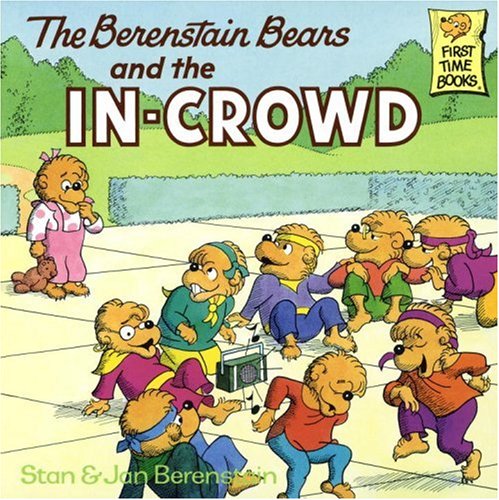
Sorry if you expected me to review this Berenstain Bears title. I can guess the plot, however. There's sure a lot of headbands sported on that playground. It's encouraging to see two bespectacled hip-cubs.

Wednesday, November 23, 2016

"Ice Age Columbus"


in this documentary film ice age columbus zia the chieftain
It never occurred to me that during the last Ice Age, European hunters might have been blown off course on the massive sub-polar pack ice covering the North Atlantic, towards North America. This thesis, contrasting with the conventional Bering Strait land bridge model of indigenous settlement, has been advanced by Bruce Bradley and Dennis Stanford. Predictably, there's been massive denial from the "Clovis" contingent defending the standard model of Siberian migration. Still, it's intriguing.

Discovery Channel in 2004 made a documentary you can see here under the clever title Ice Age Columbus. This dramatizes, with re-enactments (did the actors speak Basque?), computer analyses, and interviews, the "Solutrean hypothesis." Before Clovis spear points were found in today's New Mexico, ca. 500 years after the "Beringian" bridge was crossed, there may have been earlier survivors on the other coast who'd emigrated from today's South of France, with distinctive shaped spear tools.

One point, flaked to this standard, has been dredged along with a mastodon, from the waters off Virginia. This artifact is called the Cinmar biface, and if the dating with the wooly beast's remains is correct, dates to 22,000 years ago. The problem is that the shorelines back then, as in the Great Banks off Newfoundland which were probably the "Plymouth Rock" or "Vinland" for the cavemen and women made chilly, floating refugees, have been submerged by the waters after the glacial melting.

The Wikipedia entry linked to the hypothesis tends to argue against the hypothesis. But one link to a 2012 article in the Independent mentions a finding that appears key, despite detractors. The film for all its merits has to compress a lot in a little time. The seals drawn in a cave Bradley shows seem to suggest the natives knew how to hunt them, but the jump from this is too rapid; likewise why the Cinmar biface is not examined more in detail as to its origins invites speculation. So, the Indie piece may cheer on the few proponents of the alternative theory. Other tools from 26,000-19,000 y.a. have been tested, all from the American East Coast. Summing up Bradley and Stanford, it reports that "chemical analysis carried out last year on a European-style stone knife found in Virginia back in 1971 revealed that it was made of French-originating flint." How do the opponents respond to this?

The DNA data appear to be used by both sides. Haplotype X has been asserted as the genetic link between the two continents. It may be that more research has to be done, in a very contested debate.

The docu-drama has a memorable scene imagining millennia later the meeting of the eastward-bound natives with the descendants of the Iberians. That changes this prequel for Thanksgiving, doesn't it?

Thursday, November 17, 2016

Demographics + DNA


Éamon de Valera, President of the Irish Republic, made an honorary chief of the Ojibwe-Chippewa people, 1919
The Jarnsaxa Scale  was devised by a heathen practitioner who goes by Jarnsaxa Thorskona, a while back. She explains at the link that she devised this to differentiate between 1-6 a rough continuum or division between those who affiliated with Ásatrú. As I've been exploring the claims and contexts of this and other native European as well as Celtic Reconstructionist movements, I am posting the link to bring back the scale, which its creator admits she tried to erase during a time of separation from her spiritual path, and since more than one search engine's results, I found, attested to the dead content a seeker might encounter now.

"Rags" at this blog under "Divisions, Intensified" notes that the scale is not perfect, of course. For "many people (including the scale's creator) find that they fit somewhere in between numbers on the scale, showing further how complex the issue really is. However, in general the scale is a fairly balanced way of gauging where a person fits in the endless discussion of ancestry." You can scan too a summation of the folkish-universalist/adoptivist debate there, for FAQ reference.

Suffice to say I've set this down as notes of my own reflective study lately. This folkish controversy--if inevitably you want to label it as such in a year where "whiteness" sparks campaign clickbait--makes me wonder how applicable its adherents see it in Celtic cultures. For as the Paganachd CR site's authors explain, the construct of Celt is that of linguistics and not bloodlines. This to my admittedly general understanding differs from the importance on pedigree that tribal membership, whether among Native Americans or Ásatrúar, looms as fundamentally crucial to who gets to stay and who has to go, when ceremonies and rituals begin.

I think back to my visit to Taos Pueblo. Parts of the settlement were blocked off with signs and sawhorses for sacred purposes. I doubt any of us visiting felt excluded or discriminated against as a result. Their Blue Lake origins demand protection, after a century-plus battle to preserve a sanctuary. Sarah Merfeld explains: "Due to the persistence of the Pueblo and all who assisted in their campaign, the native people are now able to enjoy their sanctuary in privacy. The area is currently accessible only to the Taos Pueblo and outsiders are not allowed entrance. This secrecy and stick ban of any non-Pueblo members is certainly a reaction to the abusive treatment the Pueblo have received."

Therefore, I understand the analogy. Folkish rituals celebrate and commemorate ties to the ancestral roots of one's kin. They can also put up a protective barrier, a palisade, against the intruder or gawker. It's not popular now to extend this right of tribal inclusion to those of European descent, but as Stephen McNallen asks in a 2014 interview, why is one group alone not allowed to assert this claim? We live in a multicultural society, but as tensions reveal this election year, this inquiry skirts taboo.

And, logically although I have yet to find anyone arguing this at length at least on the net, that may be why the CR band opens up admission to all fellow-travelers called to that path, opposed to McNallen's AFA  indicating in its declaration their cautious approach, higher on that Jarnsaxa Scale. The proto-Celts formed a looser conglomeration; the Nordics a tighter troop committed to the core? Certainly the local stress on "where are your family from" connects, say, Iceland and Ireland. I regard these indigenous ideas as fascinating. In a nation where "demographics" stirs us into a tossed salad, it's wise to resist the "we're all mutts" resignation cutting us off from our inherited wisdom tradition. Yet I can contemplate this counter-reaction, to invite others to share our legacy, if they're sincere in it.

The argument folkish folks make is that in us, we gravitate towards our accustomed ways of affinity. The monotheistic elimination of such ties being very recent, compared to millennia among one's own. A few feel the urge to connect, as re-ligio or re-binding denotes, with this attenuated or severed flow. It may be inexplicable, and to me as intellectually uncertain as AFA's "metagenetics" claim that I doubt any biologist would accept any more than he or she would the Jungian archetype, but that tug back to recover what has been demolished persists in me, too. I recall cheering on the Druids, not St. Patrick, as I read the chronicles of my native land, and its surrounding islands, struggling for identity.

We all face forces of assimilation. Capitulated, my pre-Catholic family, and many more, 1600 years ago. What happens when the language is lost is more recent, just a century past, for my mother's father's household on the East Mayo border. Scars can be inside one's soul; trauma passed down to us to nurse. Recognizing the losses of a common tongue, a shared outlook, a cherished mindset need not expose us to charges of romanticizing a harsh existence under feudal lords and rapacious clergy. Deeply rooted, as when we hear the pipes or taste a whiskey, there persists a moment of recognition.

Yes, that does complicate it, too. If Ásatrúar argue for common bonds of the Northern peoples, this is more ancient than the Celtic-Roman-Norman-Viking-Saxon-Pict mishmash that divided up the North Atlantic Archipelago during the ages of invasion and destruction of the old heathen ways. Celts, too, I suggest, might have been more open to a less restrictive idea of unity, given the mythic nine waves of invaders, Fir Bolg and Tuatha De Danaan, Formorians and Milesians and All That. Who gets accepted as Irish simply means who lives there after a while. And a roll call of rebels and Fenians lists surnames de Valera, Pearse, Kent, Gonne, Plunkett, Tone, and Colbert, no O/Mc clans these.

Judaism is not a missionary faith, but converts after screening and preparation can prove their bona fides. Zoroastrianism, on the other hand, forbids conversion and risks dying out among the Parsees in India, let alone its persecuted homeland of Iran. DNA as I have mused before suggests intriguing results. My 93% score indicates a definite "Celtic"(sic) haplotype marking me as Irish as Paddy's pig.

But it's that 6% Central Asian, perhaps going back to 25,000 years ago and more, and maybe with bits of Neanderthal and Denisovan strains, that also makes me wonder. And that 1% East Asian tint. In shamans and in divination, in spirit-searches and transmigrations of all kinds, my family tree stretches back to ice and fur, incantations and inspirations I strain to glimpse, part of my own quest.

(Photo: Éamon de Valera, President of the Irish Republic, made an honorary chief of the Ojibwe-Chippewa people, 1919. Find out how and why at: "The Irish Revolution and Native America")

Friday, March 20, 2015

Celts or Pre-Celts?


DNA Samples
A few years ago I blogged on genetic studies conducted in Britain attempting to find out how many of the native population possessed Saxon, Celtic, Norman and/or Viking ancestry. New analyses confirm that invasion narratives of massive displacement tend to be myths, as genetics verify.  Dan Bradley's team at Trinity College has been investigating similar Irish genetic markers. Larissa Nolan in the Independent reports that similarities in the "Celtic fringe" (my words) distinguish many Irish.

"Compared to the rest of western Europe, our genetic type has remained relatively untouched and this has also been found in Wales, Scotland and the Basque country. The rest of Europe has developed but we have remained pre-Celtic, we have retained much of our genes from many years back. We have not been as affected by migration as other places and this could be why our genetics are very similar." Many share an O-blood type; those of us from Ireland's west a marked rise in similar genes. By the way, headlines that Celts are not a separate genetic group are no revelation. The Cornish differ from the Scots as do the Northern from the Southern Welsh. Always it's language and culture, not blood, making up Celts, who are many peoples linked by similar tongues and customs, ancient or modern.

Some argue we go back to Mesolithic times as there was never a massive Celtic invasion. I recall from a 2003 study that the area around where my family originates, where no "invaders" reached, Castlerea in Roscommon (a radius for my grandfather's farm of just over twenty miles north-west and about five or six miles for my grandmother's farm from Castlerea) was the highest concentration: 93% "pure" genes. DNA with another "untouched" group, Basques, and that of Irish natives matched.

This chart from the 2003 report shows a cluster of core markers uniting the Basques with two Welsh locations, Haverfordwest and Llanidloes, and with Castlerea, as highest Y-chromosome "extremes."
Is this more than other parts of Connacht, I speculate, as the Aran Islands were garrisoned by the English? The researchers chose Castlerea as an indigenous locale likely separated from in-comers.

Marie McKeown summarizes this. "Men with Gaelic surnames, showed the highest incidences of Haplogroup 1 (or Rb1) gene. This means that those Irish whose ancestors pre-date English conquest of the island are descendants of early settlers who probably migrated west across Europe, as far as Ireland in the north and Spain in the south." Maybe the Leabhar Gabhala/Book of Invasions is true!

I also have been diagnosed with an abundance of iron in my blood, which also is a trait I inherit. So, along with my very fair skin, faint freckling, blue eyes, and once reddish-brown hair, I am truly Irish.
P.S. Frank McNally in the Irish Times took the piss, as they say, out of this recondite research here.

Sunday, March 30, 2008


Colin Renfrew's "Archeology & Language: The Puzzle of Indo-European Origins" Book Review

This book argues for an Anatolian "Urheimat" (original homeland) for a core group speaking what would spread out laterally across Europe and Central Asia into the Indo-European languages. He rejects much of the competing theory of Marija Gimbutas for a "Kurgan" culture from the steppes; he also dismisses identification of Indo-Europeans with massive invasions of horse-drawn charioteers who swept across the plains east and west spreading their warlike language. Instead, combining patterns of a branched family tree with a "wave" model of concentric circles of expansion by language families, Renfrew constructs an direction that shows how IE could, starting about 6000 BCE, have spread according to the laws of linguistic evolution at steady rates morphologically and phonetically, have become the familiar tongues we speak today.

I found this study rather stodgy. The Anatolian discussion takes up far less of the book than you might expect from the reviews on Amazon before mine. Renfrew's wide ranging, and the whole IE search for origins occupies only a part of a larger effort to take his fellow archeologists to task for ignoring or misinterpreting linguistic evolution within the artifacts they excavate.

The pace of the book's slow, if the facts stay abundant; the style of the methodological marshalling of so much archeological, linguistic, and comparative cultural data turned often leaden. Any work written for a non-specialist that addresses recondite debates and learned contentions may run the risk of such arcane discourse. But, Renfrew, while no natural tale-teller, remains convinced of his iconoclastic assertions, and if you are committed to understanding this subject, this and J.P. Mallory's near-concurrent "In Search of the Indo-Europeans" represent crucial texts on the origins of IE. While I'd been meaning to read Renfrew for a long time, what impelled me to finish it was the appearance in 2007 of David W. Anthony's "The Horse, the Wheel, and Language," which proposes a Pontic steppe origin in Russia and southern Ukraine for the riders who took Proto-Indo-European across the plateaus as an "elite" language of poetry about a male sky-god and began to leave its traces with other peoples who then began cultivating PIE.

As Renfrew wrote nearly two decades before Anthony, I was curious to see if I could find anticipations of Anthony's theory in Renfrew. I prepared to understand Anthony's OIE elaborations by first learning from how Renfrew built his foundation. He discourages the findings of linguistic paleology. He warns in matching cognates of Sanskrit "ratha" with Latin "rota" that it's "a far cry from saying that some hypothetical Proto-Indo-Europeans used chariots with wheels (or indeed carts with wheels) in their original homeland." (86) Also, he discourages Gimbutas' far-reaching establishment of a PIE Russian-Ukraine "Urheimat" to better assert his competing claim-- based on analysis of early Greek-- for Anatolia.

The liveliest part of the work remains for me the incorporation of Christopher Hawkes' "Cumulative Celticity" theory that Renfrew adapts to his wave-family tree (stammbaum) plotting for PIE. He denies that the La Téne artistic style presents a hub in Central Europe for the migration of Celts, shows how that noun can be defined eight ways, and favors Myles Dillon's reasoning that fundamental language changes began "in situ" in the places we find Celtic languages developing historically, rahter than emanating from a Continental center through massive migration or war. Therefore, the Iberian (Hispano-Celtic) or Goidelic (Q-Celt) branches of ancient Celtic languages stayed far enough on the Atlantic fringes that they did not alter with subsequent innovations that warped other Celtic varietals into insular Brythonic (P-Celt) or Western European Gaulish forms attested to in the historical record.

Finally, well before the genetic applications suggested by DNA comparisons with language from Stephen Oppenheimer ("Origins of the British," 2006), Renfrew predicts in passing that in Britain prior to the withdrawal of the Romans already many people may have spoken a Germanic language (137). However, Renfrew discourages in this pre-Genome Project breakthrough in genogeography a trust in such efforts as pioneered Luigi Cavalli-Sforza: "I think experience has shown that genetic arguments in relation to language and culture quite readily lend themselves to misleading interpretations." Still, the "wave of advance maps" such earlier scholars charted with their mapping of "various blood groups in Europe, suggesting genetic affinities," Renfrew finds may "await further assessment," which two decades later appears to be occuring with scholars such as Cavalli-Sforza, Oppenheimer, and Bryan Sykes, to name only three of those addressing their findings for a wider audience.

(Posted to Amazon US today. I reviewed Oppenheimer at length in the on-line Celtic Studies journal Epona-- "Rooted in the Body, Hidden in the Ground: Searching Beyond the Celt" -- as well as a shorter review on Amazon, where I also reviewed Sykes' "Seven Daughters of Eve" & "Saxons, Vikings & Celts." Try also for a broader worldview "Genes, Peoples & Languages" by Cavalli-Sforza.)

Wednesday, February 13, 2008


Russian to investigate the origins of Welsh language
Western Mail, 13 Feb 2008.

A RUSSIAN scholar will lead a fresh investigation into the origins of the Welsh language by looking as far afield as Romania and Turkey, it was announced yesterday.

Dr Alexander Falileyev, originally from St Petersburg but currently working in Aberystwyth University’s Department of Welsh, has already written a report based on the presence of Celtic names in the Roman province of Dacia (modern day Romania).

And now, with the help of a £390,889 grant from the Arts and Humanities Research Council, he will conduct the first full investigation into evidence linking the origins of the Welsh language to South Romania and as far east as Galatia, Turkey.

The ancient Celtic language, from which Welsh is derived, has already been traced back to inscriptions in areas like Italy, France, Spain and Switzerland.

More recently, the university’s Department of Welsh, a group led by Professor Patrick Sims-Williams, has used ancient place-names in sources like Ptolemy’s Geography to prove that Celtic was spoken over a much wider area.

Professor Sims-Williams welcomed the new grant. “We know that these areas were colonised from the third century BC onwards by peoples who spoke Celtic languages. “It’s becoming clear that Celtic was one of the major languages of ancient Europe, alongside Greek and Latin. It would appear that most EU countries have a Celtic past."


Hwyl fawr to today's post "Did They Speak Welsh in Romania" over at Alan Jones' blog "Independence Cymru" for alerting me to this Western Mail article.
http://alanindyfed.blogspot.com/2008/02/did-they-speak-welsh-in-romania.html

This map "1066 and All That" here's directly relevant from the N.Y. Times, 5 Mar. 2007.
http://www.nytimes.com/imagepages/2007/03/05/science/06brits_graphic.html

See my own detailed review, "Rooted in the Body, Hidden in the Ground: Searching Beyond the Celt," which examines John Waddell's "Foundation Myths" on the evolution of Irish archaeology alongside Stephen Oppenheimer's DNA-language study, "Origins of the British." See its published pdf.file:Epona 2(2007): 1-6
http://www.epona-journal.hu/epona_languages/English/files/issue_0712/Murphy_final.pdf

Saturday, December 22, 2007


Rooted in the Body, Hidden in the Ground: Searching Beyond the Celt:


My review, in Epona 2 (2007) 1-6: Stephen Oppenheimer's "Origins of the British" & John Waddell's "Foundation Myths."


Images: figurine of a perky Epona, the Celtic horse goddess.


Reminded me of the 7-6 c BCE Hallstatt figure from the "Cult Wagon." Cowgirl up!


Tuesday, August 14, 2007


Bob Quinn's "Atlantean Irish": Review

A paragraph added to my earlier Amazon review updates a bit this consideration of a book that readers of Bryan Sykes & Robert Oppenheimer (reviewed by me there and here) should find provocative. Quinn deserves credit for thinking about these issues before the DNA & genetic findings bore him out, two decades later. A fascinating argument! (I also review his childhood memoir, "Smokey Hollow," here and on Amazon US.)

Barry Cunliffe, John Collis, Simon James, Bryan Sykes, and Stephen Oppenheimer all further ideas that Quinn proposed over two decades ago in film and print. This book revises and expands his thesis. Readers intrigued by more recent DNA, archeological, and linguistic discoveries in Ireland and Britain should read this exciting, if rather rambling, argument for Irish settlement and cultural influences coming not from across the Continent from a La Téne central hub, but from Mediterranean and Iberian sources via travels along the "Atlantic fringe" up the coastlines. (I review Sykes "Seven Daughters of Eve" and "Blood of the Isles" and Oppenheimer's "Origins of the British," all of which should have acknowleged Quinn, on Amazon; the following review I wrote in 2005 before "Blood" & "Origins" were published.)

Bob Quinn confronts received knowledge and upends the status quo. Living in a Conamara gaeltacht since 1970, his adopted locale inspired him to ask two questions that impelled the saga adapted in this update (Dublin: The Lilliput Press, 2005, 20 euro) to his 1986 work, Atlantean. Bono, in an interview with Bob Dylan, cited Quinn's initial contention: tracing ancient Gaelic song to North Africa. A new edition's range of illustrations, attractive font and design, and incorporation of material gleaned from refinement and elaboration of his initial foray into largely uncharted intellectual waters presents iconoclasts with a model of how to construct an alternative to what everyone assumes to be the only way from which to perceive 'reality.'

Looking at the púcán boats that once dotted his Atlantic coast, he noted their resemblance to lateen sails on Egyptian dhows; listening to sean-nos melodies, he marvelled at their pentatonic counterparts from the Arab realms. Quinn targets cultural echoes, archaeological evidence, and linguistic links tying Ireland not to the conventional La Tene-Celtic and thereafter European-centered diffusion pattern, but to a neglected nautical passage that, he reasoned, had long escaped the gaze of Continentally ethnocentric scholars fixated on an Indo-European genesis for the peoples and crafts that entered into the island. Now, Quinn's thesis contradicts the Celtic origins which many Irish have celebrated for 300 years.

His findings, necessarily scattershot and rather random, resemble a Victorian vicar's parlour-displayed assemblage of bric-a-brac. (Only source titles, not precise citations, fill his endnotes, frustratingly.) I suppose Quinn might retort it's instead structuralist bricolage, a bold thrust to delve deeper below the psuedo-Keltic veneer appliqued by Revivalists and Romantics to excavate the broken shards and ghostly palimpsests abandoned by those who travelled the "wine-route" from as long as 5000 BCE along the Southern Mediterranean littoral, until, drawn by tin from Cornwall and smugglers to Ireland, moving up the Iberian coasts until they continued due north to the first landfall the western and southern island shores. He advances that the true impetus for Irish culture came from North African, Egyptian, and Mediterranean lands rather than Central Europe, the Roman empire, and its successors.

Neither the ancient classical nor the native Irish authors, Quinn insists, called the indigenous people in our island 'Celts' -- this being an antiquarian and so relatively early modern coinage. In what was for me the most intriguing section of his study, he contends that North African substrata underlie our Irish language itself, and he relates the legendary accounts of the Iberian and Egyptian origins of the island's first ancestors to the migrations that would have brought trade, colonisers, refugees from early Christian persecutions, and monks to Ireland before the suspect arrival of a largely fabricated Patrick. While I lack the familiarity that Quinn has with his many sources, I wondered why, however, his use of mitochondrial DNA studies to support his claims cited Bryan Sykes (his eloquent Seven Daughters of Eve. London: 2001) of Eve, but not the concurrent team led by David Bradley from TCD, whose assertions a few years back in Science appear to complicate what Quinn simplifies about the coming of the earliest settlers from Asia Minor to Connaught thousands of years ago, Bradley's team, and other research by Brian McEvoy and colleagues at TCD, and by D.B. Goldsmith and colleagues, also depends on genetic markers still overwhelmingly present in natives to the West today. None of these researchers, active in the past decade, have been cited by Quinn, an obvious flaw.

But maybe Quinn's stacking his evidence? Bradley's TCD team and recent geneticists argue for an Atlantic fringe origin, but from Northern Spain to Scandinavia rather than further south and east. Simon James and Barry Cunliffe, among other leaders in pre-Roman Celtic-British studies, have accepted the invalidity of the "Celtic" invasion of the islands and the west thesis. Emerging challenges by linguists to the Central European genesis and Celtic invasion pattern seem to clash in their findings with Quinn's Mediterranean-African genesis for the early Irish.

Bearing the traces of peoples pushed ever westward as farmers advanced, a kilometer or so a year, the peoples (whose genetic traits distinguished at 97% in the West of Ireland among males of native descent vs. 3% in today's Turkey) came not over water but presumably over land--driven across Europe as they were pushed ahead by agriculturalists---unsettled folks from the Fertile Crescent who were shunted ever westward as farmers ploughed Europe over thousands of years. The remnants of those pre-farmers wound up settling finally into Connacht's spaces--the last nearby refuge on the North Atlantic fringe.

Again, certain portions of Quinn's argument, even to this general reader, appear akin to romanticised notions of solidarity with au courant Arab and Third World solidarity rather than the 'Thomas Cook model' of radial diffusion from an Alpine or Danubian homeland, favored by many 19 and 20c scholars. The evidence, as Quinn admits at times, for a maritime rather than continental dependence influencing Irish development depends far too often for academic scrutiny upon perhaps coincidental or random findings, albeit painstakingly and cleverly compiled by Quinn over three decades and more. His basic reliance upon his interpretation of Irish from its status as a living language rather than using Romanised inscriptions to re-create a Celtic tongue appears convincing, and I await further scholarship to clarify Quinn's educated guesses. Like the vicar, his collection impresses somewhat but also leaves the viewer muddle-headed as he examines many labels, evaluations, and connections between displays.

Chapters on Wales, Vikings, and Sheela-na-Gigs sway uneasily beside steadier accounts of monastic art, mythmaking, and the pirate trade with Algiers and Morocco. The Berber-Irish parallels again smack of the type of overly enthusiastic detective fieldwork that Lorraine Evans (Kingdoms of the Ark. London: Pocket Books, 2001) presented in establishing archaeological patterns making Queen Scota of Milesian lore into the eponymous ruler over Ireland's hordes and the instigator of the British race. I enjoyed both Evans and Quinn's attempts to scour the taint of British Israelitism off of their navigational tools, and I wondered why the latter author neglected the former, but I fear that those hidebound and tenured will publish on largely unconvinced by either freelancer's revolutionary reports.

Frustration emerges as Quinn recounts throughout his revised work the skepticism he faced from this establishment. Re-orientalists, as I term Quinn and Evans, preach to British and Irish audiences that their 'myths of origin' need not be based in a proto-Brussels conclave.

Many today, in classrooms and libraries, may not pay much attention to such independent scholars and thinkers. Yet, I applaud for Quinn that he speaks boldly from his own, equally defensible, certainly progressive, sea-ready fastness. If we descended from the Atlantic fringe sunder a Celtic heritage, we can then boast our descent from Atlanteans!

Revised from a review in the Belfast on-line journal The Blanket, "Re-orienting perspectives," March 2005.

Anyone driving from Galway city through to, say, Carna, might agree with Quinn. You hug the sea more than the mountain in drawing your bearings, your domain, and your living. Its towns and enterprises meet the needs of those traditionally travelling by huicear and not Honda, currach and not Cortina. Commonsense shows, in what Quinn should have displayed with localised and more modern archaeological maps, that from Neolithic times contacts can be charted drawing the West and South of Ireland into Spanish ports and settlement and trade more than European markets. For all the willful and accidental vagaries within Quinn's spirited and never less than readable chapters, this author takes on the 'Celtic' giant and chops his Irish progeny down to a less Eurocentric, more portable and shipworthy size. From the Arabic term for any trefoil, by the ways Quinn unveils, we import shamrakh.

Tuesday, August 7, 2007


Origins of the British: Stephen Oppenheimer's book reviewed.


Not the place to begin, but this book may reward advanced readers who can handle a popularized but scholarly work on the implications of recent findings in DNA. Earlier readers posting {this is my Amazon US review posted today; search this blog for posts on Sykes' "Blood of the Isles" and DNA British origins} frequently disparage this book's ponderous prose and its massive array of recondite DNA analyses. After reading more accessible, and considerably shorter (no coincidence!) works on genetics and anthropology by Spencer Wells and Bryan Sykes (for both authors, their two most recent books reviewed by me on Amazon), I felt ready to tackle Oppenheimer's work, despite its difficulty. While the time invested paid off in a better knowledge of the Celtic and British origin debate and the possible influence of Germanic cultural and linguistic influences preceding not only the Anglo-Saxon invasion but the preceding Roman occupation, Oppenheimer while he may be a better scholar than Sykes remains a less entertaining writer. Sykes can popularize his findings in "Blood of the Isles" & "Seven Daughters of Eve." He also can profit from them if you note the enterprise Oxford Genetics. As I commented when reviewing Sykes' "Blood," it remains curious that two geneticists both at Oxford do not even mention the other colleague in hundreds of pages of closely documented and meticulously referenced texts.

This apparent rivalry aside, Oppenheimer acknowledges very late in his text that names given to Rostov or Ian or Helena are merely "aides memoires" for R1B-11 or the like in an alphabet soup of markers all geneticists rely upon. Readers of both Sykes & Oppenheimer sniff disdainfully at this popularization, but surely both scientists and lay people need assistance in imagining "Eve" or "Lucy" or the "Ice Man" to make more personal the findings buried in blood types or bone samples. Oppenheimer carefully explains his reasons for clarifying relationships among these difficult classifications, numbering in the thousands by now. Much explanatory material on genetics here is relegated to appendices and a glossary; while Sykes & Wells integrate more definitions and analogies into their briefer, more readable books, Oppenheimer opts for density.

This can bore a reader. My eyes glazed over in the second hundred pages full of dull genetics. The first hundred, tackling the Celtic origins debate and guardedly based on scholars such as Simon James & Barry Cunliffe, and Iron Age archaeologists such as John Collis, argues a southerly direction into the British Isles for Celtic infusion, not the La Tene Danube-Central European homeland and its overland route for entry into the Isles. Personally, I'd have liked to have Bob Quinn's book "The Atlantean Irish" (reviewed by me) credited for its prescience regarding the Atlantic Celt "fringe" movement that Cunliffe and others have since fought to replace the Continental migration theories of the 19c. This vexed matter alone, building upon the past two decades of Celtic revision, or Celto-skepticism, could fill an entire book easily.

But, I did perk up eventually. This is more a reference book on a variety of unevenly covered but admittedly provocative topics. He writes clearly in places and dully in many others, depending it seems on his diligence vs. his enthusiasm! This is an arduous trek, but you need to weather this if your curiosity's aroused about this intellectual terrain that for the first time geneticists and linguists have entered to do battle over, not to mention archeologists and historians!

Advances in DNA may soon rely on its suggestions, or they may overturn its assumptions. But, Oppenheimer bravely piles all he has amassed for the benefit of science. It may be too clunky and over-ambitious, but he has done specialized researchers, armchair genealogists, and academics like myself needing a non-technical explanation of dozens of arcane debates all a service.

Oppenheimer builds on this fact-laden if recondite foundation to posit that many of today's ancestors came to the Isles perhaps as early as around 15-7,500 years ago. The land bridge before the end of the last Ice Age became submerged allowed two major inflows of migration, from a Ukrainian-Moldavian refuge, and an Iberian refuge. The former provided a basis for North Sea movements added to later by Scandinavians, Saxons, Belgae, and other Continental peoples. The latter brought people in on the Irish, Welsh, and Scottish sides closest to the Irish Sea that opened up in the later periods of global warming. Germanic languages cannot have diverged in Old English so rapidly after the Saxon incursions, nor were (against the Welsh historian Gildas' spurious claims of Celtic "wipeout") the indigenous natives necessarily Celtic-speakers all prior to the landing of Hengist and his post-Roman mercenaries.

Percentages of genetic disruption rarely reach even the point of "decimation" of 10% in a handful of Anglian areas, according to genetic studies of inhabitants today in these long-stable regions of Britain. Simply and ineradicably, this persistent divide, genetically and perhaps linguistically, Oppenheimer proposes, persists in our DNA. This parallels the Germanic vs. Celtic division of languages in the Isles, the spine of mountains serving as an insular border between these two major routes for farming and colonization.

The hoary myth of a Celtic genocide by Teutonic overlords that inspired Arthur's last stand, it seems, proves more a "Dark Age" screed than plausible history. Granted that this early medieval era remains fraught with dangers for those reliant only on chronicles or a misleading archeological record, Oppenheimer here makes his boldest suggestion.

Probably the first to enter this fray as a geneticist, he confronts linguistic assumptions about the rapid spread and dialectal evolution in only a few centuries of Anglo-Saxon in post-Roman Britain. Germanic languages, he opines, might have become established long before Romans, let alone Saxons, entered into what was not necessarily a Celtic-dominated Brittania. Celts themselves, whatever this term means given the looseness of this pseudo-ethnic linguistic concept, did not rush en masse into the islands, and they too were perhaps the harbingers of not a massive demographic invasion but an elite influencing cultural and linguistic trends among the natives, who may date back ten thousand years before the arrival of Celtic-language speakers. Unfortunately, traces of any words that are pre-Celtic lurk rarely in the archaeological record, according to most experts. We lack a Rosetta Stone to decode whatever insular peoples spoke before Celtic languages became the norm among both the newcoming elite and the long-settled old-timers.

Therefore, Oppenheimer turns to DNA for clues. He challenges linguists who for a century have been indoctrinated to ignore searching for language origins. He argues that science can offer tentative solutions that account for a Germanic undercurrent that may not be that apparent on the surface, but which aligns with what we know about rates of linguistic change that may have begun as long ago as 3000 BCE (estimates differ) that can be calibrated with patterns of genetic migration.

His thesis? Most of the original British Isles inhabitants descend from a massive "founder population"-- maybe far more than three-fourths or more of those today living in some locales. Due to genetics and settlement patterns, most humans stick to one place for millennia. This conservatism therefore provides a solid bedrock. It cannot be eroded even by the waves of more recent, and tribally-named, intruders. While closer to us in time and in the historical record (however tenuous!), these famous warriors themselves often number in the low single-digits (5% often!) in terms of percentages of genetic "material" we British and/or Celts carry today.

All subsequent immigrations, whether Celt, Roman, Saxon, Angle, Jute, Viking, or Norman, Oppenheimer states in the closing line of his epilogue, diminish by their traces in the descendants of the majority who trace their roots to British-resident or Celtic-origin DNA today. Most of the origins of the British predate even the Celts. Oppenheimer concludes: "we are all minorities compared with the first, unnamed pioneers, who ventured into the empty, chilly lands so recently vacated by the great ice sheets." (421)

Saturday, May 5, 2007

Deep Ancestry: Spencer Wells' Genographic Project

BLOGGER_PHOTO_ID_5061296382227459730
Here's my review, posted today, to Amazon US about another DNA gene pool plunge, this time by the leader of the National Geographic Society's Genographic Project. My wife and I have to send off our cheek swabs soon for the greater good of humankind. I predict she's K or N1 mDna, and I am R1b Y-chromosome.

http://www.nationalgeographic.com/genographic

[Image credit. Not much on "deep ancestry" Google image comes up except the boring cover of the book, and eventually a fantastically contentious Wikipedia page full of block, violations, flames, and passion. Reminded me of a Lewis Carroll Wonderland fracas. Or, considering my post last night, how soon an image search for "Jewish Forward" led to antisemitic cartoons by page four. Anyhow, this is from a study by Weston Smith, "Nutrition and Physical Degeneration," reprinted on Gutenberg Books Australia, from a 1930s anthropologist. This is from some dentally bold sharers of my probable R1 haplotype, across the Sruth na Maoile on the Isle of Harris; the best smiles from those on a "primitive" rather than the Sugah i' th' Tae diet. Yesterday also in the Forward issue I read of a reader's zayde who read the Forverts slowly, sipping the "glass tea" while taking, slowly, a sugar cube from a Swee-Touch-Nee tin. He held the cube between his teeth, horse-like, and then drank the tea. The cube dissolving, another took its place. The pages turned. If you are reading this in similar posture but as upwardly mobile grandson of landsman or urban pioneering heiress from bogtrotter, don't spill your g-d damned five-dollar latte on your two-thousand-dollar keyboard.]


Compared to Wells' earlier "Journey of Man" and Bryan Sykes' "Seven Daughters of Eve" and "Saxons, Vikings & Celts," (all three also reviewed by me on Amazon), this is considerably briefer, compressing the genetic information of both mDNA (female-transmitted) and Y-chromosome (male markers) lineages into 250 pp. including a long appendix listing all of the major profiles. Contrasted to the colorfully organized information on the National Geographic Society's "Genographic Project" online site, these appendices largely duplicate the same material in somber typeface. But, having it in book form combined with the previous 175 pp. of text, this makes a concise primer for public and home libraries that, even in our web-dependent age (as you and I know as we read this post!), still need print backup and expansion of material that on the web, as on the NGS site, must be too diffused and remains a bit unwieldy for easy cross-referencing and browsing.

The maps here tend to comment silently upon the material Wells discusses. Unfortunately, Wells more often than not fails to tie his sober, but not altogether dry, text tightly enough to the graphics. You look at the charts and can figure them out, sure, but if the author had taken greater effort in being more explicit, e.g. "see figure 6, where the so-and-so can be seen ranging across the this-and-that at such-and-such a rate," the integration of print and visuals would have enhanced the combined presentation of what can be challenging material for the layperson.

Wells, identified in the author's endnote as a "child prodigy," is ideally placed to write such an introduction to our "encapsulated history," but this efficiently summarized book does feel (as another reviewer commented) as a work in progress. Part of this sensation that much more is going on beneath what can be easily paraphrased for not-specialists may be that the popularization of whats going on in labs now may lag a couple of years behind what only a few experts (Sykes, Oppenheimer, and Wells himself along with possibly Luigi Cavalli-Sforza on a very short list) have the ability to translate findings derived from massive amounts of extraordinarily complex raw material into understandable prose aimed at the general reader.

Bits buried in the appendices demand whole books of their own. I look forward to future volumes about these issues....Half of Ashkenazi Jews can trace their line to four women, and three of those from one "K" group and another "N1." 10-20 people crossed the Bering Strait's landbridge to engender as "Q3" most Native Americans. Click languages may have been the earliest forms of speech. Berbers in North Africa and the Saami ("Lapps") near the Arctic Circle share roots. A non-Asian "X" haplotype is one of the five present among Native American populations; "X2" came not through Siberia but from Western Eurasia. (I wanted to know how this fit into the Kennewick Man controversy, but Wells seems to edge away from debate.) Hitting the Pamir Knot of three mountain ranges connected in Central Asia split up a formerly cohesive Eurasian clan into three main groups as they could no longer move east across that continent's Eastern France-to Korea "superhighway."

Seeing that Sykes has fired off two recent books aimed at the same audience, and that Stephen Oppenheimer also of Oxford (where Sykes taught too) has "The Real Eve" and the new "Origins of the British" in the past few years, now Wells has two. They-- each author having a book around 2002-4 and a second book within the past year) overlap in data and approach, but Oppenheimer appears the most academically dry, Sykes the most eagerly imaginative, and Wells takes the middle ground. No imagined scenarios (unlike Sykes, who by the way has a competing project to gather DNA data) for our NGS leader, but Wells does try with various individuals to make his chosen representatives from today's genetic lines come alive a bit with their own encounters with the data that the NGS finds.

But even this attempt at connecting the world of the test tube with that of those people we pass every day is not carried through enough. The relatively brief amount of discussion given, say, the African American "Odine" who shares Thomas Jefferson's own very rare if not unique genetic marker proves a letdown. Wells builds up the case with flair, but we fail to find enough by that chapter's end to understand exactly where the 3rd President got his genetic marker from and how its rarity in England points to a rather exotic lineage not only for Odine today but any descendant of the Jefferson clan.

In summary, the appendices and a well-chosen short list of suggested books and websites both anthropological and genealogical make this a useful source for beginners wanting a deeper look at their deep ancestry than the NGS site can provide, but not so technical as to bewilder the reader. In passing, Wells is surprisingly reticent about recruiting for the NGS project in his text, but there is an advertisement on the book's final page with information for those who wish to contribute. The NGS by the way uses the funds raised from volunteers here towards a Genographic Legacy Fund that gathers data for free from indigenous and traditional communities, so it's a worthwhile cause.

I would have liked to know more about how, if Wells studied with Luigi Cavalli-Sforza for his doctoral work at Stanford, or if Wells presumably worked alongside geneticists Oppenheimer and Sykes at Oxford, how his own project and conceptualization of how the DNA research could be used differed from his eminent mentors. (As an aside, Sykes in his recent "Saxons" book never mentions Oppenheimer who I assume is just down the hall from him at Oxford!) Cavalli-Sforza with his HGDP and Sykes with his company Oxford Ancestors appear to have slightly divergent goals from the NGS study, and I remain a bit unclear about where the three DNA-gathering enterprises cooperate or whether they are all amassing their data separately. Wells hints a bit about HGDP, but does not mention Sykes' company. I suspect that the whole scientific and enterprenuerial venture's combined story here may have to wait another half-century, when an elderly Wells (he's well under 40 now!) composes his memoirs.

Saturday, April 28, 2007


Dr. Francis Collins: DNA as God's Language?

I am mulling over posting this on Amazon (#743 at last count!) where about 380 people have already weighed in on "The Language of God: A Scientist Discovers Evidence of Belief" by the director of the Human Genome Project, Dr. Francis Collins. Despite the moniker he grew up with proto-hippies who had moved in the Depression to the Shenandoah Valley (where The Shakespeare Wars reviewed by me here and Amazon on April 23, the Bard's birthday I remembered only yesterday! Ron Rosenbaum describes how in the titular hamlet there a marvelous theater recalling the BlackfrC.S.Lewis, Christianity, DNA, IWOSC, Occam's Razor. Medieval Philosophy, ontological proof, Religion and Science, Theodicyiars in Elizabethan London hewed in Virgina anew out of raw wood, built due to the philanthropic campaigning and local labors under the goad of one Ralph Cohen). Raised without religion, he drifted into what he might have called "soft atheism," that is, not from any solid intellectual conviction against the existence of a deity, but out of convenience or not analyzing his true beliefs rigorously enough. Well, as a student in his twenties he read C.S. Lewis' classic work of apologetics, "Mere Christianity." Lewis, you may recall, also followed the same path as Collins; although the Inkling and "Kolbitter" of Oxford grew up in the North of Ireland, few recall.

This will likely be the only book that I'll ever read that I can verify outside of Holy Writ that Newt Gingrich, Robert Schuller of Crystal Cathedral fame, and Naomi Judd have also enjoyed; their blurbs appear inter alia before Collins' text, somewhat undermining its rarified content if not its appeal to the ordinary folks, who surely need Collins' appeal to science married to faith as much as whatever Pasadenaean recalled my copy via its public library, in-- let it be recalled-- that heart of CalTech and The Skeptic magazine-- sponsored in turn by Penn & Teller! In my review, I focus upon Collins' use of Lewis' own argument to prove that the universe could not have been created ex nihilo. Or, as I read Martin Luther's phrase today, "ex Deo nobis est, non ex nobis"-- in my poor version: from God we exist; nothing comes from ourselves.

Do you think I should post this review below? Or will it only be rated according to my reactions and not the merit of the review itself? A problem built-in to the rating system, as I told the IWOSC crowd earlier this month, given the limits of Amazon's binary, thumbs-up, thumbs-down limitations. I'd love to improve it, but on the other hand as we know, it's futile to discuss religion dispassionately. As the Good Book parable reminds us, "pearls before swine" might be my haughty reaction to the brickbats flung my way by Scopes trial fanatics and proponents of a ten-thousand year old planet.

If you have suggestions for fine-tuning my response below, let me know...

Kindly rate the "helpfulness" of this review by its contents and not your bias. On Amazon, it's not whether you agree or disagree with the author or the reviewer. It's whether the review contributes to your understanding of what you could expect from the book before you decide to read it. Here's my guidance.

I can see from previous reviewers that their own beliefs colored their reviews. Trying to avoid this bias for my own comments, I will try for objectivity. Perhaps I am an ideal reader for this book. I share interests in religion and DNA- informed "genogeography" that range widely. My review sums up the pivot of Collins' own conversion which he makes the basis of his defense of theistic evolution. Early in the narrative, Collins shares his inspiration when encountering C.S. Lewis's argument that our own benchmark for right & wrong that we seek within ourselves points to a Moral Rule that is a universal, a irrefutable attraction to the Good which is planted by a supernatural force outside of ourselves.

Whereas Daniel Dennett, in ""Breaking the Spell: Religion as a Natural Phenomenon" (also reviewed by me late last year; the book appeared at the same time as Collins' work), might counter that such a leaning towards altruism gives us oldsters a shorter shelf life! That is, we sacrifice ourselves, stop consuming valuable resources, and get out of the gene pool, once we've done our job and reproduced. We're driven towards saving each other even though it's inexplicable or irrational. Collins takes the kinder, ethical alternative that may explain why we'd jump into a lake and save a baby even if we risked drowning, for instance. Collins assumes this inborn unselfish quality we all would recognize-- even if we emulate its nobility only imperfectly-- is prima facie evidence of a supernatural design beyond our ken but harmonious with our spirit.

He cites Lewis: God's the architect. We live inside the house, looking at the wall or ceiling, but from our knowledge have no way to understand the mind of the house's architect. But, where Collins loses me is in his next step. He posits therefore that this Law of Moral Nature cannot be explained as cultural artifact (e.g. enhancing our appeal for mates or our status in the clan) or (contra Dennett) evolutionary by-product.

He supports his theistic claim with Lewis. He argued that "if there was a controlling power in the universe, it could not show itself to us as one of the facts inside the universe-- no more than the architect of the house could actually be a wall or staircase or fireplace in that house. The only way we could expect it to show itself would be inside ourselves as an influence or a command trying to get us to behave in a certain way. And that is just what we do find inside ourselves. Surely this ought to arouse our suspicions?" (Lewis, Mere Christianity, 1952, pg. 21 as footnoted by Collins.) I stopped at this passage and pondered. The rest of the book builds upon this citation.

I found Lewis' argument intriguing. Yet, it did not convince me. I needed Collins to slow down and make sure we understood what he was so impelled by, but Collins wanders off for the rest of this short book into other topics. I wished he'd stuck with the veracity of Lewis' theological proof. Otherwise, why devote so much of a book ostensibly on DNA to the God behind such intricate patterns underlying the fabric of life itself? Since Collins uses this architect example so prominently as the "prime mover" of his own soul towards faith, it demands to be taken seriously by his readers. Yet, is Lewis' metaphor as compellingly persuasive to readers as it was to a twenty-something Collins?

As with his discussion of his version of Rev. Paley's venerable watchmaker analogy, Collins seems to ignore the similarity between this sort of theodicy and Anselm's Ontological Argument for the existence of a God "greater than which nothing can be conceived." Aren't we still trapped in our puny human efforts of trying to explain the vast processes of billions of years? If we cannot get past 10 to the minus 43 milliseconds after the annihilating Big Bang, in the absence of our ability to delve further back, why does this "gap" for Collins give way to a belief in a deity who started it all? How does Collins or Lewis know that the universe demands the absence of its maker from what has been made? Furthermore, the chances of finding an intricate mechanism on a desert floor as if it somehow evolved on its own outside of an external designer may defy probability, but the appearance of the watch or our own amazingly nuanced universe seems not to me to prove an "uncaused cause" that crafted the watch or ourselves. Sure, it's nearly overwhelmingly probable, but there still remains doubt. Chance could have triumphed, this once.

The problem with the Lewis analogy that so convinced a young Collins is that it assumes that a deity cannot be present within the system created, or for that matter has to be outside of the universe for the system to work. But we are making the rules that our God plays by. How can we succeed with such hubris? His assertions of theistic evolution that we cannot fully comprehend then come down more to "it's all part of God's mysterious plan" than a thoroughly investigated and exhaustively defended proposition that will convince skeptics wondering if maybe we are results of the 1-in-50-billion odds of our evolution by non-theistic causes, or one universe among many.

Collins applies Occam's razor frequently, but the fact that causes should not be multiplied without necessity does not always mean there cannot be multiplied causes. Of course, this is a short book for non-specialists. Surprisingly few endnotes, by the way, The author does take pains to remain clear in his explanations, to his credit. But, for such weighty matters, this leaves theological arguments that underly his scientific claims open to charges that he gives too superficial a foundation for his DNA-as-language theory. It's difficult to reduce such complicated material into a few pages, and when he tries to place a defense of the central claims of Christianity on top of science and DNA, it's too many messages for too small a medium.

Collins slips into the simpler explanation: God started it, since the universe is too intricate for chance or unguided design. But this fails to convince. It reminded me of Anselm's medieval "proof" for God's existence. That is, Collins edges near an a priori claim. He dismisses the multiple universes or the "hey, it just happened despite the odds" alternatives for the Anthropic Principle with insufficient consideration. This section is crucial. The subject is enticing. Collins genially presents the commonsense approach: God set it all in motion 14 billion years ago. Engagingly as Collins writes at this stage, his presentation is too brief. He embraces the theistic model too quickly. Without taking the other two possibilities of the Anthropic Principle seriously, Colloins does not fully explore why we need to take for granted the divine clockmaker as the accepted argument for evolutionary processes that unfolded ever since the Big Bang. He too complacently invites a clockmaker to wind it all up and let it tick away. This is not enough to support his claims that the best of the three Anthropic Principle models must be irrefutably that of theistic evolution.

However, intermittently, Collins' book makes complex theological and scientific subjects accessible for the non-theological, non-scientific reader. But it moves too quickly. Collins has the ability to expose false claims made by those too credulous in namby-pamby childish conceptions of deities, as well as those scientists too dismissive of the claims that faith and reason can join to expand our knowledge of the universe.

But here he needlessly complicates his argument. As a Christian, I suppose Collins felt he must testify. But his appeal for religion and science thus weakens. He clings too closely to his own model of religion, understandably as a believer but too restrictively as a scientist who seeks broader ground upon which to allow diverse religious and determinedly scientific proponents to meet and exchange ideas. Near the end he brings Jesus and the redemption/ substitution/ resurrection in as essentials for the religious truth of his assertions. I wondered why he had to make the deity so specifically incarnate in Christ's role. He states that His intercession was necessary to pay the human debt for our misdeeds, but fails to ask why people have had to be under the thumb of such a petty and vengeful taskmaster as the version we know incompletely as Yahweh. Collins by his faith accepts this, but this cannot convince a reader who does not share his belief.

The Anthropic Principle that we evolved in a universe fine-tuned for our evolution into creatures capable of appreciating our existence in that very universe can be fascinating if to me at least still unprovable. Collins seems to think the odds are against any evolution without a kickstart by a Creator. This part of the book, however debatable, shows Collins at his most lively. Curiously, the part on DNA I found comparatively dull. Still, his appendix raises relevant points about the film "Gattaca" vs. a probable future, genetic predisposition vs. predetermination, and pre-implantation genetic technology that are all explained clearly and concisely.

Collins is very convincing in explaining the shortcomings of Intelligent Design. He neatly proves why the "God in the gaps" approach to inserting "then a miracle occurs" into the Great Chain of Being fails as science constantly progresses and what we once thought Providence achieved only through intervention has been found to have a perfectly rational scientific explanation. Here he is at his best, and the book would have been more consistently convincing if he had left off his own Christian witness and kept to what a scientist who believes in God can bring to the debate that Dawkins and Dennett lack, and what creationists and ID proponents remain ignorant about from his genetic discoveries. The strongest feature of this short study is Dr. Collins' ability to sum up the strengths of theistic evolution.He offers an appealing counterargument to Dennett or Richard Dawkins who claim perhaps too smugly that belief in God and endorsement of Darwin cannot co-exist.


Sunday, March 25, 2007


Threading "British" & "Celtic" DNA Labyrinths

Following up my blog post earlier this month on the NY Times' Nicholas Wade's March 6 article about the debates over the common "Celtic" indigenous origins attributed to most of the "British" Isles' present-day inhabitants, here's today's Amazon review of Bryan Sykes' "Saxons, Vikings, and Celts: The Genetic Roots of Britain & Ireland." (WW Norton, 2006). Alas, but no local library yet carries his colleague Stephen Oppenheimer's new book, "The Roots of the British: A Genetic Detective Story."

Earlier reviewers sum up Professor Sykes arguments well. I read "Seven Daughters of Eve," and what struck me about this "sequel" is that Sykes does not engage in the imaginary narratives with which he enlivened the composite "life and times" of his seven genetic prototypical mDNA matriarchs. Those tales gave a poignant and charming (albeit popularized and therefore probably bound to annoy his colleagues) glimpse into the conjectured "inspired by a true story" that we cannot fully translate from Paleolithic Europe. "Saxons, Vikings, and Celts" avoids this fictional device.

Reading between the lines, as many readers and critics misunderstood his "seven daughters" as "real" individuals, Sykes may have opted for less creative methods to explain the patriarchal counterparts-- which are far more numerous if less attractively developed here in their genetically distinguishable progeny, it seems from their Y-chromosome variants. Instead you get potted histories and summarized geographies of the early formation of the land and the tribes that entered the various insular regions post-Ice Age. While valuable to a general readership who never heard of Geoffrey of Monmouth or learned where the Grampians sprawl, such data does fill these pages with a lot of material that veers tangentially from his genetic research. It's difficult in a book aimed at non-scholars to combine so much information from so many fields; it reminds me too of Jared Diamond's similarly ambitious, polymathic, and synthesizing efforts that roam widely in rounding up support for the grand scientific thesis that spans millennia. Like Diamond, Sykes arouses scholarly and popular controversy. He too likes a good anecdote, and labors to entertain as well as educate, and shows he can speak to audiences outside the learned seminar. We need academically trained authors who can fill this necessary role and so counter so much merciless jargon and dismal prose from their more timid, tenure-tracked, and dryasdust peers.

What puzzles me is the lack of any bibliography, any footnotes. Even popularized accounts usually provide references or suggestions for further reading. The work by Paul Besu into Scots emigrants' search for roots sounds intriguing from the quotes on pp. 53-4. But what's Besu's book, or article, titled? From where in his work are the quotes taken? There's nothing to go on here.

Sykes apologizes at one point for having to even mention "haplotypes." I was relieved he finally did; he builds on Prof. David Bradley and his Trinity College Dublin team's analyses of Irish DNA that were initially published about half-a-dozen years ago. When Bradley had announced this data initially, I had searched in vain for any layman's explanation of the study beyond a paragraph or two in the press. This book met my expectations for a summary of Bradley's team's work I could understand. Certainly, as on pp. 112-113, Sykes shines when he talks of the humanity behind the numbers to the thirteenth decimal point, and how the Isle of Skye's weather at his second home suits his scholarly pursuit. These moments of candor and passion sparkle amidst the recitals of the highest peaks in Scotland, evidence from Roman amphorae, and where to get the best ice-cream in Lampeter! It's as idiosyncratic as the studies of his lovingly- described forebear in research, John Beddoe, a century ago.

In "A United Kingdom, Maybe?" by Nicholas Wade, in the March 3, 2007, Science section of the New York Times, Stephen Oppenheimer's theory that most in the Isles descend from ancestors 16,000 years ago is also explained along with Sykes' somewhat variant interpretations. But Oppenheimer, also a geneticist at Oxford and so presumably just down the corridor from Sykes, is never mentioned in SV&G. Why? Professional rivalry? Reluctance to mention his colleague's work that would be explained in Oppenheimer's 2006 "The Origins of the British," that came out alongside Sykes' book? Silence seems strange, given both profs work on "British" DNA. Maybe it's academic etiquette or cautious reticence.

Oppenheimer agrees overall with Sykes that the Isles were settled by the group still genetically predominant today. Oppenheimer appears to claim a date significantly earlier than Sykes suggests here with "Cheddar Man," (whose tooth drilling by Sykes begins his book vividly) but the two are both arguing for a primarily "Celtic" (despite the problems with that psuedo-"racial" 19c term for a linguistic and not an ethnic identity common among certain earlier Europeans, as Sykes explains well) "bedrock" of shared ancestry for most of the Isles' present-day people. Sykes wanders these Isles before asserting this in his conclusion. Lots of his byways are fascinating, others depending on the reader's own predilections may be tedious, as on any journey with an eager if rambling guide.

Certain places of interest on the journey lack necessary details. While he cites Ireland's island-wide population at 5.7 million, how does the current situation in the Republic whose 10% of its residents are now foreign-born effect his estimations, which seem to assume all of the Irish population are of families at least a few centuries longer established? Similarly, I wondered how soon the genetic impacts of Italians, Poles, Jamaicans, Nigerians, or Chinese begin to alter the DNA composition in ways that can be measured in the peoples native to, but intermarrying with now, those arriving in recent decades as global immigrants into Great Britain. Did Sykes in his gathering of samples only test people who knew they had "native" origins? This selection is implied but not explained.

Also, he cites for a surname, e.g. "Dyson," (pg. 272) that 90% of those with the paternal surname share the same Y-chromosome from common ancestry. Does this confirm the rumor of supposed (10% of, some say, although this figure by others as been said to be inflated) offspring who are not paternally sired by their putative "fathers"-- or what of those adopted into a family, or in the old days fostered? Is there a "rate" measurable of non- "paterfamilial" births by women that shows a pattern over the centuries of a steady percentage of extra-marital pregnancies? Does this 10% explain the less than 100% chromosomal match to a surname assuming a paternal descendant's lineage? I am guessing these effects, but Sykes never tells us why there's this 10% discrepancy or its DNA cause.

More gaps remained after I read "S V & C." The "DNA of Wales" chapter seemed rushed. If Ealdgyth on pg. 227 was Queen of Wales before the death of Gruffudd, why did she have a Saxon name? More crucially, speaking of Welsh genetic roots, why the lower- than- expected rate of Y-chromosome "Oisin" mutations in mid-Wales? He mentions and maps in the back but does not give any in-depth detail about the "families" of the less common markers metaphorically named Eshu and Re. Where are these groups from? No help here. I don't understand how Wodan differs from Sigurd exactly.

Finally, he argues that women rarely move about as much as the men who invade and kill off their male enemies but spare their womenfolk as potential mothers. Where did all the males keeping alive the Y-chromosomes of the pre-Germanic Atlantic-Fringe, Celtic-speaking peoples retreat to and procreate undercover in the Isles? Is Sykes arguing that the maternal "native" stock is mostly "Celtic" and so this numerical preponderance outweighs the part-"Celtic," part-"Germanic, etc." male mix traceable in their Y-chromosomes? Or, is even the male side mostly majority "Celtic" even without the female indigenous element? I still am unsure.

If Gildas' claims of the "Ruin of Britain" were exaggerations, then how did these pre-Germanic cultures adapt to their new overlords, linguistically, while preserving their stubbornly "native" bloodlines genetically? More needed filling in here. Especially since on pg. 285 he notes the opposite claim, that Y-chromosome diversity in regards to dating its settlement dates has been challenged by claims to "patrilocality," men staying put while women wander off to marry. Sykes challenges this indirectly with the "Genghis effect," but I remain puzzled about this counter-claim of "men stay, women go" that opposes his book's conclusions.

But this uneven presentation manages still to end powerfully. He compares the mDNA to a smooth umbilical cord back into maternal mists, while the male Y "thrusts its way from generation to generation." (I add, in both senses of the word!) This maniacal patriarchal drive wreaks havoc, enslaves and kills in the name of conquest and destruction and empire. "We could not have any more different conduits into the depths of our ancestry." (pg. 279) I agree with reviewers who note that in our DNA quest we are only grasping two strands of a multi-colored thread, the only two whose twists we can follow, and that this obvious fact, strangely unacknowledged by Sykes, does threaten to become too reductive a trail to chart accurately our ancestral passage through the labyrinth of time.

As Sykes notes, the blur of Teutonic ancestries with the Vikings, Normans, Danelaw, Angles, Saxons, Jutes, and Roman legionnaires makes easy "tribal" genealogies difficult to unravel from the "Wodan" and "Sigurd" strands. This key point, undermining the manipulative historical claims by the English to an Anglo-Saxon, anti-Roman Teutonic, and therefore anti-Roman Catholic legacy of Germanic freedom fighters, finally explains why so many chronicles, legends, invasions, and conquests were "justified" by those who took over the name of the earlier British if apparently not their maternal inheritance to an ineradicable pre-Germanic, indigenous, eventually Celtic-speaking matriarchal heritage for the majority in today's Isles. Pg. 206: "The later arrivals may get all the headlines, but it takes a lot to displace indigenous genes, especially on the female side." I remind you how James Joyce mused in "Ulysses" that paternity is a "legal fiction." But the woman's own record, DNA shows, can never lie.

As a non-scientist, I am grateful for Sykes' book. Despite its starts and stops, I am happy to have gone along for this intellectual ride. I am sure that geneticists will build upon the raw material here and find more intricate structures in our veins and sinews that will explain much that Sykes and his colleagues now can inevitably only suggest as educated guesses or speculate upon.

(P.S. Image: from Luigi Cavalli's map of Y-chromosome haplotype distribution; area #17, Castlerea in Roscommon, is the exact barony that my Finans, Dockerys, Fordes, and an O'Connell or Connell or Connellan all occupied since, well practically time immemorial. It has the highest percentage on this chart of the Isles, 90%, of R1B haplotypes passed down through the male line-- indicating a considerable degree of genetic isolation from the rest of the gene pool. See more at: http://www.geocities.com/littlednaproject/Cavalli.htm )