Showing posts with label iconography. Show all posts

Friday, June 2, 2017

Mary Ginsberg's "Communist Posters": Book Review

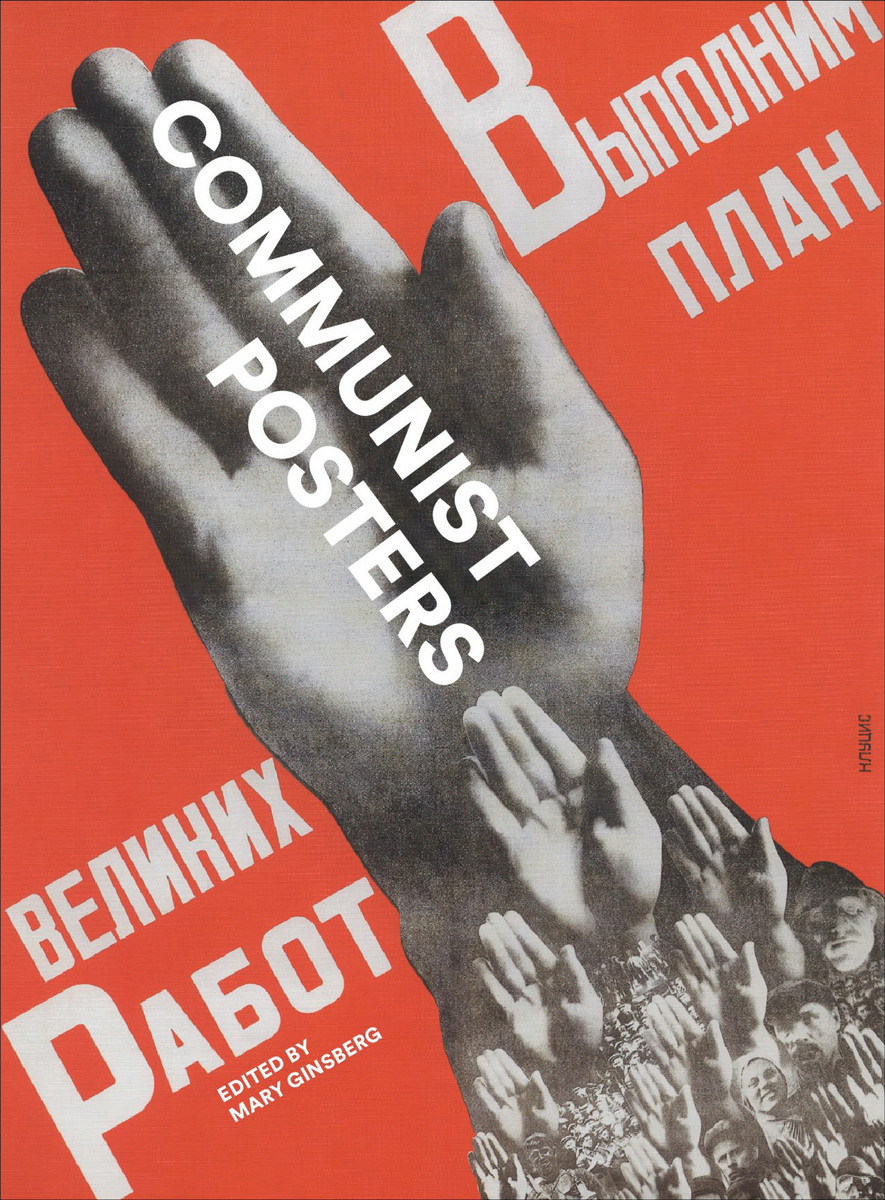
cover of book
North Korea menaces again as a foe of the United States. Cuba waits as if eager for reconciliation. Regimes against which American expended much manpower and munitions fifty years ago now trade with their neighbors in Asia, the largest of which, China, is capitalist in fact if not theory. Headlines and Wiki-Leaks pepper the news and feeds with distrust of a sinister Russia, echoing the Cold War.

This range of reactions by the U.S. government and media to Communist nations makes this collection of posters from these and allied nations under red flags relevant. On the centenary of the Bolshevik Revolution, Mary Ginsberg edits and introduces the most comprehensive presentation in print of often vivid propaganda, that for a less screen-focused century, captured the eyes and the minds of hundreds of millions. They celebrated, endured, or hated the heydays of Fidel or Mao, Lenin and Stalin and the various apparatchiks who tried to implement their theories and schemes.

A representative example appears early on. Red Loudspeakers Are Sounding Through Every Home (1972), as Ginsberg observes, documents the use of images to instill obedience. In a Chinese village, slogans, songs and lectures emanate from speakers installed on the streets. Their indoctrination may have seemed inescapable. For such broadcasts cannot be shut off. Other means further the deification of the leader as well as his dictates. The home shown on the poster has only a framed portrait of The Chairman, surrounded by small banners with sayings and little red books. Outside, a family gathers.

Over 330 illustrations demonstrate the range and the scope beyond the U.S.S.R. and the P.R.C., Korean, Mongolian, Eastern European, Vietnamese and Cuban chapters provide essays by scholars. These cross-reference the pictures, providing a narrated guided tour that alerts readers to the themes.

These depend heavily on Constructivism and photomontage. Art as function and promotion through photography combine to sell the peasants and workers on these products of the intellectuals. What they peddle are exhortations to produce more, fight harder and act braver. The verbosity of the caption can weigh down the impact of the 1937 image. Sergei Igumnov's red fist emerging from the rolled-up sleeve showing off a worker's clenched and muscular arm strangles a snake with swastika eyes. What this depicts is: "We'll Uproot Spies and Deviationists of the Trotsky-Bukharin Agents of Fascism." Given the relentless purges under the Man of Steel, such creations linger longer for their visual force rather than the ever-changing explanations linking the art to the enemy of the moment.

As dynasties bore down, the masses viewed ideals. Aleksei Lavrov's The People's Dreams Have Come True (1950) has a grandfather resembling Lenin. He clasps a Young Pioneer's shoulder. The old man's smile encourages the slightly wistful, perhaps hesitant, fantasies of the boy, looking up from his book, penned by "a critic of urban social conditions." Pravda sits on the table of their ship's cabin. Behind their sofa a reproduction of "the famous Repin painting Barge Haulers on the Volga" is a bit blurred, but "confirming how terrible things used to be." Outside, ships sail past factories that gleam.

The last Soviet poster blurs into patterns mirroring 1920s abstractions. Other lands drew on their own artistic legacies. Mongolian folk art and calligraphy enter many of its first efforts, while later ones mimic the Chinese Communist preference for red banners, gesticulating vanguards, rosy cheeks and marching masses. Polish aesthetics, as evocatively shown on film posters, also grace political ones.

Silhouettes, shadows, stark typefaces and surreal figures shunted aside the Soviet template. Czech and Hungarian designers likewise incorporated pop art and psychedelic patterns into silkscreen and montage takes on opera, a new television model or Allende's brief Chilean victory. Anti-Americanism also heightens for Western audiences a Chinese imitation of an anti-Vietnam war mural, with placards of English-language denunciations of the war machine. North Korea dutifully perpetuates this type.

The appeal of stylized "characters in primary colors, along with shrill slogans, dotted with exclamation marks" predates the reign of Kim Il Sung. But their "visual recognizability and readability" sustain themselves for two-thirds of a century due to the simple, even atrophied graphics. As Koen de Ceuster explains in this section, campaigns prove unrelenting under the Kims, and so the shelf life of a given poster is limited: "the message prevails over the package." He also asks a necessary question: "Where does art end and propaganda begin?" For the D.P.R.K., art theory combines ideological with artistic equality through a unified concept. Agitprop exhorts the Koreans to work diligently against an Uncle Sam whose competing tanks, bombers and missiles always loom.
What distinguishes Korean versions is a frequent inclusion of a mythical horse flying over smoking chimneys and rice paddies. Eyes also lead the way as they flare up and as fingers point the way on.

Vietnam takes French and Indochinese influences, hand-drawn lettering, indigenous themes and guerrilla poses from street art for some of its varied products. They stand out as more awkward and more original than the Soviet, Maoist or Korean contributions. They perpetuate the raw, eyewitness sensibility of not an imagined but a real struggle against an imperialist invader, or more than one.

Another rich array of approaches results in Cuban artifacts. International influences entered into the island's art long before 1959. Capitalizing on tourism and a worldwide market, its posters were sold as commercial items. Diminishing the Socialist Realism quotient, they increase the use of stencils, hand-cut and silkscreened. Disparate objects may juxtapose; so may "humour and visual wit." Not to mention Castro's 1977 proclamation: "Our enemy is imperialism, not abstract art." Contrasting the sophistication of the Cuban propaganda against the simplicity of Mongolian, for instance, reminds viewers and readers of the connections one Communist enclave may enjoy, as opposed to another.

One closes this collection wondering what the future holds for political posters. Capitalist systems appeal to the watcher of a screen far more than the passerby of a placard. Scholars in this current century may have to hope that our soon-outmoded digital technology records the catchphrases and memes generated by the political spectrum today as carefully as archivists have these bold posters. (Spectrum Culture 12/1/17 with slight changes) 432 pages 04-22-17 Reaktion Books

Friday, April 24, 2009

"Chasing Hares": Buddha's Three Easter Bunnies?

Mad March Hares, chocolate bunnies, Astarte, lunacy, menstruation, fertility, Buddhism's three refuges, the Trinity, and the Virgin Mary. Along the Silk Road, through the Golden Horde, the same ancient symbol. Three circling and intertwined hares spread east to China and west through Germany to Devon. Coincidence? Chance? Kismet?

While the Chinese and the Christians who incorporated the motif into their places of worship both appear to have forgotten the original meaning, they displayed the three rabbits chasing each other upon roof bosses, treasure chests, wall paintings, and even Mongol coins. Sure, threes-- my lucky number-- is a given for many cultures. But, the specificity of the three hares does establish a singular pattern that did not originate independently. Its distinction marks its common birthplace, in Persia.

James Crowden wonderfully and eloquently follows the diverging, and then unifying path taken by three scholars. They pursued this image over thousands of miles. Listen to the November 16th 2004 BBC Radio 4 Programme "Chasing Hares." Crowden alludes to the connection: hares were by many ancients supposed to reproduce asexually, their fertility was tied of course to spring but also to the lunar cycle, and the half-lost ties to Astarte-Esther-Eostre-Easter, feminine wiles, and sexual potency jumbled together. Into "spring fever"!

The trio themselves of archeologist Dr. Tom Greeves, art historian Sue Andrew, and photographer Chris Chapman explored around 2004 the Three Hares icon's dispersion and origin. They have inspired an array of websites with pictorial links to the iconography and the provenance of this symbol. I don't think the hares made it to Ireland, but this triple intertwining, reminiscent of Celtic swirling interlace but somehow folklorically international and maddeningly common in many storytelling traditions, may have influenced the triskele of the Isle of Man and they have been traced to the North of England in formerly Celtic realms during the Middle Ages.

Many conventional scholars belittle the idea that Christian and Buddhist, Western and Eastern, Nestorian and Catholic, perhaps Celtic and Himalayan could have had much verifiable contact. (I admit caution here despite my romantic wish for fulfillment; I found out on my own, tangentially, that as late as 1291, a Tibetan Buddhist monastery survived in Persia, for example.)

What about the Italian friars contemporary with Marco Polo who travelled to Samarkand and Swat? The forgotten sailors who must have skippered from Cairo to Cornwall? The traders who lugged cauldrons and crafted torcs across the sands and steppes. If my Celtic ancestors may have exchanged goods with those prehistorically from Scythia or Danube, Galicia or Tunisia, why could such trade not glimmer later?

I'm now mapping out historical predecessors in pseudo-scholarship by antiquarians of Buddhist-Celtic ties. Professors scoff at this documented need by some of those on the fringe. Outliers persist in melding together what academicians sever. This energy produced, recently, determined constructions of hybrid spiritualities. While the Silk Road may be replaced by the Information Highway, the yearning to cross over from one culture, one faith, to another, still beckons a few bold pilgrims today.

The solution to the mysterious origin-- as far as we can surmise-- of the three hares suggests that our ancestors shared intriguing lore from faraway lands. No less than hipsters with Chinese tattooes, Lhasa residents better or worse working at Holiday Inn, or sushi bars the world over-- and pre-fab Guinness-tapped chain pubs. This venerable trail of interlocked beasties attests for us in a globalized age of a slow diffusion from a caravan-burdened, clipper-ferried, or tinker-peddled less hectic, more marvelling, past.

Here are two representative links: Chris Chapman's photos for the "Three Hares Project." Metapage to Crowden's talk, Chapman's pictures, Chinese parallels, and similar puzzles: "Three Hares Homepage." St. Andrew's Church, South Tawton, Devon image; photo by Chapman.

Sunday, December 21, 2008


Welsh Rugby, Papal Death, Coca-Cola Douches.

Now, that's a great trifecta of search terms. BMJ reports on the first two paired; the third-place finisher, to your probable surprise, stands on its own two legs, so to speak. Among other current BMJ tidbits: headbanging rockers can suffer repetitive head-and-neck injuries, Oliver Twist's diet would have proven impractical to keep even workhouse inmates employed, and sugar doesn't make kids hyper. As for the supposedly spermicidal powers of shake-and-spray cola application, watch out for that bottle cap in the dark. "Contraception doesn't go better with Coca-Cola."

Should the Pope be worried that Wales won the rugby Grand Slam this year?


"Research paper: Rugby (the religion of Wales) and its influence on the Catholic Church: should Pope Benedict XVI be worried?"

Doctors in the Christmas issue published on bmj.com today are urging the Vatican's medical team to keep a special watch over the Pope this Christmas, after their research investigating the link between papal deaths and Welsh rugby performance suggests that he has about a 45% chance of dying by the end of 2008.

Dr Gareth Payne and his team from Cardiff found no evidence to support the urban legend that "every time Wales win the rugby Grand Slam, a Pope dies," but they did find limited data linking Welsh rugby performance and papal deaths. Worryingly for Pope Benedict XVI, Wales won the Grand Slam in 2008.

The researchers charted all northern hemisphere rugby championships since 1883, but discarded the years 1885, 1888-9, 1897-8 and 1972 because not all the scheduled matches were played. For the purposes of their research, a Grand Slam was defined as one nation beating all other competing teams.

Since 1883, eight Pontiffs have died, five in Grand Slam years - three deaths happened when Wales completed the sweep, and two others occurred when Wales won the tournament but not the Grand Slam.

Interestingly, say the authors, although the deaths did not always coincide with a Welsh Grand Slam win, they did correspond with a victory of a predominantly Protestant nation (England, Scotland or Wales), rather than a Roman Catholic nation (France, Ireland, or Italy).

The authors comment that the link between Popes and Grand Slams "is nothing more than an urban myth ... This comes as something of a relief as we are at a loss to see how the events could be linked, especially given the continuing rapprochement between Catholic and Protestant churches."

However, given that the research suggests a link between the success of the Welsh rugby union team and papal deaths, the authors believe that the Vatican medical staff "can't fully relax until the new year arrives."

Illustration: No, I couldn't find one to match all three terms either. But, a great image from Paine Proffitt's paintings! "All Welsh Rugby Players Go To Heaven, 2005 - "This was the first time I used a dreamlike, surreal, narrative approach, inspired by Chagall" - PP." See #2, inspired by a medieval triptych, too. Visit: BBC: Rugby in the Frame

Friday, September 19, 2008

Buddhist Erotic Art: In search of?


Buddhist Erotic Art: In Search Of?

I recall a joke book: "Irish Erotic Art." Opening it, blank pages faced you. While perhaps the palimpsestic scrapings of guilty monks erased whatever salacious scribblings which might have adorned the pages of some Book of Monasterboice or Clonmacnoise or Termonfecken dug up from a bog, I do wonder why such absence, given admittedly-- this being a work computer-- a "moderate safe search" of images (text is anything goes!) of Buddhist equivalents looms in my brief but devoted scrutiny of snaps on the Web. Lacking any books to confirm or deny "Buddhist" + "erotic" / "sexual" + "iconography," I rely on the engines of clumsy cyberspace, which must for now hunt around words coupled near photos for any hints of enlightenment.

This query started when I found a while back the explanation of the one illustration that's ubiquitous: the "yab yum" pose pictured above in an uncredited source (at least triplicated on the Net) of a Tibetan scroll-painting, a "t[h]an[g]ka." Yab= father and yum=mother in Tibetan. Now, the male Buddha-deity represents in his union with his "consort" the joining of his "skillful means" and expression of compassion into the female's wisdom and emptiness. Talk about the big O. Hamlet would have liked this conjunction function.

So do the proprietors of an Amsterdam coffeehouse-cum-brothel, Hong Kong techno LP compilers, a rather dubious San Francisco purveyor of Tantric therapy, and the source of one host of this image, an earnest and learned New Age Dutch fellow enjoying the golden years in a garden in Victoria BC at Free By Nature . (Caveat lector: it's one of those endless pages you must scroll down four years' worth of posts to scan, but there might be pearls of wisdom therein lodged amidst the colorful and erudite musings.)

Still, all this symbol hunting made me feel like poor Causabon in "Middlemarch." I kept pondering: why did Buddhism appear, from the evidence scattered in my unscientific forays, to lack visual representations of sexuality? Did they come to conceive of sacred sex as this pose only? After all, many Westerners-- as with the Amsterdam and Tantric referents-- link liberated lubricity with Shangri-Las and Nirvana on earth. There seems an implicit contrast between the "Irish erotic art" reaction to a severe Christian denial of our urges and the Shiva-limbed, creative, and carefree contortions favored in, famously, one of the few sites to have escaped by its remote jungle overgrowth the annihilation (by Islam, but if the Jesus-freaks had got there first...) of Buddhism in its Indian homeland, Khajuraho. Here's an array of explicit photos from the temple friezes . Luckily, these supple carvings now are protected by UNESCO as a world heritage site, unlike the fate of the Bamian Buddhas obliterated by the Taliban or the deteriorating landmarks at Angkor Wat.

Still, the Buddhist options extant as pictured appear to be either Khajuraho or Yab Yum. Losing one's self, literally, in a higher experience symbolized by blissful conjugation, or losing one's self, temporarily, in a fleshly encounter sculpted for sensory overload. Perhaps two levels, then, may better sum up this dichotomy, this reliance, based on admittedly a narrow range of material and the vagaries of keywords and Google and my own vast ignorance?

I came across on a Tantric Australian site (can't backtrack for it) an intriguing suggestion: the temple had been so graphic on the outside of its depictions for a curative purpose. Once the viewer had gotten over being dazzled by the Kama Sutric variety, then the pilgrim would be ready for entrance into Khajuraho's interior, as austere as a Calvinist kirk of stimuli. (See Michael Rabe's article for details and photos, although he minimizes this Down Under understanding.)) As I wrap my mind around it, Buddhism requires its seekers to understand that desire itself sexually is not sinful as it has conventionally been confined-- if in a distorted fashion-- by Christian orthodoxy. Yet, our libido does keep us attached to the demands of a restless body. Taken as a brutal force or a dangerous drug, sensuality can drag us down into lusts, bewilderment, and selfishness. Rather than freeing us into the spirit that strives to separate itself from its troublesome throbbing shell.

There's considerable discussion, unsurprisingly, in print about Buddhism and sexuality. Lawrence Sutin, in the study which I just reviewed here a few days ago, "All Is Change," records how gay and lesbian Buddhist converts, upset by what they found as a considerably more puritanical set of restrictions on practices allowed under the "Third Precept" that proscribes "sexual misconduct," asked the Dalai Lama to reconsider its prohibitions, as interpreted by Tibetans, of non-procreative activity. Of course, this request came in San Francisco. I see this end run around the tradition to advance modern freedom as akin to what freethinking Catholics might challenge as those actions permissible only as "open to the possibility of conception." His Holiness took their request seriously, I suppose more so than the Pope entertains such appeals to the Magisterium.

Reading Pico Iyer's "The Open Road," (reviewed by me here after I wrote the above paragraph), I add this clarification in the following two paragraphs: Iyer cites a friend and scholar who objected that "the famous injunction against" non-coital "intercourse was a late addition to a text that spoke only against adultery; Tibetan Buddhism at its heart prescribed no such doctrine, which would exile male homosexuality." Iyer has just noted that the texts "said nothing about women," an out(let) for me reminiscent of OT loopholes in Leviticus for the disport of the fairer sex, or the lack of laws against lesbianism in Victoria's England supposedly since the queen'd never heard of such behavior.

"The Dalai Lama, true to form, said that if his friend could produce the text and show him in completely scholarly terms that he had misjudged the old texts, he would certainly be open to changing his mind, but till then he could not go against the code he had inherited." (146) Strict, but at least there's room for a fumble and recovery with the Dalai Lama, who has argued that science can replace Buddhist tenets. For instance, the sun and the moon are not of equal size, and there's no lunar light emitted, contrary to Tibetan dogma! Like Galileo, it may be a long wait for those appealing similar freedoms from the Vatican. For forty years many have protested against the encyclical of Pope Paul VI in vain, to the detriment of common practice and adherence to the faith of my fathers-- and mothers-- by millions of Catholics. Still, it's a tough call, given the coherence of natural law theology. As doubtful to me as the lunar radiance, but an illusion easily followed by many others.

However-- and this remains independent of my own reactions to such doctrinal interpretations-- it seems to me both traditional Catholics and conservative Buddhists share an ineradicable understanding. They both favor the male-female, yab-yum, penile-vaginal connection as fundamental. This must be, at least from my knowledge of Humanae Vitae and the Dalai Lama's "The Way to Freedom" recapitulation of the Lam Rim core teachings of his Geluk Tibetan "ways along the path," cautiously grounded in the conventional norm of intercourse. Deviating from this ideal, both appear to preach, means losing one's self in one's own pleasure rather than the purpose for which coitus has been designed. This in turn endangers a relationship by putting the ego ahead of the other person's needs. And, of course, this understanding runs smack into the problem nowadays. (The reason, I might add, why my wife donated yesterday in the name of Bristol Palin a contribution to Planned Parenthood.) People no longer must couple only to make babies; contraception, education (not the sort Mrs. P. wishes for her daughter or our children) and variety both allow a broader range of sexual expressions, akin more to Khajuraho's abundance rather than Yab-Yum's concentration.

How this erotic expansion fits into the narrower version of proper sexual activity that the Third Precept expects will prove as daunting for Western Buddhists to reshape as it has been for liberal Catholics to reclaim. The erotic may, however, I suspect be more akin to Eastern acceptance of the flesh's right to fulfillment vs. the standard Abrahamic religions that tend to keep the women under suspicion of their Edenic powers of temptation. Now, Buddha five centuries before Christ also labored under his own prejudices. The legends tell us that when he-- years after abandoning his young wife and infant son as he tiptoed out one night and began his quest-- approached her on a sort of grand tour, she refused to see him again despite his fame. ( Andre Bareau: "A Mysterious Being: The Wife of Buddha.") Since I read Hesse's "Siddhartha" as so many teens have, I've always felt sorry for Yasodhara and their boy, Rahula. Junior later became a monk. She, long suffering, deserves a thangka, at least.

Historians assure us that, no less than any other age, even the Buddha instilled prejudices of his patriarchal era. At least his women followers could enter monasteries; the stress, however, on the separation of the committed adept from the lay devotee, in both Christianity and Buddhism, does heighten the tendency to favor renunciation as a necessary corollary of ultimate commitment to the teaching. For this, I do find that Muslim and Jewish practices may be in this case more admirable, for at least they tend to keep the family-- with necessary acknowledgment however fumbling or reluctant-- to conjugal domesticity as the heart of the practice. (If only to make more babies for the Faith, which is a whole other karmic conundrum.)

There's a discipline involved for the committed Christian or Buddhist, contrarily, that demands that he or she distance the body from the spirit so the latter can begin to ascend. Such tension inevitably erodes the erotic expression in favor or its spiritual sublimation. The Buddhists in the West, as Sutin notes, have been markedly reluctant to take on the ascetic attitudes towards the Third Precept's more stringent interpretation. He suggests that this distinction may prove one of those that will encourage a mature philosophy of dharma perhaps, and this is me chattering now-- differentiating Western Buddhists from both the more stringent guidelines of such as the Dalai Lama and from papal or evangelical Christian limitations on sexual choices.

I know many in the West distort Tantra-- in its primary meaning a channeling of the universal energy, achieved not by overnighters at Esalen but by initiates steeped in years of Buddhist study and guru-approved supervision. In fact, such unauthorized detours into the realm of the senses Georg Feuerstein's labelled as "California Tantra," confusing orgasm with sublimity. Maybe it's only a venal sin? Still, as with interpreting the esoteric "Tibetan Book of the Dead" as an LSD manual, anyone translating Buddhist conceptions into countercultural expression may see such metaphors, and simplifications, as perhaps inevitable distortions for eager laity.

For Buddhism, it may be that Khajuraho's the accessible portal into rarified Yab-Yum. We wear ourselves out happily on the lower levels of the playground, and then we climb the ladders. Contemplating the Yab Yum, I speculate on its perspective: the woman is on top of the man; this embrace appears reliably on tantric websites. Why doesn't a feminist paint it the other way around? Give us the back of the Buddha's head and show the whole face of his consort. Make her the one we're gazing upon? And, I keep nagging away: surely there's a wider range of postures that some Tantric initiates must have depicted on some thangka? Where's a 21st c. re-orientation for a lascivious, lithe, and/or laughingly lovelorn lama?

See the "Red Thread" discussion (linked below) by a Zen nun about her own romp along this path from fornication to realization. Could one, I idly and saucily meditate, employ erotica as a visual stimulation into the mysteries of the Buddha-deity and his consort? Or, would such a use tangle one in attachment to karma, to a samsaric want for easy entry into more esoteric insights? Similar perhaps to the distrust-- also noted by Sutin-- of Buddhists for a psychedelic shortcut to what yogis sought to encounter by prolonged fasting and bodily deprivation. Here, too, perhaps Westerners may imagine erotic and pharmaceutical aids towards elevation. Drugs, debauchery, and drink brought down more than one guru in his mission to the West in recent years. Scandals do not only taint the Church. So, another precept's prohibition against stimulants may make this as problematic as alcohol is for the Beehive state full of Jello-addicted Mormons. Still, one wonders what full-immersion virtual reality may bring.

Now, in the service of scholarship I recognize a problem akin to if, in search of Western postures, I entered but two terms, say, "missionary position" and "soixante-neuf." I simply do not know the vocabulary for alternative arrangements that may open up other imagery or information. Not to mention the linguistic barriers. Perhaps this is why Tantric instruction's not given to the prurient? There's always a come-on to lure us deeper into the coming attraction, the price of admission that draws us into the shrouded shade outside the fairground's glare.

I feel as ignorant as those intrepid bible-thumpers stumbling upon a delightful orgy amidst the jasmine and boganvilleas. One wonders how many Khajurahos have been demolished as surely as the Bamian Buddhas. This being said, it appears-- and seems illustrated in later Buddhist art if Tibet's any indication-- that Yab Yum's ecstatic model dominates the discussion; India's earlier exuberance we find preserved only by luck of the jungle vines that shrouded its scenes from Muslim ga(u)zes.

P.S. There's much more on this topic, by its endlessly provocative nature! Here's a list of further reading that I recommend.

Dr. Alexander Berzin: Issues in Buddhist Sexual Ethics. 1998 lecture.

Thich Nhat Hanh: The Third Precept: Sexual Responsibility. 1993 rpt. essay.

Winton Higgins: Buddhist Sexual Ethics. Buddha Net article, n.d. Also see link to a stern "Rejoinder" here.

Stephanie Kaza: "Finding Safe Harbor: Buddhist Sexual Ethics in America."Buddhist-Christian Studies 24(2004): 23-35. Project Muse: not available freely online.

Michael Rabe. Sexual Imagery on the "Phantasmagorical Castles" of Khajuraho. Int'l Jrnl of Tantric Studies 2:2 (Nov. 1996).

"Red Thread Zen: The Tao of Love, Passion & Sex." Dharma Web. 1993 teisho.

Roohi Saluja. Mystic Mandala of Khajuraho. Life Positive. Jan. 2005 essay.

M. O'C. Walshe: Buddhism & Sex. 1975 tract.

Saturday, September 8, 2007


"Love, Sex & Marriage in the Middle Ages: A Sourcebook" ed. Conor McCarthy: Review

This compiles mostly British sources in translation, as well as a few Islamic texts along with mainly Western European literary, medical, historical, and legal sources. Attention to all three topics manages to dispel the notion that this book would lack for content. As McCarthy notes in his helpful introduction, the subject gains both more sustained if less explicit treatment than today's readers may imagine.

Besides the expected troubadours, Chaucer, Rabelais, Margery Kempe, Abelard & Heloise, and Marie de France, for example, there are lesser-known works such as extracts from conduct books such as "Holy Virginity," saint's lives, Anglo-Saxon and Norman statutes, Bede, Old English riddles, Gratian, Jerome, lots of Augustine, and medical advice from Avicenna and psuedo-Albertus Magnus. The controversial practice called "clandestine marriage" gains considerable coverage. Notably, fascinating testimony from a transvestite prostitute, the ambiguous John/ Eleanor Rykener from London, 1394, attests to a "Boys Don't Cry" Brandon Teena type of case. The dozens of entries are footnoted judiciously; all writings included are preceded by brief notes cross-referenced with an excellent bibliography.

Posted to Amazon US. Cover: David & Bathsheba, Morgan Picture Bible, 1250. I recall my first tidbit about medieval iconography learned when I was 18 and had checked out an illustrated Chaucer from my public library. Adulterers were shown with one at least of the partner's feet exposed at the tail end of the coverlet, but here Bathsheba's well tucked in alongside our dancing, psalming, militant, lusty harpist-King. This Pierpont Morgan Library URL allows you a zoom on the thumbnail manuscript reproduction.
http://www.themorgan.org/collections/swf/exhibOnline.asp?id=216