Showing posts with label Middle Ages. Show all posts

Tuesday, May 12, 2020

Death + Didascalicon


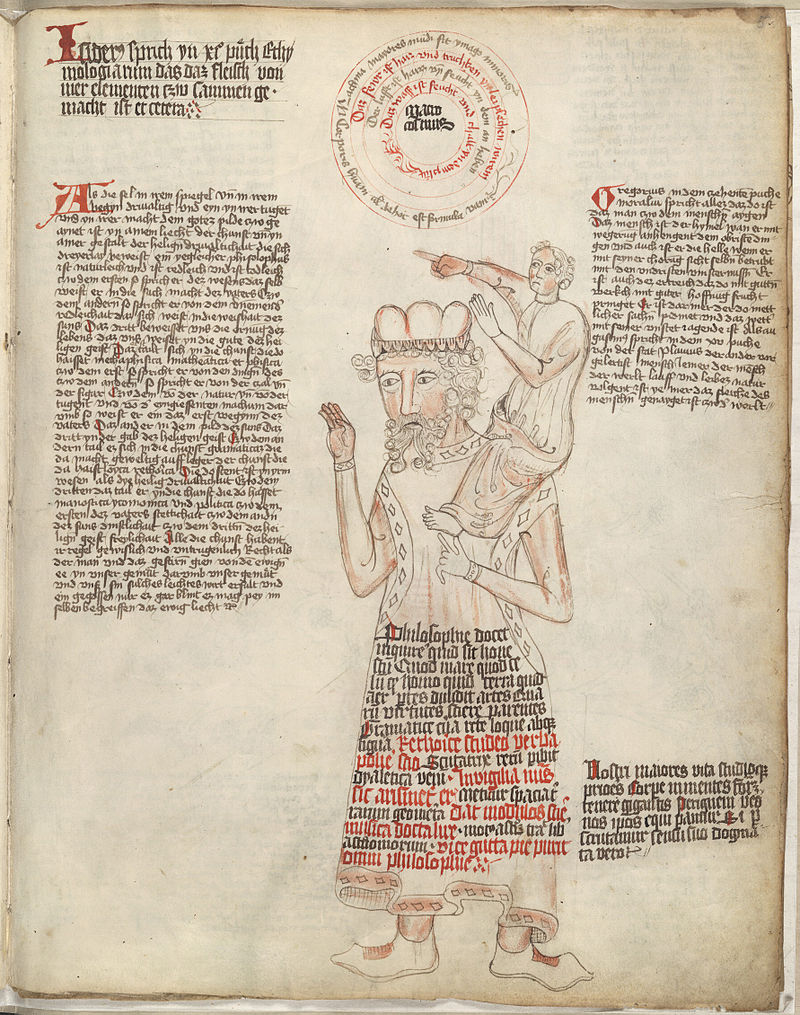
Last post began with a promised juxtaposition that stayed delayed. Too much grading intervened, too many importuning appeals. Here's the connection. In Rik Van Nieuwenhove's An Introduction to Medieval Theology (2012), the Didascalicon of Hugh of St Victor (ca. 1096-1141; pictured above) gets its moment. Don't be scared off by the title, as it's a guide to what, as you can see in my self-description on this very blog, is the medieval progression of study. The trivium's triple way from grammar to rhetoric to logic, whose remnant may be Freshman Comp (now "First-Year" to avoid gender), and then the more abstract realms of the four paths as the quadrivium into arithmetic, astronomy, geometry, and music. In turn, wisdom under the guise of theologia rules as Queen over the sciences. Literally, the fields of knowledge, from the Latin scire, to know, not our modern convention.
These seven liberal arts show the student freed from manual labor the direction to follow.

"The start of learning, thus, lies in reading, but its consummation lies in meditation; which, if any man will learn to love it very intimately and will desire to be engaged very frequently upon it, renders his life pleasant indeed, and provides the greatest consolation to him in his trials. This especially it is which takes the soul away from the noise of earthly business and makes it have even in this life a kind of foretaste of the sweetness of the eternal quiet."

That last phrase lingers like poetry. With less noise lately, more of us get squirrely, but some of us stay content. Turning off the machine and tuning in to nature, and the mind, and soul.

I'm trying to write shorter pieces for the blog, as looking back I can see I wrote ones that the ruder folk online dismiss as tl;dr (too long, didn't read). Philistines leaving graffiti, IMHO.

All the same, I am not attempting always to weave together various threads. More like the commonplace book I originally thought this blog'd be, I'll be inserting some reviews from the past couple of years stored up, as well as some even before that, Italian focused often as they were preparation for my visit there in what seems, given our already altered, or at least interrupted, collective memory, a while ago, rather than the few years on the calendar count.

What I'm musing about for much of my life: how we construct our notions of death and what either does or does not await us afterwards. Teaching a Contemporary Fine Arts, I offer a dozen very flexible theme choices so students can select an approach to slot in their own works to analyze. At first, when I added to the boring original six the course designer plunked down, another much more engaging, naturally six, and revising the six previous ones, I hesitated a second before creating one centered around death and mortality. It's been the most chosen by far each term. Sometimes half of those enrolled opt for it eagerly.

And in an already annoying to me media blitz where infection rates rise next to CNN sharing only one topic for two-plus months and counting, and where "uncertain times" came two weeks into this shutdown in two separate brands of cars advertised on air, and then a month in, the "we're with you poor brutes who have to go out and be nurses and DoorDash drivers" self-congratulatory missives, and now products pitched at the housebound or unsheltered in place, eager as the latest off-road jeep spiel starts, "from Park to Drive"--well, it's more apt than averring as I might let's have neighborhood book reads of Defoe's Journal of the Plague Year (can't get it from the library e-books as it's way booked) and the Decameron. I leave aside Camus' The Plague as it's allegory, but I do add to the shelf my own pick at the end.

Of course, I've been musing on this mortal coil and its contortions. I have my own loss that I keep private. Not sure if not being able to attend what would have been three (so far) funerals indirectly hastened to be sure by the virus and the ripple effect on hospitals, nursing homes, and the speed at which a kid drives a McLaren sports car and kills a certain pedestrian on an empty downtown L.A. street is a blessing or curse. But I am leaving off prognostications. Only noting my bemusement when a "Plan-demic" video was posted on a discussion forum, and seeing at the bottom of its conspiratorial manifesto a tag line to go to Alex J's Info-W's to purchase a 95-whatever mask. Profiting off panic, survivalist suckers.

For now, I'm reflecting, not predicting. And trying to parse if "through July" as issued by the California governor just now means shut-in until the end of June or of July itself. So, my reading will, deo volente, live on. As in this via Harper's weekly archive of arch finds from its 160 or so years of publication. As a subscriber, I unlock the magic door behind a paywall.

This pdf reveals the late John Berger's Sept. 2008 list "On the Economy of the Dead." I've been mulling it over as the past week I'd watched too the Amazon series Upload, all about the attempts of corporations in 2033 to create theme-park-resorts for those whose consciousness has been beamed onto a hard drive. Then the simalacra of the un-dead, as avatars, roam above in their digitally run paradise. With the supervision of their customer service reps in human form at keyboards who oversee their accounts--and as long as their earthbound relatives or loved ones foot the bill for their continued upkeep and fancy AI digs.

Which in turn reminds me strongly, in this lockdown phase of our own time, this 2006 novel. See my (admittedly mixed, may be spoilers) review of The Brief History of the Dead.
Have fun matching up which number you choose to align with long-gone Hugh of St. Victor.
  1. The dead surround the living. The living are the core of the dead. In this core are the dimensions of time and space. What surrounds the core is timelessness.
  2. Between the core and its surroundings there are exchanges, which are not usually clear. All religions have been concerned with making them clearer. The credibility of religion depends upon the clarity of certain unusual exchanges. The mystifications of religion are the result of trying to produce such exchanges systematically.
  3. The rarity of clear exchange is due to the rarity of what can cross intact the frontier between timelessness and time.
  4. To see the dead as the individuals they once were tends to obscure their nature. Try to consider the living as we might assume the dead to do: collectively. The collective would accrue not only across space but also throughout time. It would include all those who had ever lived. And so we would also be thinking of the dead. The living reduce the dead to those who have lived, yet the dead already include the living in their own great collective.
  5. The dead inhabit a timeless moment of construction continually rebegun. The construction is the state of the universe at any instant.
  6. According to their memory of life, the dead know the moment of construction as, also, a moment of collapse. Having lived, the dead can never be inert.
  7. If the dead live in a timeless moment, how can they have a memory? They remember no more than being thrown into time, as does everything which existed or exists.
  8. The difference between the dead and the unborn is that the dead have this memory. As the number of dead increases, the memory enlarges.
  9. The memory of the dead existing in timelessness may be thought of as a form of imagination concerning the possible. This imagination is close to (resides in) God, but I do not know how.
  10. In the world of the living there is an equivalent but contrary phenomenon. The living sometimes experience timelessness, as revealed in sleep, ecstasy, instants of extreme danger, orgasm, and perhaps in the experience of dying itself. During these instants the living imagination covers the entire field of experience and overruns the contours of the individual life or death. It touches the waiting imagination of the dead.
  11. What is the relation of the dead to what has not yet happened, to the future? All the future is the construction in which their “imagination” is engaged.
  12. How do the living lie with the dead? Until the dehumanization of society by capitalism, all the living awaited the experience of the dead. It was their ultimate future. By themselves the living were incomplete. Thus living and dead were interdependent. Always. Only a uniquely modern form of egotism has broken this interdependence. With disastrous results for the living, who now think of the dead as eliminated.

Saturday, May 9, 2020

Dwarf, Shoulder, Giant


Finding in juxtaposition very divergent commentary can reveal surprising connections. These serendipitous discoveries, one of my M.A. profs warned us, did not please him when inserted into essays. He taught us Shakespeare, the Jacobeans, some recondite philosophy in truth-claims I hated, and Milton. He hated it when he'd read an academic foray that suddenly, say, for example as this was a seminar back in 1984, brought in a passage said critic had just been perusing on her pillow the night before from, say, the bestselling Stephen King yarn Pet Semetary to illustrate a passage of, I dunno, Areopagitica. The fact I had to look up what reached the NY Times top of the charts that Orwellian year shows how out of touch I was with what the Anglophone world enjoyed beyond my academia.

Nonetheless, with a shock the other day, I tallied up my own chronicle of a life spent among admittedly far less sylvan and delightfully liberal arts campus classrooms as that one in Claremont, and I figured out I'm in my thirty-sixth (I thought it was thirty-three, the age of perfection for medievals as that is when Jesus died) year of teaching. Having begun it, as a 7-12 grade sub while attending said grad school, my first year out of college, before entering UCLA that fall for my Ph.D.

I've been taken with an odd compulsion to finally read a book that helped nudge Thomas Merton towards his faith and vocation. A sign of the times when one'd pass Scribner's window display in Manhattan and see none other than Etienne Gilson's The Spirit of Mediaeval Philosophy staring back. Merton bought it. His life took the direction we know, for better as well as for his own dangers to his quest along the uneven path as a monk towards learning and folly, holy wisdom and human passion.

Anyhow, I had a battered secondhand copy (rescued from the UCLA Newman Cente's discard bin, tellingly, of my own collegiate era) of that 1938 translation of his Gifford Lectures given, admitted in Gilson's casual aside in the book's afterward, to an audience of non-philosophers (replete with Latin untranslated and all the erudition expected of undergrads like Merton, I suppose, of Cambridge and Columbia eminence, as well as whomever Gilson delivered his twenty talks to back in 1932 or so at Edinburgh university. To think that such a title would 1) be sold like a Stephen King novel by a bookseller 2) be bought instantly on impulse by an admittedly brilliant college student 3) furthermore comprehended by him, boggles my mind, perched as if a dwarf on the shoulders of giants, as Bernard of Chartres (living at least until 1124) is said to have invented that analogy, in the words of John of Salisbury. Of course, Gilson uses that enduring image in his own lessons, and that's a neat turnabout.

For, after having finished the lapidary construction, where no sentence sidled in as superfluous, of Gilson's study, I wanted more context on intellectual history back then. Rik Van Nieuwenhove's An Introduction to Medieval Theology filled that gap. I'd had assigned David Knowles' The Impact of Medieval Thought and Friedrich Heer's The Medieval World for respectively my Medieval Philosophy and my history of ideas in the Middle Ages undergrad electives (maybe I had a bit of Merton's aspiration in me, despite the decline of Western civ), but as for a specifically theological survey, surprisingly there's none to balance the philosophical ones of Fr Copleston, Anthony Kenny, Gilson himself, his student Armand Maurer, or the podcast-turned-popularizations of Peter Adamson.

More about what I found by that professor, who intriguingly to me teaches at tech-heavy University of Limerick, where I'd once given explored the archives by the Shannon one day, next blog posting.

Sunday, September 10, 2017

Edward Gibbon's "The Decline + Fall of the Roman Empire": Kindle Book Review

The Decline and Fall of the Roman Empire : Abridged ...
As editions jumble and formats collide on Amazon for such classics, I'll explain Kindle versions. The public-domain ones for free or a buck or two are the Anglican reverend H.H. Milman's 1838/45 version, interspersing his commentary--which about Gibbon's anti-religious musings, was defensive. J.B. Bury's 1897 ed. can be downloaded elsewhere than Amazon. Bury kept his comments appended after Gibbon's famous footnotes. These older eds. online differ somewhat in presentation; some relegate footnotes and some place them within the main text after every relevant page.

David Womersly's abridgment of his 3 vol. 1990s ed. in Penguin provides eleven complete chapters and footnotes. Hans-Friedrich Mueller's 2003 abridges the Modern Library 1987 ed. Mueller assures us in his preface that the whole work still should be read and consulted. He admits in his task a different emphasis than, say, Milman. Keeping in the religious, political and institutional concentrations, he excises 2/3: battle details, genealogies, ethnologies, and footnotes. Mueller avers this fits contemporary concerns and aligns with relevant issues. On the Kindle, it's elegantly legible.

Daniel Boorstin's original introduction remains, preceding a critical essay by Mueller and Gibbon's preface. The maps are small, as they were copied from the paperback ed. What remains are parts of every chapter. Mueller indicates where cuts or excisions occur so one may consult the full text. He does provide parts of all 72 chapters for a "continuous narrative." The complete Womersly set sits on my shelf. But I chose this condensed ed. for the ability to take notes and highlight passages, which I wouldn't do in my tomes. And for road trips. ( Amazon US 9/10/17)

Friday, December 4, 2015

At Siena


The train was jammed on Sunday afternoon. Upon arriving at the central Rome station. Layne found out our packet of reserved tickets procured online were partially invalid. One had needed to be printed out, no cellphone image, but the others had not. It did not matter much, as she had to stand in two lines for nearly an hour while I stood stolidly. I watched the hustle. Immigrant men, mostly younger but one very grizzled, tried to chat up travelers who looked foreign like me or simply bewildered like more. I expected they wrangled tips, but I could not see cash exchanged. Some of them "helped" at the ticket machines, others pointed to the right platforms in the distance, and both yelled at an Italian pair, as if an older man and his son, who appeared to commandeer them. I leaned against the back of a chrome rail, tried to meditate on the transience of transit, and watched the numbers slowly climb on the electronic readout until Layne's was called. Two nuns had been before her, but she was seen first. But the nuns left, I noticed, having been served, while she still lingered.

On the stifling train, we settled into the first seats we could. Layne's suitcase being too heavy to hoist, we set it in the doorway nearby for the moment. An old woman glared at us from her pink iPad across from us. Then, we had to move. We learned in halting English that all seats were reserved. We tucked our bags as best as we could by the diner car and went a few cars' length down, to find our seats. I tried reading my Italian lessons on my Kindle, determined while in linguistic boundaries to struggle along. I made it through a short piece on the Balthus exhibit we'd just seen in the in-train magazine.

Past Bologna, with its post-war housing towers, until we changed for Siena and headed into the sunset on a much less congested train. Soon we got our taxi and landed at the Camporeggio, the steep steps that faced the Alma Domus. A converted convent next to the house of St Catherine of Siena, this austere hotel nonetheless was set out well enough (if a no-nonsense booklet prohibited food brought in, not that it had a microwave or mini-fridge let alone mini-bar anyway) A fantastic view. A vantage point many stopped at to look uphill at the greenish black-and-white Duomo cathedral's nave and steeple to the right, the peak of the Palazzo Publicca in the center, and what must have been a square block tower of the Salimbeni fortress edging over the brown, earth-colored houses with green shutters that made up the intact medieval core of this former republic, and still a "commune."

Siena occupies a slanted city center, as no ground (as the Duomo's builders found) is that flat for long. Il Campo itself tips in as if a modest ampitheater, while the slopes of the city core rise so steep above the miniature "valley" of Fontebranda, lower down the steps of the Camporeggio, that it's quite a hike, although a short climb, up to the ancient arched ways of the Via della Galluza or Via Fontebranda. Around there, as I learned later from Siena: The Gothic Dream, Catherine was born to a dyer and a washerwoman. Until recently, the arches below the Alma brought water to Siena. and from these humble beginnings, the girl who at sixteen vowed to join the Dominicans became a correspondent and counselor of the mighty, named in 1970 the first female Doctor of the Church.

For such a compact city, Siena boasts nearly twenty "condada," or local guilds who compete in the famous horse race at the Palazzo, the Palio. Our first night there, strolling the streets that can be confounding in their similarity and curvaceousness to the newcomer, we decided to eat at the first place that looked appealing. I never had risotto as delicious as I did at Il Taverno di Cecco. On the dark lane named after Cecco Angiolieri, haunt of a local poet who never made it into the Tuscan pantheon, I later learned from the book above that this was the lair of La Civetta, the Owl's guild.

The next day, fortified by the hotel's muesli and yogurt if not much more, I found while staring at my shoes awaiting Layne's emergence from a gourmet shop that my stalwart Croatian walking shoes were fraying on the other foot as well as the one that a kind redhead glued to hold back the danger back in Drogheda for free. I despaired, but we found a Bata store, and I purchased grey suede desert boots. I'd have liked the Italian green ones we saw in another window, but these were about 40% less. Although I learned after the fact they were made not even in the EU but Bangladesh, unlike others at Bata I'd peeked into, they held me up. A shoemaker the clerks directed us to glued my other shoe's crumbling rubber sides back for two euro, but I figured this attempt was as doomed as its sole mate.

But the panforte Layne bought on the Piazza Independenzia proved a true boost to my spirits. We saw the baptistry of St John the, uh, Baptist at the Duomo. We looked at a majestic painting of an ascendant Jesus, while angels' baby faces twisted under his weight below his feet, peeking up from the orange clouds. A crypt revealed fragments of frescoes, and the sanctuary itself took me in by the individual busts of hundreds of popes high over the nave. Like R. Crumb's many progenitors of the patriarchs in his illustrated Book of Genesis, the artist took pains to make each a real, distinctive face.

The ambitions of the artists commissioned to make the Duomo the cathedral without equal in the late Middle Ages nearly succeeded. But, only ten out of the fifty thousand inhabitants survived the Black Plague, so they had to scale back their plans to extend the nave in another direction. We climbed up, after touring the museum. inadvertently having entered the stairwell, the Facciamente. This is the remnant of what would have connected this retaining wall to the extant sanctuary in the distance. From it, we looked down on our Alma Domus' window and much more. Although not as tall as the Palazzo's soaring tower, given my feet were developing blisters, we concurred that this was enough.

Our dinner that night at a little place just around the corner from that domicile, named after the Il Compaccio for which the passageway was known, was more nouvelle cuisine, but we liked it. Our friendly server and we talked about our cats and dogs, and the meal was tasty and elegant, if far more affordable than at home. Our wine, a red Il Paggio from a Castelnuovo Berardenga vineyard nearby, tasted far more expensive than ten euro. For an hour, a night at least, we pretended we lived here.

The next day, we needed to do laundry. Having passed a place while we visited the Pinacotecha Nazionale, we returned. After the bargain price of a four euros brought us a surfeit of the most complete collection of gold-tinged altarpieces, frescoes, paintings, and sculpture from Siena ever, we needed a break from so many breastfed babies, pierced virgins, upside-down crucified, and grumpy saviors. By the way, one of the easiest jobs ever must be an Italian museum guard. Grab a plastic seat, pick up your paperback (those Einaudi editions are elegant) or cradle your tablet or smartphone. You're set, sitting for the next few hours, and barely casting a glance up. For the automatic video whirs and sense detectors emit klaxons any time you accidentally lean in (sorry Sheryl Sandberg).

Tasty pairs of panini and potato pizza by the slice accompanied us as we sat later on metal chairs ourselves a few yards away. We kept our eyes on the laundromat, as a decidedly sketchy character seemed its purported attendant. I needed to stretch, so I sauntered up a steep incline off V. S. Pietro.

It took me sharply up to the Via San Quirico, into a neighborhood nearly empty. Many dwellings seem deserted, for no windows allow evidence of life, but the heavy doors do open or are left so now and then to afford glances into dark interior passages. Behind them, immigrants lived, families played, and children, by their toys sometimes resting in entrances, thrived. What was it like to live in such an old place? The prices in a tellingly titled German-named real estate window selling it seemed retirement or second (third?) homes to European gentry were very steep, but these were for villas. I supposed the upkeep on such as these flats in the city, like the ones we stayed in at Rome and would in Florence next, was considerable. How did the Moroccans make it, selling selfie sticks to us?

After resting, we took another walk, this time to the Camollia district. We looked at the mummifed head of St. Catherine at the massive church of St. Dominic which looked down on the Alma Domus, another monument to that Order's might, we passed the Piazza Antonio Gramsci, and we entered the auto zone, for the heart of Siena is blocked off--although taxis, trucks, and a suspiciously high number of cars that are neither still shove you aside on its cobbled thoroughfares nonetheless. After I had to dash into a thousand-year-old church that was once home to Templars and still now the Knights of Malta's sway, I imagined the pilgrims who wore out their shoes on these same steps. We found a dusty place, a cozy relic of the 1970s hippie trail, but its pasta and house wine satisfied us.

That edifice from the Crusading era, and the fervor it represented, lingers in Siena's shadows. These may entice those of us who visit, but closer attention reveals a haunted and disturbing resonance. When I got back home, I checked out from the library a 1999 scholarly study of the preacher whose sermons were celebrated in his hometown. Inside, The Preacher's Demons includes one of the two pieces paired by an artist whom I admired for his odd geometry at the Pinacotecha, Sano di Pietro.

Although most of what he painted seemed conventional (more Madonnas), I admire the angles and composition of two depictions of St Bernardine of Siena, one at the Il Campo, the other in front of the Church of St. Francis. (Gloomy when I visited, brown stripes barely visible in the murk, paintings indiscernible, its vast convent now the economics and law part of the municipal university, a plaque commemorating a Midwestern professor who lectured there for years, after a thesis critiquing Marx. I passed a begging student on the way down the V. del Rossi, but he was gone on my return, so I gave my change to a shawled woman playing the accordion on the Banco de Sopra from whose tables, broken if the lenders proved unfaithful, our term bankruptcy originated. The world's oldest bank survives here despite scandal, and has always been a formidable patron of the arts in Siena, too.)

Off the Via Salicotto, a sign points to Sinogoga Ebraica. On a sign nearer Il Campo, the latter word was erased. Plaques outside the door commemorate two events. The first, those murdered in 1944. The second, the burning of the ghetto in 1799 by an "Ave Maria" riot. Franco Mormando of Harvard recounts the terror that Franciscan friar levelled upon his triple threat. His axis of evil revolved around the Jew, the witch, and the sodomite. We marvel today at the splendid sights at which he summoned the faithful, but who is there to notice the beggar, the busker, the alley to the little shul?

Thursday, October 22, 2015

Miri Rubin's "The Middle Ages: A Very Short Introduction": Book Review

Very straightforward. In 120 pp. of text, this London-based medieval historian applies her knowledge to chapter 1's overview of a time in the "middle" according to the Renaissance humanists, but of course continuing from the Roman times into that early modern period with less disruption and more continuity than supposed. Rubin stresses the more seamless and less dramatic divisions that permeated a long medieval period, in some areas ending as early as the 1300s and in others going as far as into the 1800s.

Chapter 2, "People and their life-styles" covers such issues as what colorful clothing men, women, and children wore respectively in Norse Greenland, and then on the next page, shows how the medieval notions of the humours effected what people were expected to do and how they were assumed to act on their nature. She often, as her sources show, draws on very specialized monographs for her examples. These may not be that accessible to general readers, but she does provide recent studies by scholars of each topic. While literature and popular culture may not earn as much attention, and while philosophy and theology are submerged, this remains a quick primer.

"The big idea: Christian salvation" comes next, and unsurprisingly Rubin shows how this filtered into all walks of life. The illustrations of sculpture and art are well chosen to enliven the impact of Christian piety upon the masses. Similarly, "Kingship, lordship, and government" treats this subject briskly, if in less space. I found the religious element more stimulating, by contrast. The effects of belief and popular piety gain verve, while the theories of how rulers dominate felt more stolid.

"Exchange, environments, and resources" looks at the environmental impacts. The use of the forest (as she tells, from the Latin for "outside,") is deployed here to show woodland management. Rubin reminds readers how rather than untamed wilderness, the woodlands were often a locale of careful attention and frequent visits by many people from different ranks and for diverse reasons.

"The 'Middle Ages' of 'others" treats not only Muslims and pagans in passing, but the persecuted Jews. Their precarious position, as they found themselves dependent on rulers, was difficult. Often they had to convert and even then, as in Spain, they remained under suspicion. Maneuvered into go-betweens for finance and trade, they were often pawns of unscrupulous Christian regimes.

Finally, "The 'Middle Ages' in our daily lives"  suggests in universities, especially, ties to our own times. As Rubin says, the Middle Ages can be manipulated for unions and radical reform, or for conservative and traditional lifestyles. Its thousand years, here summed up rapidly by necessity, suggest a period as complicated and free of stereotype as any other for our European ancestors.
(Amazon US 5-8-15)

Tuesday, October 20, 2015

Johannes Fried's "The Middle Ages": Book Review

The Western world's "progression towards a culture of reason" over a thousand years, between classical decline and colonial ascendance, results in this dense but readable narrative. In about five hundred pages, Frankfurt historian Johannes Fried tells the story of the Middle Ages. He emphasizes the mental as well as material shifts necessary to understand this transitional epoch, even as he blurs its beginning and endings. Rejecting neat chronology, Fried favors the evolution of rational mentality.

He begins with Boethius, the last of the classical thinkers. A Christian but also a Neoplatonist, he was among the final generation connected to the legacy many in the Church sought to eliminate. Fried defines the Catholic replacement for thought by its avoidance of abstraction, a loss of systematic or categorical organization, and a lack of "mental acuity and of methodically controlled thinking". Visions and dreams swayed decisions for all.

Pope Gregory the Great exerted papal ambitions early on, even as he favored faith rather than the faint lessons of the crumbling classical learning which he inherited. Furthered by an alliance with the Franks, Rome's resurgent clerical power extended as its protege Charlemagne united the Christian West. Fried, in this very German-centric study, details from his native heartland the impacts of European unity. The Holy Roman Empire sought to continue Rome's complicated legacy, creating a lingua franca of Latin for its relatively educated court. Classical texts began to be preserved. The motto of "knowledge before action" inculcated order into the Carolingian schools. A rational modus operandi began, as time was studied and human activity within it was appreciated for its own sake. This nudged a retreat from portents and miracles as if guides for living.

This shift from divinely inspired to logical paradigms did not happen quickly. Fried's notable, if inevitably submerged, contribution in such an immense book comes from his attention to mentalities. Kings "would explain their motivations by means of signs, gestures, and rituals" in Carolingian times. Millenarian fears grew as the dreaded apocalyptic year of 1000 neared. Systems by which the living could remember the dead, and intervene to accelerate the entrance of the departed into heaven, spurred ecclesiastical renewal. Monastic innovations, legal classifications, clerical and royal reforms ensued. The "two powers doctrine" of separating priests from prelates to rule the Earth became contentious. Throughout, Fried tracks centuries of struggle as secular forces contend against popes.

"The world was out of joint. The papacy was split, the successor to the throne of Saint Peter was preaching war, the abbot of Cluny was embroiled in the dispute between the king and the pope, the mysteries of faith were being openly questioned, there were monks preaching on the streets, and fanatical mobs roaming the countryside slaughtering Jews." So Fried sums up the situation at the end of the eleventh century, as the Crusades commenced. "Everywhere, civil war seemed to be raging while Byzantium teetered at the verge of collapse, and many believed the advent of the Antichrist was nigh--where was peace in all this, and the power of prayer and salvation?" This passage demonstrates the verve with which Fried describes medieval events, and vigor helps offset many slow passages about Ottonians and Hohenstaufens, which his German audience may appreciate more.

Fried injects a dramatic style now and then, especially when praising those who advanced reason. "This heavily persecuted individual, whose only crimes were to have fallen in love with a woman and displayed consistent reasoning--and to have openly admitted to both--this thinker who was cast adrift by his peers, but who pioneered the whole concept of free will and paved the way for the expression of human freedom and must count as one of the great minds of the world": so Fried dramatizes the influence of philosopher Peter Abélard. Peter Lewis' translation reads fluidly in such moments.

As the later medieval period began, imperial hegemony, an urban boom, usury, debtors' prisons, Islamic and Jewish learning entered the Western European experience, as feudalism began to fade. What replaced this system were nascent empires and emerging nation-states, but popes fought back. As Innocent III phrased it, his papal reign shone like the sun. Secular powers could aspire only as far as the full moon, reflecting Rome's solar splendor. The laity and clergy, eager to emulate this illumination, popularized devotion rather than learning. But this move unsettled the popes, who implemented inquisitions and spies to root out heretics, the origins of our own persecuting societies.

"All profit can be turned to salvation", in the estimate of the zealous Franciscan friars who pioneered an "ethics of money". They served as confessors to the growing mercantile and bourgeois classes in the cities. These priests tried to "alleviate the fear" that the poor brethren's wealthy patrons "felt for their eternal souls" during confession on account of their business schemes. Rediscovery of fundamental truths about human destiny stoked rational inquiry as well as doubt among the faithful. Humanists investigated nature and plumbed law and logic. Jurisprudence, coherence, and a concern for the common good grew. Marsilius of Padua and William of Ockham gain Fried's acclaim as secular proponents who challenged papal politics. The Holy Roman Emperor Charles IV earns Fried's admiration for his emulation of Paris, as the ruler built Prague into a center of learning and of civility.

Such progress was slowed but not terminated by the Black Death. By the end of the fourteenth century, globalization dominated the European outlook. Still, old habits persisted. "Reason thirsted after secrets, belief, and miracles; enlightenment, it seems, always comes up against frontiers that frustrate it." Fried's snappish epilogue targets Kant as a purveyor of Enlightenment canards that demeaned earlier efforts to understand the world. Fried rejects this blinkered view of the Middle Ages "as a kind of self-inflicted intellectual immaturity". Instead, he champions Abélard's "systematic doubt" as a harbinger of the truer enlightenment whose origins arise far earlier. His erudite study traces our evolution towards reason, worldwide exploration, and rational procedures to a dynamic medieval period. This is the springboard to the modern era, as innovation won out against stagnation.
(Amazon US 2-7-15 and PopMatters 2-19-15)

Saturday, October 10, 2015

Richard Kieckhefer's "Magic in the Middle Ages": Book Review

This book meets the needs of advanced students who need a introduction to this topic. Richard Kieckhefer specializes in medieval belief systems, so he is suited for this difficult subject to summarize in 200 pages. He examines magic as a "crossroads" where high and low, clerical and folk, popular and learned cultures intersect. He stresses a difference, however, between natural and demonic models.

He reminds us on pg. 16 that our data is tainted. Those attacking magic tended to record their critiques. Those practicing it tended to hide their lore from the persecutors and the client alike. And for the illiterate, their attitudes are difficult to recover, given the power of the elite over this knowledge, used both to suppress and to spread practices often outside the ambit of the Church. Yet here, too, overlap occurs, for clergy sought to learn secrets, and rituals involving magic took elements from the dominant as well as the indigenous suppositions still surviving from paganism and classics. Islam disseminated its own concepts, and so did alchemy, nascent science, and astrology. The author gives a cogent account of the last category; he captures the appeal of love charms well on pp. 81-3. (I cite the 1990 ed.)

"Historians can set up all the conceptual walls they want, but they should not be surprised when medieval people flit through them, like ghosts." (18) Magic was not the province of women, monks, or physicians. Kieckhefer follows distribution as a "common" type over much of medieval Europe.

Yet as he concludes, he turns to the witch hunts of late medieval and early modern times, and he notes how women were made vulnerable to attack. They lacked the power men had to resist, when the clerical and legal institutions were arrayed against them, and when suspicion by neighbors heightened the precarious condition of a local healer, a midwife, an herb-gatherer, or a quarrelsome village scold.

These everyday events were exaggerated into terrors perpetrated as a conspiracy of devil worshipers was imagined, and when those putting trust (and this itself is hard to measure) in spells or potions, charms or amulets, fearful of exposure, gave over the weaker among them to save their own skins. Reading Kieckhefer, as a counter to the more sensationalized depictions of this era, or the more romantic fictions, a balance for the reader will arrive, and one may want then to explore this deeper. (6-13-15 to Amazon US.)

Thursday, May 7, 2015

Stakeholders

How many were burned for witchcraft? Feminists in the 1970s asserted in "The Burning Times" that nine million women met this fate. Anne Barstow's Witchcraze estimated 100,000. However, recent historians lower this to 40,000-50,000. Also, about a fifth were men, further complicating figures on this controversy.

My FB feed today generated a Halloween 2013 essay  "What Witches Have to Do With Women's Health." In Salon, Soraya Chemaly links to Barstow as "the latest scholarship."
As Barbara Ehrenreich and Deirdre English explain in the 2010 revision to their classic book “Witches, Midwives & Nurses,” between the 14th and the 17th centuries, tens of thousands of people were killed as witches. Estimates range, but the latest scholarship puts the number at roughly 100,000 people, 80-85 percent of them women. By the mid-16th century there were villages where all but one woman had been killed for practicing witchcraft.
Looking this up, I figured nearly twenty years ago may not be the most recent research. In the preview of the Ehrenreich-English book online, on pg, 14, they explain in the 1973 original (only the introduction is updated) that they relied on figures of between 50,000-100,000, and that others have claimed as many as a million murdered. They cite the leading American historian of the witch hunts, John Demos, in a necessary aside, that those killed were but a fraction of those accused or suspected.

I did find in my reviews medievalist Jeffrey Burton Russell's 2007 revision of Brook Alexander's A History of Witchcraft. This expert on witchcraft reckons 60,000 victims hanged or burned for heresy. Russell and Alexander remind us of the difficulty of defining victims. "Sorcerers, heretics, and pagans" comprise a triple definition of a "witch". If 4:5 are women, this may align with the estimate  accepted by reputable scholars today. Relying on accusers, as on hearsay, may lead to devilish errors.

Tuesday, October 28, 2014

"Barlaam and Josaphat/ In Search of the Christian Buddha": Book Review

Canonized unwittingly as St. Josaphat, a corruption of "bodhisattva," the Buddha, condemned as an idol worshipped by his duped followers, had his story transmitted after long centuries within the hagiography translated to convert the Japanese in the 1600s. So runs one of many twists in Barlaam and Josaphat, translated by Peggy McCracken and introduced by Donald S. Lopez, as a Penguin Classic. 

Gui de Cambrai (around 1220-25) adapted the story into French verse; McCracken renders it efficiently into modern English. Gui takes the core elements of the Buddha legend. 1) The prediction that the prince will be a saint or a king. 2) The ensuing protection by his father the king to keep him from the sights of the world. This ruse fails, as a series of chariot rides reveal mortality, sickness, age, and death to the coddled lad. 3.) Then, seductive women seek to dissuade the prince from his destiny and enlightenment as he vows to depart the palace for a life of asceticism. But first, to fulfill his duty, he fathered an heir, as a prince who is expected to carry on the royal family line.

What the medieval teller adds, Lopez in his brief introduction and McCracken in her 2014 edition (if short on footnotes) show, is an elaborate disputation between Greeks (ahistorically if entertainingly including Plato's brother and a nephew of Aristotle for good measure), Chaldeans, and pagans. They integrate fine stories in succession cobbled from ancient lore, and this transmission as with the larger storyline contains inherent interest for how this comes down through to the early eleventh century in Old French. We get clever glimpses into the culture, as when perverse sex earns condemnation in a comparison to chess. Those engaging in "a shameful game" allow themselves "to be mated from the corner." The hectoring narrator goes on: "The clerics were first to adopt it, and they taught the game to knights. The deed is base--anyone who would leave the clearing for the woods is like a base peasant." (100-101) Finally, the teller shakes free of the vice he despises, and the story later elaborates into a set-piece about the Crusades, with the characters off to a holy war. Another addition is the use of the disputation between the body and the soul, a medieval trope, to fit neatly into the frame-tale's theme of renunciation for sacrifice, and the leaving of one's family to seek a higher path.

This tale was one of many which told the Buddha's story with nobody suspecting this until the 1600s. While a chronicler of Marco Polo's journey caught on to a resemblance, modern scholars in the 19th century, investigating the sources for the misunderstood origins of Shakyamuni, or Prince Siddhartha, finally figured out the elaborate and entangled transmission gone haywire much later. Lopez, as a noted scholar of Buddhist reception in the West (see Prisoners of Shangri-La on Tibet and The Scientific Buddha for attempts to reconcile the historical Buddha with post-Darwinian science), is well-suited to convey these crossed messages. Joined by medievalist Peggy McCracken, the two seek to explain In Search of the Christian Buddha: How An Asian Sage Became a Christian Saint (also 2014) the origins of the tales told throughout the Middle Ages, as the Buddha's story was embedded into narratives and biographies which asserted often the superiority of non-Buddhist ideas.

The tale of Barlaam and Josaphat was one of many which told the Buddha's story with nobody suspecting this until the 1600s. A 1446 editor of Marco Polo's journey caught on to a resemblance. Then scholars in the 19th century, investigating sources for the misunderstood origins of Shakyamuni, Prince Siddhartha, finally figured out elaborate, entangled transmissions gone haywire.

Here's the basics. In Persia in the 8th c. a Muslim writer compiled Bilawhar and Budasaf.  Armies of Islam had begun entering northwestern India, the first home of Buddhism. They spread the stories westward. Arabic preserved some of the core tale's triple elements mentioned above. A century later, the Muslims conquered the Christian kingdom in what is today Georgia. Refugee monks fled to Jerusalem and turned the Muslim story into a Christian one, the Balavariani. A Jewish translator four centuries on took the story from Arabic and sent it west again, via Muslims, into Moorish Spain, where it would turn The Prince and the Hermit via Hebrew and much later, rendered into both German and Yiddish.

Greek and Latin stories, once attributed to John of Damascus in their beginnings, kept the idea that the prince learned about God from a hermit, Barlaam. This turned into stories as told in lives of saints, such as the very popular Latin Golden Legend or Legenda Aurea, by Jacobus de Voragine.

The authors err repeatedly on p. 139. While Franciscans are mendicants, they are not monks. Benedictines are not mendicants but they are monks. Additionally, the hagiographer of Ss. Barlaam and Josaphat and many others, Jacobus de Voragine (Jacobo de Varazze), was not a "monk belonging to the Benedictine preaching order" but a Dominican mendicant friar of the Order of Preachers.  Another aside: the book relies on paraphrases of the main texts and one loses some idea of their various styles, lengths, and flavor. Textual excerpts might have helped key in readers as to their strengths or weaknesses, cited more directly. Primarily summarized, the source texts discussed float past rather than sink in.

Back to the authors' main narrative, part of the spark of this tale comes when the stories of saints get sent to Japan by those seeking to win the natives away from Buddha to Christ. The irony is dealt with lightly by Lopez and McCracken, but it cannot be denied. Condemning idolators, the story of Josaphat is used against those supposedly worshiping false gods such as Xaca, the name garbled from Shakayamuni.

Subsequent thinkers, clued in bit by bit to such garblings, sought to deploy them differently. For some in the early 19th century, the discovery of the historical roots of Buddhism in India led them to propagate a bold claim. Buddhism and Christianity were purer as world religions open to all. Judaism and Hinduism were grounded in tribal identities, and not open to adoption by other peoples. Furthermore, the "Aryan" roots of Jesus who studied in the East were purported. Buddhism could be seen here as an attempt to detach Christian origins from Hebrew tribalism.

Others enticed by folklore found appeal in those three core stories repeated. They also liked the tale of three caskets in it, used by Shakespeare in The Merchant of Venice. Finally, another tale of women named as "geese" to a curious boy seeing women for the first time (cited in Boccaccio's Decameron) reveal intriguing tidbits, as elements of folk narrative dispersed across time and space into tales.

Still others saw in Buddhism a palliative to other faith. In it nestled human striving, and purer motives rather than superstitious, quasi-Catholic accretions. Some sympathetic to Protestant reform or humanist progress sympathized therefore with attenuated evidence of the antiquity and durability of the Buddha's presence over so many different times and places. On the other hand, those who liked to sneer at the Church found plenty of ammunition in the ironic canonization of St. Josaphat by Buddhist persecutors. Lopez and McCracken aver some of this guilt underlies the fascination recent scholars have had in the eager reception of this tale's provenance and message. Even if the trace elements of the Buddha's coming of age story are faint by the time they are detected by recent critics, the telling manner in which critical reception "seems to dissolve in the presence of the Buddha," a theme Lopez often analyzes, may account for--if not excuse--the appeal of a sage without priests, ritual, or dogma.

As Lopez repeats a phrase from his "scientific Buddha" book in 2013: "The goal of the Buddhist path is not creation but extinction." (37) The authors here conclude that the aim of Buddhism is not perpetuation of narrative or allurements of story, but a rejection of the pleasures of palace and princes. Separation from the enticements of this world is necessary. As the editors insist, for Buddhism, "The goal is to finally stop dying." (222) Flawed by change and doom, this world is not transcended as in Christian or Muslim terms for future reward but by renunciation of family, goods and attachment to all that would impede separation from its glittering delights. The Christian story of Barlaam and Josaphat sought to lure listeners away from the secular to the spiritual realm of the Church, and to ensure princes listening took care of pious hermits. But as Lopez and McCracken hint, these durable tales also sought to keep alive the very system that Buddhism seeks to put to an end.
(Both reviews edited and revamped a bit to Amazon US 7-28-14: Barlaam and In Search.)

Sunday, October 26, 2014

Donald R. Howard's "Chaucer: His Life, His Works, His World": Book Review

This provides one of the liveliest narratives on medieval times that I can recall; the added bonus that a leading Chaucerian wrote this just before his death in 1987 adds poignancy, given the final line of the text proper contemplates eternity. Donald R. Howard navigates the difficult path between speaking to his fellow scholars and welcoming a wider audience into the author's works, life, and times. He does this with verve; he shows what Chaucer would have seen and what he did read and where he did travel. He reminds us of how far Chaucer roamed, even if he was a bookworm who preferred staying in London.

The challenge, as Howard admits, is that facts for the Middle Ages are few, and liable to change. For much of this, Howard has to reason on probabilities. For instance, I consulted this wanting more on Dante and Boccaccio, given as a grad school prof (himself a medievalist) asserted Chaucer was likely the first person in England to read the Commedia, as he knew Italian so as to make his diplomatic visit there. Howard supplements this fact with supposition--Chaucer may have met Boccaccio, may have had a quarrel with him, may have therefore not cited him by name in his later literary works, may have rubbed a man twice his age the wrong way. This is all intriguing, but as Howard might have admitted, he has had to fill out much of the bare bones of Chaucer's record with such insights, and so the book turns more a depiction of Chaucer's world and works than his life, and this does fill the book. It is more readable, but it does have to make tangents.

It does, however, with insight. As Howard presented the pilgrim's perspective well in earlier studies, so here. He shows how the mental map of a traveler inverted, so a vague Earthly Paradise atop the half of the sphere named Asia beckoned, whereas Jerusalem was at the center, and bisecting the other half are Europe on the left, and then near the Devil's sinister hand, and Africa on the other quarter. He adds that the Southern Hemisphere was debated as possible back then, and that Columbus did not think any more than many then that the earth was flat. So, in a few pages, Howard corrects crucial ideas many have about medieval lore. He aligns his pitch at both scholars and everyday readers.

This tone sustains the interest that keeps the pace moving along. Howard has to compress a lot about the Canterbury Tales into the latter parts, the sections many may want expanded. Howard's previous The Idea of the Canterbury Tales book may be recommended as is his shorter one on pilgrimage as more in-depth on crucial topics. What provides this book's verve and infuses its pages is Howard's fascination with Chaucer and his time and influences, and now, as fewer turn to this author and his works for pleasure or even for coursework, this biography merits your time and your immersion.
(Amazon US 10-14-14)

Friday, October 24, 2014

Wayne Rebhorn (tr.) Boccaccio's "Decameron": Book Review

This handsome edition fulfills the need for a brisk American English version of these hundred tales. This interpreter of Dante a generation before, and friend (or rival?) of Petrarch occupies the third position in fame among the Italians who championed energetic tales and vivid verse. As this U. of Texas professor emphasizes in his helpful introduction, "being in the middle of things" not only sums up Dante as he started his epic, but Giovanni Boccaccio. Around 1348, nearly half a century after the Commedia took place and the Inferno began, this Florentine set his prose in the wake of the Black Death. Rebhorn reckons that Boccaccio followed the Renaissance-minded Petrarch in turning away from the medieval mindset, as well as the vernacular which Dante had championed, but luckily Boccaccio took time from his classic endeavors to copy his manuscript and to preserve it from a pious mood later in his life when he threatened to burn it and the other salacious or sly stories.

These, of course, kept his reputation, more than what Chaucer took from the classical tales and moralistic concerns before and after the hundred tales. It "takes a set of medieval genres and fills them with Renaissance themes and characters." (xxvi) More women, more merchants, more ribaldry and fewer nobles than before. Seven women and three men tell the tales, ten a day with breaks for all to pray and the women to bathe for the Sabbath, in retreats just outside plague-ravaged Florence. These follow in Rebhorn's interpretation a ritual community of ten tellers, considering as if case studies (for the book ends abruptly and the return to normal life is sudden) of four themes: the power and the temptations of intelligence, fortune, desire, magnanimity (a more sly virtue than it seems).

The stories have unsettled some; their sexual content is famous but the real tug against convention persists beneath the rather decorous tone Boccaccio sustains for his properly raised tellers. That is, the tales test our understanding of why they draw us so much into a morally ambiguous array of characters, and how they often carry out their subversion free of any comment from author and usually the teller. Sophisticated prose in longer fiction was, after all, starting to emerge back then. I will leave explication of the tales aside, for the bulk of this encourages slow reading, as too many rushed by make their themes blurred, and a sensation is dulled of contents. Like Chaucer or Dante, this collection of adventures merits a more thoughtful pace than we modern readers tend to cultivate.

Don't expect, therefore, a quick rush as you make your way through. These tales reflect an early stage in narrative, and they do not display the links between themes and characters or tellers as sharply as Chaucer's tales started to do, a few decades later. As an aside, it's noteworthy to consider how Chaucer seemed to side with Petrarch's advice to Boccaccio to move to the classics for inspiration, even as of course how Chaucer supported his own polished vernacular phrasing, and mixed wittier or earthier content with the very learned and dogmatic pronouncements akin to those three Italians. 

Rebhorn strives for the long, periodic and sinuous sentences of the original, but he admits he cuts some for clarity, as the tone of Boccaccio can elude the more direct phrasing our own time favors. He suits a modern ear, although he often avoids the more elegant diction of British predecessors.  He captures the register and the class or dialect range of the original, and the endnotes assist users, who need a sturdy large-format edition that can hold up under use, as opposed to smaller paperbacks from preceding translators and presses, which have small type and fewer notes, let alone a lovely typeface.
(Interview by Steve Donoghue with the translator; Quarterly Conversation 2013 review by Donoghue helpfully compares Rebhorn's phrasing to previous translations. My review to Amazon US 10-14-14.)

Wednesday, October 22, 2014

Boccaccio's "Decameron" (Norton Critical Edition): Book Review

The first baby steps in Italian prose, away from the mystical, the ascetic, the heavenly, the Papacy towards the sensuous, the sexual, the clever, and the bourgeoisie, were taken by Boccaccio in his hundred tales, Decameron. These lively (if sometimes awkward or hesitantly told) stories reveal everyday men--and many women, at last--keeping up appearances, fooling priests and potentates, and striving to express their fleshly, calculating, and grasping desires. Narrated by seven young ladies and three gentlemen fleeing Florence during the Black Plague of 1348, these clever schemers may succeed or fail, but their ambitions energize these tales. They promote the Renaissance humanist, eager to hear from his peers.

Twenty-one representative novelle were chosen for a 1977 Norton Critical Edition; the somewhat ironically surnamed Francisco De Sanctis sums up their appeal as human comedy: "The flesh entertains itself at the expense of the spirit." Considered in the triad if below Dante, we get the next two conversing, via the letters of Petrarch, who chides his old friend Boccaccio for recanting (I wonder if Chaucer knew this when he abandoned his frame-tale scheme for his Canterbury project?) and threatening in a state of guilt to burn his manuscripts. Colleagues tended in their biographical accounts to admire not these "new" tales so much as his more edifying ones, inspired by the classics.

Later, scholars weigh in. Seeing this was issued in 1977, I'd reckon as with other Norton Critical Editions (yes, this has a few footnotes if not many), that a revision with some newer scholarship might enhance its value. As to what's in this version, I sympathize intuitively with literary historian Ugo Foscolo, who advances the idea of Boccaccio separating his concerns from Church and urging the expression of the female, the mercantile, even the roguish voices, along with those of the elite and the clerics who had long dominated the conversation of who should act how, in fact as well as fable. Erich Auerbach follows with an excerpt from Mimesis analyzing stylistic variety, and Aldo Scaglione takes on nature and love as the concerns supplanting those of piety and renunciation. Wayne Booth explains how Boccaccio tries out both telling and showing as a narrator early in the evolution of a longer set of fictional tales. Even if he did not meet our expectations, yet he tried to show, not tell.

Similarly, Tzvetan Todorov as to structure and Robert Clements as to collections illustrate the sorting process within stories and among them. Marga Cottino-Jones argues how patient Griselda's account uses the Christian figurative mode to elevate her status, and how despite however moderns react, for the audience of Boccaccio, such a presence resonated with Christ-like ideals of endurance and sacrifice. Ben Lawton defends Pasolini's 1971 film as true to some of the spirit of the source, even as it skips from a medieval time and place to a jarringly modern one, if but two-thirds of a bold triptych.

Translators Mark Musa and Peter Bondanella, who later published a Signet edition of all hundred stories, conclude by pointing to the meaning of them all. Beyond the purported audience of "idle ladies," the impact of the Decameron reverberates in themes of love, intelligence, and fortune. Instead of God's will governing this universe, men and women seek to procure not heavenly but earthly fame.
(Part of this is on a List Inconsequential: Late Summer Reading List, 7-31-14, Spectrum Culture.)

Monday, October 20, 2014

Thomas G. Bergin's "Boccaccio": Book Review

Avuncular in tone, accessible yet scholarly, this survey from the late Yale professor and translator of Dante and Petrarch introduces the third great Italian humanist, Giovanni Boccaccio. Appearing in 1981, this provided readers with a general overview of the life (and in an dense but useful opening chapter, the times) of the writer known in the fourteenth century for his chivalric stories of love, lives of ancient heroes, and edifying if often tedious (to us) or didactic moral tales. Drawn often from ancient sources, mixed with stories closer to the beginning of the Florentine Renaissance, the author, in Thomas G. Bergin's judicious, thorough yet graceful narrative, seems often at a loss for the brio and energy evident in the Decameron. 

He starts with an eloquent evocation of medieval mentality (26 ff.) which while brief, is insightful. Bergin reminds us how the medieval traveler resembled a reader, who wanted not to rush to a destination, but to enjoy the journey, as in the long tale of knightly romance, the Filostrato. (99) Lots of what Boccaccio wrote, for modern audiences, wears less well. However, typical of his eye for the telling or humorous detail, Bergin finds a bit of welcome wit buried in the largely anti-feminist sallies of the Corbaccio: "to one who kisses two mouths, one must stink." (201)

In the "pungent and sometimes spicy package" of the hundred famous tales which secured for Boccaccio his place in the triumvirate of his time, Bergin stresses their secular, anti-eternal quality. This distinguishes the Decameron from its predecessors, written by his peers or himself, and Boccaccio's own succeeding texts. (290) Like our era, here Boccaccio's very human, cunning, and resourceful characters sought to advance themselves. "It is a rational world, a commonsense world, compassionate at least if not altruistic." (336) This remains a fine resource for any Boccaccio reader.
(Amazon US 9-20-14)

Thursday, October 16, 2014

A.N. Wilson's "Dante in Love": Book Review

This English academic turned journalist-novelist combines an explication of Dante's political milieu with an overview of his life and times. While it ranges sometimes so deeply into the endless Guelf-Ghibelline contentions that non-historians may find their attention flagging, Wilson's "Dante in Love" fulfills Wilson's wish: a primer for those needing help before taking on Dante.

Wilson does take some liberty, given that much in Dante's crafting of his Commedia eludes precise documentation. For instance, on pg. 35 Wilson points to Pope Boniface's conniving to literally rake in cash at the altar of St. Peter's at the 1300 Jubilee as a way to profit from the newly formulated doctrine of Purgatory as a place as well as a state, where the souls of the dead might be assisted by donations as well as sacrifices by the living. Wilson then claims this set in Dante's "brain a sequence of inspirations which would create a literary masterpiece, the beginnings of modern literature with human singularity and self-consciousness at the center of it." But where is the proof?

His title repeats that of Harriet Rubin's 2004 attempt in similar fashion to provide an introduction full of guidance and ideas for the doughty reader of Dante, and Wilson wanders from the straight path similarly. It's difficult to follow a chronological presentation integrating Dante's formation as a Papal backer turned imperial supporter, and how this gets embedded into the poem and his earlier texts. So, Wilson in 2011 like Rubin goes on tangents and down byways, like Dante the pilgrim, to indulge his curiosity. Along with the political allegiances and the "allegorical autobiography" Wilson notes in the poem a third concentration, unlike that of Chaucer or Shakespeare: Dante's ambition to further his professional credentials as a poet, given the competition such as Guido Cavalcanti, around Florence.

While Wilson's title promises love, Dante also is "the poet of hate, the poet of vengeance, of implacable resentment and everlasting feuds." (40) Hell fills from "hard cases"; those who binge, addicts who choose desires or ambitions rather than God's plan. While the infernal realm itself gains less evocation in Wilson than one may expect (lots of politics, lots of papal intrigue dominate this narrative), he does show the careful reader how Dante used the text to integrate bits of his own life, a confession of sorts aimed at, as the epic unfolds, "universal application" rather than the Rousseau model of self-promotion. Even as Dante filled Hell with Italians and post-dated it to settle his scores.

Wilson finds Dante veering between tenderness and "Tourette's Syndrome" (280) on his quest, and suddenly lurching from one register to the other; at least it stays animated. As in Rubin, Wilson wisely varies the translations to show the variety of ways English voices try to echo the propulsive line of Dante. Certainly terza rima cannot be duplicated, meaning any word-for-word cadences of the language must give way to English sentence structure and can turn stilted or clunky. Wilson cites how the Commedia increased the stock of written Italian from 60% to 90% with its inventive vocabulary.

As one who had left Christianity as an adult and later returned to an Anglican observance, Wilson discerns hints of proto-Reformation unease in Dante's critiques of the Catholic Church, however hidden for understandable caution. Wilson finds a Catholic innovation of purgatory guided by the Aeneid's example in its sixth section of how souls were hung up on the winds or purged by fire, but he does not elaborate this intriguing claim. While endnotes often do point to sources, not all his readings or assertions are grounded, but the list of works consulted does attest as he says to a life spent studying Dante since his teens and a visit to Florence, as well as learning Italian early on there.

One advantage of this study is while Wilson eschews the step-by-step commentary through the poem, he does spend more time in Paradise than, say, Rubin or many readers. They tend to lose steam after the Inferno, bogging down as they hike up Mount Purgatory. The lack of a single translation of the last cantica by a poet to set along Robert Pinsky, Ciaran Carson, or many other versifiers of Inferno, or the elegant W.S. Merwin rendering of Purgatorio, speaks perhaps to this lack of interest for us. Wilson does not say this straight out. But he recommends that "months" spent in the last section may reward, as the verses can be pondered a very few at a time per day, slowing the pace to allow insight.

"Heaven is crowded, but it draws its citizens one by one." (303) Wilson finds beauty in Dante's difficulty, as he moves from observer in Hell to participant in Purgatory to guest in Heaven. By then, we readers find we have entered the allegory, to join Dante "to be unclothed before the searchlight of heaven." In his chapter on Paradise, Wilson reaches his own heights, and this portion merits acclaim.

He follows with "Dante's Afterlife," a fine tour through the ways mainly how Europeans since have kept Dante's memory buried or alive. We glimpse how Henry Francis Cary's 1814 version excited the Romantics; Gladstone himself immersed himself in Dante, as did many Victorians and Edwardians, later in a Temple Classics bilingual edition. From the troubadours to Ezra Pound, Wilson avers the "great European mainstream" endured in its canon, but that this died with T.S. Eliot and Pound's generation. We are walled off from Pound's "common Kulchur" and in that poet's fumbled attempts, Wilson finds "danger" in how moderns might interpret Dante's obsessions. Wilson rightly regards the attempts of today's readers to tackle the Comedy as a classic akin to starting the Bhagavad-Gita. A classic, but a remote one from Western secular mentality, and full of references we lack nowadays.

Still, Wilson leaves us with two suggestions as to its appeal for our century. Outrage at corrupt institutions, and a quest for a "Good Place" animate the poem. Dante continues to anticipate and to articulate our own unease at the past and the present, and tells us our dreams for a better future. This narrative straddles the Christian tradition and the post-Christian attitude many of us inherit whatever our allegiance, and Wilson fairly strives to show Dante's relevance as each century reinterprets this. (Amazon US 10-12-14; see also Prue Shaw's invaluable thematic 2014 study, Reading Dante)

Sunday, October 12, 2014

George Holmes' "Dante": Book Review

Although only a hundred pages, like its counterparts in the Past Masters series from Oxford UP, this contribution by a professor at Oxford is pitched at an elevated level. It introduces Dante Alighieri and covers his life, but it emphasizes his works. Not only his most famous, but the predecessors, the Vita Nuova, the unfinished Convivio, and the crucial Monarchy prepare the reader for La Commedia.

For, Holmes stresses the tension between the younger Dante, pre-exile, debating the issues of his time, and the man who after the pivotal year of 1300 soon found himself cast out from Florence and in danger. From Ravenna, he wrote his supreme work, one which Holmes ties to earlier texts by the author's increasing immersion into a novel combination of Aristotelian and Neo-Platonic lore. Out of this ethical and cosmological concoction, Dante went from score-settling and digressive debates that enlivened Inferno to a more extended depiction of otherworldly concerns beyond the circles of hell, ones that invited Dante as pilgrim to participate.

As Holmes sums it up: "Hell is a tour conducted by Virgil; Purgatory is a purification from which Dante emerges changed and able to understand what he had not understood before." (74) That is, how the secular and the spiritual occupy their own principalities, how Dante's backing of both a divine plan and a Roman Empire open to non-Christian influences might endure in an era where the popes battled princes and the Italians had to choose allegiances, and how Thomistic theology and Franciscan controversies over poverty and millennial messages infused Dante's own mindset as well as his work.

By the end, with Paradiso, Holmes notes how the quest compelled Dante in its lines to carry back the reminder to his fellow humans about not only here "what he wished to say, but what he had 'seen.'" (92) Emboldened by divine authority, Holmes reads Dante as commissioning himself to condemn corruption and promise "imperial salvation." Despite the poem's poetic power, which can be glimpsed best in the Italian verse sometimes placed before the English snippets throughout, this book works best in conveying the way Dante took pieces of learning from classical commentaries and combined them into his idiosyncratic epic, as it evolved over decades. You don't find in such a brief study much depth about much of the vision or the verse, but you will learn how the epic unfolded and altered as it served to record and to respond to Dante's fate, his faith, and his particularly personal concerns.

Many facile readers forget how long the 100 cantos took to emerge, and Holmes places their evolution within the longer cycle of Dante's obsessions and preoccupations which flavored his sprawling work so markedly, so it lacked imitators. What it did best was merge, Holmes concludes, the emerging vision of a European mind akin to Michelangelo or Shakespeare, with a fusion of the Northern scholastic thinking and the Italian city-state mentality, for a new way of perception. The 1980 book ends with some reading recommendations, which may be updated by consulting recent translations, but the overview remains helpful, if rather austere--perhaps like its subject himself. (10-10-14 to Amazon US)

Sunday, January 19, 2014

Prue Shaw's "Reading Dante": Book Review

This veteran expert on Dante guides us through thematic chapters rather than a chronological commentary through the Commedia or a critical biography introducing us to the highlights of his life. The results can be challenging, but if you can keep the Guelphs from the Ghibellines straight--and this Cambridge professor makes sure we do--this study may reward those new to Dante, or those, like myself, looking for a broader overview of his career, and his influences, than a footnoted edition of The Divine Comedy might provide.

Dr. Shaw appears to have spent half a century examining Dante. Therefore, she knows every facet of the poet's considerable erudition, his complicated political entanglements (we are reminded he faced torture and death for his allegiance), and the dramatic achievement that made the vernacular, after the poet had his way with Tuscan dialect and his own nimble invention of so many more words that he recorded in his verse, the standard for the emerging language of Italian, from an era when regional variations proliferated. None, as Shaw shows, as good as Dante's own, as he agrees in a show-off comparison he set down to display his own Florentine expertise. This type of confidence, growing as Dante took on more challenging models after 1300, resulted in those famed hundred masterful cantos.

Reading Dante progresses by chapters on friendship, power, his life, love, time, numbers, and words. I found to my surprise those on time and numbers as engrossing as those on love and words. For, Shaw sharpens her gaze when delving into the textual acumen that displays Dante's talents at their best. You come away convinced that the more Dante took on--the journey down to hell, up past purgatory, and to the Beatific Vision and that surpassing expression itself on a human plane--the more he rose to the occasion and found language worthy of the subject, certainly one to humble any one.

A few highlights from Shaw's take on Dante: he's a "good Catholic but an independent thinker," and humanity's place in the cosmos and the individual's place in society occupy his center stage. His journey downward and upward is also "the story of becoming capable of writing the poem about the journey." In examining for me the unexpected presence of public non-believers in medieval Florence, condemned to suffer infernally, we note Dante's typical symmetry, the punishments he often invents that match or invert the crime perpetrated above on earth. "Those who thought life ended in the grave are destined to spend eternity in a tomb."

However, the Commedia isn't a political tract any more than it is a sermon, for Shaw promotes Dante's primary concern within the "power of words" to chastise his contemporaries and to correct the many flaws of his troubled city and a compromised Church. The vanity of Pope Boniface VIII gains special note, for his massive statue as a memorial--shown in one of the helpful illustrations throughout this volume (although on a Kindle I had to enlarge many to make out their detail, as in the delicate Botticelli line drawings of the cantos)--finds few admirers today, certainly. Shaw contrasts this with a statue of Dante she glimpsed in New York City behind shrubbery. Elsewhere she brings in Catholic schoolgirls in 1950s Australia, UN sanctions, and Siena-Florence soccer rivalries as apropos. She connects the controversies of Dante's era, often in the political realm ones that feel very distant from our own, by revealing a poet who strives to fix his society's woes by honest poetic craft.

While his masterpiece may also appear arcane, Shaw notes how it's "not an account of a dream" as were other visions of the time, "but of something that happened when the poet woke up" at the start of the cantos, intriguingly. We are charmed by some of those whom Dante and Virgil meet in hell, but the moral scrutiny persists. Ulysses or Francesca may inspire our sympathy, but we must keep our guard, for Dante presents an ethical strategy that keeps ambiguity alive along with dispassionate judgment, reflecting after all divine justice as well as human frailty.

The epic spirals down into earth, where Satan burrowed after he fell from heaven, only to claw itself up the slope of the soil displaces from the center of the earth, as purgatory carries Dante to its summit. And, since the cantos end with the heavenly light, and language must stop trying to capture this scene, it's a poignant "dream that one cannot recall on waking" which "leaves a trace of the emotions experienced in it. Snow melting in sunlight retains a faint tracing of an imprint on it. The oracles of the Sibyl are lost on the winds that blow away the pages they were written on."

Thus, referring to dazzling images employed by Dante in his writings, Shaw leaves us with our own wonder at Dante's bold ambition and the courage taken to put down honestly his revulsion against so much corruption clerical, personal, and political around him. He also undertakes a redemptive task, to make his everyday language, enhanced by his talent and coinages, capable of taking on the next world, not to mention this one. From Here to Eternity is her aptly chosen subtitle for this study.

Supplemented by notes and a very extensive bibliography, told in scholarly but engaging language, Shaw's survey of Dante should reward anyone wanting to learn more about him and his times. She makes a strong case for his linguistic range and his dogged ambition, and one will close her own book more convinced than ever, most likely, that Dante's legacy deserves to sustain its lofty power.
(Amazon US 2-6-14)

Thursday, November 21, 2013

John MacGregor's "Propinquity": Book Review

This takes place in Australia starting around forty years ago. Clive Lean relates nearly all of the story firsthand, yet his school chum Julian Lake's early portion comes via an omniscient narrative from the outback. John MacGregor conveys Clive's tale from an exuberant sensibility open to irony and levity. By contrast, Julian's snippet comes in a straightforward, unaffected tone: this does, however, make you wonder why this portion departed from the first-person perspective dominating Propinquity.

Originally published in 1986, it's now re-issued as an e-book by the author, who requested my review.  (There remain typos and misspellings; not sure if this is due to transfer to Kindle format or if they were in the printed edition. The author has reported to have revised the e-book since my review.) I liked Clive's schoolboy glimpses of countercultural fervor and political naivete; the author's own subsequent work to assist others abroad, his journalistic coverage of abuses in East Timor and among his homeland's politicians may be predicted from this novel. A lot of Australian-specific references that eluded me, but the general plot however uncanny remains clear.

Clive deals with the ups and downs of his father's garden equipment business while Julian wanders into a seeker's quest. Part two introduces Eustace Harkin, a WWII vet on the down and out, to Clive. A surprising transaction follows, enabling Clive to leave Australia to study medicine at Oxford. At Oxford, he falls in with friends (the Vishenkar group) who experiment with psychedelics. (Meanwhile, Gilberte, their classmate, is a bodyguard for the Italian president, unfortunately Aldo Moro; Alistair, another classmate is in Baby Doc's Haiti, during the era of contras and CIA blowback: their itineraries eventually intersect with the main plot neatly if a bit predictably.) In transit through London, Clive meets Sam Goode; her familial ties to the "Royal Peculiar" status of Westminster Abbey picked up (for me) the pace. This will be sustained by quite a memorable place for a tryst.

Berengaria, not a figure likely to ring any reader's bells, but Richard the Lionheart's peripatetic and bold queen from Navarre, comes to light in Sam's recital. Then, the novel unlocks the Abbey's secrets. Kabir, a Vedic teacher, Joseph of Arimathea, and Gnostics intertwine with Sam's "spellbinding" tale to Clive ca. 1200. The nature of fiction, as in real life, requires this emerges "as told to" in long conversations. (The Benedictine monks as far as I know were removed from the Abbey about forty years before 1599, but I am unsure if this date was shifted forward by MacGregor--or Sam--for the novel's own purposes.)

How students' medical expertise merges with medieval evidence merges in the book's second half. It moves as expected, an entertaining story mixed with a clever, erudite "what-if" premise. Given the dramatic findings, there's an understated tone of acceptance that either betrays the author's own attitude, or the characters' sangfroid in a chiller climate than Australia to the startling revelations. However, a madcap abduction later restores vigor, and earns "eleven minutes of national prime time." It ends in a modest resolution, open-ended while keeping the mysteries uncovered open to possibility.
(Amazon US 7-23-13; the author informs me the typos have been fixed since I read a review copy.)

Thursday, September 5, 2013

Paul Kriwaczek's "In Search of Zarathustra": Book Review

Well-written and intricately assembled, this tale by the author, who as a child left Vienna for England as a Czech Jewish refugee, integrates his story with other encounters and exiles when ideologies and itineraries generate the force of a concept made real. He hunts down the impacts of a faith preaching one god, conflict between good and evil, a judgement day, an afterlife of the damned and saved, and a messianic savior. This ancient faith, nearly dead in its Iranian homeland and surviving somewhat among the Parsis who emigrated to India in the 8th-10th centuries to evade Islamic imposition, fascinates Kriwaczek.

From the Oxus River and the Hindu Kush, to Hadrian's Wall and Mithras' temple in the heart of the City of London, from the last fortress of the Albigensians in the Pyrenees to the destruction wrought by Alexander the Great of Persia, from Roman legionaries to a poignant portrayal of Nietzsche: Kriwaczek connects events and places to the spread of Zoroaster's prophetic preaching.

The chronology of his 2003 work, accumulating incidents and travels over many years, does not follow conventional linear narration. One shortcoming, perhaps due to the seemingly eternal strife in many of the regions Kriwaczek roams, is that you meet far too few Zoroastrians. While a remnant survives in intolerant Iran, and while they may fear a foreigner's intrusion, I wondered why he did not balance this with a stay among the Parsis, or followers who attempt to perpetuate their culture abroad; one wants more, given that converts to today's Zoroastrianism are forbidden.

It's instead an engaging history of ideas combined with a brisk journey to places where some connection however tenuous with Zoroastrianism might be argued. I found this travelogue engaging; the asides by Kriwaczek reveal a fresh perspective on familiar topics. "Belief always takes on the face of its environment." (18) A desert faith's landscape evokes severity amidst sparseness; dales, vales, and seas welcome spirits and gods into a richer terrain for the imagination of those at ease. 

The contrasting emphasis of Christian "evidence" vs. such a mythic rather than "literal" memory encourages the convert to Christ. Kriwaczek reasons that the appeal of the Gospel lay in its insistence that Jesus lived recently among us. A "gospel truth" may have swayed many away from paganism or Judaism due to this relevance. He also notes how a lunar calendar fits a nomadic culture and the pilgrim's wanderings, while a solar one matches the imperatives of tillage and settlement. (168)

Another ancient impact shows as Satan grows from prosecutor or antagonist to policemen or "agent provocateur"; "Evil" enters via the Assyrian conquest of Judea and Babylonian exile which enables Zoroastrian suppositions to filter into the Tanakh as it gets written down. (198-199) This leads to another insight. Oral tradition gets inscribed, Kriwaczek reminds us, only when crisis comes. (207)

Ezra for the Bible, the Talmud for the teachings after the final destructions of the Temple and the Jewish nation, and an orthodox reaction that fixed the version of the Almighty, theology, and the afterlife as known but not seen: this characterizes the approach of monotheisms. (207-209). The Qur'an shared this conception. The fratricide following the Prophet's demise impelled its recording.

Finally, the problem of evil and its persistence sparked different monotheistic responses Kriwaczek attributes to each major variety. Jews blamed themselves. Christians agreed but added that all of Adam's progeny inherited this flaw. Muslims wait for the afterlife's recompense for their theodicy.

These religions unwittingly pass on core teachings traced (if in too brief a fashion at the end of this narrative on pg. 228) to Zoroaster and the followers of Mani and magi. Good and Evil as archetypal foes, "named angels," the Devil, a binary otherworld, and a messianic deliverance at the world's end define the persistence of a faith small in size today but enduring in ideas. (Amazon US 6-30-13)