Showing posts with label Tao. Show all posts

Friday, July 17, 2020

Sean Carroll's "The Big Picture": Book Review

The Big Picture ISBN 9781780746074 PDF epub | Sean Carroll ...
This book by a Caltech physicist continues his series of semi-popularizations of cutting-edge theory. The Big Picture may not reveal much more about "the meaning of life" than that we are meant to ask about it, but on the origins of life and the universe, it delivers a lot. It alternates between in-depth analysis of details and paraphrases of findings. Carroll writes for the "educated reader," but despite this being read also as a audio version, the complexity of the work (and some of its diagrams or illustrations) probably is best comprehended at least for a first time around by a text in front of you.

The chapters are grouped thematically, gradually shifting among the sub-titular topics. "We humans are blobs of organized mud, which through the impersonal workings of nature’s patterns have developed the capacity to contemplate and cherish and engage with the intimidating complexity of the world around us." Carroll begins, after an opening vignette with him stuck on the notorious 405 freeway in L.A., by situating life's meaning as he pursues it in perhaps a surprising admission by a scientist, but a welcome one. "Poetic naturalism strikes a middle ground, accepting that values are human constructs, but denying that they are therefore illusory or meaningless." Carroll channels this.

He explains that this approach "strikes a middle ground, accepting that values are human constructs, but denying that they are therefore illusory or meaningless." He continues: "The raw materials of life are given to us by the natural world, and we must work to understand them and accept the consequences. The move from description to prescription, from saying what happens to passing judgment on what should happen, is a creative one, a fundamentally human act. The world is just the world, unfolding according to the patterns of nature, free of any judgmental attributes. The world exists; beauty and goodness are things that we bring to it." This limits the human inquiry, however.

For he cautions about this creative quest as he reminds us of its inevitable barrier. "What we can’t do is demand that the universe scratch our explanatory itches." Still, one of the most innovative aspects of Carroll's endeavor is in his notion of chronology and duration. "Our progress through time is pushed from behind, not pulled from ahead." A sensible concept, but one I'd never heard of before. 

It's worthy of elaboration even in a summation here."There is conservation of momentum: the universe doesn’t need a mover; constant motion is natural and expected. It is tempting to hypothesize—cautiously, always with the prospect of changing our minds if it doesn’t work—that the universe doesn’t need to be created, caused, or even sustained. It can simply be. Then there is conservation of information. The universe evolves by marching from one moment to the next in a way that depends only on its present state. It neither aims toward future goals nor relies on its previous history." This reminded me of the Tao, in that it does not merit any rational explanation other than that it exists. 

The core of his book is that "the critical ontological question" of "what is the world, really?" is that it's a "quantum wave function." For now, at least, given how theories keep evolving as we learn more.

As we know almost instinctively, so much we may rarely notice, time and the universe parallel each other. "There is not a moment in time where there is no universe, and another moment in time where there is; all moments in time are necessarily associated with an existing universe. The question is whether there can be a first such moment, an instant of time prior to which there were no other instants. That’s a question our intuitions just aren’t up to addressing." As you can see, this narrative does strain itself as far as our knowledge can take it. While parts of it bogged down, and while his discussion of evolution for me did not resonate with quite the same freshness as the parts quoted, it does compile a lot of information that those of us who rely on "physics for poets" accounts to make at least a bit of sense of all this data, The Big Picture is valuable; it steps back as well as looks closely. 

What it comes down to is that there's no grand meaning imposed on the universe from "beyond." Carroll concludes: "The universe is a set of quantum fields obeying equations that don’t even distinguish between past and future, much less embody any long-term goals." It keeps moving along. 

Ultimately, neither the cold reduction to those muddy blobs nor a warm embrace of transcendental guidance will do. "We are collections of vibrating quantum fields, held together in persistent patterns by feeding off of ambient free energy according to impersonal and uncaring laws of nature, and we are also human beings who make choices and care about what happens to ourselves and to others."

This balance reminds us of our short time within this space. "Three billion heartbeats. The clock is ticking." Here I found out that there are 10 to the 50th power atoms on earth, and 10 to the 100th years for the universe itself. I never knew either calculation. They awed me, and show how puny we are in the great span of existence. What may lie beyond even this universe as we barely know it? 
(Amazon US with slight additions 9/26/17)

Tuesday, May 19, 2020

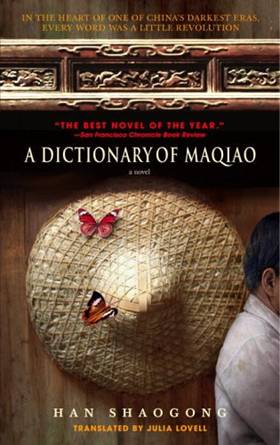
Han Shaogong's "A Dictionary of Maqiao": Book Review

A Dictionary of Maqiao

Julia Lovell translates Han Shaogong's 1998 novel, which explores the remote village to which he (or a version of such) was sent as one of the "Educated Youth" during the Cultural Revolution. The author uses the structure of dictionary entries on particular words and terms, so limited to the region and dialect, some not, to illustrate the culture he found, and gradually, as the non-alphabetical and subtly topical arrangement reveals, the stories of those who lived there. It's neither romanticized nor sensationalized. It's intellectual without sounding clever, and philosophical without losing pithiness. Lovell notes how the Tao is filtered (in some odd and creepy settings) through the last of the "Immortals" skulking about the temple ruins. You smell the stench and recoil at the sensory assault.

The novel reminded me immediately of Milorad Pavic's A Dictionary of the Khazars (1994; tr. 1988) I recall seeing this book a lot when it appeared, in the finer bookshops, but I have never heard anyone discuss it since. It boasted that the "male" and "female" editions were identical--except in one paragraph. Thanks to the Net I did not have to buy a second copy and trace each entry in tandem. The answer is here. Not sure if it matters much, and I doubt if I'll try to find out. I liked the book but was not wowed by it. Still, the predecessor in the "lexicon novel" is worth mentioning, as Shaogong's was prepared by 1995, published in 1996, and translated in 2003. Looking up this data, I learned from its Wikipedia stub: "After the book was published, some critics claimed that it violated the copyright of Pavic's novel, Dictionary of the Khazars. The author, Han Shaogong, brought a defamation case against the critics and won this case." That stub documents in turn this helpful resource of reviews.

Not an easy read, this compendium, but not beyond comprehension. This strategy's pitched at an erudite bookworm, and not a drugstore (if they still sell such) paperback. I agree with Danny Yee's site above that the narrator gets subsumed into the density of his (?) descriptions, and I repeat Lowell's admission that she could not capture a few of its 115 entries as puns, leaving them out.

And what remains, over four hundred small print pages, tends to glide past. While the "Maple Demon" and "House of Immortals" sections early on stood out, when going back to check their titles, I found that great chunks of other sections had not registered much of an impact on me. That may be my fault rather than the author or translator, but, again, this ambitious book might inevitably have some of its depth diffused in rendering it in understandable English and for an audience who did not survive the depredations of Chairman Mao and the "Down to the Countryside Movement." (Most of the above to Amazon US 11/12/17)

P.S. Lowell quotes the Sinologist A.C. Graham in her introduction to the work:

"Taoists are trying to communicate a knack, an aptitude, a way of living… [They] do not think in terms of discovering Truth or Reality. They merely have the good sense to remind us of the limitations of the language which they use to guide us towards that altered perspective on the world and that knack of living. To point the direction they use stories, verses, aphorisms, any verbal means which come to hand. Far from having no need for words, they require all available resources of literary art." I haven't been able to track online the provenance of Graham's remark so far, but it's apt.

P.P.S. I paste the start of this entry as an example of the author's strategy and scope. "*Maple Demon"

"Before I started writing this book, I hoped to write the biography of every single thing in Maqiao. I'd been writing fiction for ten or so years, but I liked reading and writing fiction less and less- I am, of course, referring to the traditional kind of fiction, which has a very strong sense of plot. Main character, main plot, main mood block out all else, dominating the field of vision of both reader and writer, preventing any sidelong glances. Any occasional casual digression is no more than a fragmentary embellishment of the main line, the temporary amnesty of a tyrant. Admittedly, there's nothing to say this kind of fiction can't approach one angle on the truth. But all you have to do is think a little, and you realize that most of the time real life isn't like that, it doesn't fit into one guiding, controlling line of cause and effect. A person often exists in two, three, four, or even more interlocking strands, outside each of which a great many other elements exist, each constituting an indispensable part of our lives. In this multifarious, scattered network of cause and effect, how valid is the domination of one main thread of protagonists, plot and mood?

Anything left out of traditional fiction is normally something of 'no significance.' But when religious authority is all-important, science has no significance; when the human race is all-important, nature has no significance. When politics is all-important, love has no significance; when money is all-important, art has no significance. I suspect the myriad things in this world are in fact all of equal importance; the only reason why sometimes one set of things seems to have 'no significance' is because they've been filtered out by the writer's view of what has significance, and dismissed by the reader's view of what has significance. They are thus debarred from all zones of potential interest. Obviously, judgement of significance is not an instinct we are born with-quite the contrary, it is no more than a function of the fashion, customs, and culture of one particular time, often revealing itself in the form into which fiction shapes us. In other words, an ideology lurks within the tradition of fiction, an ideology which reproduces itself only on passing through us.

My memory and imagination aren't totally in line with tradition.

I therefore often hope to break away from a main line of cause and effect, and look around at things that seem to have no significance whatsoever, for example contemplate a stone, focus on a cluster of stars, research a miserable rainy day, describe the random back view of someone it seems I've never met and never will meet. At the very least I should write about a tree. In my imagination, Maqiao couldn't do without a big tree. I should cultivate a tree-no, make that two trees, two maple trees-on my paper, and plant them on the slope behind Uncle Luo's house in lower Maqiao. I imagine the larger tree to be at least twenty-five meters tall, the smaller around twenty. Anyone visiting Maqiao would see from faraway the crown of the trees, the tips of whose branches would spread out to encompass a panoramic view.

This is excellent: writing the biography of two trees."

Sunday, May 17, 2020

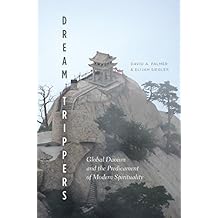
David Palmer + Elijah Siegler's "Dream Trippers": Book Review

https://images-na.ssl-images-amazon.com/images/I/51GxSrW+ROL._AC_US218_.jpg

Daoism, unlike Hindu and Buddhist faith systems, has not yet been studied seriously by many in the West. Until the dawn of the last century or so, very few scholars knew much about its texts, rituals and customs over its long history in China. During the past dozen years, professors David A. Palmer and Elijah Siegler investigated the spread of the Dao and its practices in "transnational circulations."

Dream Trippers stands for those from Healing Tao USA, seekers visiting the sacred mountain site of Huashan, "Flower Mountain." There, they meet with monks and mix with throngs of secularized Chinese tourists. For these two scholars, the "water" of Daoism sloshes in and out of its "institutional container," as Eastern and Western fluidity wash aside facile dichotomies and stereotypical binaries.

A third presence triangulates with these two Daoist groups. Louis Komjathy, a West Coast-based religious studies professor, insists upon a far more bookish, scholarly and faithful adherence to a demanding regimen which, in this American-born academic's estimation, the Dream Trippers dismiss.                                                                                                                                               Complicating matters, monastic master Chen Yuming leaves Huashan and those pilgrims who had depended upon him for guidance. Palmer and Siegler narrate the "anxieties" generated by the "predicament" of global spirituality through its "encounters, flows, and appropriations" of the indigenous traditions as they return to the motherland "Americanized." Through tours, marketing and networks, the Dao's adepts and aspirants follow "trajectories" as subjects within late modernity.

Adopting Zygmunt Bauman's post-modern critique of the self-improvement Esalen/ Human Potential movements which the 1960s counterculture promoted as a consumer commodity, the authors situate these various representatives of Dao, as a fresh product shared and sought recently beyond East Asia. As Chinese autonomy dwindles in the homeland of the Dao, American ambitions increase among the pilgrims coming to Huashan to accelerate their immersion into qigong (vital energy practice).

But factions resist easy categorization. Western does not equate with anti-traditional, nor does any authentic Chinese experience trump any fabricated New Age-tinged experience. Palmer and Siegler respect all the participants whom they observe in Huashan, beginning in 2004. They witness the massive tourism overwhelming Huashan as the corrupt regime markets its dramatic vistas and quaint monks as lucrative attractions for a burgeoning base of eager novelty seekers from within a freespending China. Those eroding the Daoist legacy come not only from abroad, but within a cynical state calculating a pro-Daoist turnabout as countering the burgeoning Christian presence throughout the PRC. Many of the monks are unsuited for the rigors of their life, and loaf as "temple rascals." 

In thematic chapters, Palmer and Siegler compare the Dream Trippers as "metaphysical travelers" to the monastic system struggling to sustain itself as Huashan's slopes fill with Chinese crowds. The Westerners value therapeutic methods channeling the power of the Dao and the complicated "inner alchemy" developed over two millennia ago; Easterners come and go for the very vertiginous vistas.

This book will appeal to anthropologists, sociologists of religion, and religious studies professors and students. While Palmer and Siegler commendably avoid jargon, and offer a detailed index and glossary, they expect their audience to possess familiarity with postmodern theorists and thinkers.

One under-examined aspect is the wider impact of the Dao on contemporary popular culture; references direct the inquirer to sources, through documented end notes and a broad bibliography. A general reader will gain value from this in-depth look at a novel predicament created by the global reach of a faith-system which until recently has mostly been relegated to (often woefully inaccurate) translations of the Daodejing and the tales of Zhuangzi when it comes to shelf visibility abroad. 

No pure legacy remains in Huashan. The rupture caused by communist devastation of religion has eased, but it has left behind a weakened heartland for the Dao. Yet the authors regard this communal evolution with equanimity. "Simply another wave" of many meetings between East and West characterizes the broad view taken of Asian reactions to the West, and vice versa. A "back and forth" pattern of outer forms adapting to each era exists within this religious discipline. Pursuits elevating the mind and energizing the body link enthusiasts from affluent professions and nations. Palmer and Siegler assert real connections, however brief, bonding the visitors with those dwelling on Huashan.

Louis Komjathy opposes this benign judgment. He denies that Daoism suits the likes of the Trippers.

A diligent exegete, his textual study grounds his everyday life as a Daoist, heir to a priestly lineage. Combining an introspective pursuit with a teaching career, he responds (as do others interviewed) to the authors by claiming fidelity to the Chinese contexts. This, lacking in callow New Age itinerants, disqualifies for Komjathy any who traverse the "spiritual marketplace" browsing fake commodities. Michael Winn, founder of the Trippers, begs to differ; the authors hear all sides out and report fairly.

That predicament, Palmer and Siegler surmise, blends a Western consumer mentality with an esoteric Eastern pursuit. Whether the Dream Trippers embody a cure or a symptom to the present-day "liquid self," lacking once-stable social structures in a hyper-capitalist consumer-driven existence, is left for the reader to contemplate. In a coda, Chen Yuming gets the last word. This sage announces: "The flower has dried up, but the root is alive." As institutional Daoism totters under tourism, a few from all over the world join those indigenous holdouts who agree to pursue virtue and find transformation.

Reviewed for Spectrum Culture. 3/8/18.

Friday, May 8, 2020

Distancing + Dao


I've been off the blog for a while. As I mentioned to a few faithful friends, I've kept a lower profile. My employment is not guaranteed and my tendency to speak frankly has met with my diminished expression of opinions on subjects deemed too controversial or retrograde for comfort. And, I teach about the dangers of groupthink and the necessity for caution and reason in putting out one's ideas. My students get my mini-rants about the challenges of honest communication in what's lately been deemed a "cancel culture." A visit to contrarian contributors at Quillette documents its impacts.

However, there's a lot I've wanted to chime in on. So, I am earning back online. My article in OnePeterFive yesterday represents my interest in a long-standing phenomenon, which I've been fascinated with for decades. How countercultural or marginal figures in the media and in activism may drift in their views as they mature. Not a facile "right" leaning or a "libertarian" niche, but one instead that takes from what's been called for lack of better phrasing the place in political typography charted as "left-libertarian." Not as communal as principled anarchism, maybe more an interpretation of the Daodejing (fka Tao te ching) as a collection of suggestions for not tuning out or dropping out, but rather a meditative anthology on the wisdom of opting out of the maniacal version of "social justice" which denigrates nobody but those of a particular category, which happens to be my own.

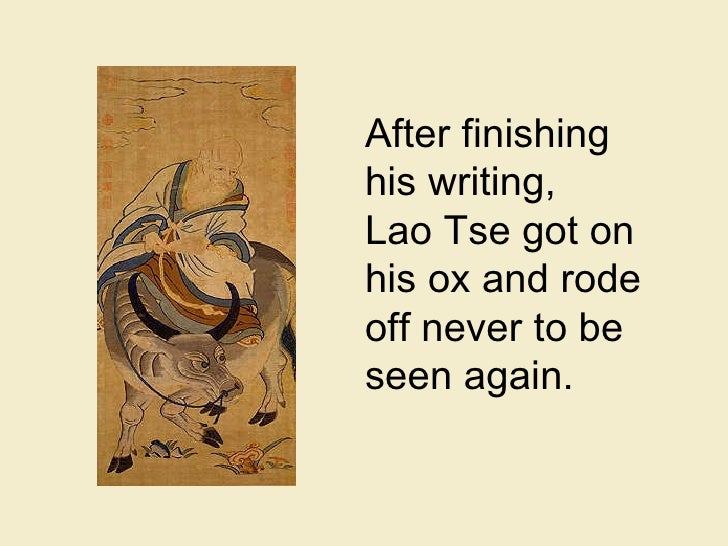
How can concepts attributed legendarily to Lao Tse's dictation as he stepped off of his ox and dictated to the gatekeeper before the sage departed China (his insights in about 5000 characters can be read in English in about 70 minutes) be tied into a situation as we find ourselves in, dodging each other's rhetorical brickbats and even before the phrase "social distancing" became literally overnight the new normal for billions of us, seeking a safe space from those we offend simply by being born this way?

That was some convoluted sentence. But as I think as I type, for better or worse, I found I have a theme to contemplate. How much do we distance ourselves from what threatens us, or unsettles us?

Monday, September 25, 2017

Ursula Le Guin's "The Telling": Book Review

The Telling by Ursula K. Le Guin — Reviews, Discussion ...
This was inspired by the suppression by the communists of the Taoists in China. Le Guin in her introduction to the 2017 Library of America edition of her collected Hainish works admits that her knowledge of this cultural obliteration came relatively recently. She fits this into her system, with an emissary from Terra, of Asian Indian origins, living in Vancouver. Terra is in tumult too; fanatics try to impose a one-god regime upon the disparate peoples in the tellingly named Sutty's multicultural land. She is sent as an anthropologist to Akan to investigate that world's parallel descent into control.

The control is exerted by a relentless hatred of the old. The peons are remade into "producer-consumers," and the state itself, influenced by the same fanatics earlier, seems to have learned their dark lessons well. Le Guin sharply depicts the soulless situation of the inhabitants who toil mirthlessly. Redolent of not only China under Mao or North Korea under its dictators, Akan is bleak. 

Sutty finds her mission to observe on behalf of the Ekumen, and to report back, compromised by a minder called by her The Monitor. Their fates will intersect as Sutty travels north from the megapolis into rural areas where she learns that not all of the old learning and forbidden ways have vanished. 

At this stage in her long career, Ursula Le Guin incorporated feminist themes and fluid sexuality into her characters. Sutty's lesbianism puts her further apart from those seeking complete domination over the private as well as public life. Technology has advanced, too, and the parallels to our age are there.

This story moves slowly. Especially at first, Le Guin channeled through her protagonist parcels out facts we need to know sparingly. But there is a fascination with the way that Akan plays off our Earth. Totalitarian dystopia in the name of progress, unity and conformity isn't only "science fiction." 

It also wraps up very suddenly. Sutty's summoning is brought about in a paragraph halfway, with seemingly no foreshadowing. This may reflect life's surprises, but it threw me off. The conclusion follows rapidly after some earnest negotiation. It's not a tidy ending, either. But it may be more real. (Amazon US 9/24/17) 

Tuesday, September 5, 2017

Ursula Le Guin "Hainish Novels + Stories": Book Review

These Hainish fictions aren't a cycle. Rather "a convenience" than "a conception." So Ursula Le Guin introduces this deluxe edition from Library of America in typically forthright, pithy, and sly terms.

Daughter of a groundbreaking anthropologist who taught at Berkeley and Columbia, Ursula Le Guin pioneered the meticulous investigation of her imagined societies within the popular genre of speculative storytelling. She began writing as a child during the Depression. Beginning in 1966, her contributions began in the Ace Doubles, SF pulp. Editors and fans recognized her skill. Although her sophisticated interplanetary system took a while to form, and even if its inconsistencies bother nitpicking critics, Le Guin avers this genesis gave her freedom to shift between stories and novels. She learned the difference between "willful suspension of disbelief" and merely "faking" it when invention stirred. (Her Hainish books need not be read in order, she has assured readers before.)

Part of Le Guin's innovation came through the "ansible," a device enabling instant communication across the universe. This became a standard tool throughout the science fiction cosmos. Her other innovation in the 1960s, she notes, has received less attention from a wider audience. The Left Hand of Darkness won both the Hugo and Nebula prizes, but it faced backlash, from pedants and from feminists. Le Guin's decision to use a fixed "he" for her people lacking a fixed gender--it alternates in the month--leads to her reiteration fifty years on. Despite many recent changes in social perception of gender differences, "we still have no accepted ungendered pronoun in narrative." Demurring from the term "prequel" for her story "The Day Before the Revolution" preceding her anarchist utopia novel The Dispossessed, "word-hound" Le Guin returns to her central verbal concern. "What matters most about a word is that it says what we need a word for. (That's why it matters that we lack a singular pronoun signifying non-male/female, inclusive, or undetermined gender. We need that pronoun."

This anthology's first volume gathers the first five Hainish novels. In a brief review, only a glimpse at the many realms Le Guin presents can suffice. Roncannon's World turns out for the Hainish ethnographer Roncannon an orb which will bear his name. (Hain's a planet resembling our own as the original homeland of humanity; the handsome endpapers in volume two make its earth-tones of continents heighten this suggestion, but it is not equivalent to Le Guin's Terra: an example of Le Guin's off-kilter approach to world-building.) Some telepathy occurs, but this wound up so overwhelming a condition for her menagerie of bio-forms that their creator edged away from it as a must as she expanded her fictional forays. Roncannon blends SF with fantasy. Its episodes entertain.

But eagle-eyed readers of venerable tropes may not be entirely convinced. There's a lot of humanoids evolving here on a smallish globe, so how they remain dispersed and sustaining may stem from Le Guin's anthropological curiosity more than a command of her developing talent in constructing plot.

Two more shortish novels follow. Planet of Exile as the title tells finds human colonists stranded on a hostile Werel. The arrival of attenuated seasons will become a factor in her present and future Hainish terrains: when winter comes, it stays for 15 years, and the "hilfs" arrive during this cold snap. These nomads call the humans "farborns." They both face savage hordes and snow-ghouls. One wonders if George R.R. Martin's vast audience knows of this 1966 predecessor, pitched again at the Ace crowd.

The following year, City of Illusions presents one raised by forest dwellers, but not born one of them. His quest across a ravaged earthscape and a dystopia full of occluded psychics also includes talking animals. Who can and cannot take life provides the complex theme, further taking on brainwashing.

The Left Hand of Darkness (1969) and The Dispossessed (1974) attain canonical status. Many will be most familiar with these dense novels. They deepen the SF genre. They will demand attention; they will reward reflection. This volume adds an "original" version of the experimental core of what became Left's alternating genders on Gethen. "Winter's King" sparked Le Guin's curiosity. What if "the king was pregnant" popped up in a tale? Both tales investigate how warfare equates with "predominantly a male behavior," If some people reverted to being female with an overwhelming sex drive for a few days a month, while others were male, how might this play out for an Ice Age planet a.k.a. Winter? Furthermore, Le Guin addresses how language, power plays, and relationships evolve.

The last work in the first volume, The Dispossessed may not have lasted as long in curricula and on reading lists as its gender-driven counterpart. It emerges from Le Guin's weariness with the Vietnam War, and her Cold War affinity for Peter Kropotkin and Paul Goodman's non-violence. Pairing this via her youthful exposure to Lao Tzu, Le Guin incorporates the Tao into a study of no-coerced-order.

For it has to recognize anarchy's discontents. Determined to leave his anarcho-syndicalist home on Anarres, physicist Shevek travels to a patriarchal society on Urras. Class war, religious dissension, and the grip of the in-group naturally mesh with Le Guin's intellectual interests. While less read now than Left, this novel of ideas also remains less popular than certain pulps penned by Ayn Rand. But Rand cannot match Le Guin's U.S.-of-A.-like A-Io for its ambiguous appeal as the Yang to the Yin of Urras. Capitalism gets its comeuppance, but so does socialism. Despite dense discussion, it's far more vivid than any Rand. For one "cannot buy the revolution. You cannot make the revolution. You can only be the revolution." How one's possessive power gets mired in habit dramatizes--admittedly too tediously for readers craving more drama--its theories and its morality, as a thought-experiment.

As her fiction sweeps up allegory, her story arcs sometimes twine; but not neatly or necessarily. Her motivations push reflection arguably more than action. She leaves one pondering, despite what can be ponderous to those weary of nuance. Her erudite character studies and linguistic riffs predominate.

Le Guin's Hainish elaborations continue into the mostly shorter pieces of the second volume. The novella The Word for World Is Forest has always struck me as a protest against the defoliation of Vietnam. It may align more with the Earth Day sentiments of the early Seventies, but either way, the revolt of those on Athshe against the invading Terrans bent on taking its resources to sustain their own depleted earth has remained topical. Le Guin acknowledges this sad truth in her appended 1976 introduction for Word. She relates how her own "fantasy" at that time that a Philippine tribe called the Senoi stood for a "dream culture" akin to her imagined one for her indigenous resisters. While these claims were largely debunked among anthropologists, Le Guin reasons that for her threatened world, the use of its scientific data may diminish accordingly as its "speculative element" compensates.

Hainish stories overlap in characters and ideas now and then among the seven compiled here. Her faster-than-light communication device the ansible excited her fellow scribes. By 1990, Le Guin took up a possibility akin to Madeleine L'Engle's "wrinkle in time." Le Guin was "allured by the notion of transilience, the transfer of a physical body from one point in space-time to another without interval."

Christening it "churtening," she allows that those who pull it off in her fiction are never sure how they did it, or if they can do it again. "In this it much resembles life." Her 1994 collection A Fisherman of the Inland Sea weaves influences from a Japanese folktale with Hain-adjacent love stories. She attempted in this decade "to learn how to write as a woman." Her latest brainstorm, the "sedorutu," sets on the world named O an institutionalization of hetero- and homosexual relationships "in an intricate four-part arrangement laden with infinite emotional possibilities--a seductive prospect to a storyteller." Her "gender-bending" produces stories enriched by her own decision to speak out not only on behalf of women, but all who are loners and introverts. In an era bent on overpopulation, "unlimited growth," and "mindless exploitation," Ursula Le Guin retreats. She considers the misfit.

Her final entries twist more categories. Dark-skinned people enslave light-skinned ones. The emerging "story suite" becomes Four Ways to Forgiveness. Meanwhile, Le Guin learns of the destruction of "religious Taoism" during the regime of "aggressive secular fundamentalism" in China.

The Telling (2000) closes this volume. Le Guin sees around her in her own homeland the rise of similar "divisive, exclusive," and dogmatic instigators of hatred perverting "the energy of every major creed." This concluding novel depicts "the secular persecution of an ancient, pacific, non-theistic religion on another world." Those responsible, tellingly, originate among "a violent monotheistic sect on Earth." No matter what ignites the dynamic fusion of thought and action in her Hainish fictions, Ursula Le Guin generates provocative and intelligent considerations of complex forces. A tribute to her craft, these elegant volumes combine into a welcome set for loners, introverts, and the rest of us.
(Combined volumes: Amazon US 9/5/17. Vol. 1  and  Vol. 2 ) PopMatters as Ursula Le Guin's Science Fiction Stories about Class, War, Religious Dissension and More  9/14/17)

Tuesday, March 25, 2014

Bill Porter's "Road to Heaven": Book Review

Porter, who translates Chinese poetry under the name of Red Pine, travels into the Chungnan range dividing the wheat from the rice, the north from the south. His visit is either well or badly timed, the late spring of 1989. He gets caught up in a pro-democracy demonstration, but departs for the hills in search of hermits before the Tiananmen Square crackdown in early June. He and his photographer partner decide to return that August. Perhaps the chill in the political air permeated those he meets, for there's less told here that delves into the fate of hermits under Mao and the PRC.

In a sort-of sequel to this account, "Zen Baggage" (reviewed 6/2013), Bill Porter relates this demonstration to a CIA operative, who wryly notes that the Agency noted Porter's spontaneous involvement. Like "Zen," "Road to Heaven" carries a wandering sensibility. Porter reveals less than in the other book about himself (not that he tells much) but lots about the dates, names, and history of the contexts for the shrines, temples, and hermitages he visits. While accessible to the non-specialist reader such as me, this material can slow the pace. Porter favors lots of detail and the result feels like a guidebook's commentary rather than a vividly conveyed, personal, rendering of sights.

However, he intersperses conversations, often terse, with often no-nonsense Taoist (and a few Buddhist, or hybrid) monks and nuns who've managed despite persecution during the Cultural Revolution to survive, on and off for some, steadily for a few, in the remote regions traditionally sought by those dropping out from the pressures of society to pursue the precepts of the Dao and the simple but demanding solitude that for them leads to wisdom, and if Taoists, to try to attain entry into immortality.

Like the Dao, this concept's pretty fuzzy even when hermits try to articulate this famously allusive ideal. I like Lao-Tzu's notebook remark, after he passed royal graves: "we can see the loss of desire/the cost of what we keep" (40). An abbot sums up the pursuit of Pure Land Buddhism or Zen as basically two paths to one goal. "Practice is like candy. People like different kinds. But it's just candy. The Dharma is empty." (96)

Not much happens during the travels Porter shares. He's off on less beaten paths, he does not have many extraordinary encounters to enliven these pages. Grounded more in historical narration and brief, sometimes stolid, interviews, there's far less of the itemized, step-by-step, price-by-price pace of his later travelogue from 2006 when he sought out Zen practitioners. But there's a similar reticence among those he talks to to reveal what life was like during their privations under Communism or during WWII. The recovery of the Zen monasteries after decades of persecution ties into the regime's wish to cash in on tourism. For Daoists, the same profit motive via the Party's control as a trade-off for monastic survival, as on fabled Huashan, appears to threaten the hard-kept and hard-won isolation that few monks or nuns can find today.

As Porter concludes after a visit to the splendid vistas of Taipaishan: "Those who follow the Tao cannot divorce themselves from others, yet to find the Tao they must retire from society, at least temporarily, to practice self-cultivation and concentration of mind." (199) Porter fittingly tries to capture what he knows he cannot, the message of the Tao that can be found by practice, and meditation, not by study or books. But, a few hermits try to explain; so must Porter. This little book may not succeed more than any other in that attempt, but it avoids the wry aphorisms or exotic packaging that commonly makes this challenging self-scrutiny too tidy for us. (6-16-13 Amazon US)

Sunday, February 24, 2013

Richard Hathaway's "Zen Explained"

In 128 Kindle pages, this aligns with its aim: demystification and clarity, rational presentation of what's often occluded. Richard Hathaway favors a scientifically and psychologically enriched introduction that rewards today's Westerner seeking a no-nonsense approach. He takes the novel cognate "eu zên" in Aristotle's "living well" virtue ethics and shows how it compares (harmony, satisfaction, idealization) and contrasts (impermanent, elusive, unstable) with the Zen meaning.

Early on, he investigates the "checksum" parallel of two-signal computing, and decision making based on neural chemistry that is pre-cognitive or before volition, despite our tendency for our brain to shout over our impulses. Thoughts themselves are shown to be all we are: "if there are thoughts and we are aware of these thoughts, then what we are is that which is aware of thoughts, You and I; we are consciousness." Read this section and this will make more "sense" than my concision may present this intricate but accessibly conveyed food for thought.

As to our "apparently hard-wired propensity that people have to infer that entities with plans and intentions cause the things they observe around them," I needed more. Hathaway cites Stephen Pinker about this supposition that we create a "theory of mind" to attribute causality to someone (often a God to punish us), but this section was under-explained. He appropriately turns to Daniel Dennett regarding the ego as narrator, a character in our own work of fiction--we write not our autobiographies but our biographies, Hathaway avers. Our self-identity rests on our imagination.

Of improvement, no rational system can totally please the one looking for answers. Looking within ("know thyself" and the examined life) for answers may fool us. "We have made of ourselves the author, and the author knows if the story is over he or she is finished, out of a job. There must always be a new chapter to write." That impels us to strive for goals, progress, or achievement. What Zen counters: an end to such ideals. Instead, an acceptance of one's mortality, and the freedom from grasping to what will vanish or decay. "Unhappiness stems from not accepting life as it is and instead clinging on to an image of what we want it to be." Rather, Zen offers enlightenment from within, not from without "to walk a path of quite [sic] joy, of serenity and inner peace that is always underfoot, and, as walked in the present now, lasts and does not fade in the murk of the remembered past or anticipated future." This passage demonstrates the calm with which Hathaway conveys himself.

Despite this very Buddha-dharma perspective, the treatment's light on the message attributed to the Buddha. He keeps the Asian vocabulary to a minimum. Hathaway stresses rather Taoist influence in its depths as the teaching passed through China. He elides this (saying it can be looked up elsewhere), but emphasizes that "wu wei" or "do nothing/ going with the flow" fits better with the Dao's spirit than with its superficial gloss of dharma. Whatever its derivation, it's not a system but an attitude: Zen lets us let go of our own burden, as if waking from a nightmare to find we're safe in our own bed. Wu wei encourages us to act without will or intention, to kill the ego and to stop needless striving.

Yet, we cannot seek our own release. It's a Catch-22: we cannot aim for the target we want to hit. While his chapter "Not Catholicism" disappointed by its facile caricature of that faith as teaching that one can do whatever harm one wishes as long as confession absolves the sinner, and then it's back to dirty deeds, Hathaway tries to teach, if via that poorly chosen example, how Zen demands commitment without time off during the week: it's not as if one does one's duty once on Sunday.

Reading on, I understood slightly more why Hathaway may have stereotyped Catholicism: his passion, after a "kensho"-like experience that hit him one day in Portsmouth, England, changed him from a rational skeptic--apparently non-religious and very fact-oriented--to an advocate for Zen. That term's stripped here, notably, of "Buddhism" as common qualifier or accompaniment. "In Taoism, just as God is an invention we made up between ourselves to explain nature, so the SELF [he capitalizes this as EGO to show its dominance] is an illusion we have spun into existence to explain our inner nature to ourselves. Enlightenment is realising this is so."

While I would have liked more on Taoism's influence on a more purely anarchic (in the positive sense), liberating Zen, Hathaway reminds the reader to stop reading about it. "Don't believe in Zen. Don't intellectualise and rationalise it. That is anti-Zen. Experience Zen yourself, directly. Practise zazen. Be mindful. Just that. Only that." He goes on to observe how religions are "ex vivo" (out of the living") in that they affirm an afterlife or reincarnation; Zen remains "in vivo," tethered to the here and now, yet not bound by it within the ever-present, eternal moment. Out of its creative anarchy, its creative principle moves everything.

Tricky, as this expands into a challenging take on Zen's analogous affinity with quantum physics and our own creation of our own perceived universe. He lost me a bit with this partial koan: "the universe would exist only as a probability wave if there were not living beings around to make it real." I anticipated this might lead to Teilhard de Chardin's noosphere, and a few pages later, there it was. Later, Hathaway ties such a derivation to a link from ancient Greek for moral dimensions of Zen. This material proved rewarding, if for a small book too compressed at times to take in; with about a dozen typos, sometimes the casual style mixing with lofty concepts needed clarification and editing.

He concludes by encouraging us to take on Zen with the practical, experienced integration of it not as merely "dianoia" or book-learning, but "noesis." As a lived knowledge become understanding that goes beyond words, he promises that if we sit and we then practice mindfulness not as an activity but as within our spirit, the transformation will be telling, if beyond verbal expression: "Very soon all your questions will be answered." (Amazon US 1-23-13. I was provided a copy by the author; I found this a stimulating and provocative book worth reading.)