Showing posts with label theology. Show all posts

Friday, July 31, 2020

Yves Chiron's "Annibale Bugnini: Reformer of the Liturgy": Book Review

{Given my friend designed the cover, and first told me about the mystery man behind the scenes in Rome who's the subject of the book, I reviewed it: Reading Religion, July 25, 2020}

Annibale Bugnini
Archbishop Annibale Bugnini's method to "proceed discretely" (3) to advance his Vatican II reforms attests to his clever persistence and subtle scheming. The "new Mass" introduced fifty years ago owes much of its promotion to this Vincentian cleric. After Bugnini's success, “"conspiracy theories” (7) impugned his loyalty. The truth remains elusive, for his clerical collaborators refuse to release his correspondence. Therefore, drawing on interviews, archives, diaries, and memoirs of his confreres, French historian Yves Chiron in his twenty-sixth book, Annibale Bugnini: Reformer of the Liturgy, investigates the career and achievements of the past century’s leading liturgical innovator.

Dom Alcuin Reid introduces this book’s English-language edition, averring how Bugnini in Chiron's 2016 study "emerges as a remarkable organizer rather than as a theologian or liturgy expert" (11). Refusing hearsay, Chiron provides a sober account of Bugnini’s life’s work, limited to interpreting the documents at hand. This caution makes this biography trustworthy. It also results in a sober, cut-and-dried recital of facts.

From his novitiate in 1920 at the age of eighteen, Bugnini committed himself to the Liturgical Movement spearheaded by French and German Benedictines, Dominicans, and Jesuits. These pioneers had already invented, for at least a generation, experimental “paraliturgies” (25) aimed at increasing lay involvement and decreasing barriers to full entry by the congregation into the celebration of the Mass through a shift in prayers and songs to what they labeled a living language, the vernacular. Bugnini after his ordination composed a brochure touting such a service, where a lay lector would interpret and comment in Italian upon the Latin.

Starting in Rome in 1943, his bilingual Mass engaged the people with dialogue, as they chanted the responses, prayed aloud, and accompanied the priest's actions with their own gestures. Bugnini's self-published booklet of this version as "Our Mass," by its twelfth and final edition in 1962, had sold a million and a half copies.

Fittingly, by that year, Bugnini had embedded himself deep within the preparations for the ecumenical council announced by John XXIII. Bugnini’s eponymous “method” (82) to advance his liturgical reforms worked this way. First, he assigned specialists to meet separately to convene on restricted subjects. These specialists rarely had a chance to meet with their colleagues for a plenary vote on proposals. Second, he inserted vaguely worded passages into conciliar documents, to avoid censure or scrutiny.

After the Council could then be applied, free from papal censure, the reformers capitalized on their ambiguous phrasing and implied suggestions. This strategy worked; by the time Paul VI figured out how his trusted cleric within the Congregation of the Rite had tipped the scales in favor of the progressives, the Pope could not turn back the experiments which became the new normal in the 1969-–1970 vernacular Mass. Chiron acknowledges his subject's "perfect mix of know-how and communication skills" (109) which broadcast bold models. Concelebrated Masses, altars facing the congregants, and lay-led functions took precedence, followed by Communion in the hand and elimination of all Latin.

Chiron asserts that these features had been incrementally introduced through the 1960s, and that thus they are not as novel as detractors claim. This statement diminishes the ambitions of the reformers to sidestep the Council's insistence that Latin be preserved for the Canon as the foundation of the Mass. All the same, his judgment that by the end of the decade, the new Mass synthesized the updates already inserted by various bishops in certain dioceses or countries remains incontrovertible. A communal meal more than a sacrificial ceremony became the global standard, with every approved Mass entirely in the local language.

After shepherding further reforms in the breviary and other liturgies, Bugnini in his words had "been resigned" (137) suddenly in 1975. Pope Paul may, Bugnini alleges, have been influenced by "court intrigues" and rumors that he was a Freemason. This calumny persists. Translator John Pepino appends further documentation considering its effect on Bugnini a few years later as he denied the charge made in a letter to an American review of homiletics. Chiron sides with Bugnini given at least a reasonable doubt remains of his innocence.Yet Chiron admits he finds the evidence "inconclusive" (168). Until Bugnini's colleagues open his correspondence to public research, the case cannot be satisfactorily judged. Chiron gives Bugnini the benefit of his doubt.

Having no knowledge of Spanish, Bugnini refused the papal command to serve as nuncio in Uruguay. A year later, Bugnini found himself in Iran instead. He empathized with the burgeoning revolution against the beleaguered Shah; again, given the lack of documentation, the context of brief remarks Bugnini had written awaits the release of his letters. He continued writing books on the liturgy as well as his autobiography, which remains untranslated from Italian. He returned to Rome before his death in 1982. With that, Chiron's account stops too quickly, granting only a few paragraphs to his lasting impact after his daring implementation of reforms that have altered the Mass and liturgies ever since.

This brief book provides readers with a compendium of the documents and decisions undertaken over decades of liturgical innovation and experimentation. The audience may remain specialized, scholars of Church history and Catholic liturgy. Chiron eschews commentary or analysis of his subject. All the same, for English-language audiences, this gathers what is known at present from available sources.

Chiron leaves open the question of what impelled Bugnini to dismantle so much from so many centuries of Catholic heritage and accumulated stability. The book delivers the information, which may guide scholars into his proof-texts and the writings of those who worked with, or against, Bugnini.

For the time being, resigned to the embargo placed on full access to Bugnini's personal papers, Yves Chiron compiles what can be said to be known about this controversial prelate's mission to replace a venerable rite with a modern liturgy.

Sunday, June 28, 2020

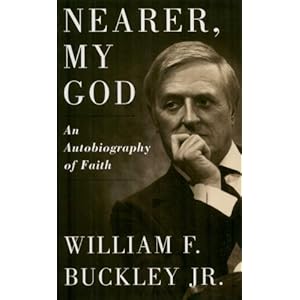
William F. Buckley's "Nearer My God": Book Review

Nearer, My God
I chose this on a whim as it was so far out of my usual orbit. No recollections of the old sod or stickball, and barely any for altar boys and fearsome clergy. Instead, a patrician account and series of reflections and reactions to the course of Catholicism from the venerable era in which Buckley was elegantly raised and the postconciliar malaise which has affected so many in the less certain Church.

His noblesse oblige permeates. There's a couple mentions of devout black butlers, but that's about it for class consciousness. It's rather astounding to follow this chronicle, so removed from the reality most of us share when it comes to education, privilege, or sailing at every opportunity at a summer home. This elevated lifestyle unfolds, and Buckley surely as he's accustomed to the manor/ manner born comports himself as he's been raised. It makes for a very curious spiritual autobiography/ FAQ.

For Buckley turns this midway into a novel experiment. He interviews a few of his friends, mostly converts, and all conservative fellow-travelers, often at the National Review, naturally. They also feature priests who've transferred to Catholic clergy from Protestant denominations. Buckley surveys their takes on many questions he raises about dogma, belief, and practice. Although as a cradle Catholic I must confess none of the statements he compiles would have convinced me to join "Rome," it's instructive to learn the mindset of those coming to "the faith" without being raised in it.
I could follow the theological details, but for many who admire Buckley, this granular examination may bore or bewilder. There's far less of his famed politics, and not much of his wit or rhetoric either.

It does all make for an oddly paced book. It's more a series of explorations and reflections, although the central theme of examining what persists post-Vatican II as the liberals often left the clergy and left the administration to overworked and understaffed priests and laypeople is important. For it demonstrates the rebound, if by default given the numerical advantage of the diminished remnant in control, of the traditionally minded episcopate and papacy, of what's a dwindling number of cradle-born congregants in America and Europe. This does all tilt in Buckley's view, as expected, to slant away from a global awareness of how the Church will fare as its center slides towards the "South."

As a result, this work will appeal to the small coterie of like-minded sympathizers with both Buckley's worldview and likely his class and background. The name-dropping may come without hesitation to this author, but it does remind the hoi polloi of our place among the pews and practically as peons. Few of the rest of us may be able to enter this intimately connected and convinced realm even via print, but it's a document to this reaction to what was meant as a reform to appeal to millions presumably reluctant to accept a pre-modern Church, even though the results in sweeping that aside enchanted far fewer than anticipated, at least among Buckley's entitled cabal. (Amazon US 12/12/17)

Saturday, January 20, 2018

The March of Time

Mortality

Today, my wife's marching for a second year downtown with hundreds of thousands of Angelenos, mostly women, with fewer children, dogs, and men. I reflect on the past year and more, but often since the last election, I prefer to retreat into my books, whether Kindle or print, to read reflectively.

Rather than research for my "professional development" or reviews of new titles, this aims at not an external but an interior goal. The Benedictines called it lectio divina. Catholic schools when I attended may have called it spiritual reading. Whatever the post-Catholic varietal, I need this "safe space." But it's not that. It's one where I confront hopes and fears, anxieties as well as contemplation.

My wife and friends would doubtless interject this, when I am not spewing what they regard as a jumble of reactionary-neofascist elitist populism leaning towards left-libertarianism more than conventional (!) anarchism, that I am in this natural state unless roused by work, meals, or chores.

I am choosing as the hunches move me. Julian Barnes' harrowing Nothing to Be Frightened Of was peddled a baker's dozen years ago as the first "post-Dawkins" take on mortality and our fears of death. Not sure about that, but despite or on account of his avuncular (albeit when he wrote this he was about four years older than I am now) digressions and erudite detours, his rambling ruminations and his Francophone excursions, I found his audio rendition so engrossing, listening to it in the dark before sleep, that I purchased a copy of the book. I liked the Canadian and British covers, with various Tarot/ chapbook depictions of Le Mort more fitting than the American version, which had his stereotypically featured English countenance, as Barnes (as myself if in a somewhat more Irish if also elongated physiognomy, I have been told by colleagues) looks exactly like a reader would expect.

Then I turned to my e-book public library's "if you liked this, then" options and browsed. The past year, since I discovered at last that the system had finally synched with Kindle, I've been borrowing audio and print (?) titles diligently, and I save 200 more as treats on my ever-changing moods wishlist. It's fun to preview samples, and like the bookstores where I have spent so long a part of my past life I am overwhelmed with tomes around where I type, and terribile dictu in the disarray of my garage, it's an efficient if frustrating (for there as in brick-and-mortal realm, so much is not where you want it electronically or physically--what you search for in vain only whets your appetite) pursuit.

I dutifully filled notes with many highlights of the next suggested title, the restive, grouchy (if not as acerbic as sensitive-plant critics had averred) David Bentley Hart's The Experience of God: Being, Consciousness, Bliss. That formidable study (my review linked quotes extensively from Hart's dense analysis, rewarding if rambling) in an endnote directed me to the somewhat (until math and biology kicked in halfway) easier God's Undertaker investigating if religious inquiries trump materialist dogma as to if an intelligence (steady there--as agency or impetus rather than design per se?) might be discerned. Lennox as an informed scientist handles data confidently, adroitly. and commendably with modesty tempered from both and all sides, and I did enjoy his witty analogies summing up the various ways science itself calculates the immense odds against our being here at all. And it's not merely the Anthropic Principle all over again. He marshals detailed arguments and documents them.

Both Lennox and Hart share a commendable connection with Barnes and the author I will mention next. They all expect a sophisticated audience (Hart perhaps too much as his volume, the only one from a university press, expects philosophers whereas a lot of "laypeople" are curious sorts who want to know precisely where his quest aims) and they reward by upending some of our pet hobbyhorses.

Somehow I wound up no idea how (maybe one of the previous three authors quoted him) with G.K. Chesterton's 1908 Orthodoxy. Not the best title as he admitted, but he answered his foes who challenged him, after he took on the chattering classes' champions in Heretics, to respond in turn with his own metaphysical riposte. So this blend of blurred autobiography (shades of Newman's Apologia pro Vita Sua, I wonder?) and theological assertion of the necessity of paradox as the manner in which people grasp feebly the shards of the divine presence and plan in what seem contradictory fashion served as the prolific (too much, that) pundit's foray into theological discourse for the rest of us. Many admire GKC's aplomb. Fewer admit he can exhaust one's patience with his relentless reversals.

Maisie Ward's early biography of her friend, who was published by the firm of Sheed & Ward she co-founded, has been relegated as a "hagiography" in Garry Wills' first book on GKC which for all its acumen does smack as he'd admit now of the eager grad student more than the sagacious scholar he became. Apropos of saint-hailing, the blogger "Innocent Smith" offers a needed reminder that if the fringes alone claim GKC and his circle for their own cause only, this bodes not well for all.

Ward too takes pains now and then to call GKC to task, for after his conversion to the Church finally occurred in 1921, his compulsive, frenetic graphomania on top of a regular lecture circuit far and wide rendered a lot of his various genres into padded, rumbustious postures which seemed, at least to Wills, to have been set when GKC was barely in his twenties. Ward offers a nuanced portrait.

But she concurs that the quality suffered and the workload did him in, hastening his relatively premature demise. Still, late in her enjoyable consideration (if as she warns you may not want to learn all about his brother Cecil's entanglement in the Marconi case, which rivals Bleak House in its interminable litigation), she cites (anyone writing on GKC finds this necessity more than the usual subject may violate the standard 2:1 ratio I enforce for student assignments of originality to secondary material) him as usual, generously. In his talk in 1931 but perhaps printed in 1927, "Culture and the Common Peril," I found a pleasing echo of Hart's conclusion advising skillful contemplation, and Aldous Huxley's 1962 lecture to the Tavistock Institute, which I will quote after.

"The coming peril is the intellectual, educational, psychological and artistic overproduction, which, equally with economic overproduction, threatens the wellbeing of contemporary civilisation. People are inundated, blinded, deafened, and mentally paralysed by a flood of vulgar and tasteless externals, leaving them no time for leisure, thought, or creation from within themselves." GKC castigates the flood of information-but-not-knowledge, while Hart and current critics warn of our data overload empty of wisdom sifted from this inundation which a century on churns that flood into a tsunami.

About three decades after GKC's death, after more war, more automation, more standardization, Huxley reflected on his Brave New World Fordist scenario. The ultimate transformation, he opines, applies a subtler form of control than neural injections or tinkering with our bags of skin and water. Situated on the cusp of the counterculture, this speaker has been, a search of sites shows, linked by those where the far right meets the far left, and accused of conspiratorial aims. I will leave that surmise aside as I do rumors of reptilian overlords and ZOG machinations, but from the transcript: 

"There will be, in the next generation or so, a pharmacological method of making people love their servitude, and producing dictatorship without tears, so to speak, producing a kind of painless concentration camp for entire societies, so that people will in fact have their liberties taken away from them, but will rather enjoy it, because they will be distracted from any desire to rebel by propaganda or brainwashing, or brainwashing enhanced by pharmacological methods. And this seems to be the final revolution.” It's intriguing, if aesthetically maddening considering the manner in which dodgy websites present Huxley's less, uh, assigned musings, to find then Alan Watts' further reflections. (That is, I think it's him. This infuriatingly font-crazed resource credits an Alan Watt speech, 2006.) A drawback for the inquirer persists in that so many less mainstream sources simmer on suspicious blogs and addled archives which, to say the least, fail to meet tenured types' muster.

Stick around among the formerly mocked pop cultural fans, all the same, and at least safely employed academics may come to elevate what they once cast aside, as this next author proves. I thought of another prediction when I read GKC just after quoting that Huxley passage on FB. Philip K. Dick's exponentially closer to Huxley than Chesterton (although the latter has been credited by Adam Gopnik--drawing on previous judgments I suspect--as the "pivot" between Lewis Carroll/ Edward Lear and Kafka/ Borges. Anyone familiar with the Argentine Anglophone knows his admiration for Chesterton. I'd been thrown off, three decades ago, by The Man Who Was Thursday. I want to return to it without spoilers, having vaguely remembered the ending as extremely odd even by post-Victorian experimentation in the company of H.G, Wells, one of GKC's dear foils-as-friends. I speculate if PKD might have been directed, in his own late-life Gnostic virtual reality simulation, deep in his soul by tales subsuming spiritual as well as spectral confabulations, in a steampunk age.

PKD mused not long before his own untimely demise, in of all places a dreary Santa Ana condo: "Because today we live in a society in which spurious realities are manufactured by the media, by governments, by big corporations, by religious groups, political groups... So I ask, in my writing, What is real? Because unceasingly we are bombarded with pseudo-realities manufactured by very sophisticated people using very sophisticated electronic mechanisms. I do not distrust their motives; I distrust their power. They have a lot of it. And it is an astonishing power: that of creating whole universes, universes of the mind. I ought to know. I do the same thing.” Re: his Flow My Tears, The Policeman Said (1974 SF novel.) He became agoraphobic but made sure to stay within walking distance of the post office and Trader Joe's, where he purchased frozen dinners and roast beef sandwiches. GKC, renowned for breadth and width, would've chuckled loud over his fellow fabulist.

PKD and I share a Californian (although he like another nearish neighbor Huxley I regard as blow-ins) curiosity about what's out there and within us. Huxley intrigues me far less as a popularizer of perennialism than as a skewed satirist; despite what many who see me think, inside lurks a touch of humor, albeit inappropriate invariably in these perpetually "outraged" and "scandalous" times these poetasters preached about all too accurately. GKC plays a shell game with rhetoric, entertaining as he instructs, but he can weary with his relentlessly paradoxical phrasing. Yet he pleases me for his "little England" outlook congenial with Tolkien and a scholar of these two men, Joseph Pearce and "distributism." Pearce and I are exact contemporaries, coming of age as exurbs paved over our childhood haunts. I anticipate naysayers of idealists and dreamers who will bring up Eric Gill (similar to Jefferson, we lecture others on their sins and not their successes) by advising a reread of John 8:7.

The Ball and the Cross, I figured, might be easier to start with, but I gave up the audio halfway in. Although Gildart Jackson tries his best to dramatize the madcap pursuits, I felt as if Heckle and Jeckle, or more precisely Tom and Jerry were bashing away at each other. You can see the warm-up for Orthodoxy: Brits landing on an island that perplexes them, lunatic asylums, lunatics, and an apocalyptic conclusion that again does not jibe with the main plot, but feels tacked on before and after, without surprise or suspense. I long for theological thrillers, a sadly neglected sub-genre I have tried to suss out from Goodreads and web inquiries but finding nearly nothing of note I have not noted. But GKC promotes a dour Scot, worse yet a humor-challenged Highland Catholic recusant, as his hero, while naturally the other Scot, an atheist bookseller, gets a few sputters of wit for his lot. I scanned the rest myself, but found it slapdash, meandering even for a brief novel, and a fusty curio.

I tried Sherlock Holmes a couple of years ago, figuring I'd delight in the Victorian London which captivates me. If I could go back in history, I'd enter the Great Exhibition of 1851 at the Crystal Palace. To my letdown, although I liked re-reading A Study in Scarlet and The Sign of Four, the stories did not grab me. Mysteries haven't done much for me. But talking to a close friend, I related how GKC forays led me to his favorite fictional character, James Bond, by a circuitous route through Maisie's friend Caryll Houselander, evidently a troubled type who saw visions and dreamed dreams as a Catholic convert turned mystic. She'd been left in the lurch by none other than "Sidney Reilly" (born a Rosenblum in the Tsarist pale) the "Ace of Spies" who inspired Ian Fleming's inventive 007.

My friend praised The Man Who Was Thursday as a story he'd returned to over and over with joy. Although no believer himself in what another friend of mine likes to relegate to "priestcraft," he likewise recommended the Father Brown mysteries of GKC. I've previewed online Michael Hurley's Penguin introduction and his explanation of their weird assumptions and wily craft suggests they may blend better for me than Sherlock in evoking GKC's unsettlement behind such searches for "truth." Michael Newton approves a recent BBC series, contrasting the priest with the deerstalker detective.

I have no profound wrap-up but I set down my jottings as a reminder to myself that the wanderings of whatever mind, spirit, soul and/or brain generates within me, set into type, mark wherever I'm at today. I don't call my orientation by any label or denomination or philosophy, and I leave that to academics who strive to categorize our irreducibly, incorrigible yearnings. As for me, I look ahead. Similar to Barnes, I deeply fear what may come. Like Hart, I inform myself on what others scoff at as metaphysics; as with Lennox, I try to keep up if lagging far behind with physics, if as it is for poets.

How I drift from book to book, quoteworthy utterance to dusty volume (even if digitized; public domain combined with a Kindle frees me of shelf-space guilt), remains explainable maybe to a scientist, but might a sage add a nod? As always, I ruminate. I wonder what and/or who's guiding me.

(photo credit)

Saturday, January 6, 2018

David Bentley Hart's "The Experience of God": Book Review

December | 2013 | "Sublunary Sublime"
I found out about David Bentley Hart from a review of his 2018 translation into blunt English of the clunky Greek often expressed in the New Testament. His acerbic reputation against "The New Atheists" as well as other thinkers who cross his sylvan path intrigued rather than dissuaded me, and I checked this out. This 2013 book is not a work of apolegetics, and not a defense of the proofs of God's existence. Instead, The Experience of God: Being, Consciousness, Bliss applies what the Hindu labeled as sat, chit, and ananda to assert the non-contingent, ultimate, and transcendant force that many call one God. He encourages skeptics and naysayers to at least take seriously the truth of what a God outside of as well as permeating all creation means, as opposed to the childish notions of a fussy judge noting what's naughty or nice, or an addled fundamentalist's blinkered creationism.

Beginning each part with a moving, eloquent analogy of a dreamer imagining what occurs parallel to what's actually happening outside his sleep, which is filtered into his sensorium as transformed, sets up a main text demanding attention, widening one's vocabulary, and presuming philosophical insight.

Therefore it may prove daunting to many, believer, seeker, denier, or wanderer. It could have been shorter. The "pleonastic fallacy" Hart often decries in his opponents' claims--too many words--enters these three-hundred-plus pages frequently, as the author shares this weakness. He digresses, and then catches himself over and over. Much of this resembles a sage's ruminations to an erudite fellowship.

I wonder who's the target demographic for this Yale UP publication. It'll never get the notoriety of bestsellers by his detractors, nor will it entice many believers unable to handle his dense forays into the history of ideas and the shape of theology which have enriched and warped this perennial theme.

I come to this matter as a fence-sitter, and I aver it's rewarding to hear out both sides in this long debate. How it may be settled may defy the evolutionary biology Hart detests, and the defections of many of the formerly faithful, or, who knows, the final secret may be found, against all logic or odds. Hart counters that God outside of the cosmos, the sole non-contigent presence in the universe, can never be satisfactorily understood by the nature of our limitations within our human mind and body.

However, Hart dismisses the "Just-So Stories" of the adherents to a reductionist materialism in a manner which tempts a mirror image of a empiricist who wonders how God can be grasped if essentially and existentially beyond the reach of human comprehension, as equally (?) intangible.
I am unsure how this argument will convince any who reject the simpler notions of a creator God similar to the "watchmaker" metaphor, or how "magic" ex nihilo which is never "quite" nothing itself can substitute for the discarded divinity, for "naturism" might be swapped for "belief" in crude terms.

Yet the value of the notes, and the help of his annotated list of further reading is welcome. He praises the atheist J.K. Mackie's work as a worthy foil; he recommends John Lennox's God's Undertaker: Has Science Buried God? as a primer to many topics overlapping with his own deeper examination.

I share some highlights, for in such a challenging project, Hart's own words deserve their place rather than paraphrase or summary which may distort his patterns of inquiry or dilute his concentrated prose. At its best, it will inspire many bookmarks and times for an attentive reader to reflect upon. Its shortcomings remain, and will be countered surely by his eager rivals, but it's a valuable investment in one's time, and I found myself staying up more than one night, curious about what came next.

"The human longing for God or the transcendent runs very deep—perhaps far too deep to be trusted, but also too deep to treat as mere primitive folly—and it has produced much good and much evil in human history. It lies at the heart of all human culture. All civilizations to this point have grown up around one or another sacred vision of the cosmos, which has provided a spiritual environment and a vital impulse for the arts, philosophy, law, public institutions, cultural revolutions, and so on. Whether there will ever be such a thing as a genuinely secular civilization—not a mere secular society, but a true civilization, entirely founded upon secular principles—is yet to be seen. What is certain is that, to this point, most of the unquestionably sublime achievements of the human intellect and imagination have arisen in worlds shaped by some vision of transcendent truth. Only a thoughtless person can possibly imagine that the vast majority of those responsible for such achievements have all clung pathetically to an understanding of the transcendent as barbarously absurd as the one casually presumed in the current texts of popular unbelief. We really ought to put such things away and discuss these matters like adults." What may escape notice is that Hart never tries to use his theories to prove a particular God or religious revelation. It's refreshing to find a non-Christocentric approach. He admits that God after all may not be founded on what we surmise as outside our sensorium, too. This appears to challenge his thesis, to say the least, but I may have missed some sly subtlety here.

"From the perspective of classical metaphysics, Hawking misses the whole point of talk of creation: God would be just as necessary even if all that existed were a collection of physical laws and quantum states, from which no ordered universe had ever arisen; for neither those laws nor those states could exist of themselves." Hart likes to go at the cosmologists who reckon that the quantum foam and random wave fluctuations from a vacuum spontaneously coming in and out of reality have always been there, prior to the Big Bang. He hammers home the simple denial that these are still created. I wondered why an eternal, recurring universe or set of such might be calmly suggested. But although Hart nods briefly to Buddhist contexts, he does not delve into their supposition. I was also disappointed that other Eastern concepts such as Dao did not enter this endeavor. He makes an aside early on that they may apply, but he will not incorporate or remove them from his central emphasis.

"And my final reason for using precisely these three words {of the subtitle} is that, so it seems to me, they perfectly designate those regions of human experience that cannot really be accounted for within the framework of philosophical naturalism without considerable contortions of reasoning and valiant revisions of common sense. They name essential and perennial mysteries that, no matter how we may try to reduce them to purely natural phenomena, resolutely resist our efforts to do so, and continue to point beyond themselves to what is 'more than nature.' Hart here shows his opposition to naturalism.

"Even if one could conceivably prove, as is occasionally suggested these days, that cosmic information is somehow ceaselessly generated out of quantum states, this still would not have decided the issue of causality in favor of the naturalist position. As a brilliant physicist friend of mine often and somewhat tiresomely likes to insist, 'chaos' could not produce laws unless it were already governed by laws." Mentioned above, this estimation refuses to accept any "eternal" possibility.

"To use an old terminology, every finite thing is the union of an essence (its 'what it is') with a unique existence (its 'that it is'), each of which is utterly impotent to explain the other, or to explain itself for that matter, and neither of which can ever be wholly or permanently possessed by anything. One knows of oneself, for instance, that every instant of one’s existence is only a partial realization of what one is, achieved by surrendering the past to the future in the vanishing and infinitesimal interval of the present. Both one’s essence and one’s existence come from elsewhere—from the past and the future, from the surrounding universe and whatever it may depend upon, in a chain of causal dependencies reaching backward and forward and upward and downward—and one receives them both not as possessions secured within some absolute state of being but as evanescent gifts only briefly grasped within the ontological indigence of becoming." The "how" of the universe may be ascertained, but not the "why." That remains inaccessible to any discovery or test made by science.

Likewise, Hart gives no credence to the "strategy of avoiding the word 'God' only by periphrastically substituting the word 'universe.' In the end, ontological necessity is not a property that can intelligibly attach to any nature other than God’s. If one wishes to view the physical universe as the ultimate reality—whether one imagines it as having no beginning or as having a beginning without cause—then one must also accept that it is still an entirely contingent reality, one which somehow just happens to be there: an 'absolute contingency,' to use an unavoidable oxymoron. It may be an absurd picture of things—certainly there seems to be no argument against it more potent than its own perfectly self-evident incoherence—but it seems to me to be an absurdity that one can quite blamelessly embrace so long as one is willing to grasp the nettle and accept that this just-there-ness is logically indistinguishable from magic. Everyone needs a little magic in life now and then." Surprise!

"God is the infinite 'ocean of being' while creatures are finite vessels containing existence only in limited measure." Hart holds this is a frequently used image in spiritual works, but it's new to me.

"At that uncrossable intellectual threshold, religions fall back upon inscrutable doctrines, philosophers upon inadequate concepts, and mystics upon silence. 'Si comprehendis, non est deus,' as Augustine says: 'If you comprehend it, it is not God.'" So, what surpasses commonsense or speculation therefore comprises that which we cannot comprehend, but nonetheless, we by our senses say this? This reminds me of Thomas Aquinas' bow to mysticism, for all his texts were but "straw."

"The first-person perspective is not dissoluble into a third-person narrative of reality; consciousness cannot be satisfactorily reduced to physics without subtracting something." Hart doggedly insists that we can never get outside our own heads to truly explore the mystery of what our consciousness "is."

"What, precisely, did nature select for survival, and at what point was the qualitative difference between brute physical causality and unified intentional subjectivity vanquished? And how can that transition fail to have been an essentially magical one?" He nags at the biologists who aver that evolution can account fully for these leaps from animal to human within the evidence of the record.

"My claim throughout these pages is that the grammar for our thinking about the transcendent is given to us in the immanent, in the most humbly ordinary and familiar experiences of reality; in the case of our experience of consciousness, however, the familiarity can easily overwhelm our sense of the essential mystery. There is no meaningful distinction between the subject and the object of experience here, and so the mystery is hidden by its own ubiquity." God surrounds, if to us routine?

"If one is to exclude the supernatural absolutely from one’s picture of reality, one must not only ignore the mystery of being but also refuse to grant that consciousness could possibly be what it self-evidently is." Tricky. I guess that he reiterates the hard fact that we cannot figure out our own mind.

"The vanishing point of the mind’s inner coherence and simplicity is met by the vanishing point of the world’s highest values; the gaze of the apperceptive 'I' within is turned toward a transcendental 'that' forever beyond; and mental experience, of the self or of the world outside the self, takes shape in the relation between these two 'supernatural' poles." Within the book, this passage gains support. Maybe, that horizon is where God lurks, and where morals and what we yearn for rests by design.

"God is the one act of being, consciousness, and bliss in whom everything lives and moves and has its being; and so the only way to know the truth of things is, necessarily, the way of bliss." Late in the book, Hart tells us that without God, neither good nor evil would be present among us. I admit I remained unclear about this bold statement. Perhaps it's that God generates all that "matters" even if as conceived as mental constructions (aesthetics, love, truth, goodness?) rather than evolution itself?
Sometimes I felt as if Hart was hacking his way into thickets determined to strike down the biologists who advance the primacy of these "moral" conceptions as generated from our inner workings. He kept cutting down Daniel Dennett, for instance, but I wished he'd given his foe more of a fair hearing.

"Whether God is indeed to be found in these dimensions of experience, that is where he has traditionally been sought, as the unconditioned and transcendent reality who sustains all things in being, the one in whom all that nature cannot contain but upon which nature depends has its simple and infinite actuality." Hart encapsulates the central gist of his formidable repetition of this verity.

"We cannot encounter the world without encountering at the same time the being of the world, which is a mystery that can never be dispelled by any physical explanation of reality, inasmuch as it is a mystery logically prior to and in excess of the physical order." Hart repeats his immaterial worldview.

So "much of what passes for debate between theist and atheist factions today is really only a disagreement between differing perspectives within a single post-Christian and effectively atheist understanding of the universe. Nature for most of us now is merely an immense machine, either produced by a demiurge (a cosmic magician) or somehow just existing of itself, as an independent contingency (a magical cosmos)." Back to that magic he mocks in the materialists as the only fallback they have for the evolutionary leaps. A bit of the "god of the gaps" inverted against the fact-checkers.

"It is rather as if a dispute over the question of Tolstoy’s existence were to be prosecuted by various factions trying to find him among the characters in Anna Karenina, and arguing about which chapters might contain evidence of his agency (all the while contemptuously ignoring anyone making the preposterous or meaningless assertion that Tolstoy does not exist at all as a discrete object or agent within the world of the novel, not even at the very beginning of the plot, and yet is wholly present in its every part as the source and rationale of its existence)."" I liked this all the more as I just finished that novel. It assists those of us who at this rarified level of cogitation wait for an easier sussed idea.

He turns Marx inside out a bit next. "In our time, to strike a lapidary phrase, irreligion is the opiate of the bourgeoisie, the sigh of the oppressed ego, the heart of a world filled with tantalizing toys." He's getting warmed up at the conclusion, encouraging contemplation to get beyond all this mental exertion, and warning us that without such committed endeavor, these distractions will dull us, and we will fail to make the necessary attempt to turn from the shadows and leave Plato's screened cave.

"If one is left unsatisfied by the logical arguments for belief in God, and instead insists upon some 'experimental' or 'empirical' demonstration, then one ought to be willing to attempt the sort of investigations necessary to achieve any sort of real certainty regarding a reality that is nothing less than the infinite coincidence of absolute being, consciousness, and bliss. In short, one must pray."

"Late modernity is, after all, a remarkably shrill and glaring reality, a dazzling chaos of the beguilingly trivial and terrifyingly atrocious, a world of ubiquitous mass media and constant interruption, a ceaseless storm of artificial sensations and appetites, an interminable spectacle whose only unifying theme is the imperative to acquire and spend. It is scarcely surprising, in such a world, amid so many distractions, and so many distractions from distraction, that we should have little time to reflect upon the mystery that manifests itself not as a thing among other things, but as the silent event of being itself. Human beings have never before lived lives so remote from nature, or been more insensible to the enigma it embodies. For late modern peoples, God has become ever more a myth, but so in a sense has the world; and there probably is no way of living in real communion with one but not the other." Preaching to me, a disenchanted and disaffected member of the late capitalist choir, this concludes Hart's spirited counter-cultural turn, where he encourages us to stay still. Few of us may have the privilege he does to live in hilly woods, but we can seek a better place to reflect.
(Amazon US 1/5/18 in much shorter form)

Friday, November 3, 2017

Ross Douthat's "Bad Religion: How We Became a Nation of Heretics": Book Review

Bad Religion Audiobook | Ross Douthat | Audible.com
No, the venerable (and atheist) L.A. punk band does not figure in this learned recounting of how accommodationalists of both major Christian versions, evangelicals, conservative Catholics, and Mainline Protestants have multiplied and dwindled over the past few decades in America. But Ross Douthat strives for a punchy presentation of data which threaten to weigh down his pages. As the token Catholic/ conservative New York Times pundit, his columns benefit from his pithy remarks.

How does Douthat manage the shift to a long-form format? I felt very early on that this unfolded as if a dutiful, well-researched, but rather by-the-numbers tallying of the bull and bear markets as applied to Christian America's gains and losses, among the varying denominations and recent "para-church" endeavors. While I admit I was being educated, as a reader, I wondered if the pace would pick up.

Bad Religion begins with Douthat's refinement of his subtitle. He's not celebrating the demise of faith. His title refers to "the slow-motion collapse of traditional Christianity and the rise of a variety of destructive pseudo-Christianities in its place." (3) The past fifty years finds the orthodox Catholic and Protestant bulwarks eroding, having "entered a state of near-terminal decline." The churches connected most to the past fade; the elite abandons its at least measured sympathy for Christian ideas. Hostility or indifference, as surely this former editor of The Atlantic knows, characterizes this culture.

While the U.S. remains an outlier in its high rates of reported belief among the "advanced" nations, a growing segment of its Christian majority, as it weakens overall in numbers, waters down traditional theology. Conservative or liberal, these factions appeal to the political and pop-cultural marketers. Often "spiritual" without being "religious," some seek a wider set of options for faith. Others distort, in Douthat's estimation, what has been the accepted dogmas and doctrines of conventional churches.

Neither conservatives nor "their secular antagonists" (4) recognize this drift. The religious right blames all flaws on explicitly anti-Christian elements. Secular stalwarts denigrate every form of belief as equally foolish or fanatical. Douthat explores those enclaves of our nation where teachings of Christ "have been warped into justifications for solipsism and anti-intellectualism, jingoism and utopianism, selfishness and greed." (4) Here, neither papal encyclicals nor New Atheists are perused.

For a hundred pages, Douthat takes us through a vanished world of post-war confidence in religion, which fifty-or-so years ago began to implode as accommodationists hastened reforms which wound up, for many believers, leaving them to wonder "why show up on Sunday after all" if the ecumenical denominations earnestly insisted that deep down they were all the same, and that divisive details overcome were all that was needed to satisfy and stimulate the faithful. Yet the accommodationists in Mainline Protestant and Vatican II Catholicism almost immediately found their pews emptying, as the disaffected rejected religion, preferred spirituality, or most tellingly, defected to the evangelicals.

Douthat, writing in 2012, reminds those keen to denigrate evangelical and Catholic voters that now there is no "Catholic bloc." That broke up under Bill Clinton. Both Catholics and evangelicals span the range of income and professions as Americans on average. They both edged ahead, by the 1990s, when it comes to income and education. Long derided as the backward bullies of the rural heartland in the Midwest and South, evangelicals now are likely to fill the megachurches of Sun Belt and Mountain West suburbs and exurbs. While Catholics have only Latino immigration to thank that their totals have not dipped more, a tenth of all Americans have left that Church; these departed would be the country's second-largest faith cohort, if definitions were tinkered with. Evangelicals hold at about 20%. Douthat does not harp on his fact: evangelicals accept "limited inerrancy" rather than slavishly literal readings of the bible which fundamentalists cling to. This means that while science in scripture may be accepted as outdated, that the transcendent truth of God's will remains forever without fault.

"He who marries the spirit of the age is soon left a widower." Douthat quotes Anglican Ralph Inge (106) aptly. As one who grew up in the very first batch of post-Vatican II Catholic children indoctrinated in the "Kumbayah" mindset, I can attest even among kids raised on The Monkees as we watched hippies delay adulthood, that the novelty of guitar mass for hand-holding congregants wore off fast for many with whom I was raised; few of them sustained this fervor well into their maturity.

Given his talent for cultural critique, Douthat documents well this transitional period when the counterculture strove to become the ecclesiastical norm. When he turns to the deconstruction of the Gospels by scholars who prefer the rabbi rebel Jesus to the Pauline redeemer Christ, I feared that Douthat would fumble. This tricky terrain challenges any to keep up. But he remains steady. I liked his comparison of the Bart Ehrman and John Dominic Crossan, Elaine Pagels and Jesus Seminar crowd's "historical Jesus" shorn of his halo to those dogged claimants who assert they've found the "real" Shakespeare. Both "turn out to be masters of detection and geniuses at code breaking, capable of seeing through every cover-up and unpacking every con." (171) No wonder we wind up with conspiratorial Dan Brown. The power of magical thinking and the relativism of po-mo profs blur.

Resisters dig in and strike back against the humanists and their Christian fifth column. Whereas mainstream seminaries diminish, a parallel evangelical and conservative Catholic set of colleges, institutions, and scholars emerge. The alliance between those once damned as papists and their former "holy rollers" foes looms larger, as the fight against abortion and for 'values' rallies both.

As the chronology catches up with recent events, the analysis sharpens. In the wake of the bursting of the 2007 housing bubble, Douthat notes in passing a telling truth. Hispanic, black, and white working class adherents of a prosperity gospel were most likely to have been swept up and over by the burst.

His chapter on this "name it to claim it" proposition, as filtered through Joel Osteen's lucrative ministry, makes God "seem less like a savior and more like a college buddy with really good stock tips." (189) Yet, the author cautions, the "crudeness" of the wealth-theology rhetoric "can obscure the subtlety of its appeal,"for it reassures followers that the sin of avarice can be assuaged by overcoming with stock phrases of credulous tit-for-tat "a simple failure of piety." (191) Rather than send down angels to prove His love for you, Douthat paraphrases, "He can just send you a raise." Similarly, Douthat delves into "financial ministries" and remains nuanced on the suitability of capitalism and its good works undertaken with the donations funding charitable endeavors. I wanted to read more on the megachurch entrepreneurial "outreach" and franchising, but this gets passed over perfunctorily.

Still, he's clever on seguing into the related New Thought-derived business empire. For it shares with the prosperity preachers an emphasis on "the social utility" of belief, an eagerness to define spiritual success in worldly terms, a hint of utopianism, and an abiding naïveté about human nature." (205)

Theodicy nestles not only within the wealth-faith, but in "the God within" predilection inherited from similar concepts of exchange with the powers above. Deepak, Oprah, Sam Harris, Eat Pray Love, Avatar, and even earnest apologist Karen Armstrong demonstrate the profitability of such pitches. Both affirm that humans figured out how the universe works, and how the spiritual forces respond. The "quest for God as the ultimate therapy" dominates. Not "I believe" but "one feels," to paraphrase prescient 1966 psychologist Philip Reiff, cited by Douthat. (230) This generates narcissism, infidelity, and a lack of empathy. The results can be tracked over the permissive period evolving in this purview. We wind up with a "spirituality of niceness" (234) Charting this among youth, as he does, is sobering.

Another congenial solution arrives with a universal God which outlasts petty local deities and clans. Drawing on Franz Rosenzweig and George Steiner, employing promised lands to polarized if both favored tribes, shows Douthat's erudition applied intelligently. Lacking the European penchant for blood-and-soil ties, Americans worship the exceptionalist, "city on a hill" civic religion of patriotism. Messianic, apocalyptic, reactionary crusades such as Glenn Beck's conflate populists with patricians. Paranoia, conspiracy theories, jeremiads of doom invigorate both extremes on the political spectrum. Angst, backlash, hubris, and adulation for whomever occupies the Oval Office produce craven American kitsch peddled for both parties and their anointed leaders ready to rescue despairing flocks.

That penultimate section of the book I found agreeable if not surprising, having lived under Reagan-through-Obama regimes. It's what you'd expect Douthat to expand upon from his columns. I do applaud his "heresy of nationalism" and his distrust of "religious faith" married to "political action."

He concludes with four "potential touchstones for a recovery of Christianity." Global, rootless life may seek an antidote to power plays and exhausted ideologies. Douthat suggests separatists offer a second route, withdrawing from the arena so as to regroup and reflect. Or, the massive movements bringing immigrant churches and missionary zeal back to America from the Third World might energize more at home. Diminished expectations, finally, might restore humility along with rigor.

Being political but non-partisan, ecumenical but also confessional, moralistic but also holistic, and last of all, oriented toward sanctity and beauty. I aver this final aspect may inspire a "saving remnant," regardless of creed, to appreciate the "great wellspring of aesthetic achievement" that unfortunately persists more as relics and canons rejected by most in schools and nearly all in culture.

Literature, architecture, film and television certainly display a dearth of Christian creative achievement. Douthat chides, correctly, that "many Christians are either indifferent to beauty or suspicious of its snares, content to worship in tacky churches and amuse themselves with cultural products that are well-meaning but distinctly second-rate." (291) This muffles the impact of a legacy.

While naysayers will dismiss Bad Religion as stale superstition or sinister priestcraft, open-minded audiences concerned with the stability of a post-Christian polity will benefit from this balanced judgement from within the Christian intelligentsia, and they may concur that those two terms are not oxymorons. Douthat backs his side, but he's poised, professional and alert to all in the faith game.

P.S. Pp. 152-3 collect a deft summation of the paradoxical models of Jesus that believers affirm and scholars may debate. This exemplifies journalist Douthat's knack for mediating scholarship for a wider readership. I admit that many who'd benefit from his book will never hear its timely message.

Sure, there are places I'd have preferred more elaboration. For instance, the tacit influence of Teilhard de Chardin on Vatican II, to me at least, is a fascinating aside begging for more. But on key topics as how evangelicals adopted the pro-life campaigns of Catholicism even as its own members dissented, or how the excesses of flower-power liturgy hold up, if in retrospect to those of us who as youngsters barely recall them (like me) or weren't around yet (like the author), are worthwhile. Certainly his judgment that those who chased reform wound up a half century on looking as if graying curators of  dated curios, overseeing a little attended museum (I extend his metaphor) rings true, when one does the math on the evaporation of vocations to those very orders that figured the only thing holding them back from really appealing to more young men and women was more Bob Dylan, far fewer hymns. (Amazon US 11/3/17 a bit altered)

Thursday, January 5, 2017

Christopher Hitchens' "The Portable Atheist": Book Review

Details about THE PORTABLE ATHEIST - CHRISTOPHER HITCHENS (PAPERBACK ...

As many reviews on Amazon precede mine, I will offer a sample of the places I found most engaging. Christopher Hitchens received plaudits from some and suspicion from others, even fellow travelers, for what seemed in the wake of his "god Is Not Great" bestseller a cash-in with not as much editing of the inclusions as a rapid assemblage. Too many of the 47 excerpts drag on; a careful compiler would have excised portions and given overviews, while translating passages from other languages and footnoting arcane references as so much material is drawn from sources long ago.

His introduction, on the other hand, pleases. It's a joy to read Hitchens, whether you agree with him or not. Early on his contrast between god-like cats and dogs who treat us like gods (15) establishes his point memorably. His frank question why "semi-stupified peasants in desert regions" receive revelations of their Creator vs. those among the rest of mankind resounds. (18) His humility that whether innate or inexplicable, we can still laugh at our folly of invention humbles us against such faith-claims. (25) As he cites his friend Richard Dawkins, we are all atheists of some sort, for who among us still worships Jupiter? (20) Hitchens thunders against theocracy as the original totalitarianism, the tyranny exerted against anti-theists who take on a more active stance of opposition against the despots determined still alive among us who exact punishment against thought-crime. (23)
Hitchens pithily and typically sums up the struggle: "the main enemy we face is 'faith-based.'" (29)

Among the entries, I perked up with Thomas Hobbes' examination of the four causes for the "natural seed" of religion. (45) David Hume's extended foray into the contradictory elements of a deity demanding both praise and terror serves as an early examination of the force that compels our fealty. (61) Then the poet Shelley tackles both the argument by design (89), and the fact that even two centuries ago, "men of genius and science" championed atheism (94) attests to this venerable legacy.

Leslie Stephens' name may be less familiar than the three mentioned above, but he responds to Cardinal Newman's appeal to conscience for belief in God with the plain admission that such an appeal "has no force for anyone who, like most men, does not share his intuitions." (155) Anatole France wittily captures the conundrum at Lourdes, full of crutches "in token of a cure." His friend points "to these trophies of the sick-room and hospital ward" to whisper: "One wooden leg would be more to the point." (168) Emma Goldman reasons how in every age, God has been forced to adopt himself to human affairs, a petty meddler rather than an eternal, awesome force for goodness. (186)

Bertrand Russell earns his allotted span in this anthology. He encourages the dogmatic reader to read papers of opposing views, good advice still. "If an opinion contrary to your own makes you angry, that is a sign that you are subconsciously aware of having no good reason to think as you do. (275) Carl Sagan wonders logically why God is so visible in the biblical world while so obscure in ours. (318) Dawkins conjures up Mt .Improbable, where the seeker can climb by a gentler back slope towards rational discovery rather than a leap up the front precipice, as a way towards clarity. (387)

Victor Stenger's chapter 37 on cosmic evidence is lengthy but rewarding, as he dismantles arguments. A zero energy universe, rather than a miracle, is exactly its "mean energy density" for one appearing "from an initial state of zero energy, within a small quantum uncertainty" initially necessary. (314) While John Updike's rambling conversation in his novel Roger's Version puzzled me at first, the explanation of how quantum fluctuations or tunnels via Higgs Bosons sparked what became time and space prepared the way helpfully for the learned astronomical discussions by scientists in later pages.

Ibn Warraq's in-depth exegeses from Why I Am Not a Muslim similarly fill out a need here to get away from a steady attack on the Jewish and Christian versions of an Almighty. He also debates the principle within Islam of supersession, a series of revelations urging departure from earlier forms of belief to higher and then single ones. "If there is a natural evolution from polytheism to monotheism, then is there not a natural development from monotheism to atheism? is monotheism doomed to be superseded by a higher form of belief, that is, atheism--via agnosticism, perhaps?" (396) Wise words.

H.L. Mencken, for those contemplating pagan or pantheistic retreats, lists outmoded powers above and below to illustrate the dead voices of forgotten or outmoded forces once called upon by millions of our ancestors. Michael Shermer's discussion of the legend of the Wandering Jew seems superfluous, but Sam Harris' "In the Shadow of God" states a fundamental warning. "Whenever a man imagines that he need only believe the truth of a proposition, without evidence--that unbelievers will go to hell, that Jews drink the blood of infants--he becomes capable of anything." (457) A twist on the Grand Inquisitor of The Brothers Karamazov (the latter tale not here) as to God and morality?

Back to Dawkins, he notes how the Bible fails as a "truly independent guide to moral conduct," serving instead as a "Rorshach test" where people pick out what reflects their own morals and interests. (341) The God in this volume fails, he adds, to ultimately care about his creation. (336) Steven Weinberg seconds this. "But the God of birds and trees would have to be also the God of birth defects and cancer." (372) Salman Rushdie reflects: "Only the stories of 'dead' religions can be appreciated for their beauty. Living religions require much more of you." (381) A.C. Grayling denies that an atheist should label him or herself as one. "The term already sells a pass to theists, because it invites debate on their ground. A more appropriate term is 'naturalist,' denoting one who takes it that the universe is a natural realm, governed by nature's laws." (475) This spins back to Hitchens' start.

That is, he broadens the other contested term. "Religion is, after all, more than the belief in a supreme being. It is the cult of that supreme being and the belief that his or her wishes have been made known or can be determined." (loc. 393) This may be reductionist for scholars of the philosophy of religion. I aver so, but Hitchens tries to focus on the disputes among atheists over an "intervening" divinity. Men and women will continue, he avers, to create such. "We are unlikely to cease making gods or inventing ceremonies to please them for as long as we are afraid of death, or of the dark, and for as long as we persist in self-centeredness." (loc. 385) One last reminder, from the introduction again. "If anything proves that religion is not just man-made but masculine-made, it is the incessant repetition of rules and taboos governing the sexual life." (loc, 418) Hitchens, for all the scattered evidence marshaled here untidely at times against the presence of such a querulous God, endures as a presence. (Amazon US 1/5/17)

Saturday, October 24, 2015

Charles Taylor's "A Secular Age": Book Review


The first half of this massive 2007 study by a Canadian philosopher has appeared as Gifford Lectures, the prestigious Scottish series which since 1888 has featured leading thinkers discussing "natural theology." In the third and fourth paragraphs of his preface, Taylor admits the sketchiness of much of what follows, and his determination nonetheless to map out a vast intellectual terrain, in hopes others will fill in the blanks. While the results may frustrate those who find his habitual enumeration and his tendency to go two steps forward and one step at least back, as he zig-zags across the past five centuries, and while the prose leaves one wishing for the grace of his predecessor at the Lectures, William James, it nonetheless represents a formidable achievement that kept me thinking, annotating, and reacting.

As Taylor does often, one must sum up his argument by his own numbers.
David Ewart paraphrases Taylor's three stages of secularism thus:
  1. "The first stage is characterized by the withdrawal of the religious world-view from the public sphere. This is the result of much more than just the rise of scientific world-view. This is the disenchantment of the cosmos. Secularism is the move from the enchanted reality to the de-enchanted reality - this freed science to follow its own trajectory. In an enchanted worldview science, politics and religion all shared the same world view. When that enchanted world-view disappeared science became free to follow its own rationale.
  2. The second stage is seen in the decline in personal religious practice and commitment. This is a individual's withdrawal from the community. People shift the source of meaning away from external 'eternal' sources to more personal choices.
  3. The third stage is the most recent development, which has caused a fragmentation of our ideas of social order. This is the shift in the culture away from assuming Religious Faith is the norm, or the default expectation of how to live your life. Faith is now one option among many. This is society living in a universe which has no central point around which it revolves."                 

Some of this, of course, is familiar. Max Weber's theory of "disenchantment" as driving secularism inspires Taylor's first parts of his schema. But he denies "subtraction theory" as the fullest explanation for why people don't believe like they used to. Simply saying religion retreated as science advanced leaves us wondering about the contested turf, for the same pre-modern landscape did not exist, for two worldviews to fight over. Instead, since 1500 or so, Taylor accounts in part three of his stages for the key difference making his analysis fresh. He shows how a "buffered" sensibility in modern people supplanted the "porous" reception of impacts and influences which characterized our forebears. They saw themselves as open to the spirits for better and worse; the divine bulwark of intercession and protection helped people withstand trouble and attain reward. A "buffered" identity keeps us at a distance; we can no longer be "naive," whether believers or skeptics, in a system where the "cosmos" ordered by God or gods becomes a "universe" which includes us, but removes most contemporary adherents from the nearby intercession and interference of an intimate divine presence.

This hefty narrative stumbles along. Taylor keeps glancing ahead and then looking back as he tries to progress. He does not translate all of the French and German he cites. Some thinkers or scholars are not credited except by surnames. Taylor presumes erudition on his audience's part, so academic references may lack context or introduction. Quotes may not be integrated or identified clearly. Endnotes are uneven: they can provide valuable insight, or they can be terse and formulaic; the reader of the text proper, from that alone, may have no idea which without checking out each enumeration. Sharper editing would have improved this. This thesis did not need a hesitant, repetitive elaboration.

However, it gets easier halfway in. The Victorian doubters (even before Darwin, and this is Taylor's point proven, for it was not as if one day evolution shoved aside faith for believers) such as Carlyle, Arnold, and his niece, novelist Mrs. Humphry Ward (the last in a novel about a clergyman's unease with his creed and his replacement of a messianic Jesus-as-God with an ethical figure as a model) emerged on behalf of those unable to countenance childlike faith. This era's gradual slip, starting with these intellectuals, from confidence in religion to grudging or fuller conviction in modernism means that the Enlightenment, Counter-Enlightenment and Romanticism, and political- economic changes in the "North Atlantic" (his term for "the West") had to precede "science" as we know it. That transition and reorientation sets us in a universe edging on darkness, rather than an ordered cosmos full of light.

The conditions for "human flourishing" alter any modern believer or non-believer's reception of the religious messages we inherit. Taylor in his later chapters considers the difficulties of the therapeutic (human-potential movement, therapy, transformation from within) and transgressive (anti-humanist, Nietzschean, revolutionary) responses to religious hegemony, as neither to him satisfy the yearning. This inner longing persists no matter if the conditions for religion fade, and while Taylor never appears to question his own Catholicism or the reality of the Incarnation, he examines how the opposite, an "excarnation," has weakened the ability of many believers or skeptics to handle the needs of the body, from which we have become detached, dismissive, or destructive. He looks with caution at regarding only what Jesus taught and not what Christ did, and while Taylor's faith persists a priori, I would have liked the professor's insight into why this is so for him; this appears to limit the applicability of his lessons to non-Christians. Whatever one's identity, Taylor locates the loss of the "equilibrium" most of us need between fervor and denial; if not religion as we've known it, he reckons desire for the transcendent beyond existential limits or hedonistic immersion may endure.

He suggests that poetry, as in Jeffers, Hopkins, or Péguy, might heal the divided contemporary consciousness. He applauds church reform, but he also sympathizes with those who find, whether they themselves believe, in a weaker cultural impact for this force. Younger people are losing "some of the great languages of transcendance," and "massive unlearning is taking place" in consumerism.

In conclusion, neither "exclusive humanism" nor the Nietzschean revolt against restrictions convince Taylor. His drifting final section passes intriguing terrain. Part 5:17 has a great survey of how Christianity incorporated violence into its purportedly peaceful preaching, and death and sexuality earn attention in this chapter. But that ends not with a bang but some whispers about two stories we share. "Intellectual Deviation" tracks our cultural evolution away from medieval religious conformity imposed by a clerical elite and then upon a post-1500 community freed from "priestcraft" but a regimen insisting on communal piety, into "the rise of a culturally hegemonic notion of a closed immanent order". "Reform Master Narrative" required all to be 100% Christian, but this discipline discouraged many. The elite looked to Providential Deism as a halfway point to a mechanical model that broke away from the need for a Creator, and by the Victorians, this began to spread into the middle classes. While many adhere to fundamentalism and obedience today (an aspect under-examined in what is admittedly a rambling study and one far too long as it is), Taylor combines the theoretical ID with the RMN mass phenomenon explanations as two influences making up the "social imaginary" we all agree has replaced in the North Atlantic civilization the state-clerical polity. This prepared the way for Darwin (Marx and Freud are barely mentioned!) and the massive shifts in contemporary mindsets. Out of this two-track path, we emerge. So, we can "explain religion today."

(The above appeared with my reduced summation of the Ewart enumeration at Amazon US 1-2-15.) P.S. The Divine Conspiracy provides a pdf (search at the site) of Taylor's introduction and of Chapter 10 "The Expanding Universe of Unbelief."

Monday, October 12, 2015

Diana Walsh Pasulka's "Heaven Can Wait": Book Review

What happens to a belief in a doctrine once those who teach that try to sidle past it, in hopes of moving on? For purgatory, the Catholic concept has always been elusive to pin down. Diane Walsh Pasulka excavates its concrete aspects. In this short but well-documented work, she reveal practitioners' views of the afterlife, of their attitudes towards the dead, and of their interpretations of Catholic history. The chapters treat the evolution of the purgatorial dimensions, over many centuries.

Pasulka examines devotional and popular culture as they intersect to inculcate and elaborate this puzzling notion. For, since it was first formulated in the Middle Ages from vague suggestions found in Scripture, to meet the demand for a transitional stage of cleansing a sinful soul before it could enter heaven, purgatory presented a problem. How to align earthly time within a waiting-room into the eternal after the specified duration of a soul's sentence has been carried out challenged the Church.

First, Catholicism long defined purgatory as "a physical place of real, not symbolic, suffering". Second, it has been clarified in the post-Vatican II era as a condition, rather than a tangible state or site, of purification. Its position in the afterlife has been occluded. Growing up, I heard my family often urge us to "offer it up for the Poor Souls". This notion captured the expectation one's own sacrifices on earth were transferred to the faithful departed. Over the past half-century, this concept has faded for the majority of Catholics now. Those who aim for an afterlife expect they'll make it into heaven, with little or no preliminary cleansing from sin. But a few Catholics try to remind others of the poor souls, who seem to have been placed there by a harsher, more judgmental, more sin-concerned Church than the one that has replaced it with cheerier assurances of divine love and God's forgiveness. Pasulka investigates those today who revive apostolates aimed at succoring souls needing earthly assistance. She precedes this section with a detailed look at the one place where medieval Christians asserted an underground cave entering purgatory existed, Lough Derg in Ireland.

As a religious studies professor, Pasulka places the concrete manifestation of purgatory within what Pope Benedict elaborated in 2005 as a "hermeneutic of discontinuity and rupture". Purgatory, facing nearly the same fate as the now-discarded otherworld of limbo, languishes. The Vatican, stressing a "hermeneutic of renewal" as it reforms what it deems outmoded teaching and ritual, leaves those still believing in purgatory in a neglected niche. The bulk of this book explores these niches, as they were made real for believers in the past. These existed outside the official dogma dispensed by medieval and early-modern Rome. Whether purgatory was a literal fire or not, whether its punishments had to take place after death or during life, and the nature of the punishments as physical, mental, or spiritual were all left, in Pasulka's narrative, open to conjecture. Pilgrims to Lough Derg flocked to a place where they could endure fasting, kneel on rough rocks, and cleanse themselves of their sins.

She diligently collates archival data and scholarship on this place. However, the experiences of the thousands who still make the "stations" on this small island in Donegal today gain far less attention. The narrative favors scrutiny of previous Lough Derg events, whereas the subtitle or her book promises a focus on "devotional and popular culture". Her narrower perspective, dominated by Lough Derg's history, does not provide the reader with enough instances of how purgatory's physicality has emerged in the material practices of many Catholics, not only in Ireland but beyond, over the centuries. Instead, most of this book places Lough Derg within sectarian debates, within the Church, documented in periodicals between 1830 and 1920. These also influenced Protestant opponents.

An engaging look at the Museum of Purgatory in Rome, purporting to display proof of those who have received messages or encounters from the Poor Souls, prefaces the chapter about those desiring to revive attention to the plight of those left languishing. Pasulka summarizes a recent attempt to figure out how many of the departed need prayers. "The Mission to Empty Purgatory" uses calculations to tally how many remain in that purging place, and how many prayers are needed for their release. She adds: "The calculation also takes into consideration the number of future souls who will be in purgatory and publishes the number of prayers needed to account for the current birth rate."

Here, the tone lightens. Pasulka speaks of those she interviews, and of her own uncanny brush with the inexplicable connected to her research. If more of this study could have been given over to contemporary attitudes towards purgatory, as it recedes from many memories, the narrative would have increased its relevance for today's audience. Some typographic errors remain. The scope of this welcome view of a concept many Catholics once knew well and many non-Catholics once derided is narrower than the title promises. Perhaps other academics or theologians will return to this subject, which reminds us of how many or how few Catholics nowadays counter the "anti-materialist bias" of the Church as they insist on the reality of relics, imagery, rituals, concrete structures, and empirical evidence to support their traditional beliefs in purgatory and the connection it has with life on earth. ("How Do You Pin Down the Concept of Purgatory" to PopMatters, 7-21-15; Amazon US 8-1-15)

Monday, August 17, 2015

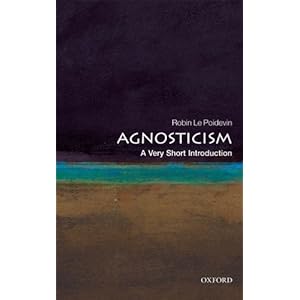
Robin Le Poidivin's "Agnosticism: A Very Short Introduction": Book Review

Agnosticism: A Very Short Introduction (Very Short Introductions)This is a densely written, concentrated set of chapters by a British professor of metaphysics, reading like a series of lectures. Robin Le Poidevin balances theist and atheist perspectives as expected, while claiming ground for agnosticism as a respected and defensible perspective, rather than the one despised by some non-believers and dismissed as waffling by many believers. He reasons calmly and doggedly, in a philosophical tone. For me, some of this material was compressed too much, but I cannot be too harsh on the constraints, after all, of these erudite primers.

Yes, Bertrand Russell's teapot is here, and Carl Sagan's dragon, and from these, after a brisk introduction to the history of the concept, the author delves into the presumption of atheism if God's existence remains unproven. Then, he examines positive arguments for agnosticism, or whether it's based on a mistake. Faith, morals, and scientific theory follow, to see if these rest on grounds compatible with or conflicting with what may be false conceptions of agnosticism. Can you live religiously while remaining agnostic? Should schools teach agnosticism? What about religions: do these come across best when taught from an agnostic perspective? You get Pascal's Wager handled deftly, and you also get a nod to zombies.

All these topics gain some attention in 150-odd pages. I found this stimulating, and one part helps me in discussing the existence of evil with students. Le Poidevin wonders as to the "superfluity" of evil in nature, not only human but in the physical realm, if this might be an answer, from a believer's point-of-view, in why bad things exist in nature beyond the fault of what can be blamed on human action or inaction. "In so far as the world and its inhabitants are the product of blind (although not random) forces, it is up to us to shape them as we see fit. What good there is must come from us. Any indication that it will come from elsewhere might lead us into dangerous passivity. It is as if (so the story goes) God intends us to look at the world and feel alone, for only then will we realize that it is up to us to make heaven on earth." (75) That's a sample of the book's style.

As he presents agnosticism, it's "namely an uncertainty as to whether there is, or is not, a being that is quite independent of any human thought or activity, a being that would, if we understood its nature, provide a single unified explanation of why the world exists, what we are doing in it, and how we should live. That issue will not go away, even if every theologian decided to ignore it." (86) In such a direct, accessible style, Le Poidevin sets out his case. This compliments Julian Baggini's "Atheism" in this same "Very Short Introduction" series very elegantly, by the way (also reviewed by me). It's a pleasure to find such contributions that respect all sides in this eternal debate with consideration, tact, and seriousness.(Amazon US 8-5-15)

Sunday, April 13, 2014

Peter Watson's "The Age of Atheists: Book Review

If neither science nor religion suffices, how do we get past our present impasse? Do we lament our lack of progress, or welcome possibility? Seven years to the day, I finished this after the same author's "Ideas: A History of Thought from Fire to Freud."  Both hefty works share this veteran journalist and now intellectual historian at Cambridge's dogged devotion to rational thinking over supposition, and the view, as his 2006 book concluded, that our human perspective is better suited to watching our world pass by and act out as if we peer at a zoo rather than a monastery. He acknowledges the scientific mission to dissect and pin down all that we observe, yet he nods to the atavistic tendency embedded within many of us to yearn for transcendence. That impulse, his new book agrees, will not fade soon, but the twentieth century charted here (although starting with Nietzsche towards the end of the nineteenth) celebrates the triumph of evolution, the breakthroughs in physics, the insights of psychology, and the wisdom of philosophy, art, literature, and communal engagement which enrich our current times and allow us so much liberty.

"Ideas" took me a month of evenings to study, given its 740 pages and 36 topical chapters, book-ended by a substantial introduction and conclusion, to chart the multi-millennial span of civilized endeavor. By contrast, I fairly raced through about 540 pages of the present book, which I highlighted (on a Kindle advanced copy, which had its flaws in format) in eighty-five instances that show my engagement with its provocative exchanges, cover roughly 125 years; Watson has also written (unread by me) "The Modern Mind" (2001) about the twentieth century, so I wondered how much of that third big book overlapped with "The Age of Atheists."

"Ideas" anticipates many of the newest book's themes. Progress continues despite those who fear it. The brain battles those who fear it. Meaning beckons but floats out of our grasp. Science discovers more only to ponder ultimate questions to pursue. Unsurprisingly, William James' pragmatism and Max Weber's sociology return, prominently among the hundreds of thinkers summarized and paraphrased here. That is both Watson's skill and this book's necessary limitation: he quotes and cites nimbly, making recondite concepts accessible. Yet, this popular touch and the breadth required to survey so much as an historian with his own biases and predilections may leave the specialized reader frustrated that his or her pet theory or favorite thinker suffered by its few pages meted out per topic.

That caveat addressed, an inevitable result of a one-volume book able to be held in two hands, this presentation conveys a firmly Western-centered, by-now familiar point-of-view. Nietzsche remains its driving force, and his fervent denial of a divine presence outside of the alienated, defiant human imagination reverberates through mavericks as diverse as Lenin and Joyce. Watson recognizes that German iconoclast's insanity, even as he roots for this raw challenge to Christian hegemony which encouraged his subjects, American and European rebels who rejected God and welcomed inquiry.

Watson's investigation roams as widely as one expects for an historian tracking modernity's slow march away from credulity and comfort found in the ethereal or emotional, to where more and more of us wind up today, in the post-modern predicament of a worldview where neither cold science nor warm faith eases the loss of grand meaning or ultimate purpose which many contemporaries lament. 
He addresses, as an early example of his wide-ranging bent, Pippa Norris and Ronald Inglehart's assertion that charts richer nations' secularization offset by declining birthrates, whereas poorer nations' perpetuation of belief-based systems as a solace for suffering and privation leads to a more populated humanity with "existential insecurity" which overall is becoming more, not less, religious.

Secular proponents, therefore, must contend with sociological explanations for belief, as well as psychological ones. Atheism, Watson finds, may be in the ascendent among the cohort he supports, but a growing sense among developed nations and educated societies of pervasive personal and social disenchantment reveals that consumerism cannot assuage the longing for meaning deep within us. William James agreed that religion emanated from what Watson phrases as "born of a core uneasiness within us" and that for many, faith was seen as the solution. Replacing that with the inspiration of music, the escapism of art, the thrill of scientific discovery, the plunge into sex or drugs, drove many in these chapters to attempt to fill up their empty souls with a spirit energized by bold possibilities.

The usefulness of religion, for James, might be succeeded by the vocabulary of reason; others who followed his suggestions looked to fields as different as dance or fashion to apply more daring experiments. Stories we tell ourselves, as Watson portrays Richard Rorty's model, move beyond the transcendental to the empirical and experiential narratives and scenarios which ground themselves in the body. Watson presents the Swiss art colony at Anscona, the critical faculties generating doubt as explored by Stefan George, and the Symbolist poetry of the early century as settings within which ecstasy might sustain itself, as generated within a movement breaking down distinctions between individuals and between concepts so as to release a mystical jolt, or a disorienting confrontation. These encounters, which would engender the cult of the body and the New Age or therapeutic trends which would return with the "religion of no religion" at Big Sur's Esalen in the 1960s, carry a charge that Watson credits by way of many current approaches in which we treat and regard each other.

George Santayana mused: "There is no cure for birth and death save to enjoy the interval by discerning and manifesting the good without attempting to retain it." A common sentiment among those Watson favors, as resignation to mortality and the impossibility of knowing the secrets behind all of creation appears to gain pace as the century's wars and brutalities weaken rational explanations. Impotence to change human nature contends against discontents driven to improve the human condition. Freud represents the latter contingent: Watson credits him for the dominant shift in modern times, "which has seen a theological understanding of humankind replaced by a psychological one".

Watson observes intriguing indicators of this shift, across the creative spectrum. The cover illustration of Georges Seurat's "A Sunday Afternoon at the Island of La Grande Jatte" (1884-1886) depicts people not worshiping, but picnicking and promenading. One couple, dressed in black, appear to be looking on, "from the (moral?) higher ground" at the crowds "enjoying themselves in very secular ways, most with their backs turned". Additionally, this French painting continues a tradition of "public contemplation" as its many figures reveal serious play. This happens despite a breakdown on the canvas of perceived or imposed order into a teasing shimmer of reality manifesting itself more subtly. The satisfaction for the viewer emanates in impressions "as a web of tiny, distinct stillnesses".

Revolutions and conflicts darken chapters; from the Soviet triumph, "one propaganda poster posited 'prayers to the tractor' as alternative ways to produce change and improvement in the community". Watson emphasizes the substitution of idolatry and worship within totalitarian societies and parties. He also notes that religion was not eradicated in many regions of the U.S.S.R. except by elimination of believers during Stalin's purges. An underlying message persists: belief will be a fallback for humans caught in difficulties, and faith may be wired into human nature despite rational powers.

Rilke sought in the foreknowledge of death that which appears to distinguish humans from other mammals: a direction to guide searchers towards a sense that mortality "drives the plot of life". He recognized that consciousness itself, as Watson puts it, may be "a crime against nature". Why evolution may have embedded within humans the powers of song, the aleatory, musical ability, or a sense of beauty, as well as a tendency in many to interpret phenomenon as supernatural, sparks some of the liveliest later chapters. Suffice to say that many arguments arise, and as many suggestions.

Virginia Woolf's often-quoted observation that around "December 1910" a change happened, so that "reality was no longer public", accompanies modernist plunge into the interior response rather than the recording of the focused, outward observation. The loss of confidence in a shared vision and the gain in conviction that a personal reaction conveyed the spiritual experience that whirled within the intimate sphere and not in the emptying cathedral propels the writers and creators Watson introduces. Oscar Wilde sums up the leap forward: "It is enough that our fathers believed. They have exhausted the faith faculty of the species. Their legacy to us is the skepticism of which they were afraid." Kafka throws up "the sediment left by the great monotheisms: that the mind of God can never be known, we shall never solve the mystery of God because God is the name we give to the mystery itself". (Watson astutely footnotes, if half the book away, an apposite aside that St. Augustine had a similar opinion.)

Through Chabad and Beckett, Salman Rushdie and The Doors, Philip Roth and Theodore Roszak, Boris Yeltsin and Timothy Leary, as the second half of the century progresses, Watson explores the impacts after the purported death of God within academia, theological disputes, and popular culture. He delves into less-familiar texts such as the forgotten bestseller Joshua Liebman's "Peace of Mind" (1946) to prove how the post-WWII merger of religion with psychology enticed clergy into roles as counselors, and how this promoted the therapeutic rather than theological cure across America. Such a range of references and examples accounts for much of the bulk of this book, but its contribution towards an accessible account from which a patient, intelligent, and reflective reader will benefit greatly cannot be diminished. Predictably, those immersed in a particular school of thought may cavil at the generalizations and judgments Wilson must convey by such compression given three-dozen chapters. However, the documentation he provides and the stimulation he generates merit respect.

Countercultural chronicler Roszak, to whom Watson gives welcome and lengthy attention, repeated José Ortega y Gasset's reminder: "Life cannot wait until the sciences have explained the universe scientifically. We cannot put off living until we are ready." An urgency boosts these late-century sections. Their pace quickens as Watson weighs dozens of competing or compatible attempts to forge a third way, apart from the calculated certainties of a stolid scientific method or the fervent claims of a fundamentalist religious precept. Roszak, following Roth and Beckett for Watson in mapping a humanist response looking hard at death if perhaps a bit more softly at mortality, laments the "boundless proliferation of knowledge for its own sake" and the exclusion of many seekers who cannot enter this closed system, and who find themselves alienated as democratic culture weakens.

Watson encourages in his closing chapters those who strive to build meaningful structures by which ecological imperatives and economic equality might co-exist. He rejects those who by faith in a better life to come justify the rape of the earth and the pain of its inhabitants. He accepts that science may not provide comfort for those who, however irrationally, search for truth and beauty beyond what can be calculated or purchased. Mark Kingswell's philosophical rejoinder to a capitalist culture "based on envy, and advertising, the main capitalist means of 'selling' consumerism, works by 'creating unhappiness'". Happiness, if God is removed from the window through which we view Watson's earlier model of the zoo vs. the monastery, may emanate from a rejection of what for many people in Western society supplants or supplements fading religious belief: the "pathography" (he credits Joyce Carol Oates for this coinage) of the dysfunctional, confessional, survivor-strutting meta-narrative that has drowned out the traditional monotheistic, and arguably I may add, modernist world-views today.

Ronald Dworkin may speak for many of his colleagues in the seminar or clinic: "Philosophers used to speculate about what they called the meaning of life. (That is now the job of mystics and comedians)." Thomas Mann cautioned that the concept of "one overbearing truth" has been exhausted. Jürgen Habermas directs us to look not above for answers but to listen to each other, for communication may produce critical meaning, and within an informed public sphere, guidance can be generated. Watson finds truth in pragmatism. "We make our lives tiny diamonds in the cosmic sands."

Few will choose this enriching and rewarding removal from reality TV and manufactured distraction, along the course mapped in these heady pages, to a sobering path of self-awareness of our fragile presence surrounded by darkness and mystery. Fewer choose Kafka over Chopra, and fewer may finish this book than the latest novel by even Oates herself. But those who persevere will glimpse in Watson's closing chapters spirited and moving testimony by wise professors and writers exchanging their versions of what Sartre phrased as "lyrical phenomenology": what Watson calls "the sheer multiplicity of experience as the joy of being alive". This quest for meaning may endure, parallel to or divergent from science. This search embraces a persistent appreciation that beyond facts hovers that which may forever suspend itself apart from our perception, no longer named God, still ineffable.  (Edited in RePrint at PopMatters 3-28-14 as "'The Age of Atheists' Considers That Beyond Reason or Science, Our Quest for Meaning Endures" and a second time to Amazon US 2-19-14)