Showing posts with label holocaust. Show all posts

Friday, May 5, 2017

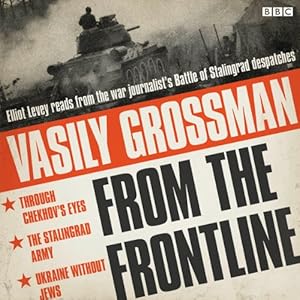
"Vasily Grossman from the Frontline": Audiobook Review

Vasily Grossman from the Front Line Audiobook

While many eyewitnesses endured the siege of Stalingrad and the battle by the Soviets to free it from the Nazi invasion, probably none has the stature of Vasily Grossman. His novels recount his and his comrades' experiences, during and then after this Great Patriotic War. when Grossman like so many fell afoul of the Stalinist regime. The Man of Steel's antisemitism increased, and Grossman was censored by the state and investigated by the KGB. Luckily, he was not sentenced to prison or gulag.

As a war correspondent for Red Star, he volunteered for service and spent over a thousand days at the front. The BBC dramatization of three of his wartime reports is well-delivered. First comes a sniper's first two days. His name's Chekhov, but his prowess comes in targeting Germans, and ensuring that their own beleaguered situation grows as the Russians figure out the layout of their ruined city's heart.

Then comes an evocation of Stalingrad. Imagine it on a moonlit night among the bombed buildings and it may nearly for a second seem romantic. Grossman applies his prose style here for more effect than one would I imagine find in journalism from the battleground. It can be flowery, but it can also be deployed skillfully. In Elliot Levey's radio recital of his account, one feels its emotional tug again.

This increases for the bleak report on the Jewish question, as answered in the Ukraine. He reports only one Jew survives in one place, and he hears rumors of two others. Out of what he claims here three million dead, a testament to victims named by trades and traits accumulates into a dour litany. (Amazon US 4/22/17) 

Wednesday, April 19, 2017

David Foster Wallace's "Brief Interviews With Hideous Men": Audiobook Review


Brief Interviews with Hideous Men | Gorgeous Book Covers | Pinterest

One blurb lauds the "hilarious" content herein. It's brief, compared to that bent on a harrowing evocation of the titular hideousness. On audio, there is talent applied diligently by a variety of youngish male actors. But this for four hours bogs down into a combination of raw (more ways than one) material for future dramatic monologues for auditions, and what feels, intentionally surely, the transcripts of a variety of depressed, bitter, lustful, wry, and/or erudite (as the author) case studies.

Halfway, #46 does reach an apex of ingenuity. The metaphorical and moral connections between Viktor Frankl's suffering endured that produced his Man's Search for Meaning and the assault perpetrated with a Jack Daniel's bottle on a teen victim ensure that no reader or listener will ever think of that Holocaust memoir-treatise the same from now on. Yet, as with the content overall, the ending's not surprising. These sound, as DFW intended I assume, as character studies of the dark side. But, as with a surfeit of crime fiction, true or imagined, the consumer may be weary too early.

There's an exhaustive determination to record betrayals, rapes, defecation, disgust, hatred, ennui, resentment, and doomed power-plays, and manipulation, in sex and other exchanges turned violent. It's surely what you see is what you get, but this is not a series of themes I care to return to. David Foster Wallace possesses insight, verisimilitude, and intelligence. But the degree to which he forces himself and then us to listen to these revelations batters you down. "His eyes were holes in the world" is how one woman sums up her attacker, tellingly for these blunt themes. (Amazon US 4-17-17)

Sunday, December 20, 2015

Primo Levi's "Complete Works": Book Review


Forever marked as a survivor of Auschwitz, known for his unflinching account If This Is a Man, Primo Levi wrote much more than that. Gathering for the first time English versions of his fourteen books over four decades, The Complete Works of Primo Levi retranslates all but one of them. And that one, If This Is a Man, has been revised by Levi’s first English translator. The Primo Levi Center in New York City claims that Levi is the first Italian author in history to have had his complete oeuvre published this way into English, “from the first to the last page.”

Prefacing this review with an indication of the scope of this project is necessary. For these three volumes exceed three-thousand pages. Memoirs, short stories, novels, essays, commentaries, and poetry are included, with nine translators working alongside the editor, Ann Goldstein. Textual notes and appendices, and an introduction by Toni Morrison, enhance this collection. (These were not made available in print galleys provided.) Serving as an equivalent to the 1997 Italian edition of the works, this enables readers and scholars to assess the whole of Levi’s career.

Born in Turin in 1919 to an assimilated Jewish family, trained as a chemist, arrested at the end of 1943 as a partisan, sent to the death camps in February 1944, Levi returned from Germany and started writing. However, his 1947 report on his experiences did not gain wide recognition until another decade in Italy. Its follow-up on his long return back from imprisonment to Turin, The Truce, appeared in his homeland in the mid-1960s. This pair occupies half of the first volume; the rest is his science-fiction stories written mainly from the same time as The Truce. These tales lack the power of his memoirs. Collected as Natural Histories and Flaw of Form, they feel slight by inevitable comparison. However, chronological order places them where they are.

Turning to the second volume, more successful stories and vignettes build the chemical structure of The Periodic Table. Basing chapters on analogies to various elements, Levi applies his laboratory expertise and rational scrutiny to his own life and that of his family. Broadening the view beyond his two memoirs, this 1975 “autobiography-in-stories” starts with a Yiddish phrase “it is good to tell past troubles.” Goodness and trouble mingle, in a book that resists easy classification, but which captures the strengths of Levi, in his steady, calm gaze, and hints of his weakness. He favors a detachment that renders humans clinically, more often than warmly.

Two-thirds of the texts in these books were written after Levi retired from his managerial post. They sustain his characteristic attention to detail, but in the novel The Wrench, the stories he collects from the working world of hands-on labor stay too inert on the page. Similarly, his shorter fiction in Lilith and the uncollected stories and essays from 1949 to 1980 were often brief columns for newspapers or book prefaces, of interest more to specialists. Their presence here testifies to the completeness of this edition, but the content can drift into the ephemeral.

Volume three opens with his poems. It continues with The Drowned and the Saved. In 1986, Levi returned to considerations of the Shoah after it appeared a generation was passing and the impact of the terror was fading from memory. He enters the “grey zone,” the ambiguity of those who survived. Disturbed, he confronts those who had to compromise to cling to life in a realm of extinction. This darker element tinges his later work, as he wrote more and more as he aged.

Rather anticlimactically, after the tension of The Drowned and the Saved, the edition gathers various essays and stories. Other People’s Trades begins with Levi’s admission that these essays “are a product of a decade and more of vagabond and dilletantish curiosity.” On writing, chess, science, and insects, among other topics, they are readable and pleasant, intended for the general audience of La Stampa. But as with his works on the camps, these lighter pieces touch on Yiddish and the Reich, if in the same conversational tone. It can be unnerving to find tonal consistency across so many pages, but Levi tended to prefer the object to the subject, the physical or the verbal as opposed to the spiritual or the human. This assertion challenges humanists who champion Levi for his life-affirming message. Yet when he concentrates on facts, Levi steadies himself. This may be a defense mechanism, given his endurance of inhuman conditions engineered by his fellow humans. It may corroborate the success of his fact-based explorations of this predicament, as a fragile man encountering wonder and chaos, more than his fictional forays. The latter leave the reader with a weaker impression of Levi’s skill as a patient observer. This had been honed by a style based on his chemical reports, efficient and precise.

Perhaps a collected works might best serve his legacy, for a wider audience at an affordable price. The cost of this edition keeps it beyond the reach of many who wish to learn from Levi. Levi’s last moments, in April 1987, still spark debate. Whether or not he chose to commit suicide, he was on anti-depressants after a prostate operation. His death, from a third-story fall in the home where he had been born 67 years earlier, marked another ambiguity in a life full of them, from a man who faced evil and who reflected in many of his works collected now upon the ability of goodness to endure within frail humans and humanity, after his own brutal encounters. (Amazon US 12-15-15; Spectrum Culture 12-06-15)

Friday, May 1, 2015

Clan Committment: Armenia + Ireland, 100 years on


This photo, "Remnants of an Armenian Family," reminds me of photos taken from An Gorta Mór, the Great Hunger, known popularly if not exactly correctly, according to many, as the Irish Famine. Change the costumes or headgear, and these five could be an evicted family from a stone cottage far northwest.

Nothing to Celebrate in ANZAC in Solidarity Net criticizes those who from colonies and dominions were encouraged to fight in useless battles for capitalism, imperialism, warlords, and false ideals. It questions the tributes to troops at Gallipoli. About 88,000 for the Ottoman and 44,000 for the British Empire died there. This slaughter and that in Armenia echo, as death returns in a region today. Small nations hunted and hated by armed fanatics, hunted for their allegiance, their clan, their religion.

James Connolly, when asked "What Should Irish People Do During the War?", after denouncing cooperation with the Crown to defend its Empire and admitting if Germany could free Ireland from Britain, that would not be rejected, finally rallied against Kaiser or King. "Should the working class of Europe rather than slaughter each other for the benefit of kings and financiers, proceed tomorrow to erect barricades all over Europe, to break up bridges and destroy the transport service that war might be abolished, we should be perfectly justified in following such a glorious example and contributing our aid to the final dethronement of the vulture classes that rule and rob the world."

Reflecting this May Day on an Irish history full of invective against its nearest and oldest enemy, I wonder about the psychic cost of raising generations a century later on what riled and inspired our families' desperation: to rage against rulers, to take up arms, to revenge eras culminating in ravaged decades filled with famine, rape, emigration, rack-rent, landlords, conscription, death fast or slow. 

While for years much of my reading and writing focused on The Cause, I find the past few years, and after all nearing two decades since truces were called and arms decommissioned and dumped in Ireland, I'm a bit weary of a sustained diet of study of these events. How, I mulled over as I studied Judaism, can people craft careers in analyzing the records of the Shoah, or literature of the Armenian genocide? It reminds me off hand somehow of the professor of Hitler Studies in White Noise, but no parody is intended by me. Primo Levi's books are being retranslated this autumn and reissued, and the publisher has to remind the press and audience he's not only a survivor-testifier from the deathcamps. 

Watching the shows that John Walsh produces as his son was killed years ago and led him to produce America's Most Wanted as the first of many successful get-tough programs on t.v., my wife and I muse over what that career must do to one's spirit. How far do you capitalize, however well-intended, on death or harm caused to you or your family? Does that market or brand you always? Levi wrote fables like his fellow storyteller Italo Calvino; he dramatized the life of workers, he crafted stories, and he told some of his best tales set before the war, in The Periodic Table, as when he hiked with his little dog. Those moments tend to get subsumed into the great drama. Some veterans never get over the most vivid and harrowing moments of their service, and I suppose for prisoners, hostages, those freed from slavery or torment, kidnapping or disaster, the life after can never create the same energy. 

Meline Toumani, an Armenian-American writer originally from Iran, warns in the New York Times: "Armenians Shouldn't Let Genocide Define Us." She speaks of how Jews are accused of self-hatred if they take issue with the prevailing notion that one must conform to the narrative of what I borrow from the saga of the Irish as "Most Oppressed People Ever." (MOPE: I don't agree with much of that last link's writer, but it's for ease of cyber-reference for this acronym.) Historian Alvin Jackson, a more reliable source, cites colleague Paul Bew who reminds us of the dubious claim "that the most oppressed people in Europe in the 1940s were to be found in Ireland." (671; Oxford Handbook of Modern Irish History.) It's almost, but not quite given the fatal lack some carry now, superfluous to say that this was a decade which few countrymen and fellow sufferers who were interned with Primo Levi survived. So, that takes us back to Toumani. Noting Kim Kardashian's support of the centennial, Toumani submits her thesis: "Watching the dubious intersection of celebrity worship and genocide commemoration, I couldn’t help but reflect on some of the less obvious things Armenians have lost since 1915: not just people and property, but a kind of existential confidence. The genocide recognition campaign itself, in the name of restoring Armenia’s losses, has been so all-consuming as to stand in the way of other kinds of development--in Armenia and in the diaspora." It should not be all Armenians, admittedly a long time away from this event, should focus on for their identity.

She argues that it's too limiting to expect members of small ethnicities and their diasporas should or must conform to a narrow range of banal exhortations to carry on or insistent dehumanization of the enemy nation or empire which committed the violence. She went to Turkey to try to learn from the other side's intransigence and denial. Therefore, in her estimation, she has been accused of "self-hatred." She defines this: "The idea is that you are embarrassed by your true nature — your ethnic nature — and so you mock it or speak out against it. The label is used not to engage in meaningful criticism, but to dismiss such criticism by chalking it up to shame. And yet the behavior labeled self-hating often reflects the opposite of shame; it reflects confidence." Comparing the plight of Armenians to that of the Jews, she continues: "The common phrase, 'Is it good for the Jews?' is implicitly present, too, for Armenians: but what does it mean to be 'good' for the Armenians, if survival means blocking out uncomfortable ideas and clinging to simplistic symbols?"

No, neither she nor I are denying horrors perpetuated. Turkey's refusal to take responsibility, Britain's collusion to worsen the potato blight's devastating impacts by pushing millions off the land and on the emigration boats if not the sides of the road to starve, or the black whirlwind of the Shoah all stand as blots on the record of what we do to each other. But how long do we stand in as "survivors"? 

Back to Ireland, similar questions can be raised. I am no great fan of the revisionists who try, as one wag put it, to tidy it all over, as if the English had a small misunderstanding with their subjects. Yet,  as the commemoration of the Easter Rising's centennial looms and politicians and pundits bicker over whether to invite the British, this drawn-out fracas, to some apart from the scrum, appears very petty.

Toumani concludes, for her small ancestral nation (one that like Ireland has clung long to an ideal of an embattled faith, a bastion of learning amid idiocy, an outpost of beauty and tradition and language apart from its brutish neighbors far greater in power, greed, and cunning): "But the question of what healing looks like beyond the use of a single word; of how children can be taught about their histories in a way that does not leave them hating the descendants of their ancestors’ killers. Of how a country can grow in meaningful ways so that there won’t be a Kardashian-size gap in its national confidence. Taking positions that don’t track with your ethnic group’s orthodoxies, or indeed living your life in a way that is not defined by clan commitment, are not signs of self-hatred but rather an indication of learning to value oneself. And this is at the heart of what it means to be not erased but fully alive."

My friends in Ireland are learning slowly how to learn a more inclusive history, as that nation itself becomes more diverse than any other time, rapidly, ever before. Some like me one generation apart from the homeland grapple with that old language, not easy to learn at home, but far more difficult pverseas, at least from my struggle. Many at home and abroad begin to drift from from clerical orthodoxies, and those who do not feel emboldened to speak out against ecclesiastical abuse. Those of us in the diaspora, passing on our heritage to our children, grapple with how much to pass on about past wrongs, and whether so much of our identity consists of commemorating ancestral pain. Clan commitment remains. But our pride does not overshadow an awareness of nuance or honesty.

Saturday, September 27, 2014

Curzio Malaparte's "The Skin": Book Review

Born Kurt Eric Suchert, this half-German writer castigates his losing side, as the Allies "liberate" Naples in 1943. Their new Italian allies take up the uniforms of the dead British they have recently killed in the defense of their Fascist nation. Italians now resolve to fight against the deposed Mussolini and the Germans. How the Napolitan natives feel about this has been rarely acknowledged by many who dramatize WWII. Malaparte, as his nom-de-plume indicates, takes the "bad side"; he shows the physical and moral costs of capitulation when one's own loyalties insist one was never defeated, and cannot surrender one's liberty unless once a slave. 


Such complex questions drive this 1949 novel. A work of fiction, but in its headlong prose rush and its tendency to indulge in set-pieces and tirades, I suspect this is better understood as thinly disguised or ambitiously elaborated vignettes from Malaparte's own experiences. The results fit better not as a sustained narrative but as episodic depictions of encounters between the Italians and those who now occupy their territory as erstwhile comrades, but also as avengers, judges, juries, and executioners.

Like Céline, Malaparte brings a complicated and shifty set of his own alliances into play, as he survives the shifts in regimes and ideologies. Similarly, this also needed an editor, for parts lapse into opprobrium, and the long conversations untranslated in David Moore's English version from French, between Malaparte's mouthpiece and his charge, Colonel Jack Hamilton, may slow the pace or dissuade a less cosmopolitan reader. But in the central section, "The Black Wind," one glimpses, finally, the power Malaparte can summon.  He had traveled to the steppes and witnessed the barbarities of the elite Germans (in this novel he appears slightly anachronistically already as "the author of 'Kaputt'"); he transforms this into a nightmare of crucified victims of the Nazis appealing for his assistance, before this segues into a tribute to his beloved greyhound Febo, and then a moving scene set in the last hour of a wounded American soldier. These three scenes, at first disparate, cohere as a meditation on death, and how we come to it ready or not. Malaparte takes dramatic license here, but the chapter works, as the central pivot in an otherwise metropolitan setting, to free the narrative from its concentration on the the demi-monde of Naples, of satire against the Allies, and lurid excess.

Rachel Kushner introduces the New York Review Classics 2013 reprint (with added passages expurgated from previous English printings) by calling Malaparte a plague or a pest, taking down all with him, and this fittingly finds an echo in the first chapter. On pg. 34, Boccaccio is cited appropriately, as compassion is felt for the afflicted of a great disaster, but this time, also by the Americans for themselves, as Christian benefactors. The trouble Malaparte finds is that such largesse cannot be reconciled with Naples' more pagan heritage, and the fact that Italian suffering predates Christian concepts. The last virgin in the city is shown intact, admission required for gawkers, and this emphasis on the grotesque (dwarf prostitutes, "Negro" soldiers hoodwinked by local "brides" and their scheming, black-market connected families despite smiles, merkins, "inverts" galore) may delight some, even if it soon gets tiresome. I get the point; Malaparte for 330 pages keeps making it.

He avers, in more provocative mood, that "capitalist society is founded on the conviction that in the absence of beings who suffer a man cannot enjoy to the full his possessions and his happiness; and that without the alibi of Christianity capitalism could not prevail." (63) Malaparte distrusts the civilizing mission of the Allies, he dislikes the craven bargaining of his false nation, and he seeks to distance himself from a Fascist past which despite partisans and reprisals does not recede so rapidly.

As with many European mid-century intellectuals, Communism hovers as a possible alternative. But Malaparte, true to his contrary nature, wonders if "pederasts" and "inverts" flocked to the red flag as if some pawns in a "Five Year Plan" hatched for easy marks among those who sought to deny their bourgeois nature and pretend to be proles, or to seek rough trade and fresh conquests among such who were driven by desperation and hunger to sell themselves to the "international community" of opportunistic coquettes and dilettante poseurs. A horrible interlude of the aftermath of phosphorus bombs in Hamburg conjures up a Dantean diorama, and innocents suffer horribly, cant and ideology aside. Children are sold to Moroccan soldiers, the Church connives, and the author speculates that this is not the inevitable outcome of moral breakdown so much as a sly campaign via Marxists to undermine the standards of a West they despise. Malaparte's suppositions may anger us, but he forces us to consider how popular or romanticized ideas generate unexpected, ugly impacts. People do not try to save their souls. all labor for good or bad only "to save their skins, and their skins alone." (129)

The rest of the book continues in the same mood. A bizarre birthing scene, a banquet of "fried Spam and boiled corn" for the Allies, a girl's death and her posthumous transformation, the eruption of Vesuvius, the entrance of the Allies into Rome--where a man welcoming the troops is run down by a Sherman tank, and a "flag of human skin" seems the appropriate icon for the Europe thus freed, reprisals against teenaged boys who fought for the losing side, and a recognition that it is a "shameful thing to win a war" (343) wrap up this journey into the rotten core of a continent as it is conquered.
(Amazon US 9-27-14)

Sunday, February 9, 2014

Ivan Klíma's "My Crazy Century": Book Review

I've long preferred Ivan Klíma's fiction to his better-known Czech colleague, Milan Kundera. Klíma and Kundera explore the collusions imposed under totalitarianism, and the uneasy compromises chosen as democracy returns and capitalism dominates their fractious post-1989 homeland. However, Klíma emphasizes moral dilemmas in sparer, simpler prose, shorn of the philosophical digressions characteristic of Kundera; as his autobiography demonstrates, Klíma avoids cant or cliché.

His preface warns how "often deceptive goals" lure young idealists towards self-sacrifice. Once Marxism, now Islam, but the moral endures: Klíma opts for sincerity, and he resists conformity, at considerable cost to his career. How he got there brings us back to his ill-timed birth in 1931; this made him, and his family of Jewish descent, a deportee to Terezín.

Klíma adopts subtle reactions to his plight as an adolescent prisoner, from his younger perspective. "Early one morning on a gloomy autumn day--probably in 1943 because Father was still with us--they herded everyone out of town and onto a huge meadow." The vague date combined with the reminder of a fragile family bond blends with his blurred, then sharpened, memory. "The women were wailing that this was the last day of our lives, that they would shoot us or toss a bomb into our midst. And as if to confirm their fears, a plane with a black cross on its wings passed overhead."

Klíma tells his family's survival within this predicament without melodrama or sentiment. He was incarcerated in the infamous show-camp manufactured by the Nazis, who used its inmates to pretend to the Red Cross that all was well with Jewish life in a staged setting. Paper money "for our ghetto" was later distributed. "On the face of the bill was an engraving of a bearded man holding a stone tablet in his arms. Mother explained that this was Moses and that carved on the table were ten laws according to which people were meant to conduct their lives." Ivan's unfamiliarity with Judaism, given his family's Communist ties and his assimilated upbringing, come across in such well-crafted vignettes, and where a lesser talent might have inflated the pathos or irony in the Nazi invention, Klíma exerts emotional control.

This typifies My Crazy Century. "It's a strange world when you are called upon to explain why you weren't murdered as a child." His admission of "having drawn one of the few lucky numbers" in this abominable lottery" of who shall live and who shall die raises uncertainty about why he let alone most of his family survived. given he was no longer considered underage before the end of the war and so as a male inmate he was exposed to the same fate meted out to millions of his neighbors. After liberation, however, his family's status (it appears thanks to two of his mother's Communist brothers who had been executed by the enemy during the war) seems to have risen, if for a while. A putsch in 1948 brought the Communists aligned with Stalin into power, and the Klímas anticipated happiness.

Klíma's cohort, too young to have remembered much of democracy, became the first to be praised by the new regime, for the young could be raised fully indoctrinated in Marxist-Leninist rhetoric. Catching up on the education he had missed behind barbed wire, he tries to seek solace in books, but these are censored; a career as a writer comes with many restrictions. Sent as part of a hapless student brigade to build a foundation for a residence, he discovers the complicity of all involved in the making of the People's Republic in its own inevitable demise. The foreman, after goading and chastising the untrained students forced to labor in rain and mud, shows his own duplicity when it comes to tallying up the pay and the hours "worked": "They were swindling us as much as they were him." "They" stands for the State, and the system against which his own father will be held liable.

His father, with a doctorate in electrical engineering, was told to run a factory full of similarly untrained workers. Production of its motors suffered. Sentenced to prison for a stint under "Paragraph 135 (endangerment of the economic plan)", only the death of Stalin and a relative easing of sentences prevented his father from serving twenty years, or worse, for "sabotage". Chastened, Ivan seeks Party membership anyway, and to his surprise despite the taint upon his long-standing Communist family, he is accepted. Yet, this ties him all the more to his limited options, after a degree purportedly in "literary studies", adulterated by the "official ideology" through which the humanities were taught.

As a cub journalist fired for his insistence to aim for a truer version of what he witnesses than socialist realism, and as a reluctant or crafty magazine and newspaper editor, Klíma struggles to comprehend his country's shift after Stalin's death. Following Khrushchev's speech denouncing his predecessor, Klíma asks his aunt, who had lived in the U.S.S.R., why she did not tell him the truth about Russia. She responds that those who had seen firsthand Stalin's dictatorship were themselves most suspected, and besides, she avers, nobody in Czechoslovakia would have believed her anyway.

Married at twenty-seven and raising two children in early-1960s Prague, Klíma learns about Stalin's evils through a book by Isaac Deutscher. Klíma seeks help in translating damning passages from its English version, through the assistance from another aunt, a survivor of Auschwitz. A dangerous task, but this collaboration emboldens his instinctive need to elevate facts rather than fiction within his own life and calling. But he must express himself, given the scrutiny of the regime, subversively as an emerging playwright and novelist. "I finally realized that in a society in which all means of expressing disagreement are suppressed and every word of doubt is considered grounds for prosecution and subsequent execution, only the despotism of the leader comes to power."

Allegory against such a dire condition, in his early plays and stories, was forced upon him, as with many Czechs from the creative class. Otherwise, censors swooped down. He joins the Writer's Union and relates many instances of more suppression as those who seek inspiration outside approved boundaries find their presses closed down and their submissions unpublished.

Throughout his long career, Klíma strives to keep honest, and pushes against his own limits as well as those from above. "Art obviously does not begin when you succeed in generating form out of formlessness; it begins when you are able to judge the caliber of your creation and not fall into raptures over the sole fact that you have created one of countless paper kites." The bestseller or the hack, Klíma opines, asserts the success of an inferior work, full of tired phrases and hackneyed plots.

The artist worries that his or her creation may not by its merits or their lack survive even its creator's lifetime. Klíma allies himself with those who fuss and worry over words. Under totalitarian regimes, verbal and freed expression may undermine foundations too shoddily built by brigades forced into tasks. Reading this memoir, I speculate that Klíma might urge societies to look to role models such as his father, trained to fulfill their potential at jobs chosen by themselves, and to direct satisfying and productive progress agreed upon by working individuals themselves, rather than by top-down imposition.

Allowed to visit Israel and its kibbutzim and then England (where he meets Deutscher, who ironically from his own perch in a plush London book-lined study counsels book-censored Klíma to praise socialism more), he moves even before the tumultuous year of 1968 towards a dramatic showdown. Rebelling against the constitutionally enshrined "eternal rule" of the Party, Kundera defends the New Wave of filmmakers in their nation, while a fellow writer cites Marx in defense of greater liberty. Klíma denies state lies, for "in the name of some sort of future objectives, the party had deprived the people of freedom, usurped all power, destroyed political life, falsified history, mocked the art of voting, and transformed a free country into a colony". Unsurprisingly, the Party expels him.

Part two (this was originally published in two volumes in Czech; this one-volume abridgement has been carried out by skilled translator Craig Cravens with the author's assistance) opens as Klíma, after fourteen years a card-carrying Communist, is fired from his editorial position. Now a class enemy, he is under surveillance.

Yet a few months later, as 1968 ushers in Alexander Dubček's brief leadership, Klíma and dissidents were reinstated. The right to act by one's conscience was asserted officially. During the "cataclysmic Prague Spring", Klíma reports: "Never before or since have I lived with such haste or intensity." This section thickens, as Klíma documents manifestos by his fellow intellectuals agitating for reform and open elections, but this is a necessary inclusion for readers who will consult this autobiography for a better insight into the forces pushing against the State, and those tanks which pushed back. That August, Soviet forces reminded Czechoslovakians that they had no right to stand up for themselves.

Even as the Warsaw Pact troops loomed, Klíma, now having an affair, tries another play in fabulist style. It was rejected. "The criminals who soon took power no longer needed their jesters."

Oddly, he and his mistress first heard that their land was invaded on the radio, from London. The couple had a chance to stay there a few weeks. Meanwhile, his wife was on a kibbutz in Israel; her summer departure had rekindled a short liaison between Ivan and his new companion Olga. But with their children in Prague, husband and wife decided they had to return. Most cars were going in the other direction as Helena and Ivan crossed back into Czechoslovakia. Many of his friends emigrated.

As "healthy forces" in Party jargon regained control, Klíma bristled. He welcomed the chance to teach at Ann Arbor in 1969. On a limited income, he lectures at other universities and spends Christmas in Midland, Texas, sponsored for a week by a local Protestant church. Four days in, he flees to Big Bend National Park. He savors his freedom, as he sneaks across even the Mexican border. He realizes he never had to show anyone his identity card, over two weeks on U.S. highways.

He and his family are summoned back prematurely, as the crackdown at home meant their visas were suddenly terminated at the end of 1969. Neither his dissident colleagues nor his mistress can believe he came back from America. Writers who refused to conform now washed windows or built the metro. Some philosophers and historians are hired by the water board to measure a stream every few hours. Returning to a still more intolerant society, Helena and Ivan have their passports confiscated. 

As he must return to the labor force, he takes on for a few months his allotted two twelve-hour shifts weekly. He logs in part-time as a hospital orderly. "Socialist health care was free, and looked like it." Each socialist workday, he explains, consists of two periods of equal length. Work is followed by a time when "everyone pretended that work took place". 

At forty, Klíma turns from stage productions to writing fiction; his membership in the PEN Club brings about his interrogation. Arthur Miller, William Styron, and Philip Roth visit a few years after Soviet occupation, before the borders are tightened. Klíma confesses astonishment when meeting earnest, deluded Westerners who applaud "Communist propaganda". He and others among over a hundred banned writers lobby for clandestine samizdat distribution at home, for a loophole means that a writer cannot be punished for "a copy made upon an ordinary typewriter". 

After all the searches, arrests, incarcerations, and deaths he had seen, Klíma joked how he'd write a thousand-page novel. Judge on Trial (originally an underground publication in 1978), remains one of his best novels, a look at those who, like its author, did not flee after the blasts ending Prague Spring. 

In the matter of love, Klíma reckoned that people could find some semblance of choice, even under a police state. When "higher goals had been degraded and disgraced" and so much was forbidden, only the "dearth of apartments or money" stood in the way when it came to erotic fulfillment. Yet, he remains discreet about some of his personal affairs. "My wish is not to draw my loved ones into my tale; it's enough that I drew them into real life." 

1977 brings Charter 77, named for an international human rights covenant. This petition predictably brings the wrath of the dictatorship down on opponents of the regime such as Václav Havel, who was imprisoned repeatedly. Klíma, who had foreseen how this charter would play into the State Security police who reacted against "reactionaries", had prevaricated and not signed it. His lack of involvement raises suspicion. Trying to trap him, the Party press reports he in fact has signed. The police wonder if he wants his passport back, Klíma gets to play his own cat-and-mouse game. What loyal citizen, after all, would claim that the paper of record published false information?

These kind of situations beg the term Kafkaesque. (Klíma to his credit avoids the cliché, but it appears apt in Prague offices run by a police state.) His interrogator asks to see his manuscripts. His books being banned, Klíma admits to the colonel: "I had no copies of my books because I didn't want any trouble."  Many pages of such admissions ensue, and earn its wry commemoration as "a crazy century". He quotes this phrase from a samizdat copy of Donella Meadows' The Limits to Growth.

He finds in middle-age himself locked in a ghetto where he too holds now the key. Unbanned writers separated from banned, and the latter, forced into secret meetings to avoid the secret police, chafed. Yet no informers were secured, and Klíma and his comrades told nobody about such gatherings. 

More writers, musicians, and artists are forced to emigrate. Intimidation increases. As his by-now regular interrogator greets him: "Wherever something provocative is going on, we are sure to find Klíma." Suspicions prove founded. As an an unofficial "mailman" he transports such documents as Meadows' along with Czech-language publications, smuggled in from abroad. Later, bored and curious about the opposite of love, he seeks garbage. He becomes a street-sweeper. As he and his wife are "persecuted dissidents against the reigning social order", it's one job nobody can deny him.

Due to bureaucracy, Klíma keeps inventive, and quirky. Although the State employs him as little as possible, Klíma has to find approved employment at least one day for each of two years prior to his retirement, to qualify for a pension. Since his writing prohibits him from making a living as an approved author, he makes do with other tasks. These jobs will provide him with inspiration for his fiction. He finagles another time-killing messenger position. Qualifying for his pension, not needing to work, in homage to Kafka he next requests a stretch as a surveyor's lineman.  At least in this abridgement, Klíma tends towards reticence about his fiction; more about its contents might have enhanced this memoir's appeal to readers, new or old, of his work, often set among everyday people in Prague's streets. His odd jobs there enliven his samizdat novel titled, of course, Love and Garbage and his stories My Golden Trades.

Grandchildren and retirement don't slow him. 1989 ushers in another January of protests in honor of Jan Palich who had burned himself alive in 1969 to protest the Soviet invasion. This year, Havel is arrested again, but unlike past years, protests do not dwindle. Water cannons drench Klíma as he marches. But this spirited year goes more smoothly than 1969. Klíma rallies the PEN Club again. A November strike at his alma mater Charles University confronts the regime, and soon the Communist Parliament unanimously elects Havel as president of the republic. 


This volume appends eighteen essays keyed to many of Klíma's autobiographical chapters, on the impacts of ideology, propaganda, subjugation, state control, and the concept of internal freedom pursued within conditions that limit external liberty. He asserts: "I wrote about the world not the way I was ordered to by the way I perceived and experienced it." His one-page epilogue concludes, after the "heavens of freedom, imperceptible only a short time ago, had finally opened before us." 

As My Crazy Century proves, Klíma in his eighties continues to do what he chose to do, despite the forces rallied for most of his life against him and his fellow marchers and writers and workers in the Czech lands and beyond. Enjoying external as well as internal freedom for the first time in six decades, he confides: "I wanted to keep doing what I knew how, at least a little. To write."
(In shorter form to Amazon US 11-21-13; to Pop Matters as above 12-8-13)

Wednesday, January 29, 2014

Mark Larrimore's "The Book of Job: A Biography": Book Review

This biblical story's always troubled me, so Mark Larrimore's energetic and pithy survey of its "multiplicity of voices" and the puzzles this oddly edited text generates is a welcome introduction. The complex history of how interpreters (starting with the book's own Elihu and Job's friends who try to counsel him) have reacted to the legend, in Larrimore's understanding, resists "closure" no less than the themes it raises, of "providence and evil, the meaning of innocent suffering, the nature of God and humanity's place in creation." Rabbinical, early Christian, medieval, Reformation, Enlightenment, Romantic, fundamentalist, New Critical, and post-Holocaust readings of the text all gain attention, as well as how the book is "performed" in liturgy.

Chapter 1 looks at ancient interpretations--oral and legendary--and Larrimore wonders if Job himself is Jewish or a Gentile, for instance, another complication for a text with such obscure characters.  Chapter 2 looks at disputations, the medieval debates where philosophers (especially Maimonides but also Aquinas and Calvin) followed the example of Job and his friends as they disputed among themselves. Chapter 3 takes on the medieval burials of the dead and how the book of Job "enacted" itself beyond the text itself in liturgy and in a French mystery play, "La Pacience de Job."

Theodicy may not be as popular as it once was, but for centuries, Job's predicament allowed a confrontation with belief as "the model of an anguished but fervent modern religiosity." As the professor's previous book dealt with the problem of evil, Chapter 4 fits Larrimore's expertise. William Blake's illustrations show another way Job's story has been transformed, and Larrimore notes the uses of Blake's depictions on the covers of studies and novels, for instance, another point that even if an aside shows the perpetuation of Job's anguish. I wish more popular culture contexts such as this were delved into, as these spark much interest.

The post-Shoah struggle with Job's lessons, themselves a tangle of textual cruxes and confusing shifts, show the "exile" of Job for the fifth chapter. Not only Kant or Leibniz, Voltaire or Herder, but Elie Weisel and Richard Rubenstein, and a provocative comparison between G.K. Chesterton and Slavoj Zizek (albeit too brief a one for me for these last two pairings) demonstrate the range of Larrimore's examples. Similarly, his conclusion touches (I wish more here too was provided, as cinematic connections stimulate curiosity) on "The Tree of Life" and "A Serious Man" as two different, and typical, takes on the positive and negative aspects of Job's dealing with his troubles.

"In its jarring polyphony and its silences," Larrimore concludes, the Book of Job "speaks to and for the broken." Larrimore notes (he teaches at The New School) that the book has in the academy become detached from "monotheism which is now in exile in our secular age," a universalized one that we seek when "stepping outside the rest of salvation history" or the rest of Scripture. Again, these observations merited much more depth, but Larrimore finds provocative insights, a value to any inquirer. Therefore, as reacting to this morally troubling and poetically bold biblical book, both atheists and "the remnants of the covenantal monotheisms" might seek solace for their suffering as shared by Job and those in this tragic, bold, strangely conceived and unconventionally arranged story.
(Amazon US 12-14-13)

Monday, September 9, 2013

Jáchym Topol's "The Devil's Workshop": Book Review

Jáchym Topol deserves your attention. Through a punk-inspired, postmodern energy erupting from his Czech homeland against its oppressors, he conveys verve, intellect, and, beneath the trot of his clipped or galloping prose, tenderness: if in Central European precedent rationed out to each according to his or her own needs. From a dissident family, a poet and a reporter for a samizdat newspaper, he helped his nation topple totalitarianism, finally doing so in 1989 by the gentle but insistent Velvet Revolution.

Topol's debut fiction conjured up diabolical vignettes memorably. He started as a rock lyricist in the 1980s, so his affinity for potent imagery shows. Out of five hundred pages of closely printed, dreamlike, and dense scenes, Mr. Novak and his heap of bones at Auschwitz loomed largest in his hallucinatory, bewildering 1994 trilogy City Sister Silver--translated ably by Alex Zucker in 2000. Even in the original language, that first novel confounded native speakers with its disjointed assault. It lashed out at materialism.

Attacking both state socialism and market capitalism, expressing the rage of those growing up in one system and suddenly under another, its urgency reminded me of Joyce and Pynchon more than his Prague predecessor Kafka. Think of the linguistic upheaval of A Clockwork Orange and the demotic fury of Trainspotting: in both film and fiction. (You can sample its first chapter translated here.) Topol returns to English audiences for his fifth novel (it appeared in Czech in 2009), with his much more matter-of-fact, unnamed narrator's voice channeled again through his Brooklyn translator, who captures Topol's conversational, insistent tone intimately. Zucker dedicates the work to the author, "my brother from another mother".

This short novel extends Topol's political direction adroitly, and more calmly. It starts in the teller's native town of Terezín, constructed in 1780 under Holy Roman Emperor Joseph II, who named its formidable redbrick, stolid fortress after his mother. (While the narrator's father claims Maria-Theresa, the last of the Habsburg rulers, "founded" the massive installation, that attribution is open to qualification; she died the year it was built.) Under the Nazis, this became the "city for the Jews"-- to show off their supposedly humane treatment to the Red Cross. After Soviet "liberation", Lebo, himself born in the imposing camp just prior to its downfall, survives as its guardian, to protect the humbler garrison town against obliteration by the post-Soviet government, who compromises by preserving only the camp. Lebo and those who've grown up there, many children of the camp survivors, rally. "Lebo didn't want to see Terezín reduced to a Monument and a few educational trails. None of us wanted that."

A commune rises, a loose camp of its own. (As Zucker notes in an afterword, this anticipates Occupy and other movements: he translated this in the fall of 2011 in New York City.) This attracts "bunk seekers", the second and third generations who search in the camps and bleak villages for traces of their forebears who had outlasted the genocide, or more often, that vastly larger contingent: those who had died. Haunted, their descendants must ask: "If it happened here, can it happen again?"

When I visited Terezín a decade ago, my then-young sons came along. Just before I read this novel, they told me that their most vivid memory was a placard at the real camp's ticket booth portal for ice cream. The juxtaposition of a place of endless deprivation and a symbol of quick satisfaction matched my own recollection; its interiors had been nearly emptied, after a flood of the River Vltava, and the emptiness of the cells and the lack of signs, furniture, or even other visitors added to its silent impact.

In The Devil's Workshop, a similar lack of specificity or detail leaves the foreign visitor to the camp vicariously in these pages filling in imagined scenes, as the equivalent gap in interpretation remains. The narrator does not play the role of a tour guide. This may stem from the familiarity of this site to Czechs; it may deepen the detached nature of the narrator's recollections about refusing to play to sentiment, as well as Topol's preference for efficient, even dry, reporting rather than effusions.

Concerning love, pursued by the narrator on fortress slopes where he once herded goats and now takes up with Sara, a Swedish granddaughter of a child transported away to freedom from the camp: "a roll in the grass was simple enough. And that's all there is to say about it." Levity or gush comes rarely to those raised here and those who peer into the shadows, one senses. Some sober pilgrims, descendants of the Czech patriots and Jewish masses kept and killed there, turn communal dwellers. "They knew they weren't in a medieval castle, but in an abyss where the world had been torn apart, a place without mercy or compassion, where anything was possible."

The narrator--back from prison--and his comrades aid Lebo by appealing to the conscience or the bank accounts of the wealthy to sustain Terezín. They amass valuable contacts. For a while, this grassroots experiment in self-sufficiency flourishes: goods are sold to tourists and ingenuity brings in cash. Sara designs a popular t-shirt, altering a certain Czech writer's image with a gallows and a stencil. "Theresienstadt: If Franz Kafka hadn't died, they would have killed him here." (This is as lighthearted as the suitably titled The Devil's Workshop gets.) By such enterprise, and by restoring the mentally ill and recuperating the bunk seekers, the modest commune succeeds.

But, its commitment cannot fend off the jealousy of bureaucrats. Scandals around Lebo are concocted by an envious press. The narrator flees, soon after meeting an older arrival at the campsite: Alex from Belarus, often called Europe's last dictatorship. Alex wants to turn the clout of Terezín's online support network against the despots of his own post-Soviet homeland, still fighting amongst itself.

Sneaking away as Terezín succumbs to "cops and doctors all over the place on account of a couple of grannies" (shades of Occupy), the narrator escapes via Prague and flies to Minsk. There, Belarusians clash as the president declares martial law. In Khatyn, Alex, leading a team of seekers more feral and less coddled than those who could afford to frequent Terezín, unearths catacombs packed with corpses. Matuška, who had ferried the narrator to safety across borders, urges him to do the math.

Stalin's henchmen murdered ninety percent of her nation's intellectuals. Czechoslovakia and Belarus have equal populations, but over ten times as many of the latter people were killed by the Nazis--and their Russian, Ukrainian, and Lithuanian collaborators. Alex informs the narrator: "The devil had his workshop here in Belarus. The deepest graves are in Belarus. But nobody knows about them. That's why you're here." Publicity and donors will enable Khatyn to outdraw tourists to Auschwitz. 

The battle over who controls the remains of four million Belarusians, what such numbers mean to a divided and shamed country where some assisted and some resisted, and who grabs their share of the tourist trade and international assistance elicits Topol's understated but firm pressure as he explores a touchy subject. This is one subject that all Belarus can agree on, and besides the income, this may achieve what a wounded nation needs for the living: the ability to finally let the dead rest in peace.

But first, their stories must be recorded, lest we forget. Topol dramatizes this in the latter half of the novel. Under the determined vision of Kagan, who as a boy made it through the ghetto and the mass grave, and Alex and their team of excavators in a land where all are bunk seekers, we see the results. Alex constructs what will be a museum unlike any other, out of a "Jurassic Park of horror".

I leave the reader to uncover the resolution. Topol integrates real accounts of barbarity skillfully into the quick snatches of testimony, and to his credit for this difficult theme, he does not revel in the re-creation of suffering. Yet, this novel proves grim. The narrator stays fresh in Zucker's translation through his everyday language and Everyman persona. But he must scurry about the settings the author designs for him as if fated. Topol turns an approachable character into a portentous archetype. 

As with his debut fiction, Topol wants to merge ideas and symbols into his perspective on the current Central and Eastern European predicament, dealing with the aftermath of of pain and deprivation. In a literary tale as short as this, while the results are more accessible for first time readers of his work, the meanings threaten to loom too large for it to carry. As the narrator finds: "soldiers come into the village and kill, houses and people burn--repeating over and over" the terrible stories then and now.

(Amazon US 8-18-13 in shorter form. As above 8/27/13 to PopMatters. See my brief take on City Sister Silver 6-19-03 at Amazon US)

Wednesday, April 3, 2013

Nicholson Baker's "Human Smoke": Book Review

Without a preface, as if a dramatically told and chronologically arranged series of note cards, he spends nearly 500 pages laying out historical cards, from WWI to the end of 1941. They reveal a hard-hearted Hitler and many Nazi minions, naturally. Baker hears Kristallnacht applied "because the word 'crystal' simultaneously distracted from, and raised a toast to, the ferociousness of the rioting," as well as echoing Edward Bernays' Crystallizing Public Opinion, a favorite book for Goebbels' propaganda model. They also attest to a childish, conniving Churchill (no surprise to any who knowing the fate of the Irish sent over to deal with Winston as part of the British diplomatic team outwitting the republican raw recruits given the task of hashing out the Anglo-Irish Treaty of 1921-22) and a firm FDR opposed to doing much to allow many Jewish refugees in or out.

Rabbi Stephen Wise is quoted as preferring that Jews meet their fate in Germany rather than be resettled in Tanganyika, so tainted is that former German colony; pacifist Gandhi opposes Zionism as counter-productive to Arab interests and as sustaining poorly implemented British colonial aims; American Quakers travel in vain to Goebbels to try to talk him out of intransigence; Huxley insists: "An evil act always produces further evil acts." (61) In the context of mass aerial bombardments carried out in Yemen by Britain and Italy in Ethiopia, his Peace Pledge Union rejects "collective security" to threaten dictators with violence. He opposes war totally. Yet, presciently, Huxley confronts the logical difficulty of dealing rationally with a mad dictator, or one so Machiavellian that total war looks a better gamble than submission to foreign governments. Milton Mayer muses that Hitler menaces America in 1939 "not because he won the last war, but because he lost it." (150)

While one may argue Baker arranges his notes to advance only his side of the argument, he does take pains to include outrages from both sides. This itself, for those of us used to a tilt given our own national involvement, can be unsettling and may not convince those who may rightly claim the Axis and fascism is far more culpable. But, I read this presentation as determined to address the Allied rush to war and its refusal to negotiate, unpalatable or uneven as this direction may be for today's audiences. Baker advances the cause of retribution as the fault of all involved, who get caught up in hate, revenge, and the lust for profit.

One advantage of this study is that Baker, as he says on its final page, reminds us of the Quaker pacifists and others opposed to war: "They failed, but they were right." An unpopular stance, as Jeannette Rankin, Montana representative and the first woman elected to Congress, demonstrated. Along with fifty colleagues she voted against the U.S. entry into WWI; alone, she did the same the day after "the day of infamy" nearly twenty-five years later.

Courageous opponents such as Himmler's Finnish masseur Felix Kersten, the German dean in Berlin the Rev. Bernhard Lichtenberg, and the Union Theological Seminary's Eight who were jailed a year and a day for refusing the call-up to the military merit mention. What Vera Brittain decried as the worst possible way to deal with Hitler, "reciprocal violence," rules as the British scrap for another fight, whether with France or with Germany, from Versailles on. The "merchants of death" fuel bombers dropping munitions on civilians. The Nazis blame the Jews for this.

Hitler's belligerence finds its match with Churchill's petulance. He shuts off food relief to Poland, enforces a blockade against supplies to the lands Hitler has conquered, and he pushes RAF attacks on cities, vowing to terrorize a term he revives, the Huns. He laments to DeGaulle the delay in the German attacks against Canterbury, Oxford, and Coventry, hoping they will draw the U.S. into the war. When Coventry is about to be bombed, English intelligence intercepts the Nazi transmission. Yet, hours ahead, no warnings are called in to the city. "Winston Churchill asked for heavy publicity to be given to the Coventry raid. He did not visit." (254)

The steady slide into patriotic cant, falsehoods phrased as truths by ministries and politicians,  conscription by the U.S. for the first time other than when at war, jailing of draft resisters follows. Baker cites Hitler on January 30, 1941, vowing to fulfill his "prewar threat: If international Jewry pushed Germany into a world war, the Jews would be finished in Europe." (283) Roosevelt, eager for any "incident" justifying entry to back Britain, is revealed as an impatient ally itching for a scrap. Churchill, as seen by Australian P.M. Robert Menzies, falls victim to his knack for the "glittering phrase" that compels Churchill to believe his boasts.

Baker shows how the RAF, soon under "Bomber Harris" would continue its remorseless retaliation as retribution (these three terms appear over and over in his sources by late summer of 1941). "The bombing offensive fed Hitler's wrath, in direct connection with his concept of the 'Jew's war' against him, and helped unite his nation behind him and justify further Nazi atrocities against the remaining Jews." (qtd. 391) Historian Schlomo Aronson's assertion supports Baker's cause and effect. Churchill's bellicosity and his courting of FDR's lend-lease of weaponry to Britain implies that the Allies were partially responsible for the mayhem and backlash of the Shoah. This view inspired Baker's Harper's May 2011 essay "Why I Am a Pacifist," which continued the story after the end of 1941, and predictably sparked a firestorm of controversy. (Amazon US 3-25-13)