Showing posts with label Spain. Show all posts

Tuesday, June 30, 2015

Ag cheannaigh leann úll aríst

Is breá Léna leann úll. Mar sin, cheannaigh mé buidéil éagsulaí le déanaí. Bhí chomoráidh éagsulaí an tseachtain seo caite againn.

Chuaigh mé go an siopa in aice leis mo láthair oibre. Díolann é fíon go leor. Ach, tá beoir freisin ann.

A bliain ó shin, fuair mé ceirtlis difriúil ansin. Bhí maith linn "Quercus" le Bonny Doon. Anois, iarraidh mé a aimsiú bhrandaí eile aríst.

Roghnaigh mé Apple Pie agus Razzmatazz le Julian ag imeall Naomh Diego, agus Slice of Life le B. Nektar i Michigan. Fuair mé Pitchfork ó piorra le Sonoma agus An Naomh le Crispin, an beirt i gCalifoirnia Thuas. Ar deireadh, bailíodh mé Petritegi ina Tír na mBascach leis lipéad galánta fós.

Rinne mé an bailíuchan ar mo gluaisteán. Bhí an-te i Fada Trá an lá sin. Tá súil agam go mbeadh an deochannaí níos fionnuar nuair iad taithneamh a bhaint as le céile go luath.

Buying cider again. 

Layne loves cider. Therefore, I bought various bottles recently. We had celebrations this past week. 

I went to a shop near my place of work. It sells lots of wine. But, there is beer there too. 

A year ago, I got different ciders then. We liked "Quercus" by Bonny Doon. Now, I wanted to aim for other brands again. 

I chose Apple Pie and Razzmatazz by Julian near San Diego, and Slice of Life by B. Nektar in Michigan. I got Pitchfork from pears in Sonoma and The Saint by Crispin, the pair in Northern Califoirnia. Finally, I got Petritegi from the Basque Country with an elegant label too.

I gathered the collection for my car. It was very hot in Long Beach that day. I hope the drinks will be cooler when we enjoy them together soon. 

Grianghraf/Photo: Teach leann úll/Cider House ó/of Petritegi from/de 1527 i/in Astigarraga, Euskadi.

Saturday, June 20, 2015

Tír na mBascach


Tá súil buaine agam faoi An Bhascais agus an Tír na mBascach. Foghlaim faoi na Bascaise fadó, ar ndóigh. Léigh mé an leabhar le Mark Kurlansky, "An Stair Bascais ar an domhan" agus an úrscéal le Bernardo Aztaga, freisin, ina dhiaidh sin.

Go fírinne, is nasc láidir idir na Bascaise agus an muintir na hÉireann anois. D'fhás sé seo leis na trioblóidí. Féachaint ar múrmhaisiú seo in hIarthar Bhéal Feirste, mar shampla.

Is "askatasuna" an bhrí na saoirse as Bascaise. Tá siad daoine an-ársa ansin. Tá muid gaolmhara sa Bhreatain Bheag agus i Éirinn go na Bascachaí ansiud an chuid is mo gar, fós, de réir gíneolaíocht.

Tá inimircigh Bascachaí ina hIdaho, Nevada, agus Califoirnea ó dheas ag imeall Bakersfield agus in Chino, gaire dom. Tá béilí mór acu ar chéile. Go minic, bhí aoirí anseo sa lá aois san Iarthar.

Bá mhaith liom ag dul go an Tír na mBascach go luath. Tá mé ábalta labhair i Spáinnis beágan agus tá mé ábalta léamh roinnt Fraincise, mar sin féin. Gan amhras, tá an teanga an Bhascais ro-deacair do achan duine ann lasmuigh den talamh ársa.

The Basque Country.

I've had an enduring interest in Basque and the Basque Country. I learned about the Basques long ago, of course. I later read Mark Kurlansky's book "The Basque History of the World" and a novel by Bernardo Atxaga too.

Truly, there is a strong link between the Basques and the people of Ireland now. This grew during the Troubles. Look at this mural in the West of Belfast, for instance.

"Askatasuna" is the meaning of freedom in Basque. The people are very ancient there. We are relatives in Wales and in Ireland to the Basques over there as our share is closest, still, in terms of genetics.

There are Basque immigrants in Idaho, Nevada, and Southern California around Bakersfield and in Chino, nearer to me. They have great meals together. Often, they were shepherds here in the old days of the West.

I would like to go to the Basque Country soon. I am able to speak in Spanish somewhat and I am able to read a share of French, all the same. Without a doubt, the language of the Basques is very difficult for everyone outside this ancient land.

Thursday, March 26, 2015

Marina Ginestà's iconic photo


"Iconic photo of Marina Ginestà on top of Hotel Colón in Barcelona." So says the Wikimedia caption. This was posted on my FB feed yesterday, and as I'd been reminded by a friend there to read Antony Beevor's The Battle for Spain, his 2006 revision of his 1982 book The Spanish Civil War 1936-39, I wanted to learn more. The Wiki entry for Marina Ginestà tells of her 1919 birth in Toulouse, her family's emigration to Barcelona, and her joining the United Socialist Party of Catalonia. That photo was taken by Hans Guttman (later, intriguingly, Juan Guzmán) who had left his native Germany to join the International Brigades, and then, 1300 SCW photos later, fled to Mexico, where he befriended Frida Kahlo and Diego Rivera. He and his subject here lived long. Juan died in 1981 in the Mexican capital, and Marina in the French capital, back to her homeland, in 2014. 

She was wounded later in the conflict, evacuated to Montpellier. To flee the Nazis, she wound up in the Dominican Republic, where she married. In 1946, she left, opposing the dictator Rafael Trujillo. By 1952 she was married to a Belgian diplomat and returned to Barcelona. I wonder how she fared, two decades under Franco and the fascists she had fought against. She went to Paris in the early '70s.

This was taken early in the war, July 21, 1936. The Wiki entry notes this is the only time she carried a rifle. For a reporter, this weapon may be more her prop. She translated for Pravda, assisting Mikhail Koltsov, in turn another character. He inspired Hemingway's Karkov in For Whom the Bell Tolls. He participated in the Russian Revolution, reported on the Spanish war and served as Stalin's go-to advisor for the Loyalists, before falling out of favor and being executed with wife #3 in 1940 or '42. 

Beevor in his thoughtful introduction (all I've read so far) cites Juliàn Marías, who "never forgot the expression of a tram-driver at a stop as he watched a beautiful and well-dressed young woman step down into the pavement. 'We've really had it,' Marías said to himself. 'When Marx has more effect than hormones, there is nothing to be done.'" Consider this and the conflicting reactions to this icon.

Friday, March 20, 2015

Celts or Pre-Celts?


DNA Samples
A few years ago I blogged on genetic studies conducted in Britain attempting to find out how many of the native population possessed Saxon, Celtic, Norman and/or Viking ancestry. New analyses confirm that invasion narratives of massive displacement tend to be myths, as genetics verify.  Dan Bradley's team at Trinity College has been investigating similar Irish genetic markers. Larissa Nolan in the Independent reports that similarities in the "Celtic fringe" (my words) distinguish many Irish.

"Compared to the rest of western Europe, our genetic type has remained relatively untouched and this has also been found in Wales, Scotland and the Basque country. The rest of Europe has developed but we have remained pre-Celtic, we have retained much of our genes from many years back. We have not been as affected by migration as other places and this could be why our genetics are very similar." Many share an O-blood type; those of us from Ireland's west a marked rise in similar genes. By the way, headlines that Celts are not a separate genetic group are no revelation. The Cornish differ from the Scots as do the Northern from the Southern Welsh. Always it's language and culture, not blood, making up Celts, who are many peoples linked by similar tongues and customs, ancient or modern.

Some argue we go back to Mesolithic times as there was never a massive Celtic invasion. I recall from a 2003 study that the area around where my family originates, where no "invaders" reached, Castlerea in Roscommon (a radius for my grandfather's farm of just over twenty miles north-west and about five or six miles for my grandmother's farm from Castlerea) was the highest concentration: 93% "pure" genes. DNA with another "untouched" group, Basques, and that of Irish natives matched.

This chart from the 2003 report shows a cluster of core markers uniting the Basques with two Welsh locations, Haverfordwest and Llanidloes, and with Castlerea, as highest Y-chromosome "extremes."
Is this more than other parts of Connacht, I speculate, as the Aran Islands were garrisoned by the English? The researchers chose Castlerea as an indigenous locale likely separated from in-comers.

Marie McKeown summarizes this. "Men with Gaelic surnames, showed the highest incidences of Haplogroup 1 (or Rb1) gene. This means that those Irish whose ancestors pre-date English conquest of the island are descendants of early settlers who probably migrated west across Europe, as far as Ireland in the north and Spain in the south." Maybe the Leabhar Gabhala/Book of Invasions is true!

I also have been diagnosed with an abundance of iron in my blood, which also is a trait I inherit. So, along with my very fair skin, faint freckling, blue eyes, and once reddish-brown hair, I am truly Irish.
P.S. Frank McNally in the Irish Times took the piss, as they say, out of this recondite research here.

Friday, July 18, 2014

Noam Chomsky: "Chomsky on Anarchism": Book Review


As Barry Pateman, Emma Goldman archivist, notes in introducing these eleven pieces (red cover above, AK Press; mostly interviews and lectures) from 1969-2004, while some repetition occurs, this 2005 anthology offers a sustained explanation by Noam Chomsky of the philosophy and practice of anarchism. He reminds us he's a fellow traveler, for anarcho-syndicalism and left-libertarian attitudes overlap along the continuum, with libertarian communist, anti-statist, and even cooperation (as in voting on crucial referenda, supporting alternative candidates, and local policies) with the state. Pateman in his own interview explores this and shows how some advancement in Chomsky's view of the state in order to contain dangerous tendencies against progressive activism might be justified for the future advance of leader-free or consensual practices of liberty.  He's a pragmatic as well as intellectual thinker, and many of the less formal interviews in the latter pages, with Irish activist Kevin Doyle, scholar Ziga Vodovnik (I reviewed his "Living Spirit of Revolt"), and Pateman capture for me a more avuncular, warmer presence than the scholarship  accumulated in some lectures.

However, these are valuable. They show the trajectory of the liberal elite's capitulation to the political and corporate interests in power. Whether allied to push policy in Vietnam, approve as Gabriel Jackson's book did the clampdown on Spanish and Catalan anarchists by Stalinists during that civil war, or prop up the US military in Central America and the Middle East, this is consistent. Chomsky shows the consistent defense of US power against the spontaneous and the insurrectionary forces that seek freedom. This may not be surprising, but he looks at how intellectuals and advisors from academia as liberals choose to deny liberty.

He examines Rousseau's 1775 Discourse Against Inequality, Jeffersonian fears of big government, federalism, and the need articulated in language for freedom. This gets a bit academic, as one may expect, but the shorter chapters lighten the tone. Here, he finally addresses workplace issues. It's a bit dated in parts as it seems the auto factory floor remains the metaphor, tellingly, for an earlier US era we are now watching in the rear mirror more than through the windshield. Yet, in entries closer to now, you get some sense of how globalization's balance sheet pits American workers against or alongside Third World workers. More on this and contemporary impacts, as the workforce diminishes and as work itself changes boundaries, is still an underexamined aspect of many anarchist discussions in print. Chomsky, at least, tries to speak in terms understandable by everyday folks. 

Handling questions from audiences, discussing the key struggle against "red bureaucracy" as Bukharin fought for anti-authoritarian social revolution rather than a top-down cadre acting on supposed behalf of the workers and peasants, and admonishing those who place too much faith in leaders, Chomsky remains relevant in these talks, even if they needed an index (Amazon US 6-12-14)

The next book, from 2013 ("A" cover in colors; New Press), overlaps a lot. A spirited introduction by Nathan Schneider (see my reviews of his fine 2013 Occupy study "Thank You Anarchy" and in longer form at New Clear Vision) places this in context of events that in Schneider's view widened anarchism's range so many curious or hostile were confronted for a time with its presence downtown. As his book had advised, Schneider here suggests churches as examples of successful mutual aid independent of the state, and how the left might overcome its tendency to reject such models as part of a "functional resistance movement." He reaches out to the libertarian capitalists who briefly tried to find common ground with OWS activists and anarchists, and he encourages the "anarcho-curious" who found that movement intriguing to contemplate more efforts to expand their impact. Chomsky himself sums anarchism up: "people have the right to be free, and if there are constraints on that freedom, then you've got to justify them." (33) He wants no more wage slavery, but work as willed.

As Schneider notes (and many of Chomsky's critics on the left, who find this inconsistent), Chomsky pragmatically or strategically accepts working within the system so as to prevent right-wing restrictions or for public safety (he uses an example of a rabid raccoon resisting humane traps so he and his neighbors agreed to call authorities to deal with it after local attempts had failed), "because by doing so you can help move to a situation where you can then challenge these structures." (41)

As for the contents, 3/5 are repeated entries from "Chomsky On Anarchism" (AK Press, 2005; none of the articles appearing there are credited as such in the acknowledgements although other reprints and their original sources are cited.) "Objectivity and Liberal Scholarship" (1969) reveals how elites and think-tanks support US foreign policy in Vietnam by "the new mandarins"; "Language and Freedom" (1970) uses linguistics and politics to examine Rousseau, Descartes, and Humboldt. "Notes on Anarchism" (1970/3) is a revision of an introduction to Daniel Guerin's anthology of anarchism.

The new inclusions appear to be a 2002 excerpt from "Understanding Power" and a 2002 interview with Harry Kreisler from his book Political Awakenings (2010). These, as many of the AK Press entries, often repeat themselves, but it makes for a briefer book than its predecessor, probably published to take understandable advantage of the post-OWS interest in Chomsky and these topics. (Amazon US 6-26-14)

Thursday, June 19, 2014

Alan Warner's "Morvern Callar": Book Review

This 1995 debut novel should outlast the Spanish rave scene as I imagine it has the Walkman that Morvern Callar uses as the soundtrack of her life. The publisher's blurb sums up the gist of what Alan Warner takes on as a difficult challenge, matching the novel's spare form, relating her story in a nearly affectless tone in many parts to its content, the aftermath of His (unnamed) suicide and her decision to do away with that evidence on her kitchen floor--in the way of her warming pizza in the oven, after all.

Warner cuts to the essentials, without calling attention to his stark, numb style, to get us into Morvern's intensely limited perspective. It's not that she is mentally damaged, perhaps, as a Faulkner or Beckett protagonist may be, but she bears the impact of whatever has warped her to keep to such a limited routine. Gradually (some may overlook this), as she enters the natural realm nearby, and then on her two journeys to Spain, she seeks more descriptions to get across these new sensations, taken from the sea, snow, and sky.

Such phrases as wiping off blood with Christmas wrapping early on capture the mood. If that appeals, read on. I was often reminded of another novel from this time and place (neither that or this film version I've seen so far), Michel Faber's "Under the Skin." I admired that story's chilling, yet matter-of-fact portrayal of another cool female on the prowl in the same way I did Morvern. It's challenging for a male writer to enter the head of a female, and capture what this male reviewer imagines as true, and for Warner, to pare down the words used and images sustained, without caricature or stereotype. Repetition reigns, the same  "goldish" lighter, the same Silk Cuts smoked, the same slang, Scottish and speckled slightly with whatever this Strathclyde-set tale has kept from the dying Gaelic, as the neighbors in her doughty, drafty port town carry, each one, not their own name but an odd nickname.

The circular nature of the plot, twice off to Spain, twice back to Scotland, and the disjointed nature of the London visit and other events, fit Morvern's mental state, altered chemically. Parts of this seem to have originated as short stories, and the Spanish YouthMed icebreaker scene stands out for its black humor and cruel invention. A counterpart for this alienated commodification of flesh and cash, again from the same time period, would be the satirical depiction of the tourism industry in Michel Houllebecq's "Platform." But parts seem from stories stitched into longer portions, and one feels a bit of this fabrication. The drivers' test conclusion seems rather contrived, and the vague parts nearer the end, as in the London section, the retirement rant earlier of--and the news later given--Red Hanna, while true to Morvern's condition, don't move the story forward as much. For a short novel, parts felt elongated, and many incidents make you wonder why they were included. Not that they detract from the main story, but it's a digressive story and one you keep wondering about, with little fact to go on.

That may be Warner's intention. He creates a believable, perplexing inner voice for the narrator, and by keeping you trapped within her lack of affect, you are forced to stick with her no matter what. The final scene makes you wonder if a sequel awaits. It's artistic, but it's stripped down, and it stings you.
(Amazon US 5-20-14)

Thursday, October 17, 2013

"To the Winds Our Sails: Irish writers translate Galician poets": Book Review


This 2010 anthology collects five poems each from ten Galician women. Irish poets translate four per poet from an English-language crib, with the remaining one rendered into Irish itself. The results reveal some of the revived enthusiasm and energy emanating from this northwestern corner of Iberia, with its alleged ancient ties to the Celtic lands, as the legendary homeland of the Irish themselves. 

How such expression cross over linguistic expanses, co-editor Mary O’Donnell observes, raise questions. ‘It remains one of the essential questions whenever translation is in the air: how should it be done—an attempt at a literal transposition, an attempt to capture the spirit of the poem, regardless what gymnastics of language and phrasing, or is it a bit like making a dog stand on its hind legs? In other words, can it be done at all?’

Comparing Luz Pozo Garza’s take (from As arpas de Iwerddon [The Harps of Iwerddon—unmentioned in this very under-annotated book but it’s the Welsh version of Éire]) on the medieval account Lebor Gabala Éren or Book of Invasions, the possibilities emerge across the sea that unites rather than divides Galician from Gael. Taking Binn Éadair as her setting in these inclusions, she evokes a John Hinde picture-postcard rather than today’s Howth full of imposing villas. She appears to wish to return to what was imagined, in venerable or more recent depictions of this fabled promontory north of Dublin, and like her translator Nuala Ní Dhomhnaill, envisions myth within or beneath today’s exurban sprawl. 

Manuela Palacios in her preface explains the context for each poet. She singles out Luz Pichel’s surrealism. The unpredictable bursts into her “Burning the Firewood’. I cite in full for a flavour of her style. ‘The fog at daybreak is crammed with the bustle/ of rushing people./ A cock’s cry that comes with from afar/ echoes the cry of the crow,/ that scurries frightened/ by the blows of men.// They rise with the day and break maces/ against the doors of the cattle shed.// Another cock responds./ I look at the woodshed and think/ how I would like to burn it all.’

Catherine Phil MacCarthy’s rendition captures the rhythm of the Galician, with about the same amount of syllables per line. English usually takes fewer words than the original, so MacCarthy’s choice shows the attention to not only meaning but melody that translation may provide. Poets were given free rein to tighten or loosen the English or Irish equivalents, and in the latter (each Galician chose which of her five poems would be singled out for the Gaelic selection; some Irish poets had their own command of Irish to translate and some were given assistance, notably by Rita Kelly), considerable change can be seen, as that language in turn often demanded more words and more syllables than the Galician, in turn.

Why use three languages? This parallels, as O’Donnell shows, compare 'two histories of struggle, two histories almost assimilated by greater, eloquent cultures that communicate in what are decisively termed world languages’, so giving Gaeilge and Gallego a chance to be heard along with English and rather than Spanish strengthens cultural exchange and encourages dialogue between the two nations, in real or idealised manifestations between two cultural cousins, seeking blood ties beyond the water.

Ultimately, the choice of ten women poets itself burrows into the land for some, and transcends its limits for others eager to enter imaginary or psychic terrain. This matters for any reader. Let Xiana Arias via Paddy Bushe conclude, as they do this volume, with a burst of transmission asserting ‘This is Not Feminine Literature’: ‘This is not feminine literature, the author said, while writing a play for children. There is a hero who snatches a beautiful woman from the arms of an evil man. In the end she leaves, alone, scoring the asphalt with her toenails.’ This image digs deep into one’s imagination, a fitting way to leave the impact of this encounter within the reader’s mind. (Slugger O'Toole 9-25-13 and to Amazon US 8-10-13)

Sunday, September 15, 2013

Ag foghlaim faoi Galicia

Faoi deireadh, bím ag léamh mír faoi na Gailíse sa Spáinn. Deirtear finscéal go raibh ndúiche Cheilteach fadó. Ach, níl mé cinnte mar scoláire, ar an drochuair.

Mar sin féin, thósaigh mé fuarthas ar iosacht leabhar leictreoneach le David Hoffman. Is treoirleabhar aísiúil é. Scriobh sé go soiléir agus gonta.

Tá mé ag gheofar ar iosacht leabhar eile leis filiochta aistrithe ó Gailísis go Béarla-- agus roinnt Gaeilge. Beidh mé sé ag thaispeáint ar bealach spraoiúil a foghlaim beag as Gaeilge agus Gailísis a chéile. Is cosúil Portaingéilis go fírinne.

Is maith liom an suíomh seo ar an nghréasán Turgalicia freisin. Tá tú in ann ag dul ag imeall an réigiún agus ag fheicéail an tír féin. Tá bealaí taistil eagsulaí ann.

Go minic, d'fhéadhfadh go mbeadh mearbhall nuair a lorg de reir "Galicia" i mBéarla. Tá sé freisin réigiún arsa sa Pholainn. Bhí conái Giúdaigh ann, go dtí go chéid seo caite. Fada ó shín, rinne Ceiltigh ansin.

Learning about Galicia

Lately, I'm reading a bit about Galicia in Spain. It's said in legend that it was a Celtic heartland long ago. But, I'm not sure as a scholar, unfortunately. 

All the same, I started with borrowing an electronic book by David Hoffman. It's a useful guidebook. It's written clearly and concisely.

I am borrowing another book about poetry translated from Galician to English--and some Irish.  It will show me a fun way to learn a little in Irish and Galician together. It's like Portuguese, certainly.

I like this site on the web Turgalicia too. You are able to go about and the region and to see the land itself. There's various itineraries there.

Often, there may be confusion when searching regarding "Galicia" in English. It's also an ancient region in Poland. Jews lived there, until the last century. Long ago, Celts did.

(Photo/Grianghraf: Cristina Pato leis bratach na Gailíse agus píopaí/with a flag of Galicia and pipes.)

Thursday, April 26, 2012

Maite Zubiaurre's "Cultures of the Erotic in Spain, 1898-1939": Book Review

Half a century before Pedro Almodóvar was born, Spain enjoyed as much excess and explicit sexuality as his daring films, for a post-Franco generation, celebrated. Contrary to the usual division of Spanish culture into conservative and liberal factions, portending the tensions which would erupt into civil war in 1936, Maite Zubiaurre charts a third path. She conveys the erotic productions, whether clandestine or popular, of sicalipsis, a peculiarly Iberian coinage of candid creation and cocky consumption. High and low culture, left- or right-wing: Spain early last century revealed herself to be more adventurous and sophisticated than scholars have dared to acknowledge.

Nationalistic, Catholic, and uneasy Spain tended, however, to fear the rest of Europe. Its women seemed--in official versions-- less charged and more circumspect, compared to say, well, France. Hypersexual and alluring females, males (and those in-between) presented opportunities for Spanish adventurers to embark on foreign affairs--even if conducted vicariously by gawking at typists, cyclists, nudists, risque postcards, or medical manuals.

UCLA professor Maite Zubiaurre sums up the distinctive appeal of this giddy period, as it "engages modernity and its commodities in an intense and often ambivalent dialogue with traditions and with the production of stereotypically Spanish cultural objects: Spanish majas wearing traditional peinetas made-in-Spain enhance their legs with imported French stockings; dark Spanish beauties leave Andalusia to sit in front of American typewriters in an office in Barcelona or Madrid; sexy middle-class señoritas speed away on German bicycles."

Dr. Zubiaurre uncovers a treasure trove of tucked-away items, cataloguing the varieties of sexual experience, imagined and real, depicted and documented, of a counter-current to orthodoxy. For instance, Hildegart Rodríguez, a socialist prodigy--before she met an early end at the hands of a jealous mother envious that her daughter had fallen in love--corresponded with Havelock Ellis. This pioneering sexologist had his work banned in his native Britain, yet it found a ready audience in Spanish translation. Ellis welcomed the response, and wrote a bestselling account of Spain.

Meanwhile, as Rodríguez and her parents preached eugenics to progressives in their homeland, Freud's psychoanalysis exited as soon as it arrived. Suspected not only by Ellis but by his Spanish hosts for its Protestant, Jewish, and capitalist associations, the imported theory withered while other sexologists met with a warmer reception in the early twentieth century. Spain tended, left or right, to look after its own interests before embracing trends from the Continent. Anarchists, freethinkers, and intellectuals advanced what they perceived as scientific progress, while sustaining antisemitic and xenophobic reactions to another form of imperialism, in the judgment of many smart Spaniards.   

Even intellectuals such as philosopher José Ortega y Gasset succumbed. Progressives preached to women as often as did clerics and doctors. A section on "amatory elitisms" documents how assiduously Ortega and other leading writers feared sex and women, despite their strenuous attempts and literary flourishes to overcome the barrier between those who tried to forge a "black Spain" out of proto-fascist tendencies and those who hammered out a "green Spain" closer to the Red ideal.

Both reds and anarchists, clerics and parishioners may have demanded a pocket-sized diversion, however under the counter or outside the confessional. Affordable and portable, postcards satisfied this demand. "Desire spoke an erotic lingua franca that ignored national borders, social differences, and levels of education." Zubiaurre contends cheap and discreet "cartomania" entered houses all over the Western world, and taught people a more open-minded way to learn love, the other-side-of-the-Pyrenees-style. She finds postcards cannot hide their saucy scenes from the gaze. They eschew the subterfuge of "artistic portfolios" of photographs or engravings for a more genteel connoisseur. They force viewers "to relinquish puerile hypocrisy and maturely confront their own multifaceted sexuality." Lesbians, dogs, dancers, dreamers, and fleas all feature in some of the examples archived by Zubiaurre in this hefty, densely printed and well-illustrated book--and at its companion website.

This literary historian alternates in both media between academic jargon and accessible prose. The promotional material and dust jacket copy frames the contents as if practically spilling out of a forgotten photo album in a Madrid antiquarian's shop. The reality attests to the more exacting analysis worthy of scholarship. So, parts of this treatise will not titillate the casual reader or peeper. It's aimed at an academic audience, and its price will likely keep it off the shelves of the idly curious.

The scholar favors close readings of her source material, drawn from attentive research. For instance, she notes, when scrutinizing a series of heterosexual vs. lesbian sequences, how the former follows an expected pattern of foreplay, while the latter appears chaotic. Postcards could, after all, be shuffled, unlike photos in books. Postcards' organic possibilities beckon viewers into a performative power of the spectator turned participant in his or her own diversion. Nudists and bathers parallel this popular appeal, but unlike on many Spanish postcards, men disrobed along with the women. Homosexual and hypermasculine poses appeared, and in a sunny, coastal nation, this lifestyle enticed those drawn to vegetarianism, holistic medicine, and perhaps anarchism or fascism. The caricature of this earnest movement exaggerated its libertine appeal. The reality tended towards austerity, sobriety, and hygiene in the pursuit of a spiritual and social control of one's urges, not their satiation.

Zubiaurre interrupts this idyll. "Nudism advertises nature but depicts civilization. It worships sunlight but cannot do without the bright artificial lights of the studio." As with all the commodified products of erotic mass consumption, it needs technology to saturate its eager market. Darker skin carries, for a country near Africa, its own connotations, and even if Spain has lost most of its empire in the year this book begins, it has not abandoned its nostalgia for its long imperial reach and reign. Anthropological and ideological complications arise, as the scholar sternly investigates the myths emerging in the archived version of ideal bodies, perfect families, and natural icons of beauty and power. Their German and Aryan models loom over the Catalan coastal resorts for Spanish bourgeoisie. Bathers, invariably females, perch before turbulent waves, striking awkward poses.

Similarly, women and girls carry their books back from the seaside to their boudoirs. The moment of sexual revelation, frozen before a mirror as the reader looks up at her own reflection, invites that of the viewer. Zubiaurre proposes that such a moment of immobility tries to capture eros outside of its inevitable chronology, in the act or the fantasy. Mirrors reflect, of course, and they repeat the admired image. (Jorge Luis Borges' line from a story springs to my mind: "mirrors and copulation are abominable, since they both multiply the numbers of man.") The books girls and women run their fingers through are meant to instruct and discipline; they also are meant to seduce and enchant them. This double nature of solitary reading, as feminist responses to these displays indicate, duplicate this idea and throw it back upon itself--is gazing at a postcard or a mirror's coquette real, or imaginary?

Playing off Borges' phrase, how does the image in the age of reproduction serve as playmate or coupled mate?  Lascivious bookplates only complicate this pairing. Small wonder Zubiaurre locates in voluminous retrievals from her discoveries dozens of examples of lesbian temptation and masturbatory submission. Within the nation's Catholic culture, such sensitive confessions tease the conventional wisdom, warning of a dangerous absorption in reading in a room of one's own, a diversion leading innocents into the adjacent zone of self-pleasure, as the "solitary vice." If women learn about their embodied energy from books, they also put their lessons of empowerment to work.

Mechanical methods of artistic reproduction depended on typewriters, and many women chose this occupation. Secretaries, if we can judge from Spanish advertising, posed near their desk in short skirts and sheer or black stockings, imported from France. Perhaps they arrived on German-made bicycles. Susan B. Anthony boasted that the bike emancipated women more than any other cause.

During the apex of these decades of suffragettes rushing into offices, enflamed by "techno-eros," Zubiaurre wryly notes both riders and typists "invariably fall" off their seats. Often, leggy and sportive women appear to be considerably disarranged in their clothing. So the pictorial evidence would lead Spanish readers to believe. Sicalipsis, she estimates, loves female immobility, but it must tantalize with the illusion of movement, however vainly caught on camera or in print. "In both cases, anxious men afraid of liberated women use the sicaliptic blender to mix warm flesh with cold iron--a simple recipe that never fails to eroticize and thus immobilize the female body and spirit."

The necessary and ensuing stupor might have been blamed on "patriotic sex: mantillas, cigarettes,and transvestites." The professor titles a chapter expounding how Spain tried to resist "foreign, modern sex."  Not all flint-eyed, dusky or fair Spanish maidens typed or rode. They might remain veiled in traditional mantles, adorning their scanty or lacy bodies with red carnations and pitch-black coiffures. Feminism, contraception, and foreign influences threatened Spanish purity, even if anticlerical and anti-royalist cartoons featured insatiable women of the realm engaged in sordid practices within the safety of church and state-sanctioned quarters.

This complicated reaction to the erotic power within the Spanish kingdom demonstrated how women channeled their own natural force, without borders to blame for their loyal forms of submission, as it were, to nationalist icons of priest, monarch, or purportedly donkey. Clad in national garb or foreign fashion, flappers, nymphets, and gypsies puff away, on the other hand, devoted to another solitary vice. Cross-dressers, then, sidle in, as cigarettes connote post-coital languor, exotic Moorish Andalusia, and what Havelock Ellis popularized by the term "inversion".

Fiction diligently promoted all these stereotypes. "Industrial pornography" sounds like what Orwell's Ministry of Truth pumped out for the proles in 1984, yet this genre found a wide audience in the Spanish 1920s. Along with the success of rising literacy and demands for high-culture short novels, appeals to the rawer sensibilities of readers found a ready market paralleling that of nudist and sex-advice literature, not to mention visual erotica. Hysteria, post-Freudian distortions, homosexuality, and vampires predictably come to light in Zubiaurre's investigation of "non-normative" sexuality and abundant ambiguity.

The transfer of such narratives to the new technology of "filmic eros" suffered comparatively harsher restrictions--outside royal or intellectual circles. The last chapter shuts the storyline down with few hints of the outbreak of civil war that pitted anarchist against monarchist, nationalist against fascist. This conclusion would have benefited from an explanation of the transformation of the erotic under the stress of war, but the book rapidly ends--even before the war seems to start, despite the titular span of dates. One does not gain a strong sense of how the civil war itself took any impetus from suppressing or exulting in the erotic culture, let alone how it would have been destroyed so quickly--if it was entrenched so deeply if surreptitiously across ideological cohorts. However, one aside, a few decades on, merits mention for audiences in other nations who may relate. In the waning years under the long dictatorship of Francisco Franco, busloads of his citizens crossed the French border to view Emmanuelle or Last Tango in Paris. Did they recall their stashes of spicy postcards?

Demarcations which outside Spain may fall on right-left lines, in Spain find more divergent paths. Liberal thinkers may often have been sexual conservatives, according to this professor. Luis Buñuel was well-known in his exile from Spain's repressive regime, but in his youth, he beat up pederasts, notes Zubiaurre, and helped "repress the Orientalist ethos" deplored by some of his intellectual compatriots. She notes how "tolerant" writers and artists who shared conservative views on sex tended to be remembered even by the Francoist keepers of the Spanish legacy, while liberals in terms of sexuality were (unsurprisingly) written out of the "official" history. 

The silence, long imposed after the war that followed the closing date of this study, has echoed within the "classic divide between liberal and conservative Spain" that this very work seeks to upend. Zubiaurre concludes with only a terse comment that this erotic culture "disappeared overnight." One wonders how these documents were preserved for decades under clerico-fascism. One muses who savored them once, and who then saved them. The youths who consumed the books and pored over the photos are likely near death. One closes this impressively detailed volume wondering what stories they might have told about body and spirit, liberated before communists, anarchists, socialists and fascists battled to call the Spanish back from naughty postcards and nudist camps to bloody duty. (Featured at PopMatters 4-11-12; shorter version of this to Amazon US 4-11-12)

Sicalipsis UCLA website archive

Wednesday, March 10, 2010

Jonathan Kirsch's "Grand Inquisitor's Manual": Book Review

Efficiently told, often convincingly argued, this surveys the late medieval and Spanish secret police, courts, and prisons where "heretical depravity" could lead to execution, a life sentence, ostracization, or exile and destitution. Kirsch extends the parallels with Stalinist, Nazi, and contemporary applications of authoritarian suppression of what an authority deems thought-crime. He strives throughout to alert us to the parallels that for nearly seven hundred years have perpetuated the crushing of what "heresy" means in its Greek derivation: "choice."

That this choice lies within the individual dissenter infuriates the forces seeking monotheism, and/or conformity of expressed opinion. Kirsch cites Kafka's "The Trial": "You can't defend yourself against this court, all you can do is confess." The show-trials and the torture were applied to not only punish resistance, but to exact the ultimate humiliation-- to reduce the accused to admit accomplices, among his or her family and loved ones.

"Fautorship," the aiding and abetting of heresy however unintentionally by one's circle of friends and family, itself could land any sympathizer, entirely uncomprehending or wholly aware, into prison as a heretic. Such pressure ensured that the eradication of some heresies in medieval Europe was nearly total. For those "guilty" of having one-sixteenth in Spain or one-fourth in the Reich degree of "Jewish blood," there was no way to escape sentencing for ancestral ties. A cadaver decades later could be exhumed and found guilty; its descendants could then be found suspected of heresy. The wealth accrued by such ambitious investigations to snare the guilty or excuse the innocent, funded by those found guilty or seeking exoneration, furthermore, corrupted the institutions that ruled all the citizens, and by such data the apparatus of Church and State grew into its modern reach and cruel imposition. Naming names, Kirsch shows skillfully, became the goal of every inquisition. To catch one guilty party, one early functionary gloats, a hundred innocents merit pain.

Kirsch touches on intriguing sidelines: the revisionist historians who finesse legal vs. moral niceties, the inability of monotheism to compel fidelity among humans hard-wired for diversity in thought and belief, and the "free-associative sexual libel" of the biblically based "impulse to equate theological error with sexual adventure." (40) As an aside, I remained curious if the legality that allowed the Church to "abandon" heretics once tortured and sentenced as guilty into the secular authority for the death penalty to be carried out had any asserted Catholic medieval parallel in the infamous scripturally justified separation by the Jewish authorities of Christ's fate at the hands of Pilate, but Kirsch does not cite any medieval predecessors of this rationale from earlier exegesis.

Reviewers on Amazon have noted the same flaws I found: uneven documentation, a wavering attitude resisting any firm tally of how many medieval victims resulted, and a slanted, if humanist and understandably offended, tone. I would add an over-reliance on a few studies about the medieval period, too rapid a glance at witchcraft in the pre-early modern period, and a tendentious attitude regarding the McCarthy era, given that later historians have unmasked some "real" spies who were working during that period in the US. Their undercover presence does not excuse the excesses of the HUAC proceedings, but as a scholar, Kirsch should have nodded towards revisionist data recently uncovered for Cold War Soviet espionage as he had for those challenging the status quo in medieval studies.

However, the bulk of his readable, brisk presentation focuses on the lack of actual guilt among earlier prisoners for deviation vs. the inquisitorial topsy-turvy rationale. Without any knowledge of one's accusers, the evidence amassed, or the charges weighed, the accused might be charged with heresy. A vulnerable woman, especially from fifty to seventy, eccentric, might be blamed for witchcraft after a botched midwife's case, a bucket of spoiled milk, a neighbor's illness. Out of such coincidences, the devil was seen to infect the social order.

The family of one arrested might find themselves homeless and penniless; the crime could be charged for one nine or ninety-six; any who refused to confess were then made to be tortured, for rarely could any escape sentencing. If one refused to confess, one hid one's stubborn, devilish motivation, If one confessed, one betrayed one's complicity. If one gave the names of others to save one's soul, one showed one's terrible connection to a sinister underground network of diabolic fifth columnists. Under the Soviets, the Spanish, the Gestapo, one finds the same set-up repeated as with the Holy Office. Eradication of any rebellion demanded total compliance, for one's own soul and to terrorize one's neighbors and community into submission. By such reasoning, "the victims of torture were the only ones to blame for the necessity of putting them to torture." (98)

Alonzo Salazar y Frias, a Spanish friar-inquisitor, noted: "There were neither witches nor bewitched, until they were talked about." (147) He hunted Jews and Muslims instead. "I have not found the slightest evidence, from which to infer that a single act of witchcraft has really occurred." (188) Perversity, however defined, meant that the forces of clerical and monarchical power would crush those accused. Mercy seemed extremely rare, and cruelty became the norm, for hundreds of years.

As a lawyer as well as historian, Kirsch navigates the intricacies of such "logic" in the name of crushing conformity deftly. He integrates scholarly predecessors smoothly, and while he may not offer as much original research, he presents in an accessible fashion the best of what's been researched and argued for hundreds of years. The fate of the Spanish Jewish converts, or holdouts, is demythologized by Kirsch deftly, for he shows how most were ardent Christians rather than defiant crypto-Jews, but also how "purity of blood" strategies inspired future Nazi outrages. Kirsch reminds us how far the terrible continuum stretches-- just over a hundred years after the last Spanish execution, crackdowns under Hitler commenced.

And here Kirsch keeps the lessons of the fragile prisoner and defiant rebel fresh, those unfairly burnt, those whose consciences could not give in to false confessions, those tormented into delusion, those beaten to death or driven mad. He also portrays those incarcerated and/or burnt alive for the "crime" of greeting a Cathar "perfectus" unwittingly, or sheltering a persecuted freethinker on the run. Ensuring that none evaded such "justice" meant that cities and towns needed to coordinate testimonies and confessions. These reports were carefully kept, humble or outrageous the faint words exacted by fear and torture as set down by scribes may seem to us today.

They form our first international database, as the medieval friar-inquisitors stored duplicate records that allowed neither the accused nor his acquaintances to escape scrutiny, for long years after. The ranks of the tainted grew as names were named, a prerequisite of arrest being this duty for the accused to accuse others. Not even corpses of those sentenced were safe from immolation. One rarely escaped the inquisition's penalties once they were extended, and the reign of terror, although somewhat exaggerated by a few, for many thousands accused or associated with those found guilty of such defiance against the norm appears to be horrifying indeed.

As Kirsch sums up: "The fundamental fact that real human beings suffered and died at the hands of the inquisitors for nothing more than a thought-crime-- or no for no crime at all-- is sometimes overlooked in the scholarly debate over the Inquisition. Now and then, we need to recall the ordeal of the Jewish 'converso' named Elvira del Campo, stripped naked and put to torture by the Spanish Inquisition in 1568 because eating pork made her sick to the stomach, if only to remind ourselves of the human face of the Inquisition: 'Lord,' she cried, 'bear witness that they are killing me without my being able to confess!'" (210) (Posted to Amazon US 1-19-10)

Monday, September 28, 2009

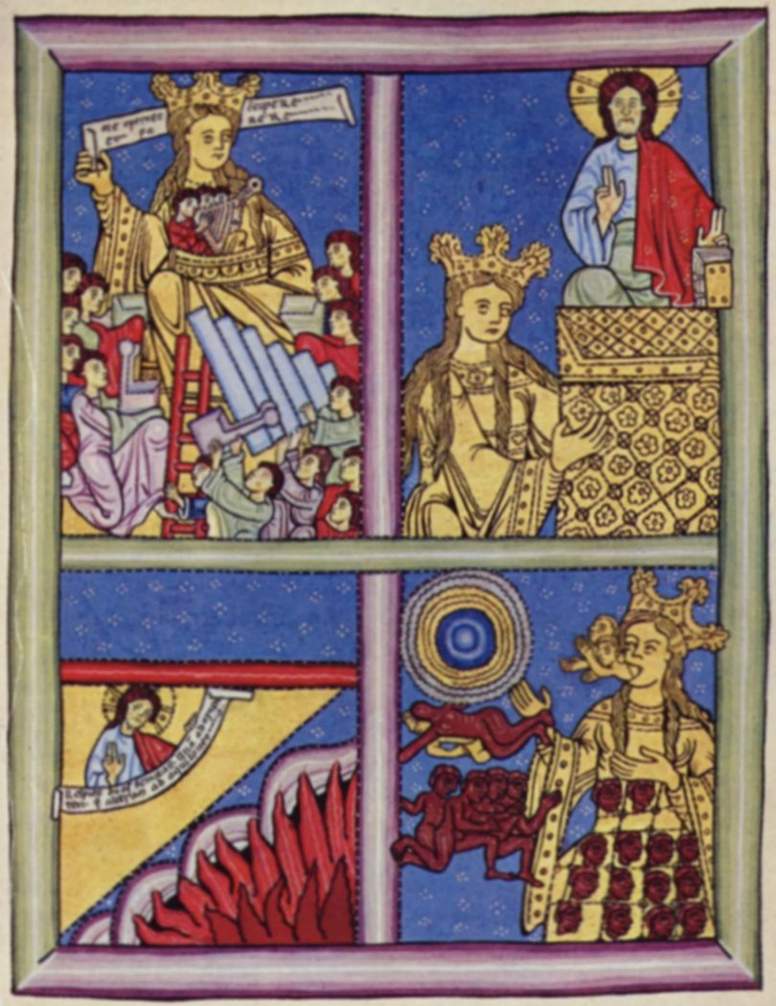
Jung, Hildegard & Beatus: 3 Bold Visions

"The Holy Grail of the Unconscious" Sara Corbett 9-20-09 New York Times Magazine. Click on image for higher resolution. I found out about this forthcoming "Liber Novus" of Carl Jung, which he inscribed and illustrated, ca. 1916-30 It reminded me of another Germanic artist, and a Spanish one: both from medieval times, but sharing vivid colors, bold graphics, and memorable craft. What do you think of their juxtaposition? I have better comparisons for Hildegard-related illustrations in my mind; I wish I could provide closer examples, but Web image variety's quite scanty. Visions stay elusive.


"The Dragon Gives His Power to the Beast" Beatus de Facundus (folio 191v). 1047, Spanish commentary on the Book of the Apocalypse. These illustrations inspired passages in Umberto Eco's great novel about medieval learning, "The Name of the Rose."


Hildegard of Bingen's been elevated practically to New Age Goddess rank the past twenty-five years, but she's a formidable defender of orthodoxy, even if she stood up to a pope. Her visions made her famous, if belatedly; so today her music. Her writings earned visualization as in this codex of her "Scivias.""Der mystische Leib." Meister des Hildegardis Codex Scivis: 1165, Germany.

Saturday, April 18, 2009

Bernardo Atxaga's "The Accordionist's Son": Book Review

This novel joins two Basque eras of conflict-- the Spanish Civil War and the ETA struggle-- by a triple narrative. Translated from Basque into first Spanish and then English, the tone seems diffused and distant. It's both evocative and muted, qualities that may or may not have been in the original Euskara.

Distance suffuses this story, told by Joseba about his childhood friend David. They both wind up in California, and David's premature death leads Joseba to translate David's self-published memoir into English for David's wife and children. Along the way, the novel includes its most gripping part, the centerpiece story "Obaba's First American," about Don Pedro, who hid Juan, David's uncle, from the Fascist forces who overran their Basque village. We learn later why David left the Basque country to come to his Central California ranch, and in the near present, why Joseba also left their native place of Obaba to stay with David's family.

In turn, the story shifts from the mid-1930s to the 1960s, when the Basque nationalists began to dare to take on the Franco dictatorship. We learn such crucially telling details as the prohibition of the Basque language even on gravestones, of the illegality of a Basque-Spanish dictionary, and of the suppression by the Church as well as the State following the defeat of those who opposed the Spanish rule after the Thirties. We also see the rebirth of resistance from the end of the Sixties onward.

However, the tales that David tells through Joseba ramble. Lots of characters and flirtations and relatives flit in and out, but few characters stand out. They blur together too much, amidst a surprisingly understated landscape. There's little of the memorable descriptions that would make the power of these events stick. It's all rather interesting, but sameness accumulates for long stretches. The tone's affable, but too much of David's growing up in a modernizing era lacks the freshness we'd expect.

I did appreciate the momentary nod to how language changes our perceptions: the peasants never talked about paranoia or neuroticism; they'd be happy or unhappy; similarly, the force of hearing "privitization" or "imperialism" for the first time in the countercultural undercurrent diminishes in time into tired cant. The feel of the novel is one of intense surges fizzling out over time's humdrum routine.

The best section, the "First American" part, proves the summit of Atxaga's skill. It moves with a vigor lacking in much of what surrounds it. Joseba very late seems to acknowledge the disparity between David's more stolid tellings and his own "improvements" in the framing device that holds down the central portions and links to the more fictional retellings (it gets a bit complex, no surprise given his previous novel of interlinked stories in a magic realist kaleidoscope, "Obabakoak").

I think that Joseba's coming-of-age story, so closely chronological with Atxaga's own date of birth, may have dragged the novel down into too many semi- autobiographical correspondences that may be more vivid in Euskara (or even Spanish) than in English. We get embedded transcriptions of the Basque within the story, as if explanations must interrupt the original, and these do push the reader away from the events a bit.

Atxaga through both tellers does, still, leap away from the more mundane recital in his reversion near the end to three "confessions" of three ETA-type (the affiliation appears to be deliberately muddled) comrades arrested by the Spanish for "terrorism." As in the "Deck of Cards" intermission, the dramatically and eloquently conveyed registers of Joseba's voice retell David's memories in a markedly more engrossing style. I understand what Atxaga in these moments breaks through three languages and three levels of discourse to show us, but it's a lot of effort for the reader to get to these moments of true literary power.

Yet, this may be Atxaga's hard-won lesson for readers used to less effort to capture the truth on the page that witnesses to the emotion felt by those for whom the Basque homeland was more than a place erased from the Spanish (or French) map. He helps us realize the intensity for which a few of his countrymen and women have for so long kept alive an utterly unique way of expression in a Europe that the Basque people have occupied longer than anyone else on the continent. For this exposure, it's worth the languors of much of the story. As in hiking up a dull scree to a dazzling vista on top of the mountain, one must put in the discipline for a glimpse at a culture so rarely seen, the chance to eavesdrop on the only surviving pre-Indo-European language and to see its words in print. This sight brings its own reward.

(Posted to Amazon US today. I use the British cover for readabilty; the American version is more artistic, but like the novel, too intricate to make out details from afar very easily!)

Tuesday, April 7, 2009

Jews, Arabs, Christians in Medieval Spain: Rémi Brague

Rémi Brague, a French historian, seeks to revise our notions of medieval thought, or what we mistakenly perceive as that era's lack of reason. His essays, "The Legend of the Middle Ages," explore philosophical intersections of Islamic, Jewish, and Christian pursuits of truth.

Adam Kirsch, in March 7, 2009's "NextBook," reviews Brague: "Medieval Times." Here, the reviewer sums up the scholar's take on how we look at science differently than they did. It's not that they did not study it, but that they studied it with an eye, literally, to seek another reason why to study natural phenomena.
For modern people, Brague suggests, physics—- broadly speaking, the study of the natural world and its laws—- can be intellectually engaging and aesthetically pleasing. But it is not “interesting” in the way it was to medieval thinkers, because we have lost the ability to see the natural world as a reflection of God and of ourselves.

The Jewish scholars of the time looked to the world as they did to the heavens. There was not the separation from the Creator that distinguishes for most moderns who enter the laboratory or the observatory today the walling off of God from matter.
To Maimonides, nature was the royal road to understanding God: “There is, moreover, no way to apprehend Him except it be through the things He has made; for they are indicative of His existence and of what ought to be believed about Him…It is therefore indispensable to consider all beings as they really are.” Gersonides, the 14th-century French Jewish thinker, went even further, writing that “Human happiness is achieved when a man knows reality as much as he can.”

Brague agrees that Gersonides sounds pretty modern himself with this admission. Modernity itself would not have emerged, the professor opines, without the tremendous push from the medievals who sought in Aristotle the summa of knowledge, next to the Prophet, for the Arabic translators in Spain who transferred Greek wisdom and ancient knowledge into their own language. Once carried over, the Greek could be discarded by the Arab: their sacred tongue then subsumed that of the infidel's vernacular.

Certainly, this differed from those Jews who learned Arabic to rescue, as it were, the Greek storehouse of Aristotelian science, or the Catholics who did the same by learning Hebrew to delve more deeply into the shared scholarship of their own times. Brague goes on to insist that the legacy of Aristotle we inherit comes from Arabic-speaking Jews and Christians who turned the texts into Latin for dissemination across Christian Europe. The Arabs, contrarily, held that once the Greeks had been rendered into the language of the Qur'an, that no more transmission was needed. Perfection had been attained in the tongue of the Prophet.

For the Jews, they bridged the divide opened in Spain by their expulsion from the southern part of Iberia by the Almohid dynasty in the twelfth century. The Spanish Jews fled north and brought with them fluency in Arabic and a knack for polyglot survival. The Christians learned what the Jews had learned from the Muslims, who had found what they wanted in Aristotle's Greek.

Kirsch sums up Brague on the contrasts between the relative openness of Jews and Christians towards their "pagan" inspirations and the rather more smug confidence of those in power and tenure, as it were, over Moorish Spain:
Brague quotes a 15th-century Tunisian writer to this effect: “[The Muslims] took them over into their own language from the non-Arab languages and surpassed the achievements of [the non-Arabs] in them. The manuscripts in the non-Arabic language were forgotten, abandoned, and scattered . . . . Thus students of the sciences . . . could dispense with all other languages, because they had been wiped out and there was no longer any interest in them.”

Europeans, on the other hand, tended to write commentaries on Greek authors, in which the original text was preserved and explicated line by line. The result was that Aristotle could be approached in his foreignness—he remained an “other” for medieval Europeans, and for that very reason could challenge their assumptions. For Brague, indeed, the noblest definition of Europe is that it is a culture which has always looked outside itself for guidance and inspiration: “The relationship with the exterior is internal to it.”

Although Kirsch does not expand on his closing point, I wonder if the commonplace observation of Islamic stagnation intellectually under centralized power and fear of unorthodox opinions that would run counter to the Qur'an can be traced back to such diasporic forces? These foreshadow, in their institutional arrogance and clerical domination, the dispersion of both the Jews and the last Muslims from Spain. That final conquest by Christians ended in 1492 with the great Sephardic scattering-- when some fleeing Jews found themselves back in Salonika, speaking of Greece, at the source again?

(A version of this posted to Amazon US today.)

Thursday, February 12, 2009

John Dos Passos' "Adventures of a Young Man": Book Review

This Lion Books pulp 1955 cover aside, this is not exactly a novel of "corrupt and bitter passions" of the libido, but rather of the liberal-- a boy from a middle-class background who wants to be one of the glorified proletariat, so as to further awareness in himself and the noble masses of the imperative to overthrow "the contradictions of capitalism." I was halfway through this story when the Depression rumbled in, reading about its coming the same day that our contemporary "stimulus bill" was passed to avert what nobody now wants to call another crash. Later, a Communist ideologue warns of fascism: "The state became in actual fact the executive committee of the ruling class," and I admit I wonder despite the party in power now if this has not happened after all, seventy years after the class wars of the 1930s. This made the novel's arc more relevant than I'd expected.

Since I liked Dos Passos' famed trilogy "U.S.A." and "Manhattan Transfer" (the latter reviewed by me on Amazon and here as well as "Three Soldiers" about WWI), and since I read last year both Virginia Spencer Carr and Townsend Ludington's massive biographies (I reviewed them too), I wanted to find out more about this fictional tale. Dos Passos retreats from his newsreel style into a conventional narrative. It moves rapidly, through "The Parental Bent" largely showing Glenn Spotswood's childhood and his try at agitprop while a counselor at a summer camp, to "Schooling and Youthful Errors," to "The Moment of Truth."

Trouble is there's nearly no mention of his schooling to get a sense of his formal education; Dos Passos wants instead to show Glenn learning life's lessons as a laborer in the Midwest and hanging out with Wobblies, then mixing with the Marxists of Greenwich Village, and finally organizing Mexican pecan shellers in East Texas. Dos Passos often captures the vernacular well, and continues his knack for the natural detail: "Outside the dim barn the sunlight fell dazzling like a blow on the back of the neck." (77)

Still, there's a detachment permeating Glenn's bildungsroman. He's an idealist, but when he takes up with the I.W.W. or the Reds it's with barely a ripple of explanation why. Dos Passos may hint that our allegiances come along with our chance conversations and our unpredictable acquaintances. You get more quick sketches of people than nuanced portraits. A few women come and go, Wheatly the Appalachian firebrand and Marice the flighty limousine liberal managing to stand out somewhat; the ladies here tend to be as predatory as the men. Episodic if epic, the chapters tend to rush into events and then settle into long debates before Glenn has to dash away again. Perhaps this reflects Glenn's own lack of insight, but there's a gap between the consciousness- raising and lack of character development that leaves this story of his adventures floating rather than racing.

This vacuum may be intentionally constructed. Dos Passos does write this straight after his disillusionment with Marxist dogmatism and its manipulation by Moscow as he had witnessed in Spain. The struggle between the Stalinists and the socialists and anarchists draws Glenn in as it had Dos Passos, and this concludes the book powerfully, recalling moments such as Sartre's later anti-fascist story "The Wall." The third section and the novel's second half, when Glenn organizes coal miners in Appalachia, and then fights against Communist doctrinaires here and in Spain, moves more energetically and ends dramatically.

Glenn encounters one leader: "Our function is to educate the American workingclass in revolutionary Marxism. We are not interested in the fates of individuals." (241) Glenn finds that the Party manipulates those it allows to be framed and jailed, if they happen to be in a union or to represent a cause that contradicts whatever "democratic centralism" the Soviet-loving servants dictate. Contrast this with Glenn: "parties and politics are built on hate." (267-68)

Glenn's pacifist dad (who lost his job at Columbia during WWI for his views) tells him, "there's a certain self-indulgence to extremism, which I am coming more and more to distrust." (130) A bit later, a local leftist lawyer reflects about a Mexican labor organizer: "called himself an anarchist, but he talked like an oldfashioned Jeffersonian democrat; funny how your attitude towards a man's political opinions depended on whether they had a nicesounding name or not." (150-1) It's not a novel of ideas, but neither does it immerse you into enough "passion."

Glenn comes of age but you do not identify totally with his inner turmoil; you watch it pass. This may in retrospect fit the disillusioned tone of the entire book; Glenn cares too much for people in all his awkward moral righteousness. You never get a firm grip on where he stands; he speaks to the masses but the speeches are never conveyed by the narrator. Before he volunteers to serve in Spain, he confides: "If you say the same words too often, you get so you don't believe them." (291)

This excerpt below shows the novel's style at its best. "Adventures" mixes a few tangy observations of Dos Passos' earlier mode with a calmer perspective that would characterize his later prose. You witness the characters as they come and go, but you sense the author's manipulation of them, as if he moves the camera eye past them. The system grinds folks down: this is doomed populism. This feature dominates Dos Passos' manner, and whether you find it illustrative or enervating depends on your predilection.

"He felt full of life. Noting with amused distant interest, as if out of somebody else's eyes, the streets, the dark storewindows, the faces of men slumped outside of flophouses, the drunk flopped like a dropped bananapeel on the sidewalk, the lively glare of uptown streets where young men and women were coming out of movies, buying papers at streetcorners, crowding into jazznoisy supperplaces past doormen in fancy uniforms opening the taxicab doors, looking carefully into drugstores and the big plateglass windows where the latest models of cars were on show, lit by trick lighting that glinted richly on chromium fittings, he walked on uptown with a richly swinging stride." (127; 1938 Harcourt first ed.)


This novel would be followed by "Number One" (1943) and "The Grand Design" (1949) to comprise what in 1952 was published as the "District of Columbia" trilogy, with Glenn's brother Tyler and the Spotswood family as major characters.

(Posted to Amazon today.)