Saturday, April 13, 2013

Feedtime: "The Aberrant Years": Music Review

Push your head inside an amplifier. Imagine Wire's lyrical minimalism and compression of song structure, crossed with an Australian underground's mutation of blues into punk. These four CDs collect the four Feedtime records on Aberrant Records, plus the expected odds and ends. In the latter half of the 1980s, I purchased their self-titled debut, Shovel, and Suction. These three studio recordings  wedged this Sydney trio into the same art-punk niche where my records by Wire and The Gun Club nestled between frequent plays. Feedtime did not capitalize their name, their albums, or song titles, but I defer to editorial convention--tellingly this band covered a poem by e.e. cummings on their Cooper-S tribute album along with songs by The Easybeats, The Rolling Stones, Lee Hazlewood, and The Beach Boys among others.

Yet, Feedtime did not sound exactly like any of these bands. This anthology (each album in a paper sleeve with original cover art, enhanced by Leon O'Regan's liner notes) improves upon the original albums, available back when I bought them via Rough Trade, with a simmering buzzing intensity. They already approached maximum if not R & B than blues-punk. Certainly raw, they reissued sound oddly spacious within unsettling digital clarity. Allen's frazzled bass, Rick's churning "electric slide guitar," and Tom's primal drums thud like their names: no nonsense, no added frills.

Feedtime takes the promise of punk and places it within an eager delight in full-frontal playing. Naked, it struts and swaggers. From the clubs and dives of Sydney, where this music did not meet apparently with universal acclaim from punters, it rises above the limits of punk by a sly craftsmanship that, as with the blues and art-rock, points back to quality tunes from earlier eras and doggedly unfashionable influences among the masses. You can hear why motorcycles appear on "I Wanna Ride," logically titled. With an album named after a car, this music begs for the open road, even if the engine of that British mini may be challenged by the endlessly open outback ahead.

There's a sly, shadowy variety within these recordings. When I played them on their original release, they loomed as monolithic slabs. The proverbial repeated listenings tease out, if not a lot of nuance, than texture. Some songs recall British art-punk of a few years earlier; the band started in 1979 and lasted a decade. I admit my affection for this era, so I forgive Feedtime any "homages" to their predecessors, beyond those covered on Cooper-S. They rethink their songs into a rapid shuffle, throwing off Wire's ratty, stiff put-downs by a sheer devotion to accelerated, terse melody.

As with Wire, Feedtime's arrangements open up subtly beneath ruffled vocals and arch lyrical shards. "In the supermarket, they're all dead crazy," goes a line that passes in "Dead Crazy," logically enough. This features a circling guitar behind a mix that shoves the other tracks ahead, into a awkward, but proudly wry, dance.

"F#" growls with its own Wire-like attitude; followed by "Clowns" which sounds sprightly by comparison, extending the British-inspired music of the late 1970s into a clunky, brawling jig. "Southside Johnny" shows off the plummet of a slide guitar over insistent plunge down into doom. The first album follows in this pattern. You can hear what Feedtime listens to, but you also note how they change their LP collection into their own answer to barroom cover bands and roadhouse blues.

"Shovel" opens that album with cleaner production that this version conveys impressively, but the second record sounds far from slick. It's less scratchy, just as with post-punk's progression. But, while that genre added keyboards, Feedtime opts for a heftier rhythm section, with, happily, even more slide guitar. Vocals aim for more howling and less growling. "Nobody's Fault But Mine" echoes in a funhouse turned horror show of bickering overdubs. "Dog" squares off between martial drums, a slip of guitar, and chiming bass. Fans of The Stooges may admire this stage of Feedtime. Their struggle between escape and release within a two minute song goes on for dozens of songs.

Sub Pop commendably delivers an anthology from a prime influence on their hometown heroes Mudhoney, and Feedtime's return to the shelves proves timely. Too much "alternative" music this current (as with last) decade feels retro in the tired sense of wearied expectations. Listen to these sixty-five (!) songs and you may rediscover what punk promised, and the blues, and primitive rock.

The covers on Cooper-S don't differ much from one another. It's amusing to hear "h.d." by e.e. cummings pressed up aside "Fun, Fun, Fun" or "Play With Fire," as if Big Black met Galaxie 500 in terms of literary preferences sidling up to deconstructive takes on classic rock. The generous amount of songs here in a similar, abrasive mood slows down an already heavy sounding band. The best combination remains the droning assaults on "We've Gotta Get Out of This Place" and "Paint It Black," the latter nearly unrecognizable except for its common note of plaintive dread.

Within a couple of minutes per song, Feedtime did what they needed to do. A few edge on Shovel and Cooper-S into post-punk in its theatrical, lumbering moments, but as all of Feedtime's songs are so short, these pass as rapidly as should-be hits such as the opener of Suction, the final album. The ditty "Motorbike Girl" feels as if "recorded" by Steve Albini in its dry pep. "Meter" bites off its words and radio chatter hisses. "I think there's been a total mistake" mumbles a voice as "Social Suction" opens into an anthem recalling the best of Commonwealth punk ten years before. Voices strain, tempos explore blues, punk, and rock in ways that surpass earlier albums in depth and scope.

Perhaps the Jesus and Mary Chain were competitors, by then, resurrecting the mid-1960s for a pre-grunge generation, but Feedtime in its last recorded incarnation hammers home its mournful squalls. Shuffles slide into shoves. Suction feels sucked out of its fetid, mucky depth, left in the antipodean sun to die, squealing and dessicated. That's a guarded, but honest, recommendation.

Hearing so many intricate, smart, but densely played songs at once may, despite brevity, in quantity lead to sonic overload. For any newcomers, from my intense experience to Feedtime even if spaced out over a subgenre's quarter-century, I advise limited exposure to build up tolerance over four discs.

This assertive yet diffident roots-punk music may not please many, but a discerning few will be pleased. The confidence Feedtime exudes comes from determination to create songs they loved. They combined art with intuition, craft with inspiration. This talent cannot be faked.

(Without italicized portion, to PopMatters 3-23-12. Reduced and simplified, to Amazon US 3-13-12)

Thursday, April 11, 2013

Russ Bestley and Alex Ogg's "The Art of Punk": Book Review

Nine hundred images, mostly record sleeves from recalled or forgotten bands, illustrate this large-format presentation of the evolution, rise, and dominance of the punk aesthetic over the past forty-odd years. Russ Bestley and Alex Ogg contribute a deft introduction, short topical essays and captions. Interviews with familiar pioneers such as John Holmstrom, Jamie Reid, and Malcolm Garrett enrich the contents, along with lesser-known designers like LukTam89: this typifies the broader chronological and geographical scope that this edition emphasizes.

This range, from the counterculture of the early 1970s to the globalized anarchists and D.I.Y. provocateurs who continue the anti-corporate ideology far from the Broadway adaptation of Green Day's American Idiot or the shelves at the Hot Topic franchise, exemplifies the reach of a movement tired of the mainstream. But, it's a movement very eager, in many cases past and present, to court mass acceptance as well as media outrage, manufactured more often than genuine. Bestley and Ogg begin by covering terrain already trod by contributors to the interviews in Jon Savage's England's Dreaming {Tapes} and John Robb's Punk Rock: An Oral History. The analysis here fits into what has emerged as the conventional narrative. However, it expands the usual Malcolm McLaren-Vivienne Westwood-Situationists-Sex Pistols-Kings Road Chelsea chronology as it continues. 

Ogg and Bestley define punk's "visual legacy" by its "graphic codes--symbols of struggle and resistance, but also a complex subcultural visual vocabulary and, more cynically, a means to tap into deeply held anti-authoritarian sentiments by lifestyle branders": this combination, they argue, resonates today. The resulting study offers valuable texts to frame the images. Posters and photos intersperse with sleeves for more singles and fewer albums, representing the bulk of the product. 

This can prove as uneven as the sounds themselves these bands recorded. The authors mention the typographic pattern on the reverse of the Buzzcocks' seminal Spiral Scratch EP but do not include it. They note how The Undertones' single "Jimmy, Jimmy" incorporated a transparent sleeve, but they leave it off of a full page filled with colored vinyl that failed to be as innovative. They applaud the work of Raymond Pettibon for SST Records but this gains far less page space than that of Winston Smith's concurrent contributions for the Alternative Tentacles label. A welcome nod later to the adaptation of the aesthetic to current styles only whets the appetite for what should have been a long chapter on this under-examined aspect of punk's relevance, a subject demanding far more depth. A related subject, punk's interpretation by designers beyond the musical world, deserved elaboration.

With a large-scale format, the editors fumble some opportunities for the wisest use of a generous page layout. A poster for Poly Styrene of X-Ray Spex gains a big share of space arguably unnecessary to demonstrate its quickly and cheaply reproduced, and rapidly overused, incorporation of photocopied tones and harsh colors. On the other hand, Jamie Reid's soon-withdrawn appropriation of a tourist advertisement for the Pistols' "Holidays in the Sun" shrinks to insignificance. 

Yet, other sections succeed. Reid's clever parody (also soon withdrawn) of an American Express advertisement for the post-Johnny Rotten Sex Pistols' appropriately titled and conceived fiasco The Great Rock 'n' Roll Swindle benefits by a large scale reproduction. A glance at send-ups of punk by enterprising bands or conniving labels shows the double-edged predicament of making fun of the clowns. Peter Gravelle's outtakes from the photo session for the pie-smeared faces whimsically adorning the debut LP from The Damned reveal the humor inherent in punk. As the photographer observes appropriately, whipped cream optional: "You'd always get, out of five, maybe one good-looking kid, two that were average, one that was a bit geeky, and one you'd have to try to hide." 

The tension and opportunity inherent for The Damned and others who managed to survive the first surges of punk in the late 1970s revealed more chances for self-mockery, as well as self-promotion, whether or not McLaren stayed on as Svengali. Bestley and Ogg decipher New Wave well. Major labels, with the cash lacking for indies such as New Hormones who released Spiral Scratch or New Rose who put out The Damned's first singles, tried to imitate the product and the sounds and the look of punk, but marketed more widely, with arguably greater or lesser amounts of ambition or cynicism.

Colored vinyl, collectibles, limited editions, novelties: the majors gleefully sought to separate fans from their wallets. However, the often maligned New Wave boasted, as its name defined, an avant-garde pedigree from film and the intelligentsia; arguably preferable in some musicians' as well as some marketers' minds to a term associated more with male prison rape prior to John Holmstrom and Legs McNeil's caricatures and long-lived promotions for the Ramones. Ogg and Bestley allow Holmstrom the room to roam into his invention, thanks to the Presidential Seal and a visit to Washington D.C., of the most enduring of logos, that for the back-to-basics leather-jacketed NYC band which preceded the rise of the media-savvy Pistols. 

As with the lucrative deals given the Pistols and the merchandising rewards for the Ramones, the division between those who stayed true to an imagined punk purity and those who sold out to the New Wave blurs. The editors conclude about this A&R fueled "battle of the bands": "Like its hipper cousin post-punk, new wave has been retrofitted to suit a neat and precise historical framework, placing it more firmly within the corporate stereotype it initially set out to oppose." Their judgment serves as an applicable verdict for the visual and aesthetic energy of punk and its restive relations. (Amazon US 10-14-12; slightly altered for PopMatters 10-23-12)

Tuesday, April 9, 2013

Joe Beil's "Beyond the Music": Book Review

Interviewing an actress, bicyclist, Catholic Worker, chef, chocolatier, Cuban-American fan of Green Day, Fulbright Scholar working for Cambodia, a psychologist specializing in males, and lots of graphic designers, printers, and publishers, Joe Biel reveals the range of those who use the mechanisms of punk's self-motivated and communally based ethos to change our world by action. Biel, as a filmmaker and zine journalist, collates his conversations from 2008-2012 with over forty who try to make a difference. He introduces this collection with an analogy to "relentless dandelions." That is, tenacious "pioneer plants" dig in taproots deep to extract minerals below an exhausted topsoil, enrich their ground, host other creatures, and out of the darkness, nourish energy.

Aaron Smith, working for the venerable and often rabble-rousing Harper's, connects its radical tradition within the mainstream to his own efforts to parallel the capitalist system. Yet, decades after punk first burst out, after there is "a 'DIY' section in every chain bookstore across the country," he asks, what about its too-often "self-congratulatory impulse"? He elaborates: "The underlying assumption seems to be: If we form enough collectives, print enough stickers and get people reading zines, everything will be alright." Detect Smith's cautious tone and you will hear the theme of realism combined with the abundant idealism articulated by many in these discussions with editor Biel.

As punks age, the camaraderie and intensity which attracted them as teens to the movement shifts into a desire to branch off from the mosh-pit, the noisy clubs, and the relentless demands of life lived rough. You learn here how to assemble a light table from dumpster diving, and how police barricades can be dismantled for window frames when squatting. (While a sense of humor may be recommended, many in these pages--too closely typeset in a font difficult for greying readers like myself to easily navigate--appear quite serious. Perhaps the disproportionate amount of interviewees who left the East Coast and Midwest for the Bay Area and especially Portland stands to blame or credit.) However, as some here gave up living rough circa the Reagan Administration, many of their lessons reflect years of paying bills, needing healthcare, raising children, or learning how not to do everything for free to help a community which may expect too much from too few over the long haul.

Illustrator Matt Gauck raises the moral dilemma: "Is it more punk to steal from Whole Foods, buy food for cash from a supermarket, or use food stamps at your local co-op? I love questions like that, because I'm not sure about the answers, but it helps define where punk fits into the grander social scheme." Biel founded Cantankerous Titles as an offshoot of his Microcosm Publishing to push such challenges into the movement, and to address the DIY system's workings, which tend to be ignored by studies of punk emphasizing the music, the fashion, and the commodification of its sounds.

He highlights the spunk of the participants, and those who try to sustain workable solutions outside the mainstream. The problem, as the recent economic meltdown exposes, is the lack of viable, true, alternatives that can survive the capitalist crisis. Putting people before profit remains altruistic, rare, and fragile as a method to make a living in a harsh climate with frayed protection against disaster.

Anarchists typify one time-tested possibility. Ramsey Kanaan of first AK and now PM Press, Sparkplug underground comics distributor Dylan Williams, and successful mainstream (?) short story writer (and former guitarist for Hellbender) Wells Tower exemplify those able to continue careers. The NYC-based artist Fly, with her spirited if understandably weary tales of life lived rough on the Lower East Side, serves as a telling case study in the desire expended to carry on outside the typical trajectory, once launched by punk into the possibilities outside the expected path. Mark Andersen's concluding essay, with its reference to Jello Biafra's analogy of punk as a virus spread by intimate contact, demonstrates the force that pulls a boy out of 1977 small-town Montana into Positive Force DC, one of the first punk collectives.

Others may, to use a few of many examples: convert restaurant grease into vegetable oil for fossil-free fuel; co-found Dischord Records; star on Friday Night Lights; investigate political malfeasance on behalf of Pro Publica; start up not one but two enduring progressive publishers; edit zines; lobby for a skatepark in a barrio. That last example is from the neighborhood next to mine, showing how the punk-driven activism may well happen around the corner from where you read this.

Forging community spaces becomes crucial for many advocates. A bookstore, an alliance to fight sexual assault, a group therapy resource for non-profits, bio-energy, a radical d.j., or vegan dessert cookbooks show the ways in which better choices may enrich customers, clients, and consumers. Theories may attract some into these causes, but Biel stresses how action emanates from the grind, the discipline, and the motivation. These require commitment to a choice that makes the political slogans and catchy lyrics once shouted a more subtle, if no less compelling, call to transformation. (Amazon US 11-9-12 and to PopMatters 11-19-12)

Sunday, April 7, 2013

Stewart Dean Ebersole's "Barred for Life": Book Review


How "The Bars" signify not only Black Flag's relevance three decades after their career, but the impact of punk upon those who in this collection were usually far too young to have seen a gig makes this photographic and journalistic anthology compelling. As I was born the same year as Dez Cadena and Henry Rollins, and as I grew up watching this L.A. scene, I admit some surprise.

Everybody interviewed with the icon is younger (with one exception: Ron Spellman, a second-generation tattoo artist a few years older) than me--or therefore the famous Hank whose arms, torso, and back became ever more inked as his power as the band's longest-lasting singer dominated the band's image and presence. Why tattoos perch or crawl over the bodies of the hirsute or hairless hundreds in these pages portrayed, whereas earlier punks did not tend (as chronicler Stewart Dean Ebersole, Spellman, and Chuck Dukowski concur) to decorate themselves with so many or so "graphic" an array of body art remains more an observation than a consideration. Yet, the generational gap between those who come after the band who choose to don The Bars and those who heard the band in its heyday persists.

While I wish this aspect was explored more, this isn't a sociological treatise. It's an angular presentation that mingles Ebersole's own rambling memoir of life in Red Lion PA with his coming-of-age with the Flag. Interspersed are intelligent interviews with band members, Spellman, and photographer Glen E. Friedman. (Greg Ginn no longer talks to the press; Rollins talks to them but not here.) I share what Ebersole wrestles over: feeling that by the 1984 "My War" LP (if not the title track, which was punchier than most other tracks) the band's move away from hardcore to jazzier and sludgier textures did not do the ensemble justice. Ebersole returns to this over and over, and many who identify (as all tattooed do here) their favorite song, singer, and album by the band list "My War" often in both categories. The editor locates this pivotal point (before the band ended in '86; note the current revival on two tours by a version of Black Flag and one of Flag) as a very punk rock one.

That is, the band challenged its followers not to expect conformity, and undermined its own fan base. "Upon exiting, Black Flag seemed to kick down the temple." (255) They always tried to take charge. Friedman reminds readers how the band, under SST's aegis and Ginn's command, forged a collective identity itself at "The Church" and its relentless devotion to rehearsing and touring, and managing itself. While Ginn's brother, Raymond Pettibon, earns full credit for his design of their logo, I recall that its symbolism might have eluded those who first saw it on records and flyers (if not yet tattoos). The four black rectangles always remind me of a row of amps.
 

The band's name evokes for me--as Chuck Dukowski reminiscences--the bug spray slogan "Kills Ants on contact" famously borrowed by the band in a Hollywood Blvd. counter-PR, anti-Adam stunt, and the popular insecticide of the era. The anarchic connection appears to have motivated Ginn to change the name of the group from Panic, coupled with his brother's icon as a memorable non-verbal logo and a rallying image of its vision. Ebersole finds that its lyrics (unlike the Dead Kennedys or I may add the Clash) have not dated as much for they were not paired to Reaganesque depredations. The deeper anarchic resonance may, however, intentionally or accidentally matter less to some who don the four staggered, as if pixillated, dramatic and stark black bars.

Billy Atwell sums this up (one of nearly four hundred wearers featured) as therefore pure hardcore. "They say something without saying something at all." (89) Ron Reyes reflects: "People don't get the cereal brand they eat in the morning tattooed on them." (125) So, what does this "secret handshake" register as? As I lack tattoos, and as Black Flag is a band I like with some songs but pass by with many more from that problematic later period, I approached this volume of those who had heard this music a decade or two after me--and often far from its home turf--with curiosity.

Scanning the testimonies from band members, Ebersole and his mates (his own tattoo is via a girlfriend's birthday gift), and those inked, the whole counterculture-as-commodity connection appears underexamined. (A couple of slips on pg. 276: Kira Roessler went not to "Yumi" but "Uni[versity]" H.S. near UCLA; so did Paul not "Bean" but "Beahm" aka Darby Crash.) Rightly, many who were in L.A. around '80 lament the turn to violence that kept such as me from the mosh pits as they grew increasingly full of the jocks who used to pummel the artsier and the lonelier who tended to comprise the first punks and the band themselves (not sure about Rollins, although certainly he was less pumped up when he joined...). Ebersole notes NYC scenesters featured more tattoos but that this faded with British bands and then earlier American ones--only to return with Rollins and mid-80s hardcore. But I kept wondering if this ink-as-marker identification was less radical or subversive than its wearers often assumed. As with many features promoted by those who place themselves outside the norm, the norm tends to catch up, surround, and profit off of their promotion.

One encounter moved me. "Chaz" returns from Iraq after leaving part of his leg behind. At Walter Reed VA, he wakes from a coma and tries to get back together. He finds Henry Rollins as part of a USO tour standing there at bedside. Chaz tells him about his ambition, and he soon dons his Bars.

I am not sure how many have tattoos of the Bars on more inaccessible or intimate areas; the ratio of males to females here appears to balance that of those inked overall in American (and Canadian, British, and Continental) cultures where many get by as bartenders, skilled workers (or not workers!), artists, or creative or casual laborers a bit off the corporate or mainstream grids. I kept turning the pages--which mimic punk collage as you need to find your way around the text and images and odd juxtapositions--expecting to find a familiar face. While I did not, I saw people that I'd like to meet--an indication of Jared Castoldi and Ebersole's casual but approachable style behind the lens. (Amazon US 4-4-13;
PM Press site for title)

Friday, April 5, 2013

Bill Ash's "Under the Wire": Book Review

Growing up in Dallas when it still echoed from the Wild West, following the boxcars as a hobo during the Depression, Bill Ash prepared for far tougher times ahead. Rejected the first time he tried to cross the border to join the RAF in Canada, he beefed up (literally) on stew and bulked up enough to be accepted two weeks later. As the U.S. had not entered WWII, Ash had to renounce his citizenship, so eager he was to serve not the Crown itself but to fight the Nazis. That he did--in the skies over the Channel--before his beloved Spitfire plane crash-landed. After a series of brave French families and Resistance fighters harboring him, he found his door kicked in and himself a doomed prisoner. 

Tortured and sentenced to death by the Gestapo in Paris, he luckily was traded off to the Luftwaffe, who could benefit from him as a bargaining chip for their own downed pilots' welfare. Imprisoned in Stalag Luft III among other camps deeper inside the Reich, he used his skills learned from privation, hunger, isolation, and survival during hard times to endure solitary in the "Cooler"--before again he tries to escape--whether in Occupied France, Germany, Poland or Lithuania. 

I wondered for a while reading this what the prisoners of war had to bargain or bribe with, to get information from the guards. Their Red Cross packets with chocolate and cigarettes did the trick. The details of how prison life led to socialism and liberation promoted as such enlisted men soon turned out Churchill after the war in Britain gains insight; one can only wonder how Ash and officers might have fared if they were not officers, who did not have to work, and so found time for reading, writing, and escaping. 

There's not the sentimental tales of how the Germans were just like us etc., however. You get a few notices of decency on the other side, if mainly when the forced march drives them all out of their last camp as the Russians close in. The chaos of the end of the Reich reverberates in Ash's telling. It's a spare story, as Ash possesses an inherent loyalty to oppose abuse--his torment under the Gestapo sobers him. Meanwhile, he'll take chances to keep sane, as when he scrambles into a huddle near a guard's site, as that man listens on the radio to the same Bach and Beethoven which have comforted Ash often.

Certainly, the inherent drama in Ash and comrades' constant, instinctive "resistance" to the Axis impels their drive to escape and the thrust of this unprepossessing narrative. The tension of being beneath the dirt, the scraping into muck and sewage with a tin scoop attached to a bedframe stick in a two-foot square confinement where only one hand can reach into the absolute darkness, the sludge and grime, the brisk breath and a sight of light that signals a breakthrough beyond the camp: this all emerges in Ash's modest style. At the Polish camp of Schubin, Ash joins dramatic tunneling: the results of what he and 33 others met after they met fresh air on the other side of the fence is compelling. Back at Stalag Luft, he's in the cooler when others make their true-life Great Escape.

He tells his tale clearly, and energetically. Educated at the U. of Texas before the war, Ash possesses his learning quietly, preferring for a straightforward approach. Yet, this passage shows the eloquence he can attain: "Human beings are surrounded by a universe many sizes too big for them and the ability either to shout out in anger or to laugh in the face of chaos are the only truly noble options available to us. That shout, or that laughter, even in the black infinity of the universe is an absolutely new and pure thing filling the void and going on, echoing off among the nebula, with an entirely human significance."

This isn't my usual genre, but an offer from Brendan Foley, who contributes the forward, enticed me. I agree with a previous reviewer that a map or two would have helped; the snapshots add faces to some names. It can be rather breezy in tone despite the brutality: certainly officers were spared much of the pain of the war, as Ash notes, even as he tried to escape. 

Adding value to this re-issue on Kindle e-book is the afterword; Ash follows up on those who helped or hindered him, from information gleaned when the book was published in hardcover. Foley and Ash join well to provide a compelling tale of how one man and his comrades felt so driven not to surrender, and to reject the meager security of life behind the barbed wire to rush towards free air. (Amazon US 4-3-13)

Wednesday, April 3, 2013

Nicholson Baker's "Human Smoke": Book Review

Without a preface, as if a dramatically told and chronologically arranged series of note cards, he spends nearly 500 pages laying out historical cards, from WWI to the end of 1941. They reveal a hard-hearted Hitler and many Nazi minions, naturally. Baker hears Kristallnacht applied "because the word 'crystal' simultaneously distracted from, and raised a toast to, the ferociousness of the rioting," as well as echoing Edward Bernays' Crystallizing Public Opinion, a favorite book for Goebbels' propaganda model. They also attest to a childish, conniving Churchill (no surprise to any who knowing the fate of the Irish sent over to deal with Winston as part of the British diplomatic team outwitting the republican raw recruits given the task of hashing out the Anglo-Irish Treaty of 1921-22) and a firm FDR opposed to doing much to allow many Jewish refugees in or out.

Rabbi Stephen Wise is quoted as preferring that Jews meet their fate in Germany rather than be resettled in Tanganyika, so tainted is that former German colony; pacifist Gandhi opposes Zionism as counter-productive to Arab interests and as sustaining poorly implemented British colonial aims; American Quakers travel in vain to Goebbels to try to talk him out of intransigence; Huxley insists: "An evil act always produces further evil acts." (61) In the context of mass aerial bombardments carried out in Yemen by Britain and Italy in Ethiopia, his Peace Pledge Union rejects "collective security" to threaten dictators with violence. He opposes war totally. Yet, presciently, Huxley confronts the logical difficulty of dealing rationally with a mad dictator, or one so Machiavellian that total war looks a better gamble than submission to foreign governments. Milton Mayer muses that Hitler menaces America in 1939 "not because he won the last war, but because he lost it." (150)

While one may argue Baker arranges his notes to advance only his side of the argument, he does take pains to include outrages from both sides. This itself, for those of us used to a tilt given our own national involvement, can be unsettling and may not convince those who may rightly claim the Axis and fascism is far more culpable. But, I read this presentation as determined to address the Allied rush to war and its refusal to negotiate, unpalatable or uneven as this direction may be for today's audiences. Baker advances the cause of retribution as the fault of all involved, who get caught up in hate, revenge, and the lust for profit.

One advantage of this study is that Baker, as he says on its final page, reminds us of the Quaker pacifists and others opposed to war: "They failed, but they were right." An unpopular stance, as Jeannette Rankin, Montana representative and the first woman elected to Congress, demonstrated. Along with fifty colleagues she voted against the U.S. entry into WWI; alone, she did the same the day after "the day of infamy" nearly twenty-five years later.

Courageous opponents such as Himmler's Finnish masseur Felix Kersten, the German dean in Berlin the Rev. Bernhard Lichtenberg, and the Union Theological Seminary's Eight who were jailed a year and a day for refusing the call-up to the military merit mention. What Vera Brittain decried as the worst possible way to deal with Hitler, "reciprocal violence," rules as the British scrap for another fight, whether with France or with Germany, from Versailles on. The "merchants of death" fuel bombers dropping munitions on civilians. The Nazis blame the Jews for this.

Hitler's belligerence finds its match with Churchill's petulance. He shuts off food relief to Poland, enforces a blockade against supplies to the lands Hitler has conquered, and he pushes RAF attacks on cities, vowing to terrorize a term he revives, the Huns. He laments to DeGaulle the delay in the German attacks against Canterbury, Oxford, and Coventry, hoping they will draw the U.S. into the war. When Coventry is about to be bombed, English intelligence intercepts the Nazi transmission. Yet, hours ahead, no warnings are called in to the city. "Winston Churchill asked for heavy publicity to be given to the Coventry raid. He did not visit." (254)

The steady slide into patriotic cant, falsehoods phrased as truths by ministries and politicians,  conscription by the U.S. for the first time other than when at war, jailing of draft resisters follows. Baker cites Hitler on January 30, 1941, vowing to fulfill his "prewar threat: If international Jewry pushed Germany into a world war, the Jews would be finished in Europe." (283) Roosevelt, eager for any "incident" justifying entry to back Britain, is revealed as an impatient ally itching for a scrap. Churchill, as seen by Australian P.M. Robert Menzies, falls victim to his knack for the "glittering phrase" that compels Churchill to believe his boasts.

Baker shows how the RAF, soon under "Bomber Harris" would continue its remorseless retaliation as retribution (these three terms appear over and over in his sources by late summer of 1941). "The bombing offensive fed Hitler's wrath, in direct connection with his concept of the 'Jew's war' against him, and helped unite his nation behind him and justify further Nazi atrocities against the remaining Jews." (qtd. 391) Historian Schlomo Aronson's assertion supports Baker's cause and effect. Churchill's bellicosity and his courting of FDR's lend-lease of weaponry to Britain implies that the Allies were partially responsible for the mayhem and backlash of the Shoah. This view inspired Baker's Harper's May 2011 essay "Why I Am a Pacifist," which continued the story after the end of 1941, and predictably sparked a firestorm of controversy. (Amazon US 3-25-13)

Monday, April 1, 2013

Pharaoh's hard heart

Commenting on my review last year of the "New American Haggadah," Matthew A. Levine asked c/o Amazon:
I just wonder about the version of the ten plagues that you mention, is the comparison to FDR, Truman, and Lincoln really applicable? Even though I personally don't believe that violent means are ever justified, at least, according to the official version of history, in these cases it was necessary to achieve a good end. According to the Passover story, the Pharaoh was ready to let the Jews go free, and then God "hardened his heart," so in this case liberation could have been achieved without any violence whatsoever. What was the point of that, and how can it possibly be morally justified?
This refers to my statement in the original review: "the Ten Plagues again by [Jeffrey] Goldberg find memorable comparisons. The power of a God who hardened the heart of the evil Pharaoh grows mysterious. Lincoln, FDR, and Truman all are shown as presidents who took the lives of many innocents in their determination to bring about a greater good. If emancipation ends or fascism succumbs, do the ends justify the means?"

I responded: "Matthew, that's precisely the type of question this Haggadah might inspire for a seder, or your own reflection. I recently re-read Nicholson Baker's 'Harper's' essay about the reaction to his own claims in 'Human Smoke' about the folly of violence even in WWII, and his remarks remind me of yours about the hardening of a heart, and how war might have done that to the Allied foes. Perhaps the collective authors strain for relevance and parts of this smack of appealing to a certain demographic, but if its contents can spark a question such as yours (and mine), it's worthwhile."

At the risk of ostracism as a wicked son (if without a Jewish father), this recent exchange stimulated my Pesach planning. My wife wondered if a seder could avoid a mention of "God," and given the spectrum of those attending this year spans secular to atheist, and skeptics with a healthy proportion of lawyers, I figured the timing was perfect for contemplating taking this on tour, if around my table.

(Update: it went well enough, given my own probable or inevitable lapse into professorial mode. After a viewing of the South Park episode, I didn't get into the WWII-Shoah context much which may have been just as well. The youngest son answered many questions from my older son's guest who did not know about the tale much. We skipped the Four Questions, but made up by our Maggid, the narrative we retold--I checked three guests' claim that Moses found out he was Hebrew from a garment shown him by sister Miriam. Not in Exodus; a charming but non-scriptural addition?)

My investigation--as a not-wicked but too-diligent son of my own has waylaid my (admittedly Reform, so perhaps while it may lean towards refuseniks even they may not agree with Baker's pacifism) Torah, detouring me from study of its gleanings--has led me to study Baker's Human Smoke: the Beginnings of World War II, the End of Civilization.  Levine acknowledged by his own glance at its Amazon raters (where my review at that link appears 3/25/13) a massive negative swell of criticism directed at it. I was dimly aware of it when it came out in 2007 but very attentive to "Why I Am a Pacifist" in Harper's for May 2011.

In the book, Baker cites Hitler on January 30, 1941, vowing to fulfill his "prewar threat: If international Jewry pushed Germany into a world war, the Jews would be finished in Europe." (283) Baker does not hold the Allies as free of culpability. The RAF, soon under "Bomber Harris," would continue its remorseless retaliation as retribution (these three terms appear over and over in his sources by late summer of 1941). The defiant British refused to negotiate and the more Hitler bombed their homeland, the more Churchill calculated FDR would send aid and be drawn into global war.

"The bombing offensive fed Hitler's wrath, in direct connection with his concept of the 'Jew's war' against him, and helped unite his nation behind him and justify further Nazi atrocities against the remaining Jews." (qtd. 391) Historian Schlomo Aaronson's assertion supports Baker's cause and effect. Churchill's bellicosity and desire for FDR's lend-lease of weaponry to Britain implies that the Allies were partially responsible by warlust of accelerating the mayhem and backlash of the Shoah.

Civilians displaced by carpet bombing were told the Jews were at fault, and German residences were appropriated by the Nazis who then sent their former occupants off to ghettos. This blame game, as American armaments intensified British raids on innocent Germans, may have hastened the Final Solution. U.S. entry spurred ever more destruction of the Jews, as they lost their hostage status as bargaining chips with the Allies. Death camps emerged, the first readied as it were the day after Pearl Harbor. Analyzing this escalation inspired Baker's Harper's May 2011 essay "Why I Am a Pacifist," which continued the story after the end of 1941, and predictably sparked a firestorm of controversy.

So far, reflecting on Pharaoh's tale, with little commentary--as a fundamentalist might advise-- Exodus makes me wonder about who's to blame. I can't avoid the mention of God, but he may share in the blame game, if not by venerable scholars; Biblical marginalia favor an Augustinian approach. That is, the Pharaoh could have chosen mercy, but he let himself act tough, as this fit a severe ruler in the Middle Eastern model and it showed all the more the comeback of the Hebrews against overwhelming odds and a Memphis home team's martial and mental advantage at Luxor Stadium.

In a 2011 Slate essay, "Sympathy for the Pharaoh," Michael David Lukas considers various rationales advanced by theologians and critics. He notes: "Towards the beginning of the story, Pharaoh hardens his own heart (or it "is hardened" in the passive voice). Following the sixth plague, however, Pharaoh seems to lose his nerve and God steps in, hardening his heart for him." While the likes of Martin Luther King and Erich Fromm aver that the hardening is due to Pharaoh's own defiance of compassion and his decision to use free will to defy Moses' appeal, Lukas reminds us that such apologists for justice and resistance to evil stay mute as to why God steps in to harden the heart that appeared to waver after the infliction upon the recalcitrant Egyptians of boils. (I confess this always impressed or repulsed me as particularly nasty, given my adolescent reaction to skin blemishes.)

My family's search for inspirational fare led to "Jewpacabra," aired March 14, 2012, episode 4, season 16. We join the action as Cartman's dream of being transported back to ancient times leads to why frogs are raining down, God's hand in this curious trajectory, and how that seems unfair to frogs. 

Kyle: It doesn't matter. Because God is going to harden the Pharaoh's heart!
Cartman: What does that mean?
Kyle: It means Jehovah is going to use his powers to keep the Pharaoh from letting us go.
Cartman: Well that doesn't seem very fair, Kyle. I mean, if God is going to make Pharaoh say no, then why would he punish him for saying no?

South Park's script is on to something, as satire snaps. A few minutes it devotes to the depiction of the plagues and Passover: here it hones in on this conundrum. Cartman continues to dream as P's son:

Cartman: Daaad, when's it gonna stop raining frogs?
Pharaoh: It'll be okay, my son. The weather will clear.
Cartman: But my friend Kyle, he says that the reason we've had all these plagues and stuff because you won't let all the Jews leave.
Pharaoh: [sighs] It's a complicated political issue, my son. An economic social issue that needs time. We can't let them leave, but is it really all that different from when the north didn't let the confederate states leave the USA?
Cartman: Wow, that makes sense. Don't think anyone can deny that. [a bloody frog lands over the edge]
Pharaoh: Poor frogs. I feel so badly for them.
Cartman: But dad, my friend Kyle says that if we don't do whatever the Hebrews want us to do, God is gonna kill little Egyptian boys.
Pharaoh: Hah, I don't think God would do such a thing, little one. No matter what happens, we can't let ourselves believe in the Hebrew version of God. We believe in a just Lord who would never murder innocent children.
Cartman: I love you, dad.
Pharaoh: And I love you son. And our love grows.

Speaking of dad, I've mused at DeMille-epic length about my own college-age antiwar stance four years ago at Pax Christi-Passover; the elevation of a pope named Francis may align with this spring's paschal ritual. In that 2009 entry, I raised many of recollections as a child hearing my dad remark "nobody ever wins a war; there are only losers" and my own naming after my mom's only brother dead on the shores of 1944 Saipan lingered. Raised with Vietnam footage on network t.v., I recalled to Niall the "Welcome Home POWs" bracelets worn by my hippie-spawned grade-school classmates from the far more liberal side of town. I credit as an teen my own surprised encounters via Thomas Merton's autobiography and J.F. Powers' incarceration to learn that Catholic Workers and pacifists during even the "good war" and the "greatest generation" existed as fellow communicants next to my presumably unaware mom and dad as they worked day and night in factories for the "war effort."

No, they were no saints, no Franciscans jailed as Fr. Louis Vitale has been (see "Pax Christi"). During the days of the Evil Empire and the contras, I showed my dad an article by L.A.'s Cardinal Timothy Manning decrying the "culture of war" and our local "defense industry." My dad and mom had worked at such factories (as did Layne's--both our dads were turned down for induction due to punctured eardrum and stuttering respectively); my machine shop, further-deafened by tool-and-die, dad looked the prelate's op-ed over with a glance and almost sneered: the Cardinal never had to worry about how his bills were to be paid or where his next meal was coming from.

Yes, I have seen the numbers cut into the arms of the elderly; Leo and I heard Dario Gabbai tell of his fate as a sonderkommando fueling the furnaces of Auschwitz. The more I study Irish republicanism over decades, the more attentive I am to what I didn't notice once upon a time: the perpetuation of "whataboutery." What about Hitler, what about the Battle of the Boyne, what about the Irish Civil War after the one that tried to gain independence, but left in the wake of a cleverly phrased and jerry-rigged treaty dividing the Free State a legacy of bitterness for generations. Baker's allies would insist any treaty brokered ought to be preferable to more death. It's hard not to disagree, despite my clan sympathies. I remain cognizant of perhaps cognitive dissonance here, but I state my case nonetheless.

Teaching PTSD vets, kids with plates in their backs and pins in their knees, wives with babies to care for while their husbands are off in Afghanistan, students called up for reserves, active duty, or desert training in the middle of a term; survivors of firefights in Fallouja who went three months without bathing in over a hundred lbs. of cloth and gear in 140-degrees: what some must undergo to qualify for an education on a GI Bill. I despise a nation and a mindset which rewards only those who may have risked their life and their sanity to cull a few thousand dollars for improving their livelihood and their mentality. I'm not naive enough to acknowledge my own desires lurk for revenge or reprisal; my Fenian blood can run deep. Yet, my maturity demands that I seek and support calmer ways to redress wrongs and right injustices. As Einstein challenged in 1930: "If only 2 percent of the men liable for war service were to refuse, there would not be enough jails in the world to take care of them." (23)

Sunday, March 31, 2013

Beirt Cháisc 2013/5773

Tá Cáisc inniu. Nach bhfuil muid a ceiliúradh a dhéanamh air anseo, go fírinne. Ar ndóigh, is maith linn chun feacháint ar scannáin faoi an séasúr seo.

Ní feidir liom a bhréatnaigh na tsraid ar an Chaineal Stair faoi An Bíobla.  Tá mé ag muintir cúrsa "Reiligiún Comparádeacha" anois. Mar sin, cheap mé gur chóir go mbeadh liom a fheicéail é.

Mar sin féin, d'fhoghlaim mé faoi Cháisc na nGiúdach. Rinne ár teaghlach "seder" ag ar an n-teach ar feadh an tseachtaine seo caite. Thug muid a chuir ár chairde ar chéile.

Pléigh muid go léir an sceal anallach. Mhín mo mhac is oige Eaxodus. Ith mo mhac is sine matzah.

Gach mo shaol, tá suim agam leis an Bíobla. Mar sin, tá mé ag mealladh chuig an ábhar seo. Bain sult as agam díospóireachta é freisin.

A pair of Easters 2013/5773.

It's Easter today. We don't celebrate it here, truthfully. Of course, we like to watch films about this season.

I can't watch the series on the History Channel about the bible. I'm teaching a "Comparative Religions" course now. Therefore, I thought I might see it.

Nevertheless, I learned about "the Paschal feast of the Jews" (no word in Irish for Passover!). Our family made a seder at the house during the past week. We invited friends together.

We discussed the ancient story. My younger son explained Exodus. My older son ate matzah.

All my life, I've had an interest in the bible. Therefore, I'm attracted to this material. I enjoy debating it too.

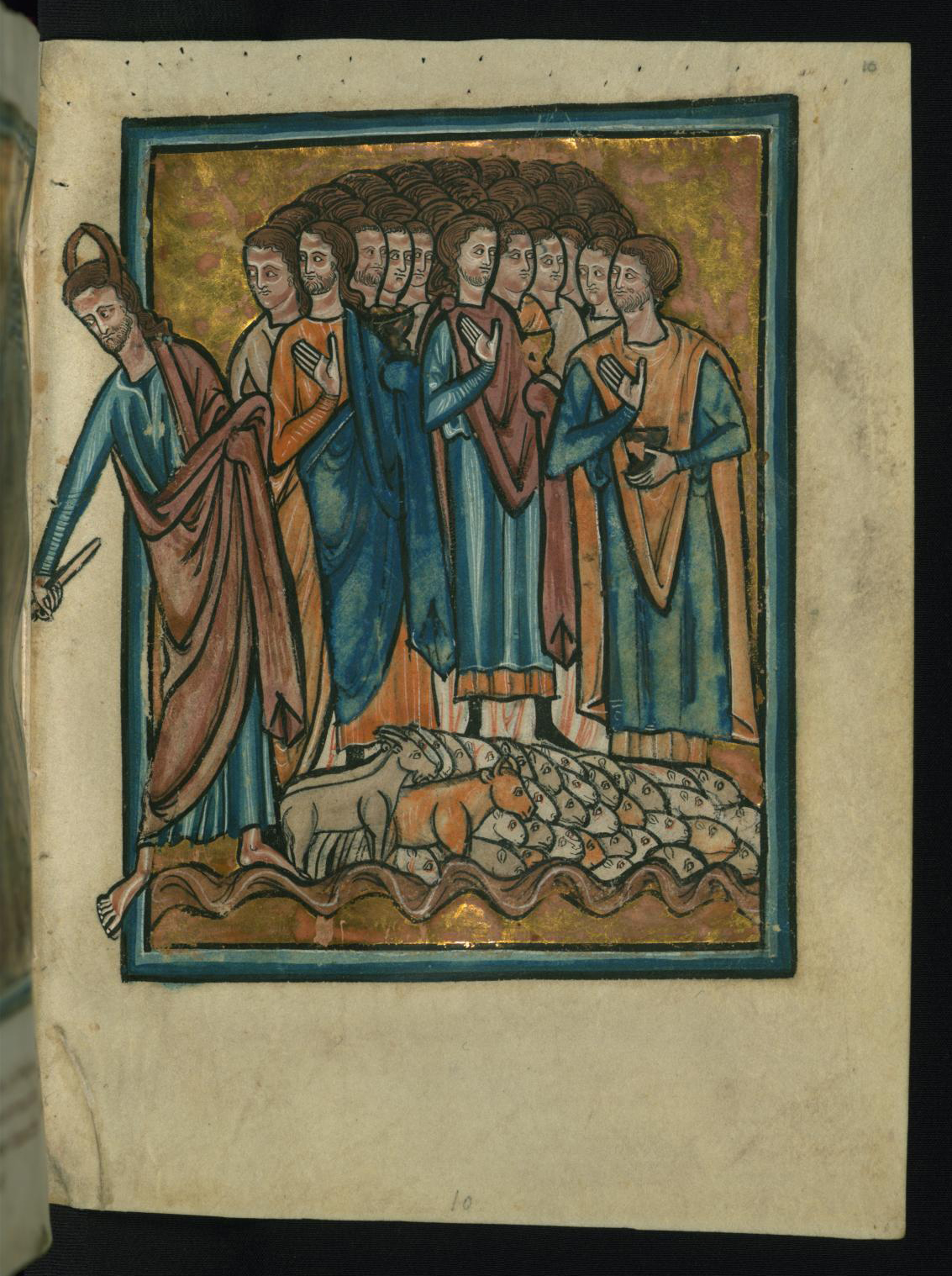
Íomhá/Image: William de Brailes: The Crossing of the Red Sea

Friday, March 29, 2013

Malachi O'Doherty's "Iscariot": E-Book Review

This Belfast journalist's previous non-fiction combines memoir and cultural and political observation well. The Trouble With Guns astutely analyzed the Provisional IRA's machinations within the Northern power structures; The Telling Year: 1972 examined the tension as he reported for the press that dramatic year about his own neighborhood; I Was a Teenaged Catholic juxtaposed his Catholic upbringing with his stint under a Hindu guru in hippie-era India; Empty Pulpits treated the retreat from mainstream Catholic dominance over much of the island this past generation. I liked each one (see my 2009 reviews on this blog or Amazon British and/or US).

It's intriguing to trace similar tension within an earlier, far more mythologized time and place: Palestine under Roman occupation in the company of Yeshua. He's "almost your double," as the narrator, Judas, tells his twelve-year-old friend, "Ben Joe," son of Yusef and Mary. Judas' own father is suspected, in the taut opening scene, of collaboration with the empire. His son, humiliated at fourteen, vows "to kill a Roman soldier." Judas by small steps--a dove, a dog, and then by mock practice with his pal--learns to take life with a knife. Certainly the shift from Ben Joe's assistance with Judas in "operations" against troops and his next encounter, watching his "double" debating Temple elders about the Book of Jonah, demonstrates a bold take on Scriptural piety. We also see the insistent resonance that widens dissension between the two youths. The puzzler that Ben Joe articulates, as Judas filters it: do you do nothing for yourself, or do you resist authority?

The combination of today's colloquial and off-color dialogue with biblical scenes enlivens this tale. Ben Joe argues that it's no crime for guerrillas to murder in the name of an oppressed people, however futile the revenge. They panic and divide the outwitted Romans--"soldiers just flailed among themselves, like a woman who has startled bees"--and stab "at close quarters" as if it's bear-baiting.

Cana's wedding, the Magdalene, the parable of the steward, and the resemblance between a pretend and a genuine preacher in Galilee complicate matters in unexpected non-Scriptural fashion. At sixteen, Ben Joe joins the zealots. The next section puts the narrator under the headstrong, wasteful command of brutal Barabbas. Pacifism meets with annihilation; the Temple rabbis counsel cooperation with the occupation. Godless Barabbas presents a compulsive alternative: more revenge.

Before murdering a man, Judas reflects: "You must either try to ignore his character or look for something in it to hate, or you will not be able to kill him."  He tells of how people expect to see what they do, as sudden death follows predictable course to provoke reprisal and worsen oppression. The pointless slaughter drives him away from the zealots.

The narrative shoves us into the baptism of the Nazarene at the Jordan by John; but confusion persists who that new preacher might be, for Judas. Yeshua's Sermon on the Mount and the loaves and fishes, however, signal a transformation. Hope arrives for Judas. He learns to put down his decade of burden. The Nazarene's sensible message is as brief and straightforward as himself, and he soon leaves the crowds for the desert.

Ben Joe, now cynical and cruel, awaits in Capernaum, where he sends out followers to do miracles and shake up the establishment, so as to further his own "authenticity." He presumes to speak for the spirit, while Yeshua restored it and taught one to listen to it. You can see how this will unfold: the preacher advocating gentle, personal transformation vs. the one defiantly rallying communal fervor against injustice. Judas must decide which Galilean to go with, and this entangles his fate once more.

Martha and Mary assist him, and they all learn of a popular preacher's arrival. The story of the "woman caught in adultery" takes a deft twist, as does that of the Samaritan, Lazarus, the Prodigal Son, and rejections of the Pharisees under a clever imperium always looking after its own interests. Back in Judas' hometown of Nazareth, complications ensue as Yeshua visits the Rabbi's home, sees Mary the mother of James, and preaches at the synagogue. "Yeshua might be a prophet, perhaps the only one to our generation, and yet mimicry and gossip had made him ridiculous." The twinned relationship skews the biblical saga; its tilted representation keeps the reader as off guard as Judas.

The novel then deepens the mystery of appeals to a wavering one's "better nature." O'Doherty's Judas filters the author's unease at subservience to another, no matter how eloquent the message or assured the medium. Yeshua confronts Peter: "Who do you think I am?" Suffice to say that the later stages of the conventional Gospel tropes of an angry and a composed, wonder-working or contemplative Jesus, a thieving Barabbas, and the conflicted narrator gain integration enriched by imagination.

The final third takes place in Jerusalem, at the Day of Atonement. Yom Kippur's autumnal timing doesn't align with the scriptural chronology naming Passover, but it allows O'Doherty to bring back the sisters and Lazarus at Bethany neatly, the cursing of the fig tree, and the entry by beast of burden into Jerusalem. It also helps him with the climactic rationale that Judas will confront. Driving out the traders from the holy precincts makes sense rearranged, as does the placement of the threat that a subversive preacher brings to the Roman citadel and Antipas and the power center of Jewish priests under Caiaphas. Parts in the home stretch, despite the natural excitement that accelerates as a fresh retelling keeps us wondering, did lag by comparison with O'Doherty's earlier revisions of the Gospel narratives. Lots of conversation slows this, as the author has to shuffle episodes around to move the logic along, and to connect characters who appeared earlier on with the action that adapts the Gospels. Admittedly, it's ambitious. Some characters felt too mustache-twiddling and backroom-conniving as villains, as the climax delays; energy lessens, explication grows. Still, you will read on, wondering how what we've long "known" of Judas' fate will square with this shape-shifting novel.

The kiss of Judas at Gethsemane earns pathos. The poignancy of the narrator's decision intersperses with the hardening of the heart. Contradictions within the Gospels, for O'Doherty's version, find commonsense solutions as he blends his fictional resolutions into those tales from the testaments--and those peddled by the apostles, Judas' "former friends." Wishing for an end, perhaps, may be salvation.

The matter-of-fact manner in which what's soon legendary starts as the mundane, mixed up by rumor by the credulous into the miraculous and manipulative, reminds me of the retellings of the Exodus and settlement of Canaan in Shulamith Hareven's trilogy Thirst (see my June 2012 review)."Iscariot" similarly reveals how it might have been, before sanctimony got the better of the secular struggles. (Kindle review to Amazon US 1-7-13)

Wednesday, March 27, 2013

Tim Robinson's "Connemara: A Little Gaelic Kingdom": Book Review

While the last published of this trilogy, Robinson tells us first off it's meant to be the second installment. It nestles into the southern Connemara coastline. Concluding this exhaustive investigation of this Irish-speaking (if increasingly threatened) enclave thirty-odd miles west of Galway city, this Cambridge-trained mathematician turned Connacht cartographer tracks down its traditional place names and wanders in the lore and the landscapes of these locales near his Roundstone residence the past thirty years. The Atlantic pounds these shores with only slightly less fury than on the Aran Islands, the chief of which marked his earlier map and two books in the 1970s and 1980s.

Now, nearing eighty, Robinson circles the last lap of his adopted home turf. He begins at Ros Muc, the "little Gaelic kingdom" envisioned by Patrick Pearse a century before, and looks at other writers, natives influenced by uneasy terrain, such as Pádraig Ó Conaire and Cáitlín Maude. Robinson deftly shows the tension in the former author's novels and the latter poet's terse, "tired" verse.

In "An Piarsach"'s adopted realm, Robinson finds "a glint of comedy" during Pearse's arrival. It's "not the last of the mutual misunderstandings between ruler and subjects of the little Gaelic kingdom-to-be, for the former came with an ideal of the latter that no one east of Tír na nÓg could ever have lived up to." (30) Robinson circles from where Pearse yearned to revive both a language and a nation.

The Irish language, despite Pearse's rural and urban ambitions, recedes a century later. Efforts by "An Ghluaiseacht," the civil rights movement of its speakers, led to TnG broadcasts from the Connacht heartland, but a better economy, massive tourism, and holiday homes endanger its "health" among an anglicized, globalized younger generation. One notable advantage Robinson possesses is not only his intellect and network of contacts, but his own (however English-accented) command of the local variant of Gaeilge. He reveals its rich store of placename lore by his access to overhearing or engaging in the local craic which would elude many visitors to this region, where Irish holds much behind closed doors that outsiders cannot eavesdrop upon or tease out from a signpost.

The twilit, sunset-oriented tone of this final volume, elegiac, suits the now-venerable author himself. Previous books on Aran and Connemara tended to become weighed down by eccentric tales of a Big House owner, eccentric blow-ins and misfits, and the flora and fauna often rendered in arguably necessary but at times typically overwhelming detail, given Robinson's Cambridge training and his combination of art and science. Mandelbrot's fractals, tectonics, kelp, middens: these fit into marine expanses and geological inheritances neatly. Still, he confesses after on such effort to figure out a derivation: "I have spent too much time trying to make these fragments cohere into significance." (155) Instead, he revels if soberly by "my walking of the tide-line between place and story." (169)

He intersperses bilingual renderings of songs and stories throughout, enriching the experience of the mentality and attitude of those who've come of age and endured, or emigrated from, these rugged contours. While fewer Big House or blow-ins (including one with a tragic tie to the Titanic who merits your own discovery) managed to endure its wastes and winds among islands and peninsulas of the jagged and blustering south coast, this narrative flows smoother than the preceding two studies.

His deft portrayals of Pádraic Ó Máille and Colm Ó Gaora during the Black and Tan War, or the sean-nós singers Joe Heaney and Sorcha Ní Ghuairim, resonate. Robinson finds common cause for a preservation of freedom and heritage among these eloquent natives raised around Mám's streams or on Iorras Aintheach, who found in now treeless plains, peat-stripped slopes, or barren shores a heap of lore akin to the seaweed dragged up and left to enrich the stony soil.

Around An Cheathrú Rua, at the studio home of painter Charles Lamb, Robinson observes the disjunction between what Lamb's student Walter Verling selects to paint and what's now evident. Neither telephone wires nor bungalow blight appears. "West of Ireland naturalism is reaching the end of a narrowing outlook. It will be driven into ever-greater selectivity, and so fall into undertruth by omission, unless it takes on modernity in all its ungainly contradictions." (297) Yet, he qualifies this as an exaggeration immediately.

Robinson, not given to hyperbole or even belief in what cannot be charted, remains sensitive to the damage done by developers, as South Connemara divides between locals courting industry and visitors wishing naturalism--but who also demand accommodations, diversions, and excursions. Still, he inveighs against a Tír an Fhía "ranting demagogue" who portrayed Robinson as wanting "Connemara emptied of its human inhabitants in favour of the landscape." (335) His depictions of Carna's desolate industrial estates and defunct Sisters of Mercy school or the massive new harbor at Ros a' Mhíl which funnels 300,000 ferry passengers to Aran each year will comfort none eager to find in Robinson confirmation of an artist's careful avoidance of contemporary impacts. He ties a phrase from T.S. Eliot to a rape-murder of a girl on a waste shore; he learns where holy wells and famine graves endure next to concrete estates and gabled sprawl: he sums up much in little. (Shorter, by a couple hundred words 3-23-13 to Slugger O'Toole. As above to Amazon US 3-27-13)

Monday, March 25, 2013

Tim Robinson's "Connemara: The Last Pool of Darkness": Book Review


Taking its subtitle from Wittgenstein, who stayed here in 1948, this second installment of a trilogy surveys the tip of Western Ireland as elegantly as Robinson's previous explorations of Aran. While the little map cannot display his cartographic expertise (some places are not included and you'll have to consult his Folded Landscapes fold-out chart or an Irish road atlas), his nimble prose and learned eye combine for a rewarding companion along these byways.

I've driven many of them, but stopped on too few. So, a resident of Roundstone since 1984 such as Yorkshire-transplant Tim Robinson, with his Irish-language expertise and his mathematically trained gaze, is ideal as a guide. This time, he takes you from Killary Harbour near Leenane under the Mayo border with Co. Galway to Slyne Head in the south-west of the Connemara coast. He keeps mainly along the coast. Whereas the first book, "Connemara: Listening to the Wind," felt sometimes despairing in its evocation of ecological frailty, this one despite its subtitle feels lighter.

Even if Robinson by now is of "gammy leg and bleary eye," this volume testifies to his perspective and endurance on so many lonely lanes and along the empty shores. The concrete fills some of this, and it's sad to read of the tourist industry's scars on the landscape, too often spoiled by ugly construction. Noting the stopping of the Clifden airport on the Marconi radio station's ruins on the bog, but admitting it goes in somewhere else inevitably, he laments the "death by a thousand cuts of the natural world, and a thinning of the human spirit" that we suffer by letting one more plot of land give way to concrete and asphalt. (176)

He sees the same "mental command" in the dominating spirit to acquire and diminish even in the Neolithic sacred stones erected in 1200 BCE. This "will to power," to lock down the landscape with monumental sightlines, resembles the Ordnance Survey of the British in the imperialist age. The soil began to be depleted by these ancient Bronze Age arrivals, and it began the bog that then swallowed up the stones, "not to be revealed again until our own exploitative, turf-cutting times." (130)

He writes well of what still dominates most of the Irish west. Whether the Rev. Alexander Dallas and the Famine-era attempts to convert the Catholic peasants to Protestantism, the impact of Marconi's radio transmitter in the light of quantum physics, coral and saint's legends, or the end of Kylemore Abbey, he gets you interested. Combining scholarship with energy, he teaches you in an enjoyable and thoughtful manner at what he himself has learned and marveled.

Like his other writings on Ireland, Robinson immerses you. Sometimes in the Connemara books it feels as if the goings on of the gentry and those who have moved here take precedence over the nameless families who have endured, and perhaps then emigrated, without acclaim or notoriety. I found the sections most engaging that dealt with nature or the Irish language place names, rather than chronicles or Big Houses, but this reflects my own bias. Robinson, to his credit, tries to stay more even-handed, a mediator between those like him who have come to settle here, but who by his Irish-language acquisition understands the hidden layers. Parts may slacken only by my own comparative lack of equal engagement with a chapter's topic, but not for long--the sights keep changing as does the weather, and it's no sign of any loss of control over his considerable erudition.

He reflects on juxtapositions of ourselves with the past, hidden as the Irish language names hint at a shallow legacy under the English-language culture that has swept the old tongue nearly away and with it most of its hard-pressed natives. (I note how many living here now do not live off the land, and how many of them as himself come to this place to enjoy its views, newcomers from another land.) He ponders the lesson of the ancient markers of white quartz torn open by a bulldozer today. "Ghosts and fairies are moods of one's feeling for the Earth; they wax and wane with our desires and delusions. The glimmer of white quartz, dim afterlife of its daytime brilliance, may persist throughout a long summer evening, but will succumb to the black rainy nights after Hallowe'en." (135)

Such metaphors show Robinson's power on the page. He adds a naturalist's knowledge and a folklorist's ear to his travel account, and he mingles history, song, politics, religious rivalries, and a steady focus on the human and ecological balance in this niche off the Atlantic. Recommended and if you have not read his visits to Aran as well, add those to your list as well. (Amazon US 2-9-13)

Saturday, March 23, 2013

Tim Robinson's "Connemara: Listening to the Wind": Book Review

Reading this a few years after his pair of Aran books, the density of detail and erudition applied to what appears a far larger realm than an island is not diminished by the widened perspective. This Cambridge-trained mathematician, cartographer, and artist applies his Irish-language acquisition to his adapted terrain, where's he lived in Roundstone since 1984. Around his new home, he explores its shores, the Twelve Pins, and the Maamturk mountains inland in the western portion.

He walks without textbooks, so as not to get too bogged down in detail, but surely he consults them, as this learned first installment of his trilogy--well-indexed and over four-hundred pages-- documents. He tries to "see things as they are when he's not there," as a naturalist. (26) He visits a Dead Man's Grave and finds in its name a fitting reminder of our shared fate. He enters a bog to revel in its monoculture, where biodiversity may be lacking, but where it holds intact its own simple treasure.

As in all his writings and maps, the attention to the Irish enlivens this in terrain from which the spoken language has faded along this patch of its western enclave. "Irish placenames dry out when anglicized, like twigs snapped off a tree." (81) In a "gargoyle-logic of creation," Robinson inserts our own small span, as we add years, distort, and then fall rigid ourselves in odd postures. Mortality infuses these eloquent pages, where Beckett's "skull in Connemara" (and I think since this of Martin McDonagh's plays) lingers in the fate of a Famine village of Rosroe. Graves speckle some boreens so much that in his map-making he gave up marking them. Such poetry and philosophy combined with archives and science deepens the fatal impacts of the abandoned.

This narrative is best read slowly and sparingly, for sometimes the amount of local history (he seems to enjoy telling the comings and goings of the titled and the eccentric, as often the incomers get the attention given their printed records of power or orally transmitted anecdotes of oddity that the anonymous dweller or nameless emigrant will never reclaim) or botanical precision can weary. I would have welcomed more follow-through on colonist Sir Richard Bingham's 1641 coverage of the land, the 1660s Survey & Distribution books, or Richard Martin's holdings, for instance; Robinson has published on the Martins separately, but sometimes he alludes in this volume too briefly to matters that only whet the curious appetite. And the map here, the same in the sequel (see my Feb. 2013 review of "Connemara: The Last Pool of Darkness") is far too small and sketchy. You will need Robinson's own maps of Connemara (and Aran) to fully enjoy his books.

Still, that gap shows a book that generates interest. Derryclare Wood's five thousand years in the making, the felled conifer plantation's disaster zone adjacent make for a telling symbol of Irish stewardship for a fragile ecosystem. But, a great joke about King Edward VII's visit to Recess in 1903, and a spirited encouragement on the Barony Bridge at Ballynahinch, restored after the War of Independence, sum up promise well. Young John Barlow hesitated to cross it; an army officer at the other end cheered him on. "Come on, little boy! This bridge was built for you!" (398) (Amazon US 2-14-13)

Thursday, March 21, 2013

John McNulty's "This Place on Third Avenue": Book Review

John McNulty is not as well known as his colleague at the 1940s' New Yorker, Joseph Mitchell. Both explored the seedy side of a now-vanished East Side, but McNulty, son of immigrants, got the mood down equally well: "He's Irish, so he broods," to paraphrase his summation of one bartender's quote at Costello's at Third Avenue around 42nd Street.

Both Mitchell and McNulty thrived on capturing the rhythms of the speaker on the streets, and for McNulty, especially at the bar. Mitchell chose McSorley's, Mitchell Costello's. They listened, one suspects, more than they themselves spoke, but their essays conveyed what they heard for us, decades on. As with an oral history, we read and the tales unfold.

The best are around WWII, as the stories arranged by his widow, Faith, demonstrate the entanglements of Grogan the Horseplayer, Clancy the gigolo, and various characters. One bartender, the night before he is called up to serve, lets out bitterly with well-aimed barbs after fifteen-odd years of silence at his feckless, boasting, sodden customers. One bickers in a great vignette with a barkeep over his attempt to hold back a barometer's little figure of a woman signalling calm and a little cardboard counterpart, a tiny man as a harbinger of storms: this approaches existentialism by what it says and what it suggests.

It's a small book, easily read in a night. It got off to a shaky start, as you can feel McNulty improving after he's hired by the magazine and begins to get down his own style, and his pacing--by the time the war comes, the pace arrives and McNulty finds his voice by channeling that of others--no easy feat. It must have been a challenge to do this, for him.

Faith's foreward places her husband in his own struggles with the bottle, his tenure at the magazine, and his haunting the place that made his reputation. The patter nears music in how accurately it sustains notes of the voices, when they leap out of the silence as each man contemplates "the mirror" of a face he may not recognize or want as his own.

Out of such encounters, McNulty skillfully, and subtly, limns the tension of life in mid-century Manhattan. The fashions, slang, and drinks may change--Costello's seems an early casualty of what later decades might call yuppification after it gained a reputation in McNulty's magazine, ironically--but the lessons remain. Decency, skulduggery, and a challenge to repeat truth rather than tall tales. One senses, after his wife's remarks, that McNulty himself gazed into the mirror many nights. (See also my Sept. 2012 review of Mitchell's anthology, Up in the Old Hotel . This McN to Amazon 10-23-12)

Tuesday, March 19, 2013

Joseph Mitchell's "Up in the Old Hotel": Book Review

Preparing for a stay near McSorley's Old Ale House, I read this over a weekend. It flows, as profiles and stories aimed at "The New Yorker" often do, very well. Joseph Mitchell combines his Piedmont North Carolina roots in the fiction included with his outsider-insider's knack at recording (perhaps with a bit of editing and improving, who knows it being the '40s) his fellow denizens of the Bowery, the fishing fleets, and the boardinghouses that once comprised so much of vanished Manhattan.

This nostalgic appeal feels even in the late '30s articles very strong. Mitchell records not only Joe Gould in two extended and slightly overlapping entries about this enigmatic fellow turned down-and-outer, but others as compelling if less annoying. The glimpses of McSorley's introduce the collection reprinted of that name, and among the twenty-odd selections, I liked the masterful manner in which the back-to-back social commentary of Mohawk high steel walkers and the tipsy beefsteak celebrants were introduced and sustained. There's much on gypsies, one of Mitchell's passions, as seen by the cops. Mazie of the theater district, Lady Olga of the beard, and the rather cruel trickster Santa Claus Smith all gain noteworthy starring roles. These earlier vignettes and profiles for me proved the most intriguing.

Stories follow, with an ear for the vernacular and a tone not dissimilar from his non-fiction observations. Some are set in the same environs as the essays, others in his native South. "Old Mr. Flood" offers three long looks at local fishing. I admit about zero interest in clams, but the skill of Mitchell's diligent attention makes you--as with John McPhee's geological studies in the magazine in later years--learn as you follow a chronicler of the hidden terrain underneath our eyes and noses. However, the increasing documentation with all things maritime once upon a time in New York City may not keep you reading every salty word as closely as the tales set on the sidewalk or the tenement do.

Finally, after much more of the same adding to the anthology titled "The Bottom of the Harbor," I confessed I was happy to find the title story "Up in the Old Hotel" with its peering into the dust of an abandoned ferry hotel above the Fulton Fish Market enticing, back to a landlubber's curious gaze upward. The article chasing down lore and legend about the giant rats on the waterfront may haunt you, to say the least.

Therefore, ending this with "Joe Gould's Secret" (given away in the paperback preface of this reprint edition by David Remnick) feels appropriate. The stages of interest, disgust, fascination and forgiveness play themselves out in Mitchell's hearing and telling deftly. And, the parallels to Mitchell's own career, in its second half, will also linger as a parable. (See also my review of his colleague at the magazine, John McNulty's The Place on Third Avenue, with similar tales from the same time at Costello's. This review of Mitchell 9/29/12 to Amazon US.)

Sunday, March 17, 2013

Fáilte romhat a Phadráigín


Cheannaigh muid seo nuair ag thiomaint ar bóthar mór "na Cúig" triu Califoirnea Lárnach le déanaí.  Bhí Léna dith a dhúnadh na doirse ghluaisteáin. Ansin, a rith muid comharta leis B-O-N-S-A-I i litreachaí buí óllmhor.

D'iarr sí orm má raibh ag iarraidh "Brathair Aistil" cara. D'aontaigh lei. Mar sin, stop muid go díreach trasna on Féirm Harris: tá sé leathbhealach idir Naomh Proinsias agus an Cathair na hÁingeal.

Dhíol garraíadóir Seapanais aois leis feásóg bán agus hata tuí mór.  Stád sé ansin faoi gaoth agus grian. Shiúl fear ag imeall crannaí bídeach agus álainn.

Thúg mé sé liom go suas Naomh Crios nuair chuir cuirt ár chairde Crois agus Bob. Rinne mé grianghraf ar feadh trathnona ó ár la deireadh ina coillte. Tú ábalta feicéail crann beag anseo--agus na crannaí ruadh agus is aird.

Ainmnithe mé air "Padráigín" mar beidh 17ú Márta go luath. Ar ndóigh, tá glas é fós. Ach, sílím go raibh páganách é níos mó.

Welcome to Paddy. 

We bought this while driving on "the 5" highway through Central California recently. Layne needed to close the doors of the car. Then, we passed a giant sign with B-O-N-S-A-I in giant yellow letters.

She asked me if  "Brother Juniper" wanted a friend. I agreed with her. Therefore, we stopped straight across from Harris Ranch: it's halfway between San Francisco and Los Angeles. 

An old Japanese man in a great straw hat and white beard sold it. He stood there in wind and sun. He walked among tiny and lovely little trees.

I took it with me to above Santa Cruz while visiting our friends Bob and Chris. I made this snapshot during the twilight of our last day in the forest. You can see a little tree here--and big tall redwoods.

I named him "Paddy" since it will be March 17th soon. Of course, he's green too. But, I think he's more pagan.