Friday, May 8, 2020

“The Intelligent Catholic’s Guide to John Waters.”

 john waters

“The Intelligent Catholic’s Guide to John Waters.” OnePeterFive 5/7/20

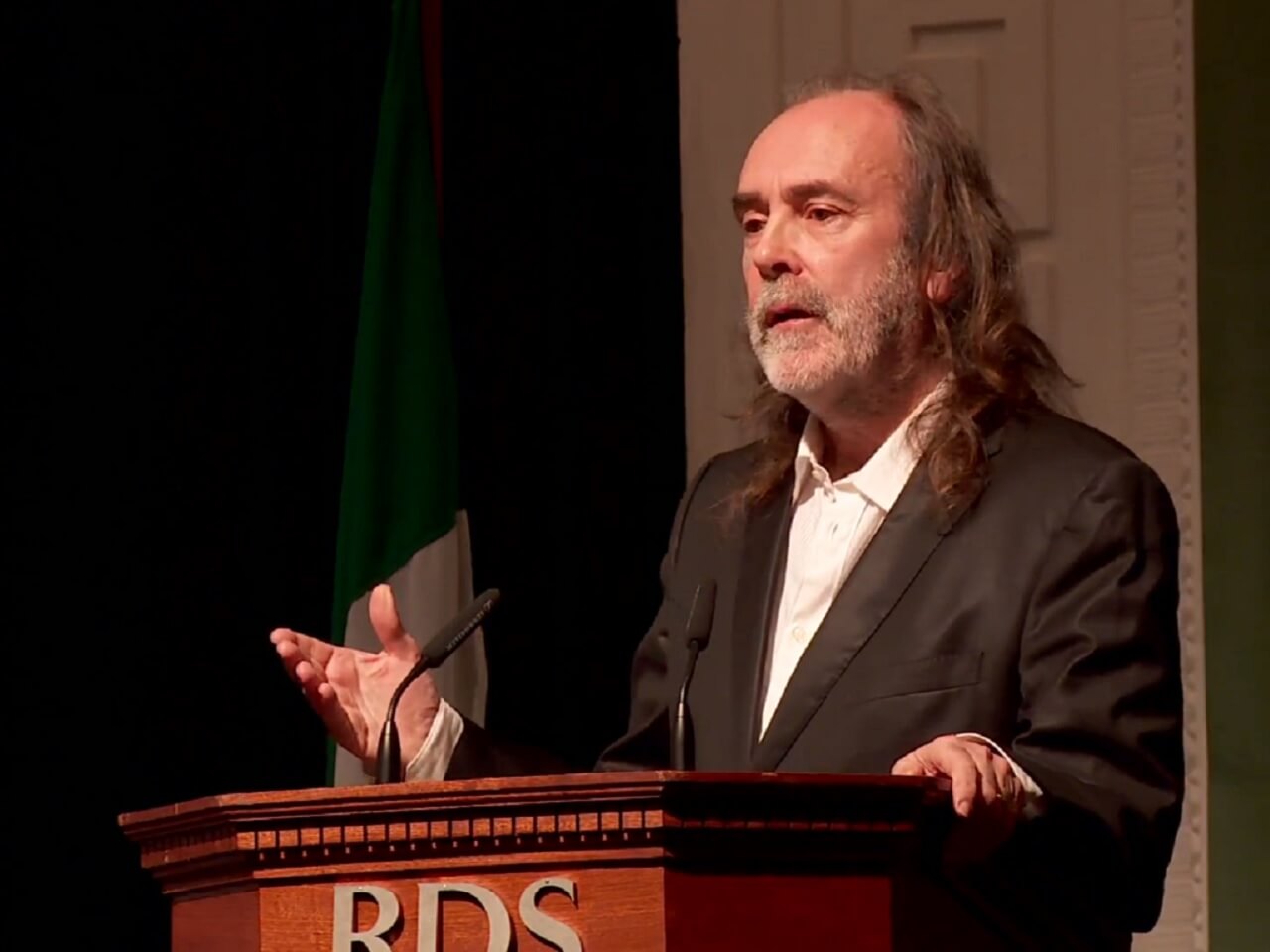
When a maverick journalist opposes popular opinion, at least as promoted by prominent media, what happens next? For rock critic turned cultural commentator John Waters, it's condemnation followed by self-imposed exile from Dublin's left-liberal, bien-pensant paper-of-record, The Irish Times.

This unrepentant dissident, not to be confused by Americans with Baltimore's cult icon and iconoclastic filmmaker, defends his patch of emerald turf against our new world order. Not (only) that of the Bushes, but of those who banish any trace of transcendence. As a longtime correspondent, Waters speaks for a “Peter Pan generation” who entered a dream-scape never glimpsed by their progenitors. Born in 1955, he and his peers from the 1960s through the 80s found themselves, boosted by a Celtic Tiger economic engine, “as foreigners working from home and emigrants in our own land.” They ushered in an “unassailable” secular agenda, rejecting Catholic, communal, rural-dominant mores once and for all.

John Waters continues his assault on post-Christian Ireland in Give Us Back the Bad Roads, his ninth book (2019). His first, a surprise bestseller Jiving at the Crossroads (1990) roughly coincided with his father's death. The period since both events unfolds in fits and starts, as the son addresses that humble mail-coach driver in a small town in Co. Roscommon, who taught him the value of manual labor and the trust in tradition. (As a relevant aside, to show how small Ireland’s networks of who-knows-who remain, my family at their farmhouse—now abandoned as all my relatives emigrated—would have gotten their post delivered by Waters and son, near the first village north of their own market-town.)

John’s career began covering music gigs for Hot Press, an upstart newspaper whose emergence proved well-timed with the punk explosion, hedonistic excess, and the demands of those raised in the wake of Vatican II to become not “the Pope’s children” addressed by John Paul II in his hyped 1979 tour, but a generation freed from clerical submission, censored expression, and class-bound economic stagnation. The results of this leap into liberation led not to freedom but to incarceration within a cunning and callow bureaucracy bent on enforcing standards of a politically-correct generation, his mates, and heirs.

This blow-back fuels Waters' longstanding determination in print and by his own interventions with similarly suffering fellow Irish families to defend the “blood link” of relationships, against referenda on “divorce-by-demand,” government intervention in the cause of “children's rights,” same-sex marriage, and legal abortion. Quixotic as this principled opposition remains in Ireland's Anglo-Americanized monoculture demolishing its customary “moral paradigm” that a younger, brash, “up from the country” Waters had volunteered to undermine, his mature self favors “common sense.” Although caricatured as a Catholic bigot by his former colleagues--“hired guns”-- and their “progressive” political-clerical cronies, Waters grounds his critique against the imposition of consumerism and corporate “rewards.”

These have obliterated his father's craft and his native town's legacy of community, sly solidarity, and respect for humble dignity. Waters witnesses the transition from his job as a railway clerk to those he and his eager counterparts sought as if Euro-topia at last, but winding up a “screen slave” or a “cubicle hostage.” The trajectory Waters has mapped in his seven intervening books gradually finds its aim. He tires of the distracted, profit-mad, sex-and-drug addled consumerism aided and abetted by his cohort.

Waters' focus, despite the repetitions (common as his many collections blending reporting, research, memoir, and cultural critique often resurrect his past and present predicaments as a prophet without honor in his homeland) sharpens. Returning to his paternal townland in a “strange collision of farmland and wilderness” overlooking Ben Bulben on the Atlantic shore (and Yeats' grave), John Waters watches turf “smoulder like Gabriel Byrne.” Bent on avoiding school on Monday, he had tried to “concentrate like Uri Geller until I conjured up a pain in my stomach.” Tellingly, Waters warns of what will transpire if the embattled “capacity to be human” gets trodden down by an Irish mob sworn to steamroller over the valuable contributions of a tradition rooted in centuries of hard-won verities rather than clogged with the media's “effluent and lies.” Waters imagines a lawn laid atop a yard of concrete: “it may briefly give the impression of health, but eventually, for obvious reason, it withers away.” Without a “consciousness of the absolute,” people will fail to nourish a mentality devoid of religion and dismissive of this venerable “public expression of the total dimension of human nature.”

Waters’ reversion to a measure of Catholic practice emerged gradually. He attended traditional Latin Mass services held at St. Kevin’s in Dublin, which were approved back in 2007. He concludes Lapsed Agnostic (2008), by documenting his growing attraction to the conservative, post-conciliar successor to Italy’s Catholic Action, Fr. Luigi Guissani’s Community and Liberation movement. Since early 2017, he contributes regularly to First Things. Last autumn, he was featured in E. Michael Jones’ Culture Wars. However, a careful parsing of John Waters’ writing presents his quest as one driven arguably far more by his own standards for uncompromising truth as any dogma. As he asks: what happens when a third generation in Ireland, and by extension, the formerly catechized realms across the world, matures with no exposure to the Faith? What follows for Ireland when the “don’ts” of Catholicism fade away?

These questions merit wise responses. Many who serve as leaders in the alternative Catholic media enter from other denominations, and, of course, perhaps none. Yet, intelligent and articulate insights from those left adrift in the last fifty-odd years, brought up in families still faithful, but who themselves fell away suddenly of slowly, often gain less vocal attention or press promotion. John Waters’ halting pilgrimage away from progressive piety might, thus, be guided well by an exchange from a once “center-left” Italian colleague in the Fourth Estate, Aldo Maria Valli (b. 1958), and composer-liturgist Aurelio Porfiri (b. 1968). Their narrative, translated last year as Uprooted: Dialogues in a Liquid Church, remains rather rare, as is that it's written by cradle Catholics too young to remember the Latin Mass as it was with any firm memories, but old enough to have undergone revised regimens post-1965.

It’s to be hoped that more thoughtful examinations of the effects of the counterculture on those now-aging Catholics who have grown apart from the Church in the experimentation and innovation may guide those who, having been raised in the pontificate of John Paul and his successors, seek solace. Not only aesthetic comfort, but, as Valli, Porfiri, and Waters concur, a way to survive amidst discontent and doubt. This demographic has been overshadowed, but it too deserves inclusion among the saving remnant. They had no recourse to clandestine TLM’s or conscientious objectors in the 1970s or 1980s.

Once recovered, after inner struggles against doubt and external battles against detractors, a reverence for the sacred, reduced among millions of cradle Catholics, lingers on. Here, Waters stands again, firm.

Headlines this past month in the Irish press reveal John Waters’ protests against a new shape-shifting foe. He and pro-life campaigner Gemma O’Doherty (another target of attack by the chattering classes) rally against COVID-19-related restrictions on public movement, in some circumstances only within a radius of two kilometers of home. Waters and O’Doherty sustain a long tradition of dissent against whatever draconian dictates they judge to come down from powers that be. Given both figures’ increasing outreach to audiences deemed beyond the pale of acceptable neo-liberal or state-socialist opinion, what transpires from their appeals to the marginalized and discontented in the Catholic circles mapped as “here lie monsters” as no-go territories will be worth watching as we continue into what the car commercials were the first to name “uncertain times,” as we ponder marks of beasts lurking ahead. 

P.S. at the site: OnePeterFive. {I was nearly at the maximum word count, so I did not get into the details of his past books, figuring that the space needed should be for introducing John Waters to a wider audience. But one of his earlier collections of essays (1997) was titled "An Intelligent Person's Guide to Modern Ireland," in turn riffing off of George Bernard Shaw's "An Intelligent Person's Guide to Socialism." In case anyone's wondering why I chose that odd and a bit verbose title.}

Friday, October 4, 2019

Patricia Applebaum's "St. Francis of America": Book Review

  St. Francis of America – How a Thirteenth-Century Friar Became America's Most Popular Saint | North Carolina Scholarship Online

St. Francis of America

How a Thirteenth-Century Friar Became America's Most Popular Saint

Patricia Appelbaum
  • Chapel Hill, NC: 
    The University of North Carolina Press. October 2015.
     288 pages $20.00.
     Hardcover. ISBN 9781469623740.
     For other formats: Link to Publisher's Website.

Review (for Reading Religion/American Academy of Religion)

Before the birdbaths, before the pet medals and the spurious sayings, Francis of Assisi stood for whatever first preoccupied Americans more than a century and a half ago. Devotees of the fine arts admired the challenges to convention by the little poor man. Rather than a refined scion, Francesco Bernardone represented a raw rebel. Today’s consumers at any gardening outlet may check him out, if reduced to a cast mold with a bar code. Both reactions to Francis remind patrons or shoppers of “what one lacks and perhaps longs for—a life free of possessions; a life that is not dominated by money or property or, in fact, consumerism (4). Religious historian Patricia Appelbaum thus introduces this well-researched and engagingly written survey of Francis’s crossover reception within a predominantly Protestant polity and now a secular, acquisitive culture. Appelbaum explains the Poverello’s enduring appeal.

Appelbaum encourages readers to widen their perceptions of her subject. She investigates how sainthood takes on or shunts aside meaning for those who do not include such a formal category in their faith or worldview. Assisi itself is elevated into a tourist site energized with an aura. The fact that Francis lived there allows seekers of any allegiance to identify with a defiant dropout who begged on medieval streets.

In nine chapters, Appelbaum surveys how Francis has been socially constructed. After placing his initial attraction within a revival of interest in Catholic aesthetics and Walter Rauschenbusch’s Social Gospel movement, she examines the impact of Paul Sabatier’s 1894 biography of Francis. The first account of Francis to reject hagiography, Sabatier’s archival effort resembled Ernest Ronan’s 1863 critical scrutiny of Christ. Appelbaum then situates this reforming impulse within the careers of Quaker Rufus Jones and socialist Vida Scudder. Their advocacy of Francis as a pacifist pioneer eased his acceptance by Progressive Era non-Catholics. These impacts sparked Catholic ripostes affirming the saint’s fidelity to the papacy and to Roman rulings.

The next section examines the era between world wars. The social activist side of Francis appealed to many, even as his advocacy of voluntary poverty hit close to home for most Americans during the Depression. The 1940s popularized the “peace prayer” erroneously credited to the saint. Meanwhile his statues spread throughout gardens across the country. Appelbaum grounds the birdbaths within a love of place. “Like the prayer, they could be private; like the hymn [‘All Creatures Great and Small’], they could be used in a small community.” This admiration set the sylvan scene for Earth Day in 1970 and the promotion of “the patron saint of ecology” (88). Postwar prosperity generated many versions of the odd man out from Assisi. Robert Lawson’s children’s tale Rabbit Hill and Bernard Malamud’s urban Jewish parable The Assistant gain in-depth analyses as they reveal narrative responses to the saint’s firm rejection of attachment to the things of this world. That such a reaction co-exists with Francis’s celebrated love of nature complicates his contemporary depictions.

Unfortunately, the hot pink and mustard yellow vibrancy of a San Francisco Summer of Love poster with an offbeat, mixed message from its municipal namesake to its hippie versus straight heirs is reproduced only in monochrome. But as with visuals throughout this study, it reveals Appelbaum’s range of references. About eighty pages document her fieldwork, list sources consulted, and include endnotes. These appendages combined with two indices enhance this book’s value. Any scholar of material Christianity or popular culture will find St. Francis of America a welcome resource.

The rise of the Jesus People and evangelicals who recast Francis as a hippie; the embrace of his spirit by environmentalists; the attempt to capture his charisma on film; and his conversion into “creation-centered spirituality” by post-Christian skeptics and New Age adherents typify recent trends. Shifts in American attitudes to Francis anticipate Appelbaum’s thoughtful inquiry into the “blessing of the animals” ritual across ecumenical or sectarian lines. Appelbaum edits replies to her 2013 questionnaire. She sifts testimony from over forty “living voices” about what Francis means personally and spiritually. These sensibilities expand into diverse contexts: Islam, postmodernism, and folklore. “Artist, poet, clown; traveler, camper, farmer; leper, street person, prisoner: the list goes on and on” (181). Sly guises illustrate disparate roles played in nine centuries of the odyssey of Francis from Assisi.

Date of Review: August 19, 2018
About the Author(s)/Editor(s)/Translator(s): 
Patricia Appelbaum is a historian and independent scholar of American religion.

Saturday, September 21, 2019

Virgin Time

File:John Everett Millais - Mariana - Google Art Project.jpg
The smoke alarm, set off by my wife's cooking something eggy in the oven as I slept, woke me. The aerator that opened last night's wine at the hands of son #2 for Shabbat dinner lay in shards, thanks to The Worst Cat in the World (TM). The birds outside clattered. So I lay in bed again, fifteen minutes, thinking about what half-an-hour later I'd type, why and how.

I'm no morning person. But I must rise early lately, due to teaching at nine one day a week. Given traffic to Irvine, over forty miles away, it takes me nearly 90 minutes, no matter when I leave near 6. If I leave later, count on two hours. As I must start at 9:30, and as I want to get some work done beforehand, lacking any space there but wherever I lay my bag down at a classroom PC before the fact, I attest to the life of a "freeway flyer" that nearly twenty-five years ago I thought I'd left behind when I landed a full-time (albeit "at will," no tenure-track being offered us faculty) gig. Now, due to precarity (all these new jobs, all of us working more than one of them to swell the boasts of whomever governs us), and unexpected worst-case scenarios due to duplicitous deceit of one among "protected" classes which earnest "progressives" romanticize and unscrupulous lawyers monetize in our blue-city-state oligarchy polis, our cash flow dwindles. We're back to both at two jobs now, and feeling it.

Pretty much where we started, thirty-0ne years ago, when we met, way before progeny. Which was about where we started, having met around this very week, or was it -end?

(I know. Looking over the last entry after I typed this one, I need to ease up kvetching. Be happy for what I have got, and kept, and found, or even lost and found. Seriously. No emoji.)

As I've intimated on this blog, the past few years I've had to cut back my true confessions. Due to a mash-up of reticence in an increasingly "outraged" sensibility bent on exposing any who dare to question the MSM and the thought police, and a pressing need to, well, grade papers, commute, and do all that teaching more students for the same pay (the post-recession's efficient production thanks to technological innovation, lowering "labor costs" and maximizing profit), something fun's got to give. I love reviewing books and music, but the lack of time and the brainpower needed to keep this endeavor going every other day put (un-) paid to my leisure-time hobby. I keep reading, but I tend to keep track on my Kindle of whatever I've checked out from the library or my own acquisitions, largely gleaned from what I can find and not buy, due to the lack of shelf space, the lack of discretionary income, and the lack of downtime to compile my wisdom for the ages. Whereas in the past, I used this blog and Amazon to keep track of my reading and notes, I now use highlights or files. Goodreads or library records can remind me of my bookish roaming, as A. does not promote any remarks I give them anymore unless it's under a "verified purchase," and those tally few.

So that means a lot of my intellectual and critical effort is off your screen. I've had to triage. Thus, the titular phrase of today, gleaned from three decades ago when a friend of a friend, a prof at USC, used it for his own time for writing before his real workday began. As a hyper-caffeinated New Yorker, of course, he was used to the grind, no matter where his career took him, L.A. or Copenhagen. I figure now that I have weaned myself, never that dependent anyhow, off tea for a boost in the morning (practically, as I may not have space enough to brew and sip before I dash), I rely on my own steam. However, my engine does not usually get in gear until nearer mid-day, if I am left to my night-owl aftermath. Yet I realize how, "burning daylight" as a Chicago exec turned Dakotan rancher chided us as we turned up near lunch, weary after traveling, to ask at his rental cabin where to drive in the Black Hills, I've been wasting away a lot of potential hours in the land of Nod. Ah, Irish Catholic guilt.

Therefore, keep looking back this way more. After all, I work every day now, hours on end. Students do not wait and administrators clock turnaround of grades, and how much I enrich  the "learning management systems" dominating my career. The days of autonomy behind closed doors on campus ended; a webcam records me. I cannot promise that the days I have to saddle up before dawn that I will be clattering away at my keyboard, but since dear friends (some of whom I have made by blogging and finding simpatico fellow-souls out in cyberia of similarly sensitive and intuitive compatibility), asked me if and when I'd begin churning out my fevered thoughts again, well, as at least some days I am blessedly at home, you may catch me here. Can't promise that I tell all, but keep an ear perked for craic go leor.

Photo: if you type in "virgin" + "time" at the Tate keyword search, this is all you get. John Everett Millais, "Mariana" (1851). If you turn off safe mode on a browser, you'll find more.

Friday, September 6, 2019

Peeping above the trench


How I Won the War Movie Review (1968) | Roger Ebert

I figure a year on, I'll keep my blog card raised tentatively. I've chosen for reasons of reticence and privacy to retreat from publicly proclaiming my every thought and opinion. Risks of generating "outrage" now imply this caution from many of us in less than secure employment (all those jobs created--nobody ever asks how many are side gigs, hustles or part-time work cobbled together or to supplement a precarious full-time position). Even if I had tenure somewhere, that does not guarantee safe passage across troubled SJW waters.

One of my most thoughtful charges observed the other day how 'we'd never have gotten to talk like this in a CalState class. We get to hear each other out, and while I suspect the prof's leanings, he never tilted us one way or the other. He always came up with a countering idea.'

This was praise indeed. That may be a perk of my predicament. Still, I proceed with caution. What used to be between four walls now has a recording angel or printer's devil, invisibly tuning in. The marvels of efficiency and increased productivity accrue, as do the human efforts assigned. Sure, I can teach from anywhere and so my students log in too in pajamas. But we still have only so many hours, and the days never expand to accommodate this pace.

More than one drudge I know in the muddy mire of academia at its basic level of labor rather than leisure as the primary mover has chosen survival tactics. The costs of censorship of ourselves presage Orwellian immanence when our mind is our only safe space. Not sure how long that long-baffling mystery within our membrane will survive jamming, hacking, and 'targeted' advertisement. As I write, A.I. cameras meant for, natch, warning the rest of us against the bad guys packing are touted, for the same device, to recognize big spenders.

As the faithful devoted to CasaMurphy know, my removal from engagement with the constant TDS-emitting transmissions upstairs from my lair lead to their own tangle of remarks, so this entry will be a politically-neutral or neutered zone, to defuse explosions. I feel the need to retreat, like perhaps John the smart sarcastic Beatle above, from the fray. My psychic wellness needs self-care as I guess a new ager might phrase it. I have enough social contact on my long commutes (and I thought I'd never have to suffer the 5 freeway again or cross the Orange County line) and my necessary attention to hundreds of people.

If you are reading this, thanks. I will likely never return to the frenetic every (or later other) day pace I reached years ago when I had more leisure for reflection, rambling, ranting, and reviewing. Amazon cut back any benefit to appearing in the firmament unless one acquired tons of material from them to be a 'verified' purchaser. Else, one's reviews sink down into the depths of the reviews, never to be seen except to the scuba divers among the few curious.

However, I reckon looking out from my increasingly keyboard tethered perch may not be so bad. I teach incessantly online more than in person, or combinations thereof, so my own life has been overtaken due to necessity with course commitments which demand my prompt, and seven-day attention. If I beg off a day, I have managerial queries emitting virtual steam, student appeals and plangent cries filling my message slot and e-mail inbox from multiple modalities. Education-speak for cameras that enable us to reach more of you than ever before. 'Scaling' comes with a prof as a thumbnail talking head, so hoodie or scantily-clad undergrads for all I know populate my invisible or rarely seen cohorts out there in cyberia.

This access also lowers costs. Not for those enrolled but for those overseeing at the rarified levels of capital human or otherwise who dictate our fates, at least as living paycheck to paycheck. Courses may double or triple in size, without in certain cases any compensation added. The pace of eight-week terms, the rapid turnaround of grades and evaluations of written (not multiple-choice autograded) submissions by those coming to my curricula with little or no preparation for the humanities--understandably as I have no liberal arts majors--has challenged me for a long time, sure, but the former alternation I had between large online enrollments and intimate onsite courses has, thanks to the Webcam and PC recorder, vanished. Now, any class can be, well, as large as 'they' want it to be, and this shows no signs of reversal. Once the tech's in place, the hands assigned adapt to the Fordist assembly line.

I hear all around on the news the desperation of those hiring for hired hands. Not in my line of work. It's always been dismal, since I went 'on the market' but the STEM takeover of the undergraduate direction, the staggering loans, and the denigrated state of the pursuits befitting the 'free men of a privileged class' among the ancients attests to the fall from grace.

As to that elusive gift from above, I have been searching myself for meaning. I keep this to myself, additionally, on a need to know basis, as this inner and outer 'journey' (a word which has been appropriated for Life Itself) takes me in directions dark and unsettling as well as bright. The second half of our expected actuarially determined span turns many of us thus. It's an often caricatured and misunderstood quest. Yet some of you out there know it well. 

Therefore, I seek solace after dinner, when I switch off my connections to the work world, even if I confess my Kindle may turn on for bookish pursuits and my endless amassing of more books to read on my varied public library wishlists. I heard recently a younger professor whom I greatly admire is leaving a post that any humanist would do the proverbial die for. When younger, I'd regard this as nearly unfathomable, but even then I'd recall a fellow grad TA at UCLA recall his watching an older prof, one of those who sauntered postwar into a niche when even ABDs were snapped up by the desperate institutions flush with Cold War and Space Age funds, drink from a mug. My colleague thought it was coffee. Somehow he found out that the prof was sipping from a big lug of Maalox. Tenure track. 

Friday, September 28, 2018

Slow down

 How to Cope with Spending the Holidays Away From Home | BootsnAll

I've been at this blog over a decade, but this year I've needed to slow down even more than the past couple of years. My tendonitis + eyestrain necessitate my screen time be devoted first to my work, which increasingly demands online attention for hours daily, seven days a week. So don't be disappointed. I will share some of my academic reviews as well as popular ones at PopMatters and Spectrum Culture when I get a bit more time off in two months. Stay tuned: see you virtually soon.
(Photo.)

Sunday, April 15, 2018

Ross Douthat's "To Change the Church: Pope Francis + the Future of Catholicism": Book Review

To Change the Church: Pope Francis and the Future of Catholicism by [Douthat, Ross]As the token Catholic/ conservative columnist for the NY Times, Ross Douthat, is a journalist I've enjoyed reading even when much of the rest of that paper of record I want to toss at my dog. (I refrain, strengthening my patience.) Douthat may be better at short opinion pieces than in-depth reporting, but as he's a central spokesman for the right-leaning Church, he's well informed to look at how the current pope is caught between a liberal rock pushing Francis towards more reform and more renewal, and the conservative hard place refusing to budge on doctrine and liturgy.
"To Change the Church" looks at the split. He does not have the rosy patronizing view many non-Catholics, less in the know about the Vatican and its global reach, have had about Jorge Berglogio SJ. Therefore it's instructive to learn about his stint as the Jesuit provincial during the times of dirty war and the disappeared in Argentina. Douthat has access to some insiders and he uncovers sobering truths. Some issues are dealt at length which those unfamiliar with the higher levels of the Church and intricate details of the bible and teachings may feel are exaggerated.

Douthat examines the compromises made by Pope Benedict to keep the traditionalists faithful, the growing rift between Vatican II advocates who demand more changes, the younger clergy and bishops who favor caution instead of chaos, and the recent pronouncements hinted regarding re-examination of the "nullity of marriage" vs. the indissolubility of the bonds which Jesus affirmed, within the German-Austrian episcopate's "Kaspar debate." These provocative topics reveal teachings that Pope Francis could not budge on without undermining fidelity to the Gospel. I hadn't considered before this how central this stance proved, whereas as Douthat documents, many other recent debates on tricky issues have not depended on this fundamental grounding in the Gospel. He digs into some "sources" who reveal how complicated this astute and considerably diplomatic (take that word in more than one sense) pontiff's maneuvers are. This is a corrective, again, to popular misconceptions and media.

Abuses we all are unfortunately somewhat cognizant of take up many headlines by outside writers investigating the Church. So it's refreshing to turn to other topics which tend not to gain serious attention in the mainstream press. Douthat, like John Thavis' "The Vatican Diaries," is a good guide. Douthat is not the resident correspondent Thavis has been in Rome, but he shares that reporter's understanding of the Church from the inside.

I am not sure I buy into Douthat's rather dire predictions of a schismatic division within Catholicism. Yet if it wasn't for massive Latino immigration, parish pews would be even emptier than they tend to be now. It looks as if the future Church will shift to African power, away from Europe, as in turn it moved from the Mediterranean and back to Jerusalem. The "developing world" with its burgeoning populations has skirmishes between Protestants, Catholics, and in some places Islam or as in China the secular regime. Here are the battlegrounds and the launch pads for a form of the Church which may soon overtake the "spiritual but not religious" West. After Francis, who knows what will follow?

Douthat also wrote a sprawling 2011 narrative-survey about the shifts of U.S. religious currents over the past generation, "Bad Religion," espousing not the ethos of a SoCal veteran punk band, but what Rod Dreher's "Benedict Option" has since popularized (?) concerning the role the Church will likely play in the changing American polity. This takes on the wider variety of Christian denominations within recent American culture and history, but it's recommended for those wanting more from this welcome voice. I reviewed "BR" at length a few months ago on this site. Amazon US 4-12-18
(Reprinted at The Pensive Quill 9-26-18.)

Saturday, March 31, 2018

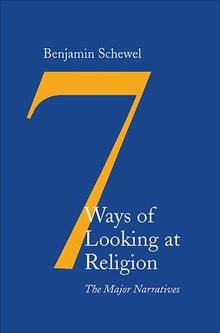
Benjamin Schewel's "7 Ways of Looking at Religion": Book Review


Three approaches to the study of religion tend to dominate. Surveys of tradition exemplified by Huston Smith, theories such as those pioneered by Max Weber and Emile Durkheim, and cultural themes as with power, gender, ritual, and belief typify this trio. None of these satisfied Benjamin Schewel, so a decade ago, he began writing a guide he could not find: this one maps a broader view.

In turn, seven perspectives beckon. These elucidate "the narrative commitments that undergird the various strands of the contemporary academic discourse on religion." (194) For each chapter, Schewel introduces a framework, a justification for its inclusion, and three exponents of the type.

Secularization unsurprisingly stimulates reactions by philosophers and historians of religion. Starting off, the inroads made by rational pursuits upon spiritual programs encourage three thinkers. Daniel Dennett suggests various suppositions about the evolution of religious tendencies and strategies on how these might be diminished now. John Dewey embraces naturalism instead of supernaturalism. Marcel Gauchet charts how religion has gradually declined as human-centered projects supplant it.

After summing up these subtractive responses, Schewel ends chapter one by suggesting alternatives. Charles Taylor's framework acknowledges transcendence yet otherwise aligns with Dewey's angle. Dewey's argument can be appreciated apart from his "non-spiritual worldview." (30) Pippa Norris and Ronald Inglehart's data on the persistence of faith among "vulnerable populations" demonstrate a subtraction narrative of how the Scandinavian paucity of believers dwindles when tallied against increasing levels of income inequality and power disparity for billions in the rest of today's world.

This structure, of introduction, presentation times three, and consideration of that approach pro and con, repeats half-a-dozen times in this short study. Schewel proves a diligent investigator as he shows readers twenty-one takes via seven types. Although why he chooses his theorists remains tacit, each proponent has his (for no female expounders make the cut) fair say. He remains balanced and poised.

Inverting subtraction, the void left by the loss of religion might be filled by a move from the margins back into the center of society. An opposite movement regards this shift "as a sign of humanity's growing desire for substantive spiritual renewal." (33) Virtue ethics imbued with a Catholic influence satisfies Alasdair MacIntyre. Recovery of the pre-Socratic openness towards investigation pleases Martin Heidegger. The resurgence of the purity of "golden-age Islam" comforts Muhammed Iqbal.

For Schewel, the simple fact that three disparate proposals coexist weakens any particular appeals to a tradition. He wonders why another solution might appear, independent of these three legacies.

Modernity may energize religion, rather than dissipate its spirit. The two forces need not oppose one another. He often cites Charles Taylor, the first of Schewel's transsecularist scholars. Taylor promotes "exclusive humanism" as but one element in an "immanent frame" broadening "metaphysical and theological conceptions in a way that premodern cultures could not." (57) By page 61, Schewel repeats a Taylor quote from two chapters earlier, but at least it's a lively excoriation of the excesses of Latin Christendom's demands. Schewel summarizes A Secular Age, and then sums up that summary. Granted, Taylor's "illuminating and profound" account deserves careful credit, for the students likely to turn to 7 Ways during an upper-level seminar or first-year graduate course will welcome a précis.

Yet, for Schewel, Taylor "ends up perpetuating a falsely nativist historical world-view" dismissing "the robust global contexts within which the modern West emerged." (63) A slump, for another observer of Western prospects, accounts for a model of an open American but monopoly European Christian market competing for the unchurched by offering believers rewards. Schewel exposes flaws in Rodney Stark's analogy, although remaining more sympathetic to Jeffrey Stout's dogged avowal of "constructive religious contributions to public discourse" (74) which advance America's democracy.

Secular and secularism share with natural and naturalism multivalent meanings. The first pair examines how religion plays out in modernity; science provides the domain for postnaturalist encounters. Their prevalence in the United States convinced Schemel that a whole category merited selection for chapter 4. Thomas Nagel's effort to assert "some kind of Platonism" as a teleological foil against the excesses of neo-Darwinian assertions for cosmic evolution incites Schemel's longest rebuttal thus far. However, he typically returns to an equitable ruling,, here on Nagel's strengths.

Hans Jonas reports Gnostic tendencies reoccurring in the modern Western intellectual as well as religious legacies. Alfred North Whitehead's historical and scientific details from a century ago need revision, but Schewel guardedly agrees with Whitehead's quest to reconcile science and religion.

Similarly, intellectual history motivates a construction narrative which looks at the massive alteration religion causes in human affairs. In too-brief an entry, Talal Asad points back to medieval Christian monasticism resulting much later in the privatization of belief and practice. Guy Strousma considers the cause of missionaries encountering the wider world in the early modern era, and their effect on an outmoded Christian and Eurocentric polity. So does Jason Josephson, examining Japanese reactions to Western intrusions. He corrects Edward Said's miscalculated locus for Orientalism, moving it from the Middle to the Far East; Josephson details Japanese influences upon Western religious notions.

Schewel approves of this historian's argument, and by devoting more space to a specific case study, articulates for a new audience Josephson's contributions. Moving onto a venerable alternative look at non-Western ideas, perennial conceptions which stretch beyond the expected Traditionalists. Instead, Aldous Huxley's now-dated but certainly stimulating outlook reminds us of the value of spiritual objectivity. John Hick's admission that such a religious reality not only exists but exceeds finite human comprehension, and that this realization generates other-centeredness away from selfishness, extends Huxley's stance. Hick's "metaphysical ambiguity" complements Rudolf Otto's arousal of love and fear into the numinous experience. Schewel settles for siding with Hick's defined transcendence.

Development and growth occupy the last thematic chapter, commencing with G.W.F. Hegel's proposal that as humans understand God better, so religion advances. The density of this thesis demands articulation, which Schewel adds. He leans away from the Eurocentricity based on Hegel's limited global knowledge. Karl Jaspers' Axial Age formulation helps. Schewel realizes its limitations, but he reminds readers that its general scaffolding has stood up to sociological inspection. Robert Bellah's interplay between "cognitive capacities" and religious stages over history incorporates Jaspers' chronology, even as Bellah hesitates at the suggestion that a second Axial Age awaits us soon. Still, as Schewel puts it pithily, Bellah fails to answer the basic question: "Why religion?"

Concluding, Schewel opts for a synthesis of the best that each of these seven typologies may proclaim. He warns that he is not giving us a history of religion, but a narrative of religious history. Like Hick, Schewel avers that a spiritual reality exceeds human understanding. He parallels the developmental narrative by highlighting the tribal, archaic, Axial Age (extended until ca. 1500 C.E.), early modern, and global stages of religious emergence. His two-dozen pages depart from tying his guided tour to its theoretical predecessors, and Schewel inserts rather a brisk overview of millennia.

His prospectus predicts that religion will occupy a major role in global affairs. Plurality of religions within competing communities will spread and accelerate. Leading figures will try to alter this future by aggressive or amicable means. Globalization serves for Schewel as a benign process enabling a mature application of how "religion's many constructive powers can be effectively encouraged" while discouraging its less amenable expressions. (191) The intellectual elite will consider religious compatibility with "the natural-scientific framework." Finally, a second Axial Age may emerge.

This reference may spark conversations among those learning about the philosophy of religion, as well as its history and cultural aspects. Schewel discusses these concepts in academic language, but he lapses into neither jargon nor cant. His endnotes not only document but in some cases enrich his text with further commentary. Nearly 250 sources display Schewel's wide range of research. Given the complexity of this content, the index assists comprehension of its many assertions. That book which Schewel had not found now can be found, and may it ease the perplexity of many inquirers.
(Reading Religion 2/21/18 in edited form)

Tuesday, February 13, 2018

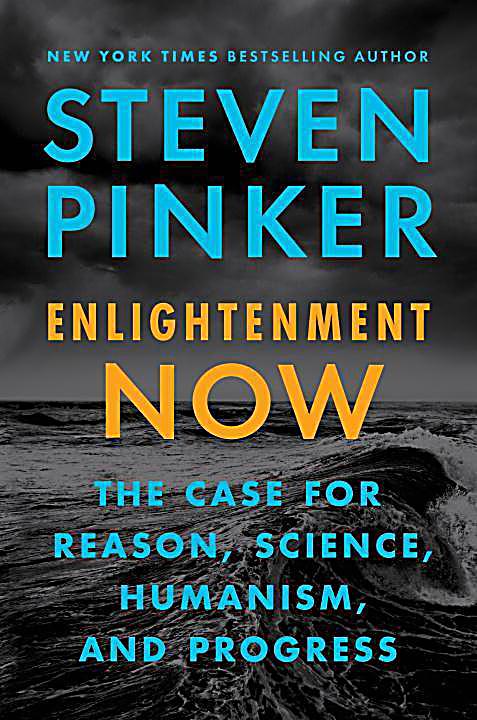
Steven Pinker's "Enlightenment Now": Book Review


Think of Aristotle's "flourishing" as our human fulfillment. That aligns well with Steven Pinker's argument addressing "people who care about arguments." Impatient with both the claims of traditional religious systems and of New Age "magical thinking," he elaborates on the critique made last year by Kurt Anderson in "Fantasyland" about the decline in rational thinking across the political spectrum in America. Defending "mainstream intellectual culture," this Harvard professor of psychology expands on his "The Better Angels of Our Nature" to prove--by about 85 charts over hundreds of pages--that progress and the goals of the Enlightenment matter most for our recognition of human progress and critical thinking.

He begins by noting the Axial Age as spun into motion by the "energy capture" of more calories from agriculture to 20,000 a day in various forms. This growth in sophisticated thinking and social organization was enhanced by language, "the original memory app." Countering entropy, information and evolution allow people to overcome a naturally "illiterate and innumerate" existence, while battling the specters of "blind justice" and sky-gods.

Part 2 looks at progress. He translates data into drama, as when after a chart of declining infant mortality 1751-2013 he eloquently reminds us of the tragedy and hope behind such dry measurements, within so many families past and present. He turns to the nuclear threat and finds it exaggerated; the Doomsday Clock's a "propaganda stunt." Pinker assures us that most terrorists are "bumbling schlemieles." and that "nuclear scare tactics" blind us to the success post-1945 of treaties and commonsense. As for the 45th President, Pinker eschews over-estimating any apocalyptic outbreak and he puts such a leader in place as spawned by a current blip in "authoritarian populism." He emphasizes the advances overall in our stability and success due to "systematic forces" over centuries, and cautions us against "dystopian rhetoric" about passing politicians amidst media hype. He notes that the "alt-right" comprises 50,000 in the U.S., 0.02 of the population.

The warning about media frenzy continues through the lengthy part 3, where reason, science, and humanism through a variety of fields and short chapters scan considerable ground across not only the sciences but some of the humanities. Pinker may have, for all his erudition, stretched himself here beyond his expertise but this is a popular book, meant to "defy any simple narrative" and to encourage reflective analyses. He's encouraged by curricula promoting critical skills to thwart an endemic polarization in beliefs expressing "identity-protective cognition." That is, when humans can't let go of opinions long held for the outmoded likes of tribal glory and one's personally elevated status within the in-crowd. This leftover default reaction we all inherit has weakened our ability to engage in rational public discourse. He suggests that the media depoliticize issues, distinguish facts from claims, and detach news coverage from an imitation of extreme sports coverage by pundits when it comes to observing and promoting the political scene through journalism. Quixotic as this may be, it's encouraging to hear this sensible proposal.

He draws on work by his partner, Rebecca Newberger Goldstein, to bolster his refutation of theist proofs. He avers our ancestors were not always trustworthy, and that "dunce-cap history" dumbs down the plain fact that religion is not a source of morality, and that scientists and philosophers might be, after all the myth and the mystical, right about the fundamental questions of existence. He shrugs away any notion that this universe is fine-tuned by a Creator, and reckons we're lucky to have won the equivalent of the cosmic jackpot, in our good fortune to live as and where we do.

I did find, for all my amateur status as a lay reader, some places where the assertions flew by without necessary verification. For instance, early on Pinker asserts that IQ scores prove that we're smarter than our ancestors by "two standard deviation points." But in a paragraph where other information has documentation in end-notes, this particular point does not. I wanted to know who determined this finding, and over how long had it been determined. If we're "smarter by 30 points than our ancestors," has this been due to schooling and literacy, or to other factors? This kind of reasoning exhibits the foundations upon which Pinker's broad thesis rests, so one expects that each iota of detail supports his general assessment.

"Enlightenment Now" displays a bit of welcome wit and a sharp intellect at work. As Pinker reiterates, romantic reactions and reactionary ideologies will not assist our survival. Our health increases, our longevity lengthens, our liberty broadens, and our happiness rises. Pinker's no Pangloss or Pollyanna, but he hammers home the evidence amassed and displayed that any problems with our predicament remain inevitable on the upward trajectory, if "defying any simple narrative." 450 closely printed pages of text elucidating this and 75 pages of documentation display how no catch phrases or naive platitudes can capture the considerable and ever-increasing complexity of how humans continue to move forward.

(This was distributed to me in an advance reading copy by the publisher, and that does not effect my review in any way. Thanks for reading it.) Posted with slight changes to Amazon US 2/13/18.

Thursday, February 8, 2018

Thomas Laqueur's "The Work of the Dead": Book Review


  • Princeton, NJ: Princeton University Press, October 2015. 736 pages. $39.95. Hardcover. ISBN 9780691157788.
 For other formats: Link to Publisher's Website.

This tome counters the wish of Diogenes the Cynic, who wanted his corpse to be tossed over a wall to be devoured by beasts. Berkeley historian Thomas W. Laqueur, whose earlier books compiled cultural surveys of the body and gender from the Greeks to Freud, and of masturbation, turns to another intimate subject: “What death leaves behind through the dead body” (xiv) takes the reader chronologically through four in-depth phases of “why the dead body matters” (1).

Laqueur applies the longue durée approach of the French Annales school to prehistoric and ancient times. Respect for the corpse, acknowledgement of its occupation at the borders of nature and culture, placement of the death of one within the social order, and how the dead “help make” our modern world comprise part 1. However, the bulk of Laqueur’s evidence derives from 1680-2000, within the purview of his expertise in English, Western European, and North American settings. This imbalance qualifies the breadth of his subtitle, but it enables a very detailed account of the post-Enlightenment gradual transition from churchyard and ecclesiastical supervision to cemetery and secular commemoration. Laqueur plumbs archives.

Documenting this shift from a space where the dead count within a weakened clerical presence, in slow pivot to a twentieth-century emphasis upon names and who the dead were, structures parts 2 and 3. Laqueur ends with what the dead consist of, when the radical revival of cremation represents a rejection of the bodily resurrection of the hallowed cadaver.

This arc spans vast accumulations of material, physical and spiritual, intellectual and religious. The enchantment and re-enchantment of the living towards the dead offers “the greatest possible history of the imagination” (17). Having despaired of extracting the testimonies of those dying, Laqueur asks instead what the living “did with and through real dead bodies,” by analyzing “what their acts meant and mean to them” (18). Relics, idolatry, aura, fakery, and necromancy display early human attempts to deal with this mortal predicament. Revenants, souls, and spirits share varieties of “persistence of being” as a “shared community” within a “complex of meanings” in his second chapter. Here, the power the dead exert over our own minds encompasses erudite reactions from Epicurus and Calvinists through Milan Kundera and Slavoj Žižek.

This collective effort of caring for what is left of the departed dwells within a “gap between what they are and what we take them to be” (81). Religion, art, politics, and poetry, in this scholar’s estimation, would not exist otherwise. This grand statement may give pause, as it may elude verification. It attests to Laqueur’s ambitious attempt to add the particular to the cosmic.

In such sweeping claims, this book leaves its most powerful impact. The granular accumulation of proof will assist academics, for it gathers arcane studies and diligent interpretations into a valuable volume. Yet as hundreds of pages demonstrate, these particulars pile up as densely as did effluvia and bones in dank churchyards that archeologists have unearthed and gravediggers had lamented. The “regime of the dead” presses down indelibly. Laqueur calculates the ratio (miniscule) between the remnants left by bones and fluids in comparison to the amount (considerable) excreted by the living within an industrialized city. Victorian reformers demanded hygiene. Their false claims of the danger of the rank corpse accelerated the trend away from crammed churchyards to planned meadows. There, increasing ranks of the dead did not wait for Judgment Day in elegiac and venerable plots where families had long relegated their village departed. In cemeteries, picnickers and strollers could enjoy their visits, where the “new regime” created “a novel and luxuriantly protean space” (212). 

Romantic-era notions of pastoral slumber presaged communal creation of the funeral industry and the bureaucratic register. Dramatizing memory, venerating preservation, admitting finitude, and defying salvation, modern habits of paying respect to the departed superseded ecclesiastical rites.

Burial plots and fancy funerals appealed as the poor imitated their betters. Exhumations exemplified the rationales for artistic, legal, criminal, medical, and clerical examinations. Again, Laqueur totes up intricate processes, which counted on the assurance that all the dead, in peace or especially in war, were accounted for, regulated, and tallied up neatly.

Naming the disembodied embeds them as a “reinscription of loss, one of its poor avatars, a substitute, a placeholder, a trace of a trace” (366). Laqueur may move his readers in such pauses from his scrutiny. He displays the “unprecedented scale” of technical, political, and emotional means by which recent mourners, brokers, claimants, and heirs collude to ensure post-mortem precision. Less than a third of twenty-six billion people born between 1500 and 2010 are known to us. Mormon genealogists labor to baptize all dead. Obituaries proclaimed public notice as newspapers expanded literacy and popularized devotions. These ceremonial practices generate a “commemorative culture” from the Civil War on, one which left thousands of memorials, modest or monumental, to the “absent but present dead,” among which were many vanished or irretrievable casualties of the Great War.

The author rarely admits the personal, but an aside merits mention. His father’s 1929 alma mater, a Hamburg gymnasium, lists those who died “fighting for Germany” together with those “as victims of the Holocaust” (423). Technological and emotional imperatives combine in massive records of both world wars, which made “knowing both possible and necessary” (466).

Cremation demoted death “to its physiological basis,” says Laqueur (509). Protestants interpreted the restoration of the body at the Last Judgment as metaphorical. The need to rest a body in sacred ground dwindled. Body, memory, and locale nevertheless persist today as obligations. Continuity in The Work of the Dead, Laqueur concludes, endures even as medical progress prevents acceptance of mortality among desperate families who seek, inevitably, miracles.

Date of Review: 
December 29, 2017

About the Author
Thomas W. Laqueur is the Helen Fawcett Professor of History at the University of California, Berkeley. His books include Making Sex: Body and Gender from the Greeks to Freud and Solitary Sex: A Cultural History of Masturbation. He is a regular contributor to the London Review of Books.

Reading Religion (1/4/18)

Saturday, February 3, 2018

John Lennox's "God's Undertaker": Book Review

Front Cover
I read this right after David Bentley Hart's The Experience of God: Being, Consciousness, Bliss. That formidable study in an endnote directed me to the somewhat (until the math and biology kicked in halfway) more accessible God's Undertaker investigating if religious inquiries trump materialist dogma as to if an intelligence (steady there--as agency or impetus rather than design per se?) might be discerned. John Lennox, as a professor of mathematics and fellow in the philosophy of science at Oxford, handles data confidently, adroitly, and commendably with modesty tempered from both and all sides. I did enjoy his witty analogies summing up the various ways science itself calculates the immense odds against our being here at all. And it's not merely the Anthropic Principle all over again.

He nods often to a bete noire of the New Agnostics, Michael Behe. I admit this straightaway, as this will already cause many to write off Lennox. He credits Behe's 'edge of evolution' imagery supporting an originator outside time and space generating evolution as "less random that is often supposed." He denies, however, this is the God of the Gaps yet again. You can read far more context than I can sum up at exactly the halfway point of the book (I refer to my Kindle page 320/638).

A bit later on (61% 391/638), Lennox repeats a helpful analogy that "the message is not derivable" on a printed page "from the physics and chemistry of paper and ink." These are deep waters, but he's discussing that the DNA code sequence's "order is not due to the forces of potential energy. It must be as physically indeterminate as the sequence of words is on a printed page." The vexing predicament of how to solve "biogenesis" by "a simple-minded appear to Darwinian-like processes" comes down to how the mutating replicator modelled by Dawkins could "even get going in the absence of life" and set in motion natural selection. At 56% 358/638, Lennox quotes Stephen Meyer: 'What needs to be explained is not the origin of order... but the origin of information." This sets up his main focus.

It got a bit easier, and more memorable for me, after his curated array of those witty analogies. The typing monkey argument dating back to Huxley vs. Wilberforce in 1860 Oxford asked whether random apes would eventually peck out one of Shakespeare's poems--or even an entire tome. Lennox avers this is unlikely the provenance as not until 1874 did typewriters hit the market--typical of the author's attentive eye! Regardless, a simulator since 2003's generating a monkey every second hitting a key, with 100 original chimps doubling every few days adds up (in the book's 2009 revision) to the then-current record of "24 consecutive letters from Shakespeare's Henry IV produced in 10^40 monkey years (the age of the universe is estimated at less than 10^11 years)." (68% 438/638)

Other memorable comparisons: the odds of us being here as is=a coin being hit by a shot from across the 20 billion light years "halo"; if coins stacked up across the American continent (or is the nation?) as high as the moon, and this was repeated on a billion more continents, what if a red-marked coin was placed by you at random? And if your friend found it first go when you challenged her, that'd be the odds of what some (if not in this book, curiously) call our own "Goldilocks" just-right universe.

Three-quarters of the way (484/638), Lennox wonders why scientists are able to accept, say, alien presence if SETI received a sequence of signalled prime numbers, yet they deny intelligent agency when it comes to similar deductions gathered in this book from a wide variety of academic experts. "We instinctively infer 'upwards' to an ultimately intelligent causation rather than 'downwards' to chance and necessity." He mentions that in the film Expelled, even Richard Dawkins appears to "have moved his ground towards admitting that design is something that, in principle, could be recognized by science." I looked this up and apparently he and fellow atheists claimed they were duped into appearing in this 2007 documentary. I'd add that Lennox relying on the supposed conversion of Anthony Flew very late in his long life has similarly been criticized for believers taking advantage.

[I am between a 4 and 5 star {on Amazon} but given the Flew incident already happened prior to the revision, this influences my rating down; I am unsure if this revision came before or after the post-Expelled disclaimer by Dawkins and other scientists, so Lennox gets the benefit of the doubt there.]

This is a diligently and incredibly complex summation of the debate about whether "science has buried God." John Lennox stays honest, recognizing his and his colleagues' limitations alongside their expansion of what reason and care have discovered, by the wonder of mathematics and physics. He concludes that "far from science having buried God, not only do the results of science point towards his existence, but the scientific enterprise itself is validated by his existence." (87% 560/638)

I approached this with no preconceptions. I've studied the big names from the opposition of late, and I've (as with Hart and Francis Collins) balanced religious adherents who've accounted for themselves in these debates. The analogies for me sparked my imagination most, but those with more ability in the maths and sciences will want to turn to the data Lennox sifts and scrutinizes. He keeps an approachable tone through dense discussion, he quotes liberally and helpfully for the greater public, and he evaluates evidence and methods from all comers. Worth your attention. (Amazon US 1/23/18)

P.S.This first pdf is a simple outline of the book. This second pdf sums up the documentation, quotation, and summarization page by page. This third pdf is the entire 2009 revised edition.
P.P.S. In Steven Pinker's forthcoming Enlightenment Now, he offers an unanswerable riposte to fine-tuning, which has occurred to me often. What if we're the Powerball lottery winner, and that's enough? We should count our luck instead of our blessings, that we beat the odds against us.