Thursday, January 8, 2009

Ag Foghlaim leis podchraoltaí as Gaeilge (& Breatnaise bheag)

Fuair mé paimfléad ó Oideas Gael ar an post inniu. Ba mhaith liom ag filleadh ar ais Gleann Cholm Cille ansuid aríst ar feadh an seachtaine seo chugainn, ach níl airgead agamsa féin anois ag dul go Dún na nGall. Mar sin féin, is mian orm a tógáil líofacht agam.

Is iontach orm. An bhfaigheadh mé ábhar go saor ar an ghreasan a cloisteáil Gaeilge ar mo h-IPhod? Ní íarraionn mé a íoc chun chinn chuig cleachtannaí níos fusa. Iarraidh mir Breatnais go luath triu podchraoltaí as teangachaí Ceilteach freisin.

Deir Foras na Gaeilge:
An Líonra Sóisialta: Craoltar an clár laethúil seo ar 7 stáisiún raidio in Éirinn agus ar fud an domhain, mar phodchraoladh (podcast) ón suíomh AnLionra.Com. Is HOST [óstach!] Conn Ó Muineacháin é.

Sonraí Teagmhála: Seoladh: ar an raidio, ar an idirlíon, thart timpeall ort, i do phóca! An Líonra Sóisealta
P.S.: Labhairt sé as Gaeilge leis blas go hiontach aigesan féin ann!


Tá sé bun-focail agus frasai furasta níos mo anseo: "Noimead Aon Gaeilge". Tá deich cleachtaí ann. Má bhéifea foghlaimeoir níos liofa, go dté tú go agallaimh agus cainte as Gaeilge le Séamas Ó Nuachtain. Tá sé i gcónaí ina h-Inis Fada, Nua Eabhrac. Cumann Carad na Gaeilge.

D'inis tú ariamh faoi Gaeilge na Seachtaine. Is banóstach é Kay Uí Chinnéide. Tá tíosach go fial fosta. Is maith liom ag eisteacht le a scéaltaí faoi aicesan féin.

Go críochnúil, is maith liom is mo Gíota Beag le BBC-NI. Rug mé ormsa féin blás beagán ó Thuaidh triu ag cloisteáil leis Fearghal Mag Uiginn ariamh ag dul go Oideas Gael arú anuraidh. Molaim go cuireadh cuairt agatsa féin an suíomh seo ar an idirlíon go minic.

Ní raibh mé ábalta fáil podchraoltaí éagsúlaí a cabhar mac foghlama Breatnaise. Ceapaim go mbheifi{?} go cruthaigh chomh mac leinn níos fearr leis ábhar níos flúirseach ar fad i mball ó Bhreatain Bheag le hais Gaeilge in Éirinn! Níor fuair mé chuig ionad nua-fhoglameoir fásta ar an BBC-Wales leis podchraolta.

Mar shampla, tá "Catchphrase" (leagan 2000) leis "na Lloyds" go brea. Níl slí a casadh clár craobhailte as comhad na h-iPod ann. Tá podchraoltaí amháin go bhfuil ar an leibheal níos ard chun chinn ag foghlaim Breatnaise: Pigion. Go cinnte, measaim go mbeadh seo níos hoíriúnach orm: Foghlaim Breatnais Podcraolta.

An mbíonn spéis i teangacha in hachan duine go hionduil? Tá Gaelgoirí beagán anseo: Podchraoltaí as Gaeilge. Tá nascannaí Gaelach eile na hAlbanach agus Éire a leithead anseo: Foghlaim Gaeilge ar an Idirlíon. Feicfidh tú eolas faoi teangacha eile ar an idirlíon anseo: Podcasting for Foreign- Language Education.

Learning with podcasts in Irish (& a wee Welsh).

I got a pamphlet from Oideas Gael in the mail today. I would like to return to Glencolmcille over there again during the next summer, but there is not money for me now to be going to Donegal. All the same, there is a need for me to build my fluency.

I wonder. Would I find material free on the web to hear Irish on my iPod? I do not wish to pay regarding easier lessons. I would seek also a bit of Welsh soon through podcasts of Celtic languages.

Foras na Gaeilge says:
"The Social Network: This weekly program's broadcast on 7 radio stations in Ireland throughout the land, through podcast from the site AnLionra.com. Conn Ó Muineacháin's the host.

Communication Details: Sent: on the radio, on the internet, all around you, in your pocket!" "An Líonra Sóisealta"
P. S. He speaks Irish with a wonderful tone himself there!

There's more basic vocabulary and easy phrases here: href="http://coffeebreakspanish.typepad.com/oneminutelanguages/one_minute_irish/index.html">"One Minute Irish". Ten lessons are there. If you would be a more fluent learner, you may go to interviews and talk in Irish at the Philo-Celtic Society, by Séamas Ó Nuachtain. He is living on Long Island, New York.

I told you before about Irish of the Week. Kay Uí Chinnéide's the hostess. She's hospitable too! I like to listen to her stories about herself.

Ultimately, I like most "A Wee Bit" from BBC-NI. I myself caught a slight accent from the North through listening to Fearghal Mag Uiginn before going to Oideas Gael the year before last. I recommend that you pay a visit yourself to this site on the net often.

I was not able to find varied podcasts to help a learner of Welsh. I think, however, that one might be better served as a student with far more abundant material from Wales elsewhere as compared to Irish in Ireland. I did not find a location for a new adult learner on BBC-Wales with a podcast.

For instance, there's a fine "Catchphrase" (version 2000) with "The Lloyds." But, there's no way to turn that program broadcast into an iPod file. There are only podcasts that are at the level for a higher learning of Welsh: Pigion. Finally, I estimate this may be for me a more suitable start: Learn Welsh Podcast.

Is there usually an interest in languages in every person? Here's a few Irish people: Podcasts in Irish. There are other such Gaelic links from Scotland and Ireland here: Foghlaim Gaeilge ar an Idirlíon. You will see information about other languages on the Internet here: Podcasting for Foreign- Language Education

Griangraf/ Photo: Lynette Fay, banóstach Blais/ host(ess) of Blas: BBC Raidió Uladh/Radio Ulster.

Siuán Ní Mhaonaigh & Antain Mac Lochlainn's "Speaking Irish": Book Review

Having studied at Oideas Gael, in Donegal, one of the places featured here, I was excited to find, the year after my course, the arrival of this book- DVD pairing. Others (on Amazon US where this appeared 12/22/08) have explained its rationale. I'll delve into its structure and organization. A brief comparison with other products (see my Listmania "Learning Irish Gaelic" for more) may assist your decision whether or not it's for you.

Twenty units focus on themes; the hardcover (thankfully-- this is a big plus in learning materials too rarely found; the ability to prop a book open is often worth the expense rather than a flimsy paperback whose pages separate and whose binding breaks) workbook naturally gives transcriptions and directions. I would have liked subtitles as an option, too; the lack of this makes it harder to keep up with the rapid (if you're at my level) speech patterns. Still, this immersion forces you to accelerate into the kind of encounters that prepare you for real life outside the halting pace of the classroom.

The timed interviews-- beginning from ten seconds and ending the book at nearly two minutes-- are prepared for with phrases or vocabulary that may differ from "school" or Standard Irish taught. Some are dialectal; some are grammatical elaborations, some cultural or vocabulary enrichments. Simple fill-in exercises may precede segments. Each chapter has a few taped snippets. Translations and answers well kept to the back of the book are given.

The range is wider than the old "The four sheep are in the high mountain meadow eating oats when Mary walks towards them" types of sentences found in primers. Buddhism, ecology, GAA, Israel and India, Irish sign language, learners vs. natives in Gaeltachtaí, dance, emigration, working mothers, the usually ignored presence of Irish speakers in North America: all receive their minute or two in the text and on the screen.

Poet Cathal Ó Searcaigh, activists Liam Ó Cuinneagáin & Helen Ó Murchú, TD Trevor Sargent, local residents, and, encouragingly, even learners from abroad can be heard among nearly two dozen interviewees. The range of accents, slips into English, and variations on the schoolhouse form of Irish may throw some off, but these are essential in preparing learners to leave the textbooks behind and begin to chat in Irish on the streets, and in the pubs. Seeing the Irish landscape behind so many of the speakers adds to the welcome illusion that you are back in Ireland hearing the native tongue vibrant, idiosyncratic, and ordinarily spoken, as it's meant to be.

This bridge into the natural communities that form by natives and learners and students refreshing earlier lessons may be lengthened with Turas Teanga, an RTÉ CD-DVD-book set geared more towards those reviving their "school Irish." This is aimed, be cautioned, at those intermediate or advanced students. SI is more practical and less linguistically focused per se than Mícheál Ó Siadhail's "Learning Irish;" it's less basic than "Gaeilge agus Fáilte;" it's certainly far beyond the Pimsleur conversations, and probably more enjoyable than the "Teach Yourself Irish" CD-book pairs.

For eager beginners: seek out "Gaeilge agus Fáilte." For SI's pricier, somewhat less user-friendly counterpart: "Turas Teanga." For serious linguists wanting a particular dialect, Cois Fharraige in Connaught: "Learning Irish." SI also is far more advanced than the new "Colloquial Irish" CD-book set, which is basic Connemara Irish of around 800 words. Ultimately, SI may prove the help that many, after finishing an immersion course in or away from Ireland, may need to continue their study when they return to a home far from a Gaeltacht.

Wednesday, January 7, 2009

Red Flag's Banner Year: 1831?

Making my slow but pleasant way through Emyr Humphreys' literary history of what he calls "The Taleisin Tradition," a sentence buried in a description of the 1831 Merthyr Tydfil uprising arrested me. Apparently this Welsh rebellion was the first time that we know of when a red flag flew as a symbol of workers' protest. The "Red Flag" entry on Wikipedia adds that the pair of banners had been soaked in calf's blood.

I'd always assumed the 1848 upheavals marked its rousing début, fueled by Marx & Engels. This corrective Welsh factoid reminds me of how little I know about the restive, or dormant, past. Unless we see a tidy bio-pic on Ché, Malcolm X, or Harvey Milk, it appears that few of us gain even that much knowledge about even a cartoonish or two-hour reductive tale from our radical past. Even more telling's the absence of celluloid stories about a conservative array of restless characters such as Samuel Johnson, Cardinal Newman, or even Éamon De Valera!

I know I speak as a minority of a minority in my interest in the Long Fellow's machinations, but Alan Rickman's haunting portrayal of Dev in the ambitious if uneven "Michael Collins" remains indelible. It also reminds me how few movies get made about right-wingers rather than lefty icons! Their absence of good looks may be to blame. Even Fox News relies on buxom bottle blondes to deliver its neo-con tirades!

I chatted with a friend last night, André, my older son's bar mitzvah coach-- doubtless one of the few black Angeleno Americans who has converted to Judaism, finished a degree in Judaic Studies at York U. and now coaches hockey from his flat in the heart of kosher Toronto while working for the second largest Conservative synagogue on our continent-- about his weariness with his own considerably complex skill set of "Jackie Robinson moments" of having to be the "first so-and-so." He aligns smoothly with the post-racial generation about to be inaugurated. Kibitzing with him and my wife about Toronto's machers, schnorrers, and schemdliks, I was reminded of how complex we essentially (in this true spirit of that adverb) are.

While many try by our skin to define and limit us, many of us resist rather than rejoice in its categorization of our supposed ideology and temperament and preferences! We learn remote languages not our "own." We challenge our heritage. We upend expectations of how we "should" talk, look, or act as if our identity's identical with our complexion.

His older brother, a gay man in L.A., nonetheless prefers to sit out the Prop. 8 debates roiling here rather than march in protest. He, a child of the civil rights era, now more calmly figures the law will right itself in time, and backlashes may be sparked by bitter boycotts. How many of us don't fit into our blue-red party lines? André reminded my wife and I about those who had preceded Obama who had been often denigrated by their own community: Colin Powell, Bill Cosby, Condoleezza Rice, for saying what our President-elect has been applauded for, regarding responsibility rather than blaming the Man. And, as Marc Goldblatt asked in January 5th's National Review Online,"The Upside of Obama," what happens now that another Man's in charge?

That's what André likes about his new home in Canada: more choices, even if the Conservatives there are at their most radical only moderate Democrats south of the border. That's the difference between, as he notes, a civilized, literate, and more thoughtful society and our own that revels in rants, vulgarity, and spectacle. Yes, I like punk and dirty jokes. I snicker when I should not at what I am shown. I enjoy malcontents ostracized (at least) for their own stubborn stances, such as Céline or Francis Stuart, alongside those lionized on the P.C. curriculum. I guess I root for whomever's shouting at the emperor for his woeful sartorial hubris. Still, as with artists, I suppose we humanists habitually sidle towards sinistrality on a political spectrum, although much of what's created by many media today should shame us all.

Speaking of colors, intriguingly, Bob Saunders archived at Libcom.org expands in details gleaned from contemporary accounts, a couple of black flags also were brandished by marchers angered at the execution of "Dic Penderyn." The red and the black, for unfurling not only in Stendhal. Visit also the "The Dic Penderyn Society." I reproduce as context a pithy but forceful entry from "Welsh Heroes," #56, "Dic Penderyn," aka Richard Lewis.

For over a week in the summer of 1831, the authorities lost control of Merthyr Tydfil. With the town already a hotbed of political unrest, news that the ironmaster William Crawshay was to cut his workers’ wages was the spark that ignited the flames of rebellion.

Troops of the Argyll and Sutherland Highlanders were sent to put down the rioters. In an ugly confrontation in front of the Castle Hotel, as many as twenty people were shot dead.

Along with the Newport Rising eight years later, it was one of the most serious violent outbreaks witnessed on mainland Britain. It is also claimed to be the first time that a red flag was waved as a banner of workers power.

In the aftermath of the disturbance, a 23 year-old miner by the name of Richard Lewis was arrested and imprisoned. Better known as Dic Penderyn, he was originally from Aberavon and was typical of the men who had flocked to Merthyr, then the largest town in Wales, to find work.

Dic was accused of wounding Donald Black, one of the Scottish soldiers. The evidence against him was slender and Black himself apparently could not identify his assailant. Nevertheless, at his trial in Cardiff, Dic Penderyn was sentenced to the gallows.

Historians have argued that the authorities were worried about the potential power of the trade unions emerging in the newly industrialised parts of Wales. As an outspoken and intelligent workingman, Dic Penderyn may well have been suspected of being a union ringleader. Although 28 people had been arrested, only he was sentenced to death.

Despite the please of several well connected Welshmen that Dic Penderyn’s life should be spared, the Home Secretary Lord Melbourne showed no mercy.

Thousands of people accompanied his coffin on its journey from Cardiff back to Dic’s home at Aberavon. Whether deliberately or through incompetence, a martyr had been created.


Back to me for postscript. Civil Rights led to such uprisings in Wales, marches in Selma, and elections in my nation. My wife tends to recall the firehoses of Bull Connor and marvels how far we've come. I tend to remember the multiracial mix of classmates that I grew up with and those students I now teach as representatives of a blended, hybrid, unclassifiably polyglot California. Andre's mom thinks of her segregated Texas upbringing; her son responds with his own truly admirable life's accomplishments. Out of such conversations, maybe we all agree that perhaps what Dic Penderyn and the red flag nearly two centuries ago pioneered may be bringing us into a new promised land. Whether milk and honey or ogres and grasshoppers dominate its cities of the plains, however, remains as elusive as when Joshua's scouts reported back after they'd entered an appealing/appalling Canaan-- which itself has battled ever since over its strategically hapless and hallowed location: haven or hell?

Illustration: ChartistNewport blog.

Tuesday, January 6, 2009

Ag Filleadh go Bhreatain Bheag

Scríobh mé bliain ó shin faoi ag foghlaim mír Breatnaise. Anois, tá sé aon bliain go deireanach go díreach agus tá mé ag scríobh fúithi aríst! Is iontach liom go meachnú faoi Breatain Bheag ar feadh an geimreadh dár gcionn! B'fhéidir, ar mbeadh macalla na h-Imbolc ormsa féin ann?

Críochnaím stair litríochta le Emyr Humphreys, "An Traidisiún na Taliesin." Insíonn Humphries faoi an measc Bhreatnach go bhfuil miotasach agus sóisialta ar chéile. Déanann sé nascannaí leis aigne ghéar aige idir eisteddfodau agus cruinnithe, draíochtaí agus Lloyd George, an teanga agus an bíobla, an Prionsa Madoc agus an seanmóiri Meitidistigh.

Measaim go raibh Breatnais níos laidir faoi láthair chomh teangacha Ceilteach eile. Tá dála staid agus suíomh anois níos daingean fúithi. Ar ghualainn leis Gaeilge, ár ndóigh, ar radharc fairsing leis Breatnais go raibh níos geal.

Is maith liom a feiceáil tairbsí Gaelach ina focail Breatnaise. Gheobhaidh mé cosulachtaí, go nádurtha. Feicfidh mé ar an gcuma chéanna. Tháinig ina beirt teanga dealramh bídeach, nó géarr, go raibh ceangail nó scarann na cianta cairbreacha ó shin. D'inis "Bo" fúthu: "Gaeilge & Breatnais" (9 Feabhra 2008) agus "Gaeilge & Breatnais 2." (10 Feabhra 2008).

Tá mé ar an ngannchuid a tógáil agam aithne níos mhaith Breatnaise bheag. Ba mhaith liom leid a thabhairt domsa fúithi. Ní bheidh sí socair. Níor tugfidh sí liom a dhéanamh ach beagán agam gan dua.

Mar sin féin, is iondúil seo go foghlaimeoir fásta! Tá ábhar go leor as Breatnais a cabhar linn. Mar shampla, feicim sé ar an BBC & S4C. Fuair mé altannaí go cabhrach le Janis Cortese. Chruinnigh sí eolas anseo: "Foghlaim Breatnais."

Tá sí bean áitiúla agam; tá sí i gcónaí ina gCalifoirnea Theas! Bheadh sí dea-shampla a thabhair uaim. Tá muid ag foghlamtha in leann Ceiltigh cónaí i bhfad ó láthair inniu. Fágann muid go dúthrachtach triu ár intinní go dtí tíorthái agus teanglachaí níos faide. Éiríonn muid go fonnmhar ar an taobh thoir go doifheicthe.

Returning to Wales.

I wrote a year ago about learning a bit of Welsh. Now, it's a year later exactly and I am writing about it again! It's a wonder to me reflecting about "Little Britain" during the following winter. Perhaps, may there be an echo of Imbolc [the Celtic solstice] in me?

I am finishing a literary history by Emyr Humphreys, "The Taliesin Tradition." Humphries tells about a Welsh blend that's mythological and social together. He makes links with his observant mind between Eisteddfods and rallies, druids and Lloyd George, the language and the bible, the prince Madoc and the preacher Methodist.

I think that Welsh may be stronger at present than other Celtic languages. The historical situation and the position of it now are firmer. In comparison with Irish, of course, the wide prospect with Welsh may be brighter.

I like to see ghosts of Gaelic in words of Welsh. I will find similarities, naturally. I will see a tiny, or sharp, resemblance in the pair of languages, shared and diverging in the distant past. "Bo" tells about these: "Irish & Welsh" (February 9, 2008) agus "Irish & Welsh 2." (February 10, 2008).

I have a desire to build up a better knowledge of a little Welsh. I would like to get a feel for it in me. It will not be easy. I cannot understand it even a little myself without difficulty.

All the same, this is ordinary for an adult learner! There's material galore in Welsh to help us. For instance, I see it on the BBC & S4C. I found helpful articles by Janis Cortese. She gathered information here: "Learn Welsh."

She is a local woman to me; she is living in Southern California! She should be a good example for me. We are learning in Celtic studies, living faraway today. We leave in diligence through our minds to lands and languages farther off. We rise in eagerness eastwards invisibly.

Iómhá/Illustration: le Senán Ó Ruanaidh/ by Simon Rooney. "Ceiltigh d'Aois Iarainn/ Iron Age Celts:" suíomh sraithe ar lion/ site of series on-line.

Monday, January 5, 2009

May, Moore & Lintott's "Bang! The Complete History of the Universe": Book Review

A while back, I read a short interview with Brian May; he described in understandable and interesting terms his long-delayed (for understandable reasons given his tenure in Queen) dissertation on interstellar dust. Impressed, I made a note to find this forthcoming astronomy text. On pg. 118, we learn that a book by Patrick Moore, "The Earth," in Brian May's school library introduced him to trilobites, "and inspired him to a life-long passion for astronomy." My sons found this book and started to borrow it themselves-- a compliment to the example set by Moore and continued by his colleagues. Compiled by May with BBC presenters Sir Patrick Moore and Chris Lintott, it's a handsome volume with plenty of helpful illustrations and color photographs. Those enchanted by the images from the Hubble Space Telescope may find many more within this wide-ranging yet compact overview.

Tucked down on the copyright page is a note on the lenticular explosion on the cover. It tries not to replicate the Big Bang, but allows us to imagine it if we could somehow step outside of our universe! The editors remind us, in the encouraging tone that permeates their first-person plural prose:
"However, we really have an even more privileged position-- we are all actually inside of the mother of all explosions, and the further we peer into space, the more we realize that, all around us, everywhere we look, the Big Bang is what we see."

As someone with no background but a long-dormant childhood exposure to the basics of astronomy, I found parts of this challenging, as to be expected. Dark matter, dark energy, particle physics, and what happened in the earliest moments after the Big Bang likewise present difficulties for those who've studied these matters for decades. Not to mention the anthropic principle, easier though that conjecture may be to summarize. The editors strive, nonetheless, to tell us what scientists know and what they conjecture in clear, conversational, and careful language.

The organization follows a timescale. "Grey areas" give sidebars on anecdotes and digressions; the main text takes you from as far back as we can guesstimate to light, evolution of the universe, stars and planets, life's emergence, and what the future holds, and the end. "We are drifting slowly but inexorably into the long twilight of the universe." (147)

It's a sobering look at the way we came to be, and humbling in its scope. Facing what appears to be the "Cosmological Constant," a Big Rip possible long after the Big Bang, our boastful humanity's dwarfed indeed by this "accelerating descent into darkness." Radiation continues even after time's annihilation.(150) For now, we learn what we can: "A Universe that ends in any of these ways seems pointless, and there well may be a vital factor that we are missing." (154) They conclude in their epilogue that they've tried to explain "how" things have happened, but never "why."
"If we spent a lifetime trying to understand completely how a single daffodil is made, we would be no nearer to understanding why such beauty is shown to us; nevertheless, we can have endless fun satisfying our curiosity in both areas. We wish you endless fun." (157)
So they conclude their text!

Their narrative may alter even in the next decade, all the more astonishingly, given the rapid pace of discoveries. Even the 2008 copy I have published by Johns Hopkins UP is a second edition, two years after the first with added material. The up-to-date, solid, and speculative blend of excitement, hesitation, and wonder typifies the thoughtful, understandably almost awed tone of much of the material that stretches any reader's mind while pondering the contents here. A series of biographies of famous astronomers, a glossary, a timeline, and a section on "Practical Astronomy" by Moore conclude this short but comprehensive book which manages to live up to its ambitious title.

(Review posted today to Amazon US.) See the book's website: BangUniverse.com

Sunday, January 4, 2009

Internet Irish Radio, Éamon Carr & "Breakfast on Pluto."

I received a note-- and spreadsheet-- of CDs that my friend up in San Francisco Lee Templeton's culling from her discs played on her Internet radio station on 365 live, "One Night at McSorley's". None that I needed, including one from some "Liverpool club band" named after a bug. Yet, her typical largess, for she has provided me with many examples of her expertise in matters related to music, Ireland, literature, and their happy overlaps, reminded me to do the same. So, a new year's resolution for you all to give her a listen.

I see in today's Los Angeles Times an item she and my wife would both like: a Sanyo R227 half the size of a breadloaf, but able to pull in Internet Radio without a computer. My wife's disheartened by the demise of her painstakingly prepared Yahoo Launchcast station, which will cease to exist. I recall Miss Templeton's comments last year about her own Come Back Horslips guestbook-site at Yahoo which I think found a similar fate. (My Yahoo groups too have either faded or gone one without me; I kept getting bounced off them by rogue e-mail glitches.) But, you can link at the right hand list here to both her CBH blog and her own logically titled "Templeton Chronicles" that have replaced the CBH archives on Blogger. Her reports from her visit to Ireland and Britain this past summer were particularly entertaining, and she's transferring them to her blog after regaling a few of us with them as e-mails earlier last year. She also has a Facebook and YouTube site. Layne tells me I need to promote myself on the former and I did not even know of the latter as an option for individuals. But, I am busy enough off-line-- and with reading enough to generated entries for this little blog and on Amazon.

The YouTube shout-out also spurs me to make room soon on my shelf of what to read next for the recent book (which I obtained via LT) by Horslips' percussionist (he's more than a drummer; check out his bodhran and bones!) Éamon Carr. You can see his videos of his recitals from it on YT. He could be said to have pioneered such presentations in his 1960s-era Beat travels and his innovative poetry-performance-musical revue that preceded Horslips, Dublin's countercultural hotline Tara Telephone. I wish I could have heard them. Visit her informative website: "Tara Telephone: An Archival History".

Carr's a longtime commentator on the radio and in print of sports, music, and culture. He possesses a wiry grace and a commanding presence. His command of an audience, although I've only witnessed it via video clips, must be memorable. His poetry collection, "Origami Crow," compares the poet Basho's periginations with Carr's visit to Japan during the 2004 ill-fated Irish team's World Cup debacle. Out of such collisions comes inspiration. This weekend, I finished (for a review to actually appear in print!) Michael Parker's two-volume "Northern Irish Literature" history-criticism, and when I found Derek Mahon's 1975 poem "The Snow Party" cited with its own treatment of Basho (1644-94) with an endnote about how he gave up his samurai court's charms for his own wandering, I remembered Carr and wondered if he knew of this Irish poetic champion composed. I'm practically certain that he does.

The juxtapositions of pop music and literature Carr himself delightedly charted on record and in concert also recall another connection. The other night, Layne brought home "Breakfast on Pluto." One of the two novels by Pat McCabe I like, despite LT's defense of "The Dead School" (in which the band appeared-- see my article here: "Horslips in Irish Literary and Musical Culture") as tied for a novel she'd rescue from a burning room. Funny enough, only my McCabe picks, "The Butcher Boy" and "BOP," made it to the screen. More black humor, my guess.

Gavin Friday appears in a great send-up of the glam scene as Billy Hatchett with his Mohawks. I won't give away Kitten's efforts to further the band's career in the dancehalls of Cavan, but the scene captures well the mix of panache and (lovable lack of?) flair that must have been part of many a rural night's meat-and-spuds early-70s rock once that preference finally replaced for the youngsters the showbands-- while continuing that genre's venerable if challenged on-stage theatrics. The episode made me think of Horslips, in their own van on dark and dangerously unapproved roads near the Border, trying to capture the likes of "The Táin" for punters in Clones or Termonfeckon. This reverie in turn prompted a mental note to ask Miss T. why Horslips had not been featured in the fine soundtrack, full of obscurities and hits from the mid-70s. Layne especially loved hearing Bobby Goldsboro's wretched "Honey" in key scenes.

Neil Jordan directed it efficiently. Despite the accents and mumbling obscuring a few subplot points regarding the gunrunning 'RA, it managed to wind up more life affirming than I'd expected. The aftermath of a pub bombing in London's filmed in a manner that summons up what a survivor might have felt rather than a bystander, and this distinction sharpens the shock. The movie might have benefitted from such brutality, or it may not. The tendency appears to be to hold back in the film, whereas I sensed the novel as more relentlessly grim.

Still, I don't think it did very well at the box office; I recall it barely showing in L.A. compared to the acclaim given "The Butcher Boy." Maybe we needed Sinéad O'Connor back for a reprise in her role as the Virgin? Again, if wearingly, the battering priests and the repressed males stalk and skulk reliably amidst the pubs and parlors. Still, the babies keep getting made, as Kitten does embody, if at first trapped in the wrong fashions.

After mulling albeit heterosexually a couple of weeks ago during "The Wind That Shakes the Barley" about how darn pretty Cillian Murphy is, his cross-dressing turn as Patrick "Kitten" Braden works well. He's a talent, no doubt. His voice soothes in the right tone for such a young man; it reminded me of similarly "at-risk youth" who worked the streets with whom I taught and listened to in Hollywood. The film captures the savagery of the Troubles perhaps too obliquely for an international audience, but Liam Neeson and Stephen Rea do their best in underwritten roles; I also liked, if that's the word, Bryan Ferry's sinister cameo although Brendan Gleeson's manic character out of a demented Wonderland seems to have been pared too closely down in the editing room.

Reviewed by me as a novel before my blog started on Amazon US, by the way, just when the film was slated to soon appear, the narrative's careening path between sanity and madness as a filmed exploration of loneliness and longing becomes somewhat less dismal, thankfully. As with BB, the narrative's familiar, perhaps too much so, as with all the McCabe I've read. He's determined to push to collapse fragile psyches under the assault of prejudiced market-town Ireland. I'm not sure, given the rapid collapse of Catholic mores there, how much longer he can keep up this motif; people younger than me, and me born but about seven years after him, will find this milieu as remote as we do Joyce's Dublin. Or, hippie Dublin.

Image: "A Tale of Love" by Éamon Carr & Two Bare Feet One foot must be Jim Fitzpatrick? Part of a Summer of Love exhibition at the Tate.

Saturday, January 3, 2009

Dafydd ap Gwilym: Poems (ed./tr. Rachel Bromwich): Book Review

Alexander Theroux in a recent L.A. Times critique of Burton Raffel's unnecessary rendering of Chaucer into contemporary English reminded me about the nearly exact contemporary across the island, Dafydd ap Gwilym. He's considered the equal of Chaucer's own versifying best, but far less accessible due to the intricacies of medieval Welsh metrics, the exceedingly alliterative and rhythmic demands of that musical language, and the inability to carry these heard harmonies into English. Still, I instantly ordered, mid-November from a seller in the book-laden Hay-on-Wye, an affordable copy of his work. I wanted a bilingual edition, so I could, as with Dante or Ovid, at least pretend I could gain an insight fleetingly into the original. Six weeks later, it arrived yesterday.

I had enjoyed Rolfe Humphries' 1969 "Nine Thorny Thickets" as a sample of Dafydd's love lyrics, and that American poet did attempt as the title shows to replicate the effects of the source. Gwyn Thomas, last month, had his own translations published, and I reckon these will be admirable. However, the sight of the Welsh facing the English in Bromwich's selections does have its own merits. The organization into topics departs from the standard 1952 edition by Thomas Parry (he gives a brief preface); Bromwich explains in her introduction how "I have arranged the poems according to subject matter, to bring out certain comparisons and resemblances;" these comprise about a third of the poet's accepted canon. (Richard M. Loomis & Dafydd Johnston translated all the originals without the Welsh text in 1982.)

Her introduction briskly surveys the little we know of his life, the metrics, the poetic craft, and the challenges of translation itself. Bromwich brought Dafydd to the attention of scholars earlier last century, and her familiarity with the author shows. She follows the example pioneered by Kuno Meyer with Irish medieval verse, in giving prose equivalents; she cites as one forerunner for her own project the versions from various languages given in Kenneth Jackson's "A Celtic Miscellany."

The fifty-six entries (cross-referenced with Williams' differently numbered originals) cover in turn love's seasons; various lovers the poet addressed; birds and animals; nature's messengers of love; love's frustrations; addresses to his friends; and meditations, a recantation, and a concluding prayer. The element of precision and incision characterizes his tightly wound, firmly grasped style.

Since I lack facility with the Welsh, I cannot give an complete estimate of Bromwich's success or failure to convey Dafydd ap Gwilym's intricacies. From what I can gather, nonetheless, this appears a valuable answer to the problem that other editions have: they lack both languages. The book's well-designed, with a readable typeface, handy size, and line references are keyed to endnotes. Leafing through the selections, the degree of compression into couplets of the Welsh does find an accessible echo in her line readings into serviceable English. She strives more for equivalents than eloquence, and her edition's geared both to somebody like myself with little knowledge of Welsh, and to the reader needing to learn more about this rarely noted (even in passing as with Theroux's review) writer who evades the attention of many of those who claim wider knowledge of medieval texts.

(All but paragraph one posted to Amazon US today.)

Thursday, January 1, 2009

Gluaiseacht ó dheas

Fhilleamar ár theaglach ar bhaile againn ar an lá Chinn Bhliana. D'fhágamar go déanach sa lá. Chaitheamar a ní an teach go maith. Níor iarramar ag imeacht ar ais ag an coillearnach ina sheamsamh ar imeall An Crios Naofa.

Chonaic mé áiteannaí éagsulaí ar feadh mo thuras ar an bóthar mór 101 níos fada. Chuaighamar amach ar an cóngair an cois ar dtús. Chasamar ag dul isteach go lár na tíre ina dhiadh Cuan Bhogach. Bhreatnaim liathróid préachán ansin ag eitilt os cionn ár carr. Bhí cuimhne liom íomhá le Escher.

Phéintáil focal faire le páirti Phoblactachtaí Ghorm ar an trucail in aice leis Príosún ina hÁit Uaigneach: "Bhí Phoblachtach é Mairtín Luther King." Bhí díth Lhéna ag fáil seomra folctha, ach níor d'oscail sé ina Naomh Ardo. Bhí sráidbhaile gan chonai freisin ann.

Bhí maith liom an comhartha "Per Bacco" saothróir fíniúna ag imeall gcathrach Naomh Lháigsech an Easpag. Bhí iontach liom faoi fíon ann. Féachfaidh mé air. Thóg tacaí úr gan fíniúina le saothrú fíniúna eile in aice leis Poll Láibe. D'eirigh siad le cosuil crosa ina reilig saighdíuir.

D'itheamar ár lón ag "La Simpatia," nó "An Cheann Cíneálta," ina Guadalupe, nó Gleann Mic Tíre. Is bhaile oibrithe feirmeachaí Meicsicigh ann. Nuair bhí Leo is óg, d'athraíomar maoinairt aige ina trunc gcarr ann! Anois, bhain sult asainn bia blasta ansin aríst.

Fuair Léna seomra folchtha eile ann. Chuair cuairt sí ar cúl. Lena linn seo, d'inis cailín freastail agam Léna chomh an-deas den saol. Lhabairt sí orm go raibh mo bhean go halainn go fiú amháin maisitheach. Aontaim mé féin léi!

Thiomáin Léna go dtí an gCathair na hÁingeal. D'eisteamar le "Lestrogynians" agus "Scylla & Charybdis" le "Ulysses" ar dlúthdioscanna. D'fhás ceo go tapaidh ar an claddagh na Aigéin Ciúin go Faoileán. Bhí ceo dlúth go dtí Fiontar ar an bóthar mór.

Rug mé orm aghaidheannái difríulaí tríd na fuinneogaí ar an tren. Tháinig sé ag dulta an ionad gan San Nioclás, ach go raibh ainm aigesan leis an lána fós ann. Scaip na nealta ar noimead amháin ag timpeall farraige idir Fiontar agus Naomh Bairbre. Bhris gealach chomh caochadh súile leis Véineas geal síos sí.

Tugadh radharc dríochtach amháin deireanach istoíche sin ann. Dhóigh tine ealaíne amháin suas sinn. Níor bhain siad le deanaí. Lhás solas saorga ochtú mile ansuid ansin go dtí an bhaile againn anseo.

Travelling South.

Our family returned to our home on the eve of New Year's. We left late in the day. We had to clean the house well. We did not wish to go away from the woodlands rising above Santa Cruz.

I saw various places during my journey on the very long Highway 101. We went along the vicinity of the coast at the start. We turned to go inland after Moss Harbor. I looked at a ball of crows there flying above the car. It reminded me of an image by Escher.

A party slogan was painted by the Black Republicans on a truck near Soledad Prison: "Martin Luther King was a Republican." Layne had a need to find a bathroom, but there was none opened in San Ardo. It was a village without anyone living there, also.

I liked the sign "Per Bacco" of a wine-grower on the edge of the city of San Luis Obispo. I wondered about the wine there. I will look for it. Fresh stakes without vines from another vintner were set up near Atascadero (=Mud Hole!). They rose up like crosses in a soldiers' cemetery.

We ate our lunch at "La Simpatia," or "The Kindly [Female Nouned] One," in Guadalupe, or "Wolf's Valley." It's a Mexican farmworkers' town there. When Leo was very young, we changed his diaper in the car trunk there! Now, we enjoyed a tasty meal there again.

Layne found another bathroom there. She paid a visit back there. During this, the waitress told me that my wife was "as pretty as can be." She told me that my wife even without make-up was beautiful. I myself agreed with her!

Layne drove to Los Angeles. We listened to "Lestrogynians" and "Scylla & Charybdis" from "Ulysses" on compact discs. Fog grew suddenly on the shore of the Pacific Ocean at Gaviota (=Gull). There was thick mist until Ventura (=Venture) on the highway.

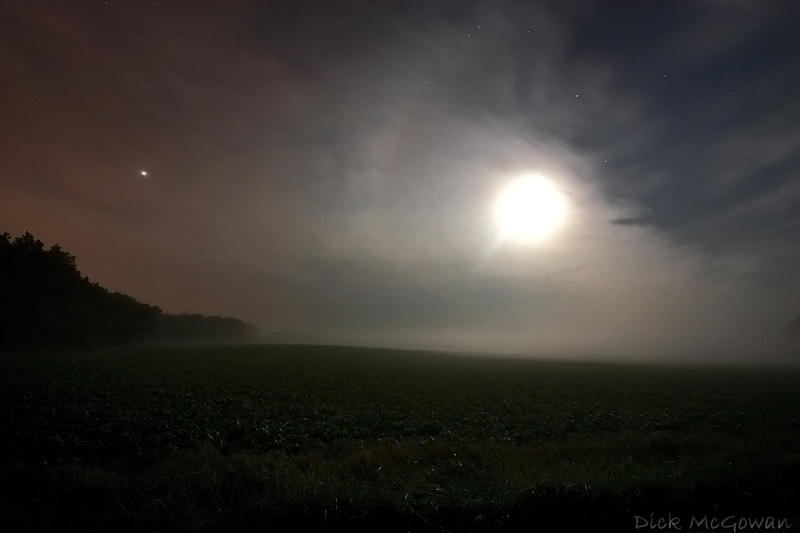
I caught me different faces through the windows on the train. It came going past the location without St. Nick, but his own name (i.e. "Santa Claus") still was on the lane there. The clouds separated only a moment around the shoreline between Ventura and Santa Barbara. The moon broke like a winking eye with Venus bright below her.

One last magical sight was brought at that night there. A single firework burned up over us. None took off afterwards. Artificial light then lit eighty miles from over there until our home here.

Griangraf/Photo: "Stacked Plates" blog, Dick McGowan.

Leaving the Forest

I walked two days before yesterday across the closed-off stretch of the road, washed out by a great storm in the '60s. It ended near where I was staying with my family above Felton on Mount Hermon, designated eminence if only as a couple hundred feet up a gentle hill rather than the equal of a biblical cedar-filled peak. Arriving after half a mile or so past the quarry at the main road to Scotts Valley, which at its bend opens into strip malls and tract homes, I turned away from its din, which can be heard more dimly from the cabin itself.

Doubling back, I passed teenagers dirt biking and a family cavorting in the quarry's spilled sand that had tumbled down onto the asphalt. I wondered if Cormac McCarthy's "The Road" might look like this half-paved, half-muddy path, an apocalyptic relic. A girl on a motorbike rattled back, and I wished that there'd been a metal gate installed at each end to stop engines from eroding the trail. Remembering cattle guards and turnstiles on Northern Irish farms, I wondered why these weren't installed out West. I was pleased to have to duck under a tree, figuring this'd thwart off-roaders, but then I saw a shortcut rutted by many tires to bypass the thickly branched obstacle placed by Mother Nature at my head's height.

Quickening down the paved stretch again, I went past the little lane where the cabin nestles within "Harper Berry Hollow." It sits with a few others that have slumbered often in the same families for decades, and the oldest, such as HBH and the one where we were, are over a century old, although remodeling and additions obscure their origins. Chris & Bob live in one of the oldest cabins around; the one we rented also celebrated its centennial a few years ago. Layne and I long to settle here, but despair at our own lack of finances, the need to make a living, the fear of the future, and the understandable tendency by the owners on these shady lanes not to sell their vacation retreats.

Continuing, I passed a newish tree zip-swing canopy. It had been installed when we last were here around the Fourth of July. Benches and ropes and signs all attested to its permanence. The Mount Hermon blog link on the right of this layout can tell you more about this desecration by the Christian camp that owns much of the Mount. I've fulminated enough about this, on line and in letters (to which no response came) to MHCCC. Suffice to say I remain recalcitrant. From where I sit typing this draft, I can see another such set-up across the ravine through the window.

Further on, the handsome gym on the south side overlooks a green lawn that once was a lake. Across, the expanding Christian family camp attests to its hundred years of prosperity. Bob came here as a boy. Last summer, Mennonite women in bonnets could be seen among those staying there; this Christmas, an Asian assemblage had convened, and the loud intonations of a language strange to me echoed among those in the parking lots who yelled from one SUV to the other as they accelerated down the road.

My pace being slower, I had time to look down into the roadside sludge at a tiny plastic bottle of Smirnoff, a brown sediment tilted in its belly. Teenaged Asian girls chattered, a grandmother with two blonde boys recited their placid adventures at the playground, and workers in logoed mini-pickups and electric carts whirred about. The confluence of Bean and Zayante creeks to the north just out of my sight reminded me of a scene the summer before last, when I wished I had a camera to take a shot of Niall, lit up all white like an angel by the angle of the lowering sun, its own beams reflecting up against the stone wall of the creek. Niall wandered in the water, playing happily, as I waited and watched on the bank. This sight I keep in mind as a memory, without any tangible proof, all the more I never want to forget.

Coming over the long bridge near Zayante Depot, I arrived at Graham Hill Road. Full of non-electric exhaust, rushing non-mini pickups, and stoplights. Across the main drag and down the old Roaring Camp train line, Henry Cowell State Redwood Preserve does that for about 4% of the riparian groves that once covered the San Lorenzo Valley. A century ago, he controlled most of the hills and valleys around here; San Francisco's houses rose out of redwoods felled here and shipped down the railroad and the rivers. After the 1906 quake and fire, I wonder how he thrived as the City grew higher and bolder, his fortune remade by another city built on beams and trestles. Fifty years earlier, John C. Frémont was said to have hidden in a redwood trunk there, perhaps during the Mexican War? Cowell must have owned millions of acres; we passed well above Pescadero on the way down the coast from San Francisco a beach named after the timber magnate.

A couple of days ago, when we stopped there, a loquacious receptionist at the Visitor Center learned that I was from L.A.; she told me her husband and she were LAUSD psychologists who once lived in Pasadena, who used to camp up here before, I presume, gratefully retiring around Felton. Bob, Chris, Niall, Leo, and Layne bringing up the slow caboose strolled for an hour and a half amidst visitors from Taiwan and India under the enormous towering cradles that filtered green aslant the air at noon into an open-aired cathedral. Clichéd, but truly the best metaphor. We glimpsed a family of deer, we saw willows bare by winter along the riverbed, we heard the train whistles and children shrieking at play. Years ago, on that mini railway, Niall and Leo were regaled by Chris who told them, to the shock of tourists sitting nearby, with suitably grim and juicy detail the fate of the Donner Party. History sidles closer here than at home; part of the appeal of vacation for us city folks.

I thought of how state parks and wilderness areas protect what's remaining of that vast sylvan and meadowed rocky sprawl up the coasts, now practically at my footstep. I could walk down the tracks to the city; I could drive south and find twenty million of my neighbors crowding around me. All the human spillover, after the Gold Rush, to this former lumber camp turned suburb of 6,500 from Santa Cruz six miles down the ridge and Boulder Creek and Ben Lomond and Scotts Valley spinning by, part of what I and my family would soon enter in our own dash south down the coast into the great Central Valley towards home over three long hundred miles away.

But, for now, I had the luxury of turning left, recircling back as the congestion eased over the little bridge that alerted me to "Zayante Creek" in its diminished capacity under the concrete road that for 150 years at least had carried pioneers and Indians and miners and most of all loggers and railroaders and speculators and owners of speakeasies up and down the summits where the redwoods towered and toppled. I dashed over the narrowed road before traffic neared at the miniscule bridge, a bump above a rivulet under a hundred foot span of concrete. A sharp left at the tracks, despite two drivers determined peering into the sun's slant to mow me down, and up I marched what remained of Roaring Camp Road back to veer right to the Mount. By now, my urban feet in sneakers, unused by treadmill to the land's undulation and the tension between natural and manmade surfaces, had begun to chafe.

Only a slight ascent now, so I looked forward to the place at the entrance to the Center when the road would level. Bob mentioned how the sign announcing Mount Hermon signalled to him a chance to visualize his release of tension accumulated from the world below. I shared the sensation of change, of leaving behind the combustion by my own energy. Never a steep incline, but I'd been at marching gait for a while now, instead of my usual treadmill, and I felt the difference in my lungs and step.

The return to my second home, if only for three days, cheered me. Layne noted how sad I seemed even with a day to go here. I miss this place very much. Just a little house under the trees, but out of such scenes, we all build our hopes and find peace.

We seem so obedient to an atavistic drive to cut down the trees and erect our Babel. Gilgamesh tells our oldest story, of cities rising and woods toppling. My ancestors touched wood, as I corrected my dear wife, not out of respect for the Holy Cross, An Crios Naofa, Santa Cruz. But, to attest to the "pagan" belief of Druids that in trees resided the spirit forces that many of us-- in those towers of glass that dwarf the groves we felled to outgrow them-- have lost touch with, unless we return to the forest.

I found a discard from a school library in the cabin, Francis Parkman's "The Oregon Trail." It had plastic covers, so I took it in the bath after my walk. There I could actually stretch out my legs and soak my blistering feet. Fifty pages passed of Parkman's 1846 trek's first stages from Missouri among Kanzans and Pawnees before I stood and dried. Two years before the Gold Rush that'd bring so many through detours into these mountains, millions to fill the Golden State who would soon follow. Here we keep roaming and clearing and circling.

Two years ago I noticed, on my own stop in Oregon City, a few hundred yards from the Conestoga-girded museum that marks grandly the end of that Trail, where a Home Depot looms. The timber keeps stacking up for fresh arrivals at the edge of the Pacific. Young Parkman made it only a third of the way. He couldn't stand most emigrants; his chronicle allows equal opportunity for the vanity and values of both settlers and natives. The Bostonian's weak eyes and poor health restrained him at Fort Laramie, where he spent months learning about the natives about whom he'd dictate, soon being blind, a shelf of vividly recounted histories about "the struggle for the continent." On a map at the Cowell center, I saw an "Ox Trail" path on the park's map. With far greater ease, if a blister or two in our softened state, we aim where Parkman did, targeting the western horizons, for our own dreams' fulfillment.

Photo: "Wake of the Storm". Caption: "I was telling everyone on Thursday that I didn't think the storms headed through the central coast were going to hit Mount Hermon as hard as some people thought, well, so far we haven't lost power and there was even a break in the clouds for a beautiful sunset." Jonathan Assink, January 5, 2008, Flickr.com.

Tuesday, December 30, 2008


Richard North & Joe Allard (eds.) "Beowulf & Other Stories": Book Review.

I learned Old English from a professor who revised what was then the standard literary history for Anglo-Saxon. Although I enjoyed the subject, I had a heavy course load in grad school and so little time to progress further with OE. Now, with North & Allard's considerably livelier survey, I can catch up on current attitudes towards our linguistic forebears. The editors and their co- contributors remind us that it's ironic how "relevance" can be used to neglect OE, when movies and sagas, old and new, Tolkien and CGI, enchant us with truly intriguing tales taken from the earliest wellsprings that flowed into our own torrents of English.

These essays, in a lively if rather surprisingly firm way-- the editors castigate straight off as "stupid" those who'd deny OE its place in the curriculum!-- aims to demystify the world we have lost. The book manages to be chatty (see the preface!) without condescending. It tries to convince you of the merit of what has scared away many previous generations of students forced to slog through, as Woody Allen warned, Beowulf. With wit, insight, and patience, this may be the first intelligent treatment aimed at the serious, but non-linguistically trained, newcomer, whether in a course where Beowulf's assigned or not! It's accessible for anyone wishing to discover the word-hoard of wealth glittering in Old English-- and some Old Icelandic -- literature. You also find out about what was spoken and written during the even less often visited transitional period between 1066 and 1200 or so.

For all English-speakers, the multicultural and polyglot world of the Anglo-Saxons (with Richard North's coverage of Old Icelandic/Norse; later there's Anglo-Norman also) returns as exciting, bawdy, reverent, and unpredictable as any other era. Once the orthography's overcome, and a few grammatical quirks and genuine or deceiving cognates get tracked, the language proves less than daunting. Especially when, as here, translations are paralleled with the original texts and commentaries.

No prior knowledge of Old English is needed; Peter S. Baker's introduction covers the basics well. Jennifer Neville's section deals wittily with the double-entendre riddles that may make people blush a millennium later. She also treats the more sober Elegies. Viking contact as filtered through the Anglo-Saxon Chronicle gains attention. (Although I would have included the handsomely illustrated translation of Anne Savage in the works cited.) The biblical tales and adventures retold under the Benedictine Reform gain notice. The Dream of the Rood and the Ruthwell Cross earn illustration verbally and visually in fine photographs. Clive Tolley's comparisons of Tolkien's "The Lord of the Rings" to OE literature should make this entry a must-read for many explorers of Middle-Earth.

Other scholars delve into Beowulf, other heroic verses, violence in Viking culture, Viking beliefs, Icelandic sagas, OE poetry and prose, Alcuin & Offa, Caedmon, the degree to which the corpus turned Christian or remained pagan, and the fusion of Anglo-Saxon with other literatures and languages after the Conquest. When only 30,000 lines of OE poetry survive, the extant texts may not be numerous, but they therefore can be approached by newcomers and understood within a comparatively compact amount of material. This intimacy likewise gives this volume a friendly, encouraging tone. Sexual trafficking, elephants, the band Travis, and GameBoy all get their nod, as the scope of the academics ranges widely and boldly, fitting this subject's own depth and breadth across surprising and topical textual terrains.

More information at Pearson: Table of Contents (Posted to Amazon US 12/18/08.)

Monday, December 29, 2008


Hugo Hamilton's "Disguise": Book Review.

How we shape our identity, and how we inherit our instability, marked Hamilton's fiction long before his memoir of growing up under an Irish-speaking father and a German refugee mother in 1960s Dublin, "The Speckled People," introduced him to many readers. I've admired each of his books; many today may not know much about his first three novels, all about Germany. (I reviewed this trio along with his stories in "Dublin Where the Palm Trees Grow" on Amazon.)

"Disguise" continues the searches of earlier families where after the war someone seeks his parent or her child. A son learns how his mother accompanied a Nazi officer who may have fired "The Last Shot"; another German mother faces Stasi-era duplicity in her quest to reunite through "The Love Test"; an Irishman delves into the GDR upbringing of his hosts before and after the fall of the Berlin Wall in that "Surrogate City."

These novels all satisfy; "Disguise" enriches Hamilton's treatment here subtly, and elegantly. I'd estimate, having read his previous eight books, that he's aiming here for targets closer to the haunted legacies of countrymen John Banville or Sebastian Barry. There's a control of phrase and pacing here that recalls also European models. "Every now and again, an apple falls to the ground with a bony kind of thud, such as the sound of a hoof on the earth. The discovery of gravity each time." (47) Or, as uncertainty advances: "His entire existence was in Mara's hands, in her imagination, in what she agreed to believe and what she would dismiss. She held him like a porcelain figure, at her mercy, waiting to be dropped to the floor in tiny pieces." (148) Hamilton selects his words patiently, mulling over simple phrases. His own tri-lingual upbringing (English, Irish, and German) may account for his style, which attains a filtered quality distinguishing it from his contemporaries.

He takes on the fringes of a topic that's often overwhelmed the talents of imaginative as well as historical talents: the Holocaust. Hamilton, typically, engages the difficult question asked by Gregor Liedmann (note symbolic echoes), with grace and poise. Was Gregor a Jewish orphan who replaced Marie Liedmann's boy, who died in a bombing near the end of the war? She refuses to admit this to herself or her husband, after he returns from Soviet imprisonment.

The plot alternates between Gregor's 2008 day picking apples (with his estranged wife, Mara, their son, Daniel, and some old hippie friends) and Gregor's exploration of his roots while growing up in the GDR. An omniscient narrator does not admit much more that we need to know, but a reader may be assured that the information given beyond the indirect first-person perspectives of Marie, Mara, or Gregor must be compared with crucial expository details given in the first chapter that are beyond Marie's immediate knowledge, if I am correct. Hamilton's skilled in producing a novel that scans very quickly, yet flows vividly, mixing poetry with philosophy.

Sentences, too many to cite (I jotted down eighteen representative references easily), reveal Hamilton's in top form. There's nuance and power evoked by wartime havoc and lasting grief. The tragedy that cloaks Germany burdens all. Gregor comes of age as if, in Mara's mind, he's unable to foster a talent for love. Mara learns from Marie a conflicting narrative that claims her son's always been such. Mara too enters an uncertain realm where the loyalty to present-day family contends against unsubstantial, unsubstantiated claims to the contrary, that tug him back to a vague allegiance. Early in her relationship with Gregor, she resolves: "Together they would work and travel and reinvent the void he had come from. They would reimagine his true origins like a lost part of music that had been burned in a fire." (66)

The tension of Gregor's reinvention stretches until the final chapter. I'm withholding plot points so as not to spoil your experience. Not a thriller, but as emotionally cathartic for more honesty and less melodrama in confronting the legacy of modern German loss, rage, and shame, Hamilton integrates his study, his family's own past, and his authorial observations into a thought-provoking analysis of survivor's guilt. As in his début novel, "Surrogate City," Berlin now celebrates enduring rather than dreams of greatness. Today, Hamilton finds comfort in a humane response, as in apple orchards, to earlier slaughter as faced by the elder Liedmann, Emil, in WWI, when the cows grazed among the dead in other fields nearby. Skillfully, as with armed Emil facing a battalion of enemy (Russian?) women, or when in a few phrases the whole absurdity of GDR behind the Wall sums itself up by a schoolboy's innocent questions, Hamilton's able to compress much into little space.

One small admission: Daniel, his partner Juli, as well as Mara's sometime lover and Gregor's old friend Martin, needed filling out. Their friends on the apple-gathering day also flit about like extras in a film, when perhaps Hamilton's application of the telling detail for each of them might have fixed their roles better for our appreciation. The Irish sojourn, again, as with the dentist Mr Eckstein, could have been deepened or eliminated; as it is there's either not enough substance or too much digression. John Joe could have been a contender for a truly memorable figure, but he, too, lingers in the supporting cast. Gregor wanders about a lot, but you fail to feel his desires on the road when doing so compared with Mara or Marie's own struggles.

Hamilton in his memoirs and fiction has roamed around Germany, Ireland, and Europe. He addresses cultural encounters within larger problems but strives, at his best here, to keep contact with immediate, recognizable people. He does not let ideas take over his major characters. This is a intelligent consideration of how we can all be warped by dreaming rather than loving, by yearning instead of accepting. Perhaps, as Mara wonders, to cope with our turmoil we all need a disguise, an invented identity?

(Posted to Amazon in US & Britain 12/24/08.)

Sunday, December 28, 2008


An sé ag sneachta anois?

Tá sé ag sneachta áiteannaí go leor anois. Chuala mé go bhfuil stoirmeachaí bhaísti ann ar fud ar tíre. Ar ndóigh, níl sneachta anseo ina gCathair na hÁingeal.

Ach, tá snas an bán air ar barr na mullachaí in aice leis mo bhaile. Tá an geimhreadh géarr sa mhullach orainn i gCalifoirnea. Feicfidh tú an buaic cnoic Naomh Antain ó mhullach go lár líonta leis sneachta.

Mar sin féin, tá sé cúig sin is fiche mile i bhfad uaim. D'fhás mé níos cóngarach dó. Bhí maith liom a feiceáil suas air os cionn na crannain líomóid nuair go raibh óg. Is cuimhne liom a fáil sioc ar na fuinneog.

Tá mé i gcónaí i ngar ar lár inniu fós. Ní fhaigheann mé sioc ar chor ar bith. Ní fhacas riamh go fóill aimsir sheaca ag imeall an ionad seo.

Ní fhaca mé na sléibhte Naomh Gabriel uaidh seo go dtí siúd. Tá an maoileann idir anseo agus ansiud. Coiscaíonn sé lánléargas.

Tá mé ábalta breith orm an radharc seo anois agus ansin. Tiomainím go bPomona ag dul ag teaghmhálacaí obair faoi thrí gach blian. Mar sin, oscailódh amharc mór orm uair in aghaidh na bliana. Níl gheofar úlloird go leor ina dhaidh sin féin ar chor ar bith anois.

Is it snowing now?

It's snowing many places now. I heard that there were rainstorms all around the nation. Of course, there's no snow here in the City of the Angels.

But, there's a polish of white on top of the ridges near my house. It's the short winter on summits for us in California. You'll see on the top of Mount San Antonio from the height to the depth filled with snow.

All the same, that's twenty-five miles away from me. I was raised very near it. It pleased me to see it there above the lemon trees when I was young. I remember seeing frost on the windows.

I'm living near the city-center now. I have not found any frost at all. I have never seen before frosty weather in this place.

I cannot see the San Gabriel Mountains over there. There's a knoll between here and beyond. It blocks a full sight.

I'm still able to catch this view now and then. I drive to Pomona to go to work meetings three times each year. Therefore, the grand vista may open-- at a yearly interval-- to me. Yet, one will not find at all now any more orchards.

Tá lipéad againn! We have this label! Íomhá/Image: Sunny Heights citrus, 1940s

Saturday, December 27, 2008


Dublin's Irish Pub: an Israeli Chain!

Searching images for yesterday's entry in the admittedly limited keyword combinations of imagery for the woeful likes of "Irish Hebrew" or "Gaeilge Israel," this came up. It deserved its own post. I cannot copy snapshots of the Hebrew menu under the faux-traditional Irish pub sign outside the door, but I assure you it's a rare meeting of Gaelic grub (no ham except in godless Rehovot) and Israel's national script. It also nicely contradicts a couple of stereotypes. Here, the happy hour has a two-for-one incentive; the generous pour's on the Jewish side of the ledger. I wonder how far you'd have to crawl to find this pub largess in many Hibernian watering holes, no matter where else long established or newly franchised?

Here's a review posted by Josh (NYC2TLV) at Virtual Tourist which reveals better than I can at my diasporic distance the culture clash, globalization, and one's demand for reward within a stiff drink no matter where you dustily trudge. Not for nothing, I might add, it's behind McDonalds to boot.

Nightlife Spot: Dublin: Irish Pub

Dublin is a growing chain of Irish pubs in Israel. They have two other locations in Rehovot and Herzliya but I found that this location is the biggest and has the best layout out of any of them. The best time to go is during happy hour as they have a limited time offer of buy one drink and receive your second for free. Generally, the Israeli people are not big drinkers so this was always a win situation for the pub.

The[y] offer a wide variety of both alcoholic and non alcoholic drinks, specializing in their wide variety of beers on tap and in bottles. Food is also available and it should be noted that the food is not kosher, but no pig products are used at this location (unlike the Rehovot pub which serves dishes that contain ham). They are very fond of foreignors [sic] in this pub and the staff speaks excellent English. During the early hours, traditional Irish music is played but toward the busy evening hours the lights are dimmed and the music becomes more rock and roll.

Theme: Eating and Drinking
Dress Code: Pants are a requirement.
Phone: +972-2-622-3612
Address: 4 Shamai Street, Jerusalem, ISRAEL
Directions: Right off the Ben Yehuda Pedestrian mall. Behind the entrance to McDonald's.


Photo: Dublin Irish Pub sign, Jerusalem.

Friday, December 26, 2008


Contrasting Hebrew & Gaelic Revivals.

In Lazarus Tongues in Israel & Ireland," the language columnist "Philologos" shares the insights of U. of Delaware grad student Kevin Barry who compares the Gaelic Revival, or its lack, with the success of the Hebrew triumph for Israel. Philologos, writing in the Dec. 19th 2008 issue of The Forward, our national Jewish weekly paper, naturally controls the court for Hebrew, but Barry helps assist with his Irish expertise. Barry's arguments may not widen the comparative presentation as much as I'd crave, but it's useful to have these sensible discussions condensed for a popular (by my standards) audience.

Many observers of Ireland's language death and resuscitation-- at least in passing-- have wondered: why not only Hebrew, but even Scandinavian languages, or Czech, or Hungarian: how did these recover in the 19c Europe when German, for instance on the Continent, appeared so dominant in terms of empire and education, jurisdiction and imposition? Why didn't the Irish rebel by reverting to their own native tongue, to reject English in the same patriotic manner as many in Mitteleuropa? For that matter, why did Welsh thrive in this same period, and why's it still much healthier today, despite a much longer lag in state-sponsored support, vs. the Republic's eighty-odd years in institutionalizing its promotion in schools, signage, and the civil service?

P.S. I left this comment on-line at The Forward:
Thanks for an informative column, as usual. One factor that Barry probably stressed in his original paper: the negative mindset associated with the pre-independence British-imposed school punishment that punished the Irish-speaking children with wearing a "tally stick" that'd be passed on to the next child caught talking in Irish (a similar "Welsh not" was the norm in Wales at this time). Such methods inculcated further the notion in parents and their offspring that Irish needed to be eliminated so that English, and progress, could advance. It's also noteworthy that mid-19c, it was estimated only about fifty people could write in Irish; contrast this with the rich oral-- and recorded-- traditions of Hebrew.


Photo: I looked mighty long for an Irish-language t-shirt of the Red Sox, "Stocaí Deargaí," and here 'tis. You can buy it and hundreds more Sox gear at Yawkey Way Store outside Fenway Park. A student of mine was a Boston fan and he directed me thus. The Hebrew version accompanies it.

Sorry to Niall who worships the Lakers, but I admit my loyalty tilts to the Celtics ever since I was a kid. The collapse of the Celtics yesterday in the final minutes, 13-2 outscored, that enabled the Lakers to win by eleven discouraged me, but as we were able to watch some of the opening game when lunching at Harris Ranch (I had veggie soup at that meat emporium, but I like the fruit crate art framed there), I could see how the Lakers had the energy, the determination, and that home court advantage.

Niall and I agree, however, that the Red Sox can remain a second choice after the Dodgers. As tomorrow's entry documents, matching Irish with Hebrew in any image hunt produces a paucity of useful illustrations.

Thursday, December 25, 2008


Shona Nollaig Daoibh i 2008!

Tá mé leis mo theaglach ag dul ar gcathair Naomh Prónsias inniu agus ina dhiadh sin in aice leis ar bhaile An Croise Naofa ar feadh an seachtaine chugainn. Mar sin, níl uair agam a scríobh go leor anois. Mar sin féin, inseoidh mé agaibh faoi ár thuras go luath, nuair fillfidh mé ar ais mo bhaile. Beidh mé foclóir agam aríst!

Merry Christmas to All of You!

I'm with my family going to the city of San Francisco today and afterwards near to the town of Santa Cruz next week. Therefore, I do not have time to write much now. However, I will tell you all about our journey soon, when I return to my home. I will have my dictionary again.

Griangraf/Photo: Gary McMurray/ Gearóid Mac Muireadhaigh.Sraid Loch Garman, Baile átha Cliath/ Wexford St, Dublin.